Medical Tourism Blog
Capsular Contracture Treatment in Korea | Best Clinics, Costs, Procedure Types & More
Table of contents
- What Is Capsular Contracture Treatment?
- Best Clinics in Korea for Capsular Contracture Treatment
- Getting Capsular Contracture Treatment in Korea
- Cost of Capsular Contracture Treatment in Korea
- Alternatives to Capsular Contracture Treatment
- Conclusion
Considering treatment in Korea? Everything you need to know e.g. — how to avoid scams, visas, interpreters, recovery tips — in our Medical Tourism Master Guide. Plan with confidence in minutes, not weeks!
Have you ever wondered why South Korea is gaining ground as a top destination for medical tourism? With its advanced medical technologies and expert cosmetic procedures, South Korea now stands at the forefront of treating capsular contracture—a common complication in breast augmentation that necessitates specialized care. This article explores the innovative treatments available in Korea, their comparative costs, and potential non-invasive alternatives, helping patients make informed decisions about their cosmetic journey.
What Is Capsular Contracture Treatment?
Capsular contracture is a common complication following breast augmentation or reconstruction surgery where the fibrous capsule that normally forms around the breast implant becomes abnormally thick, tight, or inflexible. This can cause discomfort, pain, and aesthetic distortion of the breast. Capsular contracture treatment in Korea involves various methods aimed at relieving these symptoms and restoring the natural appearance of the breast.
In Korea, where medical technology and cosmetic procedures are highly advanced, treatment for capsular contracture is typically comprehensive, employing both surgical and non-surgical methods. The choice of treatment depends on the severity of the contracture, classified by the Baker scale, which ranges from Grade I (normal, soft breasts) to Grade IV (severe hardening with obvious distortion).
Non-Surgical Treatments
-
Medication: Anti-inflammatory medications, such as leukotriene inhibitors, may be prescribed to help reduce inflammation and the degree of contracture. While their effectiveness varies, these drugs can be beneficial in treating early-stage contracture.
-
Ultrasound Therapy: This method uses sound waves to heat and break down the scar tissue causing contracture. It helps to soften the capsule and reduce symptoms like tightness and discomfort.
-
External Compression: Some practitioners may recommend external compression therapies. However, the effectiveness of this treatment is debated, and it needs to be done cautiously to prevent further complications.
-
Shock Wave Therapy: In recent years, low-energy shock wave therapy has been utilized to target the fibrous tissue surrounding the implant. This non-invasive treatment can promote tissue relaxation and relieve contracture symptoms.
Surgical Treatments
-
Capsulotomy: In this procedure, the surgeon makes incisions in the capsule to release the tightness. This allows the implant to settle back into a more natural position. An open capsulotomy involves cutting into the capsule through a larger incision, while a closed capsulotomy involves manipulating the existing capsule without incision.
-
Capsulectomy: For more severe cases, a complete or partial capsulectomy may be performed. This involves the surgical removal of the fibrous capsule. A total capsulectomy is more invasive and involves removing the entire capsule. This option is often chosen when there is a significant deformation or in cases of recurrent contracture.
-
Implant Replacement: During surgical interventions like capsulectomy or capsulotomy, the surgeon may also recommend replacing the implants. Newer implants, which have a lower risk of contracture, can be inserted.
Advanced Techniques
Korean clinics often utilize cutting-edge techniques and materials. For example, fat grafting can be used alongside contracture treatments to improve the natural feel and appearance of the breasts. Additionally, surgeons may utilize advanced imaging technologies to plan and guide precise treatment interventions.
Post-Treatment Recommendations
After treatment, patients are generally advised to follow a post-operative care plan that includes specific exercises, medications, and regular follow-up appointments to monitor progress and ensure optimal outcomes. Advances in surgical techniques and non-surgical treatment options available in Korea help in effectively managing capsular contracture, minimizing recurrence, and enhancing patient satisfaction.
This comprehensive approach to capsular contracture treatment underscores Korea's status as a leading destination for cosmetic and reconstructive surgery.
Who is Capsular Contracture Treatment for?
- Patients with Breast Augmentation: Individuals who have undergone breast augmentation are primarily at risk as capsular contracture typically involves the formation of scar tissue around breast implants.
- Those Experiencing Symptoms: Patients exhibiting symptoms such as breast firmness, changes in breast shape, or pain indicating capsular contracture.
- Individuals with Genetic Predispositions: Those with a family history of autoimmune diseases or a tendency to develop thick scar tissue.
- Patients Post-Surgery with Complications: Women facing complications after breast surgery, including the presence of biofilm causing bacterial infections around the implant.
- Grade 2 and 3 Contracture Patients: Aspen therapy has shown effectiveness for those with grade two and grade three capsular contracture, alleviating symptoms and improving breast elasticity.
- Those Seeking Non-Invasive Options: Patients preferring non-invasive treatment rather than surgical intervention to maintain or regain aesthetic outcomes.
Best Clinics in Korea for Capsular Contracture Treatment
Listed below are the best clinics in Korea for capsular contracture treatment:
| Clinic Name | Key Features | Special Techniques |
|---|---|---|
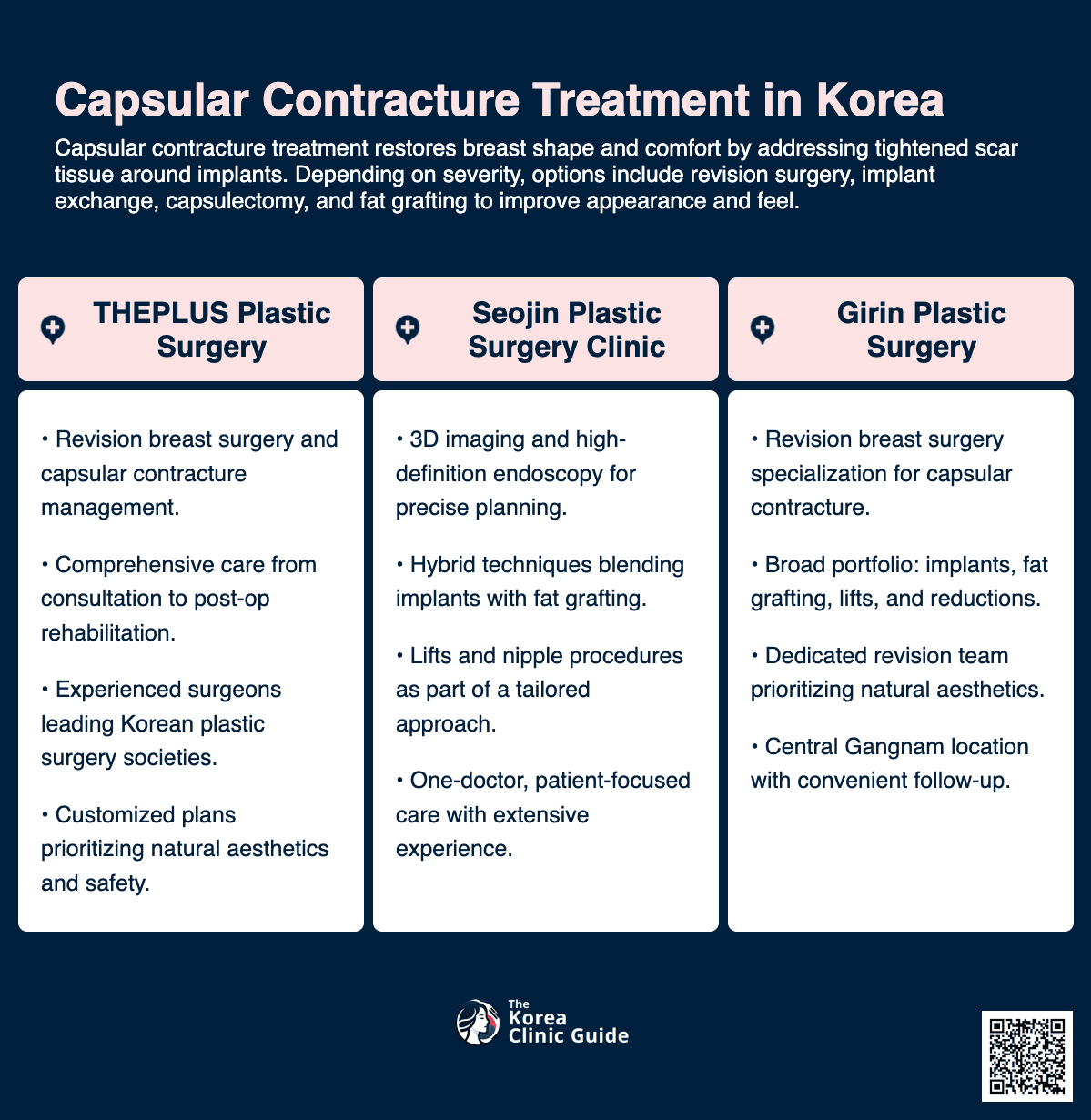
| THEPLUS Plastic Surgery | world-class, research-driven environment across four dedicated floors that cover the full continuum of care—from consultation through surgery and post-operative skincare. Led by surgeons who actively publish, teach, and present at domestic and international symposiums. Prioritizes safety, meticulous communication, and individualized planning. Strong destination in Korea for evaluation and management of implant-related concerns such as capsular contracture. Team with more than a decade of experience and active involvement in leading medical societies, including the American Society of Plastic Surgeons. | Breast augmentation expertise spearheaded by Dr. Lee; natural, long-lasting results; comprehensive care for revision breast surgery and implant-related concerns, including capsular contracture; leadership and education by director doctors Dr. Jeong Jae Yong and Dr. Kim Taek Kyun; 3D implants (Dr. Kim Taek Kyun); facial contouring and rhinoplasty. |
| Seojin Plastic Surgery Clinic | Seojin Plastic Surgery Clinic in the heart of Gangnam, Seoul, is a trusted choice for patients seeking attentive, personalized care for capsular contracture and other breast concerns. As a one-doctor clinic, Dr. Lee Hyungmin—recognized among Korea’s 100 Good Doctors—guides every step from consultation to follow-up, drawing on more than 16 years of experience to deliver safe, individualized treatment. Combining meticulous planning with state-of-the-art technology, including 3D imaging and high-definition endoscopy, Seojin tailors solutions that prioritize both function and aesthetics. With advanced expertise in breast surgery—ranging from contemporary implant procedures to hybrid techniques that blend implants with fat grafting, and complementary options such as lifts or nipple procedures—Dr. Lee provides precise, natural-looking outcomes for patients addressing capsular contracture. | 3D imaging and high-definition endoscopy; hybrid techniques that blend implants with fat grafting; lifts or nipple procedures; precise, natural-looking outcomes for patients addressing capsular contracture. |
| Girin Plastic Surgery | Girin Plastic Surgery in Gangnam Station is a comprehensive aesthetic center offering a full spectrum of surgical and non-surgical procedures delivered by some of the most prestigious plastic surgeons in Korea. Known for safe, professional, and satisfying results, the clinic’s robust breast portfolio—spanning breast augmentation with implants or fat grafting, breast lift, reduction, nipple and areola surgery, gynecomastia, and dedicated revision breast surgery—positions it as a standout destination for managing implant-related concerns such as capsular contracture. Whether you seek subtle refinement or definitive correction, Girin provides carefully tailored plans that prioritize natural aesthetics and long-term confidence. | Revision breast surgery for precise correction of capsular contracture and other implant-related issues; breast augmentation with implants or fat grafting; breast lift; reduction; nipple and areola surgery; gynecomastia; dedicated revision breast surgery; tailored plans prioritizing natural aesthetics and long-term confidence. |
THEPLUS Plastic Surgery
THE PLUS Plastic Surgery in Garosu-gil, Gangnam, Seoul, offers a world-class, research-driven environment across four dedicated floors that cover the full continuum of care—from consultation through surgery and post-operative skincare. Led by surgeons who actively publish, teach, and present at domestic and international symposiums, the clinic prioritizes safety, meticulous communication, and individualized planning. This rigor makes it a strong destination in Korea for patients seeking evaluation and management of implant-related concerns such as capsular contracture, supported by a team with more than a decade of experience and active involvement in leading medical societies, including the American Society of Plastic Surgeons.
The clinic’s breast augmentation expertise is spearheaded by Dr. Lee, a board-certified plastic surgeon with top-tier experience that includes a Surgery Specialist role at Seoul National University Hospital and active participation in major Korean plastic surgery societies. Her focus on natural, long-lasting results aligns with the clinic’s ethos of combining function and beauty. THE PLUS is further strengthened by director doctors Dr. Jeong Jae Yong, President of the Korean Society of Plastic Surgeons and an internationally recognized educator, and Dr. Kim Taek Kyun, a board-certified surgeon awarded for research on 3D implants and a leading authority in facial contouring and rhinoplasty. Together, their scholarship, leadership, and balanced aesthetic philosophy underpin comprehensive, tailored care for patients considering revision breast surgery and implant-related issues, including capsular contracture.
You can check out their website here: THEPLUS Plastic Surgery Website
Seojin Plastic Surgery Clinic
Seojin Plastic Surgery Clinic in the heart of Gangnam, Seoul, is a trusted choice for patients seeking attentive, personalized care for capsular contracture and other breast concerns. As a one-doctor clinic, Dr. Lee Hyungmin—recognized among Korea’s 100 Good Doctors—guides every step from consultation to follow-up, drawing on more than 16 years of experience to deliver safe, individualized treatment.
Combining meticulous planning with state-of-the-art technology, including 3D imaging and high-definition endoscopy, Seojin tailors solutions that prioritize both function and aesthetics. With advanced expertise in breast surgery—ranging from contemporary implant procedures to hybrid techniques that blend implants with fat grafting, and complementary options such as lifts or nipple procedures—Dr. Lee provides precise, natural-looking outcomes for patients addressing capsular contracture.
You can check out their website here: Seojin Plastic Surgery Clinic Website
Girin Plastic Surgery
Girin Plastic Surgery in Gangnam Station is a comprehensive aesthetic center offering a full spectrum of surgical and non-surgical procedures delivered by some of the most prestigious plastic surgeons in Korea. Known for safe, professional, and satisfying results, the clinic’s robust breast portfolio—spanning breast augmentation with implants or fat grafting, breast lift, reduction, nipple and areola surgery, gynecomastia, and dedicated revision breast surgery—positions it as a standout destination for managing implant-related concerns such as capsular contracture. Whether you seek subtle refinement or definitive correction, Girin provides carefully tailored plans that prioritize natural aesthetics and long-term confidence.
- Revision breast surgery expertise for precise correction of capsular contracture and other implant-related issues
- Prestigious team of Korean plastic surgeons committed to safety, professionalism, and satisfactory outcomes
- Comprehensive breast services (augmentation with implants or fat grafting, lift, reduction, nipple/areola, gynecomastia, and revision) enabling customized, full-spectrum solutions
- Extensive corrective-surgery experience, also reflected in revision eye surgery and revision rhinoplasty
- Individualized treatment planning that aligns with each patient’s goals for natural, balanced results
- Centrally located at Gangnam Station for convenient access and consistent follow-up
- Wide range of surgical and non-surgical options to support aesthetic harmony and patient comfort
Find more about this clinic here: Girin Plastic Surgery Website
Getting Capsular Contracture Treatment in Korea
Capsular contracture is a common complication that can occur following breast augmentation or reconstructive surgery, where scar tissue forms tightly around the breast implant, causing discomfort, distortion, or hardening of the breast. Korea is renowned for its advanced medical technology and expertise in cosmetic and reconstructive procedures, making it a sought-after destination for effective capsular contracture treatment.
Understanding Capsular Contracture
Before delving into the specifics of treatment options available in Korea, it's important to understand the grades of capsular contracture, which range from Grade I to Grade IV, based on the Baker Scale:
- Grade I: The breast is normally soft and looks natural.
- Grade II: The breast is slightly firm but appears normal.
- Grade III: The breast is firm and appears distorted.
- Grade IV: The breast is hard, painful, and obviously distorted.
The severity of the condition often dictates the type of treatment recommended.
Initial Assessment
Upon arriving in Korea for capsular contracture treatment, patients typically undergo a comprehensive consultation and assessment. This process involves detailed medical history taking, physical examination, and imaging studies like mammograms or ultrasounds to evaluate the condition of the implants and surrounding tissues. This thorough evaluation helps the medical team plan an effective treatment strategy tailored to the individual needs of the patient.
Non-Surgical Treatment Options
For less severe cases, particularly Grades I and II, non-surgical treatments may be recommended:
- Medications: Some Korean clinics may prescribe medications such as leukotriene inhibitors, which can help reduce inflammation and softening the capsule.
- External Ultrasound Therapy: Utilizing advanced ultrasound technology, some clinics provide non-invasive treatments aimed at softening the capsule and reducing discomfort.
These non-surgical approaches are often supplemented with massage techniques or manual therapy under expert guidance to prevent further contracture and maintain breast softness.
Surgical Intervention
For more severe or persistent capsular contracture (Grades III and IV), surgery may be necessary. Korean surgeons are known for their meticulous approach to corrective procedures, employing various techniques to address capsular contracture:
-
Capsulectomy: This surgical procedure involves the complete removal of the thickened capsule tissue surrounding the implant. In some cases, the implant itself may be replaced, especially if it is damaged or deformed.
-
Capsulotomy: In cases where the capsule is not extremely thick, a capsulotomy may be performed. This involves scoring or incising the capsule to release tension and allow the breast to regain a more natural shape.
-
Implant Replacement or Exchange: During surgery, the surgeon may opt to exchange the implant for a newer model, often using the latest advancements, such as implants with a textured surface or those filled with highly cohesive silicone gel, to reduce the risk of recurrence.
-
Autologous Reconstruction: For patients who prefer to remove implants altogether, Korean surgeons often offer alternative reconstruction options like fat grafting or flap procedures, using the patient's own tissue for breast reconstruction.
Advanced Techniques and Technologies
Korean clinics are equipped with cutting-edge technologies to enhance surgical outcomes and minimize recovery time. Techniques like endoscopic surgery and utilization of lasers offer precision and reduced scar visibility. Additionally, Korea's emphasis on holistic and patient-centered care ensures that post-operative rehabilitation and follow-up appointments are integral to the recovery process.
Cost and Accessibility
One of the appealing factors of seeking capsular contracture treatment in Korea is the competitive pricing compared to other countries, without compromising on quality. Many Korean hospitals and clinics offer packages that include accommodation, transportation, and translation services, making the journey smoother for international patients.
By choosing to get treated in Korea, patients not only gain from the high standards of surgical expertise but also benefit from a culture deeply committed to beauty and innovation in the medical field. With detailed consultations, personalized treatment plans, and supportive aftercare, Korea continues to set a benchmark in the field of capsular contracture treatment and reconstructive surgery.
Cost of Capsular Contracture Treatment in Korea
Capsular contracture, a common complication following breast augmentation, often requires surgical intervention to correct. The cost of treating this condition varies significantly across different countries, influenced by factors such as healthcare systems, surgeon expertise, and facility costs.
In South Korea, known for its advanced medical technology and highly skilled surgeons, the cost for capsular contracture treatment ranges from approximately $4,000 to $7,000 USD. South Korea's competitive pricing, coupled with its reputation as a medical tourism hub, attracts numerous international patients seeking affordable yet high-quality care.
In contrast, the cost in the United States is markedly higher. In the U.S., the price for capsular contracture treatment, including surgical intervention and post-operative care, generally ranges from $8,000 to $15,000 USD. The U.S. medical system often includes higher overhead costs, which contribute to the increased pricing, despite the high standard of care.
In Europe, the cost varies widely between countries. For instance, in the United Kingdom, the treatment can cost between $7,000 and $12,000 USD, depending on the complexity of the surgery and the choice of surgeon. Meanwhile, in countries like Germany and France, costs are somewhat comparable, ranging from $5,000 to $10,000 USD.
Australia presents another high-cost landscape, where treatment expenses typically fall within the range of $9,000 to $16,000 USD. This is similar to the United States, partly due to the comprehensive nature of healthcare service coverage and the high demand for cosmetic procedures.
In summary, South Korea stands out as an economically attractive option for treating capsular contracture due to its lower cost compared to countries like the United States, Australia, and parts of Europe, without compromising on the quality of care provided.
Alternatives to Capsular Contracture Treatment
Capsular contracture, a complication that can occur after breast augmentation surgery, is a condition where scar tissue forms a tight capsule around the implant, leading to discomfort and changes in appearance. While traditional treatment often involved revision surgery, several alternative treatment methods are now available. Here are three suitable alternatives:
1. Aspen Rehabilitation Technique
The Aspen Rehabilitation Technique is a non-invasive treatment option for capsular contracture that involves the use of ultrasound therapy. This method employs the Aspen harmonizer, a device that delivers controlled ultrasound waves directly to the breast tissue. These waves help promote the growth of healthy collagen and increase tissue elasticity, thereby softening the capsule around the implant. Aspen therapy is typically administered over two to three weeks in conjunction with antibiotic treatment to address the biofilm - a thin layer of bacteria that could be contributing to capsular contracture. This approach is particularly effective for treating grade two and grade three cases of capsular contracture.
2. Massage Therapy
Post-operative massage therapy is another alternative approach aimed at preventing and mitigating capsular contracture. Gentle massaging of the breasts can potentially help maintain tissue pliability and prevent the abnormal accumulation of scar tissue. However, it is crucial to follow a surgeon's guidance before commencing any massage to avoid damaging the healing tissue or exacerbating the condition. While massage therapy hasn't been validated by major studies as a definitive solution, it is often recommended as a preventative measure alongside other treatments.
3. Antibiotic Treatment
Biofilm theory suggests that a bacterial layer around the implant can cause persistent low-grade infections, which could lead to excessive scar tissue formation. Administering antibiotics has shown promise in combating this biofilm and reducing the incidence or severity of capsular contracture. This treatment is particularly effective when combined with other therapies like the Aspen technique, as antibiotics work synergistically with ultrasound waves to target bacterial presence more effectively. It offers a less invasive approach compared to surgical interventions, especially in the early stages of capsular contracture development.
Understanding these alternatives allows patients and healthcare providers to choose a treatment plan that best aligns with individual needs and minimizes the risk of recurrence or further complications. Always consult with a board-certified plastic surgeon to explore these options in more detail and determine the most appropriate course of action.
Conclusion
In conclusion, South Korea has emerged as a leading destination for the treatment of capsular contracture, offering a combination of advanced medical technology, skilled plastic surgeons, and an emphasis on patient-centered care. The country's commitment to innovation in aesthetic and reconstructive surgery ensures high success rates and enhanced recovery experiences for patients seeking relief from this condition. With a range of treatment options tailored to individual needs, including minimally invasive surgical techniques and comprehensive post-operative care, South Korea continues to set the standard in managing capsular contracture effectively. For individuals considering this procedure, South Korea provides a compelling combination of expertise, affordability, and exceptional medical services.