
Medical Tourism Blog
Revision Breast surgery in Korea: Methods, Recovery, Travel Planning, and Safety

Table of contents
- Revision Breast surgery at a Glance
- What Is Revision Breast Surgery?
- Who Is a Good Candidate for Revision Breast Surgery?
- How Is Revision Breast Surgery Performed?
- Why Visit Korea for Revision Breast Surgery?
- Key Information for International Patients
- Which Are the Best Clinics in Korea for Revision Breast Surgery?
- How Much Does Revision Breast Surgery Cost in Korea?
- Revision Breast surgery From Start to Finish
- Alternatives to Revision Breast Surgery
- How Can I Prepare for Revision Breast Surgery?
- Aftercare Advice
Considering treatment in Korea? Everything you need to know e.g. — how to avoid scams, visas, interpreters, recovery tips — in our Medical Tourism Master Guide. Plan with confidence in minutes, not weeks!
Last updated: September 2026
Revision Breast surgery at a Glance
- What it treats — Revision breast surgery is a customized secondary operation that can remove, exchange, reposition, or replace implants and may add pocket repair, capsule treatment, a breast lift, or fat grafting to address rupture, contracture, malposition, rippling, asymmetry, or recurrent droop.
- Cost in Korea — Typical pricing is ₩13,000,000–₩22,000,000 (about US$9,600–$16,300); extensive capsulectomy, pocket reconstruction, mesh or acellular dermal matrix, fat grafting, or a combined lift can increase the quote.
- Recovery and results — Initial recovery usually takes 1–2 weeks, while swelling, tightness, and restrictions on lifting and upper-body exercise commonly last about 6 weeks; implant position and contour are more meaningfully assessed at 3–6 months.
- Travel commitment — International patients should remain in Korea for at least 10–14 days after surgery for wound or drain checks and surgeon clearance before a long-haul flight; complex revisions or combined lifts often warrant a 2–3 week stay.
- Best candidates — Appropriate candidates have a defined implant or breast problem, stable weight and health for general anesthesia, realistic goals, no active nicotine exposure under the surgeon’s protocol, and prior operative records, implant details, imaging, and pathology when available.
- Important safety limit — New late swelling, fluid around an implant, a breast lump, persistent pain, sudden asymmetry, or enlarged underarm nodes must be investigated before cosmetic revision because infection, rupture, or implant-associated malignancy may require diagnostic care first.
- Korea-specific check — Korea has a foreign-patient registration system, but it does not prove revision expertise; independently verify the facility’s current registration, the named surgeon’s experience with the exact problem, anesthesia and emergency plans, and availability of English operative and implant records.
What Is Revision Breast Surgery?
Revision breast surgery is a secondary operation that corrects concerns after earlier breast surgery, often involving implants. It can improve comfort, breast shape, symmetry, implant position, scarring, or address rupture, contracture, recurrent drooping, or a desire for implant removal. It is a surgical procedure, usually performed under general anesthesia.
Who Is a Good Candidate for Revision Breast Surgery?
- Documented implant or breast problem — Good candidates have rupture or deflation, painful capsular contracture, malposition, bottoming out, lateral displacement, symmastia, double-bubble deformity, rippling, recurrent droop, or problematic scarring.
- Clear revision goal — Suitable goals include implant exchange, removal without replacement, pocket correction, breast lift, or contour refinement with fat grafting.
- Stable health and weight — Candidates are fit for general anesthesia and healing, have stable weight, and can stop all nicotine exposure under the surgeon’s protocol.
- Complete prior records — Bring the original operative report, implant card or device label, prior imaging and pathology, history of infection or seroma, and before-and-after photographs.
- Practical follow-up plan — International patients need enough time in Korea for wound review and a named clinician at home for later concerns.
Active breast, skin, or systemic infection rules out elective revision until treated. New late swelling, a fluid collection, lump, persistent pain, sudden asymmetry, or enlarged underarm nodes requires diagnostic assessment before cosmetic surgery, including evaluation for breast-implant associated anaplastic large-cell lymphoma (BIA-ALCL) when relevant. Poorly controlled diabetes, serious heart or lung disease, bleeding disorders, and unreviewed anticoagulant or antiplatelet treatment can make surgery unsafe. Pregnancy, breastfeeding, anticipated pregnancy, and major ongoing weight loss are reasons to postpone elective revision because breast volume, skin stretch, and clot risk can change. Implant replacement also requires accepting device-specific risks, surveillance, and the realistic possibility of further surgery.
How Is Revision Breast Surgery Performed?
Revision is tailored to the old implant pocket, capsule scar tissue, breast skin and tissue thickness, scars, symptoms, and the desired endpoint. A single operation often combines more than one method.
- Implant exchange with pocket revision — The surgeon removes one or both implants and changes size, profile, fill, shape, or placement. Capsulorrhaphy uses internal sutures to narrow or reshape an overexpanded pocket for lateral displacement or bottoming out.
- Capsulotomy or capsulectomy — Capsulotomy releases tight capsule scar tissue; partial or total capsulectomy removes capsule when clinically indicated. A 2023 review found the evidence for recurrent capsular-contracture techniques was observational, so no single capsule operation is proven best for every case.
- Implant plane change — Moving an implant between subglandular/prepectoral, subpectoral, or dual-plane pockets can address animation deformity, thin coverage, contracture, or malposition. The appropriate plane depends on tissue coverage and chest-wall anatomy.
- Pocket reinforcement — Selected recurrent malposition or weak lower-pole cases use acellular dermal matrix or mesh for support. Comparative long-term evidence remains limited.
- Explantation without replacement — Implant removal avoids a new device but can leave volume loss, loose skin, dimpling, contour hollowing, or asymmetry.
- Revision augmentation-mastopexy — Implant exchange or removal plus a breast lift corrects excess skin and low nipple position, but adds scars and wound-healing demands.
- Fat grafting — Processed body fat can soften visible implant edges, rippling, or contour transitions. Partial fat survival, cysts, calcifications, and fat necrosis can require staged treatment.
Why Visit Korea for Revision Breast Surgery?
South Korea has a formal system for institutions that attract foreign patients, but registration is not a substitute for surgeon-specific review. Revision breast surgery has no proven Korea-wide advantage in complication rates, reoperation rates, or aesthetic results over other destinations. Choose based on the named surgeon, facility, anesthesia plan, documentation, and realistic cross-border follow-up.
- Foreign-patient registration framework — Medical Korea reports that registered institutions must meet requirements including relevant specialty staffing and foreign-patient malpractice-liability coverage; verify a provider’s current status through the official registration system, not a broker’s claim.
- Established international-patient infrastructure — Medical Korea reported 3,114 registered foreign-patient medical institutions and 1,927 registered agencies in March 2025. This indicates broad access, not proof that every facility performs complex revisions equally well.
- Documentation to demand — Confirm before booking that the facility can provide English operative notes, implant manufacturer/model and serial or lot details, device card, medication list, pathology and imaging reports, drain record, and emergency contact instructions.
- Revision-specific verification — Ask about the surgeon’s experience with the exact issue—such as capsular contracture, rupture, bottoming out, or prior lift scars—plus anesthesia staffing, emergency transfer arrangements, implant authorization and traceability, and pathology handling.
Key Information for International Patients
- Minimum stay — Remain in Korea for at least 10–14 days after surgery and until the surgeon completes early wound or drain review and clears long-haul travel. Complex capsulectomy, a simultaneous lift, drains, reconstruction history, or wound concerns make a 2–3 week stay more practical.
- Flight timing — Do not schedule a long-haul return flight before clearance. CDC medical-travel guidance identifies recent surgery and prolonged immobility as venous-thromboembolism risks; previous clots, obesity, estrogen therapy, cancer, thrombophilia, and limited mobility need an individualized prevention plan.
- First two weeks — Expect swelling, tightness, soreness, bruising, fatigue, and limited arm movement. Sedentary work is sometimes possible after the first week but is unreliable after extensive pocket work or a lift.
- Activity and itinerary — Do not lift luggage, push or pull heavy bags, reach forcefully overhead, drive while taking opioid pain medicine, swim, or plan strenuous sightseeing. Heavy lifting, upper-body exercise, vigorous cardio, and high-impact activity commonly remain restricted for up to about 6 weeks.
- Follow-up at home — Arrange a named local plastic surgeon or breast clinician before departure. Complications treated at home can be expensive and may not be covered by travel or health insurance.
Travel note: On an approved flight, walk periodically or perform calf and ankle movements, stay hydrated, and do not carry cabin bags. Ask the operating surgeon whether compression or prescribed clot prevention is appropriate; never self-start anticoagulants.
Which Are the Best Clinics in Korea for Revision Breast Surgery?
Listed below are some of the best clinics in Korea for revision breast surgery.
1. THEPLUS Plastic Surgery
For revision breast surgery, you may consider THE PLUS Plastic Surgery if your plan may involve reassessing implant-based augmentation, breast position, or breast volume with an individualized approach. Dr. Lee tailors implant placement and incision planning to body type under full-HD endoscopic visualization, and the clinic also offers breast-lift and reduction techniques that may be relevant when shape, skin elasticity, or excess volume need to be addressed.
- URL: THEPLUS Plastic Surgery Website
- Location: Gangnam-gu, Seoul
- Breast surgery approach:
- FDA-approved Motiva Ergonomix® implants are used for augmentation; implant placement and incision site are individualized.
- Breast-lift planning uses a 3-D assessment of breast shape and skin elasticity, with donut, lollipop, or anchor techniques selected accordingly.
- Breast reduction uses a pedicle technique intended to preserve nipple sensation while removing excess volume.
- Surgeon background:
- Dr. Lee is a board-certified plastic surgeon specializing in breast augmentation, lift, and reduction surgery.
- Her experience includes work as a Surgery Specialist at Seoul National University Hospital and clinical training at Seoul Metropolitan Boramae Hospital.
- She is affiliated with the Korean Society of Plastic and Reconstructive Surgery and the Korean Society of Aesthetic Plastic Surgery.
- Care considerations:
- The clinic describes advanced sterilization protocols, systematic postoperative monitoring, and aftercare tailored to your healing pace.
- English-language support and dedicated translator assistance are available from consultation through recovery for international visitors.
2. Seojin Plastic Surgery Clinic
For revision breast surgery, Seojin Plastic Surgery Clinic may be worth considering if you need detailed implant-pocket and breast-shape planning. Its breast practice uses 3-D modeling, intraoperative sizing to check shape and symmetry, and anatomy-based Microscale Dual Plane planning; hybrid implant-and-fat-grafting options may also be relevant when added softness or contour refinement is being considered.
- URL: Seojin Plastic Surgery Clinic Website
- Location: Gangnam-gu, Seoul
- Planning and surgical techniques:
- 3-D breast implant modeling is used to visualize potential outcomes across implant brands and types.
- The Microscale Dual Plane technique is customized to your ribcage, breast tissue, and chest anatomy.
- 3-D spatial dissection is described as creating a smooth implant pocket and minimizing postoperative swelling.
- A sizer may be used during surgery to assess symmetry, shape, and size before the final implant is placed.
- Options for shape and volume:
- Hybrid breast augmentation combines implants with fat grafting; fat may be harvested from the abdomen or thighs to refine softness and overall shape.
- PRP is used with breast fat grafting to support graft survival and reduce the possibility of inflammation.
- The clinic describes use of specialized implants, including Mentor Boost, for selected sagging-correction cases without a traditional breast lift.
- Surgeon and practice details:
- As a one-doctor clinic, Dr. Lee Hyungmin provides end-to-end care.
- The source describes Dr. Lee as having more than 16 years of experience and recognition among the 100 Good Doctors in Korea.
- The clinic reports more than 2,300 breast surgeries and participation in Motiva and Mentor academic conferences.
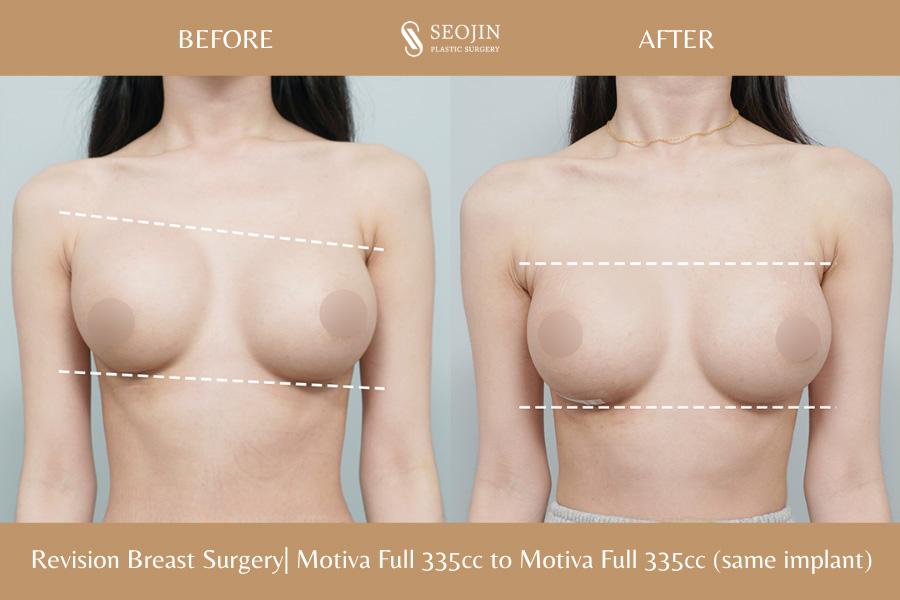
3. Okay Plastic Surgery Clinic
For revision breast surgery, you may consider Okay Plastic Surgery Clinic when your concerns could involve breast shape, sagging, excess volume, or nipple position. Its specialized Breast Center offers breast lift, reduction, and nipple-correction procedures, and Dr. Cho’s breast-surgery focus includes research and experience with severe reduction cases.
- URL: Okay Plastic Surgery Clinic Website
- Location: Gangnam-gu, Seoul
- Breast Center services:
- The specialized Breast Center offers breast reduction, breast lift, and nipple correction.
- Additional breast services listed include augmentation with implants or fat grafting, gynecomastia surgery, and procedures for inverted nipples.
- Breast surgery expertise:
- Dr. Cho is described as having ongoing study and published research in breast surgery.
- The clinic notes experience with severe breast-reduction cases requiring substantial reduction.
- Aftercare: The clinic emphasizes comprehensive aftercare intended to support natural, lasting results.
How Much Does Revision Breast Surgery Cost in Korea?
Revision breast surgery is supplied at ₩13,000,000–₩22,000,000 (approximately US$9,600–US$16,300). Individual quotes vary because revision plans range from a relatively direct implant exchange to complex capsule removal, pocket reconstruction, or a combined breast lift.
| Procedure Price | Korean Won (₩) | USD ($) |
|---|---|---|
| Low Price | ₩13,000,000 | $9,600 |
| High Price | ₩22,000,000 | $16,300 |
Exchange rate as of 2026-09-06: 1 KRW = 0.000741 USD.
What Affects the Price?
- Capsule treatment and pocket reconstruction — Capsulotomy, partial or total capsulectomy, capsulorrhaphy, or a plane change requires dissection through scarred tissue and intraoperative assessment of the existing capsule and implant pocket. Extensive capsule work, correction of bottoming out or lateral displacement, and reconstruction of a distorted pocket increase operating time, anesthesia time, and facility resources.
- Implant exchange, removal, or replacement choice — A revision may involve implant removal without replacement, exchange of one or both implants, or replacement with a different size, profile, fill, shape, or plane. Implant exchange requires new devices and device documentation, while explantation can require additional contour planning when volume loss, loose skin, or asymmetry is expected.
- Breast lift combined with revision — Revision augmentation-mastopexy adds a breast lift to address excess skin, nipple or areola malposition, or recurrent ptosis. The combined operation creates additional incisions and wound-healing demands, increasing operative complexity and follow-up needs compared with implant revision alone.
- Soft-tissue reinforcement or fat grafting — Acellular dermal matrix, mesh, or other pocket-support material may be used for weak lower-pole tissue or recurrent malposition, adding implanted consumables and fixation work. Fat grafting adds harvesting, processing, and injection steps and may be staged when treating rippling, visible implant edges, or contour deficits.
Cost tip: Request an itemized quote that states what is included, particularly the planned implant approach, capsule or pocket work, anesthesia, facility use, reinforcement materials or fat grafting if proposed, pathology or cytology when indicated, and scheduled postoperative reviews.
The US$9,600–US$16,300 conversion is approximate, based on the 2026-09-06 exchange rate of 0.000741 KRW/USD. Check the conversion again when budgeting, as exchange rates can move.
Revision Breast surgery From Start to Finish
- Remote consultation and records review — Send current photographs, the original operative report, implant card, prior imaging, pathology, medication list, allergies, nicotine status, and a clear description of symptoms and goals. Confirm English communication and whether the proposed plan can change after examination.
- Pre-travel diagnostic triage — Investigate late swelling, a mass, persistent pain, fever, or sudden asymmetry before booking cosmetic revision. Ultrasound, non-contrast MRI for silicone-implant concerns, or fluid/tissue assessment can be needed; implant assessment does not replace routine breast-cancer screening.
- Arrival and in-person assessment — The surgeon examines breast tissue, scars, implant position, chest-wall shape, nipple position, and skin quality. Pre-anesthesia testing is tailored to health history, and the final plan may be exchange, removal, lift, pocket repair, staged fat grafting, or diagnostic care instead of the original request.
- Surgical planning and consent — Review implant choices, incision options, capsule treatment, pathology plans, drains, scars, recovery restrictions, and the possibility that intraoperative findings require a different or staged approach. Do not consent to “en bloc” capsulectomy as a routine promise; it has specific indications and dissection risks.
- Anesthesia and operation — Most aesthetic implant revisions use general anesthesia. The surgeon removes or exchanges implants, releases or removes capsule when indicated, repairs or changes the pocket, and adds a lift, support material, or fat grafting if planned. Duration ranges widely because old scars and anatomy determine the work required.
- Recovery and discharge — Straightforward cases are often outpatient; extensive capsulectomy, combined lift, reconstruction, medical risk, or substantial pocket work can require overnight observation. Leave with prescribed medicines, a support-garment plan, drain instructions if used, and a responsible adult after anesthesia.
- Korea-based wound reviews — Attend early review, usually within the first week, and a further review around days 7–14 for wounds, drains, sutures, swelling, and fitness to fly. Swelling and tightness often continue through the first 6 weeks.
- Records and remote follow-up — Obtain English copies of the operative report, implant details, device card, pathology, imaging, medication list, and written escalation instructions before departure. Send scheduled healing photographs to the Korean team and share the records with the clinician following you at home.
Alternatives to Revision Breast Surgery
The right alternative depends on whether the priority is removing an implant, correcting shape, restoring volume, or investigating symptoms. Non-surgical observation avoids operative risks but cannot correct rupture, severe contracture, major malposition, infection, exposure, or suspected implant-associated malignancy.
Observation and Imaging
- Best for — Mild cosmetic concerns or symptoms without an urgent implant problem.
- Tradeoff — Monitoring avoids surgery but does not repair a displaced implant or remove a ruptured device; new swelling, mass, persistent pain, or underarm nodes need prompt assessment.
Explantation Alone
- Best for — People who want implant removal and accept a smaller or less projected breast shape.
- Tradeoff — Loose skin, dimpling, deflation, and asymmetry can remain. Systemic symptoms attributed to implants require medical assessment: FDA labeling recognizes reported systemic symptoms, but there is no universally accepted diagnostic test for “breast implant illness.”
Explantation With Breast Lift
- Best for — Implant removal with significant skin laxity or low nipple position.
- Tradeoff — A breast lift can reshape the envelope but adds scars, healing demands, and recovery time.
Staged Fat Grafting
- Best for — Modest contour correction, rippling camouflage, or implant-edge visibility in patients with adequate donor fat.
- Tradeoff — Breast fat grafting usually needs more than one session and cannot reliably replace the volume or projection of larger implants.
Autologous Flap Reconstruction
- Best for — Selected reconstruction patients with damaged implant pockets, radiation history, or a need to avoid another implant.
- Tradeoff — Flap reconstruction is a larger operation with donor-site scars, longer recovery, and different complication risks.
How Can I Prepare for Revision Breast Surgery?
- Send records early — Provide operative notes, implant card, imaging, pathology, cancer or radiation history, prior seroma or infection history, medication list, allergies, and clotting history before travel.
- Stop nicotine — Stop cigarettes, vaping, nicotine pouches, nicotine replacement, and other nicotine exposure at least 4 weeks before elective surgery when required by the surgeon, and remain nicotine-free afterward. Smoking increases postoperative complications.
- Review every medicine — Tell the surgeon and anesthesiologist about anticoagulants, antiplatelets, NSAIDs, diabetes medicines, GLP-1 medicines, hormones, supplements, and psychiatric medicines. Do not stop prescribed medicines independently; the anesthesia team must set the plan.
- Follow fasting instructions exactly — Confirm the permitted timing for food, clear liquids, and essential medicines with the anesthesiologist. Fasting instructions are procedure- and medication-specific.
- Plan the first week — Book step-free accommodation near the follow-up location, arrange private transport, and bring a responsible adult for discharge after general anesthesia. Pack front-opening loose clothing and any clinic-approved support garment.
- Protect the schedule — Keep flights flexible, arrive with time for final assessment, and plan 10–14 days in Korea after surgery at minimum. Extend the stay for drains, combined lift surgery, complex capsule work, or medical risk.
Travel note: Do not treat a surgical trip as a sightseeing itinerary. Avoid tours, shopping bags, crowded transit, and activities that require lifting or repeated arm movement during the first 1–2 weeks.
Confirm the treating surgeon’s and anesthesiologist’s individualized requirements, which take precedence over this general guidance.
Aftercare Advice
Protect healing tissue and attend every scheduled review; early overexertion, nicotine exposure, and missed wound checks can turn a manageable recovery into a serious complication.
- Move safely — Take short, frequent walks from the first days to support circulation, but avoid lifting, pushing, pulling, luggage, forceful overhead reach, chest exercise, vigorous cardio, and high-impact activity until the surgeon clears it. Restrictions often last up to 6 weeks and longer after a lift or extensive repair.
- Use medicines and garments correctly — Take only prescribed or clinician-approved pain medicines and antibiotics. Wear the approved surgical bra or support garment exactly as directed; do not drive while taking opioid pain medicine or while chest and arm movement is limited.
- Keep incisions protected — Follow the clinic’s shower, dressing, drain, and tape instructions. Do not apply silicone, scar cream, massage, or other products until wounds are closed and the surgeon approves. Avoid pools, hot tubs, ocean water, saunas, and direct sun on scars until cleared; use SPF 50 on healed exposed scars.
- Avoid nicotine and alcohol — Remain nicotine-free for the full surgeon-directed period. Avoid alcohol while taking opioid pain medicine, sedating medicines, or antibiotics when the prescriber advises against it.
- Know urgent warning signs — Contact the surgical team urgently for rapidly increasing one-sided swelling, escalating pain, sudden marked asymmetry, expanding bruising, fever, chills, spreading redness, foul drainage, wound opening, or implant exposure. Seek emergency care for chest pain, shortness of breath, coughing blood, fainting, or calf pain or swelling.
- Assess results at the right time — Initial recovery is usually 1–2 weeks, but swelling and tightness can last about 6 weeks. Implant position and a more stable contour are commonly assessed around 3–6 months; scars continue maturing for months.
Follow the treating doctor’s instructions over general advice, and contact the clinic promptly whenever healing looks or feels wrong.
Frequently Asked Questions
Related Blogs
Breast Fat Grafting in Korea vs. Global Costs: A Smart Investment for Natural Results
Explore the affordability and benefits of breast fat grafting in Korea, a popular cosmetic procedure known for its natural results. Discover why more individuals are choosing Korea for this innovative, cost-effective solution.
Updated: Sep 26, 2026
Nipple Surgery in Korea: Types, Recovery, Risks, and Travel Planning
Nipple surgery may reduce nipple size or projection, correct benign inversion, revise scars, or reconstruct the nipple–areola complex; technique, anesthesia, and recovery depend on the procedure and any combined breast or chest surgery. International patients should plan at least 7–10 days locally for uncomplicated isolated procedures, attend wound review before flying, arrange follow-up at home,
Updated: Sep 21, 2026
Breast Augmentation in Korea: Implants, Recovery, Travel Planning, and Long-Term Safety
Breast augmentation in Korea may use silicone or saline implants, or fat grafting, with planning based on anatomy, goals, incision, and pocket placement. The article covers candidacy, costs of ₩7,000,000–₩18,000,000, 10–14-day travel planning, recovery, follow-up, and implant records.
Updated: Sep 20, 2026
Capsular Contracture Treatment in Korea: Revision Options, Recovery, and Travel Planning
Capsular contracture treatment may include capsulotomy, partial or total capsulectomy, implant exchange or removal, pocket change, ADM support, breast lift, fat grafting, or autologous reconstruction based on symptoms and tissue condition. International patients should plan at least 10–14 days in Korea, complete local follow-ups, obtain surgeon clearance before flying, and arrange home-country car
Updated: Sep 19, 2026
Clinics offering Revision Breast surgery

THEPLUS Plastic Surgery Korea | Eye, Nose, Face & Body Surgery
Sinsa

Seojin Plastic Surgery Clinic Korea: Pioneering Advanced Cosmetic Procedures for Personalized Aesthetic Transformation
Apgujeong

Okay Plastic Surgery Clinic in Korea: Comprehensive Aesthetic Procedures with Sincerity and Care
Cheongdam

Banobagi Plastic Surgery: A Pioneering and Trusted Plastic Surgery Clinic in Korea
Seolleung