Medical Tourism Blog
Calcified Breast Implant Capsule: Capsular Contracture Treatment Options in Korea
Table of contents
- Understanding Calcified Breast Implant Capsules
- Medical Procedures for Capsular Contracture Treatment
- Best Clinics in Korea for Calcified Breast Implant Capsule
- Navigating Capsular Contracture Treatment in South Korea for Medical Tourists
- Cost Analysis: South Korea vs. Other Medical Tourism Destinations
- Patient Experiences and Outcomes
- Conclusion
- References
Considering treatment in Korea? Everything you need to know e.g. — how to avoid scams, visas, interpreters, recovery tips — in our Medical Tourism Master Guide. Plan with confidence in minutes, not weeks!
Breast implants are popular worldwide, serving both aesthetic and reconstructive needs, especially after mastectomy. While implants offer many benefits, they can also lead to a range of complications because the body reacts to any foreign object by forming a layer of scar tissue, called a capsule, around it. This natural process sometimes goes awry: if the capsule thickens, hardens, or calcifies, it becomes problematic and may result in conditions like capsular contracture. When calcium deposits form in the capsule, it's known as a calcified breast implant capsule, which often causes noticeable breast hardness.
This guide aims to clarify the complexities of calcified breast implant capsules and the treatments available. It explores the causes and symptoms, discusses treatment options (with special focus on surgical procedures), and outlines what patients can expect if they're considering medical tourism for treatment in South Korea—including cost, patient experiences, and the entire care journey. By the end, you’ll have a clearer understanding to help make informed decisions about your health.
Understanding Calcified Breast Implant Capsules
What is a Calcified Breast Implant Capsule?
A calcified breast implant capsule forms when calcium builds up inside the fibrous scar tissue that naturally envelopes a breast implant. Usually, the body creates a soft, thin layer, but sometimes this tissue hardens and develops calcium deposits. These show up as white flecks on mammograms. This process is one of the major reasons for breasts feeling unusually firm or hard following implantation.
Common Pseudonyms and Related Terms
You'll likely hear a calcified breast implant capsule described in several ways:
- Capsular Contracture: Refers to tightening and hardening of the scar tissue, often with calcification, and is the most common clinical term.
- Breast Hardening/Firmness: Patient-oriented terms indicating a problematic capsule.
- Fibrous Capsule/Scar Tissue: The tissue that undergoes calcification.
- Calcinosis: A general term for unusual calcium salt buildup in soft tissues.
- Foreign-Body Reaction: The body's immune response, which facilitates capsule formation.
Causes and Risk Factors
A calcified breast implant capsule typically develops due to a complex mix of bodily responses and external factors:
- Foreign Body Reaction and Inflammation: The implant triggers scar tissue and sometimes persistent inflammation, setting off abnormal capsule formation and calcification.
- Implant Rupture/Leakage: If a silicone implant ruptures, the leaked materials can worsen inflammation and increase the risk of calcification. More severe (Baker Grade IV) contractures are linked to high silicone content.
- Biofilm Formation: Microbial biofilms on the implant can cause low-level infection, a major driver of contracture.
- Genetic Predisposition: Family history of autoimmune disease or tendency to form thick scars increases risk.
- Trauma, Injury, or Previous Surgery: Previous injuries or surgeries can spark calcification.
- Implant Characteristics and Placement:
- Implant Generation: Older implants, especially those with Dacron patches, are more calcification-prone.
- Placement Plane: Subglandular (above muscle) placement increases risk compared to submuscular (under muscle).
- Surface Texture: Textured implants may lower the risk of contracture, but clinical opinions vary.
- Other Complications: Post-surgery issues like hematomas or seromas also increase risk.
Symptoms and Diagnosis
Symptoms: Common signs include breast hardening, firmness, pain, tightness, and distortion or asymmetry. Severe cases may have an unnaturally round or elevated breast appearance and significant pain.
Diagnosis:
- Physical Examination: A surgeon evaluates implant position, breast shape, tissue health, and lymph nodes.
- Mammography: Calcifications appear as white spots. Macrocalcifications are usually benign, but clusters of microcalcifications may indicate cancer. Calcified capsules can make cancer harder to detect, so distinguishing between benign and malignant calcifications is crucial.
- MRI/Ultrasound: These help investigate rupture or rule out other complications.
- Biopsy: Needed if imaging yields suspicious results.
Calcified capsules make breast cancer screening more complex, as implant-related calcifications can hide malignant ones. Thus, it's essential to seek surgeons and imaging centers experienced in breast implants. Calcification also signals advanced capsular contracture—Baker Grade IV cases, marked by extreme hardness and pain, are strongly associated with this condition and usually require surgery.
Baker Classification System of Capsular Contracture:
| Baker Grade | Description | Symptoms |
|---|---|---|
| Grade I | The breast is soft and looks normal | None |
| Grade II | The breast is slightly firm but looks normal | Minor symptoms, no major changes |
| Grade III | The breast is firm and looks abnormal | Distortion, unnatural roundness, hard to touch, mild discomfort |
| Grade IV | The breast is hard, painful, and looks abnormal | Rock-hard, very painful, distorted |
This system helps communicate symptom severity and guides treatment.
Medical Procedures for Capsular Contracture Treatment
Goals of Treatment
Treatments aim to relieve pain, return the breast to a softer, more natural state, and improve appearance.
Surgical Interventions
For severe or calcified cases, surgery is usually necessary:
- Capsulectomy (Complete Removal of the Capsule):
- The surgeon excises the whole thickened and mineralized capsule, often removing the implant as well. This procedure is typically performed under general anesthesia using the original incision to limit new scarring. It’s especially recommended for severe cases or when implants have ruptured.
- Capsulotomy (Incision/Release):
- The capsule is cut to release tightness, but most of the tissue remains. It's less invasive but usually unsuitable for heavily calcified or ruptured capsules.
- Implant Exchange or Removal:
- After capsulectomy or capsulotomy, implants can be replaced (sometimes with different types thought to lower recurrence risk) or simply removed.
- Adjunctive Techniques:
- Acellular Dermal Matrix (ADM): This supporting material helps reinforce tissue and may lower recurrence.
- Biofilm Eradication and Antibiotics: The surgeon may wash the area with antibiotics and prescribe a short course post-surgery.
Non-Surgical Approaches
Treatments like medications, injections, lasers, or targeted ultrasound have been attempted, but results are mixed. These are generally ineffective for moderate to severe capsular contracture (especially Baker Grade IV), which usually requires surgery.
Pre-operative Preparation and Considerations
Before surgery, the patient undergoes thorough imaging and medical clearance. The surgeon will discuss all surgical options, including changes in implant type or size. Smoking cessation is strongly encouraged in the weeks prior to surgery to support healing.
Post-operative Care and Recovery Timeline
- Immediate Care: Patients are monitored immediately after surgery and given medication for pain.
- Drainage Tubes: If needed, drainage tubes are typically removed within a week.
- Compression Garments: These are worn for several days or weeks as directed.
- Activity: Initial rest is required, but light activity can usually resume within days. Full recovery takes around six weeks, though the final appearance can take up to a year.
Potential Risks and Complications
Complications include scarring, bleeding, infection, poor healing, anesthesia risks, and persistent pain. Implant-specific risks are rupture, displacement, wrinkling, or loss of sensation (temporary or permanent). Furthermore, recurrence of capsular contracture or calcification is possible, especially with incomplete capsulectomy. Rarely, Breast Implant-Associated Anaplastic Large Cell Lymphoma (BIA-ALCL) can occur.
Recurrence rates of contracture can be similar between capsulectomy and capsulotomy, as underlying patient factors also play a role. High patient satisfaction, however, is typical—even with recurrences, improvements in symptoms and appearance are highly valued.
It's also important to note the current thinking on implant longevity. Proactive replacement is now recommended every 10-15 years, rather than waiting for failure, ruptures, or complications, underlining the need for regular follow-up.
Best Clinics in Korea for Calcified Breast Implant Capsule
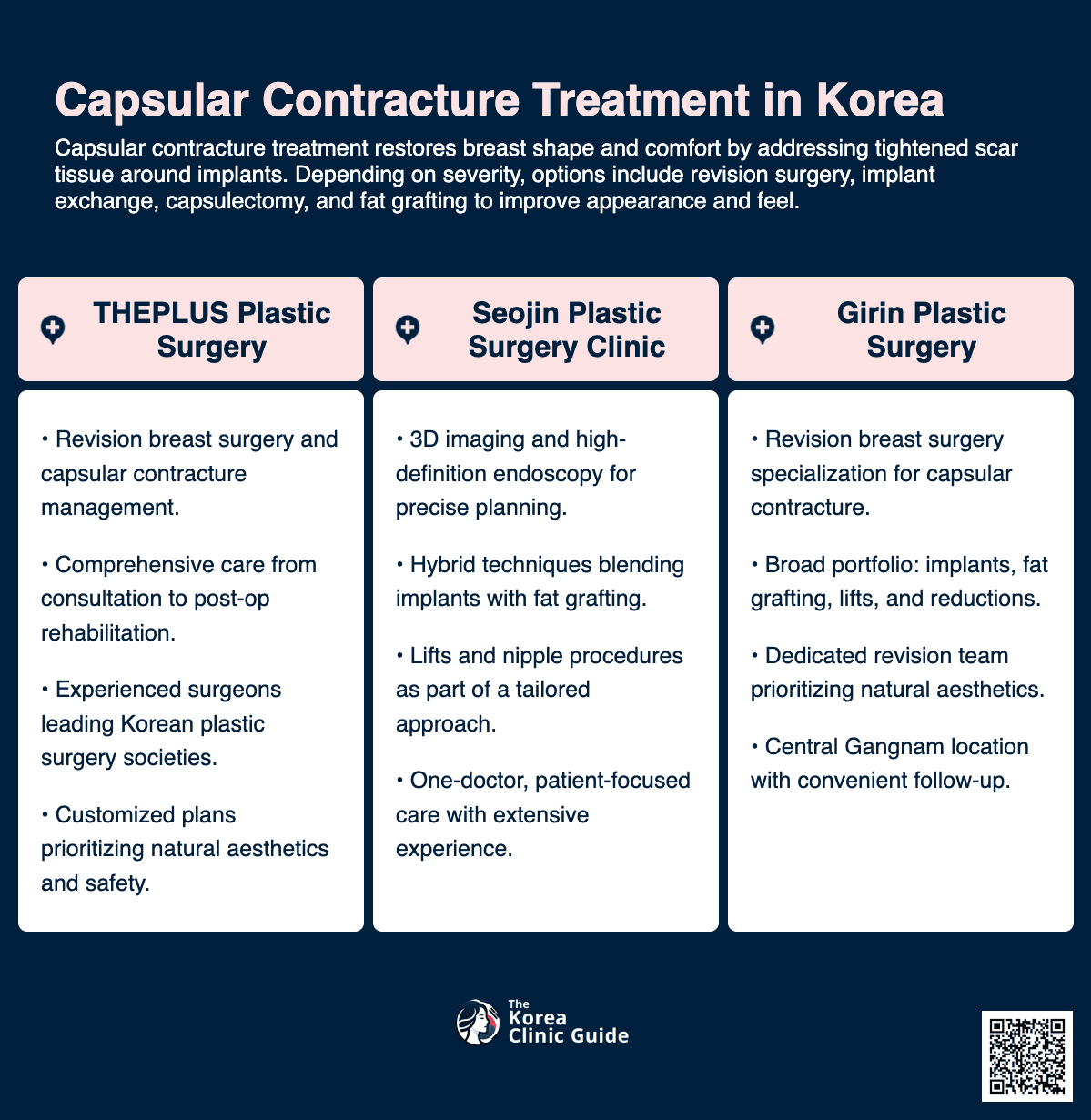
Listed below are the best clinics in Korea for calcified breast implant capsule:
| Clinic Name | Key Features | Special Techniques |
|---|---|---|
| THEPLUS Plastic Surgery | THE PLUS Plastic Surgery in Garosu-gil, Gangnam, Seoul, is a comprehensive, four-floor center delivering world-class care from consultation to surgery and post-operative skincare. Led by internationally recognized surgeons who are both clinicians and active researchers, the clinic is renowned for precision, safety, and patient-centered communication. With board-certified specialists including Dr. Lee, a breast augmentation expert with experience at Seoul National University Hospital, and directors Dr. Jeong Jae Yong (President of the Korean Society of Plastic Surgeons) and Dr. Kim Taek Kyun (award-winning researcher in 3D implants), THE PLUS is exceptionally positioned to evaluate and treat complex breast implant issues such as calcified breast implant capsules, offering individualized plans that prioritize natural, long-lasting results. | - Specialized breast expertise: Dr. Lee is a board-certified breast augmentation specialist with top-tier hospital experience, delivering natural and durable outcomes—key for revision cases involving calcified capsules. - Multidisciplinary leadership: Dr. Jeong (President of the Korean Society of Plastic Surgeons) and Dr. Kim (global society member and educator) provide oversight grounded in the latest standards and shared best practices. - Research-driven planning: Surgeons are active contributors to journals, books, and international symposiums; Dr. Kim’s awards for 3D implant research support meticulous, individualized implant strategy—crucial when addressing calcification and capsule-related changes. - Proven educator-surgeons: The team runs annual educational sessions and participates in global forums and live surgeries, ensuring techniques remain current for complex implant revision needs. - Safety-first culture: Care is delivered by highly experienced professionals with over a decade in practice, aligned with leading medical societies, and committed to rigorous, evidence-based protocols. - Seamless continuum of care: A purpose-built, four-floor facility streamlines evaluation, surgery, and aftercare, which is especially valuable for staged or complex revision pathways. - Aesthetic harmony and function: Dr. Kim’s philosophy of facial harmony and Dr. Jeong’s “function plus beauty” ethos reflect the clinic’s broader approach—balancing form, symmetry, and long-term comfort in breast procedures. - Advanced implant options: Expertise with leading implant systems, including Motiva, supports tailored implant exchange or upgrade paths when clinically indicated after capsule-related issues. - Internationally recognized reputation: Ongoing scholarly output, leadership roles, and global presentations reinforce a culture of excellence ideally suited to challenging cases like calcified breast implant capsules. |
| Seojin Plastic Surgery Clinic | For women seeking expert care for a Calcified Breast Implant Capsule in Korea, Seojin Plastic Surgery Clinic in Gangnam stands out as the best choice because every step—from diagnosis and surgical planning to revision and recovery—is led personally by Dr. Lee Hyungmin (Lee Hyeong-Min), a one-doctor system that guarantees truly tailored, end-to-end care. With more than 16 years of experience and recognition as one of Korea’s 100 Good Doctors, Dr. Lee combines proven judgment with advanced breast surgery techniques, leveraging 3D imaging for precise aesthetic planning and high-definition endoscopy for meticulous, tissue-sparing work during complex capsule revisions. Whether restoring softness and symmetry through implant exchange, incorporating hybrid techniques with fat grafting, or refining contour with complementary body sculpting expertise, Seojin prioritizes natural-looking results, comfort, and safety. This blend of recognized excellence, cutting-edge technology, and uncompromising personal attention makes Seojin Clinic the premier destination in Korea for resolving calcified breast implant capsules and confidently reclaiming a natural, refined breast shape. | - One-doctor system led by Dr. Lee Hyungmin - 16+ years of experience; 100 Good Doctors - 3D imaging for precise aesthetic planning - High-definition endoscopy for meticulous, tissue-sparing work during complex capsule revisions - Implant exchange, hybrid techniques with fat grafting - Contour refinement - Natural-looking results, comfort, and safety |
| Girin Plastic Surgery Website | Girin Plastic Surgery in Gangnam Station is a comprehensive aesthetic clinic offering a wide range of surgical and non-surgical procedures, led by some of Korea’s most prestigious plastic surgeons. With an emphasis on safety, professionalism, and patient satisfaction, the clinic provides tailored solutions across eye, nose, facial contouring, breast, body, lifting, and skin procedures to help you achieve your desired results. - Specialized in Revision Breast Surgery, a corrective option for patients who have undergone previous breast surgeries and are seeking improved results—ideal for addressing calcified breast implant capsules. - Full spectrum of breast procedures, including augmentation (implants or fat grafting), breast lift, breast reduction, nipple and areola surgery, and gynecomastia surgery, enabling individualized treatment plans that prioritize both health and aesthetics. - Led by highly respected plastic surgeons in Korea, ensuring safe, professional decision-making for complex cases like capsule-related complications. - Wide range of surgical and non-surgical offerings to customize care to your anatomy, goals, and recovery preferences. - Patient-centered approach focused on satisfactory outcomes, from initial consultation through follow-up care. - Convenient Gangnam Station location for easy access and continuity of care. Find more about this clinic here: Girin Plastic Surgery Website |
THEPLUS Plastic Surgery
THE PLUS Plastic Surgery in Garosu-gil, Gangnam, Seoul, is a comprehensive, four-floor center delivering world-class care from consultation to surgery and post-operative skincare. Led by internationally recognized surgeons who are both clinicians and active researchers, the clinic is renowned for precision, safety, and patient-centered communication. With board-certified specialists including Dr. Lee, a breast augmentation expert with experience at Seoul National University Hospital, and directors Dr. Jeong Jae Yong (President of the Korean Society of Plastic Surgeons) and Dr. Kim Taek Kyun (award-winning researcher in 3D implants), THE PLUS is exceptionally positioned to evaluate and treat complex breast implant issues such as calcified breast implant capsules, offering individualized plans that prioritize natural, long-lasting results.
- Specialized breast expertise: Dr. Lee is a board-certified breast augmentation specialist with top-tier hospital experience, delivering natural and durable outcomes—key for revision cases involving calcified capsules.
- Multidisciplinary leadership: Dr. Jeong (President of the Korean Society of Plastic Surgeons) and Dr. Kim (global society member and educator) provide oversight grounded in the latest standards and shared best practices.
- Research-driven planning: Surgeons are active contributors to journals, books, and international symposiums; Dr. Kim’s awards for 3D implant research support meticulous, individualized implant strategy—crucial when addressing calcification and capsule-related changes.
- Proven educator-surgeons: The team runs annual educational sessions and participates in global forums and live surgeries, ensuring techniques remain current for complex implant revision needs.
- Safety-first culture: Care is delivered by highly experienced professionals with over a decade in practice, aligned with leading medical societies, and committed to rigorous, evidence-based protocols.
- Seamless continuum of care: A purpose-built, four-floor facility streamlines evaluation, surgery, and aftercare, which is especially valuable for staged or complex revision pathways.
- Aesthetic harmony and function: Dr. Kim’s philosophy of facial harmony and Dr. Jeong’s “function plus beauty” ethos reflect the clinic’s broader approach—balancing form, symmetry, and long-term comfort in breast procedures.
- Advanced implant options: Expertise with leading implant systems, including Motiva, supports tailored implant exchange or upgrade paths when clinically indicated after capsule-related issues.
- Internationally recognized reputation: Ongoing scholarly output, leadership roles, and global presentations reinforce a culture of excellence ideally suited to challenging cases like calcified breast implant capsules.
You can check out their website here: THEPLUS Plastic Surgery Website
Seojin Plastic Surgery Clinic
For women seeking expert care for a Calcified Breast Implant Capsule in Korea, Seojin Plastic Surgery Clinic in Gangnam stands out as the best choice because every step—from diagnosis and surgical planning to revision and recovery—is led personally by Dr. Lee Hyungmin (Lee Hyeong-Min), a one-doctor system that guarantees truly tailored, end-to-end care. With more than 16 years of experience and recognition as one of Korea’s 100 Good Doctors, Dr. Lee combines proven judgment with advanced breast surgery techniques, leveraging 3D imaging for precise aesthetic planning and high-definition endoscopy for meticulous, tissue-sparing work during complex capsule revisions. Whether restoring softness and symmetry through implant exchange, incorporating hybrid techniques with fat grafting, or refining contour with complementary body sculpting expertise, Seojin prioritizes natural-looking results, comfort, and safety. This blend of recognized excellence, cutting-edge technology, and uncompromising personal attention makes Seojin Clinic the premier destination in Korea for resolving calcified breast implant capsules and confidently reclaiming a natural, refined breast shape.
You can check out their website here: Seojin Plastic Surgery Clinic Website
Girin Plastic Surgery
Girin Plastic Surgery in Gangnam Station is a comprehensive aesthetic clinic offering a wide range of surgical and non-surgical procedures, led by some of Korea’s most prestigious plastic surgeons. With an emphasis on safety, professionalism, and patient satisfaction, the clinic provides tailored solutions across eye, nose, facial contouring, breast, body, lifting, and skin procedures to help you achieve your desired results.
- Specialized in Revision Breast Surgery, a corrective option for patients who have undergone previous breast surgeries and are seeking improved results—ideal for addressing calcified breast implant capsules.
- Full spectrum of breast procedures, including augmentation (implants or fat grafting), breast lift, breast reduction, nipple and areola surgery, and gynecomastia surgery, enabling individualized treatment plans that prioritize both health and aesthetics.
- Led by highly respected plastic surgeons in Korea, ensuring safe, professional decision-making for complex cases like capsule-related complications.
- Wide range of surgical and non-surgical offerings to customize care to your anatomy, goals, and recovery preferences.
- Patient-centered approach focused on satisfactory outcomes, from initial consultation through follow-up care.
- Convenient Gangnam Station location for easy access and continuity of care.
Find more about this clinic here: Girin Plastic Surgery Website
Navigating Capsular Contracture Treatment in South Korea for Medical Tourists
Why South Korea for Medical Tourism?
South Korea is considered a world leader in cosmetic surgery, thanks to its advanced technology and skilled surgeons. Clinics here use high-end digital tools like 3D imaging and AI to plan procedures, providing patients with tailored and previewed outcomes.
Process of Getting Procedures in South Korea
The patient journey is thorough and well-supported:
- Initial Consultation and Planning: Many clinics (or agencies such as Seoul Guide Medical) offer online consultations using 3D modeling.
- Travel and Accommodation: Most clinics are close to major airports. Many treatment packages include hotel or in-hospital stays as well as airport pick-up and daily transport.
- Medical Clearance: Pre-operative evaluations are performed to ensure you’re ready for surgery.
- Surgery and Hospital Stay: Procedures are done under general anesthesia, with possible overnight observation. Emphasis is placed on patient safety and care.
- Post-op Care and Recovery: After surgery, patients receive thorough monitoring and pain management. Compression garments are provided, and if drains are placed, they're removed after about a week. Follow-ups are built into the process to monitor healing.
- Support Services: Dedicated patient managers, interpreters, and sometimes concierge-level services make navigation and recovery easier for international patients.
This integrated, patient-focused model transforms South Korea into a truly appealing destination for medical tourists.
General Recovery Timeline
- Resuming light activity: Within 1-2 weeks.
- Full recovery: Around 6 weeks.
- Final results: Up to 1 year.
Cost Analysis: South Korea vs. Other Medical Tourism Destinations
Typical Costs for Capsular Contracture Treatment in South Korea
Expect to pay between $3,000 and $7,000 USD for capsular contracture treatment. This usually includes a deposit of 10% to book the procedure.
Detailed Breakdown of Inclusions
Packages are often all-inclusive, covering:
- Accommodation: Close to the clinic or hospital; in-hospital stays as needed.
- Transportation: Includes airport pick-up and shuttles to/from appointments.
- Translation: Multilingual support from consultation to recovery.
- Overnight Stays and Medication: Any necessary postoperative hospital stay and standard medications are included.
- Physical Therapy: When indicated, recovery therapies may also be part of the package.
Detailed breakdowns of surgical or anesthesia fees aren’t always provided because these are bundled into the overall cost.
Factors Influencing Cost
Prices vary based on:
- Surgeon experience and reputation
- Facility quality and technology
- Clinic location (e.g., central Seoul)
- Complexity of procedure (capsulectomy vs. capsulotomy, use of ADM, etc.)
Comparative Costs by Country
| Country | Cost Range (USD) | Typical Inclusions |
|---|---|---|
| South Korea | $3,000–$7,000 | Accommodation, transportation, translation, medication |
| USA | $6,000–$15,000 | Surgery fees, anesthesia, post-op appointments |
| Mexico | $2,000–$5,000 | Lower costs; possible risks with standards and support |
| Turkey | $2,000–$6,000 | Good quality; variable standards and longer stays |
| UK | $7,000–$12,000 | Comprehensive but more expensive |
| Germany | $5,000–$10,000 | High standards, thorough aftercare |
| Australia | $9,000–$16,000 | Generally high standards, higher costs |
Value Proposition
South Korea’s “all-inclusive” pricing stands out. Bundling essentials like accommodation, transport, and language support not only lowers the overall cost but also minimizes surprises and travel stress—major benefits for international patients.
Patient Experiences and Outcomes
Addressing Common Issues
Treating a calcified breast implant capsule relieves pain, discomfort, and restores a natural breast shape. Restored comfort and aesthetics markedly boost self-confidence and quality of life for most patients.
Success Rates and Improvement
Surgical success is high, with some practitioners reporting rates above 80%. Symptom improvement runs from about 50% to greater than 90%, and overall patient satisfaction is typically high (average 8.29 out of 10). Improvements may occur even when only partial capsule removal is performed.
Long-Term Outcomes and Implant Durability
Beyond immediate relief, techniques like Acellular Dermal Matrix can reduce the risk of recurrence and help ensure new implants last longer.
Recurrence and Strategies to Minimize It
Recurrence can happen, with similar rates seen between different surgical techniques (around 30–34%). On average, recurrence may occur three years after revision. Factors like ruptured silicone implants increase risk. To lower the likelihood of recurrence, surgeons focus on:
- Complete Capsule Removal
- ADM Support
- Submuscular Placement
- Antibiotics
- Thoughtful Implant Selection
Even though recurrence can’t be ruled out, most patients are satisfied as their quality of life improves significantly.
Key Patient Considerations
- Realistic Expectations: Understand there’s always a chance of recurrence.
- Individual Results Vary: Healing and outcomes depend on many factors.
- Ongoing Follow-up: Regular check-ins aid detection and management of recurrence.
Conclusion
Calcified breast implant capsules are a serious form of capsular contracture, causing discomfort and posing diagnostic challenges, especially for cancer screening. Surgery—usually capsulectomy or capsulotomy—is the main treatment and generally brings symptom relief and high patient satisfaction, though recurrence is possible. South Korea provides advanced care and streamlined services, making it an excellent option for medical tourists seeking comprehensive treatment, support, and value. For best outcomes, patients should seek experienced surgeons and maintain realistic expectations about recovery and future risks.
References
1, 2, 3, 4, 5, 6, 7, 8, 9, 10, 11, 12, 13, 14, 15, 16, 17, 18, 19, 20, 21, 22, 23, 24, 25, 26, 27