
Medical Tourism Blog
Vitamin Injection in Korea: Methods, Safety, Travel Planning, and Recovery
Table of contents
- Vitamin Injection at a Glance
- What Is a Vitamin Injection?
- Who Is a Good Candidate for a Vitamin Injection?
- How Is a Vitamin Injection Performed?
- Why Visit Korea for a Vitamin Injection?
- Key Information for International Patients
- Which Are the Best Clinics in Korea for Vitamin Injection?
- Vitamin Injection From Start to Finish
- Alternatives to a Vitamin Injection
- How Can I Prepare for a Vitamin Injection?
- Aftercare Advice
Considering treatment in Korea? Everything you need to know e.g. — how to avoid scams, visas, interpreters, recovery tips — in our Medical Tourism Master Guide. Plan with confidence in minutes, not weeks!
Last updated: September 2026
Vitamin Injection at a Glance
- What it is — Vitamin injection can mean a targeted IM vitamin B12 shot, a single-vitamin IV infusion such as vitamin C, or a mixed IV cocktail; these are different treatments with different doses, benefits, and risks.
- Best candidates — The clearest indication is a laboratory-confirmed deficiency or impaired absorption, such as B12 deficiency from pernicious anemia; unexplained fatigue should be medically assessed rather than treated as a presumed vitamin deficiency.
- Evidence limit — Injectable replacement can correct a documented deficiency, but high-quality evidence does not support routine high-dose wellness infusions for healthy people, and no universal repeat-drip schedule or reliable cosmetic result is established.
- Recovery and travel — There is usually no downtime: light activity is typically possible the same day, while injection-site soreness or bruising may last 1–3 days. Plan 1–2 days in Korea, including an overnight buffer after a first high-dose or mixed infusion.
- Important safety check — High-dose IV vitamin C needs careful review for kidney impairment, prior oxalate stones, dehydration, iron overload, and G6PD deficiency, which can carry a risk of severe hemolysis.
- Korea-specific point — South Korean standards regulate quality attributes of individual injectable products, including sterility and labeled content, but do not create a standard vitamin-drip formula or prove that mixed wellness cocktails are effective; use a foreign-patient registered institution and request the full formula in advance.
- Records and follow-up — Before leaving, obtain an English discharge summary with every ingredient and dose, route, infusion time, tests, lot numbers where available, warning signs, and clinic contact details for your home clinician.
What Is a Vitamin Injection?
A vitamin injection delivers a specified vitamin by injection into a muscle or through an intravenous drip. It is used to correct a confirmed deficiency or provide replacement when oral supplements are not reliably absorbed; mixed wellness infusions have less certain benefits. It is a non-surgical treatment.
Who Is a Good Candidate for a Vitamin Injection?
- Documented replacement need — Suitable candidates have laboratory-supported vitamin B12 deficiency, impaired absorption such as pernicious anemia, or another clinician-defined reason that oral replacement is unreliable. Parenteral B12 is used for deficiency associated with malabsorption states.Vitamin B12 fact sheet
- High-risk thiamine deficiency — Hospital-managed patients with suspected Wernicke encephalopathy or serious alcohol-related malnutrition need urgent diagnosis-specific parenteral thiamine, not a commercial wellness drip.
- Defined, transparent infusion plan — A person considering IV vitamin C or a multivitamin infusion needs a named clinician, stated indication, complete ingredient list, dose, diluent, route, and infusion rate before consenting.
Fatigue alone is not a diagnosis: anemia, thyroid disease, infection, sleep disorders, depression, medication effects, nutritional deficiency, and systemic illness require assessment before vitamins are prescribed. Do not use a vitamin injection instead of urgent assessment for chest pain, shortness of breath, fainting, confusion, fever, gastrointestinal bleeding, severe fatigue, unexplained weight loss, or rapidly worsening symptoms. Defer elective treatment during a febrile illness, untreated skin infection at the cannulation site, unstable heart or kidney disease, or fluid-overload risk. High-dose IV vitamin C requires particular caution or avoidance with significant kidney impairment, prior oxalate stones, hyperoxaluria, severe dehydration, G6PD deficiency, or iron-overload treatment; severe hemolysis has been reported in G6PD deficiency. Pregnancy, breastfeeding, cancer treatment, anticoagulation, and diabetes medicines require an individualized medication and formulation review.
How Is a Vitamin Injection Performed?
“Vitamin injection” describes several different routes and formulas rather than one standard procedure. An IM B12 injection is not clinically equivalent to a high-dose IV vitamin C drip or a mixed wellness cocktail.
- Targeted IM injection — A single medicine, most often cyanocobalamin or hydroxocobalamin, is injected into muscle. Administration takes minutes and is used for diagnosis-specific B12 replacement rather than a generic “energy” treatment.
- Single-vitamin IV infusion — Vitamin C is diluted into an IV solution and delivered through a peripheral cannula over a clinician-set period. Dose, fluid volume, and infusion rate determine risk, so protocols are not directly comparable between clinics.
- Multivitamin or micronutrient infusion — Often marketed as a Myers cocktail, this can combine vitamin C, B-complex vitamins, B12, magnesium, calcium, and saline. Some formulations also add glutathione, amino acids, or medicines; require the precise formula and dose list before treatment.
- Monitored replacement protocol — Repeated B12 replacement or acute parenteral thiamine is arranged around the diagnosed condition, laboratory monitoring, and follow-up—not as a tourism add-on.
South Korean pharmacopoeial standards set quality requirements such as sterility, endotoxin, particulate, storage, and labeled content for individual injectable products including ascorbic-acid injection. They do not create a universal vitamin-drip formula, dose, route, or infusion schedule.MFDS monograph material
Why Visit Korea for a Vitamin Injection?
Korea offers outpatient access to injections and IV infusions, but the clinical priority is appropriate prescribing rather than a destination-specific wellness claim. No procedure-specific comparative evidence shows that vitamin injections in Korea produce better outcomes than equivalent supervised care elsewhere. Choose an institution registered to treat foreign patients and verify the proposed formula before travel.
- Foreign-patient registration — Korea operates a registration system for institutions serving international patients; this is a useful administrative and patient-protection check, not proof that an elective vitamin drip is effective.Registered institution system
- Product quality framework — Injectable products are subject to MFDS quality specifications, including sterility and labeled-content standards for products such as ascorbic-acid injection. This does not validate every mixed IV cocktail or wellness indication.MFDS monograph material
- Testing-led care — Clinics can assess a stated indication with targeted tests such as CBC, ferritin and iron studies, B12, folate, kidney function, electrolytes, or G6PD testing before high-dose IV vitamin C. Testing should answer a clinical question, not be used to justify a preselected cocktail.
- Evidence boundary — In healthy office workers, one randomized trial found lower self-reported fatigue two hours and one day after 10 g IV vitamin C, especially with lower baseline vitamin C. It did not establish durable benefits, cosmetic effects, immunity benefits, or a repeat-drip schedule.Randomized IV vitamin C fatigue trial A later evidence review found no high-quality evidence that high-dose vitamin infusions are necessary or beneficial in people without a specific deficiency or medical condition.Evidence review
Key Information for International Patients
- Minimum stay — Plan 1–2 days for a one-time uncomplicated injection or infusion. Consultation, testing, and treatment can occur on one day, but an overnight buffer allows results review and observation for delayed reactions.
- When a short visit is inappropriate — Confirmed deficiency needing repeated prescriptions, suspected malabsorption, anemia, alcohol-related malnutrition, kidney disease, cancer treatment, or complex medical history requires an individualized stay and home-clinician coordination.
- Flight timing — An uncomplicated IM injection or short infusion has no surgical flight restriction. Fly the same or next day only after post-treatment observation, when feeling well, and with the treating clinician’s agreement; postpone travel for allergy symptoms, chest symptoms, severe dizziness, or suspected infection.
- Recovery and itinerary — Normal light activity is generally possible the same day. Needle-site soreness or bruising can last 1–3 days; do not schedule a remote excursion or same-evening long-haul flight after a first high-dose or multi-ingredient infusion.
- Repeat visits — There is no evidence-based universal maintenance interval for wellness vitamin drips. Repeat treatment for a genuine deficiency depends on the nutrient, severity, neurologic symptoms, absorption cause, and laboratory response.
- Remote follow-up — Obtain an English discharge summary stating the diagnosis or goal, every ingredient and dose, route, infusion time, tests performed, lot numbers where available, warning signs, and direct follow-up contact. Send it promptly to the clinician at home.
Travel note: Travelers with prior venous thrombosis, active cancer, recent surgery, pregnancy, marked immobility, or other clot-risk factors need individualized advice for long-haul flights; an infusion does not remove travel-related clot risk.CDC air-travel guidance
Which Are the Best Clinics in Korea for Vitamin Injection?
Listed below are some of the best clinics in Korea for vitamin injection.
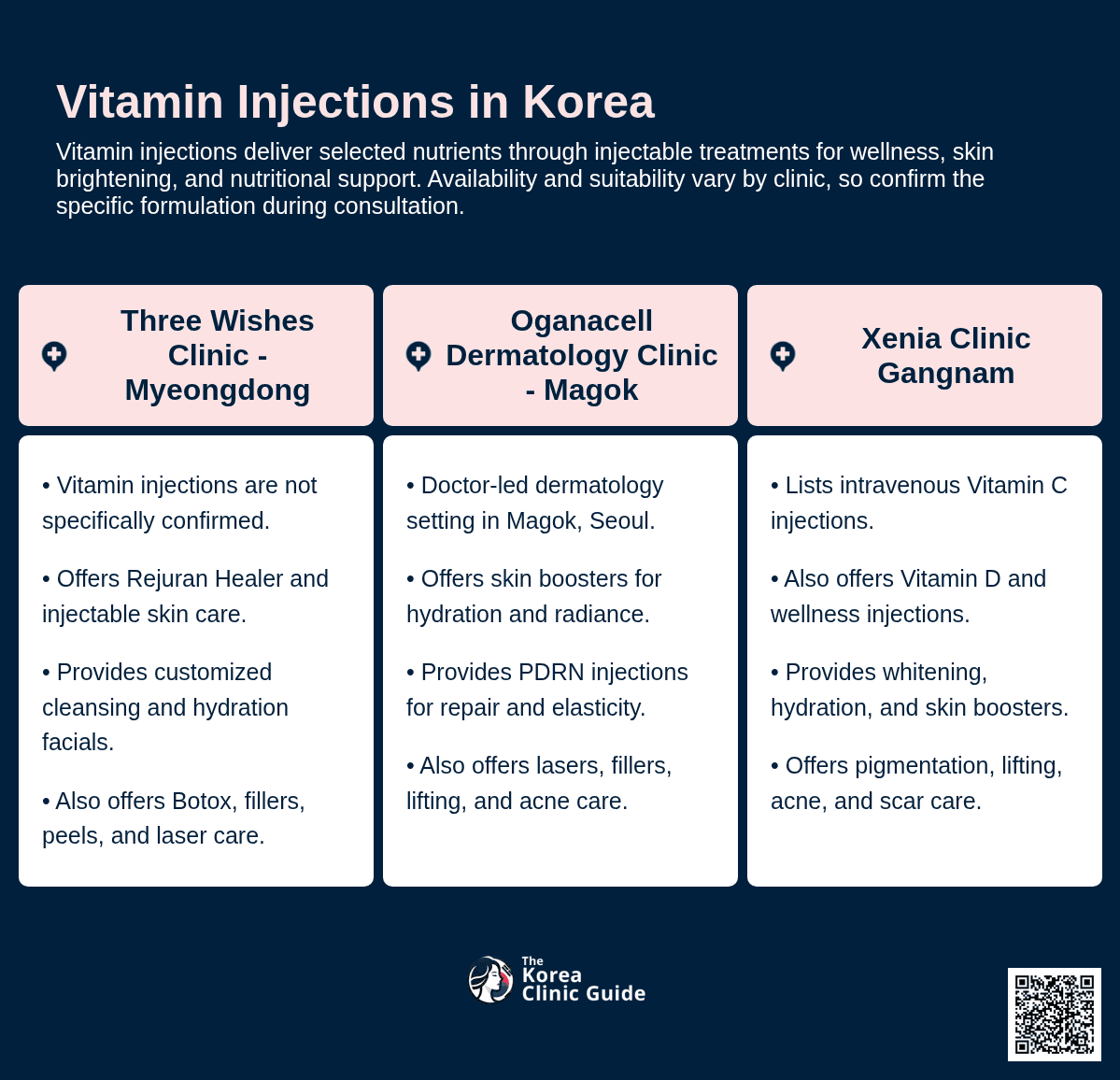
1. Three Wishes Clinic - Myeongdong
You may consider discussing your vitamin-injection needs with Three Wishes Clinic - Myeongdong if you also want access to a broad menu of aesthetic skin and injectable care; however, the available information does not specifically confirm that vitamin injections are offered, so your consultation should clarify availability and suitability for your goals.
- URL: Three Wishes Clinic - Myeongdong Website
- Location: Jung-gu, Seoul
- Related injectable and skin care:
- Offers Rejuran Healer injections using polynucleotide technology for skin regeneration, texture, elasticity, and fine-line care.
- Provides customized skin care treatments that can include cleansing, hydration, and maintenance facials.
- Also offers Botox, dermal fillers, fat-dissolving injections, thread lifting, chemical peels, PDT acne treatment, and CO2 laser resurfacing.
2. Oganacell Dermatology Clinic - Magok
You may consider Oganacell Dermatology Clinic - Magok when you want a doctor-led dermatology setting and are exploring injectable skin-quality care alongside your vitamin-injection inquiry; the provided service information does not specifically list vitamin injections, so you should confirm whether they are available and appropriate for you.
- URL: Oganacell Dermatology Clinic - Magok Website
- Location: 2F, Tower4, K-Square Magok, 105-7 Magokjungang-ro, Gangseo-gu, Seoul
- Injectable skin-quality care:
- Skin booster injections are offered for hydration, texture, radiance, dryness, and dullness concerns.
- PDRN injections are available to support skin repair, elasticity, texture, and post-treatment recovery.
- The clinic also provides botulinum toxin injections, hyaluronic acid filler, fat-dissolving injections, and hyperhidrosis injections.
- Complementary dermatology options:
- Acne care includes acne treatment, controlled extraction, Aqua Peel cleansing, and calming care for irritated skin.
- Laser plans may address tone, texture, redness, or pigmentation, with single- or multi-laser sessions available.
- Thermage FLX, Ultherapy, and thread lifting are offered for non-surgical tightening and contour-focused care.
3. Xenia Clinic Gangnam
You may consider Xenia Clinic Gangnam for vitamin injections because its listed nutrient-injection menu specifically includes intravenous Vitamin C as well as Vitamin D and other wellness-oriented injections, while its skin-booster and pigmentation-care options can support a broader skin-quality plan if that is relevant to your goals.
- URL: Xenia Clinic Gangnam Website
- Location: Seocho-gu, Seoul
- Vitamin and nutrient injections:
- Lists intravenous Vitamin C injections for skin brightening and overall wellness.
- Also offers Vitamin D injections, along with whitening, Cinderella, garlic, licorice, and placental injections.
- Vaccination services are listed as part of its preventive health-care offerings.
- Skin-quality options:
- Skin booster choices include Hycoox Injector, Fillmed NCTF 135, Rejuran, PDRN, hydro injections, and exosome treatments.
- Vitamin Whitening Care and hydration care are listed among skincare and peeling options.
- Pigmentation and redness treatments include Picosure Toning, laser toning, V Laser, Genesis Toning, and targeted packages.
- Additional aesthetic services:
- Offers lifting technologies including Shurink Universe, Inmode, Oligio, Ulthera, Thermage, LDM, and DIA Lifting.
- Provides acne, pore, and scar treatments using options such as Potenza, Pico Fraxel, Fraxel, and Juvelook.
Vitamin Injection From Start to Finish
- Pre-travel consultation — Send diagnoses, symptoms, allergies, pregnancy or breastfeeding status, kidney and stone history, all medicines and supplements, and recent laboratory results. Ask whether English or virtual consultation is available, whether treatment is IM or IV, and request the complete proposed formula in advance.
- Travel and appointment coordination — Book enough time for assessment and possible blood tests before treatment. Keep the following day flexible for a first high-dose or mixed infusion.
- In-person assessment — The clinician reviews symptoms, vital signs, hydration, medical history, medication interactions, and realistic treatment goals. Depending on the indication, testing can include CBC, ferritin and iron studies, B12, folate, kidney function, electrolytes, and glucose; G6PD screening is especially relevant before high-dose IV vitamin C.
- Prescription and consent check — Confirm the named ingredients, concentrations, total doses, diluent, route, infusion rate, expected number of sessions, alternatives, risks, and emergency plan. Do not consent to an unlabeled “vitamin cocktail.”
- Administration — IM treatment takes minutes. For an IV infusion, staff place a peripheral cannula and monitor for pain, swelling, dizziness, allergic symptoms, or infiltration while the prescribed fluid is delivered; sedation is not normally used.
- Observation and discharge — Remain for brief monitoring until clinically stable. IV access is removed before discharge unless another medical indication requires it; receive written aftercare and emergency instructions.
- Overseas follow-up — Contact the clinic promptly for concerning symptoms and arrange local follow-up for repeat labs or ongoing deficiency management. Do not rely on memory of the formula—share the written record with the clinician at home.
Alternatives to a Vitamin Injection
For a confirmed deficiency, targeted oral or prescription replacement is often safer and more practical than an elective IV cocktail when the digestive tract can absorb the nutrient. A diagnosis-specific injection is preferable to a broad infusion when the problem is B12 deficiency or malabsorption. Other wellness infusions are not substitutes for investigating fatigue or treating nutritional disease.
Oral Supplementation and Dietary Correction
- Best use — First-line when oral treatment is tolerated and absorption is adequate.
- Tradeoff — Avoids cannula, infiltration, infection, fluid-volume, and infusion-reaction risks, but is unsuitable when severe malabsorption or an urgent condition prevents reliable oral replacement.
Diagnosis-Specific B12 Injection
- Best use — Laboratory-supported B12 deficiency, particularly with pernicious anemia or another malabsorption state.
- Tradeoff — Provides a defined medicine and indication rather than an unstandardized blend; repeat timing follows the diagnosis and monitoring plan.Vitamin B12 clinical information
Investigation and Treatment of the Cause
- Best use — Persistent fatigue, anemia, restrictive diet, gastrointestinal symptoms, metformin or acid-suppression exposure, or heavy alcohol use.
- Tradeoff — Requires medical assessment and sometimes more time than a drip, but addresses conditions that vitamins alone cannot correct.
Other Wellness Infusions
- Related options — Beauty IV therapy, arginine fluid, and garlic injection are distinct treatments with different ingredients and risks.
- Tradeoff — None is an evidence-based replacement for diagnosing a deficiency, anemia, or unexplained fatigue.
How Can I Prepare for a Vitamin Injection?
- Request the formula first — Obtain the medicine names, concentration, total dose, diluent, route, infusion duration, and non-vitamin additives before arriving. Decline an unlabeled or incompletely described cocktail.
- Disclose medicines and supplements — Provide a complete list of prescription medicines, over-the-counter products, herbals, iron, oral vitamin products, metformin, proton-pump inhibitors, H2 blockers, anticoagulants, insulin and other diabetes medicines, chemotherapy, and targeted therapies. Do not stop prescribed medication unless the treating doctor and regular prescriber direct it.
- Send relevant records — Share recent CBC, B12, ferritin or iron studies, kidney results, diagnoses, allergy history, stone history, G6PD status if known, and prior infusion reactions. The clinician may order new tests based on the intended formula.
- Eat and hydrate normally — Fasting is usually unnecessary for a straightforward injection or infusion. Eat a normal meal and arrive hydrated unless fasting is required for same-day blood work or fluid intake is restricted for heart or kidney disease.
- Avoid heavy alcohol — Do not drink heavily the day before or day of treatment. Alcohol worsens dehydration and can signal a need for medical assessment, especially where thiamine deficiency is possible.
- Plan transport and lodging — Sedation is usually unnecessary, but arrange a companion or private transport for needle-related fainting, sedating medication, substantial medical comorbidity, or feeling unwell. Stay close enough to return promptly and save the clinic’s after-hours contact.
- Keep flights flexible — Build in an overnight buffer rather than treating a first high-dose or multivitamin infusion as an airport-stop procedure.
Travel note: Do not proceed with elective treatment while feverish, acutely unwell, or with a skin infection near the planned IV site; contact the clinic before traveling to the appointment.
Confirm the treating doctor’s clinic-specific testing, food and fluid, medication, and travel requirements; individualized instructions take precedence over this general guidance.
Aftercare Advice
After an uncomplicated vitamin injection or infusion, protect the IV or injection site, maintain normal hydration, and treat new systemic symptoms as a reason for medical review rather than an expected “detox” effect.
- Activity — Resume gentle daily activity once steady and well. Avoid strenuous exercise for 24 hours if dizzy, fatigued, or sore; do not drive after fainting or while light-headed.
- Injection or IV site — Keep the area clean and dry according to the clinic’s instructions. Use a cool compress for mild bruising or tenderness; do not aggressively massage a painful, red, or swollen site.
- Fluids and alcohol — Drink normally unless fluid-restricted for a medical condition. Avoid heavy alcohol for 24 hours because it can worsen dehydration and obscure symptoms.
- Warning signs — Seek urgent local care for trouble breathing, facial or throat swelling, widespread hives, fainting, chest pain, shortness of breath, fever, pus, spreading redness, severe or progressive IV-site pain or swelling, markedly reduced urine, dark urine, jaundice, or unusual weakness. IV access can cause infiltration, phlebitis, infection, and tissue irritation; high-dose IV vitamin C also has kidney, stone, hemolysis, and fluid-overload risks in susceptible patients.
- Results and follow-up — Bruising or local tenderness usually settles within 1–3 days. Improvement from a genuine deficiency depends on the nutrient, severity, underlying cause, and follow-up laboratory response; no reliable cosmetic final result or universal wellness-maintenance schedule is established.
Follow the treating doctor’s instructions over general advice, contact the clinic promptly when something appears wrong, and provide the written treatment record to the clinician coordinating care at home.
Frequently Asked Questions
Related Blogs
Nuviju in Korea: Treatment Process, Recovery, Safety, and Travel Planning
Nuviju is a prescription cholic-acid injection for adults with moderate-to-severe pinchable fat beneath the chin, delivered in a mapped series of preplatysmal-fat injections at least one month apart. The article covers candidacy screening, Korea travel planning, recovery reactions and warning signs, aftercare, and alternatives such as liposuction, neck lift, and deoxycholic acid.
Updated: Oct 13, 2026
Juveacell in Korea: Types, Safety, Recovery, and Travel Planning
Juveacell is a donor-derived hADM skin booster for gradual improvement in hydration, texture, fine lines, pores, elasticity, and dermal density, with 3% and 8% formulations documented by the manufacturer. Learn about candidate screening, injection steps, recovery, aftercare, product verification, and travel planning for treatment in Korea.
Updated: Oct 13, 2026
PRF Injection in Korea: Uses, Evidence, Recovery, and Travel Planning
PRF injections use a patient’s processed blood for facial skin or scalp treatment, typically through a series of superficial injections with short-term redness, swelling, or bruising. International patients should plan 2–3 days in Korea, arrange next-day and remote follow-up, verify the clinic’s processing protocol, and obtain English treatment records and emergency contact details.
Updated: Oct 13, 2026
Milia Under Eyes Treatment: Milia Removal Procedures in Korea for Clearer, Smoother Skin
Discover how Korea leads in safe, effective Milia removal techniques such as manual extraction, electrosurgery, and laser ablation. This blog explores the benefits of choosing Korea for milia treatment, offering advanced technology, skilled dermatologists, and affordable pricing. Perfect for medical tourists seeking quick, professional solutions to benign keratin cysts beneath the eyes and on the
Updated: Oct 12, 2026
Clinics offering Vitamin Injection

Made Young Plastic Surgery: Rejuvenating Aesthetic Excellence in Korea for Face Lifts, Contouring and More
Gangnam Station

Three Wishes Clinic - Myeongdong, Korea: Advanced Botox, Fillers, Laser, and Skin Treatments for Confidence and Care
Myeongdong

PangPang Clinic: Korea's Premier Thread Lifting and Skin Rejuvenation Specialist in Gangnam, Seoul
Sinsa

Seojin Plastic Surgery Clinic Korea: Pioneering Advanced Cosmetic Procedures for Personalized Aesthetic Transformation
Apgujeong