
Medical Tourism Blog
Arginine Fluid in Korea: Safety, Evidence Limits, Travel Planning, and Aftercare
Table of contents
- Arginine Fluid at a Glance
- What Is Arginine Fluid?
- Who Is a Good Candidate for Arginine Fluid?
- How Is Arginine Fluid Performed?
- Why Visit Korea for Arginine Fluid?
- Key Information for International Patients
- Which Are the Best Clinics in Korea for Arginine Fluid?
- Arginine Fluid From Start to Finish
- Alternatives to Arginine Fluid
- How Can I Prepare for Arginine Fluid?
- Aftercare Advice
Considering treatment in Korea? Everything you need to know e.g. — how to avoid scams, visas, interpreters, recovery tips — in our Medical Tourism Master Guide. Plan with confidence in minutes, not weeks!
Last updated: September 2026
Arginine Fluid at a Glance
- What it is — Arginine Fluid is an outpatient IV drip containing L-arginine or L-arginine hydrochloride, sometimes combined with vitamins or other amino acids; it is a wellness-marketing term rather than a standardized procedure.
- Benefits are unproven — No high-quality evidence shows that elective IV arginine improves fatigue, detoxification, immunity, weight loss, skin quality, appearance, circulation, athletic recovery, or general wellness.
- Formula must be disclosed — Before booking, obtain the complete ingredient list, concentration, total dose, diluent, infusion rate, product source, and whether the drip is a regulated medicine or a compounded mixture; do not accept an undisclosed cocktail.
- Main safety concern — IV L-arginine can lower blood pressure, while reported IV risks include allergic reactions, IV-site extravasation that can cause serious tissue injury, and possible potassium-related complications in susceptible patients.
- Who needs medical review — Avoid elective treatment with recent or active heart attack, severe acidosis, hypotension, or nitric-oxide contraindications; kidney disease, electrolyte problems, heart disease, pregnancy, and medicines such as nitrates, blood-pressure drugs, PDE-5 inhibitors, or potassium-sparing diuretics require prescriber review.
- Recovery and travel — There is no tissue-healing downtime, but plan a low-demand day and do not drive, exercise strenuously, drink alcohol, or fly if dizzy or unwell; international visitors should allow at least 1 day and avoid same-day departure.
- Korea-specific point — Korea has broad access to wellness IV services, but no evidence shows Korean arginine drips are safer or more effective than elsewhere; request a bilingual treatment record with every ingredient, dose, lot number, monitoring detail, and discharge instruction.
What Is Arginine Fluid?
Arginine Fluid is an intravenous drip containing the amino acid L-arginine, alone or combined with other ingredients. It is marketed for wellness goals such as energy, circulation, recovery, or appearance, but these benefits are not established for elective IV use. It is a minimally invasive treatment because fluid is delivered through a small IV cannula.
Who Is a Good Candidate for Arginine Fluid?
- Clinically stable adults — Elective treatment is only worth considering after a clinician has reviewed allergies, prescription and nonprescription medicines, supplements, cardiovascular and kidney history, liver disease, pregnancy status, and baseline vital signs.
- People with a specific, non-urgent reason to enquire — The stated goal should be clear, but expectations must remain cautious: “Arginine Fluid” is not proven to treat fatigue, immunity, detoxification, weight loss, athletic recovery, skin quality, circulation, or appearance.
- People able to provide the complete regimen — Request the exact ingredient list, concentration, total dose, diluent, infusion rate, intended indication, and whether the product is a manufactured injectable medicine or a compounded mixture before booking.
- People without unexplained symptoms — Chest pain, breathlessness, fainting, edema, fever, weight change, persistent fatigue, suspected anemia, mood symptoms, thyroid concerns, poor sleep, or nutritional problems require medical assessment rather than a wellness drip.
Arginine Fluid is not a standardized diagnosis or established elective treatment. Do not have an elective arginine infusion with recent or active myocardial infarction, severe acidosis, hypotension, an arginine-metabolizing enzyme deficiency, or a condition in which nitric-oxide generation is contraindicated. Defer treatment for kidney disease or kidney failure, significant electrolyte disturbance, or potassium-sparing diuretic use until an appropriate clinician reviews the risk of hyperkalemia and arrhythmia. Pregnancy, breastfeeding, low blood pressure, heart disease, diabetes, asthma or serious allergic disease, recurrent herpes infection, liver disease, urinary retention, and use of antihypertensives, nitrates, phosphodiesterase-5 inhibitors, anticoagulants, antiplatelets, or glucose-lowering medicines all require prescriber review. This is an adult elective treatment; it is not appropriate as a wellness service for children or adolescents.
How Is Arginine Fluid Performed?
There are no validated patient-facing types of Arginine Fluid with reliably different benefits. The important differences are the formulation, the clinical indication, and how the IV is administered and monitored.
- Arginine-only infusion — Contains L-arginine or L-arginine hydrochloride in an IV fluid. A regulated arginine hydrochloride product can be hypertonic; the U.S. R-Gene 10 label describes a 10% solution containing 10 g per 100 mL with an osmolality of 950 mOsmol/L, which is not evidence for a retail wellness use.
- Multi-ingredient wellness drip — Combines arginine with vitamins, fluids, or other amino acids. Each added ingredient changes the contraindications, interaction profile, and adverse-event risk. Never accept an undisclosed “cocktail.”
- Medical or diagnostic protocol — Injectable arginine has defined medical uses in some settings, including use as a diagnostic aid for pituitary growth-hormone reserve in the R-Gene 10 label. That does not validate an elective energy, cosmetic, detoxification, or recovery infusion.
- Controlled peripheral-IV administration — A trained clinician places a peripheral cannula and administers the prescribed fluid at a controlled rate while observing the patient and IV site. Rapid infusion is not an appropriate wellness shortcut; IV arginine has lowered blood pressure in volunteer studies, with effects dependent on dose and protocol.
- Product traceability — Ask for the manufacturer or compounding source, lot number, expiry date, total dose, and discharge record. Post-marketing reports for regulated arginine include extravasation with burn-like injury or skin necrosis, hypersensitivity including anaphylaxis, and hematuria one to two days after treatment.
Why Visit Korea for Arginine Fluid?
Korea offers extensive outpatient IV-service access, but that availability is not proof that Arginine Fluid is effective or safer there. “Arginine Fluid” is a wellness-marketing label rather than a standardized Korean procedure. No direct evidence shows that elective arginine infusions in Korea provide better efficacy, safety, convenience, or follow-up than care elsewhere.
- Written formulation matters more than the label — Korean clinics can offer differently named amino-acid and wellness drips, so ask for a bilingual record that identifies every ingredient, concentration, total dose, diluent, infusion rate, route, lot number, indication, monitoring, and discharge instructions.
- Check the product category — Determine whether the clinic is using an approved injectable medicine or a compounded/clinic-mixed formulation. A licensed arginine injection in another jurisdiction does not validate an undisclosed Korean wellness mixture or its advertised purpose.
- Evidence boundary — No regulator, professional guideline, or peer-reviewed protocol identified in the available evidence defines Arginine Fluid as a distinct elective regimen with a standard dose, screening process, monitoring period, repeat interval, or outcome measure.
- Do not confuse access with benefit — Studies of oral arginine do not establish the safety or effectiveness of an IV wellness drip. A systematic review in healthy military-age adults found little enhancement of athletic performance or recovery with arginine supplementation, while noting short-term gastrointestinal and cardiovascular adverse effects.
Key Information for International Patients
- Minimum stay — Allow at least 1 day for an uncomplicated outpatient infusion, but do not schedule same-day international departure. Stay locally overnight after a first infusion, a high-dose or multi-ingredient drip, abnormal vital signs, cardiovascular or kidney disease, or any symptom.
- Flight timing — No procedure-specific research establishes a safe interval before long-haul flying. Do not fly while dizzy, faint, nauseated, short of breath, or otherwise unwell; obtain treating-clinician clearance based on the formulation, dose, vital signs, and symptoms.
- Visit duration — The appointment includes screening, IV placement, infusion, observation, and discharge review. Obtain the planned infusion duration and post-infusion observation time before booking because these vary with the formulation and rate.
- Rest of the day — There is no tissue-healing recovery period, but IV L-arginine can reduce blood pressure. Keep the remainder of the day low demand; do not drive, exercise strenuously, drink alcohol, or undertake a long transfer if light-headed or unwell.
- Repeat visits — No validated elective maintenance schedule or cumulative aesthetic benefit has been established. Do not prepay repeated drips without reassessment of benefit, adverse effects, blood pressure, medicines, and renal function or electrolytes when clinically relevant.
- Remote follow-up — Leave with a bilingual treatment record and a reliable contact route for the clinic. Report systemic symptoms and evolving IV-site problems promptly, including after returning home.
Travel note: Arrange accommodation close enough to return easily after treatment. Bring a companion for a first infusion, a history of fainting, a language or mobility barrier, sedating co-medication, cardiovascular disease, or a long journey back to the hotel.
Which Are the Best Clinics in Korea for Arginine Fluid?
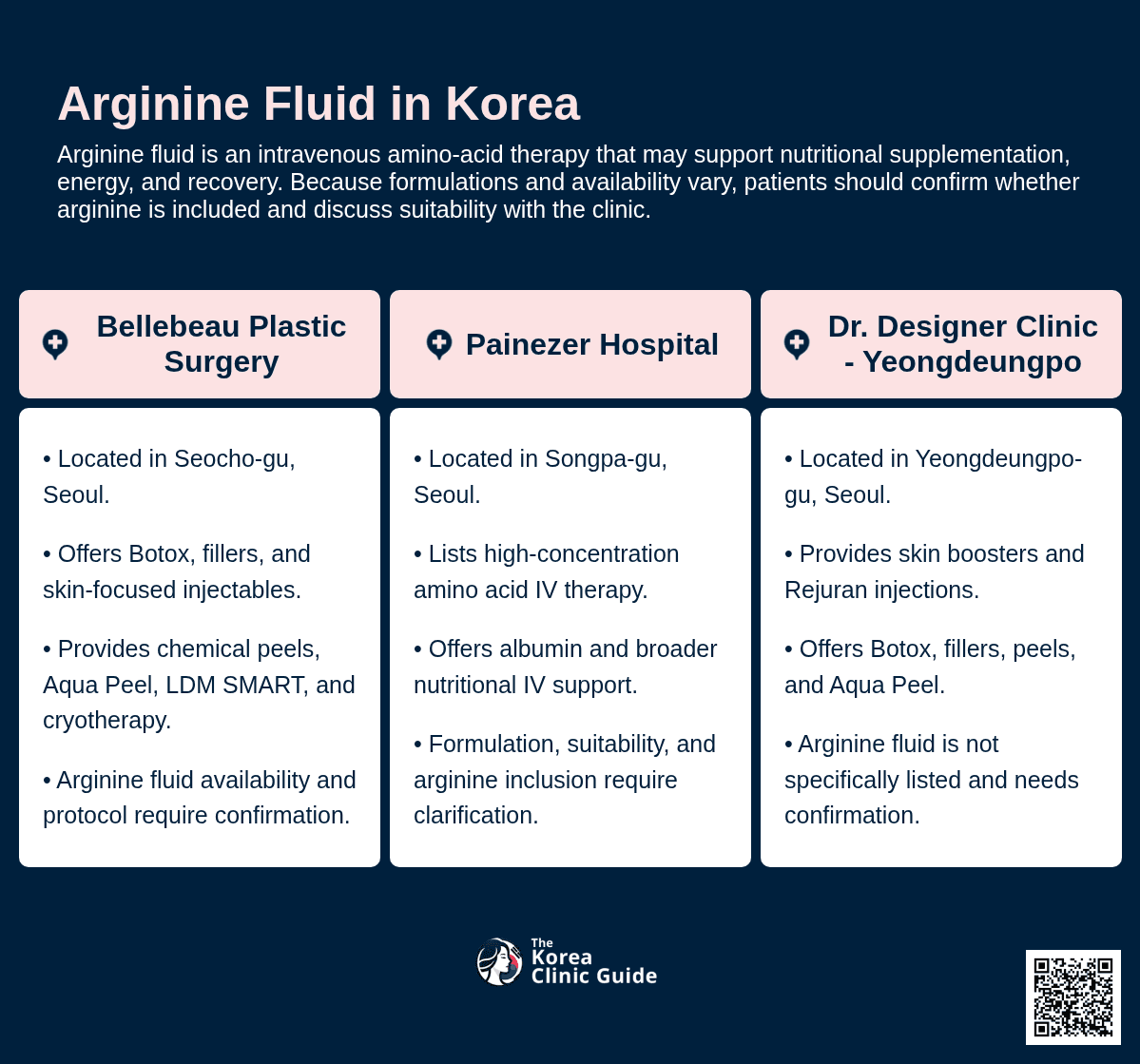
Listed below are some of the best clinics in Korea for arginine fluid.
1. Bellebeau Plastic Surgery
You may consider Bellebeau Plastic Surgery if you are seeking an aesthetic clinic with an established menu of injectable and skin-focused treatments; however, the available information does not specifically identify an arginine fluid infusion or describe its protocol.
- URL: Bellebeau Plastic Surgery Website
- Location: Seocho-gu, Seoul
- Injectable and skin options:
- Related aesthetic services:
- Ultherapy, Shrinc HIFU, and Air Jet are listed for lifting and tightening.
- Pico Plus, Excel V, Clarity Pro, and Apogee Plus are among the clinic’s laser treatment options.
2. Painezer hospital
You may consider Painezer Hospital for an arginine-fluid discussion because it offers high-concentration amino acid IV therapy within a broader nutrition-infusion menu, alongside non-surgical rehabilitation and image-guided musculoskeletal care. The available information does not confirm whether arginine is included in a particular infusion, so your suitability and formulation would need to be clarified with the clinic.
- URL: Painezer hospital Website
- Location: #502,#503, 5th Floor, Parkrio A complex, Olympicro 37 gil 130, Sonngpa-gu, Seoul, Korea
- Infusion support:
- High-dose amino acid IV therapy is listed as concentrated nutritional supplementation intended to support energy and recovery.
- Other clinical nutrition options include albumin infusion and a TPN-style nutrition IV containing amino acids, calories, fatty acids, and omega-3s.
- Thymosin Alpha-1 and placenta extract injections are also listed in the clinic’s immune-support section.
- Non-surgical musculoskeletal care:
- Image-guided options include selective nerve root blocks and epidural adhesiolysis for selected spine-pain patterns.
- Prolotherapy, PDRN regenerative injections, collagen injections, steroid injections, and knee joint injections are listed among injection options.
- Rehabilitation services include manual therapy, therapeutic exercise, Schroth-method exercises, and focused shockwave therapy.
3. Dr. Designer Clinic - Yeongdeungpo
You may consider Dr. Designer Clinic - Yeongdeungpo if your goals around an arginine-fluid inquiry are connected with skin hydration or rejuvenation, as it offers skin boosters and Rejuran among its injectable aesthetic services. The available information does not specifically list an arginine fluid infusion or provide a related treatment protocol.
- URL: Dr. Designer Clinic - Yeongdeungpo Website
- Location: Yeongdeungpo-gu, Seoul
- Injectable skin rejuvenation:
- Skin boosters are listed as injectable treatments intended to deeply hydrate skin and improve texture, elasticity, and radiance.
- Rejuran is listed as a polynucleotide-based injectable intended to support skin healing, collagen production, elasticity, texture, and hydration.
- Botox and fillers are also available for facial lines and volume restoration.
- Complementary skin treatments:
- Aqua Peel and chemical peeling are offered for cleansing, exfoliation, hydration, texture, pigmentation, and acne-related concerns.
- Pico Toning, Blue Toning, and Dual Toning are listed for pigmentation, uneven tone, acne, redness, and skin-texture concerns.
Arginine Fluid From Start to Finish
- Pre-booking consultation — Request an English-language or virtual consultation where available. Ask for the full formula, dose, diluent, infusion rate and duration, intended indication, prescriber credentials, product source, monitoring plan, emergency plan, and realistic evidence limitations.
- Medical screening — Provide a complete list of prescription medicines, over-the-counter drugs, herbal products, exercise supplements, L-citrulline, nitric-oxide boosters, L-arginine tablets, and allergies. Disclose cardiovascular, kidney, liver, respiratory, metabolic, and pregnancy-related history.
- Travel planning — Schedule the infusion early enough to permit observation and an overnight local stay when indicated. Keep flights flexible rather than treating the drip as an airport-day appointment.
- Arrival assessment — The clinician reviews the plan, checks baseline vital signs, confirms consent, and determines whether renal function, electrolytes, glucose, pregnancy testing, ECG, or other testing is needed from the medical history and planned regimen.
- IV placement and infusion — A peripheral IV cannula is inserted, then the disclosed arginine-containing fluid is infused at a controlled rate. Tell staff immediately about pain, burning, swelling, blanching, redness, leakage, itching, hives, chest symptoms, shortness of breath, nausea, dizziness, or palpitations.
- Monitoring and discharge — Remain in the facility until the infusion is complete and symptoms and vital signs are satisfactory. Before leaving, receive the treatment record, IV-site instructions, emergency warning signs, and a contact method.
- Local recovery — Rest, hydrate normally, and avoid alcohol, driving, strenuous exercise, and long-distance travel for the remainder of the day if there is any dizziness or malaise.
- Overseas follow-up — Contact the clinic promptly for worsening IV-site symptoms or new systemic symptoms. Seek urgent local care for severe reactions rather than waiting for remote messaging.
Alternatives to Arginine Fluid
For non-specific fatigue, wellness, body-composition, or appearance goals, finding and treating the cause is more clinically useful than an unvalidated arginine drip. Non-surgical IV and injection services avoid an infusion of arginine but are not established substitutes for diagnosis or treatment of disease; they carry their own formulation and injection risks.
Medical evaluation
- Best for — Persistent fatigue, fainting, breathlessness, weight change, edema, sleep problems, mood symptoms, or reduced exercise tolerance.
- Tradeoff — Takes more time than a wellness appointment, but can identify anemia, endocrine disease, diabetes, sleep disorders, nutritional deficiency, depression, or cardiovascular illness that should not be masked by an elective drip.
Beauty IV Therapy
- What it changes — A broader wellness-IV service rather than an arginine-specific regimen.
- Tradeoff — Different ingredients do not establish a durable cosmetic or energy benefit, and exact ingredients, dose, interactions, and emergency planning remain essential. See Beauty IV Therapy.
Vitamin Injection
- What it changes — Delivers selected vitamins by injection rather than an arginine-containing infusion.
- Tradeoff — Less time attached to an IV, but an injection is not a proven treatment for unexplained fatigue or general wellness without a documented deficiency or medical indication. See Vitamin Injection.
Diet IV Therapy
- What it changes — Markets IV-based support around weight-management goals.
- Tradeoff — It does not replace evidence-based assessment of diet, medications, endocrine conditions, or metabolic disease and should not be represented as a proven weight-loss treatment. See Diet IV Therapy.
How Can I Prepare for Arginine Fluid?
- Get the formula first — Before paying or travelling, obtain the exact ingredients, concentration, total dose, diluent, route, infusion rate, and product source. Decline treatment when the clinic cannot provide these details.
- Disclose medicines and supplements — Bring a written list of antihypertensives, nitrates, phosphodiesterase-5 inhibitors, diabetes medicines, anticoagulants, antiplatelets, potassium-sparing diuretics, L-arginine, L-citrulline, nitric-oxide boosters, herbal products, and exercise supplements. Do not independently stop prescribed medicines.
- Report relevant conditions — Declare low blood pressure, heart disease, previous myocardial infarction, kidney or liver disease, electrolyte problems, diabetes, asthma, severe allergies, recurrent herpes infection, urinary retention, pregnancy, and breastfeeding.
- Eat and drink normally — Fasting is not inherently required for an arginine-only infusion unless the treating clinician gives a condition-specific instruction. Arrive normally hydrated; do not arrive dehydrated, intoxicated, or immediately after strenuous exercise.
- Avoid alcohol — Do not drink alcohol on treatment day. Alcohol can worsen dehydration and light-headedness.
- Plan transport — Use a taxi, public transport with support, or a companion after a first treatment or whenever low blood pressure, fainting history, sedating medication, or a long return journey is relevant. Do not plan to drive if dizzy or unwell.
- Keep travel flexible — Do not book same-day departure. Arrange a local overnight stay when this is a first, high-dose, or multi-ingredient infusion or when medical history increases risk.
Travel note: No sun avoidance, compression garment, special accommodation, or routine companion is inherently required for an arginine-only drip. The main travel issue is monitoring for blood-pressure-related symptoms and IV complications.
Confirm the treating doctor’s individualized fasting, testing, medicine, transport, and travel requirements; they take precedence over general guidance.
Aftercare Advice
Treat new systemic symptoms or a worsening IV site as a medical issue, not as a normal “detox” response.
- Observe before leaving — Remain at the facility until the infusion has ended and staff confirm satisfactory symptoms and vital signs. Keep the clinic’s bilingual record and post-discharge contact details.
- Keep activity light — Rest for the remainder of the day. Do not drive, exercise strenuously, drink alcohol, or fly while dizzy, faint, nauseated, short of breath, or unwell.
- Protect the IV site — Keep the site clean and avoid friction or heavy use of that limb for the rest of the day. Contact the clinic promptly for increasing pain, warmth, swelling, redness, blistering, discoloration, drainage, numbness, or a firm painful cord.
- Know urgent warning signs — Seek urgent medical care for breathing difficulty, facial or throat swelling, widespread hives, fainting, chest pain, palpitations, severe or persistent dizziness, confusion, markedly reduced urine output, or severe weakness.
- Do not chase a “final result” — There is no evidence-based skincare regimen, durable cosmetic endpoint, or validated repeat-session interval for Arginine Fluid. Do not interpret absent benefit as a reason to increase dose or book a series without clinical reassessment.
Follow the treating doctor’s instructions over general advice, and contact the clinic or urgent local medical services when anything appears wrong.
Frequently Asked Questions
Related Blogs
Filler Dissolver in Korea: Hyaluronic Acid Reversal, Recovery, Risks, and Travel Planning
Hyaluronic acid filler dissolution uses targeted hyaluronidase injections, with ultrasound assessment when filler is old, migrated, deep, periocular, or uncertain. International patients can plan consultation, outpatient treatment, a review at about 48 hours, written treatment records, and remote follow-up; urgent pain, skin-color changes, visual symptoms, or neurological symptoms require immediat
Updated: Sep 28, 2026

Collagen Filler in Korea: Products, Safety, Recovery, and Travel Planning
Collagen filler treatment involves confirming the exact product, medical screening, possible allergy testing, outpatient injection, and follow-up planning. International patients should stay in Korea for 2–3 days, expect bruising or swelling for up to 1–2 weeks, and obtain emergency contacts and complete product records.
Updated: Sep 27, 2026
Ultracol in Korea: Candidates, Safety, Recovery, and Travel Planning
Ultracol is a PDO microsphere injectable intended in Korea for temporary improvement of bilateral nasolabial folds, delivered after eligibility review and product-label verification. The article covers candidate screening, outpatient treatment and recovery, travel planning, aftercare, warning signs, follow-up, and alternatives.
Updated: Sep 27, 2026

Korean Arginine Fluid Optimization: See How Costs Stack Up Against Germany, China, and More Countries
Explore the cost dynamics of Arginine Fluid in Korea, examining factors influencing its pricing and availability. Discover how economic and healthcare trends impact the accessibility of this essential amino acid supplement.
Updated: Sep 27, 2026
Clinics offering Arginine Fluid

REPIC Clinic Korea: Personalized Aesthetic Treatments with 3D Facial Analysis Near Gangnam Station
Gangnam Station

Pladen Plastic Surgery: Cutting-Edge Cosmetic and Reconstructive Procedures in Korea
Sinsa

Painezer hospital Korea: Procedures, Specialties & Patient Guide
Jamsil

Sinsoe Women's Clinic in Korea: Specialized Women's Health, Plastic Surgery, and Skin Care Services in Gangnam Station
Gangnam Station