
Medical Tourism Blog
Ear Filler in Korea: Candidacy, Safety, Recovery and Travel Planning
Table of contents
- Ear Filler at a Glance
- What Is Ear Filler?
- Who Is a Good Candidate for Ear Filler?
- How Is Ear Filler Performed?
- Why Visit Korea for Ear Filler?
- Key Information for International Patients
- Which Are the Best Clinics in Korea for Ear Filler?
- Ear Filler From Start to Finish
- Alternatives to Ear Filler
- How Can I Prepare for Ear Filler?
- Aftercare Advice
Considering treatment in Korea? Everything you need to know e.g. — how to avoid scams, visas, interpreters, recovery tips — in our Medical Tourism Master Guide. Plan with confidence in minutes, not weeks!
Last updated: September 2026
Ear Filler at a Glance
- What it treats — Ear filler usually means small-volume hyaluronic acid injections into the soft earlobe to restore modest fullness, smooth creasing, improve mild asymmetry, or cushion an intact widened piercing for light earrings.
- Best candidates — Adults with deflated, thin, creased, or mildly asymmetric earlobes are the best-described candidates; a torn, bifid, markedly stretched, or elongated lobe usually needs surgical repair rather than filler.
- Results and longevity — Volume is visible immediately, but the contour should be judged after swelling settles in about 1–2 weeks. A small 19-patient earlobe study reported effects lasting 6–9 months, so repeat treatment is individualized rather than scheduled at a fixed interval.
- Recovery — There is usually no routine downtime, although redness, tenderness, swelling, or bruising can be noticeable for several days and may take 1–2 weeks to fully resolve; avoid pressure on the ear and heavy earrings until cleared.
- Travel planning — International patients should plan 2–3 days in Korea when possible, allowing treatment on day 1 and an optional review 24–72 hours later; stay locally reachable for at least 24 hours because vascular complications require urgent care.
- Key safety issue — Severe or increasing pain, blanching, gray-blue or net-like discoloration, coolness, numbness, visual changes, or neurologic symptoms require immediate in-person assessment because accidental vascular injection can cause tissue loss, blindness, or stroke.
- Korea-specific decision — No reliable evidence shows ear filler in Korea produces better outcomes than elsewhere; prioritize a licensed injector, exact HA product and lot documentation, clear communication, and immediate access to hyaluronidase and an emergency protocol.
What Is Ear Filler?
Ear filler is a small-volume injectable treatment, usually using hyaluronic acid, to restore fullness in soft earlobes. It addresses deflation, fine creasing, mild asymmetry, or support around an intact widened piercing for a refreshed earlobe appearance. It is a minimally invasive, non-surgical aesthetic procedure.
Who Is a Good Candidate for Ear Filler?
- Deflated or creased earlobes — Good candidates want modest restoration of earlobe fullness, smoother fine creasing, or improved symmetry after age-related volume loss.
- Intact widened piercing — Conservative hyaluronic acid (HA) filler can add cushioning around an enlarged but unbroken earring hole and improve support for light earrings.
- Temporary correction — HA suits adults who accept an immediately visible but non-permanent result; the small published earlobe series reported effects lasting 6–9 months.
- Realistic anatomical goals — The best-described indication is the soft earlobe, not a major change to ear position, cartilage shape, or a structurally damaged lobe.
Do not proceed with active dermatitis, a rash, open wound, infected piercing, or skin infection near the injection area; defer treatment until it is managed. Pregnancy and breastfeeding are reasons to postpone elective filler because safety is unknown, while bleeding disorders, anticoagulant or antiplatelet medicines, severe allergy or anaphylaxis history, immunosuppression, poorly controlled diabetes, and previous serious filler reactions require individualized medical assessment. A torn, bifid, markedly elongated, or heavily stretched earlobe generally needs ear plastic surgery, not filler alone. Adults are the appropriate population for elective earlobe rejuvenation; assessment must distinguish simple volume loss from excess skin, a true split, or a scar-prone piercing problem. The FDA also advises choosing a licensed clinician trained in filler injection and the risks of the specific site.
How Is Ear Filler Performed?
“Ear filler” should mean a specific anatomical treatment. Standard earlobe volume restoration is different from injection into the upper ear, where anatomy and reported risks are substantially different.
- Standard earlobe HA volumization — A clinician places small amounts of cross-linked HA into the soft, non-cartilaginous lobe with a needle or cannula after antiseptic preparation. In a 19-patient series, treatment used 0.3–0.5 mL per ear, but this is not a universal volume target or a guarantee of duration.
- Piercing-support augmentation — HA is placed around an intact widened piercing to improve soft-tissue cushioning and the position of light earrings. It does not close a partially or fully split piercing tract.
- Dual-plane HA with superficial skin booster — A 2025 uncontrolled series used deeper cross-linked HA via a 22G cannula with superficial low-viscosity HA. At 3 months, hydration and patient satisfaction improved, but the 30-woman, short-term study does not establish superiority over conventional earlobe filler.
- Upper-auricle contouring — Helix, triangular-fossa, and antihelical injections for selected concerns such as a “lying ear” are distinct procedures, not routine earlobe filler. Published auricular HA cases include ophthalmic artery embolization, permanent visual loss, and hearing impairment after non-lobule injections; discuss this higher-complexity treatment separately.
Why Visit Korea for Ear Filler?
No credible comparative evidence shows that ear filler in South Korea delivers safer or better results than treatment elsewhere. Choose a Korean provider for verifiable clinician qualifications, clear consent, authentic product traceability, and a workable urgent-care plan—not assumptions about national superiority. For this small-area injectable procedure, communication and access to review during the first days matter more than a destination claim.
- International-care infrastructure — Korea operates a government-supported medical-tourism framework that includes registered international medical institutions and visitor-facing medical information through Medical Korea.
- Product-specific consent — Ask for the exact HA brand, formulation, total volume per ear, injection sites, and batch or lot number. Earlobe filler is off-label in the United States; Korean authorization and labeling can differ and must be confirmed with the treating facility.
- Emergency readiness — For HA treatment, confirm that the clinician has an immediate vascular-compromise protocol and hyaluronidase available. HA can be dissolved in some circumstances, but reversibility is not guaranteed and does not make vascular injury harmless.
- Evidence limitation — Earlobe evidence remains small: the main earlier study involved 19 patients, and a newer dual-plane series involved 30 women with only 3 months of follow-up. These studies do not identify an optimal product, volume, injection device, or maintenance interval.
Key Information for International Patients
- Minimum stay — Plan 2–3 days when practical: in-person assessment and treatment on day 1, with an optional review 24–72 hours later.
- Flying after treatment — No earlobe-specific study defines a mandatory no-fly interval. Remain locally reachable for at least 24 hours, preferably 48–72 hours, because vascular compromise needs urgent treatment.
- Itinerary impact — There is no routine downtime, but redness, tenderness, swelling, or bruising can be visible for several days and can take 1–2 weeks to settle completely. Avoid scheduling important photographs, events, or heavy-earring use immediately after treatment.
- Activity and pressure — Do not plan sauna visits, intense exercise, swimming, contact sport, tight headphones, or prolonged pressure on the ears until the treating clinician clears them. There is no validated earlobe-specific return-to-activity schedule.
- Remote follow-up — Arrange a photo check-in and obtain an emergency contact that works outside clinic hours. Before departure, request a written record of the clinician, facility, product, formulation, volume per ear, injection sites, lot number, and complication pathway.
Travel note: Do not board a flight with escalating pain, white, gray, blue, dusky, or net-like discoloration, unusual coolness, numbness, rapidly worsening swelling, visual symptoms, weakness, dizziness, or speech difficulty. Contact the clinic and seek urgent in-person care immediately.
Which Are the Best Clinics in Korea for Ear Filler?
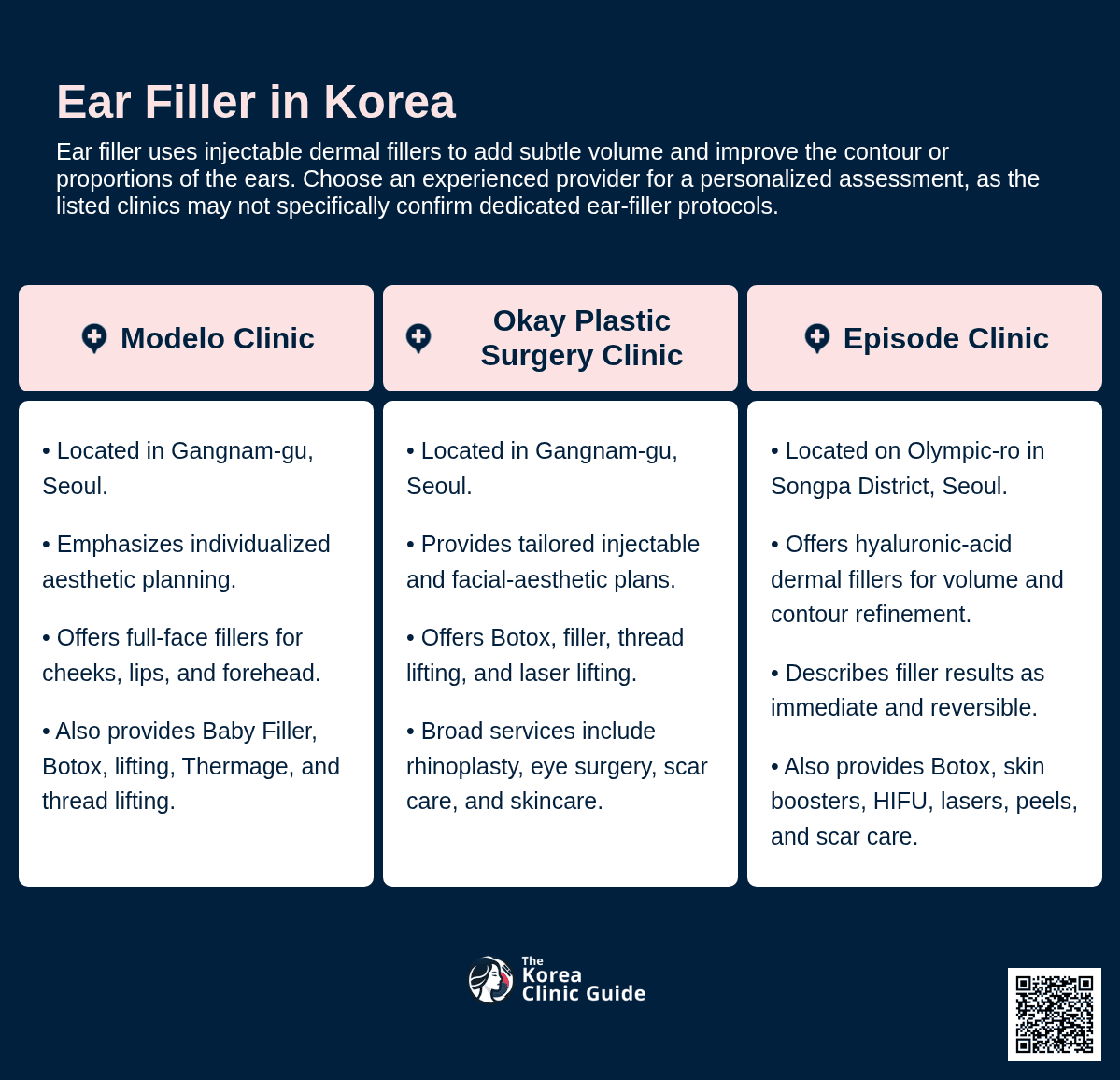
Listed below are some of the best clinics in Korea for ear filler.
1. Modelo clinic
You may consider Modelo Clinic for ear filler if you want a clinic whose stated approach emphasizes individualized aesthetics and filler-based volume enhancement rather than following a uniform look. Its filler services include full-face treatment for areas such as the cheeks, lips, and forehead, although the provided information does not specifically confirm ear-filler techniques or products.
- URL: Modelo clinic Website
- Location: Gangnam-gu, Seoul
- Injectable focus:
- Offers full-face filler for volume enhancement in the cheeks, lips, and forehead.
- Also lists under-eye “Baby Filler” for hollows and dark-circle concerns.
- Provides wrinkle Botox and contour Botox alongside filler services.
- Additional aesthetic services:
- Lists lifting treatments, Comfort Thermage radiofrequency treatment, and thread lifting.
- Offers pigmentation-focused whitening treatments using lasers and combination approaches.
2. Okay Plastic Surgery Clinic
You may consider Okay Plastic Surgery Clinic for ear filler if you value an individualized injectable plan within a clinic that also provides broad facial aesthetic and plastic-surgery services. The clinic lists Botox and filler among its petit/skincare options and describes its care as tailored to your needs, but the supplied information does not confirm a dedicated ear-filler protocol.
- URL: Okay Plastic Surgery Clinic Website
- Location: Gangnam-gu, Seoul
- Injectable and facial-aesthetic options:
- Lists Botox and filler for wrinkles, volume loss, and facial contouring.
- Provides thread lifting and laser lifting alongside surgical face-lift, mini-lift, and endoscopic forehead-lift options.
- Offers rhinoplasty services, including nose tip, bridge, nostril-reduction, and revision procedures.
- Clinical scope:
- The clinic describes care as individualized and delivered by specialized professionals, including a female plastic surgeon with extensive experience.
- Also provides eye plastic surgery, scar and keloid services, pigmentation care, and medical skincare.
3. Episode Clinic
You may consider Episode Clinic for ear filler if you are looking for a non-surgical aesthetic dermatology setting with hyaluronic-acid dermal fillers among its core injectable services. The clinic describes fillers as providing immediate, reversible volume restoration and contour refinement when placed precisely, though the supplied information does not specifically state that ear filler is offered.
- URL: Episode Clinic Website
- Location: 3f, 336 Olympic-ro, Songpa District, Seoul, South Korea
- Filler details:
- Lists hyaluronic-acid dermal fillers for restoring volume, enhancing contours, and smoothing static wrinkles.
- Describes filler results as immediate and reversible.
- Lists cheeks, lips, and nasolabial folds as example treatment areas; ear treatment is not specifically confirmed.
- Related non-surgical treatments:
- Offers Botox, skin-booster injections, deoxycholic-acid treatment for submental fat, HIFU, and thread lifting.
- Provides laser and light treatments, including pico laser, fractional laser resurfacing, laser toning, IPL, and laser hair removal.
- Skin and scar care:
- Lists chemical peels, microneedling, HydraFacial, and PRP for skin rejuvenation.
- Provides acne injections, acne extraction and medical facials, plus subcision for depressed acne scars.
Ear Filler From Start to Finish
- Remote screening — Send clear front and back photographs of both ears, describe whether the concern is deflation, creasing, asymmetry, or a widened piercing, and disclose previous filler, surgery, piercing complications, keloid history, allergies, medicines, and departure date. English-language or virtual consultation can screen suitability but cannot replace examination.
- In-person assessment and consent — The clinician examines both ears, confirms that filler rather than repair surgery fits the anatomy, reviews the exact product and its expected temporary effect, and discusses risks including infection, nodules, asymmetry, vascular occlusion, skin necrosis, visual injury, and stroke.
- Treatment planning — Agree on conservative volume, injection points, and whether the goal is lobe restoration or support around an intact piercing. Confirm the availability of hyaluronidase if HA is used and ask how urgent complications are managed.
- Preparation in clinic — The ears are photographed, cleansed, and marked. Topical anesthetic or local anesthetic can be used; uncomplicated earlobe HA filler normally does not require fasting, general anesthesia, routine blood tests, imaging, or hospital admission.
- Injection — The clinician injects small HA aliquots into the planned soft-tissue plane using a needle or cannula, reassessing contour, symmetry, and skin perfusion as treatment proceeds. The injection itself is generally brief, while consultation and observation extend the visit.
- Immediate review and discharge — The clinician checks for blanching, abnormal pain, impaired perfusion, and excessive swelling before discharge. Volume is visible immediately, but early swelling can distort the result.
- Local recovery review — Keep contact with the clinic for the first 24–72 hours and attend the optional review before international departure when possible. Mild bruising, redness, tenderness, and swelling are common short-term effects.
- Overseas follow-up — Send agreed photographs after swelling settles, typically around 1–2 weeks. Discuss repeat treatment only after the result is stable and gradual volume loss is evident; do not follow a fixed maintenance schedule without reassessment.
Alternatives to Ear Filler
The right alternative depends on whether the issue is missing volume, an enlarged but intact piercing, a true structural tear, excess tissue, or upper-ear position. Filler offers temporary, incision-free volume restoration; surgery treats structural defects more directly but involves wounds, scars, and longer healing.
Earlobe Repair or Reduction Surgery
- Best for — Split or torn piercing tracts, bifid lobes, marked elongation, and substantial excess skin.
- Tradeoff — Repair directly reconstructs the lobe but requires incision care and carries scar risk. Ear plastic surgery is generally more anatomically appropriate than filler for these problems.
Autologous Fat Grafting
- Best for — People seeking volume restoration with their own tissue rather than HA.
- Tradeoff — Face fat grafting principles apply: fat must be harvested and transferred, making treatment more invasive, while long-term volume retention is less predictable than an immediate HA result.
Hyaluronidase for Existing HA Filler
- Best for — Medically indicated reversal or an unsatisfactory result from HA filler.
- Tradeoff — Filler dissolver treatment does not dissolve non-HA materials and requires separate assessment, consent, and allergy-risk review. It is an important component of an HA vascular-occlusion response.
Otoplasty for Ear Position or Cartilage Shape
- Best for — Prominent ears, a lying ear requiring structural correction, or cartilage-shape concerns.
- Tradeoff — Otoplasty changes ear structure surgically; it is not a substitute for restoring a deflated earlobe, but it can be more suitable than upper-ear filler for positional concerns.
How Can I Prepare for Ear Filler?
- Disclose all medical details — Provide a complete list of medicines, supplements, allergies, previous filler, prior ear surgery, piercing problems, keloid history, bleeding disorders, immune conditions, diabetes, and past delayed filler reactions.
- Antithrombotic medicines — Do not independently stop warfarin, apixaban, rivaroxaban, clopidogrel, aspirin, or another prescribed anticoagulant or antiplatelet medicine. The prescribing clinician and injector must assess bruising and bleeding risk together.
- Non-prescription products — Ask the injector whether to pause non-essential products associated with bruising, such as fish oil, vitamin E, ginkgo, garlic supplements, NSAIDs, or high-dose omega-3 supplements. Follow only the clinic’s individualized timeframe.
- Skin and piercing check — Arrive without sunburn, rash, dermatitis flare, open skin, an infected piercing, or ear-area injury. Defer filler until infection or inflammation is fully managed.
- Fasting and alcohol — Do not fast unless instructed. Simple earlobe filler usually uses topical or local anesthetic only. Avoid alcohol according to the clinic’s advice, particularly when bruising is a concern.
- Travel arrangements — Book accommodation within practical reach of the clinic for 24–72 hours, keep the first days flexible, and avoid a same-day international departure.
- Product documentation — Before injection, confirm the product name, whether it contains lidocaine, planned volume, and the clinic’s emergency protocol. Never use direct-to-consumer filler, self-injection, needle-free devices, or injectable silicone for aesthetic ear augmentation.
Travel note: Bring travel insurance details, keep the clinic’s urgent phone number available without internet access, and identify a nearby emergency facility before treatment.
The treating doctor’s individualized instructions take precedence over general guidance. Confirm the clinic’s exact medicine, alcohol, exercise, earring, and flight requirements before treatment.
Aftercare Advice
Protect the injected ear from pressure, contamination, traction, and delayed recognition of a vascular complication during the first days after treatment.
- Hands and contact items — Keep hands, phones, headphones, hair products, and pillowcases clean. Do not rub, squeeze, massage, or repeatedly inspect the treated lobe unless the injector specifically instructs otherwise.
- Swelling and sleep — Use a cloth-wrapped cool compress only if advised; never apply ice directly to the skin. Avoid sleeping directly on the ears and sleep on the back with slight head elevation while swelling is present.
- Earrings and pressure — Delay tight, heavy, or dangling earrings until tenderness and swelling resolve and the injector approves. Avoid tight headphones, helmets, and any prolonged compression of the treated ear.
- Heat, exercise, and alcohol — Follow the clinic’s site- and product-specific restrictions for strenuous exercise, sauna, hot baths, alcohol, and swimming. No validated earlobe-specific timetable defines safe resumption.
- Result timing — Volume is visible immediately. Judge the settled contour at about 1–2 weeks, after swelling and bruising resolve; the limited older earlobe HA series reported 6–9 months of effect.
- Urgent warning signs — Seek immediate assessment for severe or increasing pain, blanching, gray, blue, dusky, or net-like discoloration, coolness, numbness, rapidly worsening swelling, spreading redness, pus, fever, visual change, dizziness, weakness, or speech difficulty. Inadvertent intravascular filler injection can cause skin necrosis, blindness, or stroke.
Follow the treating doctor’s instructions over general advice, and contact the clinic promptly whenever the ear looks or feels wrong.
Frequently Asked Questions
Related Blogs
Effective Brow Ptosis Support with Forehead Filler Procedures in Korea for Youthful Eyes
Discover how Korea leads in non-surgical solutions for brow ptosis, featuring forehead fillers like Hyaluronic Acid, Radiesse, and Sculptra. Learn about the forehead filler procedure in Korea, its benefits for brow support, costs, and patient experiences. Ideal for those seeking a minimally invasive way to lift drooping eyebrows and heavy lids, Korea’s expert clinics combine advanced techniques wi
Updated: Nov 3, 2026
Erase Horizontal Forehead Lines with Forehead Filler: Advanced Treatments in Korea
Discover how Korea leads in treating horizontal forehead lines with advanced dermal fillers and Botox. This article explores the causes of static wrinkles, treatment options like hyaluronic acid, CaHA, and PLLA fillers, and the importance of expert practitioners in Korea’s top clinics. Learn about the procedure steps, safety considerations, and how Korea’s affordable, high-quality medical tourism
Updated: Oct 11, 2026
Bony Hands Solutions: Hand Filler Procedures in Korea for Fuller, Youthful-Looking Hands
Discover effective solutions for "bony hands" and veiny hand aging with Korea’s leading hand filler procedures. From hyaluronic acid fillers like Restylane to biostimulatory options such as Radiesse and Sculptra, Korea offers expert treatments to restore youthful volume. Enjoy short, minimally invasive treatments with immediate results, performed by certified Korean surgeons in a patient-focused m
Updated: Oct 10, 2026
Neck Wrinkles Solutions: Neck Filler Procedures in Korea for Smoother, Youthful Skin
Discover how Korea leads in neck wrinkle treatments with advanced Neck Filler procedures like hyaluronic acid, calcium hydroxylapatite, and poly-L-lactic acid. This comprehensive guide explores causes of neck aging, treatment techniques, costs, and patient experiences in Korea—a preferred medical tourism destination. Learn about Korea’s expert injectors, affordable pricing, and all-inclusive packa
Updated: Oct 8, 2026
Clinics offering Ear Filler

Okay Plastic Surgery Clinic in Korea: Comprehensive Aesthetic Procedures with Sincerity and Care
Cheongdam
BLS Main Branch Korea (Cheongdam) – Signature Lifting, Skin Analysis & Event Facial Programs
Cheongdam

Smile Dermatology Clinic in Korea: Personalized Skin Care, Anti-Aging Treatments, and Scar Solutions

Luho Plastic Surgery in Korea: Top-Quality Cosmetic Procedures for Eyes, Nose and Facial Rejuvenation in Seoul
Sinsa