
Medical Tourism Blog
Short Chin Solutions: Chin Implant Procedures in Korea for Enhanced Facial Contours
Table of contents
- The South Korean Medical Tourism Experience: A Step-by-Step Guide
- The Chin Implant Procedure: A Clinical and Technical Overview
- Which Are the Best Clinics in Korea for Short Chin?
- Cost Analysis and Value Proposition for the Medical Tourist
- Patient Experiences and Outcomes: The Emotional and Physical Journey
- Conclusion
- References
Considering treatment in Korea? Everything you need to know e.g. — how to avoid scams, visas, interpreters, recovery tips — in our Medical Tourism Master Guide. Plan with confidence in minutes, not weeks!
When people talk about having a "short chin," "weak chin," or "receding chin," they're usually describing a cosmetic concern. Clinically, these same issues are categorized with precise terms. Micrognathia is a congenital condition where the lower jaw is smaller than usual. While some cases resolve naturally as children grow, a significantly small jaw can cause feeding challenges and future tooth alignment issues. Retrognathia refers to a receding chin where the lower jaw is set farther back than ideal, potentially contributing to temporomandibular joint (TMJ) disorders or obstructive sleep apnea. Microgenia describes a chin that's simply too small for the rest of the face. Understanding these distinctions is essential because what might be seen as just a cosmetic issue could actually involve deeper anatomical or health-related factors. That’s why a thorough consultation with a qualified medical professional is important when determining next steps.
Etiology of Chin Deficiency: The Interplay of Genetics and Environment
Chin shape is determined by more than just your DNA. Genetics lay the foundation, often following family patterns, but environment and lifestyle can dramatically influence how prominent your chin appears. Aging naturally reduces bone mass, soft tissue, and collagen in the lower face, which can cause the chin to lose definition. Habits formed during childhood, like frequent thumb-sucking, can subtly alter jaw formation and reduce chin projection. Dental issues such as an overbite may set the lower jaw back, weakening the chin’s appearance. Even the texture of foods you ate growing up—softer diets versus tougher, chew-heavy foods—can make a difference. The chin, therefore, reflects a blend of genetic inheritance and life experience, making each case unique.
The South Korean Medical Tourism Experience: A Step-by-Step Guide
The Lure of Seoul: A Hub of Innovation and Convenience
South Korea’s reputation as the "plastic surgery capital of the world" is well-earned due to its skilled surgeons and advanced technology. The widespread popularity of the "K-face" look makes it a hot spot for patients seeking balanced and harmonious facial surgery. The infrastructure is tailored to international clients, with all-inclusive packages, language assistance, airport pickups, and thorough aftercare—making it a comfortable choice for medical travelers.
A Step-by-Step Guide for the Medical Tourist
Here’s how most chin augmentation journeys unfold for international patients in South Korea:
- Research and Consultation: Patients start with online research and then set up a free consultation, often featuring 3D imaging to preview outcomes and discuss expectations.
- Pre-Trip Preparation: Once patients commit, they gather documents (proof of income, insurance, etc.) and follow pre-surgery instructions (diet changes, no alcohol or smoking).
- Arrival and Pre-Operative Examinations: Upon arrival, a representative helps with logistics and medical exams (blood tests, chest X-rays).
- The Procedure and Immediate Aftercare: Surgery is performed, with clinics providing comfort-focused post-op care, including IV painkillers and daily check-ins.
- Recovery and Follow-Up: Patients generally stay several weeks near the clinic for ongoing check-ups and swift access to medical support.
Key Considerations for International Patients
While South Korea’s system is highly efficient, caution is necessary. Don't rely solely on online reviews—clinics and surgeons should be vetted for global accreditation and board certification by the Korea Health Industry Development Institute (KHIDI). Language, while less of a barrier than in the past, still requires attention; confirm your clinic offers dedicated international coordinators and interpreting services. Most importantly, allow adequate time to stay in-country for recovery, so that any complications can be quickly addressed.
The Chin Implant Procedure: A Clinical and Technical Overview

Surgical Techniques: A Fundamental Divide in Surgical Philosophy
Choosing chin augmentation means selecting between two main procedures: chin implant surgery and osseous genioplasty. Chin implant surgery places a biocompatible implant over the existing bone—a popular, less invasive option with a quicker recovery and the possibility for removal if the patient is unhappy. Conversely, osseous genioplasty involves cutting and repositioning the patient’s own chin bone, offering stable, permanent results and often preferred by surgeons deeply trained in craniofacial surgery. Since both approaches have distinct advantages and drawbacks, it’s crucial to seek a board-certified surgeon experienced with both.
A Comparative Analysis of Chin Implant Materials
Chin implants typically rely on two materials: solid silicone and porous polyethylene. Silicone is flexible, biocompatible, low in infection risk, and easy to remove. But because it doesn't integrate into surrounding tissue, it must be secured in place and carries long-term risks like bone erosion or unwanted bone growth due to pressure. Porous polyethylene allows bone and tissues to grow into it, making the implant stable and resistant to shifting. However, it’s harder to remove and may trap bacteria, resulting in persistent infection. Other materials like Polytetrafluoroethylene (Teflon/Gore-Tex) and Acellular Dermal Matrix (donor tissue) see niche use, each with their specific benefits and trade-offs.
| Material | Pros | Cons |
|---|---|---|
| Silicone | Easily shaped, low infection, removable | Can shift, may cause bone changes |
| Porous Polyethylene | Highly stable, integrates with tissue | Infection risk, difficult removal |
| Other Materials | Teflon: soft yet strong; Dermal Matrix: low rejection risk | Teflon: less long-term data; Dermal: donor-based, mostly for reconstruction |
The Step-by-Step Surgical Process: From Consultation to Recovery
Chin augmentation starts with a comprehensive consultation, often using advanced 3D modeling to visualize results, especially in South Korea. On surgery day, patients receive anesthesia, followed by a small incision (either inside the mouth or under the chin). The intraoral approach, common in Korea, avoids visible scars. The implant is inserted, secured, and the incision closed. A typical surgery lasts one to three hours from start to finish.
Post-Operative Care and Recovery
After surgery, expect swelling, mild discomfort, bruising, and temporary chin numbness, most intense during the first few days. Maintaining a soft or liquid diet for a couple of days helps healing. Many patients resume light activity the same day but return fully to work and normal routines after about a week. Most bandages come off within a week, and a neck brace at night may be suggested. While much swelling disappears in six weeks, final results emerge over several months. Most synthetic implants last a lifetime, though those made from bone or fat could be reabsorbed eventually.
Which Are the Best Clinics in Korea for Short Chin?
Listed below are some of the best clinics in Korea for short chin.
1. THEPLUS Plastic Surgery
For a short chin, you can explore chin surgery and facial implants at THEPLUS Plastic Surgery to add projection or adjust chin proportions in relation to your nose, lips, and jawline. The clinic frames facial contouring around harmonious overall balance, with Dr. Kim’s research background in 3D implants particularly relevant when additional facial projection is being considered.
- URL: THEPLUS Plastic Surgery Website
- Location: Gangnam-gu, Seoul
- Procedure details:
- Chin surgery is offered to adjust chin size or projection for improved facial balance.
- Facial implants are available to add structure and definition where more projection is needed.
- Full face contouring, cheekbone surgery, and square jaw surgery are also offered when you are discussing proportions across multiple facial areas.
- Relevant expertise:
- Dr. Kim is a board-certified plastic surgeon with awards for research on 3D implants and a stated focus on rhinoplasty and facial contouring.
- Dr. Kim runs annual educational sessions for other plastic surgeons.

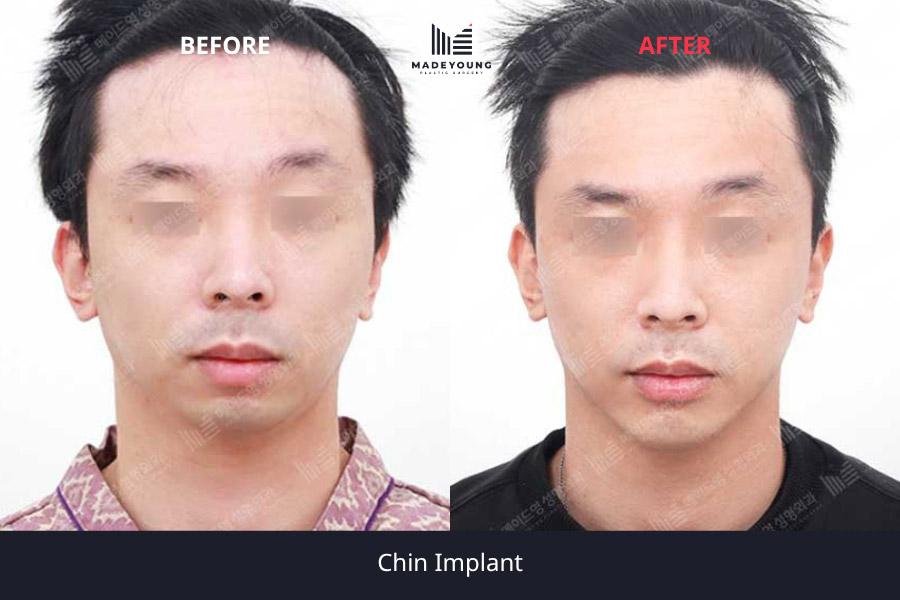
2. Made Young Plastic Surgery
At Made Young Plastic Surgery, you can discuss genioplasty (chin surgery) to enhance or reduce chin size and shape for better facial proportion. Your consultation and diagnosis are conducted directly by the medical team, and the clinic also offers V-line and jaw-contouring options if your short-chin concern is part of a broader lower-face balance assessment.
- URL: Made Young Plastic Surgery Website
- Location: Seocho-gu, Seoul
- Procedure details:
- Chin surgery (genioplasty) is offered to enhance or reduce chin size and shape.
- V-line surgery and jaw reduction surgery are available for lower-face contouring discussions.
- The clinic describes a metal-free V-line technique that does not use metal plates or screws; it states that length reduction, width reduction, and asymmetry correction are possible without screw fixation.
- Safety and aftercare:
- Full-time board-certified anesthesiologists are on site.
- The clinic describes one-to-one anesthesiologist monitoring and a cross-check system involving multiple anesthesiologists in an emergency.
- A dedicated aftercare center provides post-procedure care.
- The clinic states that procedure areas have CCTV coverage.
- Medical team: The clinic states that its doctors average more than 15 years of experience.
3. The Regen Plastic Surgery Clinic
For a short chin, The Regen Plastic Surgery Clinic offers chin surgery that can include augmentation, reduction, or contouring to improve facial proportion. You can also discuss cheekbone reduction or square-jaw reduction when the aim is to assess chin projection within your overall facial contour.
- URL: The Regen Plastic Surgery Clinic Website
- Location: Seocho-gu, Seoul
- Procedure details:
- Chin surgery may involve augmentation, reduction, or contouring based on your facial proportions.
- Zygoma reduction and square-jaw reduction are available facial-contouring procedures that may be considered alongside chin reshaping.
- The clinic also offers nose procedures, which may be relevant when evaluating balance between the chin and facial profile.
Cost Analysis and Value Proposition for the Medical Tourist
The Cost of Chin Implants in South Korea: A Conflicting Picture
Chin implant prices in South Korea range from $3,025 to $7,000 USD, depending on clinic prestige, surgeon experience, clinic location, and the chosen implant material. Some clinics in prime districts like Gangnam may charge more, especially if they offer comprehensive care packages. Patients should always ask for a detailed price breakdown so there are no surprises.
International Cost Comparison: The Total Value Equation
Comparing chin implant costs globally reveals wide variations—not just in price but in what’s included. In South Korea, $3,025 to $7,000 USD often covers consultation, surgery, aftercare, and tax refunds. The same surgery could run from $2,000 to $11,000 USD in the United States, where follow-up costs are usually extra. Turkey and Thailand offer competitive pricing and may bundle in travel and accommodation. Don’t focus just on the upfront price—aftercare and surgeon skill matter most, as a poorly done surgery can result in higher revision expenses and emotional stress down the line.
| Country | Average Price Range | What is Typically Included |
|---|---|---|
| South Korea | $3,025 to $7,000 USD | Includes consultation, aftercare, VAT |
| United States | $2,000 to $11,000 USD | Usually excludes anesthesia/follow-up |
| Turkey | $2,541 to $10,294 USD | Often includes packages with extras |
| Thailand | $3,063 to $4,811 USD | Comprehensive care and accommodations |
Patient Experiences and Outcomes: The Emotional and Physical Journey
The Physical Transformation: Restoring Facial Harmony
Chin augmentation can transform the face, adding definition and balance to the chin and jawline. This often makes features like the nose appear more proportional. Many patients combine chin augmentation with rhinoplasty or facial liposuction for a fully balanced look. Improvements can be noticeable without being obvious to others, often resulting in subtle but powerful enhancements.
The Psychological Impact: Confidence vs. Dysmorphia
The mental benefits are often as significant as the physical ones—many patients report a new sense of confidence and relief from self-consciousness after surgery. However, it’s important to recognize that cosmetic surgery isn't a cure-all for deep-seated psychological issues like Body Dysmorphic Disorder (BDD). Online forums highlight both outstanding satisfaction and ongoing struggles, sometimes intensified by social pressures related to "looksmaxxing." A strong initial mental health assessment should be part of any patient’s journey to ensure expectations are realistic.
Conclusion
Chin augmentation encompasses a complex mix of aesthetic goals, anatomical realities, surgical options, and psychological considerations. The choice between chin implants and osseous genioplasty, as well as implant material, requires careful consideration, ideally guided by an experienced, board-certified surgeon. South Korea stands out for its advanced medical tourism offerings but selecting a clinic should be done with diligent research and clear communication. Ultimately, lasting satisfaction comes from aligning physical changes with healthy expectations and holistic well-being.
References
1, 2, 3, 4, 5, 6, 7, 8, 9, 10, 11, 12, 13, 14, 15, 16, 17, 18, 19, 20, 21, 22, 23, 24, 25, 26, 27, 28, 29, 30, 31, 32, 33, 34, 35, 36, 37, 38, 39, 40, 41, 42, 43, 44, 45, 46
Frequently Asked Questions
Related Blogs

Achieve Your V Line Face Desire with V Line Surgery in Korea: The Premier Destination for Facial Contouring
Discover how South Korea specializes in V-line face surgery and non-surgical treatments to achieve a slender, V-shaped jawline. This sought-after aesthetic combines procedures like mandibular angle reduction, chin osteotomy, and masseter muscle reduction, all performed by expert Korean surgeons. For a subtler approach, options such as Botox jaw reduction and dermal fillers are popular in Korea’s v
Updated: Nov 17, 2026

Protruding Chin Correction: Chin Surgery Procedures in Korea for Improved Facial Balance
Discover how Korea leads in correcting protruding chins caused by prognathism through advanced procedures like genioplasty and orthognathic surgery. This blog explores the causes, functional impacts, and aesthetic benefits of jaw and chin surgeries in Korea, highlighting the country's cutting-edge technology, expert surgeons, and affordable prices. Learn how these transformative treatments can imp
Updated: Nov 15, 2026
Small Chin Solutions: Chin Surgery Procedures in Korea for Enhanced Facial Contour
Discover how Korea leads in small chin correction with advanced chin surgeries like mentoplasty (chinal implants) and genioplasty (sliding genioplasty). This comprehensive blog explores treatment options, cost comparisons, patient journeys, and real success stories—making Korea your top choice for safe, affordable, and expert chin enhancement. Learn everything you need to know about addressing mic
Updated: Nov 15, 2026
Protruding Jaw Correction in Korea: Double Jaw Surgery Solutions for a Balanced Facial Profile
Discover how Korea leads in correcting prognathism through advanced double jaw surgery (bimaxillary osteotomy). This comprehensive procedure realigns both the upper and lower jaws, addressing functional issues like malocclusion, bite problems, and sleep apnea while enhancing facial aesthetics. Korea’s cutting-edge technology, expert surgeons, and cost-effective packages make it an ideal destinatio
Updated: Nov 14, 2026
Clinics offering Chin Implant

THEPLUS Plastic Surgery Korea | Eye, Nose, Face & Body Surgery
Sinsa

Made Young Plastic Surgery: Rejuvenating Aesthetic Excellence in Korea for Face Lifts, Contouring and More
Gangnam Station

The Regen Plastic Surgery Clinic in Korea: Comprehensive Aesthetic Procedures for Eye, Nose, Facial Contouring, and Face Lifting
Hakdong

Mind Plastic Surgery: Excellence in Cosmetic & Reconstructive Procedures in Korea
Sinnonhyeon Station