Medical Tourism Blog
XERF Lifting in Korea: Treatment Process, Results, Recovery, and Travel Planning
Table of contents
- XERF Lifting at a Glance
- What Is XERF Lifting?
- Who Is a Good Candidate for XERF Lifting?
- How Is XERF Lifting Performed?
- Why Visit Korea for XERF Lifting?
- Key Information for International Patients
- Which Are the Best Clinics in Korea for Xerf Lifting?
- XERF Lifting From Start to Finish
- Alternatives to XERF Lifting
- How Can I Prepare for XERF Lifting?
- Aftercare Advice
Considering treatment in Korea? Everything you need to know e.g. — how to avoid scams, visas, interpreters, recovery tips — in our Medical Tourism Master Guide. Plan with confidence in minutes, not weeks!
Last updated: October 2026
XERF Lifting at a Glance
- What it is — XERF Lifting is a noninvasive dual-frequency monopolar radiofrequency treatment that heats dermal and subdermal tissue to support gradual tightening of the face, jawline, submental area, and neck; it is not surgery, a laser, fat removal, or volume replacement.
- Best candidates — It is best suited to adults with mild-to-moderate laxity and realistic expectations for subtle skin-firming and contour improvement; severe excess skin, pronounced jowling, platysmal neck bands, or major facial descent are more reliably addressed with surgery.
- Treatment schedule — The strongest prospective evidence used two treatments spaced 4 weeks apart, with outcomes reviewed 30 and 90 days after the final session; there is no well-established long-term maintenance interval.
- Recovery and comfort — No incisions or sedation are normally required, and there is usually no true social downtime, though warmth, redness, tenderness, and swelling can occur immediately; reported average discomfort was about 4/10.
- Results and evidence — In an uncontrolled 39-person study, investigators rated 84.6% as improved at 30 days and 92.3% at 90 days after the second session, but studies are small and short-term and do not prove superiority over other RF devices, ultrasound, threads, or facelift surgery.
- Korea travel planning — A single treatment can fit a 2–3-day Korea stay, but completing the two-session evidence-based schedule requires about 5–6 weeks in-country unless a qualified clinician can provide the second session at home.
- Safety screening — Avoid treatment during pregnancy or breastfeeding, and obtain individualized medical review for pacemakers or other implanted electronics, relevant metal hardware, permanent filler, facial implants, prior threads or surgery, or active infection; burns are uncommon but possible.
What Is XERF Lifting?
XERF Lifting is a skin-contact radiofrequency treatment that uses controlled heat to encourage gradual tightening and collagen remodeling. It aims to improve mild-to-moderate facial, jawline, neck, and under-chin laxity, along with fine lines and skin firmness, without removing fat or restoring lost volume. It is a non-surgical, noninvasive procedure.
Who Is a Good Candidate for XERF Lifting?
- Mild-to-moderate laxity — Adults seeking gradual tightening of the lower face, jawline, submental area, neck, or fine facial lines without incisions.
- Skin-quality goals — Candidates whose goals include modest improvement in texture and firmness alongside contour refinement, rather than fat removal or volume replacement.
- Realistic treatment goals — People prepared for a subtle, progressive result and willing to consider the two-session protocol studied four weeks apart.
- Suitable treatment area — People with intact, non-inflamed skin in the proposed area and anatomy that can benefit from dermal or subdermal tightening.
XERF is not a replacement for a facelift in people with severe skin excess, substantial jowling, marked platysmal neck bands, or major structural descent. Do not undergo treatment during pregnancy or breastfeeding: these groups were excluded from the main prospective study, so safety is unknown. An implanted pacemaker, cardioverter-defibrillator, neurostimulator, cochlear implant, metal hardware relevant to the treatment zone, permanent filler, facial implant, prior threads, or facial surgery requires an individualized medical review. The main study included adults aged 28–70 and Fitzpatrick skin types I–IV; evidence in type V is limited and no identified facial-outcome cohort included type VI. Active infection, open wounds, or significant inflammation must be assessed and treated before RF treatment; the clinical assessment should also distinguish laxity from volume loss or excess skin.
How Is XERF Lifting Performed?
XERF does not have validated consumer-facing “types.” The clinician adjusts energy depth, applicator choice, and delivery pattern to the facial zone, skin thickness, bony contours, and treatment objective.
- Shallow, middle, and deep settings — XERF sequentially uses 6.78 MHz and 2.0 MHz monopolar RF with settings selected for the target tissue depth. Preclinical work supports different heating patterns, but it does not prove human SMAS heating or facelift-like lifting.
- Sliding or gliding passes — The handpiece moves across broader, flatter areas such as the cheeks, jawline, and neck to distribute energy over a larger zone.
- Stamping passes — The applicator is placed in repeated positions over curved or bony areas where controlled contact is more important than continuous movement.
- Combined delivery — A clinician can combine gliding and stamping, and use smaller applicators around areas such as the forehead or eye contour. Published periorbital use is a technical report, not outcome-confirming evidence.
- Temperature-controlled contact treatment — A skin-contact tip and return pad complete the monopolar RF circuit. In the prospective protocol, RF output stopped automatically when tip-surface temperature exceeded 43°C; no topical anesthetic or cryogen cooling was used.
Why Visit Korea for XERF Lifting?
Korea is a practical destination only when the clinic can document the device, operator plan, and follow-up arrangement clearly. Current evidence does not verify superior Korean XERF lifting outcomes, treatment volume, or a Korea-specific regulatory advantage. Choose on clinical assessment and transparent safety practices, not on marketing claims.
- Device verification — Ask for confirmation that the exact XERF handpiece and consumables are genuine, maintained, and unaffected by applicable safety actions. The dossier records an FDA Class II recall involving certain 2025-manufactured EFFECTOR 60 units.
- Protocol discussion — The best prospective evidence used two treatments four weeks apart, with results assessed at 30 and 90 days after the final session. A Korean clinic should state whether its proposed plan follows or differs from that schedule and why.
- Evidence-aware consent — In the 39-person uncontrolled prospective study, investigator-rated improvement was reported in 84.6% at 30 days and 92.3% at 90 days after the final treatment; these short-term results do not guarantee an individual outcome or demonstrate superiority over other devices.
- Appropriate claims — Available XERF evidence supports short-term potential for improvement, not proven superiority to monopolar RF alternatives, focused ultrasound, thread lifting, or surgery.
Key Information for International Patients
- Minimum stay — Plan 2–3 days for an in-person assessment, treatment, and an optional short check-in. The published protocol did not use sedation or require extended local recovery.
- Repeat-session planning — The strongest prospective evidence used two sessions four weeks apart. Completing that protocol in Korea requires roughly 5–6 weeks in-country, unless a qualified clinician at home can safely provide the second session.
- Flight timing — No XERF-specific commercial-flight restriction was identified. Remain reachable locally until redness, tenderness, or swelling is clearly mild and improving, especially after treatment near the eyes or neck.
- Itinerary impact — There is usually no true social downtime, but immediate warmth, redness, tenderness, and swelling can affect photographs, outdoor activities, sauna visits, and events on the treatment day.
- Remote follow-up — Obtain English written aftercare, device and treatment records, before-and-after photographs, a direct clinic contact, and instructions for sending follow-up photographs after returning home.
Travel note: A single appointment is more compatible with a short trip, but one-session evidence is limited to a small retrospective study. Do not assume that one session will reproduce results reported after the two-session study protocol.
Which Are the Best Clinics in Korea for Xerf Lifting?
Listed below are some of the best clinics in Korea for xerf lifting.
1. BongBong Plastic Surgery Dermatology
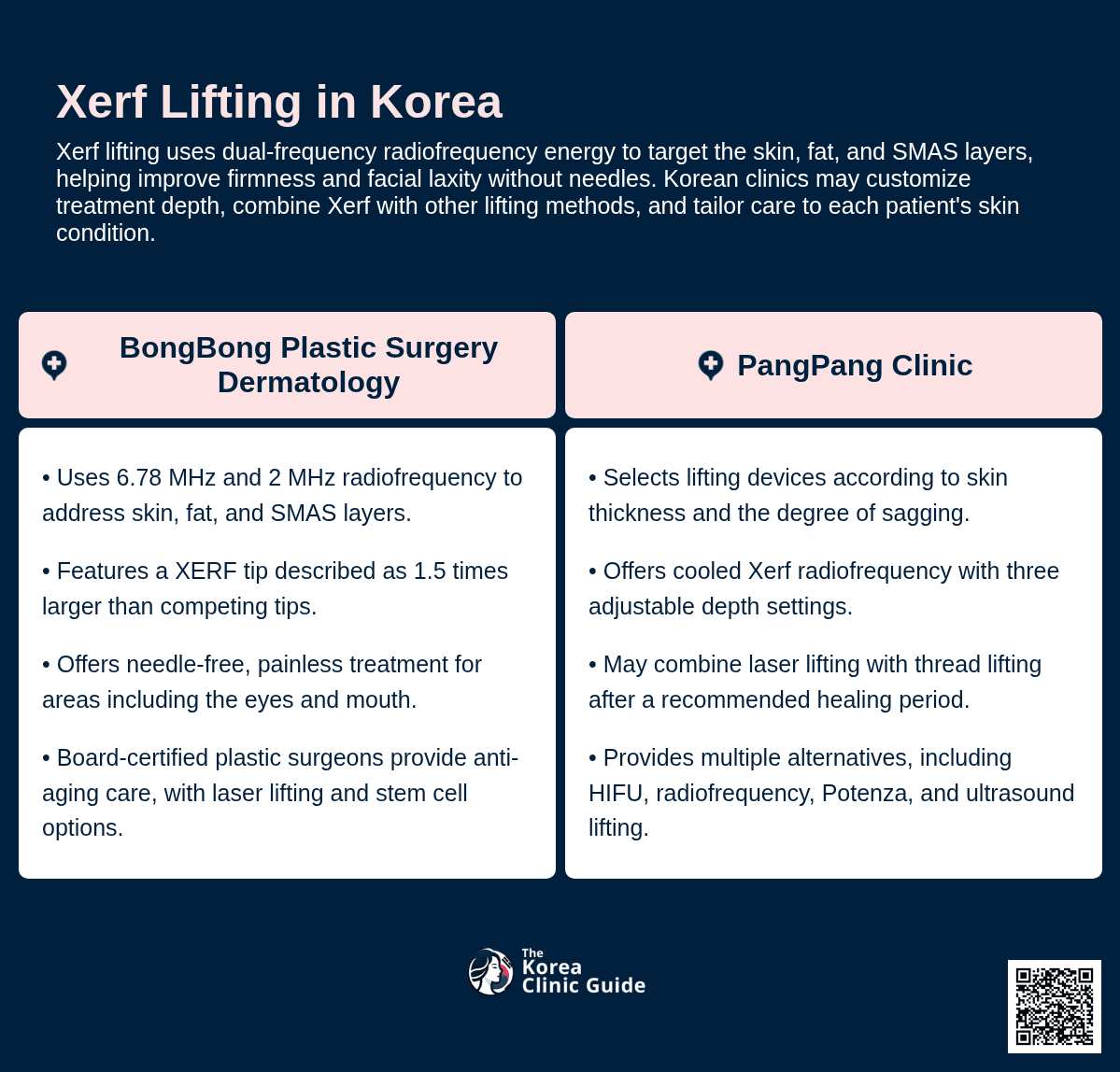
You may consider BongBong Plastic Surgery Dermatology for Xerf Lifting if you want radiofrequency treatment designed to address the skin, fat, and SMAS layers in one pass. Its XERF platform combines 6.78 MHz and 2 MHz frequencies, and the clinic pairs laser lifting with stem cell treatment; care is provided by board-certified plastic surgeons with stated anti-aging and wrinkle-surgery interests.
- URL: BongBong Plastic Surgery Dermatology Website
- Location: Gangnam-gu, Seoul
- XERF approach:
- Uses dual-frequency radiofrequency (6.78 MHz and 2 MHz) intended to work across the skin, fat, and SMAS layers in one treatment pass.
- Uses a XERF tip described as 1.5 times larger than other brands' tips.
- The clinic describes the treatment as needle-free and painless, including for areas around the eyes and mouth.
- Medical team and research:
- Dr. Sung Soo Park lists anti-aging surgery as a specialty and runs the clinic's Basic Cell Research Institute.
- Dr. Youngwoong Choi specializes in anti-aging and wrinkle surgery.
- The clinic states that its doctors are board-certified plastic surgeons.
- Related care:
- Laser lifting may be combined with stem cell treatment.
- The clinic also offers injectable skin treatments, including Botox and dermal fillers, when these are appropriate to your treatment plan.
2. PangPang Clinic
You can expect a device-selection approach to Xerf Lifting at PangPang Clinic, where a doctor considers your skin thickness and degree of sagging before choosing a lifting modality. Xerf is offered as a cooled radiofrequency option with three depth settings, and it may be used to support a thread-lifting plan, particularly after the clinic's recommended healing interval.
- URL: PangPang Clinic Website
- Location: Gangnam-gu, Seoul
- Xerf and treatment planning:
- Xerf uses radiofrequency with three depth settings and skin cooling.
- Your device choice is based on skin thickness and the amount of skin laxity described during consultation.
- Laser lifting is offered alongside thread lifting to help strengthen thread-lifting results.
- Timing after thread lifting:
- The clinic advises beginning laser treatment at least one month after a thread lift.
- It identifies around three months after thread lifting as an ideal point, when it states collagen around the threads peaks.
- Silcut Care aftercare is structured around this post-thread-lift timing.
- Lifting expertise:
- Dr. Jong-Kyung Lee is affiliated with the Korean Lifting Research Society and the Korean Society for Aesthetic & Laser Medicine.
- Dr. Jee-Yeoun Lim is a lifetime member of the Korean Society for Laser Skin and Hair and the Korean Lifting Research Society; she also trains other doctors, though she does not take bookings.
- The clinic has a Thread Lifting Research Institute and uses 31 specialized thread types for individualized thread-lifting plans.
- Other device options:
- Available lifting technologies include 10Thera HIFU, 10Therma radiofrequency, Liftera HIFU, Potenza radiofrequency, and LDM Water Drop Lifting ultrasound.
- This range allows the doctor to consider non-Xerf modalities when they better suit your treatment plan.
XERF Lifting From Start to Finish
- Remote enquiry and consultation — Send clear, unfiltered photographs and disclose goals, prior fillers, biostimulators, threads, facial surgery, implants, medicines, allergies, and relevant health conditions. Confirm whether English consultation or interpretation is available.
- In-person assessment — The clinician examines skin laxity, fat distribution, volume loss, jowling, neck bands, facial asymmetry, scars, and the planned treatment zones. Standardized photographs document the starting point.
- Safety screening and plan — The clinician reviews pregnancy status, implanted electronic devices, metal hardware, active skin disease, permanent filler or implants, and recent procedures. Agree on zones, depth settings, delivery pattern, number of sessions, and realistic expected change.
- Skin preparation — Makeup and skincare are removed. Conductive gel is applied, and a return or grounding pad is positioned to complete the monopolar RF circuit.
- RF delivery — The clinician applies the skin-contact tip using gliding, stamping, or combined passes. The prospective protocol used shallow, middle, and deep settings without topical anesthetic; reported average discomfort was about 4/10.
- Completion and discharge — Gel is removed, the skin is checked for excessive redness or focal injury, and written aftercare is provided. Treatment involves no incisions and normally no sedation.
- Early recovery and review — Mild warmth, erythema, tenderness, or swelling generally settles without treatment. Contact the clinic promptly for worsening pain, blistering, sharply demarcated burns, or increasing swelling.
- Result assessment and remote follow-up — Some immediate change can reflect temporary tissue contraction or swelling. Take follow-up photographs at about one month and three months; the prospective study assessed outcomes at 30 and 90 days after the final session.
Alternatives to XERF Lifting
The right alternative depends on whether the dominant issue is mild laxity, volume loss, fat under the chin, excess skin, or deeper structural descent. Non-surgical treatments provide more modest change with less recovery, while surgical procedures provide stronger correction but involve scars, anesthesia considerations, and longer downtime.
Monopolar RF
- Thermage or Oligio — Thermage Lifting and Oligio Lifting are monopolar RF options for noninvasive tightening. Ask about the device-specific evidence, pain-control plan, session schedule, and how the clinician selects between systems.
Focused ultrasound
- Ultherapy, HIFU, or Sofwave — Ultherapy Lifting, HIFU Laser, and Sofwave Lifting use ultrasound-based approaches rather than monopolar RF. They remain non-surgical but have different energy delivery, treatment sensations, and suitability by facial anatomy.
Volume restoration
- Filler or fat grafting — Facial Filler or Face Fat Grafting is more relevant when hollow cheeks, temples, or midface deflation create an aged or sagging appearance. Adding volume does not remove excess skin and requires careful planning when RF treatment is also considered.
Thread lifting
- Thread Lift — Thread Lift offers a minimally invasive option for selected cases of descent but places implanted material and has distinct risks, including thread visibility, irregularity, infection, and need for revision.
Surgical lifting
- Face or neck lift — Face Lift and Neck Lift address pronounced jowling, excess skin, platysmal bands, and structural descent more reliably than noninvasive RF. The tradeoff is surgical recovery and scar management.
How Can I Prepare for XERF Lifting?
- Medical disclosure — Tell the clinic about all prescription medicines, over-the-counter products, supplements, allergies, nicotine use, pregnancy plans, pacemakers or other implanted electronics, metal hardware, fillers, biostimulators, threads, implants, and previous facial procedures.
- Medicines and supplements — Do not independently stop prescribed anticoagulants, antiplatelets, diabetes medicines, or other regular medicines. Ask the treating clinician whether any product needs adjustment; no authoritative XERF-specific supplement stop period was identified.
- Recent treatments — Report chemical peels, dermabrasion, laser resurfacing, RF treatment, fat augmentation, and topical retinoids in the proposed area. The main study excluded these within the prior three months, but that was a study criterion rather than a universal waiting rule.
- Skin condition — Arrive with clean skin and no makeup on the treatment area. Postpone treatment if there is an open wound, active infection, or substantial irritation until the clinician evaluates it.
- Food and alcohol — Fasting is generally unnecessary when no sedation is planned. Avoid alcohol before the appointment if it causes flushing or makes your skin more reactive.
- Nicotine and sun — Disclose smoking or vaping. Smoking in the preceding month was an exclusion in the prospective study, although a specific evidence-based XERF cessation interval has not been established. Avoid sunburn and tanning before treatment.
- Travel logistics — Book flexible plans rather than a same-day major event, and arrange accommodation that keeps you reachable for early concerns.
Travel note: Ask for a written English plan before traveling that states the proposed number of sessions, treatment zones, expected cost, follow-up method, and who to contact after hours.
Confirm the clinic’s exact requirements with the treating doctor; individualized instructions take precedence over general guidance.
Aftercare Advice
Treat new warmth, redness, tenderness, and swelling as a reason to protect the skin and monitor its direction: symptoms should settle, not intensify.
- Activity — Resume light activity the same day when feeling well. Avoid vigorous exercise while flushing, warmth, tenderness, or swelling persists.
- Heat and alcohol — Avoid hot baths, saunas, steam rooms, and other intense heat while the skin remains reactive. Avoid alcohol if it worsens flushing.
- Skincare — Use a bland moisturizer and broad-spectrum SPF 50 sunscreen. Pause exfoliants, scrubs, topical retinoids, and acid-based products until redness and sensitivity have resolved.
- Skin protection — Do not massage, pick, or apply strong active products to irritated areas. Keep treated skin out of direct sun and avoid tanning.
- Warning signs — Contact the clinic urgently for worsening or severe pain, blistering, crusting, a sharply defined burn, increasing swelling, drainage, fever, new sensory or motor symptoms, persistent pigment change, or any eye-area concern. Thermal injury is uncommon in limited studies but remains possible; an FDA adverse-event report described full-thickness lower-face burns associated with a damaged tip.
- Results and review — Do not judge the final response on treatment day. Reassess around one month and again at three months, and follow the agreed plan for a second session if indicated.
Follow the treating doctor’s instructions over this general guidance, and contact the clinic promptly when anything appears wrong.
Frequently Asked Questions
Related Blogs
Comparing Global Costs of Pico Fraxel: Why Korea is a Top Choice for Skin Rejuvenation Without Compromise
Discover the affordability of Pico Fraxel laser treatments in Korea, where cutting-edge technology meets competitive pricing. Explore why many are choosing Korea for their skincare journey and how it compares to global costs.
Updated: Oct 21, 2026

Optimize Your Wellness: See Why Vitamin Injections in Korea Offer Value Beyond Costs Compared to the USA & More
Discover the latest trends in the cost of vitamin injections in Korea, exploring factors affecting pricing and popular clinics. Learn how these wellness treatments can boost your energy and overall health.
Updated: Oct 21, 2026
Laser Tattoo Removal Costs: Is Korea Your Best Option Compared to the USA, Turkey, and Beyond?
Discover the factors influencing the cost of laser tattoo removal in Korea, from technology and expertise to session frequency. Explore why Korea is becoming a popular destination for this effective and advanced cosmetic procedure.
Updated: Oct 21, 2026
Unlock Radiant Skin: Comprehensive Cost Analysis of Steroid Injections for Scars in Korea vs USA, Turkey & More
Explore the cost of steroid injections for scars in Korea, a popular cosmetic procedure aimed at minimizing the appearance of scar tissue. This article breaks down the pricing, factors influencing cost, and potential savings compared to other countries.
Updated: Oct 21, 2026