
Medical Tourism Blog
Eyelid Filler in Korea: Tear-Trough Results, Safety, Recovery, and Travel Planning
Table of contents
- Eyelid Filler at a Glance
- What Is Eyelid Filler?
- Who Is a Good Candidate for Eyelid Filler?
- How Is Eyelid Filler Performed?
- Why Visit Korea for Eyelid Filler?
- Key Information for International Patients
- Which Are the Best Clinics in Korea for Eyelid Filler?
- Eyelid Filler From Start to Finish
- Alternatives to Eyelid Filler
- How Can I Prepare for Eyelid Filler?
- Aftercare Advice
Considering treatment in Korea? Everything you need to know e.g. — how to avoid scams, visas, interpreters, recovery tips — in our Medical Tourism Master Guide. Plan with confidence in minutes, not weeks!
Last updated: September 2026
Eyelid Filler at a Glance
- What it treats — Eyelid filler usually means small-volume hyaluronic acid (HA) injection into a lower-eyelid tear-trough hollow to soften the lid-cheek shadow; it does not reliably correct pigmentary dark circles, eye bags, festoons, lax skin, or eyelid droop.
- Best candidates — The most predictable candidates have a mild-to-moderate true infraorbital hollow, firm skin, little baseline puffiness, and willingness to use a conservative, sometimes staged approach rather than fully fill the area in one visit.
- Early recovery — Correction is visible immediately, but allow 7–14 days for swelling and bruising to settle before judging the result or attending an important event; pooled estimates found swelling in 19.2% and bruising in 18.4% of patients.
- Key limitation — Significant lower-lid bags, chronic morning puffiness, malar edema, festoons, very thin skin, severe laxity, or a need for large volumes often make filler a poor match; midface support or lower blepharoplasty may be more appropriate.
- Serious safety concern — Vision changes, eye pain, impaired eye movement, severe escalating pain, or blanching, dusky, or mottled skin after injection require immediate emergency in-person care because this region is close to critical ocular structures.
- Korea travel plan — Plan 2–3 days in Korea for in-person assessment and treatment plus a next-day review or contact window before long-haul travel; avoid same-day international departure and do not fly with concerning pain, skin-color, visual, or neurologic symptoms.
- Korea-specific check — No high-quality evidence shows better eyelid-filler outcomes in Korea, so verify the clinician and facility through Korea’s registered medical-institution system and obtain an English record with the HA product, manufacturer, expiry date, lot number, injection areas, and amount used.
What Is Eyelid Filler?
Eyelid filler is a small-volume injectable treatment, usually using hyaluronic acid, to restore volume in a hollow beneath the lower eyelid. It aims to soften the lid-cheek transition and reduce tired-looking shadows caused by volume loss. Eyelid filler is a minimally invasive, non-surgical procedure.
Who Is a Good Candidate for Eyelid Filler?
- True infraorbital hollow — Good candidates have a mild-to-moderate tear-trough depression at the lower-eyelid/upper-cheek junction that creates a shadow or tired appearance.
- Good tissue quality — Firm lower-eyelid skin, limited baseline puffiness, and a smooth lid-cheek transition support a more predictable result.
- Realistic goal — Eyelid filler can soften shadowing and the appearance of a hollow; it does not reliably erase pigmentary dark circles, fine lines, eye bags, festoons, or eyelid droop.
- Conservative approach — Candidates accept small-volume, staged correction rather than trying to fill every depression in one appointment.
Avoid or defer treatment with a known allergy to the proposed filler or anesthetic, an active infection, herpes outbreak, dermatitis flare, rash, acne flare, or unhealed wound near the injection area. Pregnancy and breastfeeding are contraindications for elective treatment because cosmetic HA-filler safety has not been adequately established. Significant lower-lid or malar edema, recurrent morning puffiness, malar mounds, festoons, prominent fat bags, severe laxity, very thin skin, or a need for large filler volumes often make filler a poor anatomical match. Previous eyelid surgery, scar tissue, autoimmune or immune-system disease, unknown or permanent prior filler, substantial allergy history, and previous filler complications require specialist assessment; do not stop prescribed anticoagulants or antiplatelet medicines without the prescribing clinician.
How Is Eyelid Filler Performed?
Eyelid filler generally means hyaluronic acid (HA) filler for a lower-eyelid tear trough or infraorbital hollow. Upper-eyelid filler is a separate, less established use: the available six-month case series included only 20 selected patients, so its indications and predictability should not be assumed to match lower-eyelid treatment.
- Direct tear-trough HA filler — The injector places a small amount of HA gel, commonly in a deep plane near the orbital rim, to soften a localized hollow and reduce shadowing.
- Midface-first support — Cheek volume loss can deepen the lid-cheek junction. Supporting the midface first and reassessing the remaining hollow can reduce the need to overfill the narrow under-eye area.
- Needle delivery — A needle allows targeted placement. A prospective-trial meta-analysis found more bruising with needles than cannulas, but this does not prove that either device is universally safer.
- Microcannula delivery — A blunt-tip cannula is another delivery option and was associated with more edema in that meta-analysis. A systematic review of needle versus cannula techniques found no significant overall difference in reported outcomes or adverse-event incidence.
- Staged correction — Intentional under-correction followed by reassessment after swelling settles is often safer than pursuing complete correction immediately.
HA is generally the practical material in this area because it can be broken down with hyaluronidase when medically indicated. Dissolving filler is still a medical procedure and can require more than one session.
Why Visit Korea for Eyelid Filler?
There is no high-quality comparative evidence that eyelid-filler outcomes or complication rates are better in South Korea than elsewhere. For this high-risk anatomical area, prioritize appropriate patient selection, relevant periorbital experience, product traceability, and an emergency plan rather than destination marketing. Confirm the clinician and facility before booking through Korea’s registered medical-institution system.
- Documented care pathway — Ask for an English treatment record naming the exact HA product, manufacturer, expiry date, lot number, injection areas, amount used, and contact details for follow-up.
- Complication readiness — Confirm before treatment that emergency supplies, including hyaluronidase, and a written vascular-complication escalation protocol are available. New visual symptoms require emergency in-person assessment, not a delayed online reply.
- Evidence-informed consent — A 2024 meta-analysis of 2,556 participants pooled satisfaction at 91.0%, but techniques, products, patient selection, and follow-up varied substantially. It reported edema in 19.2%, bruising in 18.4%, contour irregularity or lumps in 5.3%, and blue discoloration/Tyndall effect in 0.9%.
- Important evidence limit — Long-term rates of delayed edema, retained filler, migration, and outcomes after repeated treatment remain incompletely measured, particularly in people with chronic swelling, festoons, prior surgery, or unknown prior filler.
Key Information for International Patients
- Minimum stay — Plan 2–3 days in Korea: an in-person assessment and treatment day, plus a next-day contact or review window before long-haul travel. This is conservative planning, not an evidence-based mandatory no-fly interval.
- Flight timing — Do not book treatment immediately before departure, a remote excursion, or an important event. Do not fly with escalating pain, skin-color change, eye pain, blurred or double vision, impaired eye movement, or any neurologic symptom; obtain urgent in-person evaluation.
- Early appearance — Correction is visible immediately, but swelling and bruising can temporarily make the lower eyelid appear fuller, uneven, or darker. Allow 7–14 days before judging the early cosmetic result.
- Activity and itinerary — Keep the first 24–48 hours flexible. Avoid strenuous exercise, alcohol, intense heat, facial pressure, and rubbing or pressing the area unless the injector gives different instructions.
- Remote follow-up — Keep the clinic’s emergency contact details and English injection record accessible during travel and after returning home. Send follow-up photographs only if requested, but do not rely on remote messaging for urgent symptoms.
Travel note: The periorbital region is close to critical ocular structures. A review of reported ocular HA-filler complications cannot estimate the risk per routine injection, but it shows why any new visual or neurologic symptom needs immediate emergency care.
Which Are the Best Clinics in Korea for Eyelid Filler?
Listed below are some of the best clinics in Korea for eyelid filler.
1. Haru Clinic
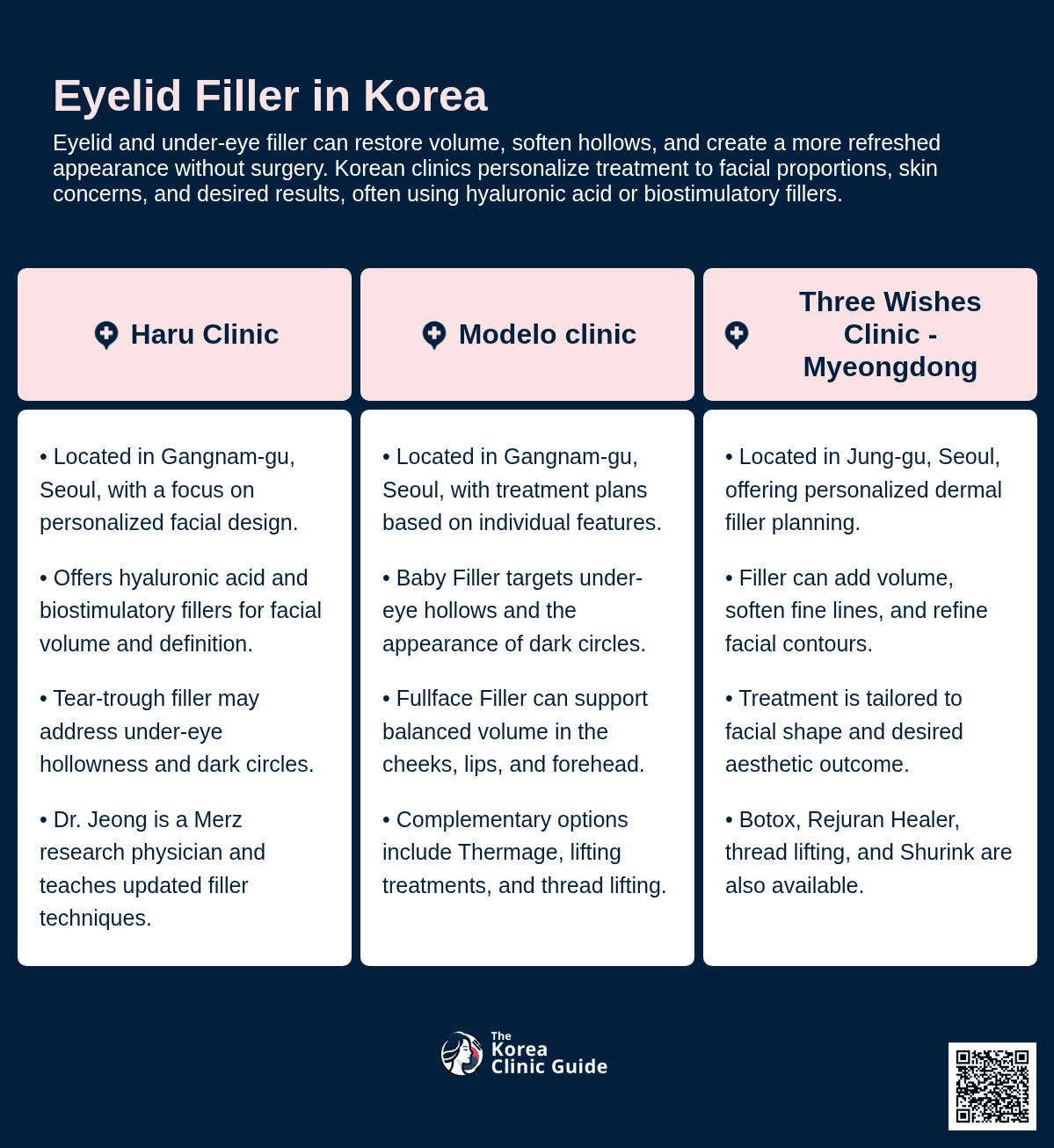
At Haru Clinic, you can discuss eyelid-area filler as part of a tailored, non-invasive facial balancing plan. Dr. Jeong’s approach emphasizes precise facial design and a natural, refreshed result, with filler options also described for the tear trough to address under-eye hollowness.
- URL: Haru Clinic Website
- Location: Gangnam-gu, Seoul
- Filler approach:
- Offers hyaluronic acid and biostimulatory fillers for facial volume and definition, including the tear trough.
- Uses individualized facial assessment with an emphasis on harmony and balance.
- Clinical experience:
- Dr. Jeong is an official research physician for Merz, the company behind Belotero Filler.
- Dr. Jeong teaches other doctors updated filler techniques.
- Related under-eye care: Customized dark-circle care may combine tear-trough filler with laser or PRP depending on hollowness, pigmentation, and fine lines.
2. Modelo clinic
At Modelo Clinic, you can consider filler treatment within a plan centered on your individual facial features and long-term aesthetic goals. Its Baby Filler specifically targets under-eye hollows and dark circles, while full-face filler can be used to support balanced volume in other facial areas.
- URL: Modelo clinic Website
- Location: Gangnam-gu, Seoul
- Under-eye filler: Baby Filler is intended to plump the under-eye area and reduce the appearance of hollows and dark circles.
- Facial volume options:
- Fullface Filler can add volume to areas including the cheeks, lips, and forehead.
- The clinic frames treatment around your individual features rather than trend-based results.
- Complementary treatments:
- Lifting treatments are tailored to individual skin characteristics and aging concerns.
- Comfort Thermage uses radiofrequency for gradual skin tightening, while thread lifting provides a minimally invasive lifting option.
3. Three Wishes Clinic - Myeongdong
You may consider Three Wishes Clinic - Myeongdong for eyelid-area filler if you want a personalized filler plan that can add volume, soften fine lines, and refine facial contours with immediate results. The clinic describes tailoring dermal filler treatment to your facial shape and desired outcome.
- URL: Three Wishes Clinic - Myeongdong Website
- Location: Jung-gu, Seoul
- Filler treatment:
- Dermal fillers are used to add volume, smooth fine lines, and enhance facial contours.
- Treatment can be tailored to your facial shape and desired result, with immediate results described.
- Related aesthetic options:
- Botox is available for dynamic wrinkles such as crow’s feet and forehead lines.
- Rejuran Healer uses polynucleotide injections to support skin regeneration, texture, elasticity, and fine-line improvement.
- Thread lifting and Shurink are available as minimally invasive skin-lifting options.
Eyelid Filler From Start to Finish
- Remote inquiry and consultation — Send clear front and angled photographs without filters, a description of the concern, prior treatment history, medicine and supplement list, allergies, and travel dates. Confirm whether English consultation and post-treatment communication are available.
- In-person facial assessment — The injector examines the lower eyelid, tear trough, lid-cheek junction, skin thickness, fat bags, laxity, malar edema, pigmentation, and asymmetry. The assessment should distinguish a volume hollow from pigment, vascular discoloration, swelling, or prolapsed fat.
- Medical-history and product review — Disclose all prior facial filler, fat grafting, threads, lasers, eyelid surgery, and past filler complications. Ask to see the HA product details and confirm that the clinic will provide the manufacturer, expiry date, and lot record.
- Treatment planning and consent — The clinician recommends direct tear-trough treatment, midface-first support, staged correction, an alternative procedure, or no filler. Consent should cover swelling, bruising, lumps, asymmetry, Tyndall effect, delayed edema, vascular compromise, and rare but serious visual complications.
- Preparation and anesthesia — The skin is cleansed and marked. Treatment generally uses topical anesthetic, local anesthetic, or anesthetic included in the filler; fasting is not ordinarily needed when no sedation is planned.
- HA filler placement — Using a needle or microcannula, the injector places small, conservative amounts of HA in the planned deep plane, then reassesses contour and symmetry. The injection itself is usually brief, but consultation, marking, consent, and observation extend the appointment.
- Immediate review and discharge — The clinician checks skin color, capillary refill, pain, symmetry, and vision-related symptoms before discharge. Receive written aftercare, emergency contact details, and the treatment record in English.
- Next-day contact and overseas follow-up — Complete the agreed next-day review or contact before long-haul departure. After returning home, seek qualified in-person assessment for persistent swelling, lumps, discoloration, or asymmetry rather than arranging blind additional filler.
Alternatives to Eyelid Filler
Non-surgical filler suits a selected structural hollow and has limited downtime, but it does not remove fat bags or excess skin. Surgical approaches can address laxity and prolapsed fat more directly, with longer recovery and different risks.
Midface or Under-Eye Filler
- Best for — A lid-cheek transition driven mainly by cheek volume loss or a small residual hollow.
- Tradeoff — Midface support can reduce the need for direct lower-eyelid filler, but it remains an injectable treatment with edema, bruising, and vascular risks. See under-eye filler.
Fat Grafting
- Best for — Patients seeking potentially longer-lasting volume restoration after assessment confirms that volume loss is the main problem.
- Tradeoff — Fat grafting is surgical, with variable graft survival and more recovery than HA filler. See eyelid fat grafting or under-eye fat grafting.
Lower Blepharoplasty With Fat Repositioning
- Best for — Prominent lower-lid bags, fat prolapse, festoons, significant laxity, or anatomy that would require excessive filler.
- Tradeoff — Surgery can address structures that filler cannot, but requires a more substantial recovery period and planned in-person follow-up. See eyelid fat removal or repositioning.
Upper-Lid Surgery or Ptosis Correction
- Best for — Upper-lid skin excess, brow descent, or true eyelid droop rather than an under-eye hollow.
- Tradeoff — These procedures correct the underlying structural concern; filler does not lift a drooping eyelid. See upper blepharoplasty or ptosis correction.
How Can I Prepare for Eyelid Filler?
- Disclose medicines and supplements — Provide every prescription medicine, over-the-counter medicine, vitamin, herbal product, and supplement before booking. Anticoagulants, antiplatelets, NSAIDs, alcohol, and some supplements can increase bruising; never independently stop prescribed blood-thinning medicine.
- Report prior procedures — List all prior filler, including unknown or permanent products, fat grafting, threads, laser treatments, and eyelid surgery. Bring previous records when available.
- Arrive with healthy skin — Defer treatment for a herpes outbreak, active infection, rash, dermatitis or acne flare, unhealed wound, or sunburn near the treatment area.
- Fasting and alcohol — Fasting is usually unnecessary for topical or local anesthetic alone. Avoid alcohol before treatment when instructed, particularly when bruising is a concern.
- Travel and transport — Schedule a next-day review window, keep flights flexible where possible, and avoid same-day international departure. Arrange accommodation close enough for urgent reassessment and save the clinic’s emergency number.
- Bring sun protection — Pack broad-spectrum SPF 50 sunscreen and sunglasses for the recovery period, particularly if bruising or discoloration makes the area more noticeable.
Travel note: Do not schedule eyelid filler immediately before a major event or travel to a location with limited medical access; bruising and swelling are common short-term reactions.
Confirm the treating doctor’s individualized medicine, alcohol, fasting, skincare, and travel instructions before treatment; they take precedence over general guidance.
Aftercare Advice
Protect the treated area and act quickly on any pain, skin-color, vision, or neurologic change.
- First 24 hours — Avoid strenuous exercise, rubbing, pressing, and self-massage of the under-eye area unless specifically instructed by the injector.
- Heat and alcohol — Avoid alcohol, saunas, hot baths, intense heat, and activities causing facial pressure for roughly 24–48 hours when advised, as these can worsen swelling and bruising.
- Swelling and bruising — Expect temporary swelling, tenderness, or bruising. Do not judge the contour immediately; allow 7–14 days for the early appearance to settle.
- Skin protection — Use gentle skincare and broad-spectrum SPF 50 around the area. Do not apply pressure while cleansing or removing makeup.
- Urgent warning signs — Seek emergency medical care immediately for blurred or double vision, any vision change, eye pain, impaired eye movement, severe or escalating pain, blanching, dusky or mottled skin, severe headache, facial weakness, confusion, speech difficulty, limb weakness, or shortness of breath.
- Clinic review — Promptly contact the injector for persistent or worsening swelling, a firm lump, blue-gray discoloration, drainage, fever, increasing redness, or marked asymmetry after the normal early recovery period. HA filler sometimes requires hyaluronidase management, which must be performed by an appropriately qualified clinician.
Follow the treating doctor’s instructions over this general guidance and contact the clinic promptly when anything appears wrong.
Frequently Asked Questions
Related Blogs
Erase Horizontal Forehead Lines with Forehead Filler: Advanced Treatments in Korea
Discover how Korea leads in treating horizontal forehead lines with advanced dermal fillers and Botox. This article explores the causes of static wrinkles, treatment options like hyaluronic acid, CaHA, and PLLA fillers, and the importance of expert practitioners in Korea’s top clinics. Learn about the procedure steps, safety considerations, and how Korea’s affordable, high-quality medical tourism
Updated: Oct 11, 2026
Bony Hands Solutions: Hand Filler Procedures in Korea for Fuller, Youthful-Looking Hands
Discover effective solutions for "bony hands" and veiny hand aging with Korea’s leading hand filler procedures. From hyaluronic acid fillers like Restylane to biostimulatory options such as Radiesse and Sculptra, Korea offers expert treatments to restore youthful volume. Enjoy short, minimally invasive treatments with immediate results, performed by certified Korean surgeons in a patient-focused m
Updated: Oct 10, 2026
Neck Wrinkles Solutions: Neck Filler Procedures in Korea for Smoother, Youthful Skin
Discover how Korea leads in neck wrinkle treatments with advanced Neck Filler procedures like hyaluronic acid, calcium hydroxylapatite, and poly-L-lactic acid. This comprehensive guide explores causes of neck aging, treatment techniques, costs, and patient experiences in Korea—a preferred medical tourism destination. Learn about Korea’s expert injectors, affordable pricing, and all-inclusive packa
Updated: Oct 8, 2026
Veiny Hands Solutions: Hand Filler Procedures in Korea for Smooth, Youthful-Looking Hands
Discover how Korea leads in hand rejuvenation treatments to reduce prominent veins and restore youthful hands. This blog covers the causes of veiny hands like aging and genetics, explains popular procedures such as hand fillers—including hyaluronic acid, Radiesse, and fat grafting—and highlights Korea’s affordable, high-quality care for medical tourists. Learn about the step-by-step process of get
Updated: Oct 8, 2026
Clinics offering Eyelid Filler

Haru Clinic Korea | Fully-Customized Full-Face Non-Surgical Rejuvenation With Threads, Botox & Fillers
Sinsa

Three Wishes Clinic - Myeongdong, Korea: Advanced Botox, Fillers, Laser, and Skin Treatments for Confidence and Care
Myeongdong
ID Hospital - Main Branch in Korea: Specializing in Safe & Customized Facial Plastic Surgery and Post-Care Services
Sinsa

VandS Dermatology Clinic - Dongtan, Korea: Comprehensive Skin Care and Cosmetic Procedures for Youthful, Radiant Skin
Hwaseong