
Medical Tourism Blog
Chin Botox in Korea: Mentalis Treatment, Recovery, Risks, and Travel Planning
Table of contents
- Chin Botox at a Glance
- What Is Chin Botox?
- Who Is a Good Candidate for Chin Botox?
- How Is Chin Botox Performed?
- Why Visit Korea for Chin Botox?
- Key Information for International Patients
- Which Are the Best Clinics in Korea for Chin Botox?
- Chin Botox From Start to Finish
- Alternatives to Chin Botox
- How Can I Prepare for Chin Botox?
- Aftercare Advice
Considering treatment in Korea? Everything you need to know e.g. — how to avoid scams, visas, interpreters, recovery tips — in our Medical Tourism Master Guide. Plan with confidence in minutes, not weeks!
Last updated: September 2026
Chin Botox at a Glance
- What it treats — Chin Botox uses botulinum toxin type A in the mentalis muscles to soften dynamic pebbled, puckered, or “orange-peel” chin texture that appears with talking, pursing, or forceful lip closure.
- Best candidates — It is best for adults whose concern is caused mainly by mentalis contraction and who want a temporary improvement, not greater chin projection, double-chin reduction, or permanent reshaping.
- Results and longevity — Muscle weakening may start in 2–7 days, the settled result should be assessed at 10–14 days, and effects commonly begin fading after about 3–4 months.
- Recovery — There is no surgical downtime; small red marks, tenderness, swelling, or bruising may last from hours to several days, and direct pressure or massage of the chin should be avoided for about 12–24 hours.
- Key lower-face risk — Inaccurate placement or excessive effect on nearby muscles can cause lower-lip weakness, altered lip closure, speech changes, or smile asymmetry, so conservative dosing and a 10–14-day review are especially useful for first treatments.
- Korea travel planning — A routine injection-only visit usually requires 1–2 days in Korea, but staying 10–14 days is preferable for a first chin treatment, pre-existing asymmetry, or a combined lower-face plan; otherwise arrange photo or video follow-up.
- Korea-specific check — Korea does not have proven superior Chin Botox outcomes, so confirm the named injector’s Korean license, clinic affiliation, foreign-patient registration, exact toxin brand, and written product record; toxin units cannot be compared across brands.
What Is Chin Botox?
Chin Botox uses botulinum toxin injections to temporarily relax the muscle that creates chin puckering and dimpling. It aims to smooth a pebbled or orange-peel chin texture that appears with expression, without adding projection or permanently changing chin shape. Chin Botox is a minimally invasive, non-surgical injection treatment.
Who Is a Good Candidate for Chin Botox?
- Dynamic chin dimpling — Good candidates want to reduce a pebbled, puckered, “orange-peel,” or cobblestone texture that becomes more visible while speaking, pursing the lips, or forcefully closing the mouth.
- Temporary muscle modulation — Treatment suits adults who accept a temporary reduction in mentalis activity, with results generally fading over about 3–4 months.
- Realistic structural goals — The best fit is a concern caused mainly by mentalis contraction, not a wish for major chin projection, permanent reshaping, double-chin reduction, or correction of a markedly recessed jaw.
- Stable lower-lip function — Candidates need assessment of lip closure, smile symmetry, pre-existing asymmetry, dental or skeletal history, and prior chin filler, implant, or surgery.
Defer elective treatment during pregnancy because adequate developmental-risk data are lacking. During breastfeeding, defer treatment or make an individualized decision with the prescribing clinician because human-milk data are inadequate. Do not inject through an active infection, inflamed acne lesion, dermatitis, or open wound. Known hypersensitivity to the toxin or its components, myasthenia gravis, Lambert-Eaton syndrome, significant generalized weakness, or swallowing, speech, breathing, or respiratory problems require medical review and often rule out cosmetic treatment. Chin Botox is an adult cosmetic treatment; assessment is particularly important when lip incompetence, malocclusion, skeletal retrusion, or baseline facial asymmetry drives the chin movement.
How Is Chin Botox Performed?
Chin Botox is not a standardized product category or a single universal injection pattern. The injector selects depth, points, laterality, dilution, and dose after observing the chin at rest and in motion; botulinum-toxin units cannot be reliably converted between brands.
- Mentalis-only treatment — Intramuscular botulinum toxin type A targets the paired mentalis muscles in the central chin to soften dynamic dimpling and skin bunching.
- Conservative staged treatment — A modest first treatment followed by review at 10–14 days prioritizes lower-lip movement and is sensible for a first lower-face toxin treatment or a patient concerned about weakness.
- Mentalis plus DAO planning — When downturned mouth corners accompany chin dimpling, the clinician can assess the depressor anguli oris (DAO). This is not a routine add-on: nearby lower-face muscles must remain balanced.
- Structural combination planning — A premental crease, poor projection, or volume deficiency often calls for chin filler or a surgical assessment rather than toxin alone. Toxin does not replace structural correction.
Why Visit Korea for Chin Botox?
Korea’s value for an international Chin Botox patient is practical rather than a proven superior outcome. The treatment is brief, but safe planning depends on verifying the named injector, the toxin product, and the facility’s foreign-patient process before travel. Published evidence does not establish that chin-toxin outcomes in Korea are better than outcomes elsewhere.
- Licensed medical practice requirement — Korean law restricts medical practice to licensed medical personnel and requires medical institutions to be properly established under the Medical Service Act. Confirm the named clinician’s Korean license and clinic affiliation rather than relying on a booking platform or coordinator alone. Korean medical-practice requirements
- Foreign-patient registration checks — A medical institution registered to attract foreign patients must meet statutory conditions, including applicable specialist staffing and medical-malpractice liability coverage; registration must be renewed every three years. Foreign-patient institution requirements
- Required patient information — Registered institutions must display their registration certificate and provide information on diagnosis, treatment method, potential adverse effects, treatment contract, and expected cost. Foreign-patient information obligations
- Product documentation — Ask for the exact toxin brand, total units, dilution, injection map, and lot documentation where available. Product authorization is product-specific, and brand units are not interchangeable.
Key Information for International Patients
- Minimum stay — One to two days is practical for an uncomplicated injection-only appointment. Consultation, consent, photographs, and treatment can often occur on the same day.
- Flight timing — No evidence-based flight restriction exists after routine facial botulinum toxin solely to prevent toxin migration. Depart later that day or the next day if feeling well and no sedative was used.
- Best timing for first treatment — Stay 10–14 days when this is a first toxin treatment, a new chin area, an extensive combined lower-face plan, or there is pre-existing asymmetry. This permits an in-person review once the effect has settled.
- Itinerary impact — Expect possible pinpoint redness, tenderness, swelling, or a small bruise for hours to several days. Schedule important photographs, filming, or events after the 10–14-day assessment point when possible.
- Remote follow-up — Arrange standardized photo or video review at 10–14 days if returning home earlier. Keep consent documents, before-and-after photographs, product records, and the injector’s direct contact details.
- Activity planning — Avoid pressing or massaging the chin for 12–24 hours. Defer sauna, steam rooms, hot yoga, and very hot baths for the rest of the day when the injector recommends this to limit flushing and bruising.
Travel note: Do not schedule an automatic early “top-up” before departure. Mentalis weakening usually starts in 2–7 days, and the cosmetic result should be judged at about 10–14 days.
Which Are the Best Clinics in Korea for Chin Botox?
Listed below are some of the best clinics in Korea for chin botox.
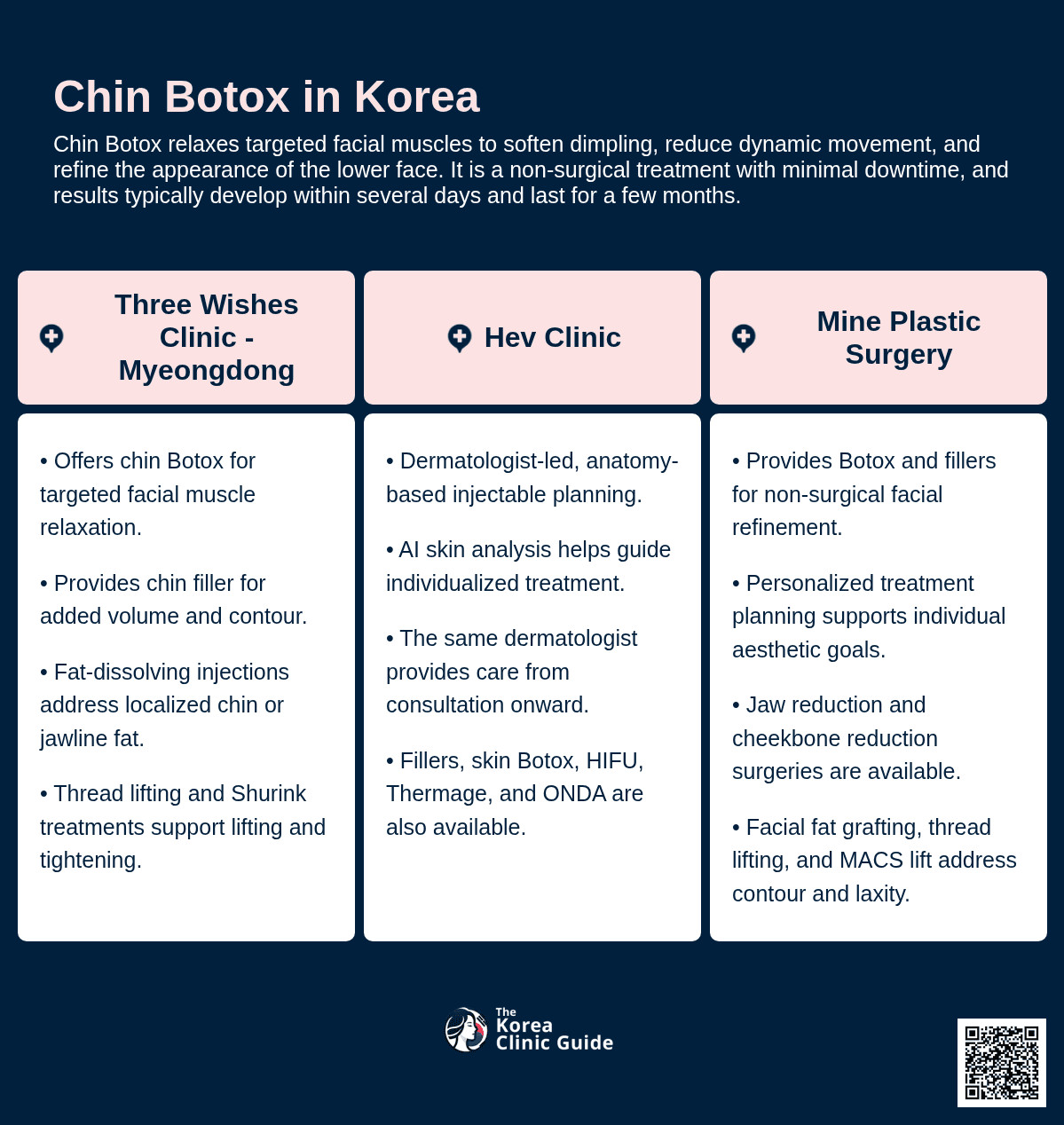
1. Three Wishes Clinic - Myeongdong
You may consider Three Wishes Clinic - Myeongdong for chin Botox if you want a non-surgical injectable approach to relaxing targeted facial muscles and refining facial contours with minimal downtime. The clinic also offers complementary contouring options, including chin filler and fat-dissolving injections, which may be relevant if your consultation identifies concerns beyond muscle activity.
- URL: Three Wishes Clinic - Myeongdong Website
- Location: Jung-gu, Seoul
- Related contouring options:
- Chin filler is offered to add volume and enhance chin contour, with results tailored to your facial shape and goals.
- Fat-dissolving injections are available for localized fat in the chin, jowls, or jawline.
- Thread lifting and ultrasound-based Shurink treatments are also listed for facial lifting and skin tightening.
2. Hev Clinic
You may consider Hev Clinic for chin Botox if you value dermatologist-led injectable care shaped by facial anatomy, individualized assessment, and continuity with the same attending dermatologist from consultation through aftercare. Botox is used to relax selected facial muscles to soften dynamic movement and refine contours; its effects are described as beginning in 3–7 days and lasting about 3–4 months, with minimal downtime.
- URL: Hev Clinic Website
- Location: Gangnam-gu, Seoul
- Specialist-led planning:
- Dr. Shin Ji-yeon is a board-certified dermatologist whose listed focus includes customized non-surgical facial contouring.
- The clinic describes anatomy-based targeting intended to minimize nerve and vascular injury risk.
- AI skin analysis is used to assess factors such as skin thickness and aging before building a one-to-one treatment plan.
- Comfort and continuity:
- The same attending dermatologist performs care from consultation to completion.
- A non-sedation, pain-controlled anesthesia system is intended to allow real-time communication during treatment.
- The clinic uses a 100% appointment-based private care environment.
- Related treatments:
- Dermal fillers are available for immediate, adjustable facial volume and contouring, including the jawline.
- Skin Botox uses superficial micro-droplets to refine pores, reduce sebum, and smooth fine lines without freezing expression.
- HIFU, Ultherapy, Thermage, and ONDA are listed among options for lower-face, under-chin, or skin-laxity concerns.
3. Mine Plastic Surgery
You may consider Mine Plastic Surgery for chin Botox if you want a non-surgical wrinkle and facial-rejuvenation treatment from a clinic that also provides facial contouring procedures. You can expect Botox and fillers to be available as quick, non-surgical options for reducing wrinkles and fine lines, alongside personalized care aimed at your aesthetic goals.
- URL: Mine Plastic Surgery Website
- Location: Gangnam-gu, Seoul
- Facial contouring context:
- The clinic also offers jaw reduction and cheekbone reduction surgery for structural facial contouring.
- Facial line fat grafting is available to restore volume and contour areas of the face.
- Thread lifting and MACS lift are listed as options for sagging facial tissues.
Chin Botox From Start to Finish
- Remote screening — Send front, three-quarter, and profile photographs at rest, smiling, pursing, and forcefully closing the lips. Disclose previous toxin, filler, chin implant or surgery, dental or orthodontic issues, allergies, medicines, supplements, and any history of facial weakness or swallowing difficulty. Confirm whether English consultation and remote follow-up are available.
- Travel and appointment coordination — Request the named injector, exact toxin brand, anticipated treatment scope, written estimate, consent process, and post-treatment contact route before booking flights. Ask whether the institution is registered to attract foreign patients.
- In-person assessment — The clinician examines mentalis movement, chin texture, lip closure, smile balance, lower-lip position, skin quality, and asymmetry. They determine whether the concern is muscular, structural, or mixed and explain why toxin alone may not meet a projection or contour goal.
- Consent and baseline records — Discuss expected temporary smoothing, common injection effects, lower-lip weakness risk, rare systemic warning signs, and alternatives. Baseline photographs document movement and symmetry.
- Injection treatment — Makeup is removed and the chin skin is cleansed. The injector marks dynamic landmarks and uses a fine needle to place individualized intramuscular injections into the mentalis; treatment is brief and normally requires no sedation.
- Discharge — Most patients leave shortly afterward. Pinpoint bleeding, redness, swelling, tenderness, or bruising can occur; no surgical downtime is expected.
- Settling period — Early change can appear within 2–7 days. Avoid judging the final result or requesting additional toxin during the first few days because muscle weakening is still developing.
- Review and overseas follow-up — Assess chin smoothing, speech, lip closure, smile symmetry, and lower-lip movement at 10–14 days in person or by photo/video. Contact the treating clinic promptly for a new functional or asymmetric change; seek local emergency care for breathing, swallowing, speech, vision, or generalized-weakness symptoms.
Alternatives to Chin Botox
The right alternative depends on whether the concern is active muscle contraction, deficient projection, volume loss, a static crease, or skeletal jaw position. Non-surgical options are temporary and do not correct major skeletal retrusion; surgical options can change structure but involve anesthesia, longer recovery, and materially greater commitment.
Chin Filler
- Best for — Insufficient projection, contour deficiency, volume loss, or some premental creases rather than primarily dynamic dimpling.
- Tradeoff — Chin filler adds volume and contour but has different risks, including vascular complications; it does not directly relax mentalis contraction.
Chin Implant or Genioplasty
- Best for — Marked skeletal retrusion or a substantial projection concern after facial plastic or maxillofacial assessment.
- Tradeoff — A chin implant or chin surgery offers structural change but entails surgery, recovery, and surgical risks that Botox does not carry.
Broader Lower-Face Toxin Treatment
- Best for — Chin dimpling combined with a demonstrable DAO-related downturned mouth corner or another adjacent-muscle concern.
- Tradeoff — Facial Botox or mouth-corner lift Botox expands the treatment area and requires careful preservation of lower-lip balance.
Skin Botox
- Best for — Superficial texture concerns where deep mentalis hyperactivity is not the main cause.
- Tradeoff — Skin Botox does not replace intramuscular treatment for true mentalis-driven puckering.
How Can I Prepare for Chin Botox?
- Medication disclosure — Provide a complete medication and supplement list. Specifically flag other botulinum toxin treatments, aminoglycoside antibiotics, curare-like neuromuscular blockers, muscle relaxants, anticholinergic medicines, and medicines affecting neuromuscular transmission.
- Bleeding and bruising review — Tell the clinician about warfarin, apixaban, rivaroxaban, clopidogrel, aspirin, NSAIDs, fish oil/omega-3, vitamin E, and other products associated with bruising. Do not stop prescribed anticoagulants or antiplatelet medicines unless the prescribing clinician directs it.
- No routine fasting — Fasting is not normally required for an office injection performed without general anesthesia or routine sedation.
- Skin condition — Reschedule for an active chin infection, open wound, inflamed acne lesion, significant dermatitis, or sunburn. Coordinate timing before booking if the chin recently had an aggressive peel, laser procedure, or microneedling.
- Alcohol and smoking — Avoid alcohol immediately before treatment when bruising is a concern. Smoking does not create the same procedural issue as surgery, but disclose it as part of the medical history.
- Transport and companion — A companion is generally unnecessary after an uncomplicated non-sedated appointment. Arrange support if prone to fainting, receiving sedatives, or combining several procedures.
- Flexible travel plan — Keep flights and major social commitments flexible when possible, especially for a first lower-face treatment or combined plan.
Travel note: Bring or securely save medication lists, prior toxin records, and photographs showing the chin at rest and in motion. These help distinguish pre-existing asymmetry from a treatment-related change.
Confirm the treating doctor’s clinic-specific preparation requirements; individualized medical instructions take precedence over general guidance.
Aftercare Advice
Protect lower-lip function during the settling period and contact the clinic early if movement changes appear abnormal.
- Do not press the chin — Avoid rubbing, facial massage, gua sha, aggressive makeup application, and other direct pressure over injection sites for about 12–24 hours or for the injector’s specified period.
- Keep heat and strenuous activity brief — Defer strenuous exercise, sauna, steam rooms, hot yoga, and very hot baths for the rest of the day when instructed, mainly to reduce flushing and bruising. Normal facial movement and air travel have not been shown to cause toxin migration after routine facial injections.
- Treat minor marks gently — Expect small red marks, tenderness, swelling, or a bruise on the day of treatment through several days. Cleanse gently once puncture sites have closed; do not use harsh exfoliants on irritated skin.
- Assess at the right time — Early weakening can begin in 2–7 days. Judge the settled result at 10–14 days, not immediately after injection; effects commonly begin fading around 3–4 months.
- Know urgent warning signs — Contact the clinic promptly for progressive lower-lip weakness, marked smile asymmetry, inability to close the lips, persistent severe pain, increasing warmth or redness, drainage, or allergic-reaction symptoms. Seek emergency care immediately for trouble swallowing, speaking, or breathing, double vision, generalized weakness, or other possible distant toxin effects.
Follow the treating doctor’s individualized instructions and contact the clinic promptly when anything appears wrong.
Frequently Asked Questions
Related Blogs
Discovering the Cost: Masseter Botox in Korea vs. USA, Mexico, Turkey, Thailand, and Australia
Discover the affordable and effective Masseter Botox treatments in Korea, renowned for their popularity in cosmetic enhancements. Learn about the costs, benefits, and why many choose Korea for this specialized procedure.
Updated: Oct 21, 2026
What Hyperhidrosis Botox Costs Globally: A Comparative Study of Korea, the USA, Mexico, and Beyond
Discover the cost of Hyperhidrosis Botox treatments in Korea, a popular solution for excessive sweating, offering an affordable yet effective option compared to global prices. Learn about pricing variations, treatment benefits, and how to find reputable clinics for a seamless experience.
Updated: Oct 18, 2026
Explore the Cost of Gummy Smile Botox: Why Korea Outshines the USA, Mexico, Turkey, and More
Discover the affordable world of Gummy Smile Botox treatments in Korea, where cutting-edge cosmetic procedures offer stunning results without breaking the bank. Learn about pricing, benefits, and what to expect from this increasingly popular smile-enhancing solution.
Updated: Oct 18, 2026
Mouth Corner Lift Botox in Korea: Candidacy, DAO Technique, Recovery, and Travel Planning
Mouth corner lift Botox uses targeted DAO injections, sometimes with platysma treatment, to temporarily soften muscle-driven downward mouth corners. The article covers candidacy, procedure steps, travel planning for Korea, aftercare, follow-up, risks, and alternatives for fixed folds or skin laxity.
Updated: Oct 18, 2026
Clinics offering Chin Botox

365mc Hospital: Korea's Leading Liposuction and Body Contouring Clinic with Innovative AI Technologies and Comprehensive Patient Care
Gyodae

Haru Clinic Korea | Fully-Customized Full-Face Non-Surgical Rejuvenation With Threads, Botox & Fillers
Sinsa

Hev Clinic Korea | Premium Sinsa Clinic for Skin, Laser & Injectables
Sinsa

Three Wishes Clinic - Myeongdong, Korea: Advanced Botox, Fillers, Laser, and Skin Treatments for Confidence and Care
Myeongdong