
Medical Tourism Blog
Cheek Descent Solutions in Korea: Restore Youthful Contours with Endotine Lift Procedure
Table of contents
Considering treatment in Korea? Everything you need to know e.g. — how to avoid scams, visas, interpreters, recovery tips — in our Medical Tourism Master Guide. Plan with confidence in minutes, not weeks!
The Science of Cheek Descent: Understanding the Anatomy
Defining Mid-Facial Aging: What Is "Cheek Descent"?
"Cheek descent" is a hallmark of aging in the mid-face. It happens when the malar fat pads—the supportive, fatty tissues above the cheekbones—shift downward. In younger faces, these pads sit high and create youthful contours, especially when smiling. As time passes, the ligaments that anchor these structures weaken, and the fat pads begin to droop, leaving the cheeks looking tired or hollow.
There are two main ways experts explain facial aging: the gravitational theory and the volumetric theory. The gravitational theory blames sagging on the soft tissues descending due to weaker supporting ligaments, often worsened by repeated facial expressions. The volumetric theory attributes aging to the loss of fat or volume in certain facial areas, especially the malar fat pad. Most research now recognizes that both sagging and volume loss contribute to mid-face aging. The combined effects make the fat pads push forward and down into the nasolabial folds, resulting in deep lines and a less youthful appearance.
The root cause of "cheek descent" is much deeper than the skin—it’s a collapse of the underlying support system. That's why surgical procedures that re-anchor tissue to the bone are often more effective and lasting than treatments that only work on the skin’s surface.
Common Terms and Related Conditions
If you’re researching "cheek descent," you’ll likely run across several terms that describe related conditions. Here’s a handy guide to the most important ones:
- Malar Fat Pad Ptosis: The precise medical term for the drooping of malar fat pads.
- Mid-Face Ptosis / Mid-Facial Aging: Broader terms that cover not only malar fat pad changes, but also the development of nasolabial folds and lower eyelid hollowing.
- Buccal: Refers to anything related to the cheek area. Don't confuse malar fat pad lifting with buccal fat removal—they have entirely different goals.
- Jowling: When facial tissues sag along the jawline, leading to jowls. Lifting the mid-face can sometimes reduce jowling.
- Festoons or Malar Bags: Swelling or bag-like laxity below the lower eyelid, sometimes improved with mid-face lift techniques.
Below is a quick term reference:
| Term | Common Pseudonym(s) | Definition |
|---|---|---|
| Malar Fat Pad Ptosis | Cheek Descent, Droopy Cheeks | Downward sagging of cheekbone fat and connective tissue resulting in a tired, hollow appearance. |
| Mid-Face Ptosis | Mid-Facial Aging | Overall descent and volume loss of mid-face soft tissue, including malar pads and nasolabial folds. |
| Buccal | Cheek | Medical term describing the cheek or mouth area. |
| Jowling | Sagging Jowls | Sagging of lower facial tissues at the jawline, can be reduced with mid-face lifting. |
| Festoons / Malar Bags | Eye Bags | Loose skin and muscle below the lower eyelid, sometimes improved through mid-face surgical lifting. |
The Endotine Lift: A Step-by-Step Guide
What Is the Endotine Device?
The Endotine Lift is a minimally invasive surgery that relies on a bioabsorbable implant, made from poly-lactic acid, to anchor lifted facial tissue securely. The device itself is small—usually under one centimeter—and its surface has gentle upward-facing tines that grip the tissue.
What makes Endotine different is its multipoint fixation. The device attaches to the bone, and the surgeon drapes the lifted cheek tissues over the “tined” surface, which holds them in place. This distributes tension more evenly than traditional sutures, lowering the risk of skin irregularities or dimpling. The implant dissolves naturally over about a year, leaving behind scar tissue that supports the new position long-term. Physicians often favor the Endotine because it’s user-friendly and allows real-time adjustments during surgery.
Surgical Techniques and Uses
Endotine technology is used in several facial rejuvenation procedures. It’s important to know that its role in mid-face lifting is distinct from its application in brow lifts.
- Mid-Face Lift: The Endotine Midface Lift specifically targets the central face, lifting sagging cheeks and smoothing the lower eyelids. Surgeons can insert the device through incisions hidden inside the mouth or lower eyelid, or use endoscopic techniques through small scalp incisions. The goal is to elevate the malar fat pad, soften deep folds, and gently correct tear troughs.
- Forehead/Brow Lift: For brow lifting, the Endotine device is inserted through small incisions in the hairline to raise drooping brows and minimize forehead creases—opening the eye area for a rejuvenated look.
Weighing Alternatives for Mid-Face Rejuvenation
If you're exploring "cheek descent" solutions, you'll find a spectrum of options ranging from non-surgical treatments to more invasive surgeries.
- Non-Surgical/Minimally-Invasive Options:
- Thread Lift: Uses dissolvable sutures to lift skin—suitable for mild sagging, results last about two years.
- Ultherapy: A non-invasive ultrasound treatment that triggers collagen production for gradual tightening.
- Dermal Fillers and Fat Grafting: Restores volume; fillers are temporary, while fat grafting is longer lasting.
- Endolift Laser: A laser procedure for treating malar bags through skin tightening and fat reduction.
- Surgical Options:
- Deep Plane Facelift: A comprehensive approach, freeing and lifting all facial tissue layers for dramatic, long-term results—especially effective for severe jowling and restoring heart-shaped contours.
While the Endotine Lift is less invasive than a full facelift, it still delivers the long-lasting lift of surgery by anchoring tissue back to the bone. The exact surgical approach—whether deep plane or sub-periosteal (as in endoscopic lifts)—can significantly affect outcomes. There is no one-size-fits-all solution; the right choice depends on each patient's facial structure, goals, and the surgeon’s preferred methods.
The Medical Tourist Experience in South Korea
South Korea is now recognized as a global hotspot for medical tourism in plastic surgery. Patients benefit from a highly organized, patient-centered process that manages far more than just the surgery.
Pre-Trip Planning and Virtual Consultation
Thorough research marks the start of the journey. Patients should seek a Korean Society of Plastic and Reconstructive Surgeons (KSPRS)-certified doctor and look for clinics registered with the Korea Health Industry Development Institute (KHIDI). Joint Commission International (JCI) accreditation is an extra quality marker.
Initial video consultations allow patients to discuss goals, review medical history, and get basic pricing and eligibility information. Visa needs should be checked in advance, but most can visit short-term with minimal red tape.
On-Site Evaluation and Getting Ready for Surgery
Upon arrival, many clinics offer airport transfers. The first in-person consult includes a detailed exam and a finalized care plan. Patients undergo pre-op testing (blood, urine, chest X-ray) to ensure they’re healthy for surgery; recent test results from home, in English, are often accepted.
The Surgery and Immediate Aftercare
Endotine mid-face lift surgery takes about 0.5 to 1.5 hours. It’s commonly done under general anesthesia or “twilight” sedation, always with a dedicated anesthesiologist monitoring. After surgery, patients recover briefly at the clinic and are then moved to on-site accommodations. Clinics often provide an automatic IV painkiller for the first couple of days to ensure comfort.
Recovery Support in Korea
Recovery takes 2–4 weeks, with initial swelling, some tightness, and bruising expected. Most can resume light tasks within a week. What makes Korea stand out is its daily post-op care—routine checkups, wound care, and anti-swelling treatments are standard. Patients are encouraged to keep their heads elevated, avoid strenuous activity, and steer clear of alcohol or smoking to optimize healing.
Korea’s medical tourism infrastructure handles every detail—from transfers to translation—offering a seamless, low-stress experience.
Here’s a simple checklist for planning a surgery trip to Korea:
| Phase | Tasks and Considerations | Estimated Time |
|---|---|---|
| Initial Research & Consultation | Find clinics, arrange virtual consults, discuss goals and pricing | 2–4 weeks |
| Securing Visa & Booking | Handle travel docs, book flights, accommodation, airport pickup | 4–6 weeks |
| On-Site Evaluation | Arrive in Seoul, complete consult and medical tests | 1–3 days |
| Procedure Day | Undergo surgery, spend recovery time at clinic | 1 day |
| Recovery & Aftercare | Follow daily post-op care and restrictions; get anti-swelling treatments | 10–14 days |
| Departure | Final checkup, collect records, arrange transport, and apply for any tax refunds | 1 day |
Which Are the Best Clinics in Korea for Cheek Descent?
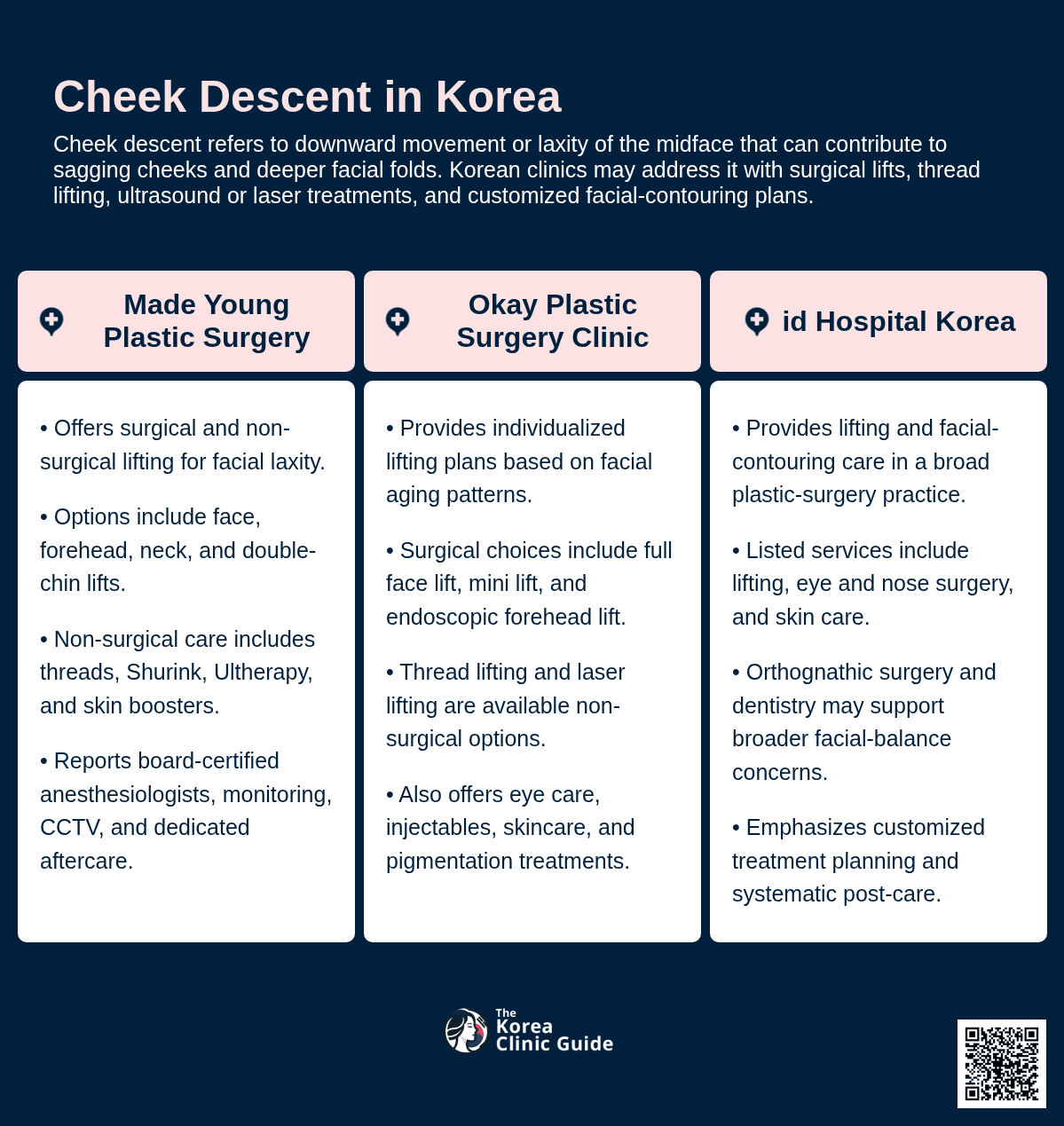
Listed below are some of the best clinics in Korea for cheek descent.
1. Made Young Plastic Surgery
For cheek descent associated with broader facial laxity, you can discuss surgical and non-surgical lifting options at Made Young Plastic Surgery, including face lift, thread lift, and ultrasound-based lifting. Its documented endoscopic lifting approach uses Full HD visualization for delicate dissection and can address connected forehead, brow, and upper-face concerns when relevant to your treatment plan.
- URL: Made Young Plastic Surgery Website
- Location: Seocho-gu, Seoul
- Lifting approaches:
- Surgical options listed include face lift, forehead lift, sub-brow lift, neck lift, and double chin lift.
- Non-surgical options listed include thread lift, Shurink focused ultrasound treatment, Ultherapy, V-Line lifting, and skin boosters.
- The clinic describes endoscopic lifting with lifting of skin, periosteum, and muscle; its forehead approach may include procerus muscle resection and authentic Endotine fixation.
- Safety and aftercare:
- Full-time board-certified anesthesiologists are listed, with one-to-one continuous anesthetic monitoring and an emergency cross-check system.
- The clinic reports CCTV coverage of procedures and a separate aftercare center for post-procedure care.
- The medical team provides direct consultation and diagnosis before procedures.
2. Okay Plastic Surgery Clinic
For cheek descent, you can explore a tailored lifting plan at Okay Plastic Surgery Clinic based on your individual aging pattern. Available approaches include full face lift, mini lift, thread lifting, and laser lifting, with laser treatment described as an option to combine with the surgical plan.
- URL: Okay Plastic Surgery Clinic Website
- Location: Gangnam-gu, Seoul
- Lifting options:
- Face lift surgery and mini lift surgery are available for differing degrees of facial rejuvenation.
- Thread lifting and laser lifting are listed as non-surgical lifting options.
- An endoscopic forehead lift is also available when upper-face laxity or forehead concerns are part of your overall assessment.
- Related facial care:
- The clinic also lists under-eye surgery, middle-aged eye surgery, Botox and filler treatments, medical skincare, and treatment for pores, acne, scars, and pigmentation.
- Care is described as individualized, with treatment design tailored to your needs and goals.
3. id Hospital Korea
For cheek descent, you can consider lifting and facial-contouring care at id Hospital Korea within a practice focused on facial treatments. The clinic describes customized treatment planning, a patient-safety-oriented approach, and systematic post-care.
- URL: id Hospital Korea Website
- Location: Gangnam-gu, Seoul
- Relevant services:
- Listed treatment areas include lifting, facial contouring, eye and nose plastic surgery, skin care, and petit plastic surgery.
- Orthognathic surgery and dentistry are also listed, which may be relevant when your facial-balance concerns extend beyond soft-tissue laxity.
- Care approach: The clinic describes customized plastic surgery planning and systematic post-care.
Costs and Financial Considerations: Comparing Your Options
What Does It Cost in South Korea?
South Korean cosmetic surgery is famous for offering value. Here are typical costs:
- Endotine Forehead Lift: ₩4,500,000–₩9,000,000 ($3,300–$6,600 USD, average ~$4,418)
- Mid-Facelift: $4,500–$6,500 USD
Most clinics offer all-inclusive pricing, intelligently bundling consultations, tests, the surgery itself, anesthesia, medications, and aftercare. This transparent approach makes budgeting much simpler.
South Korea Versus the West
In the U.S., cosmetic procedure costs are noticeably higher—and less predictable due to itemized billing:
- General Facelift: Just the surgeon’s fee averages $11,395; total costs easily hit $13,000 or more depending on extras.
- Mid-Facelift: $6,453–$16,375
- Endoscopic Facelift: $7,372–$17,601
- Brow Lift: Surgeon’s fee typically $5,460, but full costs can surpass $20,000.
Are All-Inclusive Packages Really a Better Value?
The dollar savings are real, but there’s more to consider. For low-to-mid-priced procedures (under ~$6,000), costs of travel and accommodation may cancel out the price difference. South Korea’s true advantage lies in its all-inclusive approach and tailored patient care, reducing hidden expenses and hassles. Each patient should still compare detailed, itemized quotes, factoring in possible revisions or complications, before committing.
Below is a cost comparison snapshot:
| Country | Estimated Cost Range for Mid-Face Lift (USD) | What's Typically Included |
|---|---|---|
| South Korea | $4,500–$6,500 | All-inclusive: consults, tests, surgery, meds, translation, follow-ups, sometimes accommodation |
| United States | $6,453–$16,375 | Itemized: surgeon, anesthesia, facility, tests, prescriptions |
Patient Outcomes and Real-World Experience
What Are Patients Saying?
Most reports indicate high satisfaction: one study found 95.3% of Endotine forehead lift patients were "happy or very happy." The general "cheek lift" procedure enjoys an 85% "Worth It" score on review websites, and many patients report looking younger and more refreshed.
However, not every story is positive. A minority report feeling overly "stretched," "unnatural," or unhappy with facial proportions post-surgery. Some describe their cheeks as positioned too high, or eyes looking different, leading to regret. These cases stress the significance of choosing a skilled and experienced surgeon who understands facial aesthetics and technique. The possibility of an unintended, artificial look serves as a reality check for expectations.
What Are the Risks and Side Effects?
Every surgery comes with some risks:
- Typical Side Effects: Swelling, bruising, and facial tightness are common early on; swelling may take months to fully subside.
- Endotine-Specific Issues: The implant may be noticeable to the touch for some time while it dissolves; occasional lumpiness or tenderness can occur and persist for months.
- Serious Risks (Rare): Implant shifting (occasionally requiring a revision), nerve injury (causing temporary or rarely persistent numbness), infection, slow healing, and rare instances of hair loss around incisions.
Synthesis of Testimonials
When Endotine Lift works as intended, it offers significant, lasting improvement with only modest invasiveness. Most patients highlight a quick recovery and a natural-appearing result. Yet, occasional negative experiences remain a sobering reminder that satisfaction is not guaranteed—which underscores the need for thorough research, skilled surgical hands, and an honest appraisal of risks.
Conclusion
"Cheek descent" stems from both structural drooping and volume loss of the mid-face, and the Endotine Lift is a minimally invasive, bioabsorbable solution that gets to the heart of this problem. While South Korea’s affordable, all-inclusive approach to medical tourism adds value far beyond pricing, the most critical factors remain careful research, finding a top surgeon, and realistic expectations. In the end, thoroughly understanding the procedure and choosing an expert provider are the keys to a rewarding outcome.
References
1, 2, 3, 4, 5, 6, 7, 8, 9, 10, 11, 12, 13, 14, 15, 16, 17, 18, 19, 20, 21, 22, 23, 24, 25, 26, 27, 28, 29, 30, 31, 32, 33, 34, 35, 36, 37, 38, 39, 40, 41, 42, 43, 44, 45, 46.), 47, 48, 49, 50
Frequently Asked Questions
Related Blogs
Renuvion in Korea: Methods, Recovery, Risks, and Travel Planning
Renuvion uses helium-plasma radiofrequency energy beneath the skin, alone or after liposuction, to address mild-to-moderate localized laxity; Dermal resurfacing treats surface wrinkles with an external ablative handpiece. The article covers candidacy, alternatives, preparation, recovery, risks, Korea travel planning, and the need for surgeon clearance before flying.
Updated: Oct 13, 2026
Temporal Lift in Korea: Methods, Recovery, Risks and Travel Planning
A temporal lift elevates the outer brow through temporal scalp incisions, using open, subcutaneous, endoscopic, or combined techniques chosen for brow position, hairline, and eyelid anatomy. The article covers candidate screening, Korea facility and surgeon verification, a 10–14-day stay, recovery restrictions, aftercare, warning signs, and alternatives such as forehead lift, blepharoplasty, and p
Updated: Oct 13, 2026
Premature aging face treatment in Korea: Face Lift options for younger-looking skin
Early onset facial laxity and wrinkles are rising among 30s–40s. Our Korea medical tourism guide explains rhytids and how a rhytidectomy (face lift) can refresh the lower face and neck. Explore options: Deep Plane Facelift, SMAS Facelift, Mini Facelift, Lower Facelift and Neck Lift, plus non-surgical adjuncts. Learn candidacy, recovery timelines, costs, certifications, and tips for planning surger
Updated: Oct 12, 2026
Brow Ptosis in Korea: Forehead Lift and Subbrow Lift Treatment Options
Thinking about Brow Ptosis surgery in Korea? This expert guide explains diagnosis, functional vs cosmetic concerns, and compares a Forehead Lift with a Subbrow Lift—indications, scars, recovery, and costs. It maps the South Korea medical tourism journey (planning, visas, surgery day, follow-ups), highlights surgeon credentials and safety, and shares real outcomes, risks, and patient stories so you
Updated: Oct 12, 2026
Clinics offering Endotine Lift

Made Young Plastic Surgery: Rejuvenating Aesthetic Excellence in Korea for Face Lifts, Contouring and More
Gangnam Station

Okay Plastic Surgery Clinic in Korea: Comprehensive Aesthetic Procedures with Sincerity and Care
Cheongdam
ID Hospital - Main Branch in Korea: Specializing in Safe & Customized Facial Plastic Surgery and Post-Care Services
Sinsa
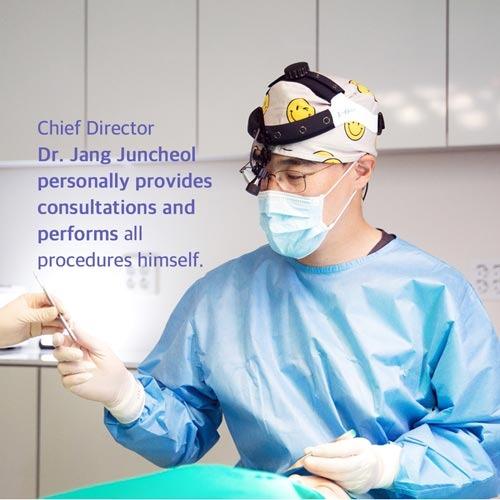
GGN Plastic Surgery Korea: Expert Cosmetic Procedures for Eye, Face, and Non-Surgical Enhancements in Gangnam Station
Gangnam Station