
Medical Tourism Blog
V Beam laser in Korea: candidacy, treatment process, recovery and travel planning
Table of contents
- V Beam laser at a Glance
- What Is Vbeam Laser?
- Who Is a Good Candidate for Vbeam Laser?
- How Is Vbeam Laser Performed?
- Why Visit Korea for Vbeam Laser?
- Key Information for International Patients
- Which Are the Best Clinics in Korea for V Beam Laser?
- V Beam laser From Start to Finish
- Alternatives to Vbeam Laser
- How Can I Prepare for Vbeam Laser?
- Aftercare Advice
Considering treatment in Korea? Everything you need to know e.g. — how to avoid scams, visas, interpreters, recovery tips — in our Medical Tourism Master Guide. Plan with confidence in minutes, not weeks!
Last updated: September 2026
V Beam laser at a Glance
- What it treats — Vbeam is a 595-nm pulsed dye laser that targets hemoglobin in superficial vessels, used for facial redness, telangiectasia, cherry angiomas, port-wine stains, red hypertrophic scars, and selected persistent red post-acne marks.
- Best candidates — It is best suited to clinician-diagnosed vascular redness or visible vessels; it can improve rosacea-related erythema but does not cure rosacea or prevent future flushing and vessel formation.
- Not for scar texture — Vbeam treats red vascular color, not brown pigment or depressed, tethered acne scars; textural scars usually need options such as subcision, fractional laser, RF microneedling, TCA CROSS, filler, or punch techniques.
- Downtime choice — Non-purpuric treatment usually allows normal indoor activity immediately, with burning or swelling for hours to 48 hours and redness for several days; purpuric settings intentionally leave purple bruise-like marks for about 7–14 days.
- Results and repeat sessions — Assess improvement after acute changes settle, usually around 2–4 weeks; a treatment series is common, with sessions generally spaced about 4–8 weeks apart, and chronic rosacea or recurring vessels may need maintenance.
- Korea travel planning — Allow at least 2–3 full days in Korea after a conservative non-purpuric facial session; plan 7–14 days or arrange treatment near home for purpura, large areas, a first session, or prior blistering or pigment complications.
- Key safety consideration — Recent tanning or sunburn, active infection or cold sores, open wounds, severe dermatitis, and undiagnosed changing or pigmented lesions require postponement or diagnosis first; darker skin types and those prone to post-inflammatory hyperpigmentation may need a test spot and conservative settings.
What Is Vbeam Laser?
Vbeam is a 595-nm pulsed dye laser that targets hemoglobin in superficial blood vessels to reduce vascular redness. It can improve visible facial vessels, rosacea-related redness, red post-acne marks, cherry angiomas, and selected vascular birthmarks or scars, though repeat sessions are often needed. Vbeam is a minimally invasive, non-surgical outpatient laser treatment.
Who Is a Good Candidate for Vbeam Laser?
- Diffuse vascular redness — Good candidates have clinician-diagnosed facial erythema, flushing-related visible vessels, or rosacea-related telangiectasia and understand that pulsed dye laser (PDL) improves visible vessels rather than curing rosacea.
- Persistent red acne marks — Vbeam can target the vascular redness of post-acne erythema after active acne is controlled. A small randomized trial found reduced erythema after 595-nm PDL for post-comedone-extraction redness, but this does not establish one protocol for every red acne mark or skin type.
- Discrete vascular lesions — Cherry angiomas, small telangiectases, and selected red hypertrophic scars can be suitable focal targets after diagnosis.
- Capillary malformations — Port-wine stains often respond to a series of treatments, although substantial improvement does not guarantee complete clearance.
- Realistic downtime needs — Non-purpuric treatment suits patients who need little visible downtime; those accepting 7–14 days of purple bruise-like marks can discuss purpuric treatment for an appropriate vascular target.
Vbeam is a 595-nm PDL that preferentially targets hemoglobin in superficial blood vessels, so the diagnosis and color of the target matter. It is not a pigment laser, does not release tethered or depressed acne scars, and does not prevent future flushing or vessel formation. Do not treat an undiagnosed changing, bleeding, or pigmented lesion until cancer and other diagnoses have been excluded. Active infection, open wounds, severe dermatitis, active cold sores, recent tanning or sunburn, and inability to maintain sun protection require postponement; recurrent facial herpes can require clinician-directed antiviral prevention. Pregnancy and breastfeeding are common reasons to defer elective treatment because direct safety evidence is limited. Fitzpatrick IV–VI skin, melasma, previous post-inflammatory hyperpigmentation, keloid history, anticoagulant use, and a planned purpuric endpoint require individualized assessment; evidence in darker skin remains limited, with a review identifying only nine port-wine-stain studies involving 241 Fitzpatrick IV–VI patients.
How Is Vbeam Laser Performed?
Treatment is tailored to vessel depth, redness pattern, skin type, and acceptable downtime. Confirm the exact Vbeam device, wavelength, planned endpoint, and cooling system; some Vbeam Prima configurations also include a separate 1,064-nm Nd:YAG modality.
- Purpuric PDL — Settings intentionally create immediate purple discoloration, indicating vascular injury. This approach can be selected for discrete vessels, capillary malformations, or some scar protocols, but the discoloration usually takes 7–14 days to fade.
- Non-purpuric PDL — Lower or adjusted settings aim to reduce diffuse redness with little or no bruising. This is often practical for facial erythema when social downtime matters, although response and session count depend on diagnosis and parameters.
- Focal treatment — Individual telangiectases and cherry angiomas receive targeted pulses. Short appointments are common when only a few lesions are treated.
- Field treatment — Overlapping pulses cover broader areas such as the cheeks, nose, chin, neck, chest, a red scar, or a port-wine stain. Larger areas take longer and tend to cause more temporary swelling and redness.
- Cooling and settings — Spot size, fluence, pulse duration, passes, vessel characteristics, skin phototype, and epidermal cooling determine the plan. Dynamic cooling improves comfort and protects the surface skin, but does not eliminate burn or pigment-change risk.
Why Visit Korea for Vbeam Laser?
Korea has an established medical-tourism framework and access to outpatient dermatologic laser care. That does not mean a Vbeam session in Korea produces better results than the same appropriately selected protocol elsewhere. Correct diagnosis, conservative parameter selection for the skin type, device maintenance, and accessible follow-up matter more than country.
- International-care infrastructure — Korea’s official Medical Korea platform provides information for overseas patients seeking Korean healthcare services.
- Device verification matters — Ask the clinic to identify the device model and actual wavelength used. “Vbeam” is a brand family, not a diagnosis or a guarantee that 595-nm PDL is the planned modality.
- Evidence-based limits — A systematic review found PDL broadly comparable with other light-based rosacea treatments, while judging support for device-specific recommendations low to moderate. Inconsistent rosacea outcome reporting also limits direct comparisons among branded protocols.
- Skin-type planning — Patients with Fitzpatrick IV–VI skin should ask about test spots, pigment-risk counselling, and experience with their specific indication rather than assuming a standard setting is suitable.
Key Information for International Patients
- Minimum stay — After a conservative non-purpuric facial session, remain in Korea for at least 2–3 full days so an in-person review is still possible. Plan 7–14 days, or arrange treatment close to home, for purpuric settings, a large area, a first treatment, or a history of blistering or pigment complications.
- Course timing — A complete course cannot usually fit into one trip. Sessions are commonly separated by about 4–8 weeks; many courses use 4–6-week spacing, while one rosacea study used 6–8-week intervals.
- Flights — Uncomplicated outpatient PDL does not usually create a medical restriction on flying. Delay departure and obtain review for marked facial swelling, oozing, blistering, eye symptoms, or possible infection.
- Itinerary impact — Non-purpuric treatment often permits normal indoor activity immediately, although burning and swelling can last hours to 48 hours and redness can remain for several days. Avoid scheduling outdoor sightseeing, beach activities, sauna visits, and important photographs immediately after treatment.
- Remote follow-up — Agree on an English-speaking contact route before treatment and send clear daylight photographs if instructed. There are no validated travel-specific remote-follow-up protocols, so arrange a qualified dermatologist at home for complications or ongoing care.
- Treatment documentation — Obtain an English record before leaving: diagnosis, device and wavelength, spot size, fluence, pulse duration, cooling method, treated areas, endpoint, photographs, supplied medicines or ointment, aftercare instructions, and emergency contact.
Travel note: Do not combine a first Vbeam session with aggressive peels, ablative or fractional resurfacing, RF microneedling, or several unfamiliar injectables during a short trip. Combination treatment raises irritation risk and makes a complication harder to identify and manage.
Which Are the Best Clinics in Korea for V Beam Laser?
Listed below are some of the best clinics in Korea for v beam laser.
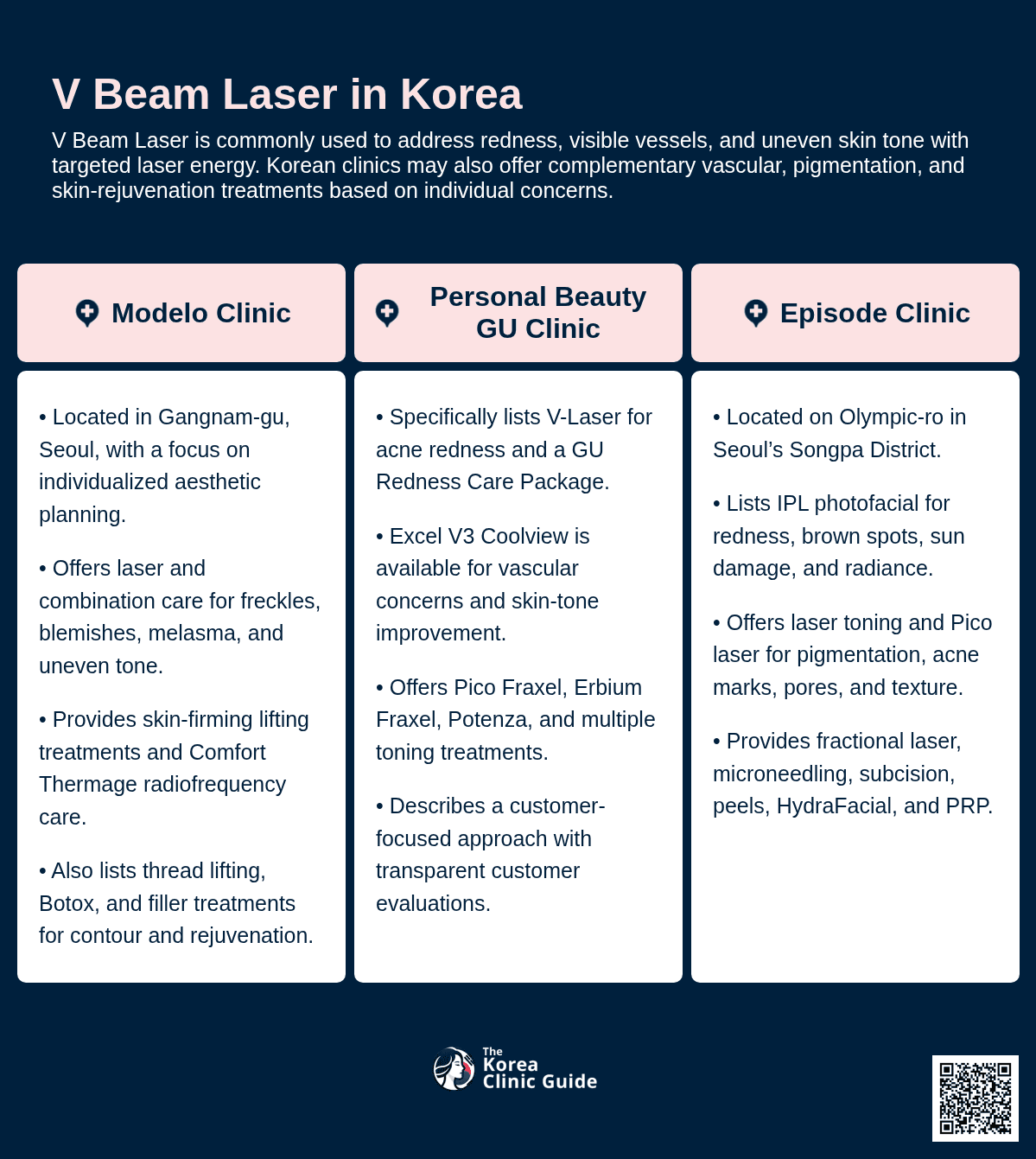
1. Modelo clinic
If you are considering V Beam Laser for concerns such as redness or uneven tone, Modelo Clinic’s provided information emphasizes individualized aesthetic planning and laser-based combination care for freckles, blemishes, melasma, and overall skin clarity; it does not specifically list V Beam by name.
- URL: Modelo clinic Website
- Location: Gangnam-gu, Seoul
- Skin-focused care:
- Whitening care is described as targeting freckles, blemishes, and melasma to promote a brighter, more even-looking complexion.
- The clinic notes the use of various laser and combination treatments, tailored to your skin characteristics and concerns.
- Other listed services:
- Skin-firming lifting treatments and Comfort Thermage radiofrequency care are listed for sagging skin and contour concerns.
- Thread lifting is listed as a minimally invasive option intended to lift and tighten sagging skin while supporting collagen production.
- Botox and filler services are also listed, including wrinkle Botox, contour Botox, full-face filler, and under-eye “baby filler.”
2. Personal Beauty GU Clinic
For V Beam Laser–type redness concerns, Personal Beauty GU Clinic specifically lists V-Laser for acne redness and a GU Redness Care Package, alongside vascular-focused Excel V3 Coolview treatment. Its broader laser menu also includes pigmentation, texture, scar, and tone treatments, allowing your redness concerns to be considered alongside other skin goals.
- URL: Personal Beauty GU Clinic Website
- Location: Seocho-gu, Seoul
- Redness and vascular care:
- V-Laser for acne redness is specifically listed among the clinic’s pigment-toning and spot-removal options.
- The GU Redness Care Package is listed as comprehensive care for reducing skin redness.
- Excel V3 Coolview is listed for vascular concerns and skin tone.
- Related laser options:
- Gentle Max Pro is among the clinic’s listed equipment.
- Pico Fraxel is listed for pigmentation, scars, and texture improvement; Erbium Fraxel is listed for resurfacing and collagen production.
- Potenza RF microneedling is listed for wrinkles, fine lines, and texture concerns.
- Star Toning, Titanium Toning, Genesis, Dual Toning, and Curas Hybrid Melasma Toning are also listed for pigmentation and tone-related concerns.
- Practice background:
- The clinic describes a customer-perspective approach and states that it transparently discloses customer evaluations.
- Its Gangnam branch is described as being led by the Vice President of the Gangnam Unni group.
3. Episode Clinic
If you are exploring V Beam Laser in Korea for redness, Episode Clinic’s provided service list does not specifically name V Beam, but it does list IPL photofacial for redness, brown spots, and sun damage. It also offers several complementary skin treatments for pigmentation, texture, acne marks, and scars.
- URL: Episode Clinic Website
- Location: 3f, 336 Olympic-ro, Songpa District, Seoul, South Korea
- Redness and tone options:
- IPL photofacial is listed as targeting redness, brown spots, and sun damage while supporting subtle texture and radiance improvement.
- Laser toning is listed for evening pigmentation and brightening dull skin with low downtime.
- Pico laser is listed for spots, freckles, acne marks, texture, pores, and overall clarity.
- Texture and scar care:
- Fractional laser resurfacing is listed for collagen remodeling to improve scars, wrinkles, texture, and tone.
- Microneedling is listed for scars, pores, and fine lines.
- Subcision is listed for tethered depressed acne scars and may be combined with lasers or fillers.
- Chemical peels, HydraFacial, and PRP are also listed among skin-rejuvenation options.
V Beam laser From Start to Finish
- Remote enquiry and image review — Send unfiltered daylight photographs and explain the diagnosis, target area, previous laser treatments, skin type and tanning history, cold-sore history, pigment or keloid history, allergies, pregnancy or breastfeeding status, medicines, supplements, and travel dates. Confirm whether English consultation or virtual pre-screening is available.
- Treatment planning before travel — Ask whether the plan is 595-nm PDL, whether purpura is intended, how many sessions are likely, and whether a test spot is appropriate. Build in 2–3 full post-treatment days for conservative facial treatment, or longer for visible purpura or higher-risk circumstances.
- In-person medical assessment — The clinician examines the redness or lesion, excludes active inflammation or infection, reviews phototype and prior procedures, and determines whether Vbeam is suitable. Baseline photographs should be taken; a test spot is particularly useful after recent tanning, previous post-inflammatory hyperpigmentation, uncertain diagnosis, or in darker skin.
- Skin preparation and comfort — The area is cleansed and protective eyewear is mandatory. Cooling alone is often sufficient; topical anesthetic is sometimes used for sensitive or extensive areas. Standard outpatient PDL does not require fasting unless sedation is planned.
- Laser delivery — The operator selects spot size, fluence, pulse duration, cooling, and coverage based on the vessels and endpoint. Pulses commonly feel like heat or a rubber-band snap. A few focal lesions take minutes, while full-face, neck, chest, extensive scar, or port-wine-stain treatment takes longer.
- Immediate assessment and discharge — Temporary redness, swelling, itching, pinpoint darkening, or planned purpura are checked before discharge. Most adults leave the same day without a companion; arrange one for a child, sedation, or pain or swelling that could interfere with travel.
- Early recovery and review — Use the written aftercare plan and attend the arranged review if there is persistent concern. Assess improvement only after acute redness, swelling, and any purpura settle, commonly around 2–4 weeks.
- Overseas follow-up and next session — Send requested photographs to the treating clinic and seek local medical review promptly for concerning symptoms. Schedule further sessions around the clinician’s recommended interval rather than compressing treatments into a single visit.
Alternatives to Vbeam Laser
The best alternative depends on whether the main problem is superficial vessels, diffuse redness, brown pigmentation, active rosacea inflammation, or scar texture. Light-based treatments can address vascular color without surgery, but they cannot correct depressed or tethered acne scars; those scars often need structural procedures.
IPL
- Best fit — IPL can address diffuse redness alongside some pigment concerns.
- Tradeoff — It is not PDL and is not automatically suitable for every skin type, vascular target, or discrete vessel. See IPL.
Medical rosacea management
- Best fit — Persistent flushing, papules, pustules, burning, or ocular symptoms require phenotype-based rosacea care alongside or before laser treatment.
- Tradeoff — Topical brimonidine or oxymetazoline can temporarily reduce erythema, while anti-inflammatory topical or oral therapies address appropriate inflammatory disease; neither replaces evaluation of visible vessels. See redness treatment.
Acne and acne-scar treatment
- Best fit — Active acne needs acne-directed management, while rolling, boxcar, ice-pick, or tethered scars require morphology-based planning.
- Tradeoff — Subcision, fractional laser, RF microneedling, TCA CROSS, punch techniques, or filler target texture and scar architecture, not just red color. See acne treatment and acne scar treatment.
Other vascular lasers
- Best fit — KTP 532-nm laser can suit superficial facial vessels; long-pulsed 1,064-nm Nd:YAG can be considered for deeper or larger vessels.
- Tradeoff — Wavelength selection depends on vessel depth, color, anatomical site, and skin type rather than brand preference.
Hypertrophic-scar therapy
- Best fit — Raised, symptomatic, or keloid-prone scars often need a combined plan.
- Tradeoff — Silicone, pressure therapy, intralesional corticosteroid or 5-fluorouracil, and recurrence prevention can be more central than PDL; PDL is generally adjunctive for scar redness. See steroid injections for scars.
How Can I Prepare for Vbeam Laser?
- Sun and tanning — Avoid intentional tanning, tanning beds, self-tanner, and sunburn before treatment. Use broad-spectrum sunscreen and physical protection; recent ultraviolet exposure increases burn and post-inflammatory hyperpigmentation risk.
- Medicines and supplements — Disclose aspirin, NSAIDs, warfarin, apixaban, clopidogrel, other anticoagulants or antiplatelets, corticosteroids, isotretinoin, photosensitizing medicines, acne products, and every supplement. Report fish oil or omega-3, vitamin E, ginkgo, garlic, ginseng, turmeric or curcumin, and alcohol use because bruising or flushing can affect planning. Do not stop prescribed aspirin, anticoagulants, or other medicines without the prescriber’s approval.
- Active skin problems — Tell the clinic about cold sores, acne flares, dermatitis, infection, wounds, eye symptoms, and new or changing pigmented lesions. Reschedule rather than lasering infected or inflamed skin.
- Skincare and devices — Ask the treating clinician exactly when to pause retinoids, benzoyl peroxide, salicylic acid, glycolic or lactic acids, exfoliants, scrubs, and at-home devices. The pause period depends on the indication, area, skin sensitivity, and treatment intensity.
- Fasting and transport — Standard outpatient PDL needs no fasting and most adults can travel independently afterward. Follow fasting, companion, and transport requirements if topical anesthetic, sedation, or a larger treatment plan changes the clinic protocol.
- Travel logistics — Book flexible plans, avoid intensive sun exposure before and after the appointment, and reserve enough time for review. Bring your passport, medication list, allergy details, prior records, and unfiltered baseline photographs.
Travel note: Schedule the laser early in the trip rather than immediately before an international flight, especially for a first session or any treatment expected to cause purpura.
The treating doctor’s individualized instructions take precedence over this general guidance; confirm the clinic’s exact medicine, skincare, fasting, and travel requirements before treatment.
Aftercare Advice
Protect the treated skin from heat, friction, and ultraviolet exposure until it has settled, and treat unexpected worsening as a reason to contact the clinic rather than covering it with makeup or active skincare.
- Cooling and cleansing — Use cool compresses wrapped in a clean cloth; never put ice directly on the skin. Cleanse gently, pat dry, and use a bland moisturizer or petrolatum only if the clinician recommends it.
- Expected changes — Burning and swelling generally settle within hours to 48 hours; redness can last several days. Purpuric treatment intentionally produces purple discoloration that generally fades over 7–14 days. Blistering, crusting, or pigment change prolongs recovery.
- Hands, cosmetics, and skincare — Do not rub, scrub, exfoliate, pick crusts, or use retinoids, acids, benzoyl peroxide, or at-home devices until the clinic confirms the skin has healed. Ask when makeup is appropriate for the specific endpoint and skin condition.
- Activity and heat — Avoid strenuous exercise, hot baths, saunas, swimming, contact sports, and treatment-area friction until the skin has healed. Heat and alcohol can worsen flushing in people with rosacea.
- Sun protection — Use broad-spectrum SPF 50 and physical shade protection consistently. Avoid direct sun exposure, tanning, and sunburn throughout recovery.
- Warning signs — Seek urgent review for worsening pain, extensive blistering, spreading warmth or redness, pus or foul drainage, fever, major swelling around an eye, visual symptoms, persistent bleeding, or signs of an allergic reaction.
- Results and next steps — Judge the result at roughly 2–4 weeks, after acute changes settle. A series is common, and future maintenance can be needed for chronic rosacea or recurring vessels.
Follow the treating doctor’s instructions over general advice and contact the clinic promptly when anything appears wrong.
Frequently Asked Questions
Related Blogs
Effective Korea PDRN Injection Treatments for New Stretch Marks
Discover how PDRN injections in Korea offer an advanced treatment for new stretch marks (striae rubrae). Known for stimulating collagen, elastin, and skin regeneration, Korea's expert clinics provide effective solutions for early-stage stretch marks. Benefit from cutting-edge techniques in medical tourism-friendly environments, with affordable costs and proven results. Learn how Korea’s PDRN tre
Updated: Oct 30, 2026

Effective Freckles Removal with PicoSure in Korea: Top Solution for Clear, Beautiful Skin
Discover how Korea leads in pigmented spot removal with advanced PicoSure laser treatments. Ideal for addressing "small brown sun specks," freckles, and sun spots, Korea offers expert care using cutting-edge picosecond technology that effectively clears pigmentation while rejuvenating the skin. Its combination of top dermatological expertise, affordable pricing, and proven results makes Korea the
Updated: Oct 30, 2026

Transform Your Look: Neck Lines & Neck Wrinkle Treatment Procedures in Korea
Discover effective neck wrinkle treatments in Korea, including Botox, dermal fillers, Ultherapy, laser resurfacing, and surgical neck lifts. As a leading destination for medical tourism, Korea offers advanced procedures to eliminate "tech neck" lines and restore a youthful neck profile. This comprehensive guide explores treatment options, costs, and patient experiences, empowering you to plan your
Updated: Oct 29, 2026
Effective Tear Trough Depression Treatment in Korea with Juvelook Volume Filler
Discover how Korea leads in treating tear trough depression—the "sunken groove below the eye." This condition causes dark circles, hollows, and a tired look. The innovative Juvelook Volume Filler, approved in Korea, combines hyaluronic acid and polylactic acid to deliver immediate hydration and long-term collagen boost, providing natural rejuvenation. Learn how Korea's advanced clinics perform thi
Updated: Oct 28, 2026
Clinics offering V Beam laser

Modelo Clinic Korea: Achieving Timeless Beauty with Personalized Botox, Filler, Skincare Treatments & More
Apgujeong

Personal Beauty GU Clinic Ilsan, Korea - Unveiling Hidden Beauty with Tailored Treatments and Advanced Cosmetic Procedures
Ilsan

Beautiful Clinic in Korea: Comprehensive Aesthetic and Medical Procedures for Enhanced Beauty and Confidence
Konkuk University

DATENA CLINIC Korea | Personalized Dermatology, Lifting & Skin Rejuvenation in Seoul
Jamsil