
Medical Tourism Blog
Top Surgery in Korea: Techniques, Recovery, Travel Planning and Safety
Table of contents
- Top Surgery at a Glance
- What Is Top Surgery?
- Who Is a Good Candidate for Top Surgery?
- How Is Top Surgery Performed?
- Why Visit Korea for Top Surgery?
- Key Information for International Patients
- Which Are the Best Clinics in Korea for Top Surgery?
- Top Surgery From Start to Finish
- Alternatives to Top Surgery
- How Can I Prepare for Top Surgery?
- Aftercare Advice
Considering treatment in Korea? Everything you need to know e.g. — how to avoid scams, visas, interpreters, recovery tips — in our Medical Tourism Master Guide. Plan with confidence in minutes, not weeks!
Last updated: September 2026
Top Surgery at a Glance
- What it does — Top surgery is permanent masculinizing chest reconstruction performed under general anesthesia; it removes breast tissue and reshapes skin, fat, and sometimes the nipple-areola complexes to create a flatter or individualized chest contour.
- Technique depends on anatomy — Double-incision surgery with free nipple grafts is commonly used for larger chests, skin excess, or ptosis, while keyhole or periareolar approaches suit selected smaller, non-ptotic chests with good skin elasticity.
- Recovery timeline — Early wound, dressing, and drain care usually takes 1–2 weeks; lifting is limited to 5 lb or less for the first 2 weeks, and exercise, pushing, pulling, and overhead lifting are typically resumed gradually over 4–6 weeks.
- Results and permanence — Swelling improves over weeks to months, while scars and contour can continue maturing for up to 12 months; scars, altered nipple sensation, and loss of breastfeeding capacity may be permanent, and revision is sometimes needed.
- Korea travel stay — International patients should remain in Korea for at least 14 days and travel home only with surgeon clearance; a 21-day stay is more prudent after long-haul travel or when drains or free nipple grafts are used.
- Korea-specific verification — Korea offers international-patient coordination services, but these do not prove top-surgery expertise; directly confirm the surgeon’s experience with the planned technique, English-language aftercare, pathology process, and plan for complications after departure.
- Key healing risk — Nicotine from smoking, vaping, or replacement products can impair healing and threaten skin flaps or nipple grafts; many protocols require stopping before surgery and remaining nicotine-free during recovery.
What Is Top Surgery?
Top surgery is gender-affirming chest reconstruction that removes breast tissue and reshapes the chest for a flatter or individualized masculine contour. It can help relieve chest dysphoria and align a person’s appearance with their gender expression. It is a surgical procedure performed under general anesthesia.
Who Is a Good Candidate for Top Surgery?
- Informed, durable goals — Good candidates want permanent masculinizing chest contouring and understand the trade-offs: visible scars, altered or absent nipple sensation, possible nipple changes, and potential revision surgery.
- Anatomy matched to a technique — Chest size, breast ptosis, skin elasticity, asymmetry, lateral chest fullness, and nipple preferences determine whether limited-incision, double-incision, pedicled-nipple, or free-nipple-graft surgery is realistic.
- Medically prepared for surgery — Candidates can safely undergo general anesthesia and have stable conditions, a coordinated medication plan, and reliable accommodation, transport, and support during early recovery.
- Individual transition pathway — Testosterone is not inherently required for chest masculinization. Nonbinary patients and transmasculine patients can pursue a flat, reduced, or individualized chest outcome.
Top surgery is not appropriate when informed and voluntary consent cannot be established or when uncertainty about a permanent chest outcome needs further decision support. Elective surgery is usually postponed for active infection, fever or respiratory illness, pregnancy, uncontrolled diabetes or hypertension, significant unmanaged cardiopulmonary disease, bleeding disorders without a plan, or current nicotine exposure. Nicotine from cigarettes, vaping, replacement products, and other sources can impair healing and threaten skin flaps and nipple grafts. A breast mass, suspicious symptoms, prior atypia, or substantial genetic or family cancer risk needs individualized breast assessment before contouring surgery; published Korean requirements for nonresident patients, including age and documentation rules, are not standardized, so confirm the facility's policy directly.
How Is Top Surgery Performed?
Technique selection is an anatomical and goal-based decision, not a matter of choosing the shortest scar. Ask to see healed results from patients with comparable chest size, skin quality, scar tendency, and desired nipple outcome.
- Double incision with free nipple grafts — Two lower-chest incisions permit substantial glandular tissue and excess-skin removal. The nipple–areola complexes are removed, commonly resized and repositioned, then grafted. This approach is often used for larger chests, more skin excess, or ptosis; trade-offs include longer scars, approximately two weeks of dry graft-dressing care, pigment or projection changes, and reduced or permanently absent erotic nipple sensation.
- Double incision with pedicled nipple preservation — The nipple–areola complex remains connected to a blood supply while tissue and skin are removed. In selected anatomy, this can preserve more sensation, but nipple repositioning and maximum chest flattening can be more constrained than with free grafting.
- Periareolar, circumareolar, or keyhole surgery — Incisions around or along the lower edge of the areola remove tissue with shorter scars. These approaches suit selected smaller, non-ptotic chests with strong skin elasticity; greater skin excess raises the likelihood of residual looseness, areolar widening, contour irregularity, or later revision.
- Contour and nipple choices — Liposuction can address lateral chest or axillary fullness. Some patients choose no nipples; others plan later nipple reconstruction or areola tattooing. UCSF's technique overview similarly distinguishes free-nipple-graft double incision for larger chests from limited-incision approaches for selected smaller chests.
Why Visit Korea for Top Surgery?
South Korea has an established international-medical-care framework that can help visitors coordinate appointments and practical travel arrangements. That infrastructure does not demonstrate top-surgery expertise at every provider. For this operation, surgeon-specific experience, hospital and anesthesia standards, pathology handling, and an explicit plan for complications after departure matter more than a destination-wide reputation.
- International-care infrastructure — Medical Korea describes services that can include scheduling, interpretation, preoperative examinations, follow-up care, medical reports, and travel, visa, or accommodation assistance. Confirm in writing that the proposed facility actually provides gender-affirming, English-language surgical and postoperative support.
- Domestic patient-reported data — In a 2024 multicenter Korean survey published in 2025, 382 of 844 transgender and gender-diverse respondents had undergone gender-affirming surgery; among surgical respondents, 77.8% reported high satisfaction with chest/breast surgery. The survey does not provide top-surgery technique-specific complication or revision rates, compare Korea with other countries, or establish outcomes for international visitors.
- Need for direct verification — No robust public comparative evidence shows that South Korean top-surgery outcomes are better than those elsewhere. Request the operating surgeon's training, experience with the exact proposed technique, healed photographs of comparable cases and skin tones, facility accreditation information, after-hours contact process, pathology plan, revision policy, and remote follow-up protocol.
Key Information for International Patients
- Minimum stay — Remain in Korea for at least 14 days after surgery and leave only with written clearance from the operating surgeon. A 21-day stay is more prudent after a long-haul trip, especially when drains or free nipple grafts are used, because it allows usual one- and two-week wound reviews.
- Flight timing — CDC medical-tourism guidance advises delaying air travel for 10–14 days after major surgery, particularly chest surgery. Recent surgery and a flight over four hours both increase venous-thromboembolism risk; do not self-start aspirin for prevention.
- Early appointments — Expect wound and drain assessment around one week and a further review around two weeks. A representative UCSF protocol includes visits at roughly one, two, and six weeks, but the operating surgeon sets the actual schedule.
- Recovery limits — Avoid lifting more than 5 lb for the first two weeks. Strenuous exercise, pushing, pulling, and overhead lifting are generally reintroduced in stages over about four to six weeks, depending on incision healing, drains, grafts, and the surgeon's protocol.
- Companion and transport — Arrange a responsible adult for at least the first 24–72 hours. Do not drive after general anesthesia or while taking sedating pain medicine; use step-free accommodation and local transport close to the facility.
- Remote handoff — Before travel, identify a clinician at home willing to inspect wounds or remove sutures when needed. Obtain the operative report, anesthesia record, pathology report, discharge summary, prescriptions, drain record, and written aftercare plan before leaving Korea.
Travel note: Photo or video follow-up can support routine recovery, but it cannot replace prompt in-person assessment for one-sided swelling, bleeding, suspected infection, wound separation, or possible blood clot symptoms.
Which Are the Best Clinics in Korea for Top Surgery?
Listed below are some of the best clinics in Korea for top surgery.
1. Seojin Plastic Surgery Clinic
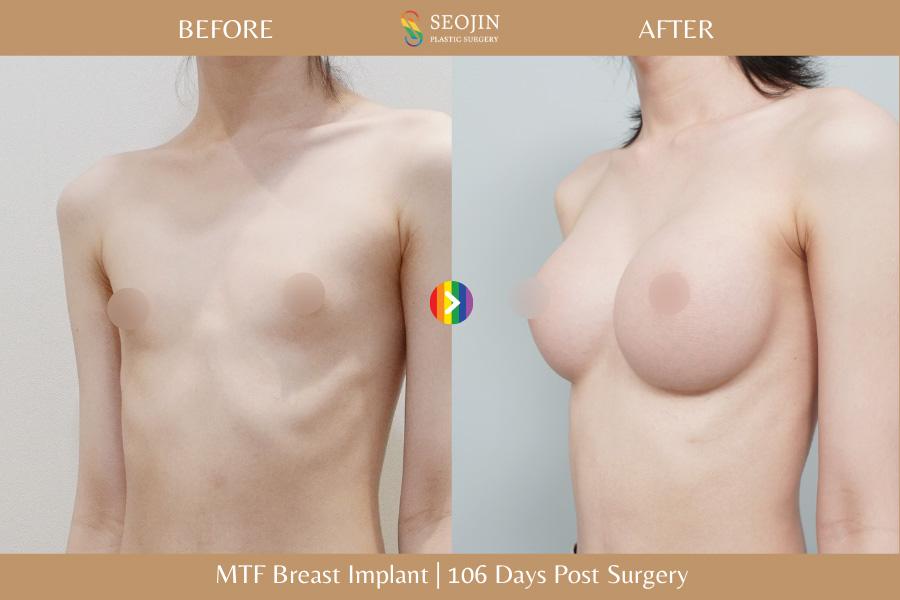
If you are exploring chest-related surgery as part of your top-surgery planning, Seojin Plastic Surgery Clinic offers breast reduction and gynecomastia procedures, alongside transgender-focused breast implant surgery. Your care is described as end-to-end with Dr. Lee Hyungmin in a one-doctor clinic; confirm during consultation whether the clinic provides the specific gender-affirming chest procedure and surgical approach you need.
- URL: Seojin Plastic Surgery Clinic Website
- Location: Gangnam-gu, Seoul
- Breast and chest procedures:
- Offers breast reduction, nipple surgery, and gynecomastia surgery intended to reduce breast size and create a flatter chest contour.
- Lists specialized breast implant procedures for transgender clients; this is distinct from chest masculinization or mastectomy, so discuss your individual goals directly.
- Also offers breast lift and hybrid implant procedures combining implants with fat grafting.
- Surgeon and planning:
- Dr. Lee Hyungmin is described as having more than 16 years of experience and as a recipient of recognition among Korea's 100 Good Doctors.
- The clinic reports using personalized consultations, 3D imaging, and high-definition endoscopy.
2. THEPLUS Plastic Surgery
For top-surgery-related planning, THEPLUS Plastic Surgery lists breast reduction among its breast procedures, with a board-certified plastic surgeon, Dr. Lee, whose stated specialty is breast augmentation. The available information does not specifically confirm gender-affirming chest masculinization or mastectomy, so you should clarify whether the clinic performs the exact procedure, incision pattern, and nipple approach that fit your goals.
- URL: THEPLUS Plastic Surgery Website
- Location: Gangnam-gu, Seoul
- Breast procedures:
- Lists breast reduction, breast lift, and breast implant surgery.
- Breast reduction is described as removal of excess tissue and skin to create a smaller, more proportionate breast shape.
- Relevant clinical background:
- Dr. Lee is described as a board-certified plastic surgeon specializing in breast augmentation.
- Her experience includes a Surgery Specialist position at Seoul National University Hospital and involvement in Korean plastic-surgery societies.
- The clinic describes a focus on personalized aesthetic care, safety, research, and specialized surgical expertise.
3. Okay Plastic Surgery Clinic
Okay Plastic Surgery Clinic may be worth considering if your chest goals involve breast reduction or gynecomastia treatment: its specialized Breast Center offers breast reduction, breast lift, nipple correction, and gynecomastia procedures. Dr. Cho is described as a breast-surgery specialist with published research and experience in significant breast reductions; ask whether the clinic provides gender-affirming top surgery and how its plan would address your desired chest contour and nipple goals.
- URL: Okay Plastic Surgery Clinic Website
- Location: Gangnam-gu, Seoul
- Breast and chest services:
- The Breast Center offers breast reduction, breast lift, nipple correction, and gynecomastia surgery.
- Breast reduction is described as reducing breast size to address discomfort and achieve the desired aesthetic.
- The clinic also lists corrective treatment for inverted nipples.
- Breast-surgery expertise:
- Dr. Cho is described as having ongoing study and published research in breast surgery.
- The source notes experience with severe cases requiring significant breast reduction.
- Aftercare: The clinic states that it emphasizes comprehensive aftercare for natural, lasting results.
Top Surgery From Start to Finish
- Remote consultation and screening — Submit the requested medical history, medication and allergy list, securely shared chest photographs, prior breast imaging or pathology, and specific goals for contour, scars, nipples, and sensation. Confirm English or interpreter access, hospital versus clinic setting, anesthesiology coverage, drains, pathology, emergency contact, and revision policy in writing.
- Travel and arrival planning — Arrive several days before surgery for jet-lag recovery and required assessments. Book flexible flights, accessible accommodation near the facility, local transport, and a companion for the first days after discharge.
- In-person surgical assessment — The surgeon examines chest volume, ptosis, skin elasticity, asymmetry, lateral fullness, prior scars, and nipple position. The consultation confirms the procedure, scar placement, nipple approach, permanent effects, and realistic contour limitations.
- Pre-anesthesia review and testing — Complete patient-specific blood tests, imaging, or specialty clearance when requested. Review anticoagulants, antiplatelet medicines, diabetes drugs, hormones, supplements, nicotine exposure, sleep apnea, prior anesthesia reactions, clotting history, alcohol or recreational-drug use, and fasting instructions with the anesthesiologist.
- Surgery — Under general anesthesia, the surgeon removes breast tissue and reshapes skin and fat, with liposuction when planned. Nipple–areola complexes are preserved on a pedicle, grafted, resized, repositioned, or omitted according to the agreed technique. The operation commonly takes about two to four hours; UCSF's clinical guidance describes short-stay or overnight care, compression dressings, and frequent drain use.
- Discharge and immediate recovery — Leave after recovery from anesthesia and confirmation of pain control, mobility, and home support, or stay overnight when clinically indicated. Receive instructions for compression, drains, dressings, medication, bathing, activity, and emergency contact.
- Korea-based wound reviews — Attend scheduled drain, dressing, incision, and nipple-graft checks. Drain removal depends on output and clinical assessment rather than a fixed date; free grafts need particularly careful early surveillance.
- Return-home follow-up — Fly only after surgeon clearance. Continue scheduled photo or video reviews and arrange in-person local care for concerning symptoms or issues that cannot be assessed remotely.
Alternatives to Top Surgery
Alternatives differ mainly in permanence and the desired degree of chest flattening. Non-surgical options are reversible but do not remove tissue; reduction retains some volume; breast-disease surgery has different cancer-control priorities and should not be treated as interchangeable with gender-affirming contouring.
Chest Binding
- What it does — Creates a temporary flatter appearance without removing breast tissue.
- Best fit — Useful while exploring chest goals, preparing medically for surgery, or choosing to delay an irreversible procedure.
- Trade-off — Binding does not produce a surgical contour or permanent change.
Gender-Affirming Breast Reduction
- What it does — Removes volume while retaining some breast tissue and shape; radical reduction can create a more androgynous result.
- Best fit — Appropriate for people seeking a smaller rather than flat chest. See breast reduction.
- Trade-off — It may not address dysphoria when the eventual goal is a flat or strongly masculinized contour.
Mastectomy for Breast Disease
- What it does — Removes breast tissue for cancer or high-risk lesions under oncologic planning.
- Best fit — Relevant when cancer, atypia, or a high-risk lesion is present; see mastectomy.
- Trade-off — Cancer surgery can involve margin and lymph-node priorities that differ from aesthetic chest contouring and requires breast-oncology input.
Delayed or No Surgery
- What it does — Preserves all future options while nicotine cessation, medical optimization, finances, social support, or decision certainty are addressed.
- Best fit — Sensible when a permanent scar, nipple outcome, or flatness goal remains uncertain.
- Trade-off — It does not change chest contour in the meantime.
How Can I Prepare for Top Surgery?
- Nicotine cessation — Stop smoking, vaping, nicotine replacement, and other nicotine products on the operating surgeon's timetable. UCSF advises stopping smoking two weeks before surgery and continuing abstinence for six weeks afterward; some surgeons require longer and can postpone surgery or test for nicotine.
- Medicines and supplements — Provide every prescription, over-the-counter medicine, injection, herb, vitamin, and supplement with generic name and dose. Anticoagulants, antiplatelets, diabetes medicines, hormones, and bleeding-risk supplements require a coordinated plan; never stop prescribed anticoagulation or hormone therapy independently.
- Health disclosure — Report sleep apnea, bleeding or clotting history, allergies, anesthesia reactions, hypertension, diabetes, heart or lung disease, prior breast reduction or implants, chest scars, keloid or hypertrophic scarring, and any breast mass or cancer-risk history. Bring English copies of imaging, pathology, and clinician contact details.
- Fasting and alcohol — Follow the anesthesiologist's exact fasting and clear-liquid instructions. Avoid alcohol and recreational drugs as directed because they can affect anesthesia, bleeding risk, and postoperative medicines.
- Chest and skin preparation — Do not shave, wax, irritate, sunburn, or apply unapproved products to the operative area. Report rashes, acne infection, open skin, fever, or respiratory symptoms immediately; surgery may need to be delayed.
- Recovery setup — Pack front-opening shirts, loose trousers, a thermometer, pillows for back sleeping, and clinic-approved wound-care supplies. Arrange a drain log if supplied, step-free lodging, transportation, and a companion.
- Travel flexibility — Arrive several days early and retain enough flexibility to extend the stay for drains, graft healing, bleeding, fluid collection, or wound care.
Travel note: Bring physical and digital copies of medical records, and confirm in advance where to obtain urgent assessment in Korea and after returning home.
Confirm the operating surgeon's individualized medication, fasting, nicotine, testing, and travel requirements; those instructions take precedence over general guidance.
Aftercare Advice
Protect the surgical result during the first weeks: healing incisions, skin flaps, and nipple grafts need more attention than the early appearance of chest contour.
- Dressings, compression, and drains — Keep compression, dressings, and drains exactly as instructed. Record drain output when asked; do not remove drains, loosen graft bolsters, or get free-nipple-graft dressings wet unless the surgical team authorizes it. A representative UCSF protocol keeps graft dressings dry for about two weeks.
- Movement and lifting — Take gentle walks once cleared to support circulation. Avoid lifting over 5 lb for the first two weeks, then avoid strenuous exercise, pushing, pulling, and overhead reaching until the surgeon advances activity, commonly over four to six weeks.
- Pain medicines and driving — Use prescribed and approved non-prescription medicines exactly as directed. Do not drive, make important decisions, drink alcohol, or combine sedatives while taking opioid or other sedating pain medicine.
- Scars and sun — Do not begin silicone gel or sheets until incisions are completely closed and approved. Cover healed scars from sun or use broad-spectrum SPF 50; protect them for up to one year while scars remodel.
- Urgent warning signs — Contact the surgical team immediately for rapidly increasing one-sided swelling or tightness, escalating pain, brisk drain bleeding, fainting, fever, spreading redness or warmth, pus or foul drainage, wound separation, or pale, dark, or cold nipple/skin tissue. Seek emergency care for chest pain, shortness of breath, coughing blood, or calf pain or swelling; these complications require timely evaluation.
- Results and follow-up — Swelling and contour continue to settle for weeks to months. Scars often look most noticeable through roughly 10 weeks and can remodel for up to 12 months; maintain Korea-based and remote follow-up, and do not judge a final result during early swelling.
Follow the treating doctor's instructions over generic timelines, and contact the clinic promptly whenever healing, pain, drainage, swelling, or nipple color appears abnormal.
Frequently Asked Questions
Related Blogs
Effective Facial Masculinization Surgery for Weak Jaw FTM Patients in Korea
Discover how Korea leads in facial masculinization surgery (FMS) for transgender men with weak jawlines. This blog covers procedures like chin augmentation, sliding genioplasty, and jawline enhancement, highlighting Korea’s advanced technology, expert surgeons, and competitive prices. Learn how FMS in Korea can transform soft or receding chins ("retrogenia") into a strong, masculine jawline, helpi
Updated: Oct 3, 2026
Facial Masculinization Surgery in Korea: Enhance Facial Masculinity for FTM Transition
Discover how Korea leads in facial masculinization surgery (FMS) for trans men and transmasculine individuals seeking facial feature transformation to reduce dysphoria. Our comprehensive guide covers FMS procedures like jawline contouring, brow ridge augmentation, and rhinoplasty, highlighting Korea's advanced techniques, affordable costs, and expert surgeons. Explore the benefits of selecting Kor
Updated: Oct 3, 2026
Voice Feminization Surgery in Korea: Methods, Recovery, Travel Planning and Alternatives
Voice feminization surgery uses procedures such as endoscopic glottoplasty to shorten or tension the vocal folds and raise habitual speaking pitch, with voice therapy often needed for resonance and communication patterns. International patients should plan at least 14 days in Korea, complete 7–14 days of voice rest, attend follow-up, and arrange ongoing laryngology and speech therapy care.
Updated: Sep 24, 2026
Voice Masculinization Surgery in Korea: Methods, Recovery, Travel Planning, and Alternatives
Type III thyroplasty lowers habitual pitch by relaxing the vocal folds through thyroid-cartilage reshaping, following laryngology and voice assessment. International patients need flexible travel plans, 10–14 days in Korea for early review, voice rest, incision care, and home-country follow-up.
Updated: Sep 24, 2026
Clinics offering Top Surgery

THEPLUS Plastic Surgery Korea | Eye, Nose, Face & Body Surgery
Sinsa

Seojin Plastic Surgery Clinic Korea: Pioneering Advanced Cosmetic Procedures for Personalized Aesthetic Transformation
Apgujeong

Okay Plastic Surgery Clinic in Korea: Comprehensive Aesthetic Procedures with Sincerity and Care
Cheongdam

Kangdong Sacred Heart Hospital LGBTQ Plus Center
Gangdong