
Medical Tourism Blog
Teardrop Implant Rotation Solutions: Revision Breast Surgery Options in Korea
Table of contents
- Revision Breast Surgery: A Comprehensive Solution
- Which Are the Best Clinics in Korea for Teardrop Implant Rotation?
- Navigating Medical Tourism: Your Journey to Revision Surgery in South Korea
- Cost Analysis: South Korea vs. Global Options for Revision Breast Surgery
- Patient Perspectives: Life After Revision Surgery for Teardrop Implant Rotation
- Conclusion
- References
Considering treatment in Korea? Everything you need to know e.g. — how to avoid scams, visas, interpreters, recovery tips — in our Medical Tourism Master Guide. Plan with confidence in minutes, not weeks!
Breast augmentation can be transformative for many, but it sometimes brings complications. One issue that especially affects patients with shaped implants is teardrop implant rotation—a problem that can change the appearance and feel of the breasts. This guide explores what teardrop implant rotation is, options for correcting it, what to expect if you seek revision surgery in South Korea, and shares real patient experiences.
Teardrop implant rotation is a form of breast implant malposition that primarily affects anatomical, or shaped, breast implants. Recognizing this condition and its symptoms is vital in seeking care.
Definition and Common Pseudonyms
Teardrop implant rotation happens when a shaped breast implant—crafted to mimic the breast’s natural silhouette—shifts from its designed position. You might also hear this condition called anatomical implant rotation, malrotation, or implant flipping. Unlike round implants, shaped implants are not symmetrical, so any shift can create noticeable changes in how the breast looks or feels. The back of the implant could end up facing forward, or the implant might turn upside down, causing visible distortion. It's a well-known complication after surgery and a major motivator for [revision breast surgery](/blog/revision-breast-surgery-korea). The specialized shape of these implants means they require more surgical precision during placement, increasing the risk of such complications.
Causes and Risk Factors
Multiple factors can cause implant malposition, including rotation. A mismatch between the breast pocket and the implant volume, poorly prepared implant pockets, or mistakes in centering the implant are common contributors. Large, wide, or heavy implants can be particularly unstable.
Capsular contracture—a condition in which the scar tissue surrounding the implant becomes too tight and thick—can cause firmness, pain, and can force the implant to flip. It’s the most common reason for re-operations after augmentation. Implant malposition can appear either shortly after surgery or years later, influenced by patient anatomy, surgical technique, and implant selection. Creating a preformed pocket (as in two-stage reconstruction) may increase the risk of rotation compared to one-stage procedures. Even a well-performed surgery can be affected over time by gravity, age, lactation, or thinning breast tissue. These biological factors mean that even well-placed implants may eventually rotate, and less-than-ideal surgical technique can make matters worse.
The take-home message is that both surgical expertise and understanding of each patient’s tissue and healing responses are crucial when placing anatomical implants.
Recognizing the Symptoms and Impact
Signs of teardrop implant rotation often include clear visual differences between the breasts, such as asymmetry, flattened appearance, loss of upper pole roundness, or visible implant edges. One breast may feel firmer or softer than the other, and discomfort can develop—especially when adjusting position. Surprisingly, malrotated implants can sometimes cause no pain at all, so visual or tactile changes might be your only clue. This is why both patients and surgeons need to be diligent about watching for any changes, not just pain. Diagnosis relies on a combination of symptom descriptions and a detailed physical exam.
Table 1: Common Pseudonyms and Symptoms of Teardrop Implant Rotation
| Pseudonym/Term | Common Symptoms |
|---|---|
| Anatomical Implant Rotation | Visual difference / Asymmetry (left vs. right breast) |
| Malrotation | Change in Breast Shape (flattened appearance, loss of upper pole roundness, distorted contour) |
| Flipping | Different Texture (firmer, softer, lumpy) |
| Implant Turned Upside Down | Discomfort / Pain (when lying down/standing, heavy feeling) |
| Implant Rotation | Visible Implant Edges/Contour |
| Note: Can be asymptomatic in some cases. |
Revision Breast Surgery: A Comprehensive Solution
Revision breast surgery is often needed to correct complications or achieve a better result after initial breast augmentation. It’s the mainstay approach for teardrop implant rotation and several other issues.
What is Revision Breast Surgery?
Revision breast surgery addresses problems with previous augmentations, such as implant malposition (including rotation), capsular contracture, rupture, asymmetry, wrinkling, bottoming out, symmastia, and general dissatisfaction with appearance. For those with teardrop implant rotation, revision surgery is critical in restoring shape and resolving discomfort.
Indications for Revision Surgery
Teardrop implant rotation is one of many reasons to seek revision surgery. Common indications include:
- Implant Malposition: Implants that have moved too high, low, to the side, or too close to each other. Rotational issues fit here.
- Capsular Contracture: The most frequent reason for re-operation; thick scar tissue makes implants hard or painful.
- Implant Failure or Rupture: Damaged implants need replacement.
- Asymmetry: Size or shape differences between breasts.
- Wrinkling or Rippling: Folds visible under the skin, often with underfilled implants.
- Patient Dissatisfaction: Wanting a different implant size, style, or type.
- Ptosis (Sagging): Drooping tissue may need a lift to match implant position.
- Double Bubble Deformity: The implant moves lower than the breast, causing a “double breast” look.
Often, a patient’s “rotation” issue is part of a broader set of concerns that might require a complete revision, such as pocket repair or implant replacement.
Detailed Surgical Techniques for Correcting Implant Rotation and Malposition
Revision surgeries use a variety of techniques, tailored to the cause:
- Pocket Modification/Repair (Capsuloplasty/Capsulorrhaphy): The surgeon may suture the scar capsule to tighten or reshape the implant pocket and re-stabilize the breast.
- Implant Exchange: Switching out old implants for new ones, often if they’re ruptured or not the right type or size.
- Pocket Site Change: Moving the implant to a different anatomical plane (such as from above to below the muscle) can improve long-term stability.
- Capsulectomy: Removal of scar tissue is often needed for capsular contracture.
- Use of Surgical Scaffolds/ADMs: Materials such as Strattice™, SERI, or Alloderm support weak tissue and help prevent repeat malposition by reinforcing the pocket and encouraging tissue regeneration.
- Breast Lift (Mastopexy): If sagging is the main issue, a lift can restore a youthful contour.
Table 2: Overview of Revision Breast Surgery Techniques for Implant Malposition
| Technique | Primary Aim/Purpose |
|---|---|
| Pocket Modification/Repair (Capsuloplasty) | To tighten or reshape the implant pocket, stabilize implant, or raise inframammary fold |
| Implant Exchange | To replace ruptured/undesired implants or adjust size/type |
| Pocket Site Change | To create a new, more secure pocket for better implant control |
| Capsulectomy | To remove thickened scar tissue |
| Use of Surgical Scaffolds/ADMs | To reinforce tissue, support the implant, and rebuild weak areas |
| Breast Lift (Mastopexy) | To lift sagging breast tissue and improve overall shape |
The Recovery Process After Revision Breast Surgery
Recovery usually takes about 4 to 6 weeks. The first week demands the most rest, with swelling peaking in the first few days. Stitches are typically removed in the first week, and bruising fades as strength returns. Aftercare may include surgical drains and strict post-op instructions. In South Korea’s clinics, care might also involve LED light therapy and IV nutrition—services that can make recovery smoother for international patients. These extra recovery supports can mean a more comfortable, efficient healing process.
Which Are the Best Clinics in Korea for Teardrop Implant Rotation?
Listed below are some of the best clinics in Korea for teardrop implant rotation.
1. THEPLUS Plastic Surgery
For concerns related to implant position or breast shape, you can expect a breast-focused consultation with Dr. Lee, a board-certified plastic surgeon whose augmentation planning tailors implant placement and incision site to your body type using full-HD endoscopic visualization. THE PLUS also outlines structured monitoring and individualized aftercare for your recovery.
- URL: THEPLUS Plastic Surgery Website
- Location: Gangnam-gu, Seoul
- Breast surgery approach:
- Dr. Lee is a board-certified plastic surgeon specializing in breast augmentation, breast lift, and breast reduction.
- For augmentation, implant placement and incision location are tailored to your body type with full-HD endoscopic visualization.
- The clinic uses FDA-approved Motiva Ergonomix® implants for breast augmentation.
- Planning and follow-up:
- Breast-lift technique selection is based on a 3-D assessment of skin elasticity and breast shape.
- The clinic describes advanced sterilization protocols, systematic postoperative monitoring, and aftercare tailored to your healing pace.
- English-language support and translator assistance are available from consultation through recovery.
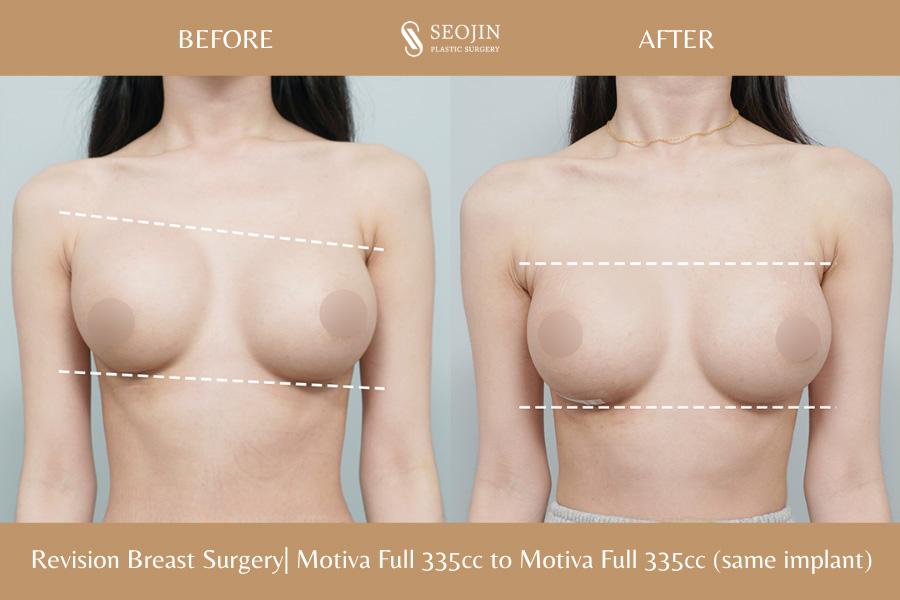
2. Seojin Plastic Surgery Clinic
For implant-shape or positioning concerns, you can expect anatomy-led breast augmentation planning at Seojin, including 3D implant modeling, an implant trial bra, and intraoperative sizing to assess symmetry, shape, and size before final implant placement. Its customized dual-plane approach considers your ribcage, breast tissue, and chest anatomy.
- URL: Seojin Plastic Surgery Clinic Website
- Location: Gangnam-gu, Seoul
- Augmentation planning:
- 3D breast implant modeling is used to help you visualize predicted outcomes across implant brands and types.
- A complimentary implant trial-bra service lets you assess fit and design before surgery.
- During augmentation, a sizer may be used to check symmetry, shape, and size before the final implant is placed.
- Techniques and options:
- The Microscale Dual Plane Technique is customized around your ribcage, breast tissue, and chest anatomy.
- 3D spatial dissection is described as creating a smooth implant pocket while minimizing postoperative swelling.
- Hybrid augmentation combines implants with fat grafting to improve softness and refine shape; PRP may be used with breast fat grafting.
- Specialized implants, including Mentor Boost, may be considered to address sagging without a traditional breast lift.
- Surgeon continuity:
- As a one-doctor clinic, Dr. Lee Hyungmin provides end-to-end care.
- The context reports more than 16 years of experience and participation in Motiva and Mentor academic conferences.
3. Okay Plastic Surgery Clinic
You may consider Okay Plastic Surgery Clinic for a teardrop implant rotation concern if you want assessment within a dedicated Breast Center led by a breast-surgery-focused team. The clinic offers augmentation and corrective breast procedures, with Dr. Cho described as having ongoing breast-surgery research experience and the clinic emphasizing comprehensive aftercare.
- URL: Okay Plastic Surgery Clinic Website
- Location: Gangnam-gu, Seoul
- Breast-focused expertise:
- Okay Plastic Surgery operates a specialized Breast Center offering breast augmentation, breast reduction, breast lift, and nipple correction.
- Dr. Cho is described as a breast-surgery specialist who has studied and published research on the subject.
- The clinic states that it provides comprehensive aftercare intended to support natural, lasting results.
- Related breast services: Available breast services include augmentation with implants or fat grafting, surgery for breast sagging, inverted-nipple correction, and gynecomastia surgery.
Navigating Medical Tourism: Your Journey to Revision Surgery in South Korea
South Korea has become a top choice for cosmetic surgery, attracting international patients with expert care and holistic support.
Why Choose South Korea for Breast Revision Surgery?
South Korea’s reputation for cosmetic surgery excellence is built on experienced, internationally trained surgeons, modern facilities, and strong safety standards. Benefits include:
- Expertise & Accreditation: Board-certified surgeons proficient in complex procedures like revision surgery.
- Cutting-edge Technology: Clinics use 3D modeling and offer trial fittings for implants before surgery.
- Competitive Pricing: Costs are often lower than Western countries.
- Comprehensive Patient Support: Clinics provide English-speaking coordinators, translators, and international patient services.
- Integrated Recovery: Amenities like dedicated recovery lodging, IV nutritional support, and wellness care help patients heal effectively and comfortably.
Many clinics, especially in Seoul areas like Gangnam and Apgujeong, are well prepared to meet international patients’ needs.
Step-by-Step Process for International Patients
Planning a medical trip to South Korea involves several steps:
- Research Clinics and Surgeons: Focus on those specializing in breast revision and check reviews and before-and-after photos. Look for international accreditation and patient testimonials.
- Book a Virtual Consultation: Most clinics offer virtual consults to discuss your history and surgery plan. Compare how each clinic communicates, analyzes your case, and breaks down costs.
- Choose When to Travel: Avoid public holiday periods, as clinics can be busier. The best recovery weather is usually spring or fall. Plan 3–5 days pre-surgery for testing and 10–14 days post-surgery for healing.
- Secure a Visa (If Needed): Some patients need a medical visa; clinics can assist with documentation.
- Book Flights and Accommodation: Stay close to the clinic for convenience. Choose lodging with helpful amenities and a restful environment.
- Pre-Arrival Checklist & Packing: Confirm appointments, payment options, and submitted paperwork. Bring essentials like your clinic’s contact info, IDs, chargers, and look into supplements to aid healing if recommended by your surgeon.
- Post-Surgery Planning: Strictly follow aftercare instructions—including taking advantage of specialized recovery treatments if provided. Also, remember that VAT refunds are available for foreign patients at participating clinics.
Cost Analysis: South Korea vs. Global Options for Revision Breast Surgery
Understanding financial considerations is vital for anyone seeking surgery abroad.
Understanding the Costs in South Korea
Revision breast surgery in South Korea generally ranges from ₩13,000,000 to ₩22,000,000 KRW (about $8,944 to $15,136 USD), though some sources quote $5,000 to $10,000 USD. Costs typically cover surgeon’s fees, anesthesia, facility, pre-surgical tests, overnight stays, post-op care, and sometimes insurance against complications.
Final pricing depends on the surgeon’s expertise, procedure complexity, clinic location and reputation, and the inclusiveness of the service package. Always request a detailed breakdown to clarify what is and isn’t covered.
Comparative Cost Overview: South Korea vs. Other Key Medical Tourism Destinations
Comparing global options helps put costs in perspective:
| Country | Estimated Cost Range (USD) | Key Inclusions/Considerations |
|---|---|---|
| South Korea | Revision: $8,944 - $15,136 (or $5,000 - $10,000); Augmentation: $3,000 - $10,900 | Surgical fees, pre-op/post-op care, sometimes insurance, high-tech, integrated support |
| Turkey | Revision: $3,200 - $5,640; Augmentation: $2,000 - $6,000 | Often covers pre/post-op care, accommodation, transport—confirm accreditation |
| United States | Generally highest; revision not always specified | Surgeon/facility fees, medication, tests |
| United Kingdom | Augmentation: $10,000 - $12,000 | High quality; additional costs possible |
| Europe | Augmentation: $8,500 - $9,500 | Excludes travel, accommodation often |
| Thailand | Implants: $2,700 - $12,000 | |
| Malaysia | Implants: $6,000 - $11,000 | May include tests, accommodation, language services |
| Belgium | Augmentation: $3,500 - $4,100 | Often no overnight stay, includes post-op care |
Value Proposition for Medical Tourists
Turkey may come out cheapest, but South Korea offers a blend of affordability, expertise, safety, and comprehensive care. The full-package ecosystem—patient guidance, advanced surgery, and thorough recovery support—brings peace of mind and potentially higher satisfaction, making South Korea an appealing choice despite mid-range costs.
Patient Perspectives: Life After Revision Surgery for Teardrop Implant Rotation
Choosing revision surgery can be emotional, but the changes it brings often go beyond the physical.
Addressing Physical and Aesthetic Concerns
Patients find that revision surgery for teardrop implant rotation and other issues restores symmetry, comfort, and a natural contour. Many who felt self-conscious or experienced discomfort after previous surgery report dramatic aesthetic improvements and relief.
The Emotional and Psychological Impact of Successful Revision
The journey can begin with anxiety or frustration. Yet successful breast implant revision surgery often brings immense relief and a sense of renewal. Improved body image, self-esteem, and quality of life are common, with many patients saying the change was both physical and deeply emotional.
Real Patient Stories and Outcomes
Real-life cases highlight the transformations possible:
- A 26-year-old with "dropping" implants gained breast crease correction and improved appearance after revision.
- Patients with shifted implants (too low/high or asymmetric) saw results after pocket modification, capsuloplasty, or switching to better-suited implants.
- Some with years-old implants and significant malposition found symmetry restored with procedure like pocket repair or use of ADMs.
- Testimonials praise surgeons for surpassing expectations, with patients reporting restored confidence and peace of mind.
- Others experiencing systemic symptoms (often attributed to Breast Implant Illness, or BII) felt improvement almost immediately after explant, including clearer skin, more energy, and reduced pain.
While some try manual fixes for flipped implants, these are generally temporary. Repeat issues make permanent surgical solutions necessary, and most patients describe their post-revision lives as significantly improved.
Conclusion
Teardrop implant rotation can be a frustrating result of breast augmentation. Its causes are complex, so recognizing even subtle symptoms is essential. Revision breast surgery, especially in a medical tourism hub like South Korea, combines advanced techniques and holistic recovery to offer reliable solutions. The rewards are often more than physical—patients frequently report renewed confidence and well-being. Making informed choices about surgeons and clinics, understanding all associated costs, and preparing for the journey are key steps toward a satisfying outcome.
References
1, 2, 3, 4, 5, 6, 7, 8, 9, 10, 11, 12, 13, 14, 15, 16, 17, 18, 19, 20
Frequently Asked Questions
Related Blogs
Nipple Surgery in Korea: Types, Recovery, Risks, and Travel Planning
Nipple surgery may reduce nipple size or projection, correct benign inversion, revise scars, or reconstruct the nipple–areola complex; technique, anesthesia, and recovery depend on the procedure and any combined breast or chest surgery. International patients should plan at least 7–10 days locally for uncomplicated isolated procedures, attend wound review before flying, arrange follow-up at home,
Updated: Sep 21, 2026
Breast Augmentation in Korea: Implants, Recovery, Travel Planning, and Long-Term Safety
Breast augmentation in Korea may use silicone or saline implants, or fat grafting, with planning based on anatomy, goals, incision, and pocket placement. The article covers candidacy, costs of ₩7,000,000–₩18,000,000, 10–14-day travel planning, recovery, follow-up, and implant records.
Updated: Sep 20, 2026
Capsular Contracture Treatment in Korea: Revision Options, Recovery, and Travel Planning
Capsular contracture treatment may include capsulotomy, partial or total capsulectomy, implant exchange or removal, pocket change, ADM support, breast lift, fat grafting, or autologous reconstruction based on symptoms and tissue condition. International patients should plan at least 10–14 days in Korea, complete local follow-ups, obtain surgeon clearance before flying, and arrange home-country car
Updated: Sep 19, 2026
Mastectomy in Korea: Types, Cancer Planning, Recovery, and Travel Considerations
Mastectomy removes breast tissue for cancer treatment or risk reduction, with total, skin-sparing, nipple-sparing, and reconstruction options selected through multidisciplinary review. International patients traveling to Korea need records review, postoperative monitoring, travel clearance, and a documented handoff to their home oncology team.
Updated: Sep 19, 2026
Clinics offering Revision Breast surgery

THEPLUS Plastic Surgery Korea | Eye, Nose, Face & Body Surgery
Sinsa

Seojin Plastic Surgery Clinic Korea: Pioneering Advanced Cosmetic Procedures for Personalized Aesthetic Transformation
Apgujeong

Okay Plastic Surgery Clinic in Korea: Comprehensive Aesthetic Procedures with Sincerity and Care
Cheongdam

Banobagi Plastic Surgery: A Pioneering and Trusted Plastic Surgery Clinic in Korea
Seolleung