
Medical Tourism Blog
Love Band Surgery in Korea: Methods, Recovery, Risks and Travel Planning
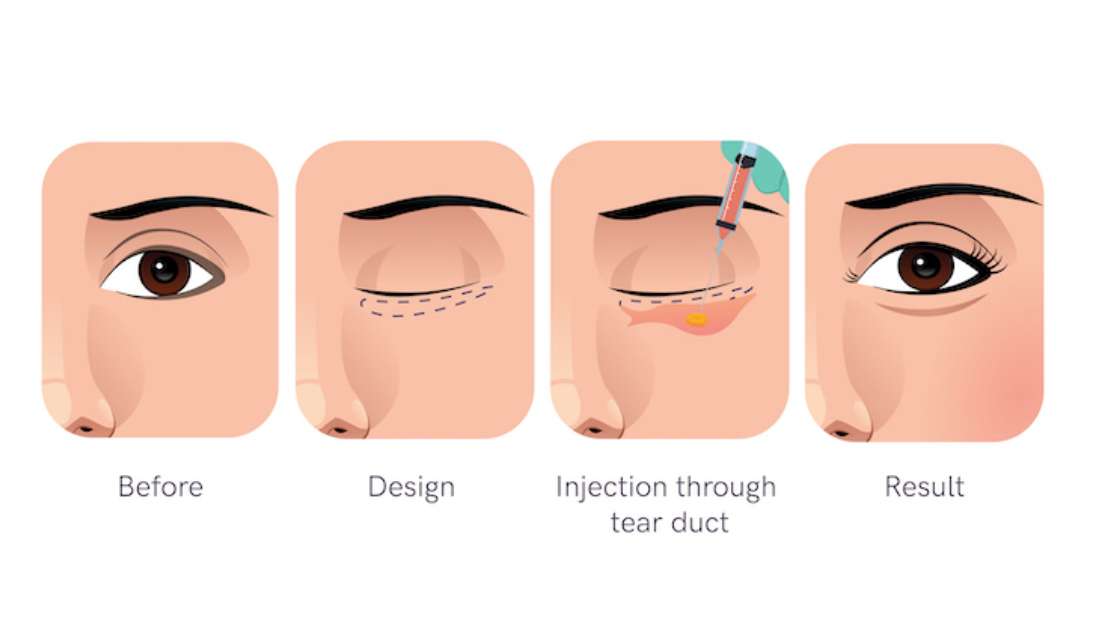
Table of contents
- Love Band Surgery at a Glance
- What Is Love Band Surgery?
- Who Is a Good Candidate for Love Band Surgery?
- How Is Love Band Surgery Performed?
- Why Visit Korea for Love Band Surgery?
- Key Information for International Patients
- Which Are the Best Clinics in Korea for Love Band Surgery?
- Love Band Surgery From Start to Finish
- Alternatives to Love Band Surgery
- How Can I Prepare for Love Band Surgery?
- Aftercare Advice
Considering treatment in Korea? Everything you need to know e.g. — how to avoid scams, visas, interpreters, recovery tips — in our Medical Tourism Master Guide. Plan with confidence in minutes, not weeks!
Last updated: September 2026
Love Band Surgery at a Glance
- What it enhances — Love band surgery creates or enlarges aegyo-sal: a narrow, soft pretarsal roll directly beneath the lower lashes, not an under-eye bag, tear trough, or dark-circle treatment.
- Method options — HA filler offers an immediate, temporary and often dissolvable trial; fat, dermal/fascia or ADM grafts, and implants aim for longer-lasting structure but are harder to revise or remove.
- Best candidates — Suitable candidates want subtle lower-lash-line fullness and have stable lid support, normal blink and closure, and no significant dry eye, retraction, ectropion, or prominent eye bags.
- Recovery and results — Filler swelling and bruising usually improve within several days to 1–2 weeks, while surgical bruising and swelling also commonly last 1–2 weeks but fat, graft, and implant contours can continue changing for months.
- Korea stay — Plan at least 2–3 days in Korea for HA filler and 7–10 days for fat grafting or implant surgery; 10–14 days is more conservative when sutures may need removal or bruising needs time to fade.
- Key risk — Injections around the eye carry a rare but vision-threatening vascular risk; sudden visual changes, severe pain, double vision, abnormal eye movement, or pale or blue skin require emergency assessment immediately.
- Korea distinction — Korean clinics commonly use the aegyo-sal or love-band concept and offer filler plus surgical graft-based options, but no comparative evidence shows that treatment in Korea is safer or produces better outcomes than elsewhere.
What Is Love Band Surgery?
Love band surgery is a cosmetic procedure that creates or enhances a narrow, soft roll directly beneath the lower eyelashes, often called aegyo-sal. It aims to add subtle lower-eyelid fullness for a more youthful, expressive appearance rather than treat eye bags, dark circles, or tear-trough hollows. It can be non-surgical with hyaluronic-acid filler or surgical with fat, graft, or implant-based augmentation.
Who Is a Good Candidate for Love Band Surgery?
- Conservative contour goal — Good candidates want a narrow, soft aegyo-sal roll directly beneath the lower lashes, rather than general under-eye volume or treatment for dark circles.
- Stable lower-eyelid anatomy — The lower lid should have adequate support, normal blink and closure, and no significant dry-eye symptoms, retraction, or ectropion.
- Realistic approach to permanence — HA filler suits people who prefer a temporary option; fat, dermal/fascia or ADM grafts, and implants require acceptance of a more difficult revision process.
- Healthy surgical profile — Candidates for fat harvest, grafting, or implantation need controlled medical conditions, adequate wound healing, and the ability to stay in Korea for postoperative review.
Love band surgery is not appropriate during an active eyelid, conjunctival, facial-skin, sinus, or systemic infection; defer treatment until the infection has resolved. Elective filler and surgery are generally deferred during pregnancy and breastfeeding because adequate safety data are lacking. New visual symptoms, unexplained tearing, uncontrolled dry eye, prominent eye bags or festoons, substantial lid laxity, or a history of complex lower-eyelid surgery require ophthalmic or oculoplastic assessment before cosmetic augmentation. Do not proceed with unaddressed bleeding risk, uncontrolled hypertension or diabetes, major nicotine exposure, known material allergy, unrealistic expectations, or inability to remain available for urgent local review.
How Is Love Band Surgery Performed?
Love band surgery is an umbrella term for pretarsal fullness or aegyo-sal augmentation. The correct method depends on the existing lower-lid contour, skin thickness, lid support, tolerance for downtime, and whether a reversible trial or longer-lasting structural change is the priority.
- HA filler injection — A very small amount of hyaluronic-acid filler is placed in the planned pretarsal area, usually with topical anesthetic in an office setting. The contour is visible immediately but early swelling can obscure symmetry. HA can often be dissolved with hyaluronidase, although suspected vascular compromise requires emergency treatment rather than simple dissolution. Repeat sessions are expected as the product degrades.
- Autologous fat grafting — The surgeon harvests and places the patient’s own fat through a small incision into a pretarsal tunnel. This can create a lasting contour but fat survival is variable, and overcorrection, resorption, nodules, and asymmetry can require revision. In a small 12-patient retrospective series, two patients developed delayed fat overgrowth requiring revision; this is not a general complication rate.
- Dermal, fascia, or ADM grafting — A narrow pocket receives autologous dermis, fascia, or acellular dermal matrix (ADM) to create a more structural roll. These options involve an incision; autologous grafts also create a donor-site wound. Published literature identifies these methods, but does not establish the best graft material, dimensions, plane, or fixation method.
- Implant and tissue-plication surgery — Some surgeons combine lower-eyelid tissue plication with a silicone prosthesis. A 68-patient retrospective series reported frequent transient edema and bruising, plus later displacement, malposition, and asymmetry in a small minority; its findings are technique- and center-specific, not comparative evidence. Ask about the exact implant, its regulatory status, fixation, removability, and revision plan.
Why Visit Korea for Love Band Surgery?
Aegyo-sal is a widely recognized aesthetic concept in Korea, where clinics offer both injectable and surgical pretarsal augmentation. Korean providers also describe this treatment specifically as love-band or aegyo-sal surgery, rather than treating it only as generic under-eye filling. There is, however, no comparative evidence that treatment in South Korea produces safer or better outcomes than treatment elsewhere.
- Procedure-specific availability — Korean clinics publicly describe surgical aegyo-sal options, including lower-eyelid graft-based techniques, alongside filler-based enhancement. This gives patients access to several approaches, not only a filler consultation.
- Established terminology — The target is commonly called aegyo-sal in Korea, while clinical publications use pretarsal fullness or pretarsal roll fullness. Published reviews document HA filler, fat, fascia, ADM, implant, and tissue-based approaches.
- Need for method-specific scrutiny — The evidence base remains observational, small, and technique-specific. Request the surgeon’s proposed plane, material, complication protocol, revision policy, and written treatment record rather than relying on country-based assumptions.
Key Information for International Patients
- Minimum stay — Plan at least 2–3 days for HA filler, allowing consultation, treatment, and an early review. Plan 7–10 days for fat grafting or implant-based surgery for wound, vision, and eyelid-function checks; 10–14 days is more conservative when sutures require removal or visible bruising matters.
- Flight timing — Do not schedule a same-day long-haul departure. No love-band-specific evidence-based flying interval exists, so the treating clinician must clear travel after examining vision, lid function, pain, skin color, and wound or injection sites.
- Itinerary impact — Filler commonly causes mild swelling, redness, tenderness, or bruising for several days to 1–2 weeks. Surgical methods commonly cause bruising and swelling for about 1–2 weeks, while contour maturation can continue for months.
- Activity restrictions — Keep the first 24–48 hours flexible after filler because heat, alcohol, strenuous exercise, sauna, hot yoga, and face-down sleeping are commonly restricted. Surgical recovery requires more downtime and delays swimming, strenuous activity, eye makeup, and contact lenses until cleared.
- Records and emergency planning — Obtain the exact filler name, lot number, expiry date, injected amount and plane, or the graft/implant material and operative record. For HA injection, confirm that hyaluronidase and an emergency ophthalmology or hospital-transfer pathway are immediately available.
- Remote follow-up — Arrange video review at about 1–2 weeks and again after the method-specific settling period. Identify an ophthalmologist, oculoplastic surgeon, or emergency department at home before travel; local clinicians may not remove or revise non-HA filler, grafts, or implants.
Travel note: Bring a companion after oral sedation, IV sedation, or general anesthesia. That person should escort you to accommodation and remain reachable overnight.
Which Are the Best Clinics in Korea for Love Band Surgery?
Listed below are some of the best clinics in Korea for love band surgery.
1. THEPLUS Plastic Surgery
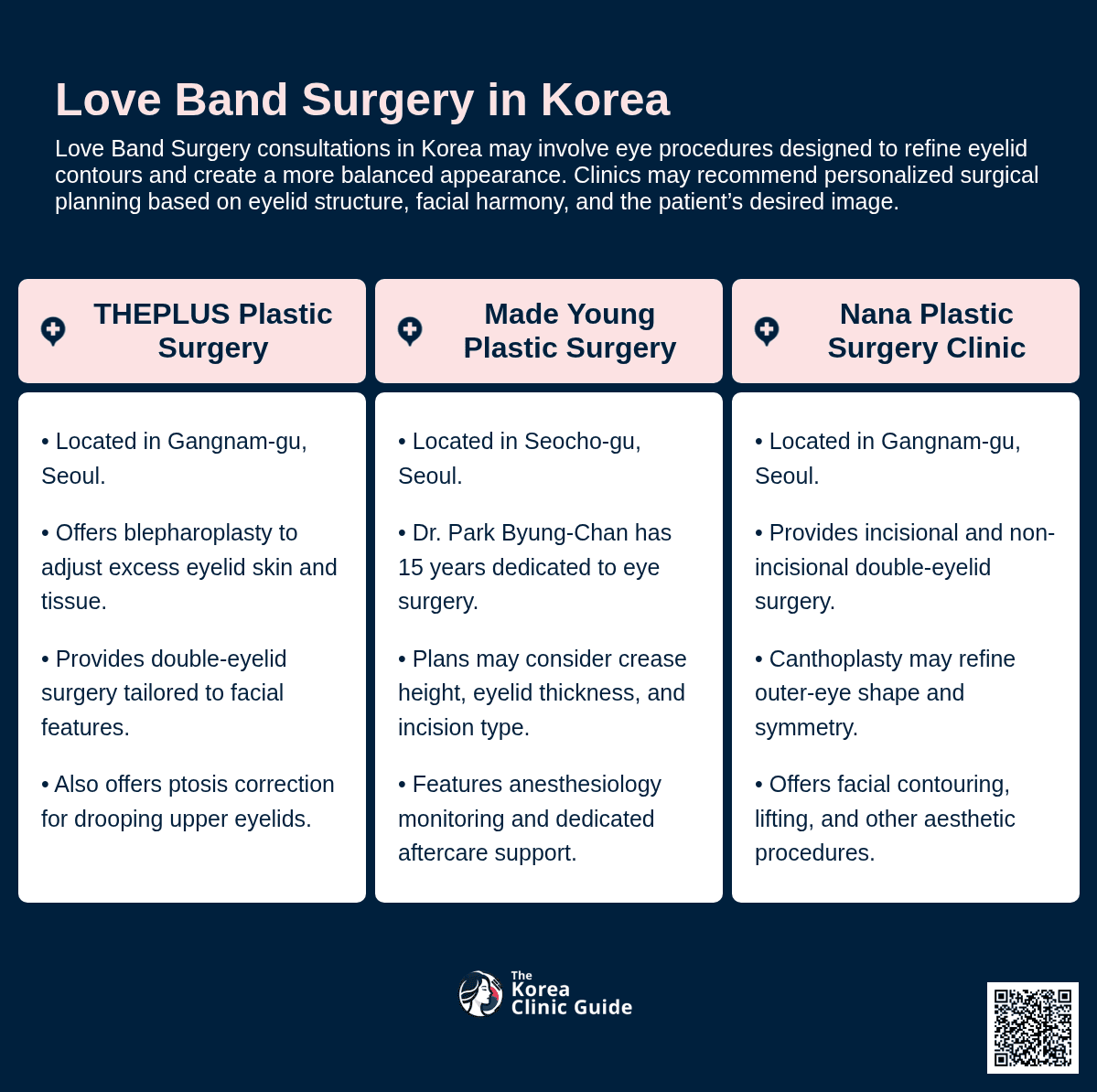
At THEPLUS Plastic Surgery, you can discuss a Love Band Surgery plan in the context of its eye-surgery offerings, including blepharoplasty to adjust excess eyelid skin and tissue for a smoother eye-area contour. The clinic’s approach emphasizes facial harmony and tailoring results to your existing features.
- URL: THEPLUS Plastic Surgery Website
- Location: Gangnam-gu, Seoul
- Eye-surgery options:
- Blepharoplasty is offered to remove or adjust excess skin and tissue around the eyelids.
- Double-eyelid surgery creates an upper-eyelid crease designed to suit your facial features.
- Ptosis correction addresses drooping upper eyelids by correcting the muscles that open the eyes.
- Surgical expertise:
- Dr. Kim is a board-certified plastic surgeon with research recognition related to 3D implants and expertise in rhinoplasty and facial contouring.
- Dr. Jeong is President of the Korean Society of Plastic Surgeons and has an academic and educational role in rhinoplasty.
2. Made Young Plastic Surgery
At Made Young Plastic Surgery, you can explore a Love Band Surgery consultation alongside dedicated eye procedures such as lower blepharoplasty, which addresses under-eye bags through fat removal or repositioning and may include skin tightening. The clinic describes individualized planning of eye shape and eyelid characteristics, with structured anesthesia monitoring and aftercare support.
- URL: Made Young Plastic Surgery Website
- Location: Seocho-gu, Seoul
- Eye-procedure planning:
- Dr. Park Byung-Chan has 15 years of experience dedicated exclusively to eye surgery.
- Planning may be customized around incision lines, double-eyelid height, eyelid thickness, and your overall desired image.
- Available eye procedures include non-incisional and incisional double-eyelid surgery, ptosis correction, upper and lower blepharoplasty, canthoplasty, and dark-circle treatment.
- Anesthesia and aftercare:
- Full-time board-certified anesthesiologists are described as being on site.
- The clinic describes one-to-one continuous anesthetic monitoring and a cross-check system for emergencies.
- A dedicated aftercare center provides systematic post-procedure care.
3. Nana Plastic Surgery Clinic
You may consider Nana Plastic Surgery Clinic for a Love Band Surgery consultation if you want to explore your concerns within a clinic that offers eye procedures alongside a broad range of facial aesthetic surgery. Its eye services include double-eyelid surgery using incisional or non-incisional techniques and canthoplasty to adjust the outer eye corners and improve symmetry.
- URL: Nana Plastic Surgery Clinic Website
- Location: Gangnam-gu, Seoul
- Related eye services:
- Double-eyelid surgery is available with incisional and non-incisional techniques to create a more defined eyelid crease.
- Canthoplasty adjusts the outer corners of the eyes for concerns such as sagging or drooping and to enhance eye shape and symmetry.
- Broader facial options:
- Facial contouring services include V-line surgery, genioplasty, cheekbone reduction, and facial implants.
- Lifting options include mini and full facelift procedures, Endotine forehead lifting, thread lifting, and neck lifting.
Love Band Surgery From Start to Finish
- Remote consultation and screening — Send clear photographs and short videos at rest and smiling. Disclose prior fillers, eyelid surgery, dry-eye symptoms, eye diagnoses, allergies, smoking or vaping, medications, supplements, and medical conditions. Ask whether the clinic offers English consultation or an interpreter.
- Treatment planning before travel — Confirm the proposed method, expected downtime, required Korea stay, anesthesia plan, and whether the concern is truly pretarsal fullness rather than eye bags, tear-trough hollowing, festoons, pigment, or skin laxity.
- In-person assessment — The clinician examines the lower lid at rest and with animation, checking lid position, laxity, blink, closure, ocular-surface symptoms, skin thickness, fat prominence, tear troughs, and asymmetry. Surgical patients may require anesthesia-related assessment or additional tests based on health history.
- Consent and documentation — Review risks, including swelling, contour irregularity, persistent edema, infection, asymmetry, and revision. Confirm the named injector or surgeon, exact filler or implant material, and emergency pathway. Photographs and markings are made upright.
- Anesthesia and treatment — HA filler is usually performed with topical anesthetic, sometimes local anesthetic. Fat grafting includes donor-fat harvest and placement through a small incision. Graft or implant surgery commonly uses local anesthesia with or without sedation, depending on the technique and patient factors.
- Contour creation — The injector or surgeon places filler, fat, graft material, or an implant into the planned pretarsal zone. The procedure must preserve a natural lower-lid contour and avoid adding volume to a true eye bag. Procedure duration depends on method and whether fat harvest or surgical fixation is required.
- Discharge and early review — Before discharge, the team checks vision, eyelid position, blink, closure, and injection sites or incisions. Leave with written aftercare, an emergency contact, a follow-up date, and a complete treatment record.
- Overseas follow-up — Attend the in-person review before departure when scheduled. Send requested photographs after returning home, and seek urgent assessment immediately for visual change, severe pain, double vision, abnormal eye movement, or concerning skin-color change.
Alternatives to Love Band Surgery
The best alternative depends on what is actually creating the under-eye concern. Love-band augmentation adds a narrow roll directly below the lashes; it does not remove orbital-fat bags, correct tear-trough hollowing, tighten lax lower lids, or reliably treat pigmentation. Non-surgical choices are generally less invasive but temporary, while surgery can address structural concerns with longer downtime and harder-to-reverse changes.
Under-Eye Filler
- Best for — A cautious, temporary trial of subtle pretarsal volume in an appropriate lower lid.
- Tradeoff — Under-eye filler avoids incisions and is potentially dissolvable when HA is used, but periorbital injection carries bruising, persistent edema, visible product, asymmetry, and rare vision-threatening vascular risk.
Under-Eye Fat Grafting
- Best for — Patients considering autologous volume and accepting surgical recovery and unpredictable fat retention.
- Tradeoff — Under-eye fat grafting avoids a manufactured gel but is not simply reversible and can leave unevenness, nodules, overgrowth, or resorption.
Lower-Eyelid Fat Repositioning or Removal
- Best for — Orbital-fat bags, lid-cheek hollowing, or a bulging contour farther below the lash line.
- Tradeoff — Under-eye fat removal or repositioning addresses a different anatomical problem and does not create a high pretarsal roll.
Lower Blepharoplasty
- Best for — Excess lower-lid skin, fat prominence, laxity, or lid-cheek deformity requiring surgical assessment.
- Tradeoff — Blepharoplasty is more comprehensive surgery, with greater downtime and eyelid-specific risks; it is not interchangeable with love-band augmentation.
Dark-Circle Treatment
- Best for — Concerns driven primarily by pigmentation, shadowing, or discoloration rather than absent pretarsal fullness.
- Tradeoff — Dark-circle injection targets a different concern and does not reliably form a dynamic aegyo-sal contour.
How Can I Prepare for Love Band Surgery?
- Disclose medicines early — List all prescription medicines, over-the-counter drugs, vitamins, herbal products, and supplements. The treating doctor and prescribing clinician must decide whether anticoagulants, antiplatelets, diabetes medicines, blood-pressure medicines, steroids, or psychiatric medicines need adjustment.
- Do not self-stop prescriptions — Never independently stop aspirin, warfarin, apixaban, clopidogrel, or similar medicines. A bleeding disorder or medication that cannot safely be adjusted can rule out elective treatment.
- Stop nicotine as instructed — Follow the surgeon’s required nicotine-free interval before fat harvest, grafting, or implantation. Nicotine exposure impairs healing and increases surgical risk.
- Avoid alcohol when directed — Avoid alcohol around treatment when instructed because it can worsen bruising and can interact with sedation or pain medicines.
- Follow fasting instructions exactly — Topical or local-anesthetic filler usually does not require fasting. Sedation or general anesthesia requires the facility’s specific fasting schedule; do not substitute general online rules.
- Arrive with a clean eye area — Attend without eye makeup, false lashes, or contact lenses unless the clinic says otherwise. Report acne, rash, conjunctivitis, fever, cold sores, recent illness, or any facial or sinus infection before treatment.
- Avoid inflammatory facial treatments — Do not schedule peels, laser resurfacing, microneedling, aggressive massage, or other facial procedures near the appointment unless the treating clinician clears them.
- Plan flexible travel — Book accommodation close enough for follow-up and keep flights changeable. Surgical patients should arrange a companion and avoid scheduling major sightseeing immediately after treatment.
Travel note: Take screenshots or printed copies of the clinic’s 24-hour contact details, aftercare plan, and treatment record before leaving Korea.
Confirm the treating doctor’s clinic-specific medication, fasting, nicotine, and travel requirements, which take precedence over general guidance.
Aftercare Advice
Protect the lower eyelids from pressure, heat, contamination, and unapproved products while early swelling settles.
- Do not manipulate the area — Do not massage, press, tape, or rub the lower lids unless the treating clinician specifically instructs it. Use only prescribed ointment, lubricants, antibiotics, or pain medicines.
- Control swelling carefully — Use cold compresses and keep the head elevated only as directed. Do not apply direct ice pressure to a fresh graft or incision without surgeon approval.
- Restrict exercise and heat — After filler, avoid strenuous exercise, sauna, hot yoga, alcohol, and face-down sleeping for the first 24–48 hours if instructed. After surgery, avoid strenuous exercise and swimming until the surgeon clears them.
- Protect incisions and eye surface — Keep wounds clean and dry as directed. Delay eye makeup and contact lenses until the surgeon permits them, particularly after graft or implant surgery.
- Use sun protection — Once injection points or incisions are closed and the clinician approves skincare, protect the area from sun exposure with sunglasses and SPF 50 to reduce discoloration risk.
- Know emergency signs — Seek emergency assessment immediately for sudden visual change or vision loss, severe escalating pain, double vision, abnormal eye movement, drooping eyelid, severe headache, weakness, speech difficulty, or white, gray, blue, cold, blistered, or intensely painful skin.
- Contact the clinic promptly — Report fever, spreading redness, pus, marked one-sided swelling, worsening asymmetry, inability to close the eye, persistent chemosis, or wound separation.
- Judge results at the right time — Filler-related bruising and swelling usually improve over days to 1–2 weeks; assess symmetry only after early swelling settles. Surgical swelling often lasts 1–2 weeks, while fat, graft, and implant contours can evolve for months.
Follow the treating doctor’s instructions over general advice, attend all scheduled reviews, and contact the clinic promptly when anything appears wrong.
Frequently Asked Questions
Related Blogs
Uneven Eyelids: Canthoplasty, Laser Canthoplasty, and Revision Eye Surgery Solutions in Korea
Discover how Korea leads in eyelid asymmetry correction with advanced procedures like canthoplasty, laser canthoplasty, and revision eye surgery. This comprehensive guide explores causes, emotional impacts, and how Korea's expert surgeons deliver natural-looking results. Learn about the surgical techniques, costs, and benefits of choosing Korea for your eyelid correction, emphasizing safety, affor
Updated: Oct 10, 2026
Sunken Eyes Solutions in Korea: Under Eye Fat Grafting and Eyelid Fat Grafting Procedures Explained
Discover how Korea leads in treating sunken eyes with advanced procedures like autologous fat grafting and eyelid fat transfer. This comprehensive guide highlights causes, symptoms, and the benefits of Korea’s top clinics, offering natural, long-lasting results. Perfect for medical tourists, learn why Korea is the ideal destination for under-eye rejuvenation, combining cutting-edge technology, exp
Updated: Oct 10, 2026
Injury to Eyelid: Ptosis Correction Procedures in Korea for Effective Eyelid Injury Treatment
Discover expert eyelid injury and ptosis correction procedures in Korea. This blog covers eyelid laceration treatments, approaches to traumatic and congenital ptosis, and advanced surgery options like external levator advancement and frontalis sling techniques. Learn why Korea is a top destination for affordable, high-quality eyelid surgeries, offering rapid recovery, aesthetic improvements, and f
Updated: Oct 9, 2026
Bulging Eyes Solutions: Canthoplasty, Laser Canthoplasty & Eyelid Fat Grafting in Korea
Discover how Korea leads in treating bulging eyes (exophthalmos) with advanced procedures like orbital decompression, Canthoplasty, and Eyelid Fat Grafting. Whether caused by Thyroid Eye Disease or trauma, these expert surgeries in Korea improve vision, reduce discomfort, and enhance appearance. Benefit from Korea’s renowned medical expertise, affordable pricing, and comprehensive care. If you’re
Updated: Oct 9, 2026
Clinics offering Love Band Surgery

THEPLUS Plastic Surgery Korea | Eye, Nose, Face & Body Surgery
Sinsa

Made Young Plastic Surgery: Rejuvenating Aesthetic Excellence in Korea for Face Lifts, Contouring and More
Gangnam Station

Nana Plastic Surgery Clinic in Korea: Advanced Aesthetic Procedures for Face, Body, and Breast Enhancement
Sinnonhyeon Station

Lienjang Plastic Surgery & Dermatology: Korea's Leading Clinic for Tailored Aesthetic Solutions and Advanced Treatments
Sinnonhyeon Station