Medical Tourism Blog
Lymphatic Drainage Massage in Korea: Clinical MLD, Recovery, Travel Planning, and Safety
Table of contents
- Lymphatic Drainage Massage at a Glance
- What Is Lymphatic Drainage Massage?
- Who Is a Good Candidate for Lymphatic Drainage Massage?
- How Is Lymphatic Drainage Massage Performed?
- Why Visit Korea for Lymphatic Drainage Massage?
- Key Information for International Patients
- Which Are the Best Clinics in Korea for Lymphatic Drainage Massage?
- Lymphatic Drainage Massage From Start to Finish
- Alternatives to Lymphatic Drainage Massage
- How Can I Prepare for Lymphatic Drainage Massage?
- Aftercare Advice
Considering treatment in Korea? Everything you need to know e.g. — how to avoid scams, visas, interpreters, recovery tips — in our Medical Tourism Master Guide. Plan with confidence in minutes, not weeks!
Last updated: October 2026
Lymphatic Drainage Massage at a Glance
- What it is — Manual lymphatic drainage (MLD) is a gentle, rhythmic skin-stretching treatment used mainly within complete decongestive therapy for confirmed lymphedema; it is not deep-tissue massage.
- Best candidates — Appropriate candidates include people with clinician-confirmed primary or secondary lymphedema and selected postoperative patients only after their operating surgeon approves the timing, treatment areas, pressure, and compression plan.
- Not a standalone fix — For lymphedema, MLD is usually paired with compression, exercise, skin care, and self-management education; a single session cannot repair damaged lymphatic drainage or provide lasting control on its own.
- Recovery and results — There is no routine downtime, and normal non-strenuous activity can usually resume immediately; clinical results are assessed over a prescribed course using limb measurements, symptoms, function, and skin changes rather than a one-session appearance.
- Important safety screen — New or rapidly worsening one-sided swelling needs medical assessment before massage, because DVT, cellulitis, venous obstruction, or cancer-related obstruction can require urgent treatment; acute clots, active infection or fever, and decompensated heart failure are contraindications.
- Korea visit planning — Allow 1–2 days for a single surgeon-authorized or wellness-oriented session, but about 2 weeks for assessment and an intensive CDT course; one Samsung Medical Center protocol used 10 sessions over 2 weeks.
- Korea-specific distinction — Samsung Medical Center in Seoul publicly offers English-language, hospital-based lymphedema rehabilitation combining MLD with compression, exercise, and skin care, but comparable credentials, fitting services, and follow-up should be verified provider by provider.
What Is Lymphatic Drainage Massage?
Lymphatic drainage massage, or manual lymphatic drainage, is a gentle rhythmic therapy that supports movement of fluid through lymphatic pathways. It helps manage lymphedema-related swelling, heaviness, tightness, and reduced movement, usually alongside compression, exercise, skin care, and self-management. It is a non-surgical, noninvasive therapeutic massage technique.
Who Is a Good Candidate for Lymphatic Drainage Massage?
- Confirmed lymphedema — Appropriate candidates have primary or secondary peripheral lymphedema, including swelling after lymph-node surgery, radiotherapy, trauma, venous disease, or other lymphatic injury. The clinical goal is management of fluid-related swelling, heaviness, tightness, movement limits, and skin-health risk.
- Self-management training — People with an established diagnosis who need an individualized self-lymphatic-drainage sequence, compression review, skin-care teaching, and movement guidance can benefit from a lymphedema-rehabilitation service.
- Surgeon-cleared postoperative swelling — Selected patients after liposuction, abdominoplasty, flap or graft surgery, or other cosmetic operations can be considered only after the operating surgeon confirms the start date, permitted areas, pressure, and compression plan.
- Clinical-program users — A hospital or rehabilitation setting is preferable when care includes baseline limb measurement, medical screening, compression fitting, and a written plan for care after returning home.
Do not treat new, unexplained, or rapidly worsening one-sided swelling as a massage problem: deep-vein thrombosis (DVT), cellulitis, venous obstruction, and cancer-related obstruction require medical assessment first. Acute DVT or pulmonary embolism, active skin infection or fever, decompensated heart failure, uncontrolled kidney failure, and infected wounds are contraindications. Pregnancy, anticoagulants or antiplatelet medicines, fragile skin, neuropathy, peripheral arterial disease, prior thrombosis, unstable hypertension, cancer history, and recent surgery require individualized screening and technique modification. MLD is not deep-tissue massage, body contouring, a detox treatment, or a weight-loss treatment; there is no evidence that it directly causes weight loss.
How Is Lymphatic Drainage Massage Performed?
Clinical manual lymphatic drainage (MLD) uses slow, light, rhythmic skin-stretching movements in a planned sequence. It should not involve forceful kneading, marked pain, or significant bruising.
- Therapist-delivered clinical MLD — A qualified clinician generally works on central or proximal drainage regions before the affected limb or body area, directing fluid toward functioning drainage pathways.
- Self-lymphatic drainage — The clinician teaches a home sequence tailored to the affected area, surgical anatomy, skin condition, likely drainage routes, and compression plan. Generic online routines are not an adequate substitute.
- Complete decongestive therapy (CDT/CDPT) — This clinical framework combines MLD with multilayer short-stretch compression or garments, prescribed exercise, skin care, and self-management education. Samsung Medical Center describes this combined approach rather than MLD alone as its lymphedema service.
- Image-guided specialist planning — In uncertain, early, or complex cases, bioimpedance spectroscopy, lymphoscintigraphy, ultrasound, MRI, or indocyanine-green lymphography can help clarify the diagnosis or lymphatic function. These tests are not necessary before every maintenance massage; Samsung notes bioimpedance and lymphoscintigraphy as potential assessment tools.
Why Visit Korea for Lymphatic Drainage Massage?
Korea has demonstrable hospital-based, English-language access to lymphedema rehabilitation at least at Samsung Medical Center in Seoul. This is relevant for travelers who need assessment and CDT rather than a wellness massage. It does not mean that credentials, imaging, compression fitting, or English-language follow-up are standardized across all providers.
- Identified lymphedema service — Samsung Medical Center’s Lymphedema Clinic publicly describes comprehensive decongestive lymphatic physiotherapy, including MLD, compression, exercise, and skin care delivered by specialized physicians and staff.
- Assessment options for complex cases — The center’s English-language information identifies bioimpedance spectroscopy and lymphoscintigraphy among tools that can support early detection or clarify uncertain cases.
- Defined intensive-course example — A Samsung hospital protocol used 10 CDT sessions over 2 weeks. This is an example of a local program, not a universal dose or a reason to buy a fixed package.
- Verification remains essential — Before paying or traveling, confirm that the provider is authorized to treat international patients, that a physician screens contraindications, and that baseline measurements, compression planning, written discharge instructions, and home follow-up coordination are included.
Key Information for International Patients
- Minimum stay — Allow 1–2 days for one surgeon-authorized postoperative or wellness-oriented session, but do not schedule it immediately before a long-haul flight. For assessment and an intensive CDT course, plan about 2 weeks plus time to obtain compression supplies and arrange care at home.
- Repeat visits — Chronic lymphedema is managed across a prescribed course and then maintained with compression, skin care, exercise, and self-management. A single session does not correct damaged lymphatic drainage.
- Flight timing — MLD itself has no mandatory no-fly interval. Travelers with lymphedema, recent surgery, limited mobility, cancer, prior clots, pregnancy, estrogen use, or other venous-thromboembolism risks need individualized travel advice; during prolonged travel, walk regularly and move the legs when able.
- Activity and itinerary — Normal non-strenuous activity can usually resume immediately after an appropriately performed session. Build in time to manage bandaging or garment fitting, especially when lower-limb compression changes footwear or mobility.
- Remote follow-up — Arrange a qualified lymphedema clinician, rehabilitation provider, cancer-survivorship team, vascular clinician, or operating surgeon at home before travel. Request a discharge summary, baseline and final measurements, and compression specifications.
- Companion and transport — A companion is not routinely needed for MLD alone. Arrange accessible transport or assistance for severe swelling, limited mobility, recent surgery, sedating pain medicine use, language needs, or frequent compression appointments.
Travel note: Do not start aspirin solely to prevent travel-related blood clots unless the clinician managing your health specifically prescribes it; CDC guidance does not recommend this practice.
Which Are the Best Clinics in Korea for Lymphatic Drainage Massage?
Listed below are some of the best clinics in Korea for lymphatic drainage massage.
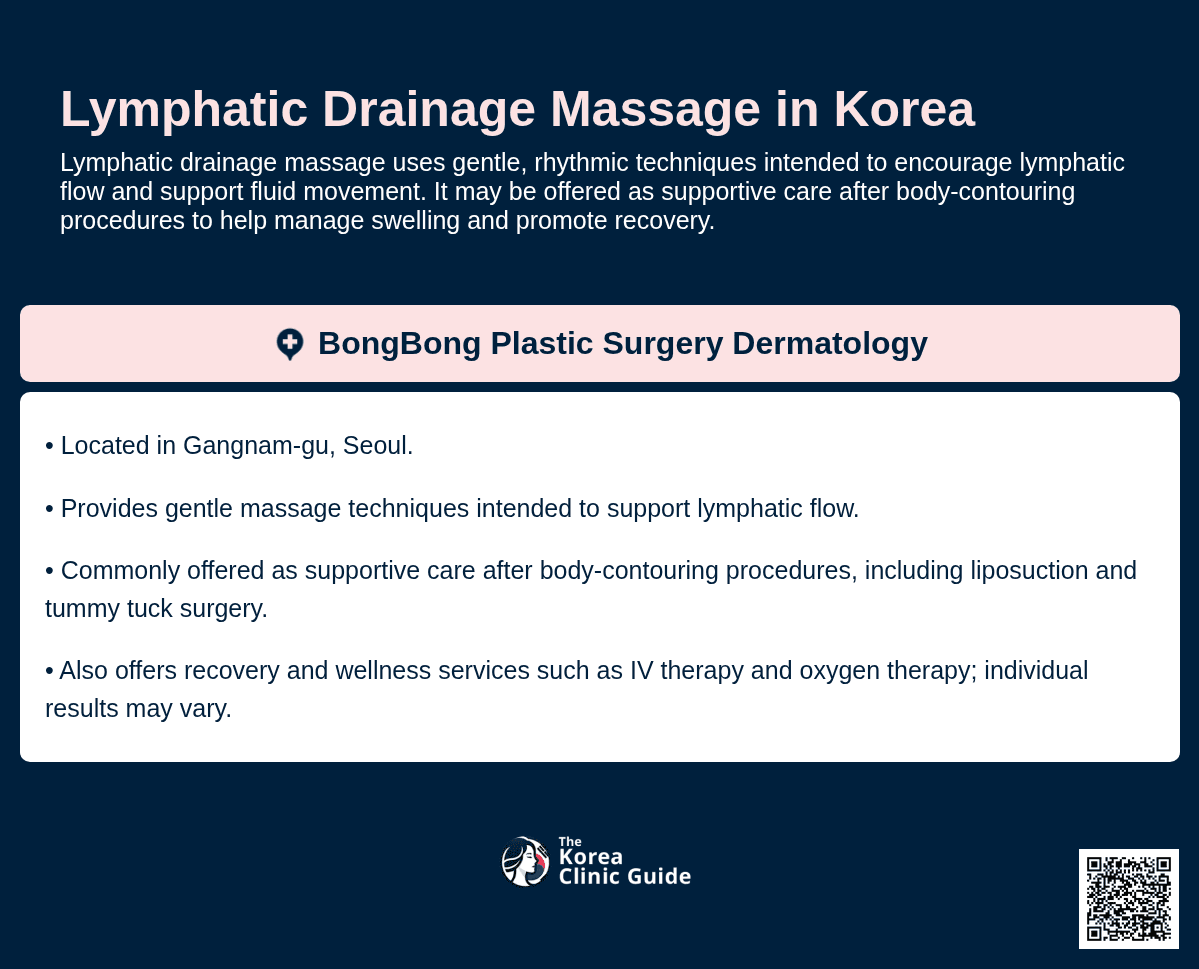
1. BongBong Plastic Surgery Dermatology
At BongBong Plastic Surgery Dermatology, you can receive gentle lymphatic drainage massage as supportive care, particularly after body-contouring treatment. The clinic presents it as a way to encourage lymphatic flow and help with post-procedure swelling and recovery support.
- URL: BongBong Plastic Surgery Dermatology Website
- Location: Gangnam-gu, Seoul
- Procedure details:
- Uses gentle massage techniques intended to support lymphatic flow.
- Commonly offered as supportive care following body-contouring procedures.
- The clinic also describes the treatment as intended to calm inflammation and support immune function; individual results can vary.
- Related services:
- Body-contouring services include liposuction and tummy tuck procedures.
- Additional recovery and wellness-oriented offerings include IV therapy and oxygen therapy.
- The clinic also provides breast, buttock, vaginal rejuvenation, injectable, scar, stretch-mark, and hair-loss treatments.
Lymphatic Drainage Massage From Start to Finish
- Send records before travel — Request an English or virtual consultation where available. Send the diagnosis, cancer-treatment and operative records, imaging, medication and allergy lists, clotting and infection history, current compression details, and home clinician’s contact information. Confirm whether the booking is for clinical MLD/CDT or a nonmedical wellness service.
- Confirm travel coordination — Agree on the proposed number of visits, whether compression bandaging or garment fitting is included, the likely appointment duration, required accommodation access, and whether the final session should be separated from a long-haul flight.
- Complete in-person screening — A rehabilitation physician, surgeon, or qualified lymphedema clinician reviews symptom onset, skin changes, pitting or fibrosis, medical history, medicines, and red flags. They examine the affected area and commonly document bilateral circumference or volume measurements; suspected DVT, venous obstruction, infection, or another cause requires medical assessment rather than massage.
- Set the treatment plan — The clinician determines whether MLD is appropriate and whether compression, exercise guidance, skin care, imaging, or treatment of an underlying problem is needed. After cosmetic surgery, the operating surgeon’s protocol controls the timing, pressure, and treatment areas.
- Receive MLD — Treatment is performed lying down or in another position suited to the body area and mobility. The therapist uses gentle, sequence-based manual movements; MLD should not feel like deep-tissue work.
- Apply compression or review garments — When clinically indicated, the visit is followed by multilayer bandaging, fitting of a garment, or assessment of an existing garment. Compression is a core part of CDT, alongside MLD, exercise, skin care, and education.
- Leave with written instructions — Obtain a plan for compression, skin protection, movement, self-MLD when appropriate, infection precautions, and urgent warning signs. Ask for measurements and garment specifications to share with the home clinician.
- Continue overseas follow-up — Send the discharge summary to the home team and continue the prescribed maintenance plan. Outcomes for lymphedema should be assessed across the course through measurements, symptoms, skin and tissue changes, function, infection frequency, and ability to maintain results—not by a single post-massage appearance.
Alternatives to Lymphatic Drainage Massage
For confirmed lymphedema, non-surgical management is usually the starting point and remains important even when surgery is considered. Surgical options are reserved for selected refractory cases after specialist assessment; they do not replace diagnosis and can still require compression. For cosmetic postoperative swelling without diagnosed lymphedema, surgeon-directed recovery care is often more relevant than a routine MLD package.
Compression Therapy
- Role — Multilayer bandaging can be used during volume reduction, while fitted garments support long-term maintenance.
- Tradeoff — Compression requires correct fitting and consistent use, but it is a central component of lymphedema management rather than an optional add-on to massage.
Exercise and Rehabilitation
- Role — Individualized movement, mobility work, and progressive strengthening support function and lymphatic return.
- Tradeoff — Exercise does not replace compression when compression is prescribed, but it is more practical for long-term management than repeated clinic massage alone.
Intermittent Pneumatic Compression
- Role — A clinician may prescribe a pneumatic compression device for selected patients as part of a broader management plan.
- Tradeoff — It is device-based rather than hands-on therapy and still requires diagnosis, correct use, skin monitoring, and compression planning.
Lymphedema Surgery
- Role — Lymphovenous bypass or anastomosis, vascularized lymph-node transfer, and selected debulking or liposuction procedures can be considered for appropriate refractory cases.
- Tradeoff — These are invasive specialist treatments with surgical recovery and ongoing assessment requirements; they do not eliminate the need for compression or self-management in every case.
Surgeon-Directed Postoperative Care
- Role — After cosmetic surgery, wound checks, prescribed compression, safe walking, and evaluation for seroma, hematoma, infection, wound separation, or DVT address recovery priorities.
- Tradeoff — This approach follows the actual operation and risk profile. Evidence does not establish a universal MLD start date, intensity, or number of sessions after liposuction or abdominoplasty, as postoperative studies remain limited and heterogeneous.
How Can I Prepare for Lymphatic Drainage Massage?
- Medical records — Bring the diagnosis, cancer and surgery history, relevant imaging, prior measurement records, infection and clot history, allergies, and contact details for the clinician who will continue care at home.
- Medicines and supplements — Continue prescribed medicines unless the prescribing clinician tells you otherwise. Do not stop warfarin, apixaban, rivaroxaban, dabigatran, aspirin, clopidogrel, or other prescribed anticoagulant or antiplatelet medicine merely for MLD; disclose them, along with diuretics, hormones, antibiotics, cancer therapies, and supplements.
- Fasting and hydration — No fasting is routinely required for MLD. Follow any clinic instruction that differs because of a separate test, procedure, or medical condition.
- Compression supplies — Bring all prescribed garments, bandages, liners, and prescriptions. Wear loose clothing and shoes that can accommodate leg or foot bandaging.
- Skin and treatment area — Report cuts, open wounds, rash, fungal infection, new redness, warmth, fever, or drainage before the appointment. Do not treat an infected area.
- Postoperative clearance — Bring the operating surgeon’s written instructions after liposuction, abdominoplasty, flap or graft surgery, or other recent cosmetic surgery. Timing, permitted pressure, scar care, garment use, and areas to avoid are operation-specific.
- Smoking, alcohol, and sun — Follow the operating surgeon’s restrictions after surgery. Avoid sunburn and protect the affected skin from cuts, burns, and insect bites because skin injury can increase infection risk.
- Transport and accommodation — Book accessible transport when bandaging, reduced mobility, or recent surgery affects walking. For intensive CDT, stay near the facility and leave space to manage garments and supplies.
- Flexible flights — Avoid scheduling the final session immediately before a long international flight when active swelling, postoperative limits, or elevated clot risk are present.
Travel note: Pack compression supplies in carry-on luggage and confirm local replacement options before travel; an ill-fitting garment that rolls, causes numbness, or changes skin color needs review rather than forceful continued wear.
Confirm clinic-specific requirements with the treating doctor, whose individualized instructions take precedence over general guidance.
Aftercare Advice
A proper MLD session has no routine downtime, but clinical benefit depends on the prescribed compression and long-term management plan rather than massage alone.
- Activity — Resume normal non-strenuous activity immediately unless recent surgery, mobility limits, or the treating clinician’s plan says otherwise. Continue prescribed gentle movement and avoid prolonged immobility during travel.
- Compression — Use garments or bandaging exactly as instructed. Contact the clinic promptly if compression rolls or cuts into the skin, causes numbness, color change, escalating pain, or worsening swelling.
- Skin protection — Keep skin clean and moisturized as directed; prevent cuts, burns, sunburn, insect bites, and fungal infection. Defer MLD and seek assessment for redness, warmth, fever, or suspected infection.
- Expected short-term effects — Mild fatigue, lightheadedness, increased urination, or temporary skin tenderness can occur. Marked pain, forceful-pressure soreness, or significant bruising are not expected with standard MLD.
- Urgent warning signs — Seek same-day medical review for rapidly increasing swelling, redness, warmth, fever, chills, new wound drainage, escalating pain, a new tender cord, or declining function. Seek emergency care for sudden shortness of breath, chest pain, coughing blood, fainting, or a new painful, warm, swollen limb because these can indicate pulmonary embolism or DVT.
- Results and follow-up — For lymphedema, track circumference or volume, tissue texture, symptoms, function, and infection frequency across the prescribed course. Evidence for MLD alone is mixed, and important variation and evidence gaps remain; compression, exercise, skin care, and education remain central to CDT.
Follow the treating doctor’s instructions and contact the clinic promptly when anything appears wrong.
Frequently Asked Questions
Related Blogs
Discover the Global Lip Reduction Cost: How Korea Competes with the USA, Turkey, and More
Explore the costs and factors influencing lip reduction surgery in Korea, a popular destination for cosmetic procedures. Discover what to expect in terms of pricing, quality, and the overall experience of undergoing this transformative surgery abroad.
Updated: Oct 21, 2026

Discover Why Protruding Ear Surgery in Korea Offers Unmatched Value Compared to Global Alternatives
Discover the cost and benefits of protruding ear surgery in Korea, where skilled surgeons offer advanced techniques at competitive prices. This article breaks down the expenses, procedure details, and why Korea is a sought-after destination for this cosmetic enhancement.
Updated: Oct 21, 2026

Korea's Competitive Edge: Comparing Global Costs and Care Standards for Cleft Lip Surgery
Discover the affordability and quality of cleft lip surgery in Korea, a leading destination for medical tourists seeking advanced healthcare solutions. Explore how competitive pricing and expert medical care make it an attractive option for international patients.
Updated: Oct 21, 2026
Navigating Bromidrosis Treatment Costs: A Global Perspective with a Focus on Korea's Advanced Options
Bromidrosis, a condition causing unpleasant body odor, is becoming a costly health concern in Korea. Explore the economic impacts and treatment options available to manage this growing issue in the region.
Updated: Oct 21, 2026