
Medical Tourism Blog
Restore Clear Vision: Eyelid Retraction Repair Procedures for Blurry Vision in Korea
Table of contents
- Understanding Blurry Vision: Causes, Symptoms, and When to Seek Help
- Eyelid Retraction Repair: Restoring Vision and Comfort
- Considering Eyelid Retraction Repair in South Korea
- Which Are the Best Clinics in Korea for Blurry Vision?
- Patient Experiences: Addressing Blurry Vision Through Eyelid Retraction Repair
- Conclusion: Empowering Your Vision Journey
- References
Considering treatment in Korea? Everything you need to know e.g. — how to avoid scams, visas, interpreters, recovery tips — in our Medical Tourism Master Guide. Plan with confidence in minutes, not weeks!
Blurry vision, often called "unclear sight," can be unsettling and disrupt daily life. With so much information online, it’s easy to feel overwhelmed when searching for answers. This guide aims to clarify the many causes of blurry vision, focusing especially on eyelid retraction—a treatable condition. We’ll explore the details of Eyelid Retraction Repair, explain what to expect when undergoing this procedure in South Korea, highlight the benefits of seeking treatment there, and share patient experiences. Our goal is to empower you with knowledge so you can make informed decisions about your eye health.
Understanding Blurry Vision: Causes, Symptoms, and When to Seek Help
What is Blurry Vision? Definition and Common Pseudonyms
Blurry vision means losing sharpness in sight, making objects look fuzzy or out of focus. It’s important to distinguish blurry vision from "cloudy vision," which feels like looking through a milky lens and is often linked to cataracts. Both symptoms can signal serious eye problems.
People describe blurry vision in many ways, including:
- Unclear vision
- Unfocused vision
- Dim vision
- Hazy vision
- Fuzzy-ghosty vision
- Foggy vision
- Mist over eyes
- Misty vision
These terms all point to reduced visual clarity, helping patients and doctors communicate effectively.
Diverse Causes of Blurry Vision
Blurry vision can arise from many causes, from simple refractive errors to complex eye or systemic conditions.
The most common causes are refractive errors, where the eye’s shape prevents light from focusing properly on the retina:
- Nearsightedness (myopia): Distant objects appear blurry, often with eye strain and headaches.
- Farsightedness (hyperopia): Close objects look blurry, causing eye fatigue.
- Astigmatism: An irregular cornea shape blurs vision at all distances.
- Presbyopia: Age-related loss of near focusing ability.
Other eye conditions causing blurry vision include:
- Corneal conditions: Such as corneal dystrophy or abrasions, which disrupt the cornea’s clarity.
- Inflammation or infections: Like iritis, causing blurred vision, pain, and redness.
- Lens issues: Including cataracts or defective lenses affecting focus.
Blurry vision can also signal neurological or systemic problems:
- Ocular migraine (retinal migraine): Causes temporary vision loss or blurriness.
- Episodic ataxia type 1: May include blurred or double vision during attacks.
- Familial hemiplegic migraine: Often presents with visual disturbances.
The Critical Link: Eyelid Retraction and Blurry Vision
One often overlooked cause of blurry vision is eyelid retraction, where the upper eyelid is pulled too high or the lower eyelid droops, exposing too much of the eyeball. This exposure dries out the cornea, leading to irritation, pain, tearing, redness, and blurry vision. When eyelids can’t close fully, dryness worsens, increasing infection risk and further harming vision. This condition, called exposure keratoconjunctivitis, shows how eyelid position is vital for eye health.
Vision depends not only on internal eye parts like the lens and retina but also on eyelids that protect and lubricate the cornea. When eyelid function is compromised, blurry vision can result. That’s why a thorough eye exam is essential if you experience blurry vision, as the cause might lie in the eyelids rather than inside the eye.
Early treatment of eyelid retraction can prevent worsening symptoms and protect your vision. If you notice persistent dryness or irritation with blurry vision, seek medical advice promptly.
Recognizing Emergency Signs
Some blurry vision symptoms require urgent care. Seek immediate help if you experience:
- Sudden, persistent blurriness that doesn’t improve after blinking
- Ongoing eye pain
- Complete vision loss in one or both eyes or parts of your vision
Eyelid Retraction Repair: Restoring Vision and Comfort
What is Eyelid Retraction and How Does It Affect Vision?
Eyelid retraction happens when the upper eyelid is abnormally high or the lower eyelid is pulled down, exposing more of the white eye (sclera). This can make the eyes look rounded or "buggy."
Common causes include:
- Aging: Eyelid tissues stretch, and cheek weight pulls down the lower lid.
- Thyroid eye disease (Graves' disease): A frequent systemic cause.
- Previous eyelid surgery: Cosmetic or reconstructive procedures can sometimes cause retraction.
- Other causes: Chronic inflammation, scarring, trauma, birth defects, eyelid masses, and connective tissue disorders.
This condition leads to dry, irritated eyes and blurry vision due to poor lubrication and exposure. Severe cases may prevent eyelid closure, increasing infection risk and vision problems.
Detailed Explanation of the Surgical Procedure
Eyelid Retraction Repair is a delicate surgery that repositions the eyelids to their natural place, improving eye comfort, protection, vision, and appearance.
The approach depends on the cause, location, and severity of retraction. Surgery is usually done under local anesthesia with sedation.
Surgical Techniques:
-
Lower Eyelid Repair:
- Incisions at the outer eyelid corner or inside the lower lid.
- Tightening the outer corner, lifting the lower lid and cheek, and possibly performing a canthoplasty to support the eyelid.
- Repositioning muscles or adding tissue grafts to raise the eyelid.
-
Upper Eyelid Repair:
- Incisions in the natural upper eyelid crease.
- Lowering the eyelid by repositioning or removing part of the eyelid muscle.
- Releasing tendons if needed.
-
Grafting:
- Used when aging, tissue loss, or scarring causes retraction.
- Grafts come from the patient’s own skin or donor tissue, such as hard palate mucosa or sclera, to support and lengthen the eyelid.
After repositioning, incisions are carefully closed.
This surgery is more than cosmetic—it restores eyelid function critical for vision and eye health. The aesthetic improvements also boost confidence and facial harmony.
Because causes vary widely, the surgery must be tailored by an experienced oculoplastic surgeon. Revision surgeries are more complex due to scarring and altered anatomy, so choosing a skilled specialist is essential.
Post-Procedure Recovery and What to Expect
Recovery is generally smooth but requires patience and care. Expect mild swelling, bruising, and discomfort for several days. Most swelling fades within two to three weeks, though some may last longer depending on individual healing.
Key aftercare tips include:
- Use cold compresses to reduce swelling and bruising.
- Apply prescribed eye drops or ointments to aid healing and prevent infection.
- Keep your head elevated.
- Avoid strenuous activity and heavy lifting for a few weeks.
- Protect your eyes from trauma and harsh environments.
Many patients notice improved comfort and appearance within weeks. Follow-up visits are important to track healing and address concerns.
Sometimes, revision surgery is needed if results aren’t ideal. Because revisions are more challenging, selecting an expert surgeon initially is crucial.
Considering Eyelid Retraction Repair in South Korea
South Korea is a leading destination for advanced oculoplastic surgery, including eyelid retraction repair. Here’s what international patients can expect.
The Patient's Journey: A Step-by-Step Guide for International Patients
1. Initial Inquiry and Remote Consultation:
- Research specialized clinics like Made Young Plastic Surgery, THEPLUS, Okay Plastic Surgery Clinic, and Noonopi.
- Contact clinics online with your medical history and photos. Many offer free remote consultations via email or video call.
- Gather details on the procedure, costs, and your stay.
2. Pre-operative Preparation (Upon Arrival):
- Arrange travel and accommodation, often in Seoul’s Gangnam district.
- Have an in-person consultation with the surgeon for a detailed eye exam and surgical plan.
- Provide medical history and undergo pre-op tests.
- Discuss anesthesia options.
3. The Surgical Procedure:
- Receive local anesthesia with sedation.
- Surgeon makes precise incisions to release and reposition the eyelid.
- Grafting may be done if needed.
- Incisions are carefully closed.
4. Post-operative Recovery and Follow-up:
- Use cold compresses and prescribed ointments immediately after surgery.
- Follow activity restrictions during recovery.
- Attend follow-up appointments to monitor healing and results.
Why South Korea Stands Out: Unique Benefits and Advantages
South Korea offers several advantages for eyelid retraction repair:
- Advanced Facilities and Technology: Clinics use state-of-the-art equipment and cutting-edge techniques.
- Expert Surgeons: Highly skilled oculoplastic surgeons combine functional repair with natural, aesthetic results, blending traditional beauty ideals with modern methods.
- Competitive Pricing: Procedures cost significantly less than in Western countries, often between $2,000 and $4,000 USD, compared to $5,000–$10,000 USD in the US.
- Comprehensive Patient Care: Clinics provide personalized treatment plans and strong support, ensuring a smooth experience for international patients.
This combination makes South Korea a top choice for quality, affordability, and aesthetic excellence.
Which Are the Best Clinics in Korea for Blurry Vision?
Listed below are some of the best clinics in Korea for blurry vision.
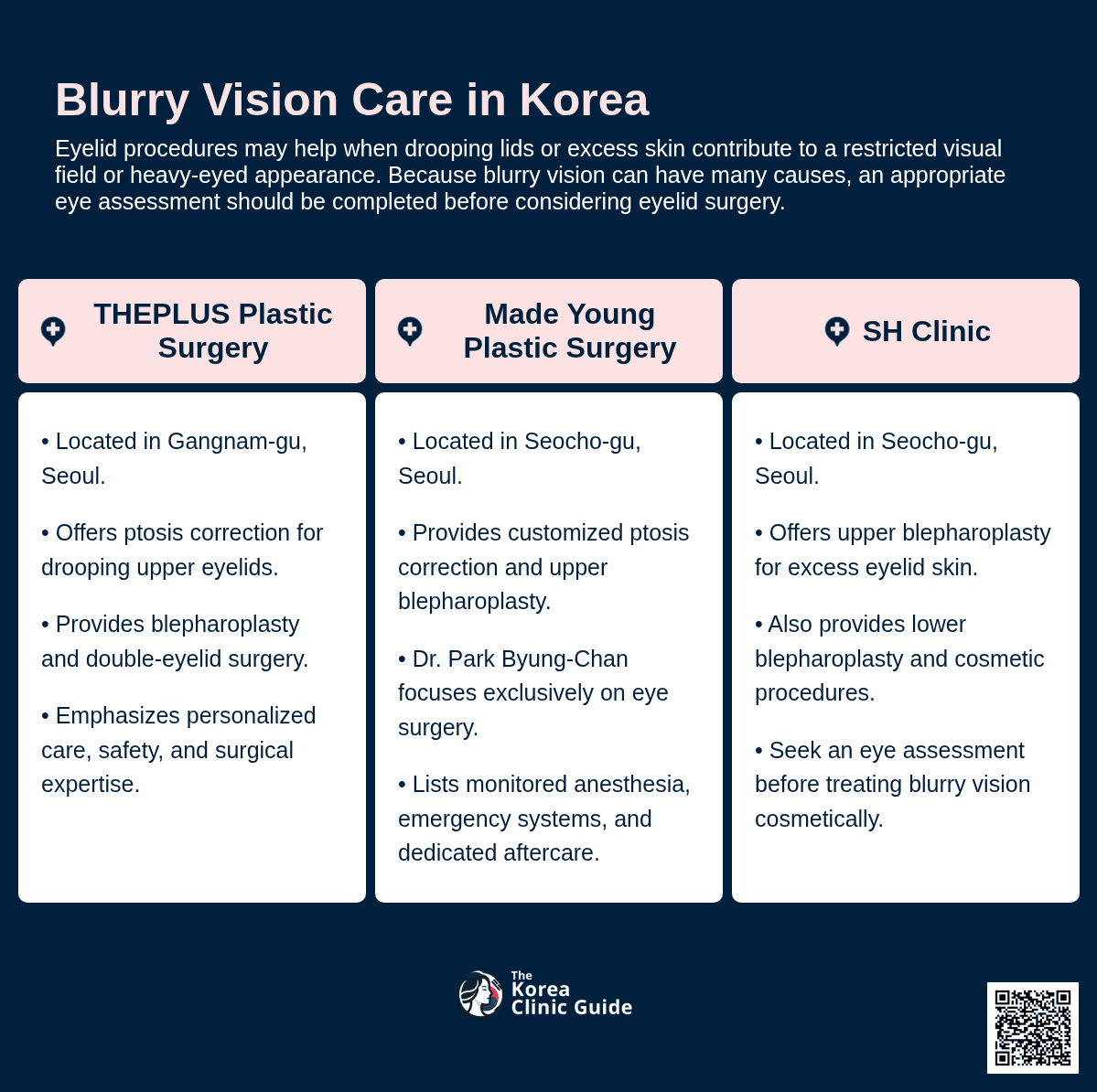
1. THEPLUS Plastic Surgery
If drooping upper lids are contributing to a heavy-eyed appearance or obstructing how open your eyes feel, THE PLUS Plastic Surgery offers ptosis correction aimed at adjusting the muscles that open the eyes, along with eyelid procedures that address excess tissue. Because blurry vision can have causes beyond the eyelids, you should obtain an appropriate eye assessment to determine whether an eyelid procedure is relevant to your symptoms.
- URL: THEPLUS Plastic Surgery Website
- Location: Gangnam-gu, Seoul
- Eye procedures:
- Ptosis correction is offered to lift drooping upper eyelids by correcting the muscles that open the eyes.
- Blepharoplasty adjusts excess skin and tissue around the eyelids.
- Double-eyelid surgery creates an upper-eyelid crease designed to match your facial features.
- Surgical expertise:
- Dr. Kim is described as a board-certified plastic surgeon with research recognition involving 3D implants and expertise in rhinoplasty and facial contouring.
- Dr. Jeong is identified as President of the Korean Society of Plastic Surgeons and has presented internationally on rhinoplasty.
- The clinic describes a focus on personalized aesthetic care, safety, and research.
2. Made Young Plastic Surgery
Made Young Plastic Surgery may be worth considering when eyelid drooping or excess upper-lid tissue is affecting your visual field or making your eyes feel heavy: it offers ptosis correction and upper blepharoplasty, with eye-surgery customization led by Dr. Park Byung-Chan, who is described as having 15 years dedicated exclusively to eye surgery. Blurry vision can also arise from eye-health or refractive conditions, so you should first confirm that an eyelid concern is the cause of your symptoms.
- URL: Made Young Plastic Surgery Website
- Location: Seocho-gu, Seoul
- Eyelid options:
- Ptosis correction is offered to repair drooping eyelids by tightening the lifting muscle.
- Upper blepharoplasty removes excess upper-eyelid skin and fat and is described as potentially improving the field of vision as well as appearance.
- The clinic also lists incisional and non-incisional double-eyelid surgery, lower blepharoplasty, canthoplasty, and dark-circle treatments.
- Eye-surgery approach:
- Dr. Park Byung-Chan is described as having 15 years of experience exclusively in eye surgery.
- The clinic states that incision lines, eyelid-crease height, eyelid thickness, and overall eye shape are customized during planning.
- It describes direct medical-team consultation and diagnosis before procedures.
- Safety and aftercare:
- The clinic states that board-certified anesthesiologists are on site full time and that one anesthesiologist continuously monitors each person during a procedure.
- It describes a cross-check emergency response system and CCTV coverage of procedures.
- A separate dedicated aftercare center is listed.
3. SH Clinic
SH Clinic lists upper blepharoplasty, which removes excess upper-eyelid skin and creates a defined crease; the clinic describes this as brightening the eye area and easing eyelid heaviness. This may be relevant if excess lid skin is the concern, but the supplied information does not identify a dedicated blurry-vision evaluation or ptosis service, so you should seek an eye assessment for blurred vision before considering cosmetic eyelid surgery.
- URL: SH Clinic Website
- Location: Seocho-gu, Seoul
- Eyelid procedures:
- Upper blepharoplasty, also described as double-eyelid surgery, removes excess eyelid skin and forms a defined crease.
- Lower blepharoplasty repositions or removes under-eye fat and tightens loose lower-lid skin.
- Clinic scope:
- SH Clinic describes itself as a multi-specialty center combining stem-cell services, women’s healthcare, aesthetic dermatology, and plastic surgery.
- Its cosmetic plastic-surgery offerings also include face contouring, facelift, liposuction, and hair transplantation.
Patient Experiences: Addressing Blurry Vision Through Eyelid Retraction Repair
Real-World Outcomes: How the Procedure Can Improve Vision and Quality of Life
Eyelid retraction repair improves vision by restoring eyelid position, enhancing lubrication, reducing discomfort, and protecting the eye surface. Patients often report a wider field of vision and relief from dry eye symptoms.
For example, Bonnie S., who had Thyroid Eye Disease with retracted eyelids and double vision, experienced significant improvement after treatment. She could wear contact lenses again after months of severe dryness, showing how correcting eyelid position can restore normal vision and comfort.
Beyond vision, the surgery improves eye comfort by distributing tears properly and reduces chronic irritation. Aesthetic benefits include correcting asymmetry and tired appearances, boosting confidence and social well-being. Many patients notice a younger, natural look as a positive side effect.
When done by an experienced surgeon, the repair offers a long-lasting solution for both function and appearance.
Important Considerations and Realistic Expectations
Patients should be aware of some important points:
- Temporary Visual Changes: Some experience blurry vision after surgery due to temporary changes in corneal shape and induced astigmatism. Most of these changes are minor and resolve or can be corrected with glasses.
- Pre-operative Counseling: Understanding possible swelling and temporary blurriness helps manage expectations.
- Revision Surgery Complexity: If initial surgery doesn’t fully correct the problem, revision is more complex due to scarring and altered anatomy, emphasizing the need for expert surgeons.
- Outcome Variability: Success depends on tailoring techniques to individual anatomy and cause, highlighting the importance of personalized care.
Conclusion: Empowering Your Vision Journey
Blurry vision has many causes, and eyelid retraction is a key, treatable one that affects vision by exposing and drying the cornea. Eyelid Retraction Repair restores eyelid function, improves comfort and vision, and enhances appearance. South Korea offers advanced care, expert surgeons, competitive pricing, and patient-focused service, making it an excellent option for this surgery. Approaching treatment with realistic expectations and expert guidance ensures the best outcomes on your path to clearer vision and improved eye health.
References
Frequently Asked Questions
Related Blogs

Brightening Eyes in Korea: Canthoplasty and Laser Canthoplasty
Brightening eyes: Discover why Canthoplasty and Laser Canthoplasty in Korea offer safe, natural results—often combined with Canthopexy or Blepharoplasty. Our article cautions against Cosmetic Ocular-Whitening (I-BRITE, WhiterEyes) due to high risks, and explains candidacy, recovery, and costs. Learn how Korea’s oculoplastic expertise helps both cosmetic goals and functional issues like ectropion a
Updated: Oct 12, 2026

Cornea Damage Treatment in Korea: Canthoplasty and Laser Canthoplasty
Discover how Canthoplasty and Laser Canthoplasty help prevent cornea damage by correcting eyelid malpositions that expose or irritate the eye. This Patient’s Guide explains symptoms, initial care, costs, and medical tourism options in Korea, plus how to choose a board-certified oculoplastic surgeon for functional and aesthetic outcomes.
Updated: Oct 12, 2026
Facial Palsy Treatment in Korea: Eyelid Fat Grafting Procedures for Facial Paralysis Recovery
Discover how Korea leads in facial palsy treatment, offering advanced surgical procedures like eyelid fat grafting, eyelid weight implantation, and tarsorrhaphy. This comprehensive guide explains the causes of facial paralysis, highlights Korea's expertise in functional and aesthetic face surgery, and covers medical tourism options. Learn about cost-efficient packages, post-surgery care, and achie
Updated: Oct 12, 2026
Change Eye Shape in Korea: Canthoplasty and Laser Canthoplasty Procedures for Eye Reshaping
Discover how Korea leads the way in eye reshaping with advanced procedures like Canthoplasty and Laser Canthoplasty. This comprehensive guide covers the differences between these popular eye surgeries, the medical tourism experience in Korea, costs, safety tips, and patient outcomes. Whether seeking almond-shaped eyes or subtle enhancements, Korea offers high-quality, affordable solutions. Learn a
Updated: Oct 11, 2026
Clinics offering Eyelid Retraction Repair

SH Clinic: Comprehensive Women's, Men's & Couples' Health Services in Korea
Sinsa

THEPLUS Plastic Surgery Korea | Eye, Nose, Face & Body Surgery
Sinsa

Made Young Plastic Surgery: Rejuvenating Aesthetic Excellence in Korea for Face Lifts, Contouring and More
Gangnam Station
ID Hospital - Main Branch in Korea: Specializing in Safe & Customized Facial Plastic Surgery and Post-Care Services
Sinsa