Medical Tourism Blog
Craniofacial Asymmetry in Adults: Facial Asymmetry Correction Procedures in Korea
Table of contents
- Medical Procedures for Facial Asymmetry Correction
- Best Clinics in Korea for Craniofacial Asymmetry Adult
- Your Journey to Correction in South Korea: A Step-by-Step Guide
- Cost Analysis for Medical Tourists: South Korea vs. Global Destinations
- Patient Journeys and Outcomes: Addressing Issues with Correction
- Conclusion
- References
Considering treatment in Korea? Everything you need to know e.g. — how to avoid scams, visas, interpreters, recovery tips — in our Medical Tourism Master Guide. Plan with confidence in minutes, not weeks!
Facial asymmetry means the two sides of your face don’t match perfectly, with visible deviations from the centerline. A little bit of asymmetry is perfectly common—hardly anyone is a true mirror image—but when differences get larger, they can affect not just confidence but daily living.
Clinically, if your soft tissue menton (chin) is off by more than 3–4 mm, it’s usually obvious to others. This crossing point is used to judge whether concerns go beyond normal variation and should be assessed medically. Knowing this distinction is important: it reassures patients when their concerns are genuine and keeps expectations realistic, since treatment usually aims for better symmetry—not flawless perfection.
Common Pseudonyms for Adult Skeletal Imbalance
If you search for help with "craniofacial asymmetry adult" or "adult skeletal imbalance of face," you’ll see a range of terms. Understanding these can make navigating information much easier:
- Facial Asymmetry (FA): Covers all forms of facial imbalance.
- Asymmetrical Face: Less formal but widely used by the public.
- Uneven Jawline: Points to skeletal imbalance in the jaw/lower face.
- Relative or Subclinical Asymmetry: Subtle, sometimes unnoticed forms.
- Static Asymmetry: Visible at rest.
- Dynamic Asymmetry: Shows up more during expressions.
- Hemi-asymmetries: Overgrowth (hemi-hyperplasia), underdevelopment (hemi-hypoplasia), or tissue wasting (hemi-atrophy) on one side.
- Malocclusion: A dental term about bite problems, often linked with jaw asymmetry.
The range in terms reflects how many different ways asymmetry can appear and how our bones, teeth, and soft tissues are all involved, often leading patients to use a mix of words when looking for help. Listing them here bridges everyday language with medical wording, making information easier to find and follow.
Causes of Asymmetry in Adults (Congenital, Developmental, Acquired Conditions)
Facial asymmetry can begin at birth, develop during childhood and growth, or appear later in life due to injury, disease, or habits.
Congenital Causes: These start from birth, including conditions like cleft lip and palate (often more frequent on the left side), or head molding due to pressure during pregnancy/delivery. These can be noticeable early but sometimes improve naturally as the baby grows.
Developmental Causes: These arise during growth, often for reasons no one can pinpoint. They become more noticeable in the teenage years when facial bones mature, sometimes due to habits like chewing mostly on one side, sleeping on one side, or orthodontic issues such as malocclusion.
Acquired Causes: These develop after childhood—think trauma, infections, tumors, or treatments like radiotherapy for childhood cancers. Effects range from TMJ ankylosis (joint stiffening, trouble eating/speaking) to direct trauma, fibrous dysplasia, tumors, unilateral condylar hyperplasia (one jaw side grows more), and rare disorders like Parry-Romberg Syndrome (progressive wasting of one facial side). Other, less common causes include infections, cysts, burns, or diseases like Paget’s disease.
Lifestyle Factors: Aging can make asymmetry more obvious as collagen and bone structure change. Other habits—like how you sleep, posture, resting your face on your hand, smoking, or losing teeth—can make things worse.
Facial asymmetry is often a blend of genetics, habits, environment, or medical events, which can make things shift over time. Understanding the cause is crucial for tailored diagnosis and treatment—sometimes habits can be changed, sometimes medical correction is the answer.
Impacts on Daily Life (Aesthetic, Functional, Psychosocial)
Significant facial asymmetry isn’t just about looks—it can affect many parts of day-to-day life.
Aesthetic Concerns: Feeling self-conscious about asymmetry, especially in photos or social situations, is very common and can drive people to seek treatment.
Functional Issues: Noticeable skeletal discrepancy can cause chewing, speech, or jaw movement problems. TMJ disorders may appear, with pain or clicking sounds, and in tough cases, things like bad oral hygiene, snoring, or even sleep apnea can result.
Psychosocial Concerns: Living with facial asymmetry can diminish self-esteem, social life, or even professional satisfaction. The effects cascade: physical imbalance leads to functional issues, which then feed psychological challenges.
Understanding these layers helps validate why patients care deeply about correction, and shows that treatment isn’t just about cosmetics but about regaining comfort, wellbeing, and confidence.
Medical Procedures for Facial Asymmetry Correction
Correcting facial asymmetry is always personal; treatments depend on the cause, severity, and goals. Options range from temporary, non-surgical fixes to more involved surgical solutions.
Non-Surgical Approaches
For mild cases, especially those from muscle or soft tissue differences, several popular non-surgical methods are available:
- Botox (Botulinum Toxin Injections): Temporarily relaxes specific facial muscles pulling unevenly. Common for uneven brows, smiles, or bulging jaw muscles. The benefit? Quick, no downtime; results last 3–4 months, with repeat treatments needed.
- Dermal Fillers (Hyaluronic Acid-based): Adds volume or contours to balance out the face—think cheeks, jawline, or lips. Effects show right away and generally last 6–18 months.
- Facial Implants (Non-Surgical, but Permanent): Placed under the skin to augment cheeks or chin for permanent correction.
- Other Non-Invasive Methods: Makeup, hairstyling, or temporary aids like eyelid tape may help very mild asymmetry, but clinical evidence for facial exercises is limited for skeletal issues (though muscle tone may improve).
Temporary injectables help with soft-tissue or muscular imbalance, but deeper skeletal problems usually need surgery for lasting change.
Surgical Interventions
For big differences in bone structure or severe symptoms, surgery is the mainstay. Surgical approaches offer permanent changes and are often highly customized, sometimes requiring multiple steps and collaboration between specialties.
- Orthognathic Surgery (Corrective Jaw Surgery): Repositions the upper (maxilla) and/or lower jaw (mandible) to correct major imbalances. Examples include Le Fort I osteotomy for the upper jaw or Bilateral Sagittal Split Osteotomy (BSSO) for the lower jaw. Many cases need both jaws adjusted. Prep includes orthodontics before and after surgery, with digital 3D planning now standard.
- Genioplasty (Chin Surgery/Mentoplasty): Adjusts chin size or position—often as part of a broader surgical plan. Options include shaving, shaping, or sliding the chin bone forward/back.
- Facial Contouring Surgery: Reshapes jawline, cheekbones, or chin using bone and soft tissue work (e.g., V-line jaw reduction, cheekbone reconstruction).
- Other Complementary Procedures: Osteotomy (bone cuts), implants, rhinoplasty if nose asymmetry plays a big role, fat grafting, TMJ surgeries, or additional procedures like brow lift or eyelid surgery for multi-feature imbalance.
Correction here is always personalized and may involve several experts and stages—not a one-size-fits-all approach. Thorough diagnosis and clear expectations are essential.
Best Clinics in Korea for Craniofacial Asymmetry Adult
Listed below are the best clinics in Korea for craniofacial asymmetry adult:
| Clinic Name | Key Features | Special Techniques |
|---|---|---|
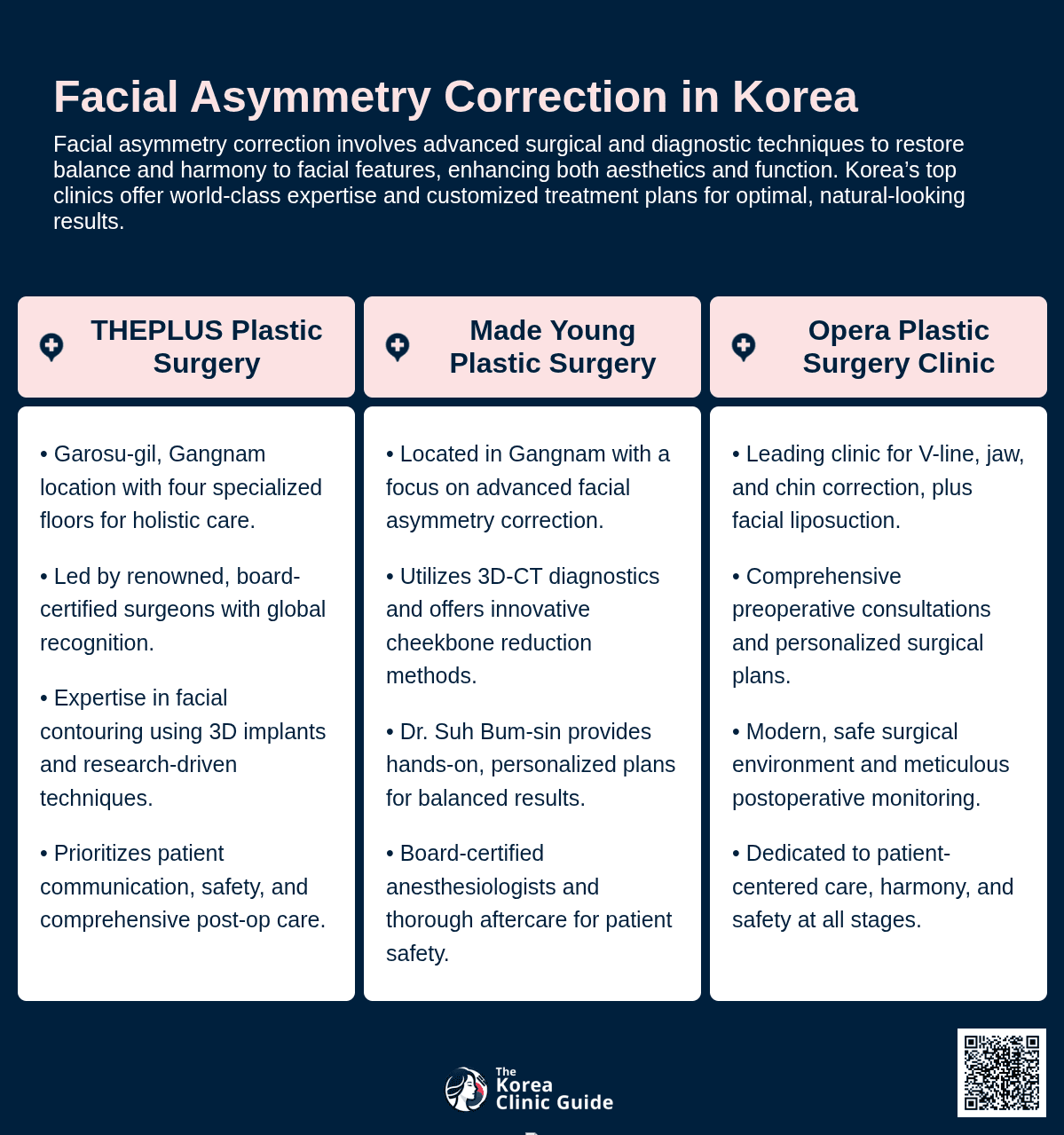
| THEPLUS Plastic Surgery Website | THEPLUS Plastic Surgery, located in the vibrant Garosu-gil area of Gangnam, Seoul, is a world-class clinic designed to guide patients seamlessly from consultation to surgery and post-operative care across four dedicated floors. For adults seeking correction of craniofacial asymmetry, THEPLUS stands out for its combination of high-level facial contouring expertise, rhinoplasty excellence, and academically driven surgical planning that prioritizes balance and natural harmony. Led by internationally recognized surgeons who actively publish, lecture, and train other plastic surgeons, the clinic brings an advanced, research-based approach to creating symmetrical, proportionate facial results while maintaining each patient’s unique features and, when needed, improving functional concerns alongside aesthetics. | - Specialized strength for adult craniofacial asymmetry: strong focus on facial contouring and balancing proportions (e.g., cheekbone, jawline, chin, and facial implant options) to restore harmony rather than producing a “one-style” look. - Leadership-level surgeons with global credibility: - Dr. Kim: Board-certified plastic surgeon, member of plastic surgery societies worldwide, award-winning researcher in 3D implants, and a leading expert in rhinoplasty and facial contouring; also runs annual educational sessions for other plastic surgeons and is known for emphasizing harmonious facial balance. - Dr. Jeong: President of the Korean Society of Plastic Surgeons, frequent international conference speaker and panelist, and a specialist in rhinoplasty (including revision cases) who prioritizes combining function and beauty in every plan. - Dr. Lee: Board-certified plastic surgeon with extensive experience at top Korean hospitals, including Seoul National University Hospital; valued for an approach aimed at natural, long-lasting results and high patient satisfaction. - Research-driven, education-forward clinic culture: the surgeons are active medical researchers contributing to journals and books, and they regularly present at domestic and international symposiums—an advantage for complex asymmetry cases that require precise analysis and planning. - Advanced aesthetic and functional integration: particularly relevant for asymmetry patients who may need both structural balance and functional improvement (such as nasal deviation and septal issues) addressed together. - Strong reputation in rhinoplasty and facial contouring: extensive experience in rhinoplasty and revision rhinoplasty, paired with facial contouring expertise, supports comprehensive facial balancing for asymmetry correction. - Safety and continuity of care: a highly experienced medical team (with more than a decade of practice) and a clinic layout built to support the full journey—consultation, surgery, recovery support, and post-operative skincare—helps ensure consistent, closely monitored outcomes. |
| Made Young Plastic Surgery Website | Made Young Plastic Surgery Clinic is a premium facial and anti-aging specialist center located in Seoul’s Gangnam district, known for combining high-level surgical expertise with a safety-first, patient-specific approach. For adults seeking correction of craniofacial asymmetry, MadeYoung focuses on precise diagnosis, meticulous osteotomy design, and stable fixation to achieve balanced facial proportions while minimizing risks such as nonunion, sagging, or bone resorption—helping patients pursue natural-looking symmetry with confidence. | - Precision planning for adult asymmetry: 3D-CT precision diagnostic system to analyze cheekbone prominence, overall facial proportions, and soft-tissue structure, then build a fully customized surgical plan for each patient’s asymmetry pattern. - Accurate osteotomy with stable fixation: Ultra-Close Contact Cheekbone Reduction technique designed to minimize gaps between bone sections, supporting precise alignment and stable fixation to reduce complication risks. - Fixation options tailored to the patient: Offers both screw-fixation and metal-free (no screws) cheekbone reduction options, allowing the surgical approach to match anatomical needs and patient preferences. - Comprehensive asymmetry correction from ear to chin tip: Specialized technique by Dr. Suh Bum-sin for smooth, natural reduction that addresses both jaw angle and jaw width simultaneously—important for adult craniofacial asymmetry where imbalance often involves multiple areas. - Reduced risk of post-surgical drooping: Includes Periosteum Repositioning to reposition the bone membrane upward after surgery, helping prevent soft tissue sagging and supporting a sharper, slimmer jawline. - Verified, highly experienced medical team: Only highly skilled doctors with an average of 15+ years of experience, with direct consultation and diagnosis by the medical team before any procedure. - Anesthesia and safety systems built for surgical care: Full-time board-certified anesthesiologists on site, a 1:1 dedicated monitoring system, a cross-check system for emergency response, and full CCTV coverage of procedures for transparency. - Structured recovery support: Dedicated aftercare center providing complete and systematic post-procedure care. - Recognized standards and credentials: 2022 Korea No.1 Award, 2022 Korea Customer Satisfaction 1st Place, selected as an Outstanding Member of the Korean Society of Plastic and Reconstructive Surgeons, and certified by the Minimally Invasive Aesthetic Surgery Society. |
| The Regen Plastic Surgery Clinic | For adults seeking correction of craniofacial asymmetry in Korea, The Regen Plastic Surgery Clinic in Hakdong stands out as a leading choice because it offers a genuinely comprehensive, symmetry-focused range of procedures that can be combined and tailored to the specific structures contributing to imbalance. Adult asymmetry often involves multiple facial units rather than a single feature, and Regen’s menu addresses this holistically: eye options such as Eye Shape Correction, Men’s Eyelid Correction, and precise Upper/Lower Eyelid Surgery can refine eyelid height, openness, and overall eye balance; nasal options including Crooked Nose Correction, Revisional Nose Surgery, and No-Implant Nose Surgery help restore midline alignment and natural proportion; and facial contouring procedures like Zygoma (Cheekbone) Reduction, Square Jaw Reduction, and Chin Surgery can rebalance the facial frame for improved harmony. In addition, Regen provides revision-focused care (e.g., Revisional Eye Surgery and Clean Eye Correction Recovery) for patients who need corrective refinement after prior operations, as well as lifting options such as Thread Lifting, Ultherapy, and Face Lifting techniques to support overall facial balance as tissues change with age. |
THEPLUS Plastic Surgery
THEPLUS Plastic Surgery, located in the vibrant Garosu-gil area of Gangnam, Seoul, is a world-class clinic designed to guide patients seamlessly from consultation to surgery and post-operative care across four dedicated floors. For adults seeking correction of craniofacial asymmetry, THEPLUS stands out for its combination of high-level facial contouring expertise, rhinoplasty excellence, and academically driven surgical planning that prioritizes balance and natural harmony. Led by internationally recognized surgeons who actively publish, lecture, and train other plastic surgeons, the clinic brings an advanced, research-based approach to creating symmetrical, proportionate facial results while maintaining each patient’s unique features and, when needed, improving functional concerns alongside aesthetics.
- Specialized strength for adult craniofacial asymmetry: strong focus on facial contouring and balancing proportions (e.g., cheekbone, jawline, chin, and facial implant options) to restore harmony rather than producing a “one-style” look.
- Leadership-level surgeons with global credibility:
- Dr. Kim: Board-certified plastic surgeon, member of plastic surgery societies worldwide, award-winning researcher in 3D implants, and a leading expert in rhinoplasty and facial contouring; also runs annual educational sessions for other plastic surgeons and is known for emphasizing harmonious facial balance.
- Dr. Jeong: President of the Korean Society of Plastic Surgeons, frequent international conference speaker and panelist, and a specialist in rhinoplasty (including revision cases) who prioritizes combining function and beauty in every plan.
- Dr. Lee: Board-certified plastic surgeon with extensive experience at top Korean hospitals, including Seoul National University Hospital; valued for an approach aimed at natural, long-lasting results and high patient satisfaction.
- Research-driven, education-forward clinic culture: the surgeons are active medical researchers contributing to journals and books, and they regularly present at domestic and international symposiums—an advantage for complex asymmetry cases that require precise analysis and planning.
- Advanced aesthetic and functional integration: particularly relevant for asymmetry patients who may need both structural balance and functional improvement (such as nasal deviation and septal issues) addressed together.
- Strong reputation in rhinoplasty and facial contouring: extensive experience in rhinoplasty and revision rhinoplasty, paired with facial contouring expertise, supports comprehensive facial balancing for asymmetry correction.
- Safety and continuity of care: a highly experienced medical team (with more than a decade of practice) and a clinic layout built to support the full journey—consultation, surgery, recovery support, and post-operative skincare—helps ensure consistent, closely monitored outcomes.
You can check out their website here: THEPLUS Plastic Surgery Website
Made Young Plastic Surgery
Made Young Plastic Surgery Clinic is a premium facial and anti-aging specialist center located in Seoul’s Gangnam district, known for combining high-level surgical expertise with a safety-first, patient-specific approach. For adults seeking correction of craniofacial asymmetry, MadeYoung focuses on precise diagnosis, meticulous osteotomy design, and stable fixation to achieve balanced facial proportions while minimizing risks such as nonunion, sagging, or bone resorption—helping patients pursue natural-looking symmetry with confidence.
- Precision planning for adult asymmetry: 3D-CT precision diagnostic system to analyze cheekbone prominence, overall facial proportions, and soft-tissue structure, then build a fully customized surgical plan for each patient’s asymmetry pattern.
- Accurate osteotomy with stable fixation: Ultra-Close Contact Cheekbone Reduction technique designed to minimize gaps between bone sections, supporting precise alignment and stable fixation to reduce complication risks.
- Fixation options tailored to the patient: Offers both screw-fixation and metal-free (no screws) cheekbone reduction options, allowing the surgical approach to match anatomical needs and patient preferences.
- Comprehensive asymmetry correction from ear to chin tip: Specialized technique by Dr. Suh Bum-sin for smooth, natural reduction that addresses both jaw angle and jaw width simultaneously—important for adult craniofacial asymmetry where imbalance often involves multiple areas.
- Reduced risk of post-surgical drooping: Includes Periosteum Repositioning to reposition the bone membrane upward after surgery, helping prevent soft tissue sagging and supporting a sharper, slimmer jawline.
- Verified, highly experienced medical team: Only highly skilled doctors with an average of 15+ years of experience, with direct consultation and diagnosis by the medical team before any procedure.
- Anesthesia and safety systems built for surgical care: Full-time board-certified anesthesiologists on site, a 1:1 dedicated monitoring system, a cross-check system for emergency response, and full CCTV coverage of procedures for transparency.
- Structured recovery support: Dedicated aftercare center providing complete and systematic post-procedure care.
- Recognized standards and credentials: 2022 Korea No.1 Award, 2022 Korea Customer Satisfaction 1st Place, selected as an Outstanding Member of the Korean Society of Plastic and Reconstructive Surgeons, and certified by the Minimally Invasive Aesthetic Surgery Society.
You can check out their website here: Made Young Plastic Surgery Website
The Regen Plastic Surgery Clinic
For adults seeking correction of craniofacial asymmetry in Korea, The Regen Plastic Surgery Clinic in Hakdong stands out as a leading choice because it offers a genuinely comprehensive, symmetry-focused range of procedures that can be combined and tailored to the specific structures contributing to imbalance. Adult asymmetry often involves multiple facial units rather than a single feature, and Regen’s menu addresses this holistically: eye options such as Eye Shape Correction, Men’s Eyelid Correction, and precise Upper/Lower Eyelid Surgery can refine eyelid height, openness, and overall eye balance; nasal options including Crooked Nose Correction, Revisional Nose Surgery, and No-Implant Nose Surgery help restore midline alignment and natural proportion; and facial contouring procedures like Zygoma (Cheekbone) Reduction, Square Jaw Reduction, and Chin Surgery can rebalance the facial frame for improved harmony. In addition, Regen provides revision-focused care (e.g., Revisional Eye Surgery and Clean Eye Correction Recovery) for patients who need corrective refinement after prior operations, as well as lifting options such as Thread Lifting, Ultherapy, and Face Lifting techniques to support overall facial balance as tissues change with age.
Find more about this clinic here: The Regen Plastic Surgery Clinic Website
Your Journey to Correction in South Korea: A Step-by-Step Guide
South Korea is a top spot for cosmetic and reconstructive facial surgeries, thanks to cutting-edge techniques, highly trained surgeons, and competitive pricing. The medical tourism experience is designed to be smooth and comprehensive.
Initial Consultation and Comprehensive Planning
Most patients start with virtual consults, sharing photos and goals with the clinic before traveling. After arriving, they’ll get a detailed physical exam and advanced diagnostics like CT scans and 3D simulations, letting doctors map out the best plan and show likely results upfront.
Multiple consults help ensure goals, suitability, and expectations are all clear. It’s especially important for international patients to discuss preference differences, as Korean standards often emphasize balance and harmony.
Sophisticated planning with 3D software improves accuracy, predictability, and satisfaction, while good communication ensures everyone is on the same page.
Pre-Operative Preparation
Korean clinics take pre-op safety and prep seriously. You’ll get thorough health checks, and must quit smoking (at least 8 weeks before and after), avoid blood thinners and certain supplements, and dissolve any fillers in the surgical area. Packing comfort items, paperwork, and being mentally ready are all part of the process.
The Surgical Experience and Hospitalization
Surgery is done under general anesthesia. Times vary: mandibular surgery might take 30 minutes, maxillary about 40 mins, while two-jaw procedures can take longer. Hospital stays after surgery are usually 2–3 days for close monitoring. Many clinics use minimally invasive techniques plus 3D planning to speed recovery—with in-clinic, nurse-supervised recovery often available. This efficiency means less time under anesthesia, and faster initial recovery—big positives for medical tourists.
Post-Operative Care and Recovery
South Korean aftercare is thorough. Daily wound checks, pain management, and swelling reduction start right away. Stitches come out in about two weeks, and clinics offer both in-person and virtual follow-up.
Swelling and bruising fade over 1–2 weeks, but full results may take 3–6 months. Optional recovery therapies like lymphatic massage or hyperbaric oxygen are available. A soft-food diet is standard for the first weeks, and light walking is encouraged, but strenuous activity, sports, and smoking/alcohol are all restricted for weeks after.
Patients are advised to stay locally for 7–14 days post-surgery for optimal aftercare and easier follow-up.
Essential Logistics for International Patients
Korea’s infrastructure makes traveling for surgery easy. Clinics and agencies often help with travel, airport pickup, and even hotel arrangements. Visa-free stays for up to 90 days are common for many nationalities. Language support is standard, and payment is accepted in won or USD.
Best times to come? Spring and fall offer mild weather, which is helpful for recovery. If possible, avoid holidays and peak tourist periods. Patients are encouraged to rest in Korea for a few weeks post-op to smooth out recovery and follow-up needs.
These services—interpreters, coordinators, and patient-friendly logistics—reduce the usual worries of medical travel and add value for overseas visitors.
Cost Analysis for Medical Tourists: South Korea vs. Global Destinations
Understanding Facial Asymmetry Correction Costs in South Korea
In South Korea, correcting facial asymmetry runs from $3,000 to $15,000 USD (₩4,352,000–₩21,762,000 KRW). For more complex cases (like full asymmetrical face surgery), the range can be $8,000–$20,000 USD. Factors influencing the price include procedure complexity, surgeon reputation, and clinic location.
Common inclusions:
- Pre-operative consultations
- Surgeon’s and anesthesiologist’s fees
- Hospitalization (usually 2–3 days)
- Post-op care and follow-up
Some out-of-pocket costs: medications for swelling/bruising, additional accommodation, airfare, food, and local transport.
Cost Comparison with Other Countries
Globally, South Korea is known for quality and value:
Orthognathic Surgery (Jaw Surgery):
| Country | Average Cost (USD) |
|---|---|
| South Korea | ~$12,833 (range $7,000–$25,330) |
| USA | $18,000–$40,000 (up to $53,000) |
| Turkey | From $2,200 (double jaw $8,000+) |
| Mexico | $6,000–$12,000 (double jaw ~$11,700) |
| Canada | $18,000–$36,000 (double jaw ~$47,700 CAD) |
| Australia | $20,000–$40,000 AUD |
Facial Contouring:
| Country | Range (USD) |
|---|---|
| South Korea | $10,000–$22,000 |
| Thailand | $4,000–$9,000 |
| Turkey | $9,500–$11,000 |
Genioplasty (Chin Surgery):
| Country | Range (USD) |
|---|---|
| South Korea | $4,960–$5,440 |
| USA | $2,500–$10,000 |
| Mexico | $900–$3,600 |
| Turkey | $2,000–$3,000 |
South Korea’s costs, especially for jaw and facial contouring, are noticeably lower than the USA, Canada, or Australia, and similar or slightly higher than other tourism hotspots. The draw is not just price, but advanced care, top skills, and extensive post-op support—especially appreciated by medical tourists.
Patient Journeys and Outcomes: Addressing Issues with Correction
Patients who opt for craniofacial asymmetry correction often see improvements in far more than just their looks.
Aesthetic and Functional Improvements
Surgical interventions like orthognathic surgery realign bones, fixing the root causes of asymmetry. Patients experience better bites (malocclusion correction), easier chewing, clearer speech, relief from TMJ pain, improved breathing/sleep, and correction of gummy smiles or lip strain.
Psychological and Quality of Life Enhancements
Facial symmetry correction can be transformative for self-esteem and social comfort. Studies confirm that both surgical and minimally invasive treatments boost social functioning and emotional well-being. The ripple effect touches appearance, health, and confidence alike.
Case Examples and Testimonials
Real-world cases tell the story best:
- Diana’s Story: After facial paralysis from brain tumor surgery, reconstructive procedures restored much of Diana’s appearance, supporting her sense of self.
- Orthodontic-Surgical Case: A 20-year-old with severe asymmetry and malocclusion underwent comprehensive jaw and chin surgeries. She gained a strong, harmonious profile, proper bite, and improved nasal contour.
- Jaw Surgery Patient: Jaw surgery can relieve TMJ pain, realign features, and restore comfort—changes that may be subtle to others but life-changing for the patient.
Research, including systematic reviews, back this up: Patients enjoy improved symmetry, reduced pain, and better quality of life—physically and socially.
Long-term Stability and Relapse Considerations
Improvements after orthognathic surgery are usually stable for three years or more, with most shifts happening in the first year. To guard against relapse, patients may wear retainers or other appliances and must stick to post-op instructions. Being diligent is key to lasting results.
Conclusion
Adult craniofacial asymmetry, or adult skeletal imbalance of the face, is more than a cosmetic issue—it can affect function, health, and confidence. Treatment options range from temporary non-surgical fixes to comprehensive surgeries, each tailored to the individual’s cause and goals. South Korea stands out globally for its affordable, high-tech, and patient-focused approach, offering world-class care and robust support for international visitors. Ultimately, facial asymmetry correction can be truly life-changing, supporting symmetry, function, and long-term well-being.
References
1, 2, 3, 4, 5, 6, 7, 8, 9, 10, 11, 12, 13, 14, 15, 16, 17, 18, 19, 20, 21, 22, 23, 24, 25, 26, 27, 28, 29, 30, 31, 32, 33, 34, 35, 36