
Medical Tourism Blog
Bruxism Treatment in Korea: Splints, Masseter Botox, Recovery, and Travel Planning
Table of contents
- Bruxism Treatment at a Glance
- What Is Bruxism Treatment?
- Who Is a Good Candidate for Bruxism Treatment?
- How Is Bruxism Treatment Performed?
- Why Visit Korea for Bruxism Treatment?
- Key Information for International Patients
- Which Are the Best Clinics in Korea for Bruxism Treatment?
- Bruxism Treatment From Start to Finish
- Alternatives to Bruxism Treatment
- How Can I Prepare for Bruxism Treatment?
- Aftercare Advice
Considering treatment in Korea? Everything you need to know e.g. — how to avoid scams, visas, interpreters, recovery tips — in our Medical Tourism Master Guide. Plan with confidence in minutes, not weeks!
Last updated: September 2026
Bruxism Treatment at a Glance
- Purpose — Bruxism treatment addresses harmful consequences of clenching or grinding—such as tooth wear, fractures, restoration failure, jaw-muscle pain, or headaches—rather than guaranteeing that all jaw activity will stop.
- Best candidates — Assessment is most useful for people with worn, chipped, cracked, or sensitive teeth; repeatedly broken fillings or crowns; morning jaw fatigue; facial pain; headaches; limited opening; or persistent daytime clenching or sleep grinding.
- Main conservative option — A custom hard full-coverage stabilization splint is scanned or molded by a dentist and primarily protects teeth and restorations; it should be fitted and adjusted without permanently changing the bite.
- Botulinum toxin timing — Masseter botulinum toxin is an optional adjunct for selected adults with forceful clenching or muscle pain; effects may appear within 4 weeks, peak at 5–8 weeks, and last up to about 24 weeks, but it does not replace tooth protection.
- Important limitation — A standard bruxism guard does not treat obstructive sleep apnea; loud snoring, witnessed breathing pauses, or major daytime sleepiness warrant sleep-medicine evaluation instead of treating grinding alone.
- Korea travel planning — Allow about 1–2 days for assessment or an injection visit and 2–5 days for a new custom splint, which needs fabrication, delivery, and a fit check; leave buffer time for adjustments before flying home.
- Korea follow-up records — Request an English treatment summary, tooth chart, relevant radiographs, scan or splint design, wearing instructions, and any injection product, dose, muscle, and date records so a home dentist can continue care.
What Is Bruxism Treatment?
Bruxism treatment is individualized dental and pain care for repetitive jaw clenching, grinding, bracing, or thrusting. It aims to protect teeth and restorations, relieve jaw-muscle pain or headaches, restore function, and identify contributors such as sleep disorders when relevant. Treatment is usually non-surgical, using monitoring, habit-focused care, custom splints, dental repair, or selected injections.
Who Is a Good Candidate for Bruxism Treatment?
- Tooth damage or restoration failure — Appropriate for people with worn, chipped, cracked, sensitive, or repeatedly damaged teeth, fillings, crowns, or veneers.
- Pain and functional symptoms — An assessment is warranted for morning jaw fatigue, masseter tenderness, headache, limited opening, jaw-joint symptoms, or painful chewing.
- Troublesome clenching or grinding — Candidates include people with persistent daytime clenching, partner-reported sleep grinding, or visible damage associated with repetitive jaw-muscle activity.
- Need for diagnosis before treatment — Good candidates accept an examination of the teeth, gums, bite, jaw muscles, jaw joints, and jaw movement before selecting a splint, restorative treatment, behavioral care, or injection.
Bruxism includes clenching, grinding, bracing, and jaw thrusting, and is not automatically a disorder requiring treatment; care is directed at meaningful consequences such as tooth damage, pain, or impaired function. Mild symptoms without damage often need monitoring rather than active treatment. Defer routine splint or restorative work with an untreated abscess, acute oral infection, uncontrolled severe pain, or an unreliable bite record. Loud snoring, witnessed breathing pauses, or marked daytime sleepiness require sleep-medicine assessment, because a conventional bruxism guard is not an obstructive-sleep-apnea appliance. Do not undertake irreversible bite-changing reconstruction, orthodontics, or jaw surgery solely for grinding or jaw pain until the diagnosis is clear and conservative options have been considered.
How Is Bruxism Treatment Performed?
Treatment targets the consequence of bruxism rather than promising to eliminate every episode of jaw-muscle activity. The plan differs between awake clenching, sleep-related grinding, damaged teeth, painful muscle overload, and suspected sleep-disordered breathing.
- Education and awake-bruxism habit work — For daytime clenching, care can include awareness reminders, a relaxed jaw-rest position with teeth apart, reducing gum chewing and hard foods during painful flares, and individualized jaw or neck exercises. An overview of systematic reviews found potentially positive results for physical therapy and biofeedback, while emphasizing inadequate long-term evidence.
- Custom stabilization splint — A dentist takes an impression or digital scan and makes a removable, usually hard full-coverage appliance. Its central role is mechanical protection of teeth and restorations; it should not permanently reposition the jaw or alter the bite. At delivery, the dentist checks retention, sharp edges, gum pressure, comfort, and tooth contacts, as outlined in splint-delivery guidance.
- Repair of dental consequences — Composite resin, replacement fillings, crowns, or root-canal treatment address cracked, worn, painful, or structurally weakened teeth. These procedures repair damage but do not independently stop clenching or treat a sleep condition.
- Botulinum toxin type A — Selected adults with persistent forceful clenching or painful jaw-muscle overload can receive injections, commonly in the masseter. This is an adjunct, not a replacement for tooth protection or investigation of dental disease and sleep apnea. A systematic review and meta-analysis found short-term reductions in bite force and pain, with effects evident within four weeks, peaking around five to eight weeks, and lasting up to about 24 weeks; doses, muscles, diagnostic definitions, and outcomes varied substantially.
- Sleep-disorder-directed care — Snoring, witnessed apneas, sleepiness, or other obstructive-sleep-apnea features call for sleep evaluation. CPAP or a professionally selected mandibular-advancement device treats apnea when indicated; a flat bruxism splint does not.
Why Visit Korea for Bruxism Treatment?
Korea can be practical for a short dental assessment, digital scan, appliance fitting, or outpatient jaw-muscle injection when the clinic can communicate the plan clearly in English. The important issue is continuity: bruxism often requires adjustment and monitoring after travel. No robust comparative evidence shows that bruxism outcomes in Korea are superior to those in other countries.
- International-patient framework — Korea operates a registered medical-institution system for international patients, which offers a starting point for checking whether a provider is registered to serve overseas visitors.
- Defined treatment records — Request an English clinical summary, tooth chart, applicable radiographs, scan or impression record, splint design and material, wearing instructions, and any restorative records. These allow a home dentist to assess fit and ongoing tooth protection.
- Injection documentation — When botulinum toxin is used, obtain the product name, dose, muscles treated, injection record, date, and planned review interval. This matters because the evidence does not establish one optimal product, dose, injection map, or repeat-treatment interval for bruxism.
- Conservative planning — A comparative review of splints and botulinum toxin found both approaches reduced pain-related sequelae without a significant intermediate-term pain difference, and described splints as the preferred conservative choice when tooth protection and function are priorities.
Key Information for International Patients
- Minimum stay — Allow 1–2 days for assessment, scans, conservative counseling, or an adjustment to an existing appliance. Plan about 2–5 days for a new custom splint so it can be fabricated, delivered, and checked; this is a practical travel estimate, not a universal clinical rule.
- Repeat visits — New splints need a delivery check and sometimes an early adjustment. Stay longer for acute tooth damage, extensive restorative work, sedation, severe pain, sleep-medicine assessment, or repeated appliance adjustments.
- Flight timing — No evidence-based universal waiting period applies after uncomplicated splint fitting or masseter injection. Do not schedule the final appointment immediately before a long-haul flight; leave time to assess poor fit, bleeding, acute tooth pain, or unexpected chewing weakness locally.
- Recovery and activity — Examination, scanning, splint delivery, and routine injections involve little or no physical downtime. Injection-site tenderness or bruising can last several days; botulinum-toxin response should be reassessed over weeks to months, not treated as permanent correction.
- Remote follow-up — Arrange both remote review with the Korean provider, where offered, and an appointment with a home dentist. Confirm before travel whether the home provider is prepared to assess a splint, tooth wear, and restoration stability.
Travel note: Bring any existing splint, recent dental images, prior injection records, a complete medication and allergy list, and photographs of visible tooth damage.
Which Are the Best Clinics in Korea for Bruxism Treatment?
Listed below are some of the best clinics in Korea for bruxism treatment.
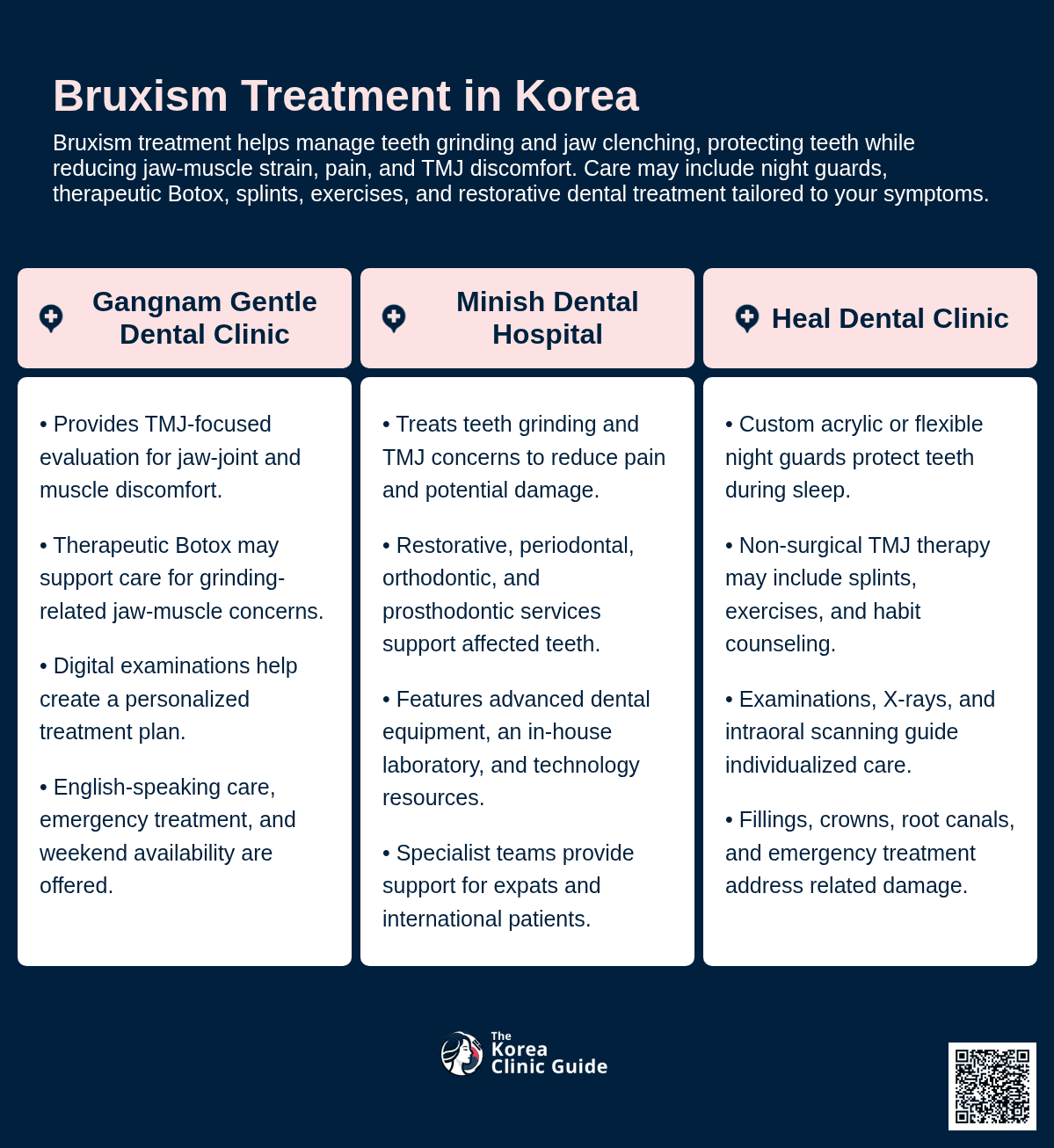
1. Gangnam Gentle Dental Clinic
For bruxism-related jaw discomfort or teeth grinding, you can receive TMJ-focused care and therapeutic Botox options at Gangnam Gentle Dental Clinic. Your treatment is supported by thorough consultation and digital examinations, with an emphasis on recommending only necessary care and tailoring it to your needs.
- URL: Gangnam Gentle Dental Clinic Website
- Location: Seocho-gu, Seoul
- Bruxism-related care:
- TMJ treatment is available for jaw-joint and surrounding-muscle problems that can cause pain or dysfunction.
- Botox is offered therapeutically for TMJ disorders and may be considered as part of care for jaw-muscle concerns related to grinding.
- Your visit:
- Dr. Travis Kim speaks fluent English and provides personalized care tailored to your needs.
- The clinic offers emergency dental treatment and has weekday and weekend availability.
- An established infection-prevention and sterilization system is described, alongside digital equipment for systematic examinations.
2. Minish Dental Hospital
At Minish Dental Hospital, you can seek care for bruxism and TMJ concerns with the aim of reducing pain and limiting longer-term damage from teeth grinding. The clinic combines jaw-health services with broad restorative, periodontal, orthodontic, and prosthodontic options if grinding has affected your teeth or bite.
- URL: Minish Dental Hospital Website
- Location: Gangnam-gu, Seoul
- Bruxism and TMJ care:
- The clinic offers solutions for teeth-grinding habits and conditions affecting jaw-joint health.
- Care is intended to reduce pain and help prevent long-term damage associated with bruxism.
- Related dental services:
- Cavities and prosthodontic treatments are available to restore teeth affected by decay or damage.
- Periodontal therapy supports gum and bone health.
- Orthodontic treatment is available for improperly positioned teeth and jaws.
- Clinic resources:
- The facility includes 19 advanced dental equipment pieces, an in-house laboratory, and an affiliated technology company.
- A team of veneer, orthodontic, and general dental specialists works under CEOs Dr. Jung Ho Kang and the clinic’s specialist team.
- The clinic reports support for expats and international visitors without language barriers.
3. Heal Dental Clinic
For bruxism, Heal Dental Clinic offers custom night guards and non-surgical TMJ therapy designed to protect your teeth from grinding, reduce jaw-muscle strain, and improve jaw comfort and function. Your care can include an assessment of your teeth, gums, bite, and oral tissues to guide a personalized plan.
- URL: Heal Dental Clinic Website
- Location: Seoul
- Protective and TMJ care:
- Custom acrylic or flexible night guards are worn during sleep to reduce grinding, protect enamel, lessen jaw-muscle strain, and help prevent tooth fractures.
- Non-surgical TMJ therapy may include splints, exercises, and habit counseling to ease pain, improve function, and reduce joint strain.
- Assessment and diagnostics:
- A comprehensive dental examination evaluates your teeth, gums, bite, and oral tissues.
- Dental X-rays can identify hidden decay, bone levels, and tooth-root conditions relevant to treatment planning.
- An intraoral scanner creates 3D digital models of your teeth without traditional impression trays.
- Care if grinding has affected your teeth:
- Tooth-colored fillings, crowns, inlays, and onlays are available for teeth with cavities, chips, or structural damage.
- Root canal treatment is available when inflamed or infected pulp needs treatment to save a natural tooth.
- Emergency care provides same-day assessment for pain, broken teeth, swelling, or infection.
Bruxism Treatment From Start to Finish
- Remote screening — Send symptoms, timing of clenching or grinding, photographs of damaged teeth, prior splints, recent dental radiographs if available, medical history, and medication and allergy lists. Ask whether English or virtual consultation is available and whether a new appliance can be completed within the travel window.
- In-person diagnostic assessment — The dentist reviews tooth wear, restorations, gums, bite, jaw muscles, joints, and range of motion. Dental radiographs or other imaging are added when tooth, root, joint, or restorative disease is suspected; sleep symptoms, reflux, trauma, locking, and neurologic symptoms also need review.
- Conservative treatment plan — The written plan should state whether the priority is tooth protection, pain and function, repair of active damage, sleep assessment, or a combination. Avoid irreversible bite changes when the diagnosis remains uncertain.
- Scan or impression and appliance design — For a stabilization splint, the clinician takes a digital scan or impression and bite record as needed, then specifies the appliance design and wearing schedule. Laboratory fabrication usually creates the need for a second visit.
- Splint delivery and adjustment — The dentist checks fit, retention, sharp areas, gum pressure, comfort, and tooth contacts before discharge. Do not file, grind, heat, or reshape the appliance independently.
- Optional masseter botulinum-toxin treatment — For selected adults, the injector confirms contraindications, reviews potential chewing weakness and asymmetry, and injects the planned masticatory muscle sites as an outpatient procedure. No sedation is normally required for a routine injection appointment.
- Discharge and local review — Leave with cleaning and wearing instructions, records, warning signs, and an adjustment plan. Keep enough time in Korea for review if the splint causes pressure, poor fit, a new bite change, locking, or escalating pain.
- Overseas follow-up — Continue review with the treating team remotely where possible and with a home dentist. After botulinum toxin, document pain response, chewing function, smile or facial asymmetry, and whether ongoing tooth protection remains necessary.
Alternatives to Bruxism Treatment
The best alternative depends on the main problem. Non-surgical approaches preserve teeth and bite anatomy and are usually preferred first; restorative procedures repair established damage, while sleep-apnea treatment addresses a potentially important medical driver rather than grinding alone.
Observation and Monitoring
- Best suited to — Mild, asymptomatic bruxism without progressive wear, fracture, pain, or functional limitation.
- Tradeoff — Avoids unnecessary treatment but requires regular examination for evolving tooth damage or symptoms.
Physical Therapy and Behavioral Care
- Best suited to — Awake clenching, jaw-muscle tension, pain flares, and prominent habit or psychosocial factors.
- Tradeoff — Does not physically shield teeth from grinding, so it is often combined with a splint when tooth wear is present. Current evidence is promising but not strong enough to define long-term benefit clearly.
Restorative Dentistry
- Best suited to — Teeth already affected by fracture, failing restorations, major wear, pain, or structural compromise.
- Tradeoff — Restores damaged tooth structure but is irreversible in many cases and does not cure bruxism. Conservative diagnosis and tooth protection should precede extensive reconstruction where possible. Related options include resin fillings, dental crowns, and root-canal treatment.
Sleep-Apnea Treatment
- Best suited to — People with loud snoring, witnessed pauses in breathing, marked daytime sleepiness, or confirmed obstructive sleep apnea.
- Tradeoff — CPAP or a titratable mandibular-advancement device treats airway obstruction; it is not interchangeable with a standard bruxism guard.
Orthodontic Treatment
- Best suited to — An independent orthodontic indication such as malalignment requiring correction.
- Tradeoff — Braces or aligners are not routine cures for grinding or jaw pain. Consider braces or clear aligners only after an orthodontic assessment identifies a separate need.
How Can I Prepare for Bruxism Treatment?
- Records and symptoms — Send recent radiographs, prior splint or injection records, photographs of visible tooth damage, and a short symptom log before travel. Note whether symptoms occur awake, during sleep, on waking, or while chewing.
- Medicines and supplements — Do not stop prescribed anticoagulants, antiplatelets, antidepressants, stimulant medicines, neurologic medicines, or other prescriptions independently. Disclose every prescription, over-the-counter medicine, vitamin, herbal product, and supplement; ask the prescriber to review drugs that could contribute to clenching.
- Botulinum-toxin disclosure — Report pregnancy or breastfeeding, bleeding disorders, prior toxin reaction, infection near the injection site, neuromuscular disease, and existing swallowing or breathing difficulty. The treating injector decides whether treatment should be postponed.
- Fasting and sedation — Fasting is generally unnecessary for examination, scans, splint fitting, and routine local-anesthetic dental care. Follow the clinic’s instructions exactly when sedation or extensive dental work is planned.
- Alcohol, tobacco, and caffeine — Reduce alcohol, tobacco, and late-day caffeine when they worsen sleep quality or clenching. Follow the injector’s individualized alcohol guidance when bruising is a concern.
- Travel logistics — A companion is usually unnecessary for a scan, splint fitting, or routine injection without sedation. Do not drive, use public transport alone, or take a long flight immediately after sedation or while using prescribed sedating medication.
- Flexible itinerary — Book a buffer before departure for splint delivery and adjustment. Confirm laboratory turnaround, the number of included adjustment visits, and access to urgent dental review.
Travel note: Arrange a home-dentist appointment before leaving for Korea, especially when a new appliance, tooth repair, or botulinum toxin is planned.
Confirm clinic-specific preparation requirements with the treating doctor; individualized instructions take precedence over general guidance.
Aftercare Advice
A correctly fitted splint protects teeth immediately, but comfort, bite contacts, and symptom response require active monitoring after treatment.
- Splint use and cleaning — Wear the appliance only on the prescribed schedule. Clean it with cool water and a soft brush, store it in a ventilated case, keep it away from heat and pets, and bring it to dental reviews.
- Do not alter the appliance — Never file, grind, heat, bend, or force a splint into place. Contact the clinic for sharp edges, gum pressure, tooth pressure, poor retention, a new bite change, locking, or worsening pain.
- Pain-flare measures — Use temporary softer foods, avoid gum chewing and prolonged wide opening, and follow clinician-directed jaw or neck exercises. Resume normal chewing as comfort and the treatment plan allow.
- After masseter botulinum toxin — Expect possible injection tenderness, bruising, temporary chewing weakness, or facial asymmetry for several days. Evaluate force and symptom change over weeks; available evidence remains insufficient to establish long-term safety of repeated treatment.
- Urgent warning signs — Seek prompt dental or medical assessment for facial swelling, fever, pus, a loose or broken tooth, inability to open or close the mouth normally, new facial numbness, or severe escalating headache. Contact the injector urgently for trouble swallowing, speaking, or breathing, generalized weakness, or allergy symptoms after botulinum toxin.
- Follow-up and final timing — Splint refinements can be needed over days or weeks. Botulinum-toxin effects are commonly assessed within four weeks and can persist up to about 24 weeks, but the duration depends on dose, muscles treated, diagnosis, and individual response.
Follow the treating doctor’s instructions over general advice and contact the clinic promptly when anything appears wrong.
Frequently Asked Questions
Related Blogs
Korea vs Global: Discover the True Cost of Gum Bleaching Across Major Destinations
Discover the ins and outs of gum bleaching in Korea, where advanced dental procedures meet affordability. Explore how this cosmetic treatment can rejuvenate your smile, and gain insights into the costs and considerations involved.
Updated: Oct 21, 2026

Experience Premier Dental Care Abroad: The True Cost of Inlay Fillings in Korea vs Global Alternatives
Discover the cost and benefits of inlay fillings in Korea, where high-quality dental care meets affordability. Learn why many choose Korea for their dental needs and what to expect in terms of pricing and procedures.
Updated: Oct 20, 2026
Explore the True Costs of Gum Contouring: Why Korea May Be Your Best Option Compared to the USA, UK, and More!
Discover the ins and outs of gum contouring in Korea, including an overview of costs and what to expect. Explore how this cosmetic dental procedure can enhance your smile while fitting various budgets.
Updated: Oct 20, 2026
Smile Bright: Investing in Teeth Whitening in Korea vs. Global Costs
Discover the affordable and high-quality teeth whitening options available in Korea, where advanced dental technology meets exceptional care. Explore the factors influencing costs and find the best solutions for achieving your brightest smile at a fraction of the price compared to Western countries.
Updated: Oct 20, 2026
Clinics offering Bruxism Treatment

Minish Dental Hospital: Korea's Premier Dental Clinic Offering Advanced Treatments and Personalized Care
Sinsa

Gangnam Gentle Dental Clinic: Your Trusted Dental Care Provider in Korea Offering Comprehensive Services with Optimal Comfort and Safety
Sinnonhyeon Station
365SeoulOneTop Dental Clinic Korea | Specialist Implants, Sedation, Cosmetic Dentistry & Invisalign in Hwagok
Hwagok
Heal Dental Clinic – Hwagok, Korea | Family Dentist, Implants & Braces
Hwagok