
Medical Tourism Blog
Root Canal Treatment in Korea: Treatment Steps, Recovery, Travel Timing, and Alternatives
Table of contents
- Root Canal Treatment at a Glance
- What Is Root Canal Treatment?
- Who Is a Good Candidate for Root Canal Treatment?
- How Is Root Canal Treatment Performed?
- Why Visit Korea for Root Canal Treatment?
- Key Information for International Patients
- Which Are the Best Clinics in Korea for Root Canal Treatment?
- Root Canal Treatment From Start to Finish
- Alternatives to Root Canal Treatment
- How Can I Prepare for Root Canal Treatment?
- Aftercare Advice
Considering treatment in Korea? Everything you need to know e.g. — how to avoid scams, visas, interpreters, recovery tips — in our Medical Tourism Master Guide. Plan with confidence in minutes, not weeks!
Last updated: September 2026
Root Canal Treatment at a Glance
- What it does — Root canal treatment removes infected or inflamed pulp from inside a restorable tooth, disinfects and seals its canals, and preserves the natural tooth rather than extracting it.
- Best candidates — It is intended for a tooth with pulp inflammation, pulp death, or root-canal infection that still has enough healthy structure and periodontal support for a durable filling or crown.
- Treatment visits — Some uncomplicated cases are completed in one appointment, but infection, drainage, difficult molar anatomy, retreatment, or time limits may require medication inside the tooth, a temporary filling, and one or more return visits.
- Recovery and restoration — Same-day discharge is typical with local anesthetic; tenderness or bite sensitivity often improves over several days, but avoid hard chewing until the final filling or, when indicated, crown is completed promptly.
- Travel timing — International visitors should plan 4–7 days in Korea for a straightforward first treatment and wait at least 72 hours before flying; complex cases, retreatment, abscesses, or laboratory crowns may require 7–14 days.
- Results and follow-up — Pain can improve quickly, but root-tip healing is evaluated clinically and on X-rays over months, commonly at 6–12 months; a treated tooth can feel normal before healing is visible.
- Korea-specific check — Korean cohort data reported 5-year tooth survival of 90.85% after initial treatment and 88.42% after retreatment, but these are not personal guarantees; verify foreign-patient registration, rubber-dam use, specialist access, English records, and emergency follow-up.
What Is Root Canal Treatment?
Root canal treatment is a tooth-preserving dental procedure that removes diseased tissue from inside a tooth, cleans and seals it, and restores the opening. It treats pain and infection while helping retain a restorable natural tooth instead of removing it. It is a minimally invasive, non-surgical treatment in most cases.
Who Is a Good Candidate for Root Canal Treatment?
- Restorable infected or inflamed tooth — Good candidates have pulp inflammation, pulp death, or infection in a tooth that can still be sealed and rebuilt. Signs include lingering heat or cold pain, spontaneous toothache, pain on biting, a gum swelling or drainage point, trauma-related discoloration, or a root-tip lesion on an X-ray.
- Tooth-preservation priority — Root canal therapy removes diseased pulp, disinfects the canals, and seals the tooth so it can remain in function rather than be extracted.
- First treatment or failed prior treatment — A previously root-treated tooth with recurrent infection, restoration leakage, persistent root-tip disease, or a missed canal can be assessed for retreatment.
- Complex-case referral — Molars with narrow or curved canals, calcified canals, traumatic injuries, suspected cracks, and retreatment cases warrant an assessment by an endodontist or a dentist with formal endodontic training.
A diagnosis requires clinical examination, pulp and bite tests, periodontal assessment, restorability assessment, and dental radiographs; symptoms alone are not enough. Root canal treatment is not a good option for a confirmed vertical root fracture, severe periodontal support loss, too little remaining tooth structure for a durable restoration, or repeated failure without a correctable cause. Uncontrolled diabetes, significant immunosuppression, unstable cardiovascular disease, bleeding disorders, and complex anticoagulant or antiplatelet treatment require coordination with the relevant doctor, not automatic cancellation. Pregnancy does not usually prevent necessary urgent endodontic care, but disclose gestational age; urgent local care takes priority over travel when facial or neck swelling, fever, swallowing difficulty, breathing difficulty, or spreading infection is present.
How Is Root Canal Treatment Performed?
The appropriate approach depends on whether the tooth has been treated before, the cause of disease, canal anatomy, and whether the tooth can receive a durable final restoration.
- Primary nonsurgical treatment — The first root canal procedure for inflamed, dying, or infected pulp. The clinician accesses the pulp chamber, cleans and disinfects the root canals, then seals them.
- Nonsurgical retreatment — The clinician reopens a previously treated tooth, removes existing canal filling material where feasible, addresses untreated anatomy or leakage, disinfects the canals, and reseals the tooth. It is used when prior treatment has not healed or reinfection develops.
- Endodontic microsurgery (apicoectomy) — Surgery at the root tip with a retrograde seal. It is generally considered when nonsurgical treatment or retreatment cannot address the cause of persistent disease.
- Radiographs and selective CBCT — Periapical X-rays are routine. Limited-field cone-beam CT (CBCT) can help evaluate complex anatomy, resorption, suspected fracture, unresolved disease, and surgical planning, but it adds radiation and is not necessary for every case. The American Association of Endodontists' CBCT guidance supports case-specific rather than routine use.
- Isolation and canal preparation — Rubber-dam isolation keeps saliva and bacteria out of the tooth during treatment. Magnification, electronic apex locators, hand or rotary instruments, irrigants, and filling techniques vary; correct diagnosis, thorough disinfection, a sound seal, and a durable restoration matter more than a particular device brand.
- Final restoration — Canals are commonly filled with gutta-percha and sealer, followed by a filling. A tooth with extensive prior decay, a large access opening, or high fracture risk often needs a dental crown after root canal treatment.
Why Visit Korea for Root Canal Treatment?
Korea has a formal government registration framework for medical institutions that attract foreign patients. This provides a practical accountability route for overseas visitors, but it does not establish that every registered dental clinic has specialist endodontic services or superior root-canal outcomes. Confirm the operator's credentials, isolation protocol, imaging access, language support, and emergency contact directly.
- Foreign-patient registration framework — International patients can review Korea's registered medical institution system when checking a provider's overseas-patient registration status.
- Large Korean survival dataset — A Korean National Health Insurance Cohort analysis reported five-year tooth survival of 90.85% after initial nonsurgical root canal treatment and 88.42% after retreatment; recorded rubber-dam use was associated with better observed survival. Read the cohort study as tooth-retention data, not a guarantee of radiographic healing or an international comparison.
- Longer-term local data — A separate Korean historical cohort reported 88.37% cumulative tooth survival at 11 years in its studied population. The 11-year cohort report does not prove a country-level advantage over treatment elsewhere.
- Case-specific specialist access — For retreatment, calcified canals, complex molars, trauma, or suspected cracks, ask whether formal endodontic specialty training, dental operating microscopy, rubber-dam isolation, selective CBCT, and referral to an endodontic service are available.
- Important evidence limit — Published success percentages change substantially according to the definition of healing and imaging method. A 2025 CBCT systematic review found pooled primary-treatment success of 85% using loose criteria but 45% using strict criteria, illustrating why no clinic or country can promise a personal outcome.
Key Information for International Patients
- Minimum stay — Plan 4–7 days in Korea for a straightforward first-time case, allowing diagnosis, treatment, and a short review. Plan 7–14 days for an acute abscess, severe symptoms, a complex molar, retreatment, a tooth with an existing crown or post, or a laboratory-made crown.
- Visit count — Some uncomplicated cases finish in one visit. Infection, drainage, difficult anatomy, time constraints, or symptoms can require intracanal medication, a temporary restoration, and a second or later appointment.
- Return flight timing — Allow at least 72 hours after nonsurgical root canal treatment before flying. A dental-tourism review identifies 72 hours as a practical minimum and one week as preferable after most dental interventions, while clearly noting limited evidence largely derived from military aviation rather than civilian long-haul travel.
- Do not fly with active problems — Postpone departure when numbness has not resolved, swelling or pain is escalating, urgent drainage or reassessment is possible, or a temporary filling is loose or broken.
- Itinerary impact — Treatment is usually under local anesthetic and allows same-day discharge. Keep the first evening and following day flexible, especially after treatment of an infected molar or when a temporary filling is in place.
- Records and handoff — Before leaving, obtain English copies of the treatment plan, diagnosis, tooth number, pre- and post-treatment periapical X-rays, any CBCT files, procedure note, prescribed medicines, materials used, and final restoration plan. Arrange a home dentist or endodontist before travel when possible.
- Sedation and escort — A companion is generally not needed with local anesthetic alone. Arrange a responsible adult escort, nearby accommodation, and no driving if oral or IV sedation, general anesthesia, or opioid pain medicine is used.
Travel note: Root canal therapy is only one part of preserving the tooth. Do not leave Korea relying on a temporary filling as a long-term restoration; arrange prompt completion of the planned permanent filling or crown at home if it cannot be done during the trip.
Which Are the Best Clinics in Korea for Root Canal Treatment?
Listed below are some of the best clinics in Korea for root canal treatment.
1. Gangnam Gentle Dental Clinic
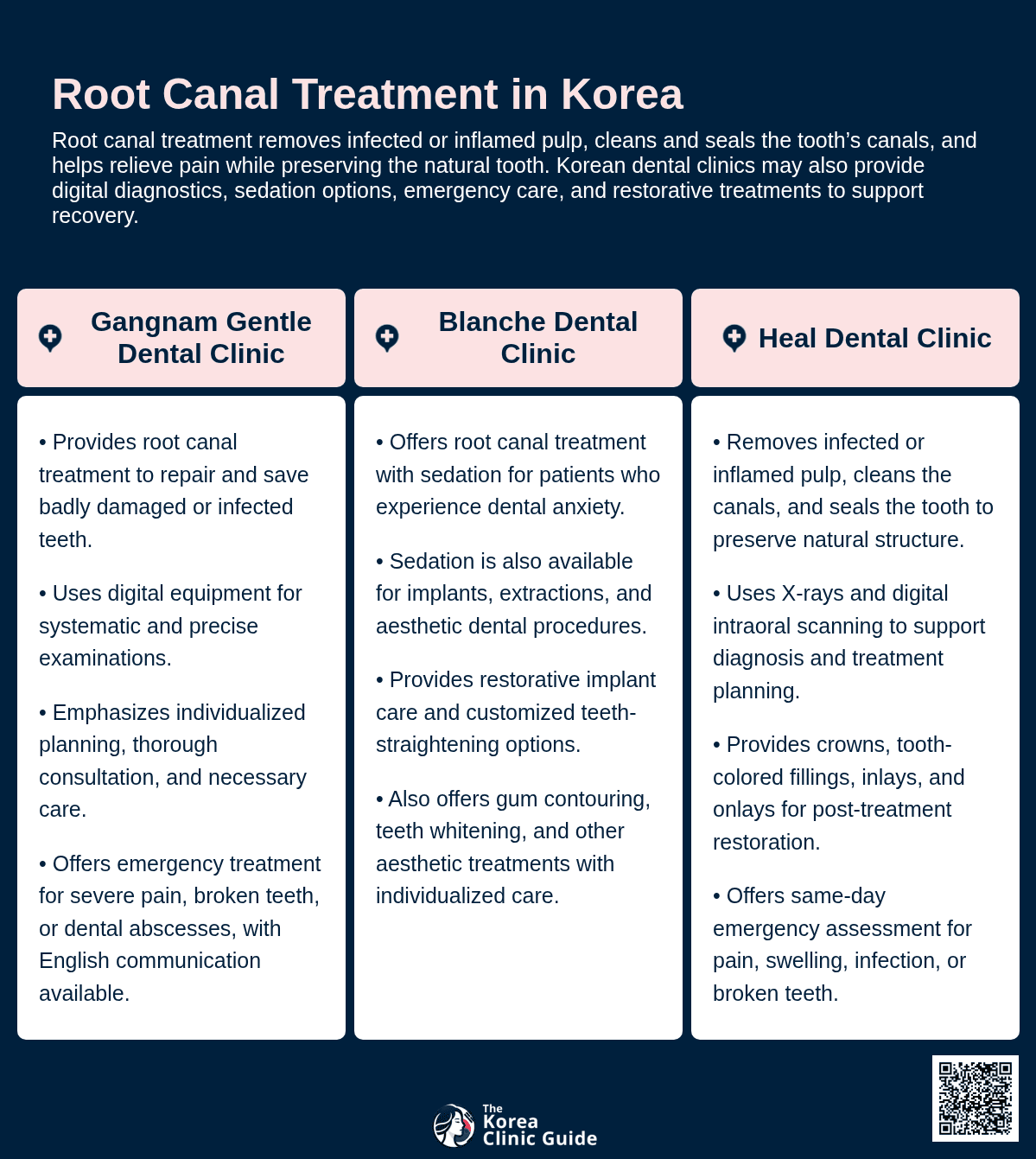
You may consider Gangnam Gentle Dental Clinic for root canal treatment if you value individualized planning, thorough consultation, and access to emergency dental care. The clinic lists root canal treatment for repairing and saving badly damaged or infected teeth, uses digital equipment for examinations, and aims to limit treatment time and unnecessary visits where appropriate.
- URL: Gangnam Gentle Dental Clinic Website
- Location: Seocho-gu, Seoul
- Root canal care:
- Root canal treatment is offered to repair and save a badly damaged or infected tooth.
- The clinic states that treatment recommendations follow thorough consultations and are limited to necessary care.
- Comfort and safety:
- The clinic emphasizes minimal-pain care and uses advanced digital equipment for systematic, precise examinations.
- An infection-prevention and sterilization system is described for a clean clinical environment.
- Emergency dental treatment is available for concerns such as severe pain, broken teeth, or abscesses.
- Communication and scheduling:
- Dr. Travis Kim studied at Ohio State University and speaks fluent English, which may help you discuss symptoms and treatment needs clearly.
- The clinic reports weekday and weekend opening, which may be helpful when arranging urgent care or follow-up visits.
2. Blanche Dental Clinic
You can expect root canal treatment at Blanche Dental Clinic to be available with the option of sedation, which may be particularly relevant if dental anxiety makes treatment difficult. The clinic describes providing sedation for root canals and other dental procedures, with care tailored to your individual needs.
- URL: Blanche Dental Clinic Website
- Location: Seocho-gu, Seoul
- Sedation option:
- Root canal treatment can be performed under sedation.
- Sedation is also offered for implants, extractions, and aesthetic dental treatments.
- Related dental care:
- The clinic offers restorative implant care, customized teeth straightening, gum contouring, teeth whitening, and aesthetic treatments.
- Its implant approach is described as avoiding unnecessary implant recommendations and explaining treatment thoroughly.
3. Heal Dental Clinic
You may consider Heal Dental Clinic for root canal treatment when your goal is to preserve a natural tooth affected by inflamed or infected pulp. The clinic describes treatment as removing the affected pulp, cleaning and sealing the canals, and aims to relieve pain, clear infection, and save the tooth; it also provides diagnostics, restorative care, and emergency assessment that can support your treatment plan.
- URL: Heal Dental Clinic Website
- Location: Seoul
- Procedure details:
- Root canal treatment involves removing infected or inflamed pulp, then cleaning and sealing the tooth’s canals.
- The stated goals are pain relief, infection control, and preservation of the natural tooth.
- Diagnostics and restoration:
- Dental X-rays are available to assess tooth roots and other issues not visible during an examination.
- Digital intraoral scanning can create 3D tooth models without conventional impression trays.
- Crowns, tooth-colored fillings, inlays, and onlays are offered to restore damaged or weakened teeth.
- Emergency and ongoing care:
- Same-day emergency assessment and treatment are available for pain, swelling, infections, and broken teeth.
- Dental examinations evaluate teeth, gums, bite, and oral tissues to guide personalized treatment planning.
- Periodontal care, including scaling and root planing, is available when gum health also needs attention.
Root Canal Treatment From Start to Finish
- Remote inquiry and triage — Send recent dental X-rays, photographs if relevant, a pain and swelling history, prior root-canal or crown information, medical conditions, medication doses, allergies, pregnancy status, and travel dates. An English-language virtual consultation can help with planning, but it cannot confirm a diagnosis.
- In-person diagnosis — The dentist reviews medical history, examines the tooth, performs percussion, bite, cold or electric pulp tests, periodontal testing, and a restorability assessment. Periapical radiographs are taken; CBCT is added only when complex anatomy, resorption, fracture, surgical planning, or unresolved disease justifies it.
- Treatment planning and consent — The clinician explains whether the tooth is suitable for primary treatment, retreatment, surgery, or extraction; discusses prognosis, number of visits, local anesthetic or sedation options, risks, costs, and the permanent restoration plan. Confirm the treating dentist's name, credentials, rubber-dam use, after-hours contact, and whether English consent and discharge documents are available.
- Anesthesia and isolation — Local anesthetic is standard. After numbness is confirmed, the tooth is isolated, commonly with a rubber dam, to reduce contamination from saliva and protect the airway during treatment.
- Canal cleaning and disinfection — The dentist creates a small access opening, removes inflamed or infected pulp, measures the canals with radiographs and/or an electronic apex locator, then shapes and irrigates the canal system. Narrow, curved, calcified, or previously treated canals can make this stage longer and more technically demanding.
- Sealing or temporary medication — When the canals are dry and ready, they are filled with gutta-percha and sealer. Active infection, drainage, difficult anatomy, or limited appointment time can require intracanal medication and a temporary filling before completion at a later visit.
- Restoration and discharge — The access opening receives a filling or temporary restoration. Obtain procedure records and images, prescriptions, emergency instructions, and a written plan for the final filling or crown. Most patients leave the same day after local anesthetic.
- Review and overseas follow-up — Return for a review before departure when treatment was staged, symptoms remain, or a temporary restoration is present. Have the home dentist complete definitive restoration promptly and arrange clinical and radiographic review around 6–12 months; root-tip healing is assessed over months, not by how the tooth feels in the first week.
Alternatives to Root Canal Treatment
The main tradeoff is between retaining a restorable natural tooth and removing a tooth with a poor long-term prognosis. Non-surgical pulp-preserving options apply only to selected vital teeth; extraction ends infection in a non-restorable tooth but creates a replacement decision.
Vital Pulp Therapy
- Best use — Pulp capping or related vital-pulp treatment can be considered when the pulp remains sufficiently healthy and preservation is clinically feasible.
- Tradeoff — It is not equivalent to treatment for established pulp death, significant root-canal infection, or an abscess.
Retreatment or Apicoectomy
- Best use — A previously root-treated tooth with persistent disease may be suitable for nonsurgical retreatment or endodontic microsurgery.
- Tradeoff — The choice depends on the reason for failure, canal access, root anatomy, restoration quality, periodontal support, and remaining tooth structure.
Extraction and Replacement
- Best use — Extraction is appropriate for a vertical root fracture, severe periodontal loss, irreparable structural damage, or a tooth that cannot be predictably restored.
- Replacement options — Discuss an implant-supported crown, a dental bridge, or a removable prosthesis after extraction.
- Tradeoff — Extraction removes the natural tooth and replacement treatment can involve surgery, healing time, additional cost, and care of adjacent teeth.
Direct or Indirect Restoration
- Best use — A small, restorable defect without irreversible pulp disease can sometimes be managed with a resin filling or inlay filling.
- Tradeoff — These restorations do not treat infected or necrotic pulp. Confirm pulp status before choosing a filling-only approach.
How Can I Prepare for Root Canal Treatment?
- Send records early — Provide recent X-rays, prior treatment notes, crown or trauma history, current symptoms, and clear travel dates. Request an English treatment plan and ask whether the clinic anticipates one or multiple visits.
- Disclose every medicine — Bring a named list with doses of anticoagulants and antiplatelets such as warfarin, apixaban, rivaroxaban, dabigatran, aspirin, and clopidogrel; diabetes medicines or insulin; immunosuppressants; antiresorptive bone medicines; and all drug allergies. Do not stop prescribed antithrombotic medicine independently; use a plan agreed by the prescribing clinician and dentist.
- Report supplements and substances — Disclose herbal products, vitamins, cannabis, alcohol, tobacco or nicotine use, and recreational drugs, especially when sedation or surgery could become necessary.
- Avoid self-prescribed antibiotics — Antibiotics do not replace cleaning, drainage, and definitive treatment of an infected tooth. Do not start leftover antibiotics simply to travel; the clinician decides when they are indicated.
- Eat and fast appropriately — Routine local-anesthetic treatment does not usually require fasting. Eat a normal light meal unless the clinic directs otherwise; follow the clinic's exact fasting instructions for oral or IV sedation or general anesthesia.
- Plan transport and accommodation — Stay near the clinic for the first night if pain, swelling, a temporary restoration, or multiple visits are expected. Do not drive after sedation or while taking opioid pain medicine.
- Protect the schedule — Book flexible flights and avoid planning a long-haul departure within 72 hours of treatment. Leave time for a review appointment and for unplanned additional treatment if the case proves more complex than remote records suggested.
Travel note: Seek urgent local evaluation instead of flying for routine treatment when facial or neck swelling, fever, difficulty swallowing or breathing, dehydration, or uncontrolled pain is present.
Confirm all clinic-specific fasting, medication, imaging, sedation, transport, and travel requirements with the treating dentist; their individualized instructions take precedence.
Aftercare Advice
Protect the treated tooth until numbness resolves and until its definitive restoration is complete; pain relief does not mean the tooth is ready for hard chewing.
- Numbness and food — Do not chew until local-anesthetic numbness has fully worn off, which can take several hours. Avoid biting the lip, cheek, or tongue, and choose soft foods initially.
- Biting pressure — Avoid hard, sticky, crunchy, or forceful chewing on the treated tooth, particularly with a temporary filling or while awaiting a crown. A high bite, cracked filling, or loose temporary restoration needs prompt dental review.
- Pain control — Mild tenderness, bite sensitivity, and limited swelling are common for several days; surrounding soreness can take up to about two weeks to settle. Use only medicines appropriate for your health history and follow the prescription or product label. Avoid duplicate acetaminophen/paracetamol in combination medicines; avoid ibuprofen and other NSAIDs when they are unsuitable because of kidney disease, ulcer or bleeding risk, relevant cardiovascular conditions, or allergy.
- Oral hygiene — Continue normal brushing and gentle flossing unless the treating dentist gives different instructions. Keep the temporary restoration clean but do not test it by biting hard foods.
- Urgent warning signs — Contact the clinic promptly for severe or worsening pain after the first few days, increasing swelling, return of original symptoms, medication reaction, inability to close normally, or a broken temporary restoration. Seek emergency care for fever with spreading facial or neck swelling, trouble swallowing, breathing difficulty, confusion, or rapid deterioration.
- Completion and healing checks — Complete the planned permanent filling or crown promptly to reduce fracture and coronal leakage. Arrange clinical and radiographic follow-up, commonly at 6–12 months; a treated tooth can feel normal while a root-tip lesion is still healing.
Follow the treating doctor's instructions over general advice, and contact the clinic promptly when anything appears wrong.
Frequently Asked Questions
Related Blogs
Bruxism Treatment in Korea: Splints, Masseter Botox, Recovery, and Travel Planning
Bruxism treatment begins with an assessment of teeth, bite, jaw muscles and joints, with options including habit care, a custom stabilization splint, dental repair, sleep evaluation, or selected masseter botulinum-toxin injections. International patients visiting Korea can plan 1–2 days for assessment or 2–5 days for a new splint, and should arrange adjustment time, treatment records, and home-den
Updated: Sep 21, 2026
Periodontal Disease Treatment in Korea: Methods, Recovery, Travel Planning, and Aftercare
Periodontal disease treatment starts with charting, radiographs, cleaning and home-care instruction, followed by deep cleaning, reassessment and selected surgery for persistent pockets or defects. International patients can plan 2–4 business days for non-surgical care, 7–10 days for early surgical review, and should arrange transferable records and follow-up with a home periodontist.
Updated: Sep 21, 2026
Wisdom Tooth Removal in Korea: Methods, Recovery, Risks and Travel Planning
Wisdom tooth removal may involve simple or surgical extraction, complete extraction, or coronectomy depending on impaction, root anatomy, nerve risk, and disease. The article covers imaging, anesthesia, recovery and travel planning in Korea, aftercare, warning signs, and follow-up requirements.
Updated: Sep 21, 2026
Gum Bleaching in Korea: Methods, Healing, Risks, and Travel Planning
Gum bleaching removes superficial benign melanin pigmentation under local anesthetic using laser, scalpel, electrosurgery, or other methods after periodontal assessment. The article covers candidacy, Korea travel planning, healing timelines, aftercare, follow-up, risks, and the possibility of repigmentation.
Updated: Sep 21, 2026
Clinics offering Root Canal Treatment

Gangnam Gentle Dental Clinic: Your Trusted Dental Care Provider in Korea Offering Comprehensive Services with Optimal Comfort and Safety
Sinnonhyeon Station

Blanche Dental Clinic in Korea: Advanced & Tailored Dental Care for a Healthy, Beautiful Smile
Nonhyeon
365SeoulOneTop Dental Clinic Korea | Specialist Implants, Sedation, Cosmetic Dentistry & Invisalign in Hwagok
Hwagok
Heal Dental Clinic – Hwagok, Korea | Family Dentist, Implants & Braces
Hwagok