
Medical Tourism Blog
Non-Surgical Rhinoplasty in Korea: Safety, Recovery, Travel Timing, and Alternatives
Table of contents
- Non-Surgical Rhinoplasty at a Glance
- What Is Non-Surgical Rhinoplasty?
- Who Is a Good Candidate for Non-Surgical Rhinoplasty?
- How Is Non-Surgical Rhinoplasty Performed?
- Which Are the Best Clinics in Korea for Nonsurgical Rhinoplasty?
- Why Visit Korea for Non-Surgical Rhinoplasty?
- Key Information for International Patients
- Non-Surgical Rhinoplasty From Start to Finish
- Alternatives to Non-Surgical Rhinoplasty
- How Can I Prepare for Non-Surgical Rhinoplasty?
- Aftercare Advice
Considering treatment in Korea? Everything you need to know e.g. — how to avoid scams, visas, interpreters, recovery tips — in our Medical Tourism Master Guide. Plan with confidence in minutes, not weeks!
Last updated: September 2026
Non-Surgical Rhinoplasty at a Glance
- What it does — Non-surgical rhinoplasty most often uses autologous cartilage, harvested from the patient's own ear or septum, injected to add volume at selected nasal points such as the bridge, radix, tip, or columella; hyaluronic acid filler serves as a quicker, harvest-free alternative. Neither involves incisions, general anesthesia, splints, or sutures.
- Best candidates — It suits medically well adults seeking modest bridge augmentation or camouflage of a mild hump, asymmetry, or small post-rhinoplasty irregularity; cartilage suits those wanting a more structural, longer-lasting result, while filler suits a quicker, temporary trial.
- Key limitation — Neither cartilage nor filler can make the nose smaller, remove a hump, narrow the bridge or nostrils, reliably straighten marked deviation, or correct breathing obstruction, since neither alters bone or the airway.
- Recovery and longevity — Contour is visible immediately, though swelling can affect symmetry. Cartilage leaves a small harvest-site wound, with swelling and bruising improving over 1 to 2 weeks and results commonly lasting well beyond a year; filler recovery is shorter, about 1 week, with results typically lasting 8 to 12 months.
- Serious risk — The nose is high-risk for any injected material: vascular occlusion can cause skin injury, and rare irreversible complications include visual loss or stroke, so severe pain, pale or dusky skin, blistering, or vision change requires immediate emergency care. Hyaluronidase reverses HA filler but not cartilage, so cartilage relies on prompt manual and medical management instead.
- Korea travel planning — Plan 5 to 7 days for cartilage injection to allow harvest-site healing and review, or 2 to 3 days for filler consultation, treatment, and early review; extend filler visits to 5 to 7 days for a first treatment, prior rhinoplasty, threads, or bruising concerns. No evidence-based post-injection flight interval exists.
- Korea-specific check — Verify the institution is registered for foreign patients, then confirm the named doctor, their cartilage-harvesting technique or, for filler, onsite hyaluronidase, a written vascular-emergency and ophthalmology-transfer pathway, and an English record of the material used, volume, and injection sites.
What Is Non-Surgical Rhinoplasty?
Non-surgical rhinoplasty most often uses autologous cartilage, taken from the patient's own ear or septum and injected to reshape the nose with carefully placed volume, offering a natural, longer-lasting result. Hyaluronic acid filler remains a common alternative for a quicker session. Both address modest contour goals such as enhancing the bridge or camouflaging a small hump or asymmetry, without reducing nose size or correcting breathing problems. Either is a minimally invasive injectable procedure, not surgery.
Who Is a Good Candidate for Non-Surgical Rhinoplasty?
- Modest augmentation goals — Good candidates want a higher radix or bridge, camouflage of a mild dorsal hump, limited tip or columellar projection, or refinement of a small contour irregularity after rhinoplasty.
- Structural or temporary change accepted — Autologous cartilage, harvested from the patient's own ear, rib or septum and injected as a fine, shaped deposit, adds volume without changing bone, the underlying septum, or the nasal airway, though results are typically longer-lasting than filler. Hyaluronic acid (HA) filler is the temporary alternative; a practical repeat-treatment planning range is 8 to 12 months, although published longevity varies substantially.
- Medically well adult — Candidates can disclose all medicines, allergies, previous nasal injections, surgery, trauma, and thread procedures, and can remain in Korea long enough for early review if required — longer for cartilage, to allow the harvest site to heal.
- Realistic anatomical goal — Neither cartilage injection nor filler can reduce nose size, remove a hump, narrow bony width or nostrils, correct marked deviation, or reliably treat breathing obstruction.
Do not proceed during pregnancy or breastfeeding, an active skin, dental, sinus, herpes, or upper-respiratory infection near the treatment or harvest area, or with known hypersensitivity to the proposed filler or lidocaine-containing product. Uncontrolled bleeding disorders, anticoagulant or antiplatelet treatment, severe allergy history, poorly controlled diabetes, immunosuppression, active inflammatory disease, a keloid-prone healing history at the ear, and delayed filler reactions require individualized medical review; never stop prescribed aspirin, clopidogrel, warfarin, apixaban, rivaroxaban, or similar medicines independently. Previous permanent filler, silicone, biopolymer, unknown injected material, significant scarring, rhinoplasty, trauma, or threads changes tissue planes and vascular risk, and often warrants specialist assessment or ultrasound. A review of 2,488 procedures found more adverse events in previously operated noses, although its retrospective design cannot prove that surgery caused those events. Post-rhinoplasty filler evidence remains insufficient to define one safe approach for every altered nose, and comparable large-scale evidence for autologous cartilage injection is even more limited.
How Is Non-Surgical Rhinoplasty Performed?
Non-surgical rhinoplasty is usually planned as conservative augmentation at selected nasal points, most safely with autologous cartilage or, as a popular alternative, HA filler. The material, delivery device, and use of imaging affect planning, but no single technique removes the nose's vascular risk.
- Autologous cartilage — A small amount of cartilage is harvested under local anesthetic from the ear (conchal), rib (costal) or, less commonly, the septum, then finely minced or micronized into an injectable paste and placed at the planned sites. Because it is the patient's own tissue, it avoids the allergy and foreign-body risk of synthetic products and is not intended to be dissolved once placed.
- HA filler — HA is the most frequently reported filler material in systematic reviews of liquid rhinoplasty. It is temporary and can be enzymatically dissolved with hyaluronidase, an important risk-management advantage for filler specifically rather than a guarantee of reversal after serious vascular injury.
- Needle or blunt microcannula — A sharp needle can place small, precise deposits of either material; a cannula can work through limited entry points. Neither device eliminates accidental intravascular injection risk, and large comparative trials do not establish either as categorically safer.
- Ultrasound-assisted planning — Doppler ultrasound can help an appropriately trained injector identify vessels, tissue planes, and retained material, particularly in a post-surgical or previously injected nose. It is a plausible risk-reduction tool, not proof of universal safety.
- Treatment-zone strategy — The radix, dorsum, tip, columella, and nasolabial-angle region are possible targets. Small deposits with repeated assessment and staged refinement are preferable to extensive multi-zone augmentation in one rushed session. In filler studies, arterial occlusion remains the central severe complication reported in recent systematic evidence; particulate cartilage carries a comparable mechanical injection risk if placed intravascularly.
- Materials to avoid — Permanent fillers, silicone oil, biopolymers, and unverified injectables are poor choices for elective nasal reshaping because they cannot simply be dissolved and can complicate future treatment or surgery.
Which Are the Best Clinics in Korea for Nonsurgical Rhinoplasty?
Listed below are some of the best clinics in Korea for nonsurgical rhinoplasty.
1. LABOM Plastic Surgery
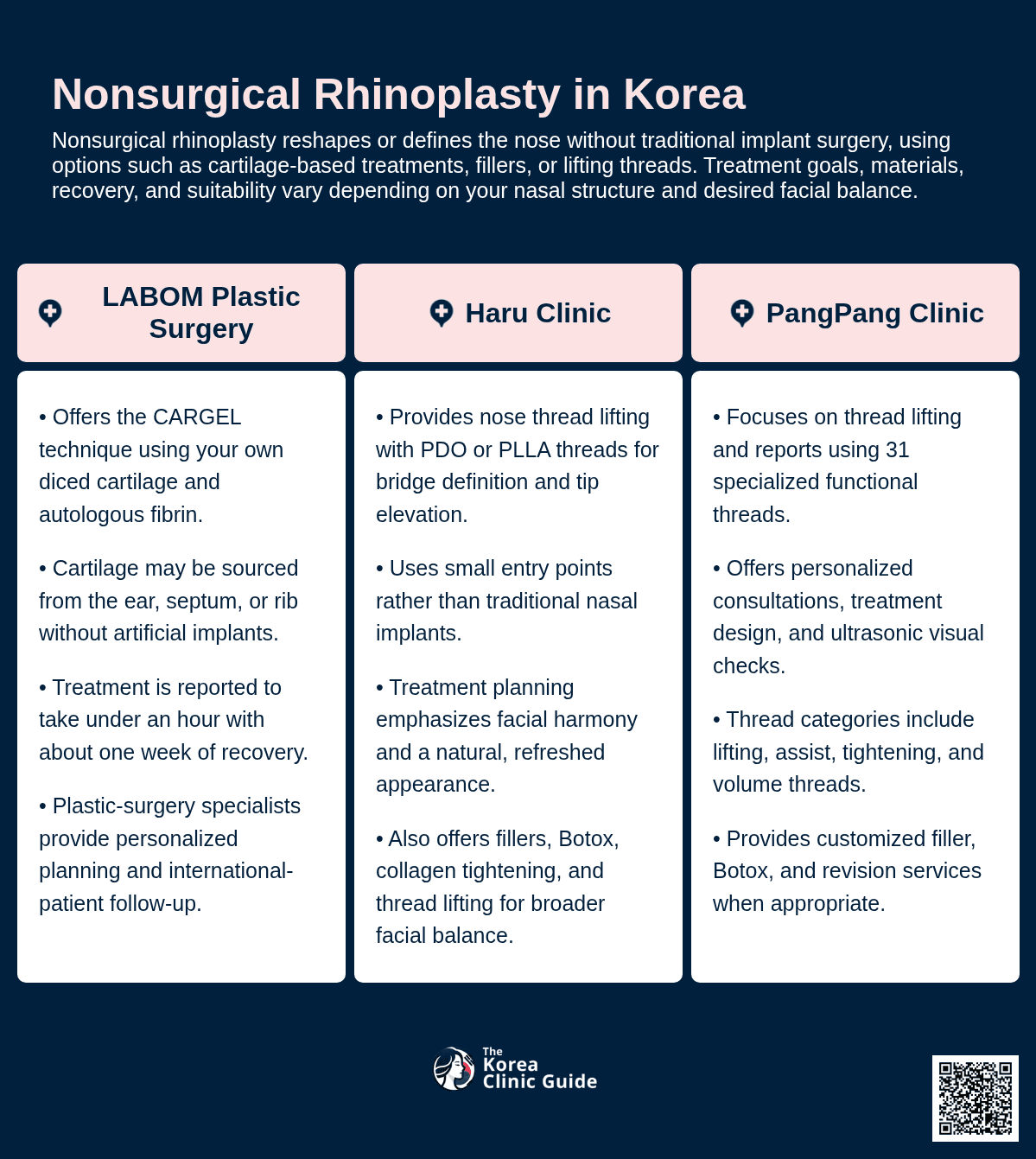
You may consider LABOM Plastic Surgery if you want a completely natural, non-implant approach to nasal reshaping: its patented CarGel technique uses your own diced cartilage combined with fibrin from your blood to shape the bridge and tip, aiming for a natural line without synthetic implants or nasal scarring.
- URL: LABOM Plastic Surgery Website
- Location: Gangnam-gu, Seoul
- Procedure details:
- CARGEL is described as an injection-based treatment using cartilage sourced from the ear, septum, or rib and mixed with an autologous fibrin concentrate.
- The clinic reports that treatment takes under an hour, with roughly one week of recovery.
- Planning considers your nasal structure and overall facial proportions rather than treating the nose in isolation.
- Material approach:
- No artificial materials are used.
- The fibrin concentrate is intended to help keep cartilage particles in position and support tissue healing.
- This may be relevant if you are concerned about implant-related foreign-body sensation or want an alternative to repeated filler injections.
- Care considerations:
- Plastic-surgery specialists perform procedures directly, with individualized consultation and pre-operative assessment.
- The clinic describes structured follow-up for swelling, bruising, scar management, and recovery, including systems for international visitors.
2. Haru Clinic
You may consider Haru Clinic for nonsurgical nasal definition if you are interested in a nose thread lift, which uses PDO or PLLA threads placed along the bridge and tip to create immediate definition and lift through small entry points rather than implants.
- URL: Haru Clinic Website
- Location: Gangnam-gu, Seoul
- Procedure details:
- Nose thread lifting is described as a nonsurgical option for defining the nasal bridge and lifting the tip.
- PDO or PLLA threads are used, with small entry points rather than implanted nasal material.
- Haru also provides filler treatments that can add adjustable facial contour and volume.
- Clinical approach:
- Dr. Jeong is identified as an official research physician for Merz, the company behind Belotero Filler, and teaches other doctors on current filler techniques.
- Treatment planning emphasizes facial harmony and balance, with a tailored non-invasive approach intended to preserve a natural, refreshed appearance.
- Related nonsurgical options:
- Available non-invasive facial options include fillers, Botox, collagen-tightening treatments, and thread lifting for areas such as the cheeks, jawline, and brows.
- These services may be useful if you are considering how nasal definition fits with your broader facial proportions.
3. PangPang Clinic
You may consider PangPang Clinic when your nonsurgical nose goals involve a thread-based consultation, as the clinic concentrates on thread lifting, uses a selection of specialized functional threads, and builds individualized treatment plans around your concerns.
- URL: PangPang Clinic Website
- Location: Gangnam-gu, Seoul
- Thread-lifting focus:
- The clinic focuses exclusively on thread lifting and reports using 31 specialized functional threads for personalized treatment selection.
- Its team participates in international beauty conferences through invited lectures and presentations.
- PangPang reports operating a Thread Lifting Research Institute and developing procedures using research and clinical data.
- Planning and technique:
- Consultations are designed to listen to your concerns and tailor a treatment plan.
- Its thread-lifting system includes a personalized doctor consultation, pre-operative design, and ultrasonic visual checks.
- Thread types described include lifting, assist, tightening, and volume threads; the appropriate technique depends on the area and goal being treated.
- Other available treatments:
- The clinic also offers customized filler and Botox treatments, which may be considered for facial structure or wrinkle concerns.
- A revision service is available for concerns following prior thread-lifting treatment and may incorporate fillers, Botox, or lasers when appropriate.
Why Visit Korea for Non-Surgical Rhinoplasty?
Korea has an official registration framework for medical institutions serving foreign patients. This is a useful administrative check, but it does not prove that a specific injector is experienced in nasal cartilage or filler work, or prepared for an emergency.
- Foreign-patient institution check — Medical Korea's registered-institution system states that registered providers must hold medical-malpractice liability insurance. Verify the actual medical institution, not only an agency or social-media account.
- Documented treatment planning — Ask in writing for the named doctor's role, the material planned (autologous cartilage or HA product, including whether it contains lidocaine), and documentation of harvest technique or, for filler, original packaging, lot number, injected volume, and injection sites.
- Emergency readiness matters more than location — Confirm that hyaluronidase is immediately available onsite for filler cases, along with a written vascular-occlusion protocol and an emergency-transfer and ophthalmology pathway for either material. Early recognition and treatment are critical, and hyaluronidase does not reverse autologous cartilage, so a cartilage-specific management plan should be confirmed in advance.
- No Korea-specific safety claim — No registry-quality comparison shows lower nasal-injection complication rates in Korea than elsewhere. Do not use country, clinic visibility, or before-and-after photographs as a proxy for injector skill or emergency preparedness.
Key Information for International Patients
- Minimum stay — Plan 5 to 7 days for autologous cartilage injection to allow harvest-site healing and proper review, or at least 2 to 3 days for HA filler consultation, treatment, and an early check if needed. Extend either to 5 to 7 days for a first procedure, prior rhinoplasty, threads, uncertain prior filler, or visible bruising concerns.
- Flight timing — No validated minimum interval for flying after nasal cartilage injection or HA filler has been established. Do not depart until the injector confirms there are no concerning symptoms and provides written emergency and follow-up arrangements.
- Itinerary impact — Mild redness, pinpoint marks, tenderness, swelling, and bruising are common for several days; cartilage cases also involve a small ear or septal harvest-site wound. Allow about one to two weeks for most visible short-term effects to settle. Avoid scheduling important photographs or events immediately after treatment.
- Activity limits — Avoid pressure on the nose and harvest site, tight eyewear, massage, strenuous exercise, alcohol, sauna, steam rooms, hot yoga, and facial treatments for the first 24 to 48 hours unless the injector gives different instructions.
- Remote follow-up — Arrange a direct English-language contact route before treatment and send agreed photographs at follow-up. Obtain an English procedure record with the injector's name, material or product, batch or lot number (for filler), volume, sites, date, and any emergency treatment.
Travel note: Severe or escalating pain, pale or dusky skin, mottling, blistering, eye pain, blurred or lost vision, weakness, facial droop, speech difficulty, confusion, or a sudden severe headache requires immediate in-person emergency care. Do not wait for a video reply or board an aircraft.
Non-Surgical Rhinoplasty From Start to Finish
- Remote screening — Send unedited front, oblique, profile, and base-view photographs, then disclose all prior rhinoplasty, trauma, threads, and injected products with dates and locations. An English or virtual consultation can discuss goals, but it cannot guarantee a result or replace examination.
- Travel and safety planning — Confirm the named injector, proposed material (cartilage harvest technique or HA filler), hyaluronidase availability where relevant, emergency pathway, direct after-hours contact, planned Korea stay, and flexible departure arrangements before booking.
- In-person assessment — The doctor reassesses the bridge, radix, tip, columella, alae, skin thickness, scars, active inflammation, facial proportions, potential harvest site, and whether volume addition can deliver the requested change. Standardized photographs and informed consent should cover irreversible vascular and visual risks.
- Testing when indicated — Healthy patients generally do not need routine laboratory tests for a simple injectable procedure. Pregnancy testing, coagulation assessment, medical clearance, or ultrasound can be appropriate when medical history, prior surgery, prior threads, or unknown filler warrants it.
- Treatment preparation — Makeup is removed and the skin is cleansed. For cartilage, the harvest site (usually the ear) is prepped and locally anesthetized separately from the nose. Topical anesthetic is commonly used on the nose; selected filler products also contain lidocaine. General anesthesia is not part of standard treatment, though harvesting involves a small incision.
- Harvest and injection, or injection and contour checks — For cartilage, a small piece is harvested, processed into an injectable form, and then placed at planned sites; for filler, the injector places small, controlled deposits using a needle or microcannula, reassessing contour between deposits. The procedure commonly takes 30 to 60 minutes for cartilage or 15 to 45 minutes for filler alone, while consultation, photography, consent, and observation extend the appointment.
- Discharge review — Before leaving, receive written aftercare, emergency warning signs, direct contact details, and a full English procedure record. The contour is visible immediately, but early swelling can distort symmetry.
- Early recovery and review — Mild swelling, tenderness, redness, pinpoint marks, and bruising generally improve over several days to two weeks; the harvest site needs its own brief check. Arrange review promptly for any concern; assess the aesthetic result and photographs more reliably after 1 to 2 weeks.
- Overseas follow-up — Send photographs as agreed after returning home, retain the procedure record, and seek local urgent care immediately for vascular or visual warning signs rather than relying solely on remote messaging.
Alternatives to Non-Surgical Rhinoplasty
Autologous cartilage and HA filler are both temporary-to-longer-lasting volume additions; surgery can reduce, narrow, straighten, or structurally support the nose but requires anesthesia, incisions, and a longer recovery. Choose an alternative based on the actual anatomical concern, especially when breathing or substantial post-surgical deformity is involved.
Surgical Rhinoplasty
Rhinoplasty is the appropriate option for lasting hump reduction, narrowing, major tip reshaping, meaningful straightening, or structural reconstruction that injected cartilage or filler cannot achieve.
- Best matched to — A large nose, broad bridge, wide nostrils, marked deviation, or a goal that requires tissue removal or structural cartilage grafting.
- Tradeoff — It provides structural change but involves surgical recovery and travel planning that are far more demanding than an injectable procedure.
Revision Rhinoplasty
Revision rhinoplasty is often more suitable than additional cartilage or filler when a prior operation has caused substantial contour deformity, scarring, collapse, or complex anatomy.
- Best matched to — Significant post-surgical concerns rather than a small, temporary contour irregularity.
- Tradeoff — Revision surgery is technically complex; injecting a previously operated nose requires heightened caution and is not a simple substitute.
Alar Reduction or Tip Plasty
Alar reduction and tip plasty address nostril width or tip cartilage anatomy when bridge augmentation is not the real goal.
- Best matched to — Wide alae, nostril flare, or a tip-shape concern that adding cartilage or filler would not correct.
- Tradeoff — These are targeted operations with scars and recovery, rather than injectable volume camouflage.
Nose Thread Lift
Nose thread lift or HIKO nose thread lift is marketed for temporary lift or projection.
- Best matched to — People considering a temporary non-injected approach after a detailed discussion of limited durability.
- Tradeoff — Threads are not equivalent to cartilage injection, HA filler, or surgery and carry risks including infection, extrusion, and asymmetry.
Filler Dissolution
Filler dissolver can be relevant when confirmed HA filler causes an unsatisfactory contour or a clinician considers reversal appropriate.
- Best matched to — A documented HA-filler history; this does not apply to autologous cartilage, which cannot be enzymatically dissolved, so unknown, permanent, silicone, biopolymer, or cartilage-related concerns need specialist evaluation instead.
- Tradeoff — Dissolution is not a universal solution for complications and cannot be assumed to reverse visual injury.
How Can I Prepare for Non-Surgical Rhinoplasty?
- Disclose every prior nasal treatment — Provide dates, product names, locations, and records for filler, cartilage injection, threads, rhinoplasty, trauma, and complications. Report permanent filler, silicone, biopolymer, or unknown material before committing to treatment.
- Review medicines early — Tell the clinic about prescription medicines, aspirin, clopidogrel, warfarin, apixaban, rivaroxaban, anti-inflammatory medicines, vitamins, fish oil, and herbal supplements. Discuss bruising risk in advance; do not stop prescribed anticoagulants or antiplatelets without the prescribing clinician's approval.
- Postpone for infection or inflammation — Reschedule for active acne lesions, dermatitis, wounds, herpes outbreaks, dental infection, sinus infection, ear infection, or an inflamed upper-respiratory infection near the intended treatment or harvest area.
- Arrive with clean skin — Attend without makeup if the clinic requests it. Avoid aggressive exfoliation, retinoids, waxing, peels, microneedling, laser or energy treatments, and other injections near the nose or ear until the injector confirms suitable timing.
- Avoid bruising and swelling triggers — Avoid alcohol before treatment if directed by the clinic, and do not smoke or vape if this worsens healing or infection risk at the treatment or harvest site in the doctor's assessment.
- Plan transport and accommodation — Book nearby accommodation, keep the day after treatment unscheduled where possible, and use flexible flights. A companion is not routinely required, but can be helpful when language barriers, anxiety, or an altered travel plan would complicate urgent care.
Travel note: Do not schedule cartilage injection or nasal filler immediately before a long-haul departure, a remote excursion, or an event where prompt medical assessment would be difficult.
Confirm the treating doctor's clinic-specific medication, skincare, fasting, transport, and scheduling instructions; those instructions take precedence over general guidance.
Aftercare Advice
Protect the treated nose and any harvest site from pressure, and treat vascular or visual symptoms as an emergency, not a cosmetic concern.
- Protect the contour and harvest site — For 24 to 48 hours, avoid rubbing, massage, squeezing, sleeping face-down, tight glasses or sunglasses, and any pressure on the nose or on an ear harvest site unless the injector gives different instructions.
- Limit heat and exertion — Avoid strenuous exercise, alcohol, sauna, steam rooms, hot yoga, and intense heat for 24 to 48 hours. Use a cool compress gently and intermittently; do not press it firmly against the nose.
- Pause facial procedures — Do not use aggressive exfoliants, retinoids, peels, waxing, microneedling, laser or energy procedures, or further injections until injection points, incision sites, and irritation settle and the injector approves. Use SPF 50 on exposed healing skin when outdoors.
- Expect short-term changes — Tenderness, redness, swelling, pinpoint marks, and bruising usually settle over several days to two weeks, with cartilage cases also healing a small harvest-site mark. The contour appears immediately, but wait 1 to 2 weeks before judging symmetry or seeking an aesthetic adjustment unless the injector requests earlier review.
- Know the emergency signs — Seek immediate in-person care and contact the injector for severe or worsening pain; pale, white, blue-gray, dusky, cold, mottled, or blistered skin; rapidly increasing swelling; eye pain; double vision; blurred, reduced, or lost vision; eyelid droop; weakness; facial droop; speech difficulty; confusion; or sudden severe headache. Reported complication guidance stresses rapid recognition; note again that hyaluronidase can address these signs for filler but not for autologous cartilage.
- Maintain follow-up — Keep the material and procedure record, send agreed photographs, and report progressive warmth, redness, pus, fever, persistent nodules, delayed swelling, migration, or a bluish appearance promptly. Durability is variable for both materials; filler is often reported at 8 to 12 months and cartilage commonly longer, but the literature cannot establish one certain duration for either.
Follow the treating doctor's individualized instructions and contact the clinic immediately when anything appears wrong.
Frequently Asked Questions
Related Blogs
Korea vs. Global Standards: A Comprehensive Cost Analysis of Cleft Rhinoplasty in Medical Tourism Destinations
Explore the cost of cleft rhinoplasty in Korea, a popular destination for medical tourism due to its advanced surgical techniques and competitive pricing. Discover factors influencing the overall expense, from hospital fees to post-operative care, and what makes Korea a top choice for this specialized procedure.
Updated: Oct 21, 2026
Philtrum Reduction Costs: Choosing Korea Over the USA, Mexico, Turkey & More for Expert Care
Discover the affordability and benefits of Philtrum Reduction Surgery in Korea, a popular destination for high-quality cosmetic procedures. Explore cost factors, surgeon expertise, and why Korea is a top choice for those considering this transformative surgery.
Updated: Oct 21, 2026
Discovering the True Value: Sinus Surgery Costs in Korea Compared to Global Options
Discover the affordable options for sinus surgery in Korea, a leading destination for medical tourists seeking quality care. Learn about the factors influencing costs and what patients can expect from their experience in this highly advanced healthcare system.
Updated: Oct 21, 2026
Non-Implant Rhinoplasty in Korea: Cartilage Grafts, Recovery, Travel Planning, and Alternatives
Non-implant rhinoplasty reshapes the nose using septal, ear, or rib cartilage, with surgical or injectable and open or closed approaches and possible septal or nasal-valve correction. International patients can find guidance on candidate screening, material-specific consent, Korea stays of 10–21 days, travel timing, recovery, and follow-up.
Updated: Oct 16, 2026
Clinics offering Non-Surgical Rhinoplasty

Haru Clinic Korea | Fully-Customized Full-Face Non-Surgical Rejuvenation With Threads, Botox & Fillers
Sinsa

PangPang Clinic: Korea's Premier Thread Lifting and Skin Rejuvenation Specialist in Gangnam, Seoul
Sinsa

B.V Clinic Korea: Advanced Aesthetic Treatments for Natural Beauty Enhancement & Rejuvenation
Sinnonhyeon Station

LABOM Plastic Surgery: Expertise in Non-Surgical Nose, Facial Lifting & Anti-Aging Surgeries in Korea
Apgujeong