
Medical Tourism Blog
Alar Reduction in Korea: Techniques, Recovery, Risks, and Travel Planning
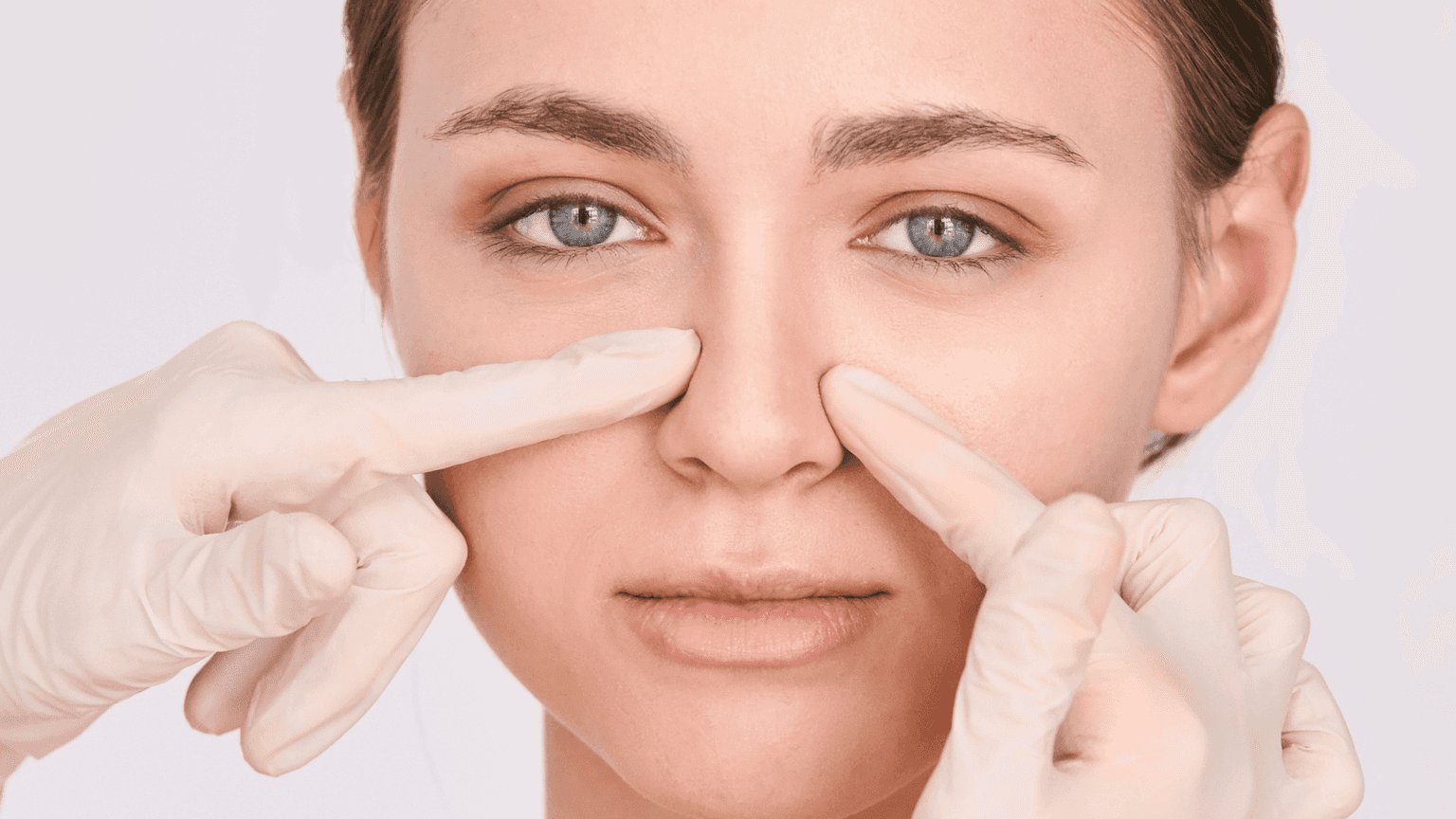
Table of contents
- Alar Reduction at a Glance
- What Is Alar Reduction?
- Who Is a Good Candidate for Alar Reduction?
- What Are the Different Types of Alar Reduction?
- Why Visit Korea for Alar Reduction?
- Key Information for International Patients
- Which Are the Best Clinics in Korea for Alar Reduction?
- How Much Does Alar Reduction Cost in Korea?
- Alar Reduction From Start to Finish
- Alternatives to Alar Reduction
- How Can I Prepare for Alar Reduction?
- Aftercare Advice
Considering treatment in Korea? Everything you need to know e.g. — how to avoid scams, visas, interpreters, recovery tips — in our Medical Tourism Master Guide. Plan with confidence in minutes, not weeks!
Last updated: September 2026
Alar Reduction at a Glance
- What it changes — Alar reduction, or alarplasty, permanently narrows selected nostril-base features by removing or repositioning tissue at the nasal wings and/or nostril sill; it does not correct a dorsal hump or reliably reshape a broad nasal tip.
- Korea price — Standalone alar reduction in Korea is listed at ₩1,600,000–₩2,500,000, approximately US$1,200–US$1,900; combined rhinoplasty, anesthesia, revision needs, and functional repair increase the quote.
- Recovery timeline — Swelling, tenderness, crusting, and mild drainage are most noticeable in the first week, with external sutures commonly reviewed or removed on day 5–7; most patients are socially presentable in about 1–2 weeks, while scars and residual swelling improve over months.
- Travel planning — International patients should plan 7–10 days in Korea for isolated surgery to complete an early wound review; allow 10–14 days for combined rhinoplasty, sedation or general anesthesia, long-haul travel, or delayed healing, with final flight clearance from the operating surgeon.
- Best candidates — Suitable candidates are medically fit adults seeking a conservative reduction of stable alar flare, a broad nasal base, wide nostril sill, or mild correctable asymmetry and who accept permanent tissue removal and a possible visible external scar.
- Key risk — Over-resection can permanently cause pinched or distorted nostrils, alar notching or retraction, scar contracture, asymmetry, stenosis, and impaired airflow, so anyone with blockage or sidewall collapse needs a full airway assessment before cosmetic narrowing.
- Korea-specific check — South Korea has an official registered-institution system for facilities treating foreign patients, but no robust evidence shows superior alar-reduction outcomes versus other countries; verify the facility registration, named surgeon’s credentials, and follow-up plan rather than relying on a broker or clinic brand.
What Is Alar Reduction?
Alar reduction, also called alarplasty, is a cosmetic operation that permanently narrows selected parts of the nostril base by reshaping tissue around the nasal wings or nostril openings. It addresses flared nostrils, a broad nasal base, wide nostril openings, or limited asymmetry while aiming for facial balance. It is a surgical procedure, performed alone or alongside rhinoplasty.
Who Is a Good Candidate for Alar Reduction?
- Stable broad nasal base or flare — Good candidates want a conservative, proportional reduction in lateral alar flare, interalar width, nostril sill width, or nostril opening size.
- Mild nostril asymmetry — Surgery can address selected asymmetry when the surgeon identifies a correctable soft-tissue imbalance; it cannot promise perfect mirror-image nostrils.
- Realistic scar and result expectations — Candidates accept permanent tissue removal, a fine external scar that can remain visible or pigment differently, and gradual scar maturation over months.
- Medically fit adult — Elective surgery requires a health and anesthesia assessment appropriate to the planned local anesthesia, sedation, or general anesthesia.
Alar reduction is unsuitable while there is a nasal, facial-skin, dental, or systemic infection. Nasal blockage, alar-rim collapse during inspiration, prior trauma, cleft-related anatomy, or previous rhinoplasty require a full airway and structural assessment because cosmetic narrowing can worsen external nasal-valve obstruction. Pregnancy, uncontrolled diabetes or chronic disease, significant anesthesia risk, bleeding disorders, anticoagulant use that cannot be safely adjusted, and a tendency to keloid or problematic scars require individualized assessment or postponement. Active nicotine use also requires cessation: the ASPS nasal-surgery practice parameter advises stopping smoking at least four weeks before surgery.
What Are the Different Types of Alar Reduction?
Alarplasty, alar base reduction, nostril reduction, and Weir excision are overlapping terms, not identical operations. Consent should specify whether the plan changes flare, sill width, nostril aperture, or several features.
- Alar wedge or flare excision — Removes selected tissue at the alar-cheek junction to move a laterally flared nasal wing inward. It primarily targets outer nasal-base width and visible flare.
- Nostril sill excision — Removes tissue from the nostril sill, the area between the columella and ala. This suits patients whose nostril width or shape is driven more by a broad sill than lateral flare.
- Combined alar and sill excision — Treats both contributors to a broad base. Conservative markings are essential because greater tissue removal increases the risk of pinching, contour distortion, and scar contracture.
- Non-excisional repositioning or V-to-Y advancement — Uses release, advancement, or medialization rather than a simple wedge alone in selected anatomy. A 312-patient single-surgeon cohort found no consensus gold-standard alar-base technique, so technique selection should follow the individual nasal base and airway assessment.
In a Korean retrospective cohort of combined sill and alar excision during rhinoplasty, 45 of 60 patients with preoperative flare no longer had flare, with four complications or unsatisfactory corrections reported. This was a 73-patient, single-setting cohort, not proof that combined excision or Korean surgery is superior to other approaches.
Why Visit Korea for Alar Reduction?
South Korea has a formal system for institutions registered to serve foreign patients. This can make international-patient coordination more accessible, but it does not establish better alar-reduction outcomes than other destinations. Verify the facility’s current registration and the named surgeon’s qualifications rather than relying on a broker, clinic brand, or social-media account.
- Foreign-patient framework — Use the official Medical Korea registered-institution system to check whether a facility is registered to attract foreign patients.
- Relevant published experience — A Korean tertiary-setting study documented outcomes of combined sill and alar excision performed with rhinoplasty, providing locally relevant published experience rather than a country-level safety comparison. Read the full cohort evidence and its limitations.
- Appropriate case selection — A credible consultation distinguishes isolated flare or sill excess from a broad tip, poor projection, septal deviation, or valve collapse. This matters because alar reduction does not reduce a dorsal hump or reliably correct tip-cartilage shape.
- Evidence limit — No robust comparative evidence establishes that Korea has lower scar, revision, airflow, or complication rates for alar reduction than the United States or other countries. Choose based on the surgeon’s documented plan, functional assessment, communication, and follow-up pathway.
Key Information for International Patients
- Minimum stay — Plan 7–10 days in Korea for isolated alar reduction so the clinic can review early healing and manage or remove external sutures, commonly checked around day 5–7.
- Long-haul travel — Plan 10–14 days when surgery includes rhinoplasty, sedation or general anesthesia, delayed wound healing, or a long-haul flight. The 7–10-day window is a practical follow-up recommendation, not an alarplasty-specific travel-trial result; obtain the operating surgeon’s written fit-to-fly clearance.
- Repeat visits — Routine repeat treatment is not expected because excision is permanent. Schedule at least an early wound review before departure and arrange photo-based follow-up after returning home.
- Flight and activity timing — Do not book an inflexible early flight. Swelling, drainage, wound separation, bleeding, or a required suture review can change travel plans; avoid strenuous activity for roughly 2–3 weeks when alar surgery is combined with rhinoplasty.
- Itinerary impact — Keep the first week low-demand. Swelling, tenderness, crusting, and mild drainage are most evident then, and heavy sightseeing, swimming, heat exposure, and crowded activities increase inconvenience and the chance of accidental contact.
- Support after anesthesia — Arrange a responsible adult and escorted transport after intravenous sedation or general anesthesia. Confirm the clinic’s discharge rules, after-hours contact route, and whether a companion is mandatory.
Travel note: Before leaving Korea, obtain the operative report, medication list, written aftercare instructions, clinic emergency contact, and a plan for urgent assessment in your home country. Broader rhinoplasty travel guidance supports allowing time for early review, but the surgeon must judge the actual wound and procedure extent.
Which Are the Best Clinics in Korea for Alar Reduction?
Listed below are some of the best clinics in Korea for alar reduction.
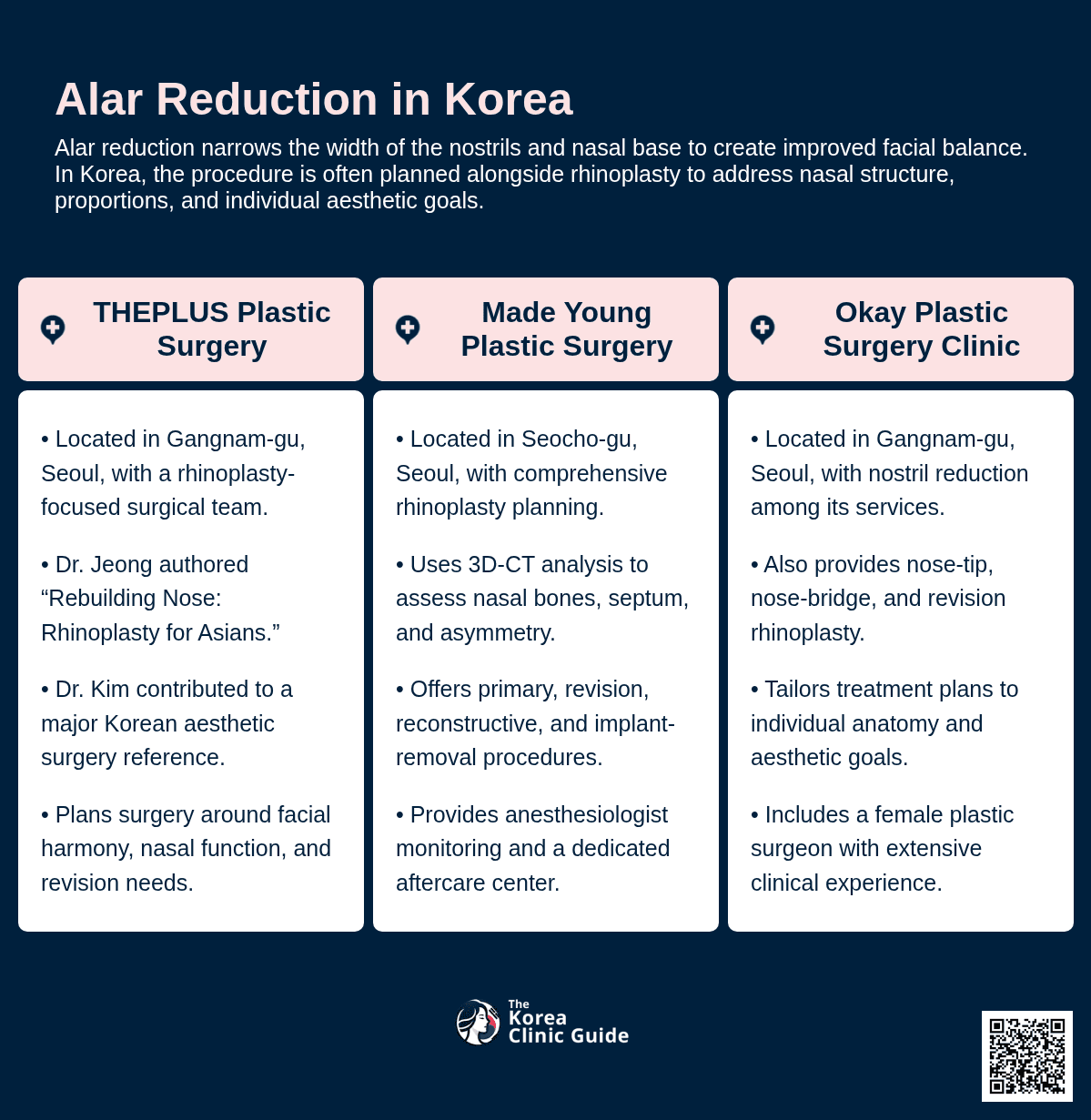
1. THEPLUS Plastic Surgery
For alar reduction as part of a tailored rhinoplasty plan, you can consult a clinic whose rhinoplasty surgeons emphasize facial harmony alongside nasal structure and function. Dr. Jeong Jae-yong and Dr. Kim Taek-kyun bring extensive rhinoplasty education, research, and conference involvement to surgical planning.
- URL: THEPLUS Plastic Surgery Website
- Location: Gangnam-gu, Seoul
- Rhinoplasty expertise:
- Dr. Jeong authored “Rebuilding Nose: Rhinoplasty for Asians,” which has Japanese and English editions.
- Dr. Kim contributed rhinoplasty and revision-rhinoplasty chapters to “The 18 Masters of Korean Aesthetic Surgery.”
- Both surgeons participate in rhinoplasty-focused education and international professional forums, including the Seoul Rhinoplasty Forum, KSPRS, and IFAAS.
- Relevant surgical approach:
- The clinic describes rhinoplasty with attention to both aesthetic balance and nasal structure.
- Revision rhinoplasty is available for concerns following prior nose surgery.

2. Made Young Plastic Surgery
You may consider Made Young for alar reduction when you want nasal width assessed in the context of your full nasal proportions. Its rhinoplasty planning includes the alar width, bridge, tip, and columella, supported by 3D-CT analysis of the nasal bones, septum, and asymmetry.
- URL: Made Young Plastic Surgery Website
- Location: Seocho-gu, Seoul
- Planning and structural focus:
- 3D-CT precision analysis is used to assess nasal bones, the septum, and asymmetry for surgical planning.
- The clinic describes techniques and materials intended to create a stable internal nasal structure and maintain nasal shape over time.
- Rhinoplasty services include primary, revision, reconstructive surgery, and nasal implant removal.
- Medical oversight and aftercare:
- Board-certified anesthesiologists are on site, with one-to-one continuous monitoring described during procedures.
- The clinic operates a separate aftercare center for post-procedure care.
- Dr. Lee Byeong-hoe is described as having more than 20 years of exclusive rhinoplasty experience, including complex reconstruction and revision cases.
3. Okay Plastic Surgery Clinic
You may consider Okay Plastic Surgery Clinic for alar reduction because nostril reduction is listed within its rhinoplasty services, alongside nose-tip and bridge surgery. The clinic describes an individualized treatment approach and also offers revision rhinoplasty, including for difficult nasal cases.
- URL: Okay Plastic Surgery Clinic Website
- Location: Gangnam-gu, Seoul
- Nasal services:
- Rhinoplasty services include nostril reduction, nose-tip surgery, nose-bridge surgery, and revision procedures.
- Difficult rhinoplasty cases and revision rhinoplasty are available.
- Individualized planning:
- The clinic describes tailoring treatment to your individual needs and aesthetic goals.
- Its team includes a female plastic surgeon with extensive experience.
How Much Does Alar Reduction Cost in Korea?
Alar Reduction is supplied at ₩1,600,000–₩2,500,000 (approximately US$1,200–US$1,900). Individual quotes vary because the surgical plan can range from a limited isolated excision to a more extensive nasal procedure with different anesthesia and operative requirements.
| Procedure Price | Korean Won (₩) | USD ($) |
|---|---|---|
| Low Price | ₩1,600,000 | $1,200 |
| High Price | ₩2,500,000 | $1,900 |
Exchange rate as of 2026-09-06: 1 KRW = 0.000741 USD.
What Affects the Price?
- Alar wedge, nostril sill, or combined excision — An alar wedge targets lateral flare, while a sill excision changes nostril-sill width. Treating both flare and sill requires more extensive markings, tissue adjustment, contour checks, and closure than a limited single-area excision.
- Standalone alar reduction versus combined rhinoplasty — When alar reduction is performed with rhinoplasty, the surgeon must coordinate nasal-base narrowing with changes to tip projection, rotation, and overall nasal shape. The combined operation uses more operating time and may involve additional nasal work, dressings, and recovery management.
- Local anesthesia versus sedation or general anesthesia — An isolated procedure may be done under local anesthesia. Sedation or general anesthesia requires anesthesia personnel, monitoring, recovery observation, and facility resources; general anesthesia is more commonly used when alar work is combined with rhinoplasty.
- Functional or revision requirements — Prior surgery, scar contracture, nostril asymmetry, narrowing, or suspected external nasal-valve compromise can require a more complex plan than primary cosmetic tissue removal. Structural assessment and, where needed, reconstructive measures such as scar release or graft support increase operative complexity and consumable use.
Cost tip: Request an itemized quote stating exactly what is included, particularly the planned alar technique, whether rhinoplasty is included, anesthesia type, facility and recovery use, medications or dressings, suture review or removal, and postoperative follow-up.
The US$1,200–US$1,900 conversion is approximate, based on the supplied exchange rate of 0.000741 on 2026-09-06. Check the exchange rate again when budgeting.
Alar Reduction From Start to Finish
- Remote enquiry and consultation — Send neutral-lighting frontal, oblique, profile, basal, and smiling photographs. Ask whether English consultation is available and disclose previous nasal surgery, filler or threads, trauma, breathing symptoms, allergies, nicotine exposure, medications, supplements, and scar history.
- Pre-travel plan — Receive a provisional discussion of whether the concern is alar flare, sill width, nostril asymmetry, tip shape, or a broader rhinoplasty issue. Remote photographs help planning but cannot replace examination of skin thickness, valve function, symmetry, and nostril anatomy.
- In-person assessment in Korea — The surgeon examines the nose, takes standardized photographs, evaluates breathing and external nasal-valve stability, reviews medical history, and confirms that isolated excision will not compromise function. Consent should cover permanent scars, asymmetry, notching, retraction, stenosis, and possible revision.
- Anesthesia planning and tests — Isolated alar reduction is often performed under local anesthesia, sometimes with sedation. Combined rhinoplasty commonly uses general anesthesia. Testing depends on health history and anesthesia plan rather than being universal.
- Marking and surgery — The surgeon marks a conservative reduction, injects local anesthetic, removes or repositions selected alar and/or sill tissue, checks nostril patency and basal-view balance, then closes with fine sutures. Full-thickness vestibular excision needs particular caution: a blinded photographic review found less perceived notching and scarring with cutaneous-only excision.
- Discharge — This is generally outpatient surgery. Isolated treatment often does not require the splint or packing used in full rhinoplasty, but dressing, antibiotic, and suture protocols differ. Leave with written wound-care and contact instructions.
- Early recovery and review — Expect swelling, tenderness, crusting, and mild drainage during the first week. Attend the planned review or external-suture removal around day 5–7 before any international departure.
- Overseas follow-up — Send agreed photographs after returning home and contact the clinic promptly for worsening pain, spreading redness, pus-like drainage, wound separation, heavy bleeding, skin color change, or worsening breathing. Delay any revision discussion until swelling and scars have matured unless an urgent complication develops.
Alternatives to Alar Reduction
The right alternative depends on what makes the nasal base appear wide. Non-surgical options can camouflage selected contours but cannot remove alar tissue; structural or functional problems generally require a procedure beyond simple alar excision.
Rhinoplasty or Tip Plasty
[Rhinoplasty or tip plasty is more appropriate when tip cartilage shape, projection, rotation, dorsal form, or several nasal features create the appearance of width.
- Best suited for — A broad tip, dorsal hump, poor tip projection, or a nose requiring balanced multi-area reshaping.
- Tradeoff — More comprehensive surgery brings longer recovery, greater swelling, and a longer period before final refinement.
Functional Nasal Surgery
Septoplasty or structural nasal-valve repair addresses obstruction caused by septal deviation, turbinate disease, or sidewall collapse.
- Best suited for — Persistent nasal blockage, inspiratory collapse, or a suspected external nasal-valve problem.
- Tradeoff — Cosmetic alar excision alone does not treat these functional causes and can worsen airflow when excessive narrowing is performed.
Revision Rhinoplasty
Revision rhinoplasty is the meaningful option for previous-surgery asymmetry, notching, retraction, scar contracture, or nostril stenosis.
- Best suited for — A structural deformity after earlier nasal surgery.
- Tradeoff — Revision often requires scar release and cartilage or composite graft support, not another simple tissue excision.
Non-surgical Rhinoplasty or Nose Filler
Nonsurgical rhinoplasty and nose filler can camouflage selected bridge or tip contours.
- Best suited for — Patients seeking temporary visual balancing rather than a smaller nostril base.
- Tradeoff — Filler cannot narrow nostril width or remove flare, and nasal injections carry separate vascular risks.
How Can I Prepare for Alar Reduction?
- Medication and supplement disclosure — Provide a complete list of prescription medicines, aspirin, NSAIDs, vitamins, herbal products, recreational substances, and supplements. Discuss medicines that affect bleeding or anesthesia well before travel; do not independently stop aspirin, clopidogrel, warfarin, apixaban, rivaroxaban, or other prescribed anticoagulants.
- Nicotine cessation — Stop smoking, vaping, nicotine pouches, and other nicotine exposure for the period required by the surgeon. The ASPS practice parameter recommends at least four weeks before nasal surgery.
- Fasting — Follow only the anesthetist’s instructions. Local-only treatment and surgery with sedation or general anesthesia have different fasting requirements.
- Skin and infection check — Arrive without sunburn, active acne infection, open wounds, recent aggressive peel irritation, or a current dental, facial, or respiratory infection. Report any illness before surgery.
- Nasal history — Disclose prior rhinoplasty, filler, threads, trauma, breathing difficulty, allergies, sidewall collapse, and a history of hypertrophic scars or keloids.
- Accommodation and transport — Stay close to the facility through the first review. Arrange escorted transport and a responsible adult after sedation or general anesthesia; keep a local phone connection and emergency contact details.
- Flexible travel — Book changeable flights and avoid a tourism-heavy first week. External sutures often need review or removal around day 5–7.
Travel note: Bring translated medical records where relevant, plus copies of prescriptions and contact information for the clinician managing chronic medicines at home.
Confirm the treating surgeon’s medication-stop dates, fasting rules, companion requirement, testing, and travel clearance requirements; individualized instructions take precedence over general guidance.
Aftercare Advice
Protect the incision and nasal airway during early healing; the permanent result depends on conservative tissue removal, uncomplicated wound healing, and scar maturation.
- Wound care — Keep incisions clean and dry exactly as directed. Do not pick crusts or apply makeup, creams, silicone products, antibiotic ointment, or scar treatment unless the clinic has approved the product and timing.
- Pressure and nose care — Do not squeeze the nostrils, insert swabs, forcefully sniff, or blow the nose until cleared. Sneeze with the mouth open to reduce pressure.
- Activity and contact — Walk gently, keep the head elevated when resting, and avoid heavy lifting, bending, straining, strenuous exercise, swimming, saunas, and situations where the nose can be bumped. Combined rhinoplasty generally requires more extensive restrictions.
- Sun protection — Once the incision is closed and the surgeon approves skincare, protect scars from sun exposure and use broad-spectrum SPF 50 on healed skin to limit pigment change.
- Warning signs — Contact the clinic urgently for worsening pain or swelling, spreading redness or warmth, fever, pus-like drainage, persistent or heavy bleeding, wound separation, dark or unusually pale nostril skin, sudden new asymmetry, or worsening breathing. Seek emergency care for severe breathing difficulty, chest pain, fainting, or uncontrolled bleeding.
- Results and follow-up — Most people look socially presentable in about 1–2 weeks, but redness, firmness, and residual swelling improve over weeks to months. With combined rhinoplasty, subtle nasal refinement can continue for up to a year, as described in standard rhinoplasty recovery guidance.
Follow the treating doctor’s instructions over this general guidance and contact the clinic promptly when healing appears abnormal.
Frequently Asked Questions
Related Blogs
Discover the True Value of Nose Implant Surgery: South Korea vs Other Top Global Destinations
Considering nose implants in Korea? Discover the average costs, factors influencing pricing, and why Korea is a top destination for cosmetic surgery in our latest article.
Updated: Sep 27, 2026
Explore Rhinitis Surgery Costs: Korea's Expertise vs Global Prices
Discover the latest insights into the cost of rhinitis surgery in Korea, where advanced medical technology meets affordability. Explore factors influencing prices, available surgical options, and expert advice to help you make informed healthcare decisions.
Updated: Sep 27, 2026
Comparing Septoplasty Costs: Why Korea's World-Class Care is a Top Choice for Medical Tourists
Discover the cost of septoplasty in Korea and explore why many consider it an affordable option for nasal surgery. This article breaks down the expenses, factors influencing pricing, and the benefits of undergoing the procedure in Korea.
Updated: Sep 26, 2026
Discover the Real Cost of Nasolabial Angle Adjustments: Why Korea Is a Top Destination for Facial Harmony
Discover the costs and benefits of nasolabial angle adjustment in Korea, a popular cosmetic procedure to enhance facial harmony. Explore what to expect, from pricing to the expertise of Korean surgeons, as you consider this transformative journey.
Updated: Sep 25, 2026
Clinics offering Alar Reduction

THEPLUS Plastic Surgery Korea | Eye, Nose, Face & Body Surgery
Sinsa

Made Young Plastic Surgery: Rejuvenating Aesthetic Excellence in Korea for Face Lifts, Contouring and More
Gangnam Station

Okay Plastic Surgery Clinic in Korea: Comprehensive Aesthetic Procedures with Sincerity and Care
Cheongdam

Banobagi Plastic Surgery: A Pioneering and Trusted Plastic Surgery Clinic in Korea
Seolleung