
Medical Tourism Blog
Non-Implant Rhinoplasty in Korea: Cartilage Grafts, Recovery, Travel Planning, and Alternatives

Table of contents
- Non-Implant Rhinoplasty at a Glance
- What Is Non-Implant Rhinoplasty?
- Who Is a Good Candidate for Non-Implant Rhinoplasty?
- How Is Non-Implant Rhinoplasty Performed?
- Why Visit Korea for Non-Implant Rhinoplasty?
- Key Information for International Patients
- Which Are the Best Clinics in Korea for Nonimplant Rhinoplasty?
- Non-Implant Rhinoplasty From Start to Finish
- Alternatives to Non-Implant Rhinoplasty
- How Can I Prepare for Non-Implant Rhinoplasty?
- Aftercare Advice
Considering treatment in Korea? Everything you need to know e.g. — how to avoid scams, visas, interpreters, recovery tips — in our Medical Tourism Master Guide. Plan with confidence in minutes, not weeks!
Last updated: October 2026
Non-Implant Rhinoplasty at a Glance
- What it is — Non-implant rhinoplasty is surgical nose reshaping that avoids a synthetic structural implant, using cartilage grafts when support or augmentation is needed; it is not a filler-based “liquid nose job.”
- Graft choice matters — Septal cartilage can provide limited support, ear cartilage suits selected tip work, and rib cartilage offers the most volume for major bridge reconstruction or revision; donor rib avoids a chest incision but is not your own tissue.
- Material disclosure — “Implant-free” does not always mean only your own tissue, so obtain a written plan naming every material, including autologous or donor cartilage, fascia, acellular dermal matrix, and any alloplastic product.
- Recovery and results — Splinting, bruising, and visible swelling usually last 7–10 days, many people are socially presentable in 10–14 days, and final contour is commonly assessed at 12 months, with tip refinement continuing for 1–2 years.
- Korea travel planning — Plan 10–14 days in Korea for an uncomplicated primary procedure, or 14–21 days for revision, major functional work, or rib harvest; splint removal is commonly around one week and long-haul travel should wait for surgeon clearance.
- Best candidates — Medically fit adults seeking durable correction of a hump, bridge, tip, asymmetry, or structural breathing issue may be candidates, while active infection, nicotine exposure, uncontrolled medical conditions, or unrealistic expectations can require postponement or rule out elective surgery.
- Korea-specific check — Verify that the Korean medical institution is registered to treat foreign patients, which requires malpractice liability insurance, but treat registration and international-care accreditation as safety checks rather than proof of superior rhinoplasty outcomes.
What Is Non-Implant Rhinoplasty?
Non-implant rhinoplasty is nose-reshaping surgery that avoids a synthetic nasal implant and may use cartilage from your body or donor biological material. It aims to create lasting changes in nasal shape or support, and can address selected structural breathing concerns. It is a surgical procedure.
Who Is a Good Candidate for Non-Implant Rhinoplasty?
- Primary reshaping candidates — Medically fit adults seeking durable changes to a hump, bridge height, tip shape, length, rotation, or asymmetry while avoiding a synthetic nasal implant.
- Cartilage-graft candidates — People who need structural tip support or dorsal augmentation and have usable septal cartilage, ear cartilage, rib cartilage, or an informed preference for donor cartilage.
- Revision or reconstructive candidates — Patients with collapse, scar tissue, a short or saddle nose, or inadequate support after earlier nasal surgery often need a larger-volume graft plan, commonly involving rib cartilage.
- Functional-and-cosmetic candidates — Patients with obstruction related to the septum or nasal valves who need assessment for combined structural work, rather than cosmetic reshaping alone.
Non-implant rhinoplasty is generally unsuitable during an active nasal, sinus, dental, skin, or systemic infection; postpone elective surgery until it has been assessed and treated. Uncontrolled bleeding disorders, poorly controlled diabetes, serious cardiopulmonary disease, current nicotine exposure, and unaddressed anesthesia risk require medical optimization or can rule out elective surgery. Elective cosmetic surgery is normally deferred during pregnancy and breastfeeding, and mature facial development is required before cosmetic nasal surgery. Skin thickness, nasal bone and cartilage strength, prior filler or implant history, scar tissue, airway anatomy, and available donor cartilage determine whether the proposed result is realistic. Candidates also need to accept that swelling takes months to settle and that revision remains possible.
How Is Non-Implant Rhinoplasty Performed?
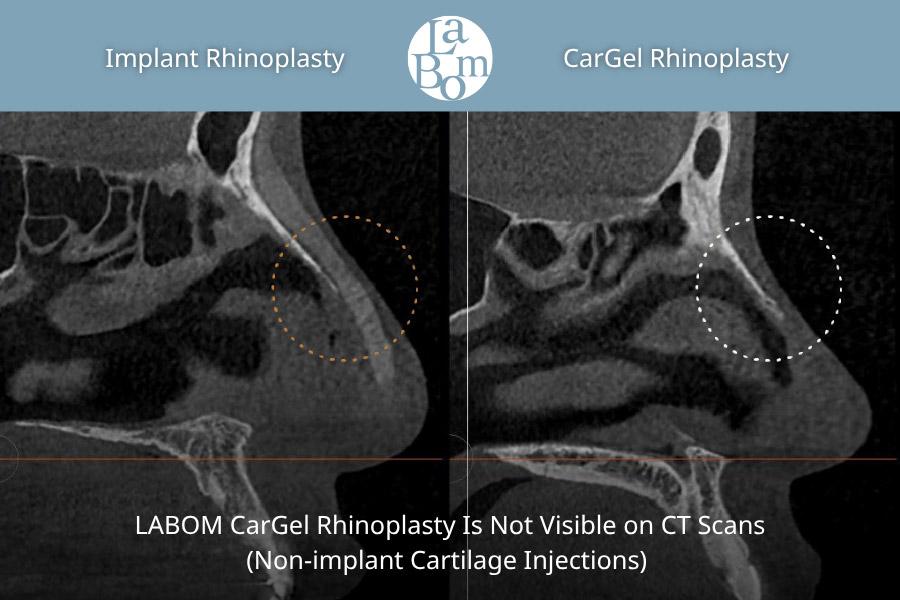
“Non-implant” describes what is excluded, not one fixed operation. Ask for a written, material-by-material plan: the term can mean no silicone bridge implant, no alloplastic material at all, or a plan that still uses donor-derived biological material.
- Autologous cartilage injections — Cartilage harvested from the nose, ear or rib is diced with autologous fibrin concentrate and injected to shape the bridge and tip, with or without nasal incisions. It suits modest refinement rather than structural or functional correction, and can be performed with both an open or closed approach depending on the clinic.
- Septal cartilage grafting — Cartilage harvested from inside the nose can provide modest structural support without a separate visible donor-site incision. Its available quantity is limited, particularly after prior septal surgery.
- Ear cartilage grafting — Curved, pliable conchal cartilage is useful for selected tip and contour grafts. It usually cannot provide the volume or rigidity required for major bridge reconstruction.
- Autologous rib cartilage — The patient’s own costal cartilage provides the greatest graft volume and support for substantial dorsal and tip reconstruction, saddle-nose correction, and many revisions. It requires a chest incision and adds pain, scarring, seroma risk, and rare pleural complications.
- Donor rib cartilage — Fresh-frozen or irradiated homologous costal cartilage avoids chest harvest but is not the patient’s own tissue. A 2025 systematic review and meta-analysis found broadly low pooled infection and warping rates across autologous, fresh-frozen, and irradiated rib cartilage, but revision findings were heterogeneous and potentially affected by publication bias; no source is universally best.
- Open approach — An incision across the columella, the tissue between the nostrils, allows broad exposure for complex graft placement and revision work.
- Closed approach — Incisions remain inside the nostrils and can suit selected less-complex plans. The appropriate approach follows the anatomy and graft requirements, not a marketing preference.
- Dorsal, tip, and functional work — The surgeon can combine bridge augmentation or reduction, cartilage-supported tip reshaping, septal correction, or nasal-valve support when examination shows a structural breathing problem.
Why Visit Korea for Non-Implant Rhinoplasty?
Korea has a formal system for medical institutions that attract foreign patients. This is useful for overseas planning, but it does not prove that a particular clinic or surgeon delivers better non-implant-rhinoplasty results. Assess the individual surgeon’s training, revision experience, proposed materials, and documented follow-up process.
- Foreign-patient registration — Medical Korea’s registered-institution system states that registered institutions serving foreign patients must carry medical-malpractice liability insurance. Verify the institution’s registration directly rather than relying only on an agency’s statement.
- International-care accreditation — Korea also has an accreditation pathway that assesses aspects of service and patient-safety systems for international care. Accreditation and registration are practical safeguards, not outcome rankings for rhinoplasty.
- Material-specific consent — The central safety issue is precise disclosure, because “implant-free” does not automatically mean “only your own tissue.” Request the exact graft source, processing type for any donor rib, use of fascia or acellular dermal matrix, and confirmation of whether any alloplastic material is planned.
- Evidence limits — Comparative cartilage studies remain largely retrospective and mix primary cosmetic, reconstructive, and revision cases. Earlier dorsal-augmentation research similarly found no statistically demonstrated pooled difference among several cartilage sources, while emphasizing the limitations of mostly observational evidence in the available literature.
Key Information for International Patients
- Minimum stay — Plan to remain in Korea for 10–14 days after an uncomplicated primary operation. This allows an early review, splint and commonly suture removal at about one week, and surgeon assessment before a long-haul flight.
- Longer-stay cases — Allow 14–21 days for revision surgery, substantial nasal-bone work, functional reconstruction, or rib-cartilage harvest. Bleeding, infection, donor-site healing, and persistent swelling can require an even longer stay.
- Flying home — CDC medical-tourism guidance cites American Society of Plastic Surgeons advice to wait 7–10 days before flying after cosmetic surgery to the face, eyelids, or nose. Surgery and prolonged sitting both increase clot risk, so obtain surgeon clearance rather than booking a fixed early departure. Read the CDC travel guidance for medical tourists.
- First-night support — Arrange an adult companion or supervised transfer after general anesthesia or sedation. Do not drive, travel alone immediately after discharge, sign important documents, or make major decisions while anesthetic effects persist.
- Itinerary impact — Expect visible bruising, swelling, congestion, and an external splint for roughly 7–10 days. Many patients are socially presentable at 10–14 days, but this is not a suitable period for strenuous sightseeing, carrying luggage, heat exposure, or activities that raise blood pressure.
- Records and remote care — Before departure, obtain an English operative report, exact graft and material details, medication and wound-care instructions, emergency contact details, and a scheduled remote-review plan. The CDC specifically advises medical tourists to obtain records in English.
Travel note: Keep flights and accommodation flexible. A long-haul flight should follow in-person review, not simply splint removal.
Which Are the Best Clinics in Korea for Nonimplant Rhinoplasty?
Listed below are some of the best clinics in Korea for nonimplant rhinoplasty.
1. LABOM Plastic Surgery
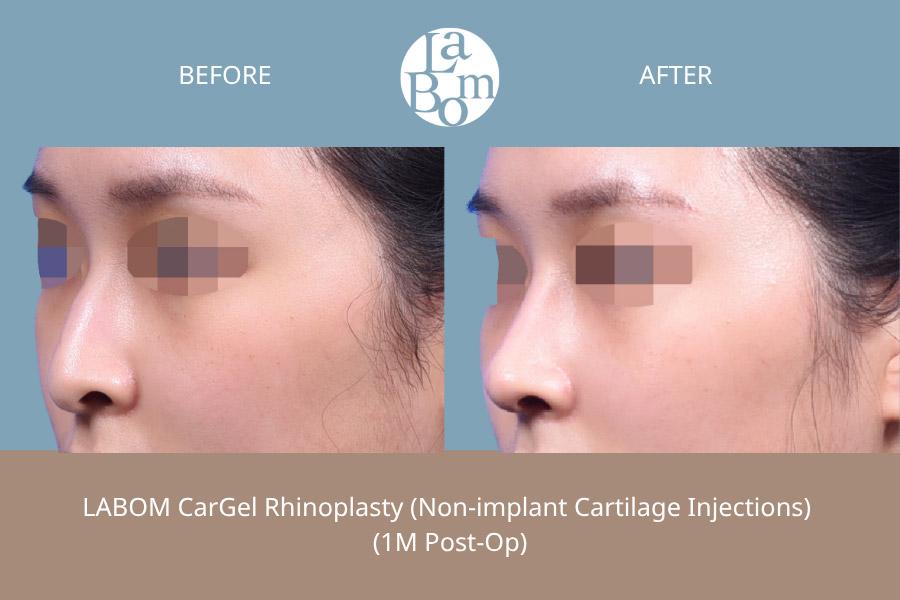
You may consider LABOM Plastic Surgery if you want nasal bridge or tip refinement without silicone or Gore-Tex implants: its CarGel technique combines your own finely diced ear, septal, or rib cartilage with fibrin from your blood to create an injectable cartilage gel. The clinic describes this as a same-day, under-an-hour procedure performed under sedation, with a small hidden cartilage-harvest incision rather than an incision on the nose itself.
- URL: LABOM Plastic Surgery Website
- Location: Gangnam-gu, Seoul
- CarGel approach:
- Uses autologous cartilage and fibrin rather than synthetic filler or nasal implants.
- Can be used to shape the bridge or tip.
- The clinic positions CarGel for people avoiding implants, seeking revision after implant concerns, or no longer getting the desired effect from repeated filler.
- Recovery and care:
- Stitches are removed at about 7 days, and the clinic estimates roughly 7 days of recovery.
- Pre-operative planning is individualized, with continuous anesthesia monitoring and structured swelling, bruising, and scar-management follow-up.
- Surgical expertise:
- Dr. Dongjin Kim is described as a board-certified plastic surgeon who trained at Seoul St. Mary's and was a visiting scholar at Mount Sinai in New York.
- The clinic reports more than 30 years of clinical experience across its specialists and ongoing academic-society participation and research.
2. THEPLUS Plastic Surgery
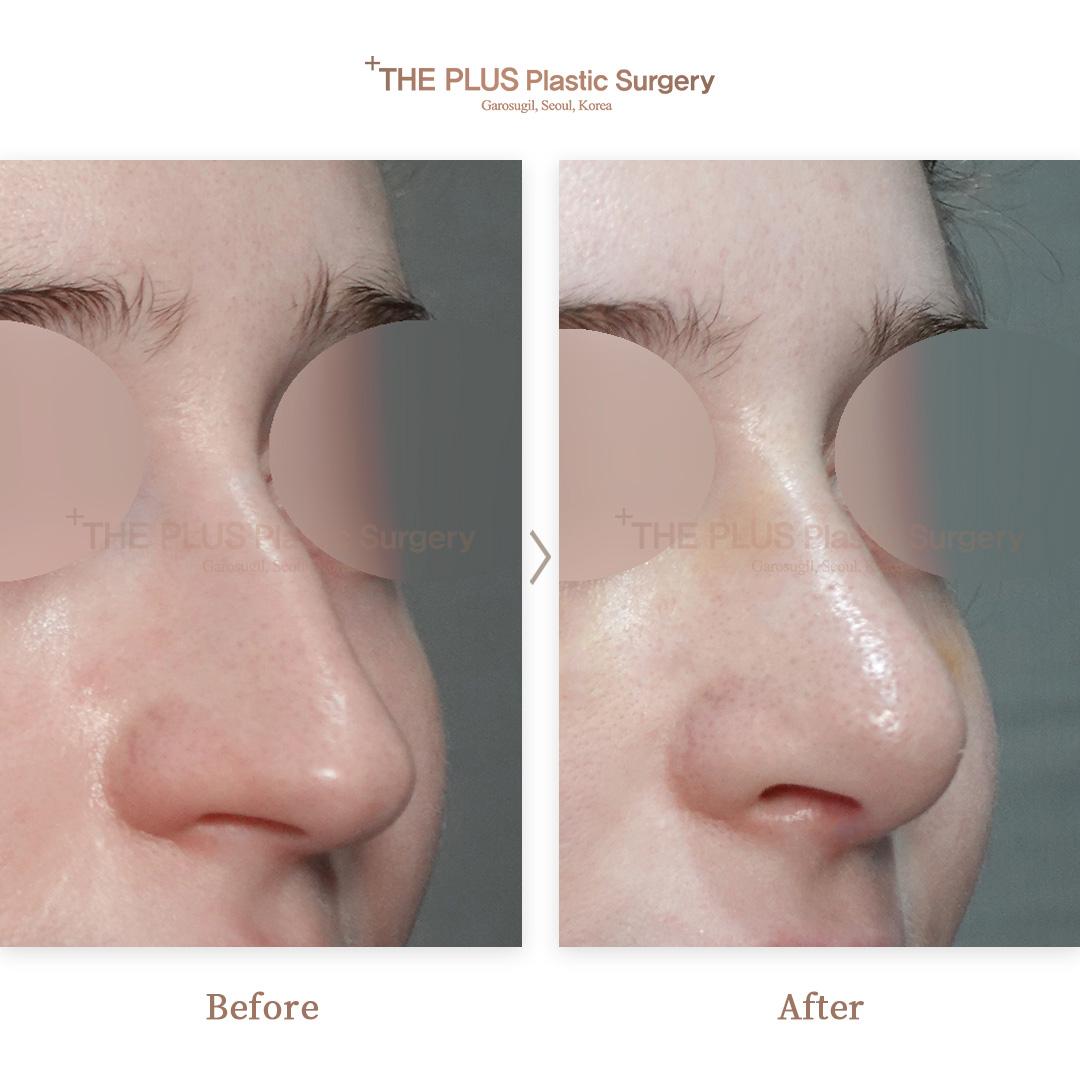
You may consider THEPLUS Plastic Surgery for a nonimplant approach when you want rhinoplasty using your own cartilage rather than synthetic implants. The clinic uses septal, ear, or rib cartilage with the stated goal of preserving both a natural appearance and nasal function; expect a 2–4 hour operation under sedation or general anesthesia, same-day discharge, stitch removal in 7–10 days, and an estimated 2–4 weeks of recovery.
- URL: THEPLUS Plastic Surgery Website
- Location: Gangnam-gu, Seoul
- Rhinoplasty surgeons:
- Dr. Jeong Jae-yong is an MD, PhD board-certified plastic surgeon and President of the Korean Society of Rhinoplasty Surgeons; he authored Rebuilding Nose: Rhinoplasty for Asians.
- Dr. Kim Taek-kyun is an MD, PhD board-certified plastic surgeon who wrote rhinoplasty and revision-rhinoplasty chapters in The 18 Masters of Korean Aesthetic Surgery.
- The clinic reports that both surgeons have more than 20 years of experience, have performed thousands of rhinoplasties, and have more than 20 academic publications.
- Autologous-tissue and revision focus:
- Cartilage may be harvested from the septum, ear, or rib rather than using an implant.
- The clinic also offers revision rhinoplasty and its surgeons present at the Seoul Rhinoplasty Forum, including a presentation by Dr. Kim on failed autologous tissue.
3. Okay Plastic Surgery Clinic
You may consider Okay Plastic Surgery Clinic if you want nose reshaping built around your own tissue, including septal, ear, or rib cartilage and dermis, rather than an implant. Its options include reshaping existing cartilage, refining and supporting the tip with sutures or layered cartilage grafts, and using either an open or closed bridge approach according to your anatomy; the clinic estimates about one hour under sedation, no hospital stay, and roughly seven days of recovery.
- URL: Okay Plastic Surgery Clinic Website
- Location: Gangnam-gu, Seoul
- Procedure options:
- Tip cartilage can be sutured to narrow and reshape the tip, while layered cartilage grafts can add tip support.
- Nostril narrowing may be performed with a thread technique without cuts or with incisions when nostril tissue is thicker.
- The clinic also lists autologous cartilage-gel injections for bridge shaping.
- Revision considerations:
- Autologous cartilage and dermis are offered for revision rhinoplasty.
- The clinic recommends waiting 6–12 months after an initial surgery before revision, and describes customizing tip cartilage to the individual nose type for stable fixation.
- Listed plastic surgeons:
- Dr. Cho Hee-eun is listed as a board-certified plastic surgeon, Seoul National University graduate, visiting professor at Korea University Anam Hospital, and published researcher in tissue transfer.
- Dr. Lee Yun-jae is listed as a board-certified plastic surgeon and a member of the Korean Society of Craniofacial Plastic Surgery and the Korean Society of Aesthetic Plastic Surgery.
Non-Implant Rhinoplasty From Start to Finish
- Remote inquiry and preliminary review — Send unfiltered front, profile, and three-quarter photographs; describe cosmetic and breathing goals; and provide prior operative reports, implant cards, and details of previous filler, threads, or implants. Confirm whether English or virtual consultation is available. Remote photographs support preliminary planning but cannot replace a physical examination.
- Written materials discussion — Ask the surgeon to identify every planned material: septal, ear, autologous rib, fresh-frozen donor rib, irradiated donor rib, fascia, diced cartilage, acellular dermal matrix, or any alloplastic material. Confirm the donor site, the reason for that material, open versus closed access, and the revision strategy if healing is unfavorable.
- In-person examination and medical clearance — The surgeon assesses skin thickness, bones, cartilage, facial proportions, scar tissue, septum, nasal valves, donor-cartilage availability, and relevant breathing symptoms. The anesthesia team reviews medical history, allergies, nicotine exposure, medicines, supplements, and required testing.
- Surgical planning and consent — Review realistic changes, limitations imposed by skin and framework, functional goals where relevant, graft-specific risks, donor-site risks, and recovery. Consent should state the exact materials rather than relying on the label “non-implant.”
- Anesthesia and operation — Rhinoplasty is performed under the anesthesia plan selected for the complexity of surgery and medical history. Through an open or closed approach, the surgeon reshapes bone and cartilage, places structural grafts where needed, and may combine septal or nasal-valve work when indicated.
- Immediate recovery and discharge — Expect an external splint and, in some cases, internal splints or packing. The operation can be outpatient or require observation depending on surgical complexity, anesthesia, medical conditions, and whether rib cartilage was harvested.
- Early in-Korea reviews — Attend scheduled checks for bleeding, wound healing, breathing, splint position, and donor-site recovery. Splint and suture removal commonly occurs at about one week; follow the surgeon’s timing if internal support was used.
- Return-home and remote follow-up — Share requested photographs and attend video follow-ups. Final contour is commonly assessed at around 12 months; tip swelling and fine refinement can continue for 1–2 years.
Alternatives to Non-Implant Rhinoplasty
The main tradeoff is permanence and structural capability versus downtime and risk. Surgical options can alter support or reduce tissue but require recovery; non-surgical filler can camouflage selected contour concerns temporarily but cannot shrink the nose or correct major structural problems.
Conventional Implant Rhinoplasty
- What it changes — Adds dorsal volume using an alloplastic implant, often for bridge augmentation.
- Tradeoff — Avoids cartilage harvest but introduces implant-specific concerns, including infection involving a foreign device, capsular problems, and extrusion.
- Related procedure — Read about rhinoplasty.
Nonsurgical Rhinoplasty
- What it changes — Hyaluronic-acid filler can camouflage selected humps or asymmetry temporarily.
- Tradeoff — It cannot make the nose smaller, reliably correct obstruction, or replace structural reconstruction. The nose is a high-risk vascular injection area; filler safety guidance warns that inadvertent vascular injection can cause tissue injury, vision abnormalities, blindness, or stroke.
- Related procedure — Read about nonsurgical rhinoplasty.
Septoplasty or Functional Nasal Surgery
- What it changes — Treats a deviated septum or selected structural causes of obstruction rather than pursuing cosmetic bridge or tip change.
- Tradeoff — It can improve airflow when obstruction is structural, but it does not automatically deliver the cosmetic changes of rhinoplasty.
- Related procedure — Read about septoplasty.
Isolated Tip Plasty
- What it changes — Focuses on tip projection, rotation, shape, or support without extensive bridge work.
- Tradeoff — Appropriate only when the bridge, nasal bones, and airway do not require correction.
- Related procedure — Read about tip plasty.
Revision Rhinoplasty
- What it changes — Addresses persistent deformity, poor support, obstruction, scarring, or problems after previous nasal surgery.
- Tradeoff — Revision work is more complex because scar tissue and depleted septal cartilage often require rib grafting and longer recovery planning.
- Related procedure — Read about revision rhinoplasty.
How Can I Prepare for Non-Implant Rhinoplasty?
- Medical disclosure — Provide a complete list of prescription medicines, anticoagulants, antiplatelet medicines, NSAIDs, vitamins, herbal products, recreational substances, allergies, prior surgery, prior nasal filler, threads, and implants. Include all breathing symptoms and any history of sinus or skin infection.
- Bleeding-risk medicines — Do not stop anticoagulants, antiplatelet medicines, or other prescriptions independently. The surgeon and prescribing clinician must provide a coordinated plan for medicines and supplements that affect bleeding.
- Nicotine cessation — Stop cigarettes, vaping, chewing tobacco, and nicotine replacement according to the operating surgeon’s cessation protocol. Nicotine impairs wound healing; disclose any recent exposure honestly.
- Infection and skin checks — Report cold symptoms, active sinus or dental infection, facial skin infection, fever, or new nasal lesions before travel or surgery. Elective surgery should wait until an active infection has been evaluated and treated.
- Fasting and medications on surgery day — Follow the anesthesia team’s individualized fasting and morning-medication instructions. Do not use a generic online fasting schedule in place of clinic instructions.
- Accommodation and transport — Book nearby accommodation, arrange an adult companion or supervised transfer for the first night, and avoid carrying heavy luggage after surgery. Keep flight dates flexible.
- Sun and alcohol — Avoid sunburn before surgery and follow the clinic’s alcohol restrictions, particularly around anesthesia and prescribed medicines.
Travel note: Bring prior operative reports and implant cards in English where possible. These records can change graft selection and the safety of revision surgery.
Confirm every clinic-specific requirement with the treating surgeon and anesthesia team; their individualized instructions take precedence over general guidance.
Aftercare Advice
Protect the healing nose and attend every scheduled review; early swelling does not show the final result.
- Splint, elevation, and swelling — Keep the external splint dry and intact unless the surgeon instructs otherwise. Sleep with the head elevated and expect congestion, bruising, temporary asymmetry, and swelling for the first 7–10 days.
- Nose protection — Do not blow the nose, pick inside the nostrils, massage or tape the nose, wear bridge-resting glasses, or use unapproved nasal sprays. Sneeze with the mouth open and use only surgeon-approved cleaning and skincare products around incisions.
- Activity restrictions — Avoid bending, heavy lifting, strenuous exercise, heat exposure, swimming, contact sports, and activities that raise blood pressure for the surgeon’s specified interval. Do not carry heavy luggage during travel home.
- Incision and sun care — Keep any columellar or chest-harvest incision clean as directed. Once the surgeon permits sun exposure, protect healing skin with SPF 50 and physical shade to reduce discoloration.
- Urgent warning signs — Seek urgent medical assessment for heavy or persistent bleeding, rapidly worsening one-sided swelling or pain, fever, spreading redness, pus or foul drainage, wound separation, pale, dusky, blue, or black skin changes, sudden breathing difficulty, chest pain, shortness of breath, fainting, or calf swelling.
- Follow-up and final timing — Attend splint and suture removal, then complete remote follow-up after returning home. Many people look socially presentable at 10–14 days, but final contour is commonly assessed around 12 months and can continue refining for 1–2 years; rib-cartilage harvest has separate chest-wound healing.
Follow the treating doctor’s instructions over general advice, and contact the clinic promptly when healing appears abnormal.
Frequently Asked Questions
Related Blogs
Korea vs. Global Standards: A Comprehensive Cost Analysis of Cleft Rhinoplasty in Medical Tourism Destinations
Explore the cost of cleft rhinoplasty in Korea, a popular destination for medical tourism due to its advanced surgical techniques and competitive pricing. Discover factors influencing the overall expense, from hospital fees to post-operative care, and what makes Korea a top choice for this specialized procedure.
Updated: Oct 21, 2026
Philtrum Reduction Costs: Choosing Korea Over the USA, Mexico, Turkey & More for Expert Care
Discover the affordability and benefits of Philtrum Reduction Surgery in Korea, a popular destination for high-quality cosmetic procedures. Explore cost factors, surgeon expertise, and why Korea is a top choice for those considering this transformative surgery.
Updated: Oct 21, 2026
Discovering the True Value: Sinus Surgery Costs in Korea Compared to Global Options
Discover the affordable options for sinus surgery in Korea, a leading destination for medical tourists seeking quality care. Learn about the factors influencing costs and what patients can expect from their experience in this highly advanced healthcare system.
Updated: Oct 21, 2026

Long Nose Correction in Korea: Rhinoplasty for a Balanced Facial Profile
Discover how to address a long nose with rhinoplasty for nasal length reduction in Korea. Our guide covers Dorsal Hump Reduction, Nasal Tip Refinement, Septal Adjustment, Alarplasty (Nostril Reduction), and Cartilage Grafting, plus open vs closed rhinoplasty, recovery, costs, and medical tourism logistics in South Korea. Learn realistic outcomes, patient journeys, and why Korea’s facial plastic su
Updated: Oct 12, 2026
Clinics offering Non-Implant Rhinoplasty

THEPLUS Plastic Surgery Korea | Eye, Nose, Face & Body Surgery
Sinsa

LABOM Plastic Surgery: Expertise in Non-Surgical Nose, Facial Lifting & Anti-Aging Surgeries in Korea
Apgujeong

Okay Plastic Surgery Clinic in Korea: Comprehensive Aesthetic Procedures with Sincerity and Care
Cheongdam