
Medical Tourism Blog
Filler Dissolver in Korea: Hyaluronic Acid Reversal, Recovery, Risks, and Travel Planning
Table of contents
- Filler Dissolver at a Glance
- What Is Hyaluronic Acid Filler Dissolution?
- Who Is a Good Candidate for Hyaluronic Acid Filler Dissolution?
- How Is Hyaluronic Acid Filler Dissolution Performed?
- Why Visit Korea for Hyaluronic Acid Filler Dissolution?
- Key Information for International Patients
- Which Are the Best Clinics in Korea for Filler Dissolver?
- Filler Dissolver From Start to Finish
- Alternatives to Hyaluronic Acid Filler Dissolution
- How Can I Prepare for Hyaluronic Acid Filler Dissolution?
- Aftercare Advice
Considering treatment in Korea? Everything you need to know e.g. — how to avoid scams, visas, interpreters, recovery tips — in our Medical Tourism Master Guide. Plan with confidence in minutes, not weeks!
Last updated: September 2026
Filler Dissolver at a Glance
- What it treats — Hyaluronidase injections break down hyaluronic-acid (HA) filler to correct unwanted volume, migration, asymmetry, Tyndall discoloration, or suspected HA nodules; they do not dissolve silicone, PMMA, CaHA, PLLA, or other permanent fillers.
- Best candidates — The most predictable cases have documented HA filler records, including the product, injection dates, volume, and sites; old, deep, migrated, or uncertain filler may need high-frequency ultrasound mapping first.
- Staged treatment — Treatment can target only the problem area rather than remove all filler, but dense, highly cross-linked, deep, chronic, or migrated HA filler may require more than one session.
- Recovery and result timing — Redness, swelling, tenderness, itching, and bruising usually improve within 24–72 hours; assess the early response at about 48 hours and wait at least 2 weeks before judging the stable result or adding new HA filler.
- Korea travel plan — Allow 2–3 days for an uncomplicated visit, including a review at roughly 48 hours; allow 1–2 weeks if the filler is uncertain or periocular, inflammation is substantial, or another session may be needed.
- Key safety limit — Worsening pain, pale or mottled skin, blistering, visual changes, or neurological symptoms after filler may indicate a vascular emergency and require immediate local medical care, not elective travel for dissolving.
- Korea-specific practical point — A Medical Korea registered institution may help international patients access multilingual coordination and formal handover records, but no comparative evidence shows that Korea has better elective dissolver outcomes than other countries.
What Is Hyaluronic Acid Filler Dissolution?
Filler dissolver is an injectable treatment using hyaluronidase to break down hyaluronic-acid filler. It addresses unwanted volume, asymmetry, filler migration, discoloration, or certain filler-related lumps, with treatment tailored to the correction goal. It is a non-surgical procedure.
Who Is a Good Candidate for Hyaluronic Acid Filler Dissolution?
- Documented HA filler — Good candidates have unwanted hyaluronic-acid (HA) filler volume, asymmetry, migration, superficial blue-gray discoloration known as the Tyndall effect, or a discrete suspected HA-related nodule.
- A focused correction goal — Candidates seeking partial reduction in one area, such as the lips, tear troughs, cheeks, or jawline, can discuss conservative targeted treatment rather than automatic removal of all filler.
- Known treatment history — The safest planning starts with the filler brand, material, injection dates, volume, sites, injection depth if known, previous hyaluronidase doses, and any prior reaction.
- Uncertain or longstanding filler — People with old, migrated, deep, or previously unresponsive filler need assessment before treatment; high-frequency ultrasound can help identify filler deposits, tissue planes, and nearby vessels.
Hyaluronidase is for HA filler, not silicone, polymethylmethacrylate (PMMA), calcium hydroxylapatite (CaHA), poly-L-lactic acid (PLLA), or other permanent materials. Do not arrange elective treatment during pregnancy or breastfeeding without a clinician’s assessment, because adequate human safety data are lacking. Active facial infection, unexplained swelling, uncontrolled illness, and a history of serious hyaluronidase allergy require diagnosis and individualized planning first. Severe or worsening pain, pale or mottled skin, blistering, visual changes, ptosis, severe headache, weakness, speech difficulty, or other neurological symptoms after filler require immediate local emergency assessment—not travel for an elective dissolver appointment.
How Is Hyaluronic Acid Filler Dissolution Performed?
The treatment approach depends on whether the goal is a small aesthetic adjustment, diagnostic clarification, or urgent management of a suspected HA-filler complication. There is no validated universal dose or repeat-treatment protocol because filler chemistry, product structure, volume, depth, age, and tissue integration affect enzyme response.
- Clinical-assessment-guided dissolution — The clinician reviews records, photographs, palpation, skin condition, and circulation, then places conservative hyaluronidase injections in the suspected HA-filled plane. This is appropriate when the material and location are reasonably clear.
- Ultrasound-guided dissolution — High-frequency ultrasound can map filler depth, spread, nodules, and vessels before targeted injection. It is particularly useful for migrated filler, prior unsuccessful dissolution, deep filler, uncertain records, and periocular concerns, but it remains operator-dependent and cannot prove that every visible contour change is filler.
- Staged or partial dissolution — Treating one area or using more than one session helps preserve wanted volume and reduces the chance of abrupt overcorrection. A small randomized in-vivo study found improvement with both 20-unit and 40-unit doses over 14 days for several HA fillers, but it does not establish one correct dose for every product or facial area.
- Emergency vascular-compromise management — Suspected vascular occlusion is not elective dissolving. It requires immediate clinician-led assessment, prompt hyaluronidase-based intervention, repeated circulation checks, and escalation to emergency, ophthalmology, wound-care, or hospital care when indicated. Evidence for ultrasound-guided emergency treatment is encouraging but limited: a 2025 review included only four studies and 55 patients, so its results cannot predict elective cosmetic outcomes.
Why Visit Korea for Hyaluronic Acid Filler Dissolution?
Korea can be practical for an international patient when the clinic is prepared to identify the filler material, communicate clearly, document the intervention, and provide a realistic review plan. The important differentiator is not the country alone; it is the treating clinician’s diagnostic judgment, ability to use ultrasound when appropriate, and emergency escalation pathway. No comparative clinical evidence shows better elective hyaluronidase outcomes in Korea than in other countries.
- Foreign-patient registration framework — Korea’s Medical Korea registered-institution system provides an administrative route for identifying institutions registered to serve foreign patients. Registration is not proof of superior aesthetic outcomes or a substitute for checking the clinician’s complication-management capability.
- Targeted imaging when indicated — Ask whether high-frequency ultrasound is available for unknown, chronic, migrated, deep, or periocular filler. This can support localization before treatment rather than assuming all fullness is HA filler.
- Documentation for onward care — Request a written handover naming the hyaluronidase product, total units, dilution, treated sites, technique, anesthetic, photographs, and any ultrasound findings. This is particularly important when follow-up will occur outside Korea.
- Evidence limitation — A scoping review of randomized evidence found only five eligible trials, all from the United States and involving 53 participants with uncomplicated HA nodules. It found no country-level comparison of safety, aesthetic results, or repeat-session rates.
Key Information for International Patients
- Minimum stay — Plan 2–3 days for a straightforward elective visit: consultation and treatment on day 1, then an in-person review at roughly 48 hours where feasible.
- Longer stay situations — Plan 1–2 weeks when filler is old, product records are uncertain, a second session is likely, inflammation is marked, or treatment involves the tear trough or other periocular tissue.
- Flight timing — No established physiological commercial-flight prohibition exists after uncomplicated dissolution, but avoid same-day departure. Remain reachable for swelling, allergic symptoms, worsening pain, or an unexpected contour change, and complete the 48-hour review when possible.
- Do not fly with warning signs — Suspected vascular compromise, skin breakdown, visual symptoms, neurological symptoms, or systemic allergic symptoms need urgent local assessment and explicit medical clearance before travel.
- Itinerary impact — Redness, tenderness, itching, bruising, and swelling usually improve over 24–72 hours after an uncomplicated session. Avoid scheduling major photographs, events, or a long-haul departure immediately after treatment.
- Repeat treatment and refilling — Dense, highly cross-linked, deep, chronic, or migrated HA filler can require staged treatment. Wait at least 2 weeks after dissolution before judging the stable cosmetic result or placing new HA filler; inflammatory cases or substantial swelling can require longer.
- Remote follow-up — Arrange a video or photo review plan before leaving Korea and identify a qualified clinician at home who could assess a delayed concern.
Travel note: A companion is not routinely needed for a simple local-anesthetic visit. Arrange one when sedation is used, vision is impaired, treatment is periocular, anxiety is substantial, or urgent assessment becomes necessary. Do not drive after sedation or with altered vision.
Which Are the Best Clinics in Korea for Filler Dissolver?
Listed below are some of the best clinics in Korea for filler dissolver.
1. DATENA CLINIC
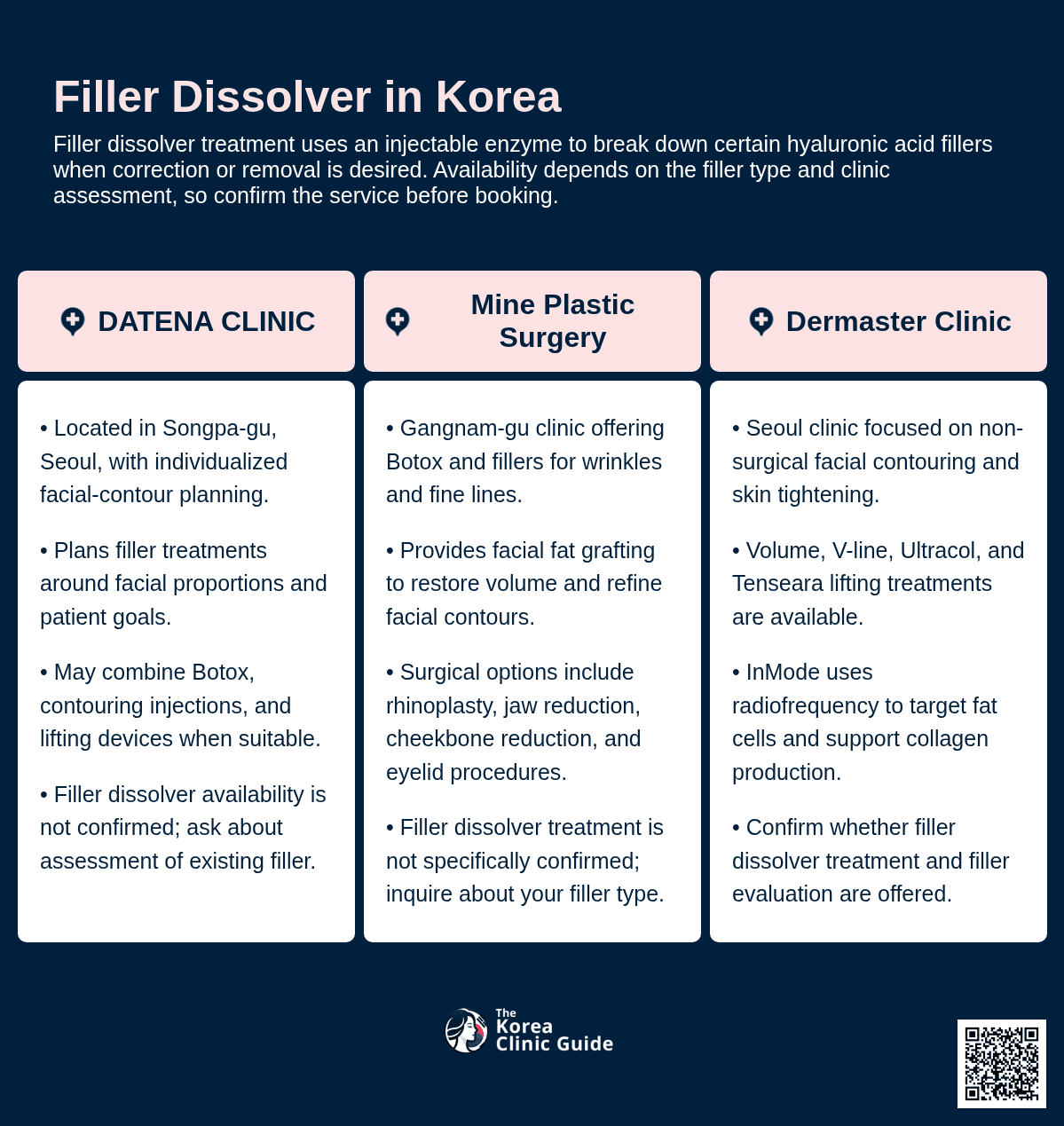
You may consider DATENA CLINIC if you want a clinic that incorporates fillers into individualized facial-contour plans based on your proportions and goals; however, the supplied information does not confirm a filler-dissolver service, so you should clarify whether it is available and appropriate for your existing filler.
- URL: DATENA CLINIC Website
- Location: Songpa-gu, Seoul
- Facial treatment planning:
- Filler treatment is planned according to your facial proportions and treatment goals.
- Design Botox, jaw Botox, skin Botox, contouring injections, and lifting devices may be incorporated into a customized contouring plan when appropriate.
- Related skin care:
- Skin-booster programs include Rejuran, Water Glow, and Juvelook for hydration, texture, and radiance-focused care.
- The clinic also lists treatment planning for pigmentation, pores, acne scars, skin texture, and slow-aging care.
2. Mine Plastic Surgery
You may consider Mine Plastic Surgery if you are seeking an aesthetic clinic that offers Botox and fillers alongside facial fat grafting and a broad range of facial surgical and nonsurgical procedures. The supplied information does not specifically confirm filler dissolver treatment, so you should ask whether evaluation and dissolution of your particular filler are offered.
- URL: Mine Plastic Surgery Website
- Location: Gangnam-gu, Seoul
- Volume and facial options:
- Botox and fillers are listed as nonsurgical treatments for wrinkles and fine lines.
- Facial line fat grafting transfers your own fat to facial areas requiring volume, smoothing wrinkles and refining contours.
- The clinic also provides rhinoplasty, revision rhinoplasty, jaw reduction, cheekbone reduction, and eyelid procedures.
- Lifting services: MACS lift, thread lifting, and endoscopic forehead lift are available for concerns involving sagging facial tissues, forehead position, and wrinkles.
3. Dermaster Clinic
You may consider Dermaster Clinic if your goals after a filler concern include non-surgical facial contouring, skin tightening, or volume-focused aesthetic care. The provided information does not confirm that filler dissolver treatment is offered, so you should verify availability and whether the clinic can assess your existing filler before planning treatment.
- URL: Dermaster Clinic Website
- Location: Seoul
- Non-surgical facial treatments:
- Volume Lifting is described as restoring lost facial volume while supporting collagen production.
- V-line Lifting targets definition of the jawline and chin while addressing facial fat and sagging skin.
- Ultracol Lifting is intended to improve elasticity, stimulate collagen production, and support facial contours.
- Device-based contour care:
- Tenseara is offered as a skin-tightening and lifting treatment focused on facial contours.
- A 30-minute InMode treatment uses radiofrequency to target fat cells and stimulate collagen for facial contouring.
Filler Dissolver From Start to Finish
- Send records before travel — Provide standardized photographs, the original filler brand and material if available, dates, volume, sites, prior dissolver treatment, allergy history, medical conditions, and complete medication and supplement lists. Ask whether English-language or virtual consultation is available.
- Confirm whether travel is appropriate — The clinic should screen for severe pain, blanching, mottled or cool skin, blisters, visual disturbance, and neurological symptoms. These require immediate local emergency care rather than a routine appointment abroad.
- Set the treatment goal — During virtual or in-person consultation, clarify whether the aim is partial correction, wider HA reduction, treatment of a localized nodule, or diagnostic evaluation of uncertain tissue change. Review the possibility of under-response, overcorrection, perceived hollowing, allergy, and repeat treatment.
- Examine and map the area — The clinician examines skin, contour, palpability, inflammation, and circulation. For migrated, old, deep, periocular, or uncertain filler, ultrasound can help identify the likely deposit and vessels before injection.
- Prepare for injection — The treatment area is cleansed with antiseptic. Local anesthetic can be used; routine local-anesthetic treatment does not generally require fasting unless the clinic gives instructions for sedation, combined procedures, or other clinical reasons.
- Inject hyaluronidase — The clinician places hyaluronidase with a fine needle or cannula into the intended tissue plane. A broad area or firm nodule can require several injection points. Direct enzyme delivery into filler is more effective than superficial application in laboratory and animal research, but this does not create a universal cosmetic dosing rule.
- Observe and leave with records — The procedure is usually outpatient. The facility should observe for immediate allergic symptoms and give written instructions. Obtain a treatment summary listing product, units, dilution, sites, technique, anesthetic, photographs, and ultrasound findings when used.
- Return at about 48 hours — Early contour changes are unreliable because injection trauma, local anesthetic, and swelling can temporarily alter volume. The clinician reassesses the area, documents the response, and decides whether observation or staged treatment is appropriate.
- Complete overseas follow-up — Send agreed photographs and attend a remote review after return home. Seek urgent local care rather than waiting for remote advice if pain worsens, skin color changes, infection signs, allergy symptoms, or visual and neurological symptoms occur.
Alternatives to Hyaluronic Acid Filler Dissolution
The right alternative depends on the filler material and the problem being treated. Non-surgical options can preserve tissue and avoid a procedure when there is no urgent complication, while surgery is reserved for selected localized non-HA or permanent-material problems and carries scarring and contour-change tradeoffs.
Observation and Time
- Best suited to — Confirmed HA filler that is unwanted but not causing infection, vascular symptoms, severe inflammation, or functional concerns.
- Tradeoff — HA filler can gradually degrade, but the timeline is unpredictable and does not address an urgent complication.
Partial or Staged Dissolution
- Best suited to — A patient who wants correction of a specific overfilled or migrated area while preserving useful volume elsewhere.
- Tradeoff — More than one visit can be needed, particularly with deep, dense, highly cross-linked, or longstanding filler.
Diagnostic Ultrasound and Specialist Assessment
- Best suited to — Unknown filler, chronic swelling, possible fibrosis, periocular concerns, non-response to prior treatment, or uncertainty over whether a lump is filler.
- Tradeoff — Imaging helps target management but cannot consistently distinguish every HA deposit from edema, scar tissue, or other tissue changes.
Condition-Specific Treatment
- Best suited to — Infection, delayed inflammatory nodules, allergic reactions, and suspected vascular compromise.
- Tradeoff — Hyaluronidase can be one part of care but is not a stand-alone answer for every cause; antimicrobial treatment, drainage, emergency care, or specialist referral can be necessary.
Surgical Foreign-Body Removal
- Best suited to — Selected localized problems caused by non-HA or permanent filler, where a specialist considers removal feasible. See foreign-body removal.
- Tradeoff — Surgery is not a simple filler-dissolver substitute and can leave scars, contour irregularity, or residual material.
Later Volume Restoration
- Best suited to — Patients with stable tissue after the dissolving result is clear who still have genuine volume loss or an anatomical hollow.
- Tradeoff — Carefully planned HA replacement, facial fat grafting, or under-eye fat removal or repositioning addresses different causes and should not be rushed after dissolution.
How Can I Prepare for Hyaluronic Acid Filler Dissolution?
- Send the filler record — Provide brand, material, date, volume, sites, injection plane if known, prior hyaluronidase doses, and previous filler reactions before booking travel. Do not assume every prior injectable was HA.
- Disclose medicines and supplements — Give the clinic a complete list of prescription medicines, over-the-counter drugs, vitamins, herbal products, and supplements. Do not stop prescribed anticoagulants, antiplatelet drugs, or other medicines without the prescribing clinician’s instruction; the treating clinician must assess bruising and medical risk individually.
- Report allergies and illness — State any reaction to hyaluronidase, bee or wasp stings, anesthetics, or drug excipients, plus active skin infection, recent unexplained facial swelling, autoimmune or inflammatory conditions, and current illness. Selective allergy testing can be considered when clinically appropriate.
- Arrive with clean skin — Attend without makeup, skincare residue, or facial products over the intended area. Do not manipulate, massage, squeeze, or attempt to self-treat a lump before assessment.
- Follow fasting instructions exactly — Routine local-anesthetic injection generally does not require fasting. Fast only when the clinic directs it because sedation, combined procedures, or other clinical circumstances are planned.
- Avoid self-injection and unregulated products — Do not buy or inject hyaluronidase independently. Allergy, infection, overcorrection, and missed vascular or infectious complications require a medically equipped setting.
- Keep travel flexible — Book accommodation close enough for a 48-hour review and avoid a same-day return flight. Build room into the itinerary for ultrasound, a repeat visit, or urgent local assessment if the finding is not straightforward.
Travel note: Bring printed and digital copies of filler records, a medication list, and emergency contact details. Confirm in advance how the clinic handles after-hours concerns and what records it will provide for a clinician at home.
Confirm the treating clinic’s individualized medication, fasting, transport, and scheduling requirements; these take precedence over general guidance.
Aftercare Advice
Protect the treated area, assess the result at the planned review, and treat warning symptoms as urgent rather than trying to correct the contour at home.
- Expect temporary local effects — Redness, tenderness, itching, bruising, and swelling commonly settle over about 24–72 hours. Do not judge the final contour on the first day because edema, needle trauma, and local anesthetic can distort the appearance.
- Avoid pressure and additional treatment — Do not massage, press, or refill the area unless the treating clinician specifically instructs it. Postpone additional injectable and energy-based facial procedures until the clinician confirms it is appropriate.
- Restrict heat and strenuous activity — Avoid strenuous exercise, saunas, hot baths, and aggressive facial massage until cleared by the clinician. The appropriate restriction period depends on injection extent, bruising, swelling, and whether another treatment is planned.
- Use simple skin protection — Keep the area clean and follow the clinic’s instructions on cold compresses. Avoid irritant skincare on puncture sites; use broad-spectrum SPF 50 on exposed facial skin once the skin is intact, especially when bruising or discoloration is visible.
- Attend reassessment — Return at approximately 48 hours when feasible. Wait at least 2 weeks before judging the stable cosmetic result or considering new HA filler; substantial swelling, inflammation, or staged treatment can extend that interval.
- Seek urgent care for red flags — Obtain immediate assessment for worsening pain; pale, gray, blue, or mottled skin; coolness; blistering; spreading redness, pus, or fever; rapidly expanding swelling; hives, wheeze, throat or facial swelling, faintness; or any visual or neurological symptom.
Follow the treating doctor’s instructions over general aftercare advice, and contact the clinic promptly when anything appears wrong.
Frequently Asked Questions
Related Blogs

Effective Tear Trough Depression Treatment in Korea with Juvelook Volume Filler
Discover how Korea leads in treating tear trough depression—the "sunken groove below the eye." This condition causes dark circles, hollows, and a tired look. The innovative Juvelook Volume Filler, approved in Korea, combines hyaluronic acid and polylactic acid to deliver immediate hydration and long-term collagen boost, providing natural rejuvenation. Learn how Korea's advanced clinics perform thi
Updated: Oct 28, 2026

Knee Hyperpigmentation Solutions: Knee Whitening Procedures in Korea for Brighter, Even Skin
Discover effective knee whitening solutions in Korea for hyperpigmentation and darkened skin. This comprehensive blog covers causes like friction and sun damage and details treatments such as topical hydroquinone, chemical peels, microdermabrasion, laser therapy, microneedling, and cryotherapy. Highlighting Korea’s advanced technology and expert care, it guides you through procedures, costs, and p
Updated: Oct 28, 2026
Ultracol in Korea: Candidates, Safety, Recovery, and Travel Planning
Ultracol is a PDO microsphere injectable intended in Korea for temporary improvement of bilateral nasolabial folds, delivered after eligibility review and product-label verification. The article covers candidate screening, outpatient treatment and recovery, travel planning, aftercare, warning signs, follow-up, and alternatives.
Updated: Oct 27, 2026
Discover the Price Spectrum: Lilied Skin Booster Costs—Korea vs. Global Destinations
Discover the latest trends in skincare with the Lilied Skin Booster in Korea. Learn about its pricing, benefits, and why it’s becoming a must-have addition to beauty routines across the country.
Updated: Oct 27, 2026
Clinics offering Filler Dissolver

Haru Clinic Korea | Fully-Customized Full-Face Non-Surgical Rejuvenation With Threads, Botox & Fillers
Sinsa

B.V Clinic Korea: Advanced Aesthetic Treatments for Natural Beauty Enhancement & Rejuvenation
Sinnonhyeon Station

Beauty Blossom Clinic Korea: Advanced Non-Surgical Skin, Anti-Aging & Aesthetic Treatments in Hongdae
Hongdae

Secret Clinic: Unveiling Advanced Skin and Body Treatments in Seongnam, Korea
Sinnonhyeon Station