
Medical Tourism Blog
Neck Muscle Pain Solutions: Trapezius Botox Procedures in Korea for Effective Relief
Table of contents
- Trapezius Botox: A Detailed Medical Procedure
- Which Are the Best Clinics in Korea for Neck Muscle Pain?
- Navigating Trapezius Botox in South Korea: A Step-by-Step Guide
- Cost Analysis for Medical Tourists: Trapezius Botox in South Korea vs. Other Countries
- Patient Experiences and Outcomes with Trapezius Botox for Neck Pain
- Important Considerations and Next Steps
- Conclusion
- References
Considering treatment in Korea? Everything you need to know e.g. — how to avoid scams, visas, interpreters, recovery tips — in our Medical Tourism Master Guide. Plan with confidence in minutes, not weeks!
Persistent neck stiffness caused by tight trapezius muscles is a common issue that can seriously affect daily life. This review explores neck muscle pain (cervicalgia) with a focus on trapezius stiffness and explains how Trapezius Botox works to relieve symptoms. We outline the procedure, especially as practiced in South Korea, and provide a cost comparison highlighting South Korea’s appeal for medical tourists. Patient experiences and clinical outcomes are also addressed, alongside benefits, risks, and long-term management strategies. Trapezius Botox brings significant relief in appropriate cases, but understanding its temporary effects and integrating it into a broader neck health plan is crucial for lasting results.
Neck pain is a widespread complaint, particularly when linked to ongoing stiffness in the trapezius muscles. This section provides information on the nature of cervicalgia, the role of the trapezius muscle, and how related conditions may overlap with neck pain.
What is Neck Muscle Pain (Cervicalgia)?
Cervicalgia refers to pain in the neck region near the cervical spine. It can be acute (a few days to six weeks) or chronic (over three months). Symptoms include persistent aches, sharp or burning pain, and pain radiating into the shoulders or arms. Other possible signs are headaches, muscle stiffness, restricted movement, and tingling sensations.
Causes range from physical strain and poor posture (often due to desk work) to mental stress, age-related changes like osteoarthritis, and injuries such as whiplash. Less common but serious sources include tumors, cysts, meningitis, or autoimmune diseases like rheumatoid arthritis.
The Role of the Trapezius Muscle in Neck Stiffness
The trapezius is a large, fan-shaped muscle covering the upper back, attaching to the clavicle and scapula. It enables shoulder movement, stability, and posture. When the upper part of this muscle is persistently painful and stiff, it's termed "Trapezius Myalgia" (TM)—not a standalone disease, but a symptom of an underlying problem such as poor posture, stress, or muscle imbalance.
TM affects 10–20% of adults with chronic neck and shoulder pain, especially women and those in lower-income groups. Symptoms include sudden pain, stiffness, head heaviness, occipital headaches, and sensitivity in the upper trapezius. Pain often improves with light activity but worsens after inactivity. Diagnosing TM involves finding trigger points and excluding other neck syndromes like cervical spondylosis, radiculopathy, or thoracic outlet syndrome.
Common Pseudonyms and Related Conditions for Neck Pain
Understanding neck pain terminology helps patients research effectively and communicate with healthcare providers. Besides cervicalgia and Trapezius Myalgia, related conditions include:
- Cervical dystonia (spasmodic torticollis): Involuntary neck muscle contractions
- Cervical spondylosis: Degenerative neck joint changes
- Myofascial pain syndrome: Chronic muscle and fascia pain
- Tension headache: Muscle tension-related headaches
- Herniated disk, spinal stenosis, poor posture, fibromyalgia, rheumatic conditions, and traumatic injuries
Table 1: Common Pseudonyms and Related Conditions for Neck Pain
| Common Term/Pseudonym | Brief Description | Associated Medical Conditions/Causes |
|---|---|---|
| Cervicalgia | General pain in or around the neck region | Physical strain, poor posture, mental stress, aging (osteoarthritis, spinal stenosis, herniated disk), injury (whiplash), tumors, meningitis, rheumatoid arthritis |
| Trapezius Myalgia (TM) | Pain, stiffness, and tightness of the upper trapezius muscle | Symptom of underlying conditions, often associated with chronic neck-shoulder pain, muscle spasms, trigger points |
| Myofascial Pain Syndrome | Chronic pain condition affecting muscles and fascia | Muscle strains, poor posture, repetitive activities, stress |
| Cervical Dystonia (Spasmodic Torticollis) | Neurological disorder causing involuntary contractions | Neurological conditions, sometimes idiopathic |
| Tension Headache | Headaches due to muscle contractions | Stress, poor posture, muscle tension |
Trapezius Botox: A Detailed Medical Procedure
Trapezius Botox has become a significant option for those suffering from unrelenting trapezius-related neck stiffness. This section explains what botulinum toxin is, how it works, details the procedure, and covers its uses.
What is Botulinum Toxin (Botox)?
Botulinum toxin (BoNT), commonly branded as Botox, is a neurotoxin made by Clostridium botulinum. It's not only used cosmetically, but for several medical conditions, such as chronic migraines, spasticity, and cervical dystonia. Types A and B are the most commonly used in medical settings.
Mechanism of Action: How Botox Relieves Muscle Tension
Botox relieves muscle tension by blocking nerve signals at the neuromuscular junction. It prevents the release of acetylcholine—needed for muscle contraction—by cleaving specific proteins involved in neurotransmitter release. This results in temporary muscle relaxation at the injection site, ideal for relieving trapezius tightness.
The Trapezius Botox Procedure: What to Expect
Typically lasting 15–30 minutes, the Trapezius Botox procedure is quick and minimally invasive. A trained physician maps and marks points on the trapezius, using a fine needle for injections. Ultrasound or electrical stimulation guidance may be used for accuracy. Numbing creams or local anesthetics help with comfort. Patients usually feel effects within a few days, reaching a peak after 1–2 weeks. Effects can last three to six months, occasionally longer, but repeat treatments are necessary.
Therapeutic vs. Cosmetic Applications
Trapezius Botox is valued for both medical and cosmetic reasons. Therapeutically, it relieves chronic muscle tension, pain, and headaches, improving mobility and quality of life. Aesthetically, it slims and elongates the shoulder line. This dual-purpose appeal is especially notable in medical tourism hubs like South Korea.
Which Are the Best Clinics in Korea for Neck Muscle Pain?
Listed below are some of the best clinics in Korea for neck muscle pain.
1. Oganacell Dermatology Clinic - Magok
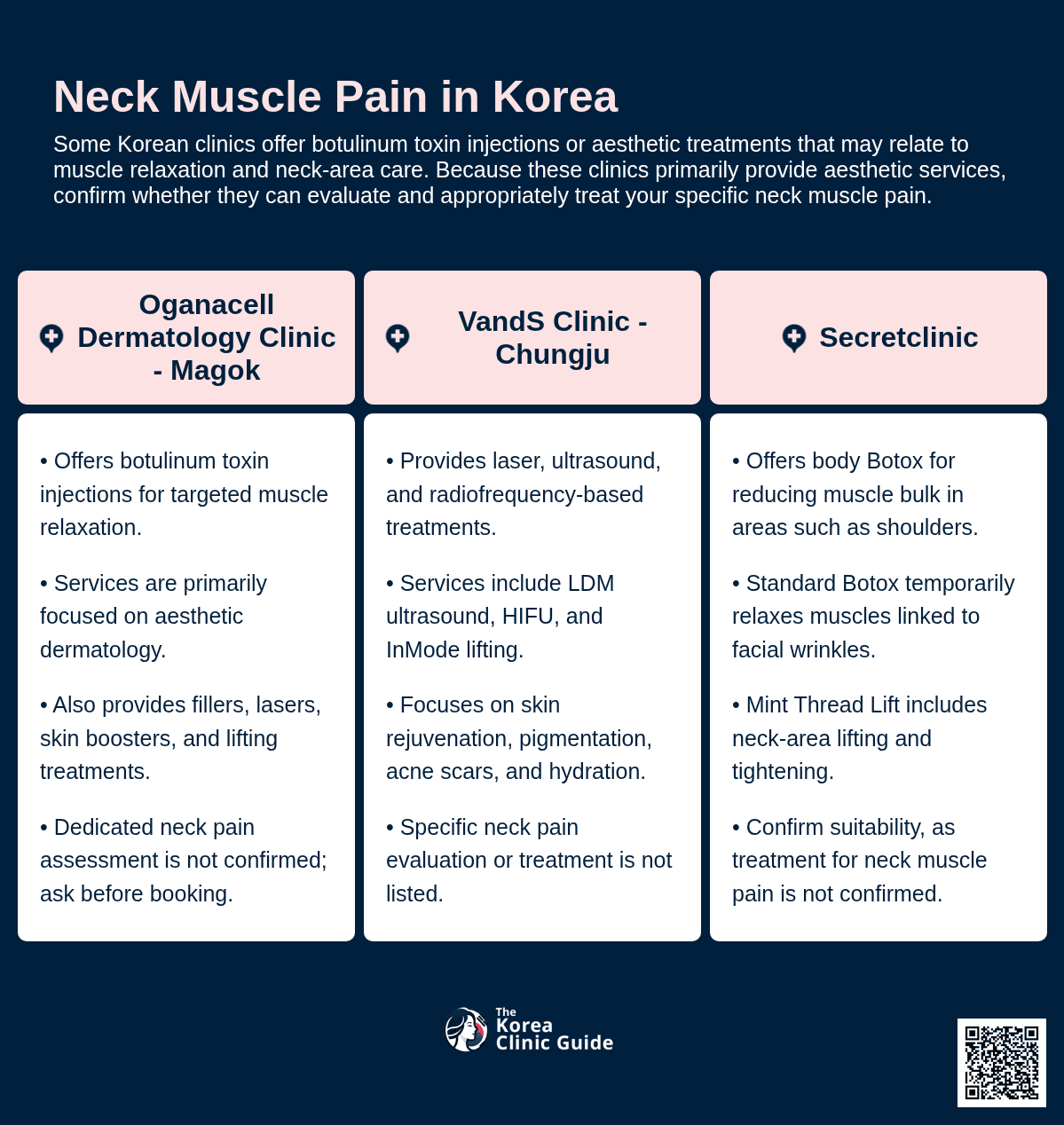
If you are exploring an injection-based approach for a muscle-related concern, Oganacell Dermatology Clinic - Magok offers botulinum toxin treatments that relax selected muscles. However, its listed services are centered on aesthetic dermatology, and the available information does not confirm a dedicated assessment or treatment program for neck muscle pain.
- URL: Oganacell Dermatology Clinic - Magok Website
- Location: 2F, Tower4, K-Square Magok, 105-7 Magokjungang-ro, Gangseo-gu, Seoul
- Muscle-related option: Botulinum toxin injections are offered for targeted muscle relaxation, including wrinkle care, jawline reduction, and other muscle-related concerns; the provided information does not specifically identify neck muscle pain as an indication.
- Related aesthetic services:
2. VandS Clinic - Chungju
VandS Clinic - Chungju provides dermatological and aesthetic treatments, including laser, ultrasound, and radiofrequency-based procedures, but the supplied information does not list a treatment, diagnostic evaluation, or injection service specifically for neck muscle pain. You may want to clarify whether your neck symptoms can be assessed there before considering an aesthetic procedure.
- URL: VandS Clinic - Chungju Website
- Location: Chungju-si, Chungcheongbuk-do
- Available services:
- The clinic lists laser therapy, chemical peels, dermal fillers, Rejuran Healer, Veloche Laser, LDM ultrasonic treatment, Shring Lift HIFU, and InMode radiofrequency lifting.
- Its documented treatments focus on skin rejuvenation, pigmentation, acne scars, hydration, and non-surgical lifting.
3. Secretclinic
Secretclinic offers body Botox for muscle-bulk reduction in areas including the shoulders, which may be relevant if your concern involves the appearance or tension of adjacent upper-body muscles. Its available information does not confirm medical evaluation or treatment of neck muscle pain, so you should clarify whether your symptoms are appropriate for its services.
- URL: Secretclinic Website
- Location: Sujeong-gu, Seongnam-si, Gyeonggi
- Muscle-focused injectable service:
- Body Botox is listed for reducing muscle bulk in areas such as the calves or shoulders; the supplied information does not specifically state that it is used for neck muscle pain.
- The clinic also offers standard Botox for temporarily relaxing muscles associated with dynamic facial wrinkles.
- Neck-area aesthetic options:
- Mint Thread Lift is described as treating areas including the neck for skin lifting and tightening.
- Face InMode, Shrunk Universe ultrasound, and several thread-lift options are listed for non-surgical facial and skin-firming treatment.
Navigating Trapezius Botox in South Korea: A Step-by-Step Guide
South Korea is recognized for excellence in aesthetic medicine. Here’s what international patients can expect when undergoing Trapezius Botox.
Initial Consultation and Assessment
A personalized consultation with a specialist is the first step, where medical history and desired outcomes are discussed. This evaluation ensures the procedure is safe and tailored to the patient’s unique needs.
The Injection Process
The physician marks injection sites after initial assessment. Botox is carefully injected using a fine needle; the whole procedure takes 15–30 minutes. Local anesthetics or numbing creams commonly enhance patient comfort. South Korean clinics emphasize patient experience throughout the process.
Post-Procedure Care and Follow-up
Patients should avoid strenuous activity and lying down for several hours post-injection. Minor side effects like bruising or discomfort typically resolve quickly. Follow-up visits help assess results and plan maintenance treatments, usually every 6–12 months.
Patient Comfort and Clinic Environment in South Korea
South Korean clinics are known for their supportive, patient-focused environments. Attention to comfort, clear communication, and a calm atmosphere—alongside expert care—make the experience attractive for medical tourists.
Cost Analysis for Medical Tourists: Trapezius Botox in South Korea vs. Other Countries
Understanding costs is key for those considering Trapezius Botox abroad. South Korea offers notable value and quality.
Typical Costs in South Korea (Units, Brands, Inclusions)
Trapezius Botox typically costs between 300,000 and 1,000,000 KRW ($230–$760 USD). Example prices for 100 units include: Wondertox ($53), Coretox ($160), Xeomin ($365), and Allergan ($790). Most Korean clinics include consultation and procedure fees in the quoted price, and overnight hospital stays are rarely needed. A small upfront deposit is common.
Cost Comparison: South Korea vs. United States and United Kingdom
- South Korea: $230–$760 USD (£180–£600 GBP)
- United States: $500–$3,000 USD (average $1,000–$1,500), usually priced per unit
- United Kingdom: $500–$1,250 USD (£400–£1,000 GBP)
Clinical quality is generally comparable, with Korean products like Nabota known for efficacy and cost-effectiveness.
Table 2: Estimated Trapezius Botox Costs: South Korea vs. Key Medical Tourism Destinations
| Country | Typical Price Range (USD) | Price Range (GBP) | Notes |
|---|---|---|---|
| South Korea | $230 - $760 | £180 - £600 | Varies by brand and includes consultation and procedure fees |
| United States | $500 - $3,000 (Avg. $1,000+) | £400 - £2,400 | $10–$20 per unit; higher total units required for trapezius muscle |
| United Kingdom | $500 - $1,250 | £400 - £1,000 | Clinic and per-unit pricing varies |
Factors Influencing Cost and Value for Medical Tourists
Costs differ based on clinic reputation, practitioner experience, product brand, and number of units. Lower Korean prices usually reflect reduced production and labor costs, not quality. The high procedure volume in South Korea also helps keep prices competitive, with no significant compromise in patient safety or results. Clinics emphasize patient care and comfort, which further enhances value.
Patient Experiences and Outcomes with Trapezius Botox for Neck Pain
Patient results and satisfaction are key in evaluating the effectiveness of Trapezius Botox.
Reported Benefits: Pain Relief, Mobility, and Quality of Life
Patients typically report:
- Pain Relief: Significant reduction in neck and shoulder pain, especially in cases of chronic myofascial pain and cervical dystonia.
- Improved Mobility: Enhanced neck and shoulder movement.
- Headache Reduction: Fewer and less severe migraines and tension headaches.
- Better Posture and Aesthetics: More elongated neckline, which is an added cosmetic benefit.
- Quality of Life: Easier daily activities, better sleep, and greater overall satisfaction.
Clinical studies confirm sustained benefits, such as reduced trapezius muscle size and improved quality of life, for up to six months post-treatment.
Potential Side Effects and Risks
Most side effects are mild and temporary:
- Injection site discomfort, bruising, swelling
- Headaches
- Temporary muscle weakness
- Flu-like symptoms
- Dry mouth (more common with botulinum toxin B)
- Increased neck pain (occasionally)
Very rarely, serious symptoms can develop due to the spread of the toxin. These include generalized muscle weakness, swallowing difficulties, or allergic reactions, all of which require immediate medical attention. Repeat treatments are needed since effects wear off in a few months. Overuse could potentially contribute to poor posture or muscle imbalance, especially if underlying causes aren’t addressed.
Real Patient Stories and Clinical Study Insights
- Gina (Cervical Dystonia): After a long diagnostic journey, Gina found relief from severe neck pain and regaining control over her life with Trapezius Botox.
- Amy (Spasticity): Botox helped Amy manage stiffness due to spasticity, restoring her daily functioning.
- Migraine/Vertigo Patient: Achieved “total relief” from chronic headaches and muscle-related vertigo after Trapezius Botox.
Clinical studies have also shown reduced pain, fewer headaches, and improved muscle appearance after treatment.
Table 3: Summary of Reported Patient Outcomes and Potential Side Effects
| Category | Outcome/Effect | Details | Duration |
|---|---|---|---|
| Benefits | Pain Relief | Significant, especially for myofascial pain, dystonia | Clinical improvement in 2–6 weeks; lasts 3–12 months |
| Mobility & Flexibility | Increased range of motion | As long as muscle relaxation persists | |
| Headache Reduction | Less frequent and severe | With muscle relaxation | |
| Posture & Aesthetics | Slenderized neckline, improved posture | Up to 6 months | |
| Quality of Life | Better daily function, sleep, enjoyment | With pain relief duration | |
| Side Effects | Injection Site Issues | Bruising, discomfort, swelling | Resolves in days to a week |
| Headaches | Temporary | Often self-limited | |
| Muscle Weakness | Localized and temporary | Days to weeks | |
| Flu-like Symptoms | Mild and short-lived | Few days | |
| Risks | Serious Toxic Spread | Rare swallowing/breathing problems | May last weeks to months |
| Temporary Relief | Results require repeat injections | 3–6 months | |
| Muscle Imbalance | Potential if underlying issues not addressed | Long-term if not managed holistically |
Considerations for Long-Term Management
Since Trapezius Myalgia is a symptom, not a disease, fixing root causes—such as posture, stress, and muscular imbalance—is key for lasting relief. Sole reliance on Botox may allow recurrent tension in other muscles, undermining postural stability over time. Integrating Trapezius Botox with other therapies is the best way to support ongoing neck health.
Important Considerations and Next Steps
For those considering Trapezius Botox, understanding whether this therapy fits your circumstances is essential.
Is Trapezius Botox Right for You?
Candidates for Trapezius Botox often struggle with persistent neck/shoulder pain, stiffness, or tension headaches, and haven’t found help with other treatments. It’s especially effective for diagnosed cervical dystonia and myofascial pain syndrome but is not a cure-all.
Consulting with a Specialist
A thorough evaluation by a pain management expert, neurologist, or experienced cosmetic surgeon is crucial. Discussing your symptoms, prior treatments, and outcomes openly enables tailored recommendations around dosing and injection points.
Alternative and Complementary Therapies
To support long-term results, combine Trapezius Botox with complementary treatments:
- Chiropractic care
- Soft tissue or massage therapy
- Corrective exercises
- Ergonomic changes at work
- Stress management through mindfulness or relaxation techniques
Conclusion
Trapezius Botox offers meaningful relief for persistent neck pain and stiffness, with proven improvements in mobility, pain, and headaches—especially when performed by skilled professionals. South Korea is a top choice for this treatment, offering affordability, quality, and excellent patient care. However, the therapy is temporary; repeat treatments and addressing underlying causes are key for long-term neck health. A holistic treatment plan and a specialist’s guidance ensure the best outcomes.
References
1, 2, 3, 4, 5, 6, 7, 8, 9, 10, 11, 12, 13, 14, 15, 16, 17, 18, 19
Frequently Asked Questions
Related Blogs
Relieve Tension Headaches with Forehead Botox Treatments in Korea
Discover how Korea leads in treating frontal tension headaches caused by contracted facial muscles with innovative procedures like Forehead Botox. This guide explores the benefits, process, and affordability of getting Botox for headache relief in Korea, a top destination for medical tourism. Learn about Korea's high-quality care, cost advantages, and how Botox relaxes muscles and alleviates pain,
Updated: Oct 1, 2026
Discover Bulky Calves Solutions with Calf Reduction Botox in Korea for a Sleeker Look
Discover how Korea leads in non-surgical calf reduction using Botox to treat calf hypertrophy. This safe, effective procedure reshapes bulky calves caused by muscle hypertrophy, enabling patients to achieve slimmer, proportionate legs. Korea's top clinics offer expert care, advanced techniques, and competitively priced treatments for international medical tourists. Experience natural results with
Updated: Sep 30, 2026

Forehead Botox in Korea: Results, Brow Safety, Recovery, and Travel Planning
Forehead Botox uses tailored frontalis injections to soften dynamic horizontal lines while considering brow position, eyelid anatomy, and desired movement. Learn about candidacy, Korea travel planning, aftercare, recovery timing, records, follow-up, and warning signs.
Updated: Sep 28, 2026
Discovering Competitive Prices: Mouth Corner Lift Botox Costs in Korea Versus Global Medical Tourism Hubs
Discover the latest trends and costs associated with Mouth Corner Lift Botox in Korea, a popular cosmetic treatment for enhancing smiles. Learn how this procedure compares in price and effectiveness to similar treatments worldwide.
Updated: Sep 27, 2026
Clinics offering Trapezius Botox

365mc Hospital: Korea's Leading Liposuction and Body Contouring Clinic with Innovative AI Technologies and Comprehensive Patient Care
Gyodae

Three Wishes Clinic - Myeongdong, Korea: Advanced Botox, Fillers, Laser, and Skin Treatments for Confidence and Care
Myeongdong

B.V Clinic Korea: Advanced Aesthetic Treatments for Natural Beauty Enhancement & Rejuvenation
Sinnonhyeon Station

Evita Clinic Korea: Body Contouring, Breast & Gender-Affirming Surgery in Seoul (Apgujeong)
Apgujeong