
Medical Tourism Blog
Inmode Lifting in Korea: Forma, MiniFX, Results, Recovery and Travel Planning

Table of contents
- Inmode Lifting at a Glance
- What Is InMode Lifting?
- Who Is a Good Candidate for InMode Lifting?
- How Is InMode Lifting Performed?
- Why Visit Korea for InMode Lifting?
- Key Information for International Patients
- Which Are the Best Clinics in Korea for Morpheus8?
- Inmode Lifting From Start to Finish
- Alternatives to InMode Lifting
- How Can I Prepare for InMode Lifting?
- Aftercare Advice
Considering treatment in Korea? Everything you need to know e.g. — how to avoid scams, visas, interpreters, recovery tips — in our Medical Tourism Master Guide. Plan with confidence in minutes, not weeks!
Last updated: September 2026
Inmode Lifting at a Glance
- What it is — InMode lifting is a non-invasive external radiofrequency treatment, not one standardized procedure; clinics may use Forma contact RF for skin tightening and/or MiniFX suction-coupled RF for small contour areas such as the jawline or under-chin.
- Best candidates — It is best suited to adults seeking gradual, modest improvement in mild skin laxity, fine lines, texture, early jawline blurring, or selected submental fullness—not a dramatic surgical-style lift.
- Results and repeat sessions — Results, if achieved, develop gradually and should be judged after the planned treatment series plus several additional weeks; there is no validated universal session schedule, and one treatment is unlikely to create facelift-level or permanent repositioning.
- Recovery — Most people leave immediately after stand-alone RF, with warmth, redness, tenderness, or mild swelling typically resolving within hours to 1–3 days; MiniFX-style suction treatment can also cause temporary bruising, so allow at least 48 hours before an important event.
- Korea travel planning — Allow 1–2 days for a consultation and one uncomplicated session, or 2–3 days if a next-day review is preferred; because a full course often requires repeat visits, arrange in advance whether later sessions will occur in Korea or at home.
- Key limitation and risk — External RF does not reliably correct substantial loose skin, pronounced jowls, neck bands, major volume loss, or major tissue descent, and important uncommon risks include burns, blistering, pigment changes, sensory symptoms, scarring, and unsatisfactory contour change.
- Korea-specific check — In Korea, “InMode lifting” is a broad marketing label rather than a fixed protocol, so request the exact machine, handpiece, treatment zones, planned number of sessions, and any add-ons in writing; a generic claim of MFDS approval does not verify the proposed configuration or indication.
What Is InMode Lifting?
InMode lifting is an external radiofrequency treatment that uses heat, and sometimes suction, to tighten skin and refine small contour areas. It targets mild skin laxity, early jawline or neck softness, fine lines, and selected under-chin fullness, with gradual and generally subtle results. It is non-surgical and non-invasive, with no incisions or general anesthesia for stand-alone treatment.
Who Is a Good Candidate for InMode Lifting?
- Mild laxity and early lower-face softness — Good candidates are adults seeking gradual improvement in fine lines, skin texture, mild cheek or neck laxity, and early jawline blurring rather than a dramatic lift.
- Selected contour concerns — MiniFX-style treatment can be considered for selected submental fullness, jawline softness, lower-cheek fullness, or small body areas after examination confirms that the concern is suitable for external RF contouring.
- Realistic non-surgical goals — Candidates accept that results, when achieved, are usually modest and gradual, often require a planned series, and are not equivalent to a facelift. Reviews of facial RF report favorable outcomes but substantial variation in devices, protocols, outcomes, and study quality, so they do not establish a predictable facelift-level result.[evidence on facial RF] (https://pubmed.ncbi.nlm.nih.gov/34923652/)
InMode lifting is less suitable for substantial loose skin, pronounced jowls, marked platysmal neck bands, major facial volume loss, or a request for one-time, durable tissue repositioning. Defer elective treatment during pregnancy. A pacemaker, implanted defibrillator, other electronic implant, metal hardware in the proposed RF field, permanent filler or silicone, active infection, open skin, herpes outbreak, sunburn, unexplained changing lesion, keloid tendency, impaired healing, neuropathy, autoimmune or connective-tissue disease, and relevant cancer history require clinician assessment or specialist clearance. Disclose dental implants, crowns, braces, facial plates and screws, prior fillers, threads, isotretinoin, tanning, and recent laser, RF, ultrasound, or injectable treatment because compatibility and timing depend on the exact area, device, and settings.
How Is InMode Lifting Performed?
“InMode lifting” is not one standardized procedure. In Korea, the term commonly describes a clinic-designed treatment using one or more InMode RF handpieces; ask for the exact platform, handpiece, treatment zones, and planned number of sessions in writing.
- Forma or Plus-style contact bipolar RF — A clinician applies conductive gel and moves a contact handpiece across the skin to create controlled heating. It is commonly used for mild laxity, texture, fine lines, and early jawline or neck concerns. Progressive warmth is typical, and anesthesia is usually unnecessary for stand-alone treatment.
- MiniFX-style suction-coupled RF — This distinct applicator combines RF delivery with suction and tissue manipulation for smaller contour-focused areas. It is often proposed for the submental area, jawline, or lower face; pulling, pressure, heat, and temporary bruising can occur. The manufacturer distinguishes MiniFX for smaller areas from BodyFX for larger areas, but this does not make every branded protocol clinically equivalent.MiniFX and BodyFX applicator distinction
- Forma plus FX combination — Clinics often combine a Forma-type pass for skin-quality or tightening goals with MiniFX in fuller lower-face or submental areas. This is a customized combination, not a validated universal “InMode lifting” protocol. Confirm whether injectables, threads, microneedling RF, or other energy devices are being added.
- Anatomy-led planning — Lower-face fullness is not always removable fat. Assessment should distinguish skin laxity, submental fat, masseter prominence, salivary-gland prominence, skeletal structure, and age-related volume loss before selecting a contouring handpiece or alternative treatment.
Why Visit Korea for InMode Lifting?
Korea offers broad access to aesthetic clinics that market InMode-based treatment, but there is no high-quality comparative evidence that InMode lifting in Korea is safer, stronger, or longer-lasting than equivalent treatment elsewhere. The practical advantage is the ability to obtain an in-person assessment and a transparent treatment plan during a short visit. Choose a clinician and protocol, not the marketing term alone.
- Clarify the broad consumer label — Korean clinic materials commonly distinguish Forma for tightening-oriented goals and MiniFX for smaller contour-focused areas, while also showing that schedules and claims differ between providers.Korean clinic description of Forma and MiniFX This variation makes a written plan particularly important.
- Verify the actual handpiece — InMode is a multi-application system rather than one treatment. The FDA clearance lists separate non-invasive RF applicators including Forma/Plus, MiniFX, BodyFX, and WMFace.InMode Multi-System clearance Ask the clinic to identify the device model and applicator rather than simply saying “InMode.”
- Check Korean authorization properly — Broad claims that “InMode is MFDS approved” do not establish the authorized indication or permitted configuration for an individual treatment. Ask the clinic to identify the exact machine and check the applicable Korean device listing and labeling through the MFDS medical-device information system.
- Keep evidence in perspective — A 2025 review of 15 facial RF studies involving 1,230 participants found generally positive texture and firmness findings, but also methodological limitations and underreporting of downtime.2025 facial RF systematic review That supports cautious expectations of modest benefit, not country-specific superiority.
Key Information for International Patients
- Minimum stay — Allow 1–2 days for an uncomplicated consultation and one stand-alone external RF session. Plan 2–3 days when an in-person assessment and next-day review are preferred.
- Repeat-session reality — A complete course often involves repeat treatment. Do not assume one Korea trip completes treatment; agree in advance whether later sessions will be done in Korea or with a qualified clinician at home.
- Flight timing — No evidence-based universal no-fly interval exists for stand-alone external RF. Same-day or next-day flying can be logistically possible when feeling well and without a significant reaction, but avoid scheduling treatment immediately before a long-haul flight or important event.
- Event planning — Redness, warmth, tenderness, and mild swelling commonly settle within hours to 1–3 days. Suction-based FX treatment can cause bruising. Allow at least 48 hours before photographs, meetings, weddings, or other important events.
- Transport and companions — A companion is usually unnecessary after external RF without sedation. Arrange escorted transport if the plan includes sedation, a nerve block, strong analgesia, injections, or an invasive add-on.
- Remote follow-up — Leave with English written aftercare, an emergency contact, and a treatment record naming the platform, handpiece, treatment areas, date, and any products or medicines used. Send standardized photographs several weeks later if the clinic requests them.
Travel note: Seek prompt local in-person care for blistering, worsening pain, expanding redness, fever, drainage, persistent numbness, or weakness. Do not rely only on messages to an overseas clinic for a potentially urgent reaction.
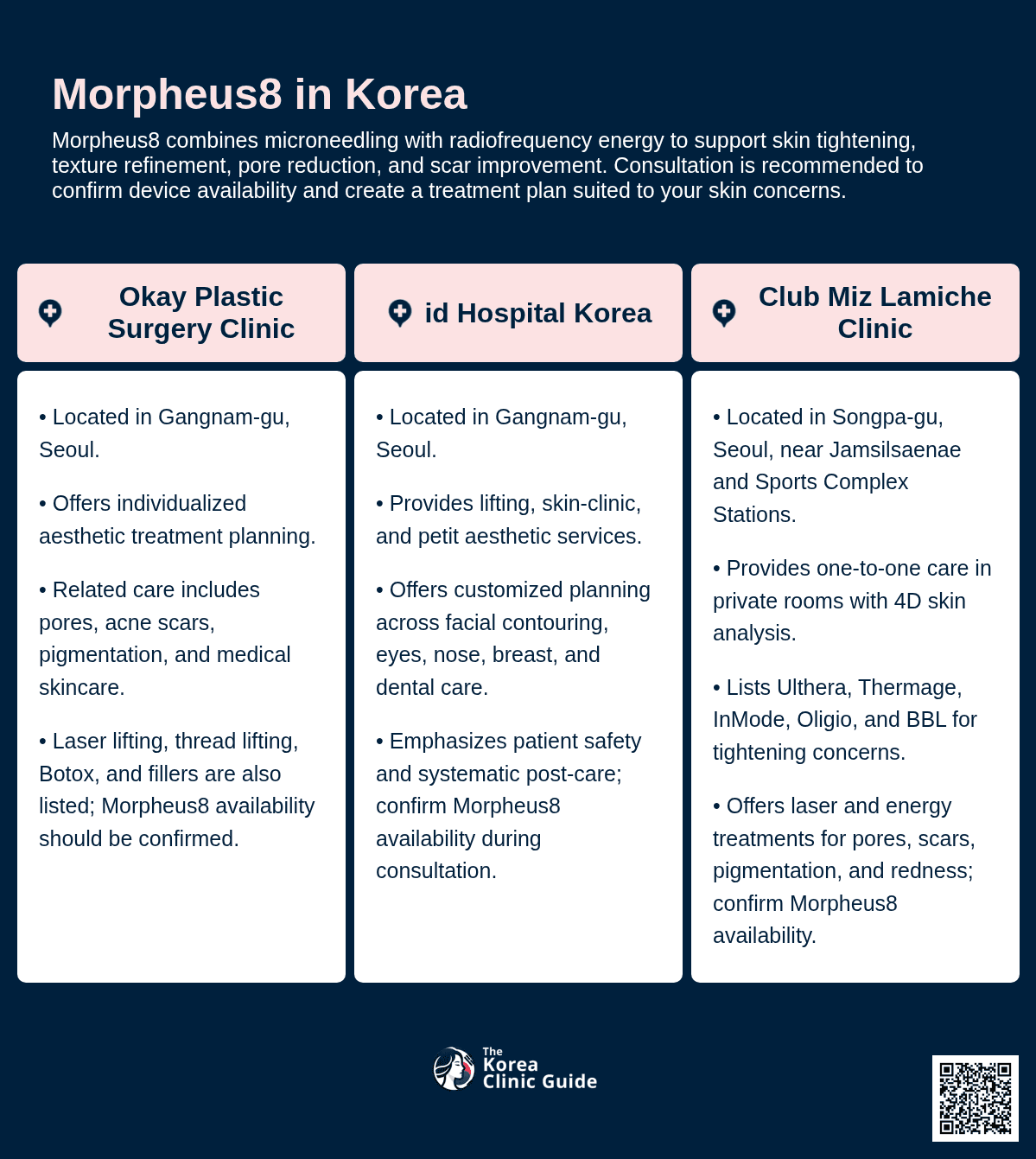
Which Are the Best Clinics in Korea for Morpheus8?
Listed below are some of the best clinics in Korea for morpheus8.
1. Okay Plastic Surgery Clinic
You may consider Okay Plastic Surgery Clinic if you want Morpheus8 discussions placed within a broader aesthetic plan, particularly when your concerns also involve skin texture, pores, acne scars, pigmentation, or facial lifting. The clinic describes individualized treatment planning and offers medical skincare, laser lifting, and scar-focused services, though the supplied information does not specifically confirm Morpheus8 availability.
- URL: Okay Plastic Surgery Clinic Website
- Location: Gangnam-gu, Seoul
- Related skin care:
- Medical skincare for ongoing skin-health support.
- Treatments listed for pores, acne, acne scars, and pigmentation.
- Dedicated scar and keloid evaluation and treatment planning are listed.
- Complementary aesthetic options:
- Laser lifting and thread lifting are listed among facial rejuvenation options.
- Botox and filler treatments are available for wrinkle, volume, and contour concerns.
2. id Hospital Korea
You may consider id Hospital Korea for a Morpheus8 consultation if you are seeking skin and lifting care in a clinic whose listed services also include facial contouring, eye and nose surgery, breast surgery, and petit aesthetic treatments. The supplied information emphasizes customized planning, a patient-safety-oriented approach, and systematic post-care, but it does not specifically confirm Morpheus8 availability.
- URL: id Hospital Korea Website
- Location: Gangnam-gu, Seoul
- Relevant services:
- Lifting and skin-clinic services are listed alongside petit plastic surgery.
- Facial contouring, orthognathic surgery, eye and nose plastic surgery, breast surgery, and dentistry are also listed.
- Care approach:
- Customized plastic-surgery planning is described.
- The clinic states that it uses patient-safety-oriented treatment and systematic post-care.
3. Club Miz Lamiche Clinic
You may consider Club Miz Lamiche Clinic for a Morpheus8 consultation if your goals involve skin tightening, texture, pores, acne scars, pigmentation, or redness and you value individualized skin assessment. The clinic offers one-to-one customized care in private treatment rooms with 4D skin analysis and lists a wide range of energy-based, laser, injectable, and lifting treatments, although the supplied information does not specifically confirm Morpheus8 availability.
- URL: Club Miz Lamiche Clinic Website
- Location: Songpa-gu, Seoul
- Skin assessment and treatment setting:
- One-to-one customized treatments are provided in individual treatment rooms.
- Treatment rooms are equipped with 4D skin analysis technology.
- The clinic has operated since 2002 and describes 22 years of clinical experience.
- Related skin and tightening options:
- Listed tightening treatments include Ulthera, Thermage FLX/CPT, InMode, Oligio, and BBL.
- Acne, pore, and scar options include Fraxel Dual, Legato 2, photodynamic therapy, and other laser or energy treatments.
- Pigmentation and redness treatments listed include Excel V, Picosure, Synergy, BBL, and Photona.
- Practical notes:
- Evening hours are available on Monday, Wednesday, and Friday, with Saturday opening listed.
- The clinic is described as a 5–7 minute walk from Jamsilsaenae Station on Line 2 and Sports Complex Station on Line 9.
Inmode Lifting From Start to Finish
- First contact and virtual screening — Send unfiltered front, oblique, and profile photographs, state the areas and goals, and ask whether English consultation or virtual review is available. Disclose prior surgery, fillers, threads, implants, dental hardware, medical conditions, allergies, medicines, supplements, pigment changes, and abnormal scarring.
- Written treatment clarification — Request the platform and handpiece name, such as Forma or MiniFX, proposed anatomical zones, whether the session is external RF only, anticipated session number and interval, and all planned add-ons. The InMode system includes multiple applicators with different designs and intended uses.FDA device clearance details
- In-person assessment in Korea — The clinician examines skin quality, laxity, fat distribution, facial structure, and prior treatment material. They should confirm candidacy, review contraindications, discuss realistic alternatives, obtain consent, and take baseline photographs where appropriate.
- Skin preparation and comfort plan — The treatment area is cleansed. Stand-alone contact RF generally uses conductive gel and does not require fasting, anesthesia, or sedation. Follow the clinic’s directions if anxiety medication, sedation, injections, or an invasive combination procedure is planned.
- RF treatment — The clinician uses the selected contact or suction-coupled handpiece according to the individualized protocol. Contact RF involves controlled movement across gelled skin; MiniFX-style treatment adds suction and tissue manipulation. The session length depends on the handpiece combination and number of areas treated.
- Discharge and immediate recovery — Most patients leave immediately after stand-alone external RF. Expect warmth, redness, tenderness, or mild swelling; bruising is more relevant after suction-based treatment. Obtain written aftercare before leaving.
- Results assessment and overseas follow-up — Do not judge the final cosmetic effect immediately after heating. Compare standardized photographs after the planned series and again several further weeks later. Contact the clinic for planned remote review, but arrange local medical assessment promptly for concerning symptoms.
Alternatives to InMode Lifting
Non-surgical alternatives can target different tissue depths or priorities, but none reliably duplicates surgical repositioning of substantial loose skin. Surgical options offer more definite structural change and longer recovery; non-surgical treatments have less downtime but generally produce subtler, less predictable change.
Focused ultrasound
- Best matched concern — HIFU lifting, Ultherapy lifting, Liftera lifting, and Shurink lifting are options for selected non-surgical tightening goals.
- Tradeoff — These use focused ultrasound rather than external RF, so comfort, depth, protocol, and suitability differ by device and anatomy.
Monopolar RF
- Best matched concern — Thermage lifting, Oligio lifting, and Volnewmer lifting offer a different RF platform and treatment approach for laxity-focused goals.
- Tradeoff — Do not assume RF devices are interchangeable; ask what tissue concern the proposed technology is intended to address.
RF microneedling
- Best matched concern — Secret RF microneedling is more relevant when pores, acne scarring, texture, or fine lines are more prominent than skin laxity.
- Tradeoff — It uses needles and therefore has different skin-injury, pigment, and aftercare considerations from external RF.
Fat reduction
- Best matched concern — Fat-dissolving injection or double-chin liposuction can be considered when medically suitable submental fat is the primary cause of fullness.
- Tradeoff — Injection and surgery carry different risks and recovery. Liposuction provides more definite fat removal but is invasive.
Thread lift or facelift
- Best matched concern — Face thread lift can create a temporary mechanical lifting vector; facelift is more appropriate for substantial jowls, skin excess, or structural descent.
- Tradeoff — Threads and surgery have more significant complication and recovery considerations, while surgery offers the greater capacity for tissue repositioning.
How Can I Prepare for InMode Lifting?
- Provide a full medical history — Tell the clinic about pacemakers, implanted electronic devices, cochlear implants, metal implants, facial hardware, braces, crowns, dental implants, prior facial surgery, fillers, permanent filler or silicone, threads, herpes history, pigment problems, keloid scarring, autoimmune disease, cancer history, neuropathy, and healing problems.
- Send all medicines and supplements early — List anticoagulants, antiplatelets, NSAIDs, fish oil or omega-3, vitamin E, ginkgo, garlic supplements, corticosteroids, immunosuppressants, isotretinoin, and medicines affecting healing or photosensitivity. Do not independently stop prescribed anticoagulants, antiplatelets, diabetes medicines, or other prescription drugs; obtain instructions from the clinician and the prescriber who manages them.
- Avoid treatment on irritated skin — Arrive without sunburn, a fresh tan, active rash, infection, open wound, or herpes outbreak in the intended area. Report any new skin lesion before treatment.
- Disclose recent aesthetic procedures — Give dates and treatment areas for recent filler, thread lift, RF, ultrasound, laser, microneedling, or tanning. Safe timing depends on the specific treatment, current skin condition, and planned RF settings.
- Fasting and alcohol — Fasting is generally unnecessary for stand-alone external RF without sedation. Follow clinic instructions exactly if sedation, anxiety medicine, injections, or an invasive add-on is planned; avoid alcohol when the clinic instructs because it can complicate recovery planning.
- Plan travel conservatively — Keep flights flexible and leave at least 48 hours before a major event. Book accommodation that allows easy contact with the clinic if an early reaction needs review.
Travel note: Use public transport or a taxi after external RF alone only when feeling well. Arrange a companion and private transport for sedation, strong analgesia, a nerve block, or an invasive combined treatment.
Confirm the treating doctor’s clinic-specific preparation requirements; individualized instructions take precedence over general guidance.
Aftercare Advice
Protect the treated skin from heat, friction, and irritation while redness, swelling, tenderness, or bruising settle.
- First 48 hours — Cleanse gently and use a bland moisturizer. Avoid scrubs, exfoliating acids, retinoids, and other irritating topical products unless the treating clinician approves them.
- Heat and activity — Avoid sauna, steam rooms, hot yoga, very hot baths, and strenuous exercise for 24–48 hours or longer when the clinician directs, especially after a contouring or combination session.
- Sun protection — Apply broad-spectrum SPF 50 sunscreen and avoid deliberate tanning. This is particularly important for patients prone to post-inflammatory hyperpigmentation.
- Skin contact — Do not rub, massage, pick crusts, or apply makeup over blistered, eroded, or open skin. Use a cool, not frozen, compress only if the clinician advises it.
- Expected recovery and results — Warmth, redness, tenderness, and mild swelling often resolve within hours to 1–3 days; suction-based FX can bruise. Assess cosmetic change after the planned series and several further weeks, not immediately after one session. A facial RF review found erythema and edema were the most frequently reported adverse effects and generally mild and transient, but also noted that studies underreported actual downtime.review of RF outcomes and adverse effects
- Warning signs — Contact the clinic promptly and seek urgent local assessment for worsening pain, rapidly expanding redness, marked swelling, blistering, ulceration, drainage, fever, persistent numbness or weakness, a hard or enlarging lump, unexpected pigment change, or herpes reactivation.
Follow the treating doctor’s instructions over this general advice, and contact the clinic promptly when anything appears wrong.
Frequently Asked Questions
Related Blogs
Comparing Global Costs of Pico Fraxel: Why Korea is a Top Choice for Skin Rejuvenation Without Compromise
Discover the affordability of Pico Fraxel laser treatments in Korea, where cutting-edge technology meets competitive pricing. Explore why many are choosing Korea for their skincare journey and how it compares to global costs.
Updated: Oct 21, 2026

Optimize Your Wellness: See Why Vitamin Injections in Korea Offer Value Beyond Costs Compared to the USA & More
Discover the latest trends in the cost of vitamin injections in Korea, exploring factors affecting pricing and popular clinics. Learn how these wellness treatments can boost your energy and overall health.
Updated: Oct 21, 2026
Laser Tattoo Removal Costs: Is Korea Your Best Option Compared to the USA, Turkey, and Beyond?
Discover the factors influencing the cost of laser tattoo removal in Korea, from technology and expertise to session frequency. Explore why Korea is becoming a popular destination for this effective and advanced cosmetic procedure.
Updated: Oct 21, 2026
Unlock Radiant Skin: Comprehensive Cost Analysis of Steroid Injections for Scars in Korea vs USA, Turkey & More
Explore the cost of steroid injections for scars in Korea, a popular cosmetic procedure aimed at minimizing the appearance of scar tissue. This article breaks down the pricing, factors influencing cost, and potential savings compared to other countries.
Updated: Oct 21, 2026
Clinics offering Inmode Lifting

Okay Plastic Surgery Clinic in Korea: Comprehensive Aesthetic Procedures with Sincerity and Care
Cheongdam
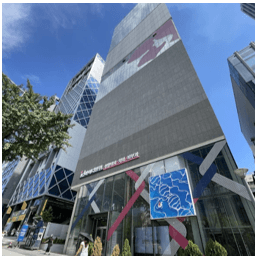
ID Hospital - Main Branch in Korea: Specializing in Safe & Customized Facial Plastic Surgery and Post-Care Services
Sinsa

Club Miz Lamiche Clinic: Leading Korean Aesthetic Medicine with Personalized 1:1 Treatments and Advanced 4D Skin Analysis Technology
Jamsil

Cheongdam Oracle Dermatology & Plastic Surgery Clinic in Korea: Offering Advanced Skin, Anti-Aging, Body Contouring Treatments and More
Seolleung