Medical Tourism Blog
Knee Whitening in Korea: Methods, Safety, Recovery, and Travel Planning

Table of contents
- Knee Whitening at a Glance
- What Is Knee Whitening?
- Who Is a Good Candidate for Knee Whitening?
- How Is Knee Whitening Performed?
- Why Visit Korea for Knee Whitening?
- Key Information for International Patients
- Which Are the Best Clinics in Korea for Knee Whitening?
- How Much Does Knee Whitening Cost in Korea?
- Knee Whitening From Start to Finish
- Alternatives to Knee Whitening
- How Can I Prepare for Knee Whitening?
- Aftercare Advice
Considering treatment in Korea? Everything you need to know e.g. — how to avoid scams, visas, interpreters, recovery tips — in our Medical Tourism Master Guide. Plan with confidence in minutes, not weeks!
Last updated: September 2026
Knee Whitening at a Glance
- What it is — Knee whitening is not one standardized procedure; it is dermatologic treatment for localized knee hyperpigmentation using trigger control, topical medicines, superficial peels, or conservative pigment laser.
- Listed cost — The listed Korea price is ₩30,000 per treatment, although the final quote depends on whether care involves a consultation, products, a peel, a laser session, a test spot, and one versus both knees.
- Best candidates — Suitable candidates have stable, localized darkening, intact calm skin, realistic expectations of gradual fading toward their natural surrounding skin tone, and can reduce kneeling, rubbing, scrubbing, and sun exposure.
- Recovery and results — Topical treatment has no procedural downtime but commonly takes 8–12 weeks or longer for visible fading; superficial peels may cause redness and scaling for 1–7 days, while laser can cause temporary redness or swelling.
- Pigment risk — Peels and lasers can worsen post-inflammatory hyperpigmentation or cause lighter patches, particularly in pigment-reactive skin; a conservative test area before treating both knees is often appropriate.
- Korea travel plan — Plan 3–5 days in Korea for an uncomplicated consultation, test spot, peel, or conservative laser session so the early reaction can be reviewed before departure, and obtain an English treatment record for home follow-up.
- Korea-specific limitation — Korea offers accessible outpatient dermatology and pigment devices, but no evidence shows that a Korean whitening package or laser-toning protocol is superior for dark knees; diagnosis and conservative settings matter more than the marketing label.
What Is Knee Whitening?
Knee whitening is a non-surgical dermatologic approach to treating localized darkening around the knees through cause control, topical products, superficial peels, or carefully selected laser treatment. It aims to fade excess pigment toward the surrounding natural skin tone while reducing triggers such as friction and inflammation. It is non-surgical; treatment is usually outpatient and tailored to the skin’s condition and pigment sensitivity.
Who Is a Good Candidate for Knee Whitening?
- Stable localized pigmentation — Good candidates have darkening confined to one or both knees, want the color brought closer to their surrounding natural skin tone, and accept gradual, partial improvement rather than an artificially lighter result.
- Identifiable friction or inflammation history — Repeated kneeling, rubbing from sports gear or clothing, prior eczema, psoriasis, injury, shaving irritation, or ingrown hairs can guide cause-directed treatment.
- Intact, calm skin — The treatment area should be free of open skin, sunburn, active rash, folliculitis, bacterial or fungal infection, and recent abrasion.
- Commitment to trigger control — Candidates must be able to reduce kneeling, friction, picking, harsh scrubs, and ultraviolet exposure during the treatment course.
- Pigment-risk planning — People with darker Fitzpatrick skin types or a history of post-inflammatory hyperpigmentation (PIH) need conservative settings, strict aftercare, and often a small test area before treating both knees.
Do not treat a new, rapidly spreading, widespread, velvety, markedly thickened, or otherwise unusual dark patch as a cosmetic issue before medical assessment. Acanthosis nigricans can be associated with insulin resistance, type 2 diabetes, hormonal conditions, medicines, and rarely malignancy. Defer peels and laser over active inflammation because irritation can intensify PIH. A dermatologist must individualize or postpone treatment for keloid tendency, poor wound healing, photosensitivity disorders, photosensitizing drugs, previous laser-induced darkening or light spots, and pregnancy, conception attempts, or breastfeeding; topical retinoids, hydroquinone, steroid combinations, and oral tranexamic acid require a medication-specific review.
How Is Knee Whitening Performed?
“Knee whitening” is a marketing term, not one standardized procedure. The correct method follows diagnosis, pigment depth, skin reactivity, and the practical ability to stop the trigger causing the darkening.
- Trigger control and barrier repair — Reduce kneeling and rubbing, stop abrasive exfoliation, use an emollient, and treat eczema, psoriasis, folliculitis, infection, or ingrown hairs first. This is central to preventing recurrent friction hyperpigmentation.
- Clinician-directed topical therapy — Azelaic acid, retinoids, hydroxy acids, niacinamide, cysteamine, or supervised hydroquinone can target pigment or skin-cell turnover. There is no procedural downtime, but visible fading commonly takes 8–12 weeks or longer.
- Superficial chemical peel — A clinician applies a controlled exfoliating agent to selected stable pigmentation. Redness, dryness, and scaling generally last about 1–7 days. Evidence from frictional dermal melanosis includes lactic-acid courses of 2–6 sessions, but involved sites included shins rather than defined knee-only cohorts, so it does not establish a best knee-peel formula or interval. The available peel evidence is indirect.
- Conservative pigment laser — Q-switched or picosecond approaches can be considered after assessment, especially when pigment appears deeper or topical care has not been sufficient. Warmth, redness, and mild swelling are common short-term effects; blistering, hypopigmentation, pigment rebound, and PIH are more consequential risks.
- Test treatment before bilateral laser — A small test area is sensible for pigment-reactive skin, previous PIH, or uncertain diagnosis. The closest relevant trial used three Q-switched Nd:YAG sessions at 2-week intervals for frictional dermal melanosis and found greater improvement with 1,064 nm than 532 nm through three months, but it was a small, diagnosis-specific study and not a validated knee protocol. Read the trial’s limitations and findings.
- Avoid systemic “whitening” injections — Injectable or systemic treatments are not appropriate routine care for isolated dark knees. The FDA has reported contamination-related concerns with compounded injectable glutathione products, so these injections should not be treated as a standard cosmetic knee treatment. FDA safety reminder on glutathione injectables.
Why Visit Korea for Knee Whitening?
Korea offers outpatient dermatology access for assessment, topical plans, superficial peels, and device-based pigment treatment. However, no evidence establishes a Korea-specific laser, peel, or “toning” protocol as superior for knee hyperpigmentation. Choose a clinic for diagnostic dermatology, conservative planning, and clear follow-up—not a generic whitening package.
- International-care infrastructure — Korea’s official Medical Korea platform provides a national entry point for overseas patients seeking Korean medical services.
- Appropriate access to common modalities — A dermatology consultation can distinguish whether a topical plan, superficial peel, or carefully selected pigment-targeting laser is appropriate rather than assuming every dark knee needs laser treatment.
- Documentation for continuity of care — Request an English record listing the diagnosis considered, photographs, products and active ingredients, peel agent or laser device, wavelength, settings, test-spot response, and written aftercare. This is especially important because knee-specific evidence is limited and treatment often continues at home.
- Evidence limitation — The broader PIH literature is dominated by acne-related, largely facial cases. In a systematic review, laser and energy treatment also worsened PIH in 2.6% of treated participants; these findings cannot be directly converted into a knee-treatment success rate. See the systematic review.
Key Information for International Patients
- Minimum stay — Plan 3–5 days for an uncomplicated consultation, test spot, topical plan, superficial peel, or conservative non-ablative laser session. This is cautious travel planning so the clinician can assess the early reaction, not an evidence-based mandatory stay.
- Repeat treatment — Topical care commonly needs 8–12 weeks or longer before visible fading. Peels and laser usually require reassessment and sometimes multiple sessions; do not book a fixed package before the diagnosis and test response are known.
- Flight timing — There is no published universal safe-to-fly interval after an uncomplicated knee peel or laser. CDC’s 7–10-day recommendation is specifically for laser or cosmetic procedures of the face, eyelids, or nose, not knees. Confirm departure timing with the treating clinician.
- Itinerary restrictions — Avoid sunbathing, swimming, strenuous exercise, repeated kneeling, and rubbing from tight clothing or sports equipment while the skin is irritated. A superficial peel can visibly scale for 1–7 days; a laser reaction can be prolonged by blistering or PIH.
- Remote follow-up — Arrange a home dermatologist or primary-care contact before travel, send agreed photographs if the Korean clinic requests them, and obtain the treatment record in English.
Travel note: CDC advises discussing medical-tourism plans with a clinician well before departure, coordinating care for complications in advance, and obtaining complete overseas records. Review CDC medical-tourism guidance.
Which Are the Best Clinics in Korea for Knee Whitening?
Listed below are some of the best clinics in Korea for knee whitening.
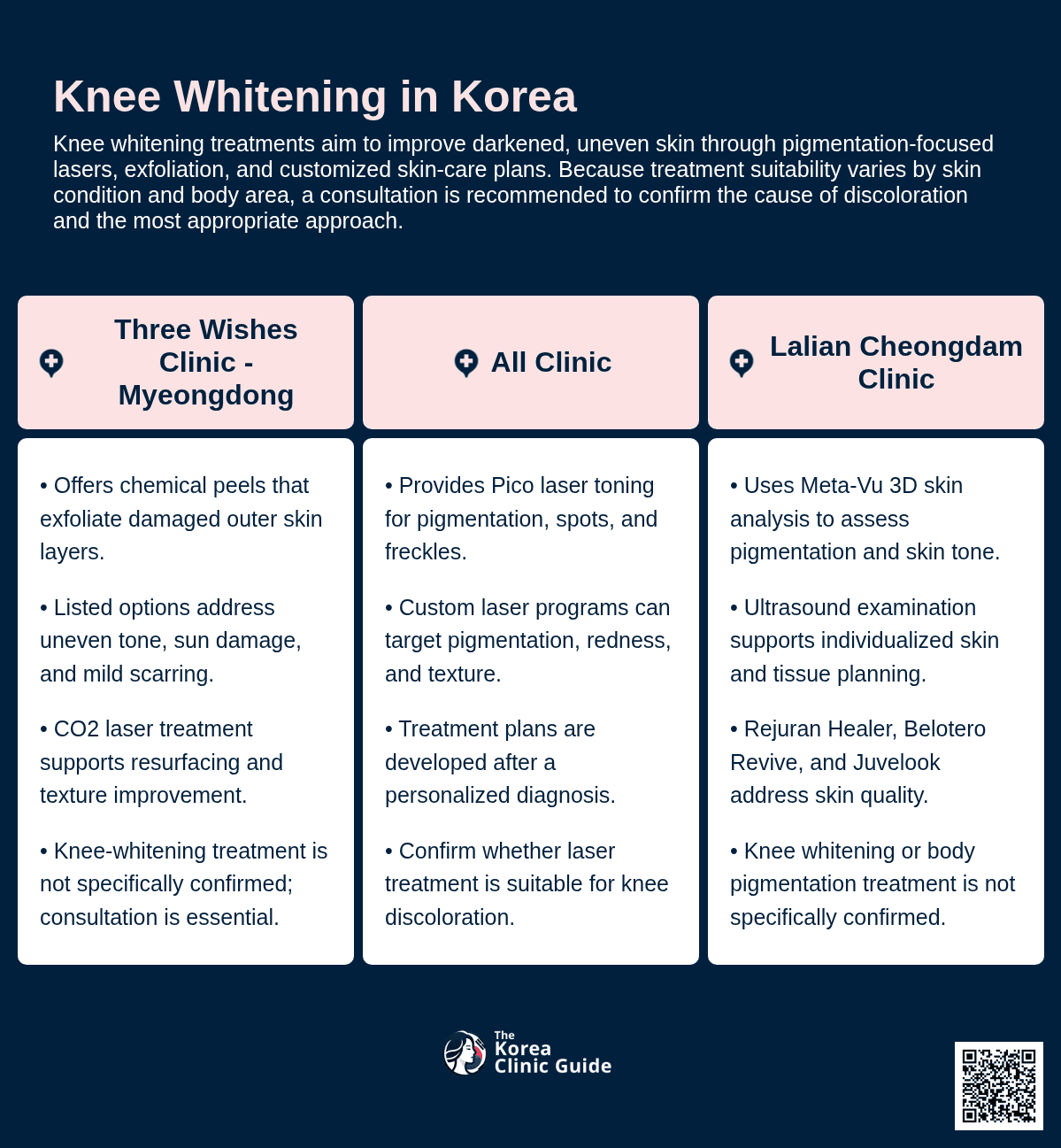
1. Three Wishes Clinic - Myeongdong
You may consider Three Wishes Clinic - Myeongdong if you want an aesthetic consultation that can review skin-quality concerns, but the available information does not specifically confirm a knee-whitening treatment. Its listed options are primarily facial and general skin treatments, so you would need to clarify whether treatment is suitable for knee pigmentation and what approach may be used.
- URL: Three Wishes Clinic - Myeongdong Website
- Location: Jung-gu, Seoul
- Relevant skin options:
- Chemical peels are listed for exfoliating damaged outer skin layers and addressing uneven tone, sun damage, fine lines, and mild scarring.
- CO2 laser treatment is listed for skin resurfacing, texture improvement, wrinkles, and acne scars.
- Customized skin care treatments include cleansing, hydration, and maintenance-focused care.
2. All Clinic
You may consider All Clinic for an assessment of knee discoloration because it lists Pico laser toning for pigmentation and a custom laser program for pigmentation and uneven skin concerns; however, the available information does not specifically state that knee whitening is offered. A consultation can determine whether your concern and treatment area fit its laser-based options.
- URL: All Clinic Website
- Location: Jung-gu, Seoul
- Pigmentation-focused options:
- Pico laser toning uses ultra-short pulses to target pigmentation such as spots and freckles and to brighten overall tone with minimal downtime.
- A custom laser program can address pigmentation, redness, and texture through a sequenced, diagnosis-based plan.
- Planning considerations:
- The clinic describes personalized non-surgical aesthetic treatment by experienced medical staff.
- Its custom laser plans are developed after diagnosis, which may help determine appropriate devices, session sequencing, and settings for your skin concern.
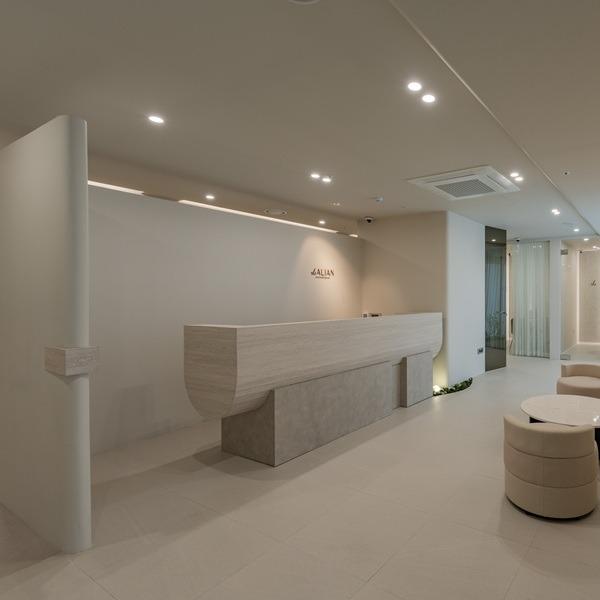
3. Lalian Cheongdam Clinic
You may consider Lalian Cheongdam Clinic if you want a personalized evaluation of skin condition before pursuing treatment for knee discoloration, although its available information does not confirm that it provides knee whitening or body pigmentation treatment. The clinic’s documented focus is on individualized dermatology and aesthetic planning, with diagnostic tools that assess pigmentation and skin tone.
- URL: Lalian Cheongdam Clinic Website
- Location: 2nd floor, Dosan-daero 59-gil, 9, Gangnam-gu, Seoul, South Korea
- Assessment and planning:
- 3D skin analysis with Meta-Vu assesses pores, wrinkles, pigmentation, and overall skin tone and can help track changes over time.
- Ultrasound examination evaluates soft-tissue layers such as fat and muscle depth to support individualized treatment planning.
- Listed skin-quality treatments:
- Rejuran Healer is listed as a polynucleotide skin-repair injection for skin regeneration, texture, fine lines, pores, and resilience.
- Belotero Revive is a hydrating skin booster for dryness, dullness, and texture concerns.
- Juvelook is a collagen-stimulating injectable aimed at gradual improvement in pores, fine lines, and uneven texture.
How Much Does Knee Whitening Cost in Korea?
Knee Whitening is listed at ₩30,000 (approximately US$0). Individual quotes vary because “knee whitening” can mean topical management, a superficial peel, or a conservative pigment-laser session, each requiring different clinical resources.
| Procedure Price | Korean Won (₩) | USD ($) |
|---|---|---|
| Low Price | ₩30,000 | $0 |
| High Price | ₩30,000 | $0 |
Exchange rate as of 2026-09-06: 1 KRW = 0.000741 USD.
What Affects the Price?
- Treatment method — A clinician-selected topical plan, superficial chemical peel, and pigment-targeting Q-switched or picosecond laser are distinct treatments. A laser session requires device use, parameter selection, and monitoring for pigment reactions, while a peel requires selection of an appropriate peeling agent and intensity for friction-prone knee skin.
- Treatment area and course of sessions — Treating one knee versus both knees increases the skin area treated and the time required. A course of peels or laser sessions also uses repeated treatment visits; related frictional-melanosis studies used 2–6 peel sessions or three laser sessions rather than establishing a single universal treatment.
- Test treatment and pigment-risk precautions — For darker or pigment-reactive skin, or a history of post-inflammatory hyperpigmentation, a small test area and conservative laser or peel settings require additional assessment and early-reaction review before broader bilateral treatment.
Cost tip: Request an itemized quote stating what is included, particularly the consultation, test spot if advised, treatment method, whether one or both knees are covered, and planned follow-up.
The US$0 conversion is approximate, based on the exchange rate dated 2026-09-06, and should be checked again when budgeting.
Knee Whitening From Start to Finish
- Remote inquiry and consultation — Send clear photographs in natural light, a history of onset and triggers, current skincare, allergies, medication list, previous pigmentation treatments, and any history of eczema, psoriasis, keloids, poor healing, or PIH. Confirm English-language or virtual consultation availability directly with the clinic.
- In-person dermatology assessment — The clinician examines both knees and surrounding skin, asks about friction, kneeling, injury, shaving, rash, infection, medicines, sun exposure, and metabolic symptoms, and decides whether the patch needs medical investigation rather than cosmetic treatment.
- Plan selection and consent — The clinician explains whether trigger control, topical therapy, a superficial peel, laser, or a combination is justified. Discuss the realistic target—fading toward the surrounding skin tone—and the risks of uneven darkening, lightening, blistering, and recurrence.
- Test spot when indicated — For laser or a stronger peel, especially in pigment-prone skin or after previous PIH, a small area can be treated first. Delay broader treatment until the reaction has been reviewed.
- Treatment visit — Routine topical planning, superficial peeling, and conservative non-ablative laser are outpatient treatments and normally need no fasting, sedation, driver, companion, or overnight stay. The clinician cleans the knees, protects adjacent skin, and applies the peel or delivers the selected laser passes; treatment intensity follows the diagnosis and test response rather than a fixed “whitening” setting.
- Immediate recovery review — Staff provide written instructions and assess redness, warmth, swelling, or discomfort before discharge. Expect no downtime from a topical plan, roughly 1–7 days of possible scaling after a superficial peel, and transient redness or swelling after conservative laser treatment.
- Early in-Korea check — Attend the planned review before departure, particularly after a test spot, peel, or laser. Report blistering, increasing pain, or rapidly worsening darkening rather than booking another session.
- Overseas follow-up — Continue only the prescribed products, send progress photographs when requested, and share the English treatment record with the clinician managing care at home. Reassess before any repeat peel or laser session.
Alternatives to Knee Whitening
The main tradeoff is between slower, lower-irritation management and faster procedural attempts that carry a greater risk of inflammation and PIH. Surgery has no meaningful role in routine localized knee hyperpigmentation unless a separate lesion requires surgical diagnosis or treatment.
Cause-directed dermatology care
- Best for — Darkening linked to eczema, psoriasis, folliculitis, fungal or bacterial infection, ingrown hairs, medication-related pigment, or suspected acanthosis nigricans.
- Tradeoff — Treating the cause protects against continued pigment production, but cosmetic fading is not immediate and an underlying metabolic or inflammatory condition needs ongoing care.
Topical pigment treatment
- Best for — Stable, superficial-appearing pigmentation where the skin barrier is intact and a gradual course is acceptable.
- Tradeoff — Azelaic acid, retinoids, niacinamide, cysteamine, hydroxy acids, or supervised hydroquinone avoid procedural downtime but require consistent use and can irritate skin when overused. See pigmentation treatment.
Superficial chemical peel
- Best for — Selected friction-related pigmentation after trigger control and barrier recovery.
- Tradeoff — A peel can provide more controlled exfoliation than home acids, but redness and scaling can last 1–7 days and excessive intensity can cause PIH. See chemical peeling.
Conservative laser treatment
- Best for — Carefully assessed pigmentation that has not responded adequately to cause control and topical care, particularly when a test spot supports proceeding.
- Tradeoff — Q-switched Nd:YAG or picosecond laser approaches can target pigment, but parameters are not standardized for knees and the risk of PIH or light spots requires conservative treatment. See laser toning or pico toning.
Camouflage cosmetics
- Best for — Immediate temporary color correction for an event or travel period without provoking an active pigment reaction.
- Tradeoff — It does not treat the cause or remove pigment, but avoids the healing period and pigment risks of a peel or laser.
How Can I Prepare for Knee Whitening?
- Medical assessment first — Seek assessment before booking treatment for new, fast-changing, widespread, velvety, thickened, itchy, painful, or inflamed pigmentation. Bring prior dermatology records and laboratory results relevant to insulin resistance, diabetes, hormonal conditions, or inflammatory skin disease.
- Medication and supplement disclosure — Provide every prescription, over-the-counter medicine, topical product, supplement, and prior procedure to the clinician. Do not self-start or stop hydroquinone, retinoids, steroid-containing creams, or oral tranexamic acid; the treating doctor determines whether and when to pause active products.
- Sun and irritation control — Avoid tanning, sunburn, harsh scrubs, loofahs, home peels, waxing, shaving across irritated skin, and recent abrasion before treatment. A peel or laser on inflamed skin increases PIH risk.
- Friction reduction — Stop repeated kneeling where possible and bring loose trousers or skirts that do not rub the treated knees. Plan alternatives to kneeling exercise, floor work, and tight sports gear during recovery.
- Photographs and test spot — Take baseline photos in consistent lighting. Ask whether a test area is appropriate before bilateral peel or laser treatment, particularly after prior PIH, hypopigmentation, or laser complications.
- Travel logistics — Book flexible flights and accommodation for 3–5 days, avoid pool or beach plans, and arrange access to a clinician at home if a reaction develops. Routine treatment does not normally require fasting, sedation, a driver, or a companion.
Travel note: Ask for the planned diagnosis, treatment method, aftercare, and flight advice in writing before committing to travel.
Confirm the clinic’s exact product-stop period, arrival instructions, and test-spot policy; the treating doctor’s individualized requirements take precedence over general guidance.
Aftercare Advice
Protect the healing skin from friction, inflammation, and ultraviolet exposure; these steps are as important as the procedure itself for limiting rebound pigmentation.
- Barrier care — Apply bland moisturizer or the clinician-prescribed product exactly as directed. Do not pick peeling skin, scrub, use exfoliating gloves, or restart retinoids, acids, bleaching agents, or other active products until the clinician confirms barrier recovery.
- Friction and activity — Wear loose clothing, avoid repeated kneeling and rubbing from sports gear, and postpone strenuous exercise that causes direct knee friction while redness, tenderness, or scaling remains.
- Heat, water, and hair removal — Avoid hot baths, saunas, swimming, and waxing or shaving across irritated knees until the skin has settled. Follow the clinic’s specific restriction period after a peel or laser.
- Sun protection — Cover the knees when practical and apply broad-spectrum SPF 50 to exposed, intact skin. Reapply during outdoor exposure; tanning can worsen or re-trigger hyperpigmentation.
- Warning signs and follow-up — Contact the clinic promptly for increasing pain, spreading redness or warmth, marked swelling, extensive blistering, pus or drainage, fever, red streaking, dark-gray wound change, allergic rash, or sharply lighter patches. Do not repeat a peel or laser until an adverse pigment change has been reviewed.
- Results — Topical care often needs 8–12 weeks or longer for visible fading. After peel or laser, judge improvement only after redness and scaling settle; the final trajectory depends on pigment depth, inflammation, friction control, and whether PIH develops.
Follow the treating doctor’s instructions over general advice and contact the clinic promptly when the treated skin appears wrong.
Frequently Asked Questions
Related Blogs

Dehydrated Lips Treatment with Hydro Injection in Korea: Effective Solutions for Moisturizing and Rejuvenation
Discover the benefits of Hydro Injection in Korea, a leading solution for dehydrated lips caused by cheilitis and related conditions. This minimally invasive procedure uses hyaluronic acid-based treatments to deeply hydrate, smooth, and rejuvenate lips, addressing issues such as chapped lips and fine lines. Korea’s advanced clinics offer expert care, streamlined processes, and cost-effective optio
Updated: Oct 3, 2026

Allergic Pigmentation Treatment with Pico Toning in Korea: Effective Solutions for Clear Skin
Discover how Pico Toning laser treatment in Korea effectively addresses Post-Inflammatory Hyperpigmentation (PIH), also known as allergic pigmentation or post-inflammatory brown spots. This advanced skin pigmentation procedure uses ultra-short pulses to break down melanin, making Korea a top destination for safe, affordable, and expert care. Learn about the treatment process, benefits, costs, and
Updated: Oct 3, 2026
Sallow Complexion Solutions: Skin Whitening Injection Treatment in Korea for Radiant Skin
Discover how Korea leads in medical tourism for skin whitening and treatment of sallow complexion. This blog explores causes like anemia and vitamin deficiencies, details Korea’s innovative skin whitening injections—featuring glutathione, vitamin C, and tranexamic acid—outlining procedures, costs, and patient experiences. Learn how Korea’s advanced clinics offer safe, effective treatments to brigh
Updated: Oct 2, 2026
Effective Korea PDRN Injection Treatments for New Stretch Marks
Discover how PDRN injections in Korea offer an advanced treatment for new stretch marks (striae rubrae). Known for stimulating collagen, elastin, and skin regeneration, Korea's expert clinics provide effective solutions for early-stage stretch marks. Benefit from cutting-edge techniques in medical tourism-friendly environments, with affordable costs and proven results. Learn how Korea’s PDRN tre
Updated: Oct 1, 2026