Medical Tourism Blog
Jaw Implants in Korea: Types, Recovery, Travel Planning, and Risks
Table of contents
- Jaw Implants at a Glance
- What Are Jaw Implants?
- Who Is a Good Candidate for Jaw Implants?
- What Are the Different Types of Jaw Implants?
- Why Visit Korea for Jaw Implants?
- Key Information for International Patients
- Which Are the Best Clinics in Korea for Jaw Implants?
- Jaw Implants From Start to Finish
- Alternatives to Jaw Implants
- How Can I Prepare for Jaw Implants?
- Aftercare Advice
Considering treatment in Korea? Everything you need to know e.g. — how to avoid scams, visas, interpreters, recovery tips — in our Medical Tourism Master Guide. Plan with confidence in minutes, not weeks!
Last updated: November 2026
Jaw Implants at a Glance
- What it changes — Jaw implants are solid devices placed over the mandibular angles or jaw body to add lower-face width, projection, definition, or symmetry; they do not move teeth, correct a bite, or treat TMJ disorder or sleep apnea.
- Custom versus stock — Stock implants can suit a localized, symmetric angle goal, while CT/CBCT-designed custom implants are often more appropriate for marked asymmetry, prior jaw surgery or bone reduction, trauma, revision cases, or a continuous wraparound jawline.
- Recovery timeline — Swelling and bruising commonly peak at 48–72 hours; desk work and light activity are often possible in 7–10 days, noticeable swelling may last 4–6 weeks, and the contour becomes more settled over several months.
- Long-lasting result — Implants are intended to provide durable structural augmentation rather than ongoing repeat treatments, but infection, malposition, chronic symptoms, dissatisfaction, or later facial change can require revision, removal, or replacement.
- Who is a candidate — Good candidates are adults with completed facial growth who want external jawline contour improvement and have realistic goals, stable oral health, and no untreated bite, chewing, airway, or major skeletal jaw-position problem.
- Korea travel planning — International patients should plan to remain in Korea about 10–14 days after surgery for in-person checks; return flights should be flexible, with surgeon clearance guiding timing rather than a prebooked itinerary.
- Korea-specific due diligence — Korea offers registered foreign-patient institutions and CT/CBCT-based custom implant workflows, but these do not prove better outcomes; verify the named surgeon, final implant plan, material, manufacturer, fixation method, and English-language device and operative records.
What Are Jaw Implants?
Jaw implants are solid devices placed over the lower jaw to increase width, projection, definition, or symmetry. They address a weak, narrow, uneven, or poorly defined jawline while leaving tooth position, bite alignment, and jaw function unchanged. Jaw implant placement is a surgical facial-contouring procedure.
Who Is a Good Candidate for Jaw Implants?
- Contour-focused candidates — Adults seeking more width, projection, definition, length, or improved symmetry at the mandibular angles or along the jaw body.
- Asymmetry or contour-defect candidates — People with a stable developmental asymmetry, prior trauma, previous bone reduction, or a post-surgical contour deficiency that can be addressed by external skeletal augmentation.
- Custom-design candidates — Patients with marked asymmetry, a complex wraparound jawline goal, or previous jaw surgery for whom CT/CBCT-based patient-specific planning is more suitable than a stock implant.
- Informed surgical candidates — People who understand that implants change external lower-face contour, not tooth position, bite mechanics, chewing function, temporomandibular disorder, or sleep apnea.
Elective jaw implants should be deferred until craniofacial growth is complete. Active dental, periodontal, oral, skin, or systemic infection requires treatment before implantation, since an implant-associated infection can require removal. Uncontrolled diabetes, immunosuppression, major bleeding disorders, substantial cardiopulmonary or anesthesia risk, and current nicotine exposure require individualized assessment, optimization, or can rule out elective surgery. Significant malocclusion, skeletal jaw-position discrepancy, functional chewing symptoms, or airway concerns require orthodontic, oral-maxillofacial, orthognathic, or sleep-medicine assessment instead of assuming an implant is the answer. Meaningful informed consent also requires realistic goals and communication in a language the patient fully understands.
What Are the Different Types of Jaw Implants?
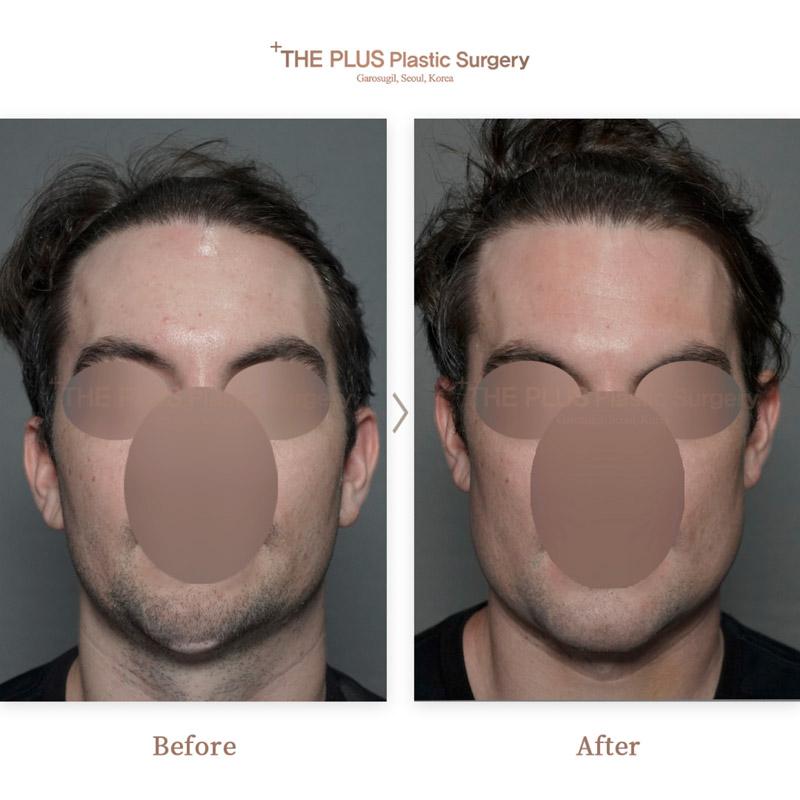
Jaw implants are solid alloplastic devices placed directly over the mandibular bone. “Jaw implants” usually refers to augmentation of the mandibular angles, jaw body, or a wraparound jawline; it is distinct from a central chin implant.
- Stock or preformed implants — Standard angle or mandibular-body shapes selected from available sizes and sometimes trimmed during surgery. These can suit a localized, relatively symmetrical contour goal; silicone and porous polyethylene are established facial-implant materials.
- Custom patient-specific implants — CT or cone-beam CT images are used for virtual planning and CAD/CAM manufacture. PEEK and titanium are reported custom-implant materials. A custom design is particularly relevant for asymmetry, prior bone reduction, trauma, revision surgery, or a continuous angle-to-body contour.
- Unilateral or asymmetric designs — Different implant volume or shape is designed for each side when one mandibular angle or body needs more correction than the other.
- Wraparound jaw implants — A larger custom implant can extend across the angle and mandibular body, sometimes toward the chin, to create a continuous lower-jaw contour. This is a more extensive operation than placing small angle implants.
- Combined lower-face augmentation — Jaw implants can be paired with a chin implant, face fat grafting, neck contouring, or, when indicated, skeletal jaw surgery. Each addition changes anesthesia, recovery, risks, and the required stay in Korea.
Evidence does not establish a universally superior custom-implant material. A 2026 review of 29 clinical studies covering 392 patients found pooled complication estimates of 6.94% for PEEK and 4.77% for titanium patient-specific facial implants, without a statistically significant between-material difference; the studies included mixed facial sites and reconstructive as well as aesthetic indications, so these figures are not a personal jaw-implant risk estimate. Read the systematic review and its limitations.
Why Visit Korea for Jaw Implants?
Korea offers a formal framework for registered institutions serving foreign patients and access to CT/CBCT-based virtual planning workflows. These features can be useful for custom or revision-oriented jaw implant cases, but they do not prove superior outcomes over other countries. Judge the named surgeon, implant plan, and complication-management arrangements rather than country-level marketing.
- International-patient protections — Korea’s foreign-patient framework requires information on diagnosis, treatment method, potential adverse effects, expected costs or contracts, and dispute-resolution processes. Use a registered institution or agency and verify its status through Medical Korea’s reliable-provider resources.
- Custom planning access — CT/CBCT imaging, virtual surgical planning, and CAD/CAM workflows are relevant when a patient needs a patient-specific implant for asymmetry, previous bony surgery, traumatic contour loss, or a wraparound design.
- Device-level documentation — Ask for the material, manufacturer, lot or device details, fixation plan, implant dimensions or design files where applicable, and the surgeon’s written approval of the final virtual plan. These records matter if revision or assessment is needed after returning home.
- Evidence limit — There is no reliable comparative evidence showing that jaw-implant outcomes in Korea are better than outcomes elsewhere. Published facial-implant complication research is highly heterogeneous across implant sites, materials, approaches, indications, and follow-up periods, as outlined in this 2026 review.
Key Information for International Patients
- Minimum stay — Plan for approximately 10–14 days in Korea after surgery, allowing early in-person checks of the incision, oral hygiene, swelling, sensation, and implant position. Complex custom wraparound implants, combined procedures, delayed healing, infection concern, or elevated clot risk can require a longer stay.
- Custom-planning timeline — A custom implant often requires CT/CBCT-based planning and manufacturing before surgery. Send prior scans, standardized photographs, medical history, dental history, medication and supplement lists, and prior operative records early; some cases need an earlier planning visit.
- Flight timing — Do not book a non-changeable return flight close to surgery. CDC cites American Society of Plastic Surgeons guidance to wait 7–10 days after facial cosmetic procedures before flying; this is general guidance, not a jaw-implant-specific trial, and the operating surgeon must provide the actual clearance date after examination. Review CDC medical-tourism guidance.
- Recovery and itinerary — Swelling and bruising are commonly most noticeable at 48–72 hours. Desk work and light activity are often possible in 7–10 days, but noticeable swelling can persist for 4–6 weeks and the more settled contour takes months. Do not schedule major tourism, nightlife, strenuous activity, or facial-trauma-risk activities during the early recovery period.
- Companion and accommodation — Arrange nearby accommodation and a responsible adult for discharge after sedation or general anesthesia. Do not plan to recover alone immediately after surgery.
- Records and remote follow-up — Before departure, obtain English copies of the operative report, anesthesia record, imaging, implant manufacturer/material/lot information, design dimensions or files where relevant, prescriptions, and discharge instructions. Arrange a local clinician willing to assess problems at home; CDC notes that complication care can be prolonged and may not be covered by insurance. Read CDC advice for medical tourists.
Travel note: Long-haul flights and recent surgery both contribute to venous-thromboembolism risk, especially with prior clots, obesity, estrogen therapy, pregnancy or recent postpartum status, cancer, limited mobility, or cardiopulmonary disease. Discuss individualized clot prevention and flight clearance with the surgeon and anesthetist.
Which Are the Best Clinics in Korea for Jaw Implants?
Listed below are some of the best clinics in Korea for jaw implants.
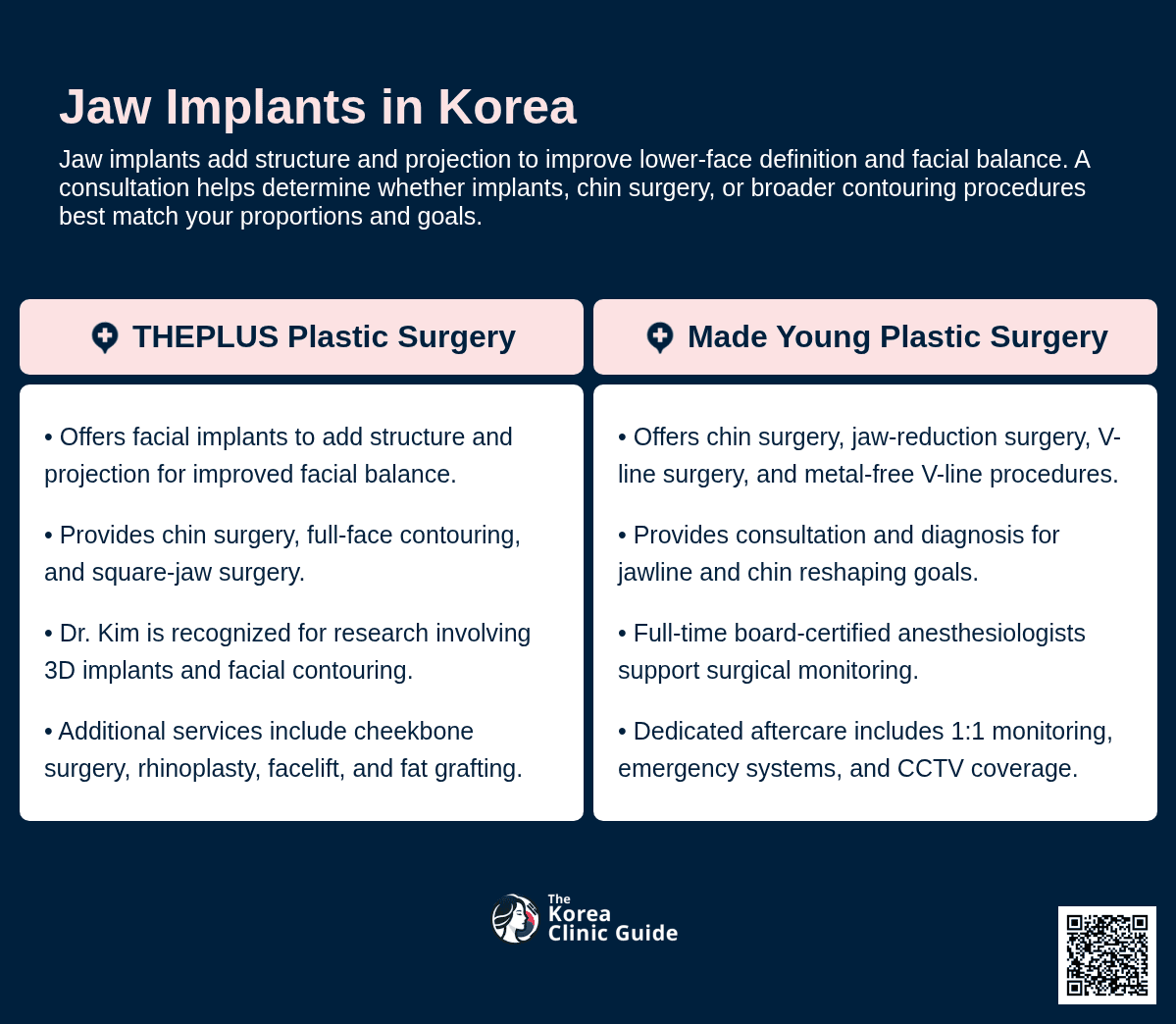
1. THEPLUS Plastic Surgery
For jaw implants, THE PLUS Plastic Surgery offers facial implants within its facial-contouring services, with an emphasis on adding projection where needed to improve facial balance and definition. Its approach to contouring is supported by Dr. Kim’s research recognition in 3D implants and focus on harmonious facial proportions.
- URL: THEPLUS Plastic Surgery Website
- Location: Gangnam-gu, Seoul
- Procedure focus:
- Facial implants are offered to add structure and projection to facial areas that need greater definition.
- Chin surgery is also available to adjust chin size or projection in relation to the nose, lips, and jawline.
- Full face contouring and square-jaw surgery are listed options when your goals involve broader lower-face or overall proportion changes.
- Relevant surgical expertise:
- Dr. Kim is a board-certified plastic surgeon with awards for research on 3D implants and expertise in facial contouring.
- Dr. Jeong is President of the Korean Society of Plastic Surgeons and emphasizes combining function with aesthetic considerations in his practice.
- Related services: Cheekbone surgery, rhinoplasty, facelift, thread lift, and facial fat grafting are also available for facial-balance and contouring plans.
2. Made Young Plastic Surgery
For a jawline-focused surgical consultation, Made Young Plastic Surgery offers facial-contouring options including chin surgery, jaw-reduction surgery, V-line surgery, and a metal-free V-line approach. Although the provided information does not specify jaw-implant techniques, you can expect direct consultation and diagnosis from the medical team before a procedure.
- URL: Made Young Plastic Surgery Website
- Location: Seocho-gu, Seoul
- Jawline and chin options:
- Chin surgery (genioplasty) is offered to enhance or reduce chin size and shape for improved facial proportion.
- Jaw-reduction surgery and V-line surgery are available for reshaping the jawline.
- Metal-free V-line surgery is described as a jawline-and-chin sculpting approach that does not use metal implants.
- Safety and monitoring:
- Full-time board-certified anesthesiologists are on site.
- A 1:1 monitoring system assigns one anesthesiologist to continuous monitoring during a procedure.
- The clinic describes a cross-check emergency system involving multiple anesthesiologists and CCTV coverage of procedures.
- Aftercare: A separate dedicated aftercare center provides systematic post-procedure care.
Jaw Implants From Start to Finish
- Remote inquiry and consultation — Submit standardized facial photographs, goals by anatomical area, medical and dental history, nicotine status, allergies, medicines, supplements, prior operative reports, and any CT/CBCT scans. Confirm whether English-speaking consultation or a qualified interpreter is available and whether the goal concerns angle width, jaw-body definition, chin projection, or asymmetry.
- Surgical assessment and imaging — The surgeon examines facial proportions, skin and soft-tissue coverage, occlusion, oral health, prior trauma or surgery, and symptoms involving chewing, TMJ function, airway, or sensation. CT or CBCT is commonly used for a custom implant or complex asymmetry; blood tests, pregnancy testing where relevant, ECG, and anesthesia or medical clearance depend on the planned anesthetic and health history.
- Design and consent — For a patient-specific implant, imaging is converted into a virtual plan. Confirm in writing the exact regions being augmented, stock versus custom rationale, material and manufacturer, whether screw fixation is planned, incision route, expected scars, and what happens if infection, malposition, or revision is required. A digital simulation is a planning tool, not a guarantee of final soft-tissue appearance.
- Preoperative coordination — The team confirms fasting, prescribed medication adjustments, transport, companion arrangements, and accommodation near the clinic. Treat dental pain, gum disease, mouth ulcers, drainage, or other suspected oral infection before elective intraoral surgery.
- Anesthesia and incision — Depending on implant extent and patient factors, surgery is performed under local anesthesia with sedation or general anesthesia. The incision is commonly inside the mouth, which avoids an external scar but requires careful oral hygiene during healing.
- Implant placement — The surgeon creates a subperiosteal pocket directly over the mandibular bone, inserts the preformed or custom implant, adjusts symmetry and contour, and may secure it with screws to reduce migration. Intraoral incisions are generally closed with absorbable sutures.
- Immediate recovery and discharge — Many jaw-implant procedures are outpatient operations. Discharge follows stable vital signs, controlled pain and nausea, ability to drink, and confirmation that a responsible adult will accompany the patient after sedation or general anesthesia.
- Early postoperative reviews — Attend scheduled examinations in Korea to assess swelling, wound or oral-incision healing, sensation, implant position, hydration, diet tolerance, and any infection signs. The clinic will individualize pain control, antibiotics when prescribed, oral rinses, diet advancement, and activity progression.
- Overseas follow-up — Share requested photos and symptom updates with the operating team after returning home. Seek local urgent care promptly for fever, rapidly increasing or one-sided swelling, pus or bad taste, wound opening, sudden contour change, breathing or swallowing difficulty, chest pain, shortness of breath, or calf pain and swelling.
Alternatives to Jaw Implants
Jaw implants add structural external contour but do not reposition the jawbones or correct the bite. Non-surgical options are temporary or less structurally precise; skeletal procedures are more invasive but can address jaw position and function when an implant cannot.
Chin Implant
- Best suited to — Insufficient central chin projection rather than lack of width at the posterior jaw angles or mandibular body.
- Tradeoff — A chin implant changes the central lower face but does not create the same angle-to-body jawline width as mandibular implants. See chin implant.
Sliding Genioplasty
- Best suited to — Chin concerns requiring changes in forward projection, vertical height, or transverse position using the patient’s own bone.
- Tradeoff — More invasive than a chin implant and focused on the chin rather than posterior jaw width; it can be more versatile for complex chin deformity. See chin surgery.
Orthognathic Surgery
- Best suited to — Malocclusion, substantial skeletal discrepancy, jaw-position asymmetry, functional chewing concerns, or selected airway indications.
- Tradeoff — Orthodontics and jaw repositioning can correct function and skeletal relationships that implants cannot, but recovery and travel planning are substantially more demanding. See double jaw surgery.
Facial Fat Grafting
- Best suited to — Soft-tissue hollowing or mild contour imbalance where a sharply defined bony angle is not the main objective.
- Tradeoff — Uses autologous tissue but has variable retention and does not reliably reproduce the crisp structural definition of a mandibular implant. See face fat grafting.
Injectable Filler
- Best suited to — Temporary contour testing or small-volume lower-face enhancement without surgery.
- Tradeoff — Hyaluronic-acid filler is potentially dissolvable, but no filler creates the same fixed skeletal augmentation as an implant and injections have their own vascular and contour risks. See facial filler.
Masseter Reduction
- Best suited to — A lower face widened by masseter muscle bulk rather than deficient jawbone contour.
- Tradeoff — Botulinum toxin or surgical muscle-reduction approaches generally reduce lower-face width, the opposite direction from jaw implants. See masseter reduction.
How Can I Prepare for Jaw Implants?
- Medical disclosure — Provide every prescription medicine, over-the-counter product, injection, vitamin, herbal product, allergy, past operation, medical condition, dental issue, and nicotine exposure. Include cigarettes, vaping, heated tobacco, pouches, gum, and patches.
- Anticoagulants and antiplatelets — Do not independently stop warfarin, apixaban, rivaroxaban, clopidogrel, aspirin, or other blood-thinning treatment. The prescribing clinician, surgeon, and anesthetist must agree on a perioperative plan.
- Other medicines and supplements — Ask specifically about NSAIDs, aspirin-containing products, fish oil, vitamin E, herbal supplements, diabetes medicines, steroids, seizure medicines, and psychiatric medicines. Some products affect bleeding, fasting, glucose control, or anesthesia, but the correct stop or continuation period is individualized.
- Dental and oral health — Report toothache, gum bleeding, periodontal disease, mouth ulcers, cold sores, drainage, or recent dental treatment. Resolve active oral infection before an elective intraoral implant procedure.
- Nicotine and alcohol — Stop nicotine according to the operating surgeon’s protocol because nicotine impairs healing. Avoid alcohol for the interval directed before surgery and throughout use of opioids, sedatives, or any medicine for which alcohol is unsafe.
- Fasting — Follow the anesthetist’s written fasting instructions exactly. Do not assume a standard fasting schedule applies to diabetes medicines, GLP-1 drugs, or other individual health circumstances.
- Travel arrangements — Book flexible flights, remain close to the clinic for postoperative reviews, secure accommodation with easy access to soft food and pharmacy services, and arrange a recovery companion after anesthesia.
- Records and planning — Bring identification, imaging, prior operative records, medication list, contact details for home clinicians, and copies of the final implant plan when supplied. Confirm what English-language records will be provided before leaving Korea.
Travel note: Keep the first 10–14 postoperative days free of long-distance transfers and fixed sightseeing commitments. The surgeon’s examination—not a pre-booked flight—determines when long-haul travel is appropriate.
Confirm all clinic-specific fasting, medication, nicotine, oral-hygiene, and arrival requirements with the treating doctor; individualized instructions take precedence over general guidance.
Aftercare Advice
Protect the implant position, keep the incision or oral wound clean, and treat a sudden change in swelling, pain, sensation, or breathing as a reason to contact the surgical team promptly.
- Swelling and head position — Expect swelling and bruising to be most evident during the first 48–72 hours. Keep the head elevated as directed and use cold compresses only according to the surgeon’s instructions; do not place pressure directly on the implant area.
- Diet and oral hygiene — With an intraoral incision, follow the prescribed soft or non-chewy diet, commonly for about one week, and advance texture only when cleared. Use any prescribed mouth rinse, such as chlorhexidine, exactly as directed and maintain careful oral hygiene.
- Activity and contact — Walk lightly when medically appropriate, but avoid heavy lifting, strenuous exercise, vigorous chewing, facial massage, impact risk, and contact sports for about four weeks or until cleared. Do not manipulate the jawline in an attempt to alter implant position.
- Medicines and nicotine — Take prescribed pain relief, antibiotics, and other medicines exactly as directed. Avoid alcohol with incompatible medication and do not restart nicotine until the operating surgeon approves it.
- Warning signs — Seek urgent assessment for fever; rapidly worsening or one-sided swelling; spreading redness; pus, drainage, or a bad taste; wound opening; escalating pain; persistent vomiting or dehydration; sudden contour change; new or worsening numbness or weakness; breathing or swallowing difficulty; calf pain or swelling; chest pain; or shortness of breath.
- Follow-up and results — Attend in-person checks before flying home and send requested photographs after departure. The contour is present immediately but obscured by swelling; early assessment takes weeks, visible swelling can remain for 4–6 weeks, and a more settled aesthetic result takes several months. Implants are intended as durable structural augmentation, yet infection, malposition, chronic symptoms, dissatisfaction, or later facial change can require revision, removal, or replacement.
Follow the treating doctor’s instructions over this general schedule and contact the clinic promptly when anything appears wrong.
Frequently Asked Questions
Related Blogs

Okay clinic - arms sagging after dieting
Discover how brachioplasty in Korea can help remove loose arm skin after major weight loss, creating a smoother and more toned appearance. Learn about the procedure, recovery, and why Korea is a popular destination for advanced body contouring after dieting.
Updated: Jun 8, 2026

Korean Dermatologist Reveals Their Exact Skincare Routine | Dr. Yeoun Korea
Discover a Korean dermatologist-approved skincare routine for sensitive, acne-prone skin, featuring gentle cleansing, barrier repair, and calming hydration. Learn how experts in Korea treat breakouts without irritation using effective ingredients and minimalist daily steps.
Updated: Apr 20, 2026

Korea Clinic Guide 2025: Complete Medical Tourism Master Guide (A–Z)
Updated: Oct 15, 2025

What Questions Should Foreigners Ask During an Online Consultation Before Plastic Surgery in Korea? (2025 Guide)
Updated: Oct 1, 2025