
Medical Tourism Blog
Hypertrophic Scar Treatment in Korea: Methods, Recovery, Travel Planning, and Results
Table of contents
- Hypertrophic Scar Treatment at a Glance
- What Is Hypertrophic Scar Treatment?
- Who Is a Good Candidate for Hypertrophic Scar Treatment?
- How Is Hypertrophic Scar Treatment Performed?
- Why Visit Korea for Hypertrophic Scar Treatment?
- Key Information for International Patients
- Which Are the Best Clinics in Korea for Hypertrophic Scar Treatment?
- Hypertrophic Scar Treatment From Start to Finish
- Alternatives to Hypertrophic Scar Treatment
- How Can I Prepare for Hypertrophic Scar Treatment?
- Aftercare Advice
Considering treatment in Korea? Everything you need to know e.g. — how to avoid scams, visas, interpreters, recovery tips — in our Medical Tourism Master Guide. Plan with confidence in minutes, not weeks!
Last updated: September 2026
Hypertrophic Scar Treatment at a Glance
- Individualized, multimodal care — Hypertrophic scar treatment is a staged plan—not one fixed procedure—using silicone or pressure therapy, steroid or 5-FU injections, vascular or fractional laser, rehabilitation, or surgery according to the scar’s redness, thickness, stiffness, symptoms, and effect on movement.
- Best candidates — Treatment is most relevant for a fully healed raised scar that stays firm, red, itchy, painful, thick, sensitive, or restrictive; scars crossing joints may need pressure, splinting, and range-of-motion rehabilitation, while tethered or function-limiting scars may need reconstruction.
- Gradual, not scar-erasing — The goal is a flatter, softer, less symptomatic and more functional scar rather than scar-free skin: silicone and pressure require daily use for months, while injections and laser usually require a series of sessions and surgical scars remodel over months.
- Downtime depends on method — Injections and vascular laser usually cause only short-lived soreness, swelling, bruising, or redness, whereas fractional ablative CO₂ or Er:YAG laser causes several days of redness, swelling, pinpoint oozing, and crusting; surgical revision follows an incision-healing timeline.
- Plan for repeat care and travel — A single Korea trip usually cannot complete serial injection or laser treatment: allow 2–4 days for office-based care, about 5–7 days after ablative laser, and roughly 10–14 days or longer after surgery, with follow-up arranged at home before travel.
- Important diagnostic and safety limit — Do not treat an open, infected, ulcerated, rapidly changing, bleeding, severely painful, recurrent, or wound-edge–extending lesion as an ordinary hypertrophic scar until it has been clinically assessed, sometimes with biopsy; laser and surgery also carry pigment-change and healing risks.
- Korea-specific practical safeguard — For care in Korea, verify that the institution is registered to serve foreign patients through Medical Korea and obtain English records of the diagnosis, scar photographs, laser settings, injected drug concentration and dose, and follow-up plan; registration and malpractice insurance are safeguards, not proof of superior outcomes.
What Is Hypertrophic Scar Treatment?
Hypertrophic scar treatment is individualized care for raised scars that remain thick, red, firm, itchy, painful, or tight after a wound heals. It aims to make the scar flatter, softer, less noticeable or uncomfortable, and less restrictive of movement, rather than erase it completely. Treatment can be non-surgical, minimally invasive, or surgical, depending on the scar and its effects.
Who Is a Good Candidate for Hypertrophic Scar Treatment?
- Raised, symptomatic scars — Suitable candidates have a firm, elevated scar that remains red, itchy, painful, thick, or sensitive after the original wound has closed.
- Texture or stiffness concerns — Fractional laser or intralesional treatment can be considered for scars with thickness, uneven texture, reduced pliability, or persistent symptoms.
- Burn and joint scars — Pressure therapy, splinting, range-of-motion rehabilitation, and reconstructive surgery are particularly relevant when a burn scar crosses a joint or restricts movement.
- Mature linear scars under tension — Scar revision can be appropriate when a stable linear scar remains painful, tethered, widened, or function-limiting despite conservative treatment.
Treatment is unsuitable until an open wound, infection, unexplained ulceration, or delayed healing has been assessed and controlled. A lesion that is rapidly changing, bleeding, severely painful, recurrent, or extending beyond the original wound needs diagnostic review, sometimes including biopsy, rather than automatic scar treatment. Skin-pigment history, scar cause and age, body location, tension across the scar, prior excessive scarring, diabetes, immunosuppression, circulation, and nicotine exposure all affect the treatment plan. Children and adolescents require a clinician to account for ongoing growth, especially for scars across joints or near mobile anatomical areas. No method guarantees scar-free skin; the realistic aim is a flatter, softer, less symptomatic and more functional scar.
How Is Hypertrophic Scar Treatment Performed?
Hypertrophic scar treatment is a staged plan rather than one fixed procedure. The clinician selects treatment according to redness, thickness, stiffness, symptoms, scar maturity, body site, movement restriction, and pigment-change risk.
- Silicone gel, sheets, and paper tape — Silicone is a noninvasive option for a fully closed wound or active raised scar. Sheets suit flatter areas needing prolonged daily contact; gel is often more practical on the face, neck, joints, and curved areas. Consistent use is required for months.
- Pressure therapy and rehabilitation — Custom garments are most relevant for extensive burn scars, grafted skin, and scars requiring rehabilitation. Massage, splinting, and range-of-motion therapy can be essential for a scar crossing a joint.
- Intralesional medication — Triamcinolone acetonide is injected directly into a persistent thick, itchy, or painful scar; some clinicians combine it with 5-fluorouracil (5-FU). Sessions are usually repeated. Ask for the drug name, concentration, total dose, interval, and planned session number because steroid placed outside the scar can cause skin or fat atrophy, visible vessels, ulceration, and pigment change.
- Vascular laser — Pulsed-dye laser targets prominent redness and vascularity and is often combined with silicone or injections. A systematic review of 34 adult randomized trials supported pulsed-dye laser as one evidence-based option but found no universal treatment approach.
- Fractional ablative laser — Fractional CO₂ or Er:YAG laser creates controlled microscopic columns in scar tissue to improve texture, thickness, pliability, itch, pain, and sometimes tightness. A randomized-trial review found clinical appearance improved with fractional CO₂ laser, but follow-up was short and stronger long-term trials are needed.
- Cryotherapy-assisted treatment — Cryotherapy can be an adjunct for a small, thick scar, sometimes before injection. Pain, blistering, delayed healing, and pigment change require particular discussion for pigment-prone skin.
- Surgical revision and reconstruction — Excision with layered tension-reducing closure, Z-plasty, local flaps, grafting, or contracture release addresses a tethered, painful, or function-limiting scar. Surgery creates a new wound and usually needs a recurrence-prevention plan rather than excision alone.
Why Visit Korea for Hypertrophic Scar Treatment?
Korea can be a practical destination when a patient needs in-person assessment and access to conservative, laser-based, injection-based, or reconstructive scar care. It is not possible to claim that hypertrophic-scar outcomes are better in Korea than elsewhere: direct country-to-country outcome evidence is lacking. Choose the treatment plan and follow-up structure, not the destination alone.
- Foreign-patient registration framework — Verify that the institution is registered to serve foreign patients through Medical Korea’s registered-institution system. Registered institutions have been required to subscribe to medical-malpractice liability insurance since 2016; this is an administrative safeguard, not proof of superior results from a clinician or device.
- Multimodal planning — Scar management can combine silicone, pressure and rehabilitation, triamcinolone or 5-FU injection, vascular laser, fractional CO₂/Er:YAG laser, and reconstruction. This matters because trial evidence supports several options, while no single treatment fits every hypertrophic scar.
- Documented technical details — Request English records of the diagnosis, scar score such as Vancouver Scar Scale or POSAS where used, standardized photographs, laser device and settings, injected drug concentration and total dose, and follow-up plan. These details allow a clinician at home to continue serial care safely.
- Evidence limits — Fractional CO₂ laser plus triamcinolone has encouraging comparative evidence, but the 2026 meta-analysis included 19 randomized trials and 1,775 participants entirely from China, with methodological limitations. It does not establish a best Korean protocol or predict results across all skin types.
Key Information for International Patients
- Minimum stay — Allow 2–4 days for consultation plus silicone or pressure planning, steroid injection, or non-ablative/vascular laser when the clinician does not require an early review. Plan about 5–7 days after ablative fractional CO₂ or Er:YAG laser to support an early-healing assessment. Excision, Z-plasty, grafting, flap reconstruction, or contracture release generally needs 10–14 days or longer for wound review, possible suture removal, and surgeon clearance.
- Repeat treatment — Silicone and pressure treatment require months of daily adherence. Injections and laser are commonly staged, so a full course cannot usually be completed during one trip. Arrange named follow-up care at home before booking travel.
- Flight timing — There is no universal evidence-based flying rule for scar injection, laser, or revision surgery. Base travel clearance on wound closure, infection risk, pain control, anesthetic exposure, and the need for in-person care.
- Itinerary impact — Injections and vascular laser usually permit light sightseeing, with short-lived soreness, swelling, bruising, or redness. Ablative laser causes several days of redness, swelling, pinpoint oozing, and crusting; surgical revision requires activity restriction and a wound-care-focused itinerary.
- Sedation and transport — A companion is generally unnecessary for silicone, injections, or laser under topical/local anesthetic. Arrange a companion and do not drive after oral or IV sedation or general anesthesia.
- Remote follow-up — Leave with English aftercare, generic medication names, procedure details, photographs, urgent-contact information, and instructions for sending follow-up images.
Travel note: Do not book a non-changeable return flight until the treated site has been examined. Do not fly with fever, escalating pain, spreading redness, active drainage, wound separation, uncontrolled bleeding, or a need for daily in-person wound care.
Which Are the Best Clinics in Korea for Hypertrophic Scar Treatment?
Listed below are some of the best clinics in Korea for hypertrophic scar treatment.
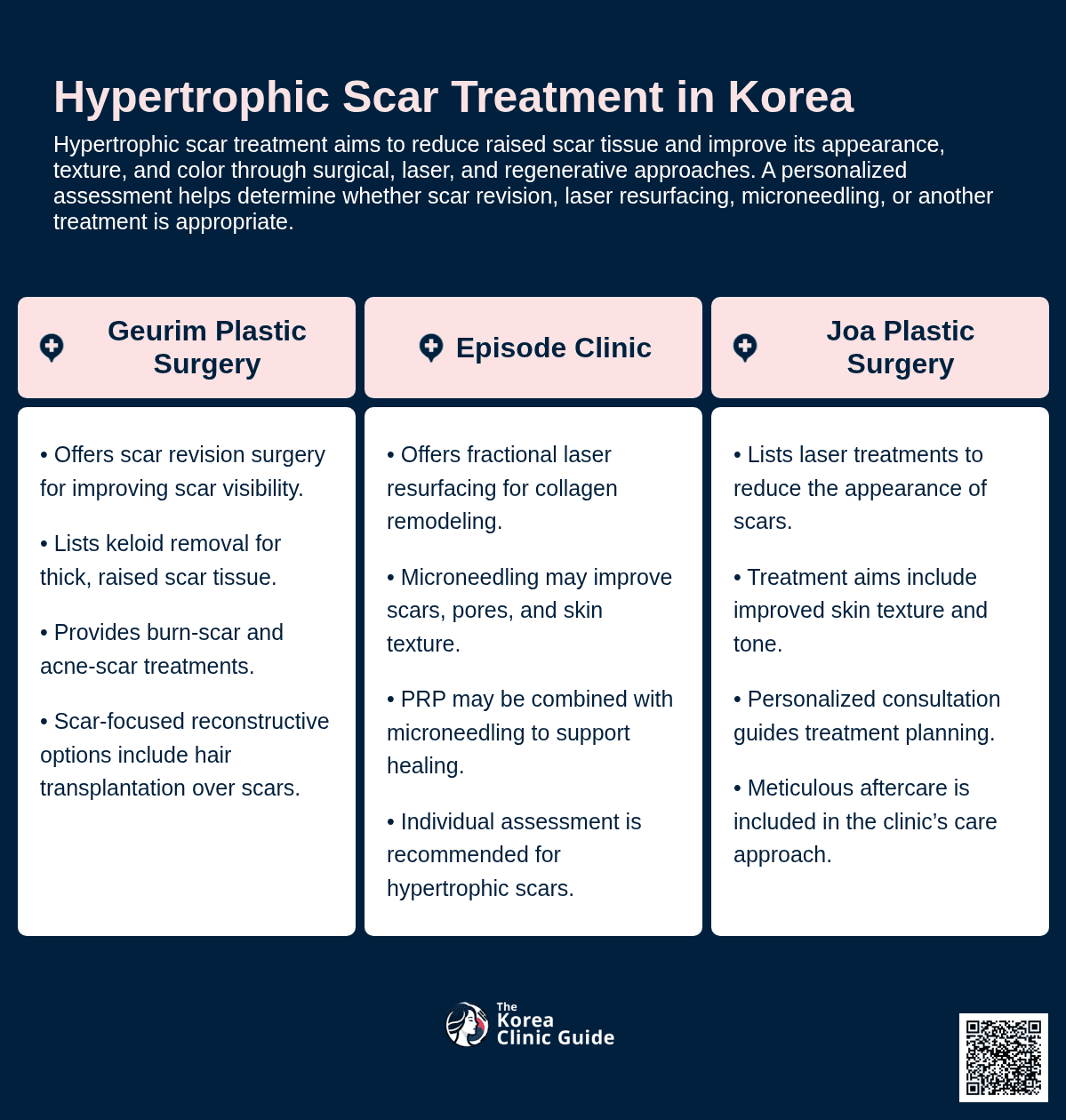
1. Geurim Plastic Surgery
You may consider Geurim Plastic Surgery if your hypertrophic scar needs a reconstructive scar-focused assessment, as its listed services include scar revision surgery, keloid removal, and burn-scar treatment alongside treatments for other scar types.
- URL: Geurim Plastic Surgery Website
- Location: Seoul
- Scar-focused services:
- Scar revision surgery is listed to improve the appearance or reduce the visibility of scars.
- Keloid removal is available for thick, raised, and potentially itchy scar tissue.
- Burn-scar treatment and acne-scar treatment are also listed.
- Additional reconstructive options:
- Hair transplantation on a scar is listed as an option to mask scar tissue in hair-bearing areas.
- The clinic also lists cleft lip and cleft palate surgery and foreign-body removal among its specialized procedures.
2. Episode Clinic
At Episode Clinic, you can expect a non-surgical aesthetic dermatology setting with fractional laser resurfacing listed for collagen remodeling and scar smoothing. Because the available information does not specifically name hypertrophic-scar protocols, you would need an individualized assessment to determine whether its laser-based approach fits your scar.
- URL: Episode Clinic Website
- Location: 3f, 336 Olympic-ro, Songpa District, Seoul, South Korea
- Scar and texture treatments:
- Fractional laser resurfacing creates controlled micro-injuries intended to remodel collagen and improve scars, wrinkles, texture, and tone.
- Microneedling is listed to stimulate collagen and improve scars, pores, and fine lines.
- PRP may be injected or used with microneedling to support healing and collagen production over a series of sessions.
- Related skin options:
- Pico laser is listed for pigmentation, acne marks, texture refinement, and pores.
- Chemical peels are available in light to medium depths depending on treatment goals and downtime.
3. Joa Plastic Surgery
You may consider Joa Plastic Surgery for a consultation about hypertrophic-scar treatment if you are looking for a plastic-surgery clinic that lists laser treatments to reduce the appearance of scars and improve skin texture and tone. The supplied information does not identify a specific hypertrophic-scar technique, so your consultation should clarify whether its laser options are appropriate for your scar.
- URL: Joa Plastic Surgery Website
- Location: Seocho-gu, Seoul
- Scar-related treatment:
- Laser treatments are listed to reduce the appearance of scars, pigmentation, and signs of aging.
- The stated aims of laser treatment include improved skin texture and tone.
- Care approach:
- The clinic describes personalized consultation and meticulous aftercare as part of its approach.
- Its broader surgical practice includes facial, body, breast, and nasal procedures.
Hypertrophic Scar Treatment From Start to Finish
- Remote screening — Send unfiltered photographs with a scale, the scar’s cause and date, symptoms, prior treatment, medication and allergy list, medical conditions, and any operative or pathology reports. Confirm whether English-language or virtual consultation is available. Remote review is screening, not a diagnosis.
- In-person assessment — The clinician confirms whether the lesion is hypertrophic scar tissue rather than keloid, infection, inflammatory disease, or another condition. Assessment covers height, redness, firmness, itch, pain, skin-pigment history, tension, and movement restriction.
- Plan and testing — Discuss treatment goals, expected staged sessions, pigment-change risk, recurrence risk, and recovery. Healthy adults do not usually need laboratory testing for simple office treatment; testing becomes relevant for surgery, sedation, suspected infection, pregnancy considerations, or significant medical conditions.
- Anesthesia and treatment — Silicone fitting requires no anesthesia. Laser commonly uses topical anesthetic; injection or surgery can use local anesthetic, while more extensive reconstruction can require sedation or general anesthesia. The clinician applies silicone or pressure planning, injects medication into the scar, performs vascular or fractional laser passes, or revises the scar surgically according to the agreed plan.
- Same-day recovery and discharge — Office treatments are typically outpatient. Surgical discharge depends on the extent of reconstruction and anesthetic used. Obtain a written record of the exact modality, laser settings where relevant, medication concentration and dose, photographs, prescriptions, and emergency contact route.
- Early review in Korea — Attend the wound check or laser-healing review scheduled by the treating clinician. Surgical patients may need dressing changes, drain care where applicable, and suture removal before travel clearance.
- Overseas follow-up — Continue silicone, pressure, rehabilitation, injection, or laser sessions with the agreed clinician at home. Send standardized photographs as requested and seek local assessment promptly for possible infection, wound opening, or concerning pigment change.
Alternatives to Hypertrophic Scar Treatment
Non-surgical options preserve the existing scar and are usually gradual and repeat-based; surgery can release tension or change scar direction but creates a new incision and carries recurrence risk. The best alternative depends on whether the main issue is redness, thickness, itch, stiffness, or contracture.
Silicone and Pressure Therapy
- Best suited to — A fully closed scar, early raised scarring, burn scars, grafted areas, or patients who need a noninvasive plan.
- Tradeoff — Requires daily use and professional garment monitoring for months; it does not immediately remove established thick tissue.
Steroid or 5-FU Injection
- Best suited to — Localized thick, itchy, or painful scars needing direct flattening treatment. See steroid injections for scars.
- Tradeoff — Requires repeat sessions and can cause pain, ulceration, pigment change, telangiectasia, and local skin or fat atrophy.
Vascular Laser
- Best suited to — A scar where redness and vascularity are more prominent than bulk. See V-Beam laser.
- Tradeoff — Usually requires several sessions and does not replace reconstruction for a tethered or movement-limiting scar.
Fractional CO₂ or Er:YAG Laser
- Best suited to — Textural irregularity, thickness, stiffness, and symptoms in an established scar. See CO₂ laser treatment or scar-removal laser treatment.
- Tradeoff — Ablative treatment involves open-surface healing, crusting, strict sun avoidance, and pigment-change risk. Optimal device settings and session protocols remain uncertain across studies.
Surgical Revision or Contracture Release
- Best suited to — A linear scar under tension, a tethered scar, or contracture that limits function after conservative care. See scar-removal surgery or burn scar treatment.
- Tradeoff — Recovery follows an incision-healing timeline, and postoperative silicone, taping, pressure, injection, or laser may still be needed to reduce recurrent raised scarring.
Keloid-Focused Assessment
- Best suited to — Scars extending beyond the original injury boundary or repeatedly recurring after treatment.
- Tradeoff — Keloids behave differently from hypertrophic scars and need a different recurrence-prevention strategy. See keloid injections or keloid removal.
How Can I Prepare for Hypertrophic Scar Treatment?
- Send complete records early — Provide scar photographs with a ruler, the cause and date of injury, prior treatment, operative or pathology reports, symptom history, and pigment-change history. Ask whether the scar needs examination or biopsy before treatment.
- Disclose medicines and supplements — List anticoagulants, antiplatelets, NSAIDs, corticosteroids, diabetes medicines, isotretinoin or other retinoids, herbal products, allergies, liver or kidney disease, immunosuppression, and anesthetic history. Do not stop a prescribed medicine unless the prescribing clinician approves the plan.
- Avoid nicotine — Stop smoking, vaping, and nicotine products when feasible before laser or surgery because nicotine impairs healing. Follow the surgeon’s exact cessation period for revision surgery.
- Protect from sun — Avoid tanning, sunburn, and intentional sun exposure before laser. Disclose bleaching products, retinoids, exfoliating acids, and any prior post-inflammatory hyperpigmentation.
- Prevent herpes recurrence — Report previous cold sores before facial or perioral laser. The clinician can decide whether antiviral prophylaxis is indicated.
- Follow fasting instructions — Fasting is generally unnecessary for silicone, injection, or topical-anesthetic laser visits. Follow the facility’s exact fasting and medication instructions for oral/IV sedation or general anesthesia.
- Plan practical support — Arrange accommodation close enough for wound reviews, reserve flexible flights, and organize a companion for sedation or surgery. Pack loose clothing that will not rub the treated area.
Travel note: Build extra days into the itinerary for wound checks, unexpected swelling, delayed surface healing after ablative laser, or surgeon-directed suture removal.
Confirm all clinic-specific preparation requirements with the treating doctor; individualized instructions take precedence over general guidance.
Aftercare Advice
Protect the healing scar and follow the exact plan for the treatment performed; picking, friction, unapproved skincare, and missed follow-up can compromise recovery.
- After injection — Keep the area clean and avoid rubbing or pressure as directed. Report blanching, blistering, ulceration, worsening pain, or expanding discoloration promptly.
- After ablative laser — Cleanse gently, apply the prescribed bland barrier ointment and non-stick dressing if ordered, and do not pick, scrub, or exfoliate crusts. Avoid pools, saunas, hot tubs, and heavy sweating until the surface has healed.
- Skincare and sun protection — Do not restart retinoids, acids, fragranced skincare, makeup, or bleaching agents until cleared. After re-epithelialization, use broad-spectrum SPF 50 and strict sun avoidance to reduce post-inflammatory pigment change.
- After surgical revision — Protect the incision from stretching, tension, heavy lifting, vigorous exercise, and rubbing until authorized. Start silicone, massage, pressure, or scar taping only when the incision is fully closed and the surgeon approves.
- Warning signs — Seek urgent in-person care for fever, escalating pain, spreading warmth or redness, pus, malodor, persistent drainage, wound opening, black or gray skin, extensive blistering, widespread rash, or breathing difficulty.
- Result timeline — Injection and laser results are gradual and typically require staged sessions. Silicone and pressure need months of daily adherence, while surgical scars continue remodeling for months. Residual redness or pigment change after laser can last longer than the initial crusting phase.
Follow the treating doctor’s instructions over general advice and contact the clinic promptly when the treated area appears wrong.
Frequently Asked Questions
Related Blogs
V Beam laser in Korea: candidacy, treatment process, recovery and travel planning
Vbeam is a 595-nm pulsed dye laser that targets superficial blood vessels for diffuse redness, red acne marks, telangiectasia, cherry angiomas, selected scars, and port-wine stains. The article explains candidacy, purpuric and non-purpuric treatment, recovery, travel timing in Korea, preparation, aftercare, risks, and follow-up.
Updated: Sep 20, 2026
Secret RF Microneedling in Korea: Candidacy, Recovery, Treatment Planning, and Travel
Secret RF microneedling uses sterile needle electrodes to deliver fractional RF heat for atrophic acne scars, texture, pores, fine lines, and mild laxity, often over 2–4 sessions spaced 4–8 weeks apart. International patients can find guidance on candidacy, travel timing, recovery, aftercare, warning signs, and remote follow-up for treatment in Korea.
Updated: Sep 20, 2026
Accusculp in Korea: Internal Laser Lipolysis, Recovery, Safety and Travel Planning
AccuSculpt is an internal 1444 nm laser procedure performed under tumescent local anesthesia, with aspiration added in some treatment plans for localized fat pockets. The article covers candidate screening, device verification, preparation, aftercare, warning signs, and planning 7–14 days in Korea with an early wound review before long-haul travel.
Updated: Sep 20, 2026
PicoSure in Korea: Uses, Recovery, Safety, and Travel Planning
PicoSure treatment can address selected benign pigment concerns, shallow acne scars, texture changes, fine lines, and tattoos through pigment, fractional, or tattoo-specific laser protocols. The article covers candidacy, preparation, recovery, travel planning for Korea, aftercare, repeat-session needs, and alternatives.
Updated: Sep 20, 2026
Clinics offering Hypertrophic Scar Treatment

DATENA CLINIC Korea | Personalized Dermatology, Lifting & Skin Rejuvenation in Seoul
Jamsil
Kangdong Sacred Heart Hospital
Gangdong

Flower Skin Clinic: Premier Dermatology and Advanced Aesthetic Care in Korea
Mokdong

Joa Plastic Surgery: Premier Aesthetic Procedures & Personalized Care in Korea
Sinnonhyeon Station