
Medical Tourism Blog
Collagen injection in Korea: types, safety, recovery, and travel planning
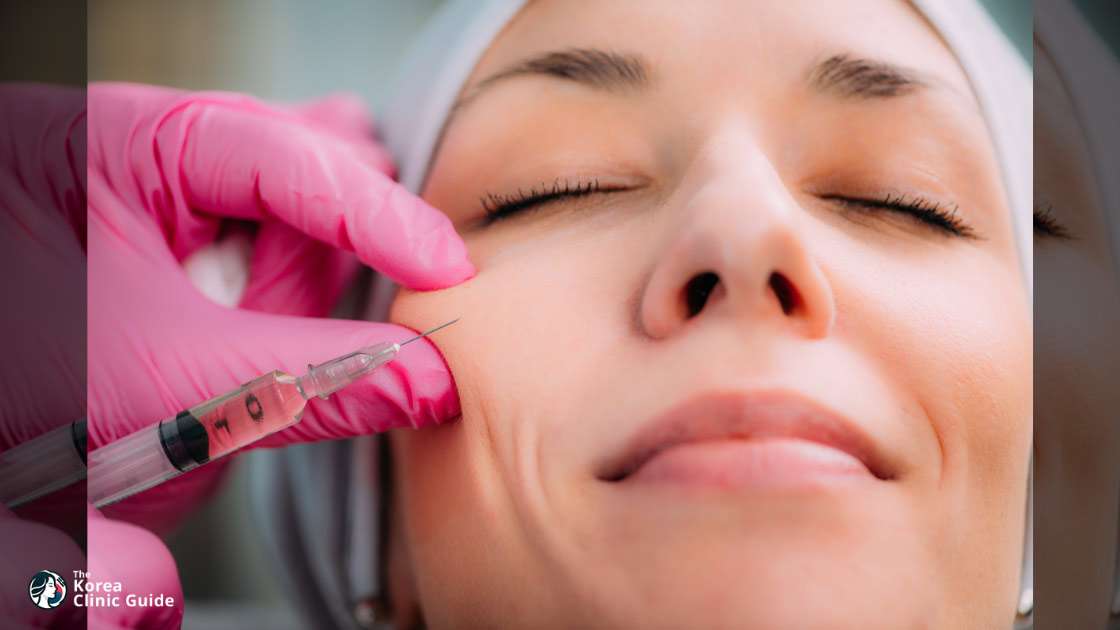
Table of contents
- Collagen injection at a Glance
- What Is a Collagen Injection?
- Who Is a Good Candidate for a Collagen Injection?
- What Are the Different Types of Collagen injection?
- Why Visit Korea for a Collagen Injection?
- Key Information for International Patients
- Which Are the Best Clinics in Korea for Collagen Injection?
- Collagen injection From Start to Finish
- Alternatives to a Collagen Injection
- How Can I Prepare for a Collagen Injection?
- Aftercare Advice
Considering treatment in Korea? Everything you need to know e.g. — how to avoid scams, visas, interpreters, recovery tips — in our Medical Tourism Master Guide. Plan with confidence in minutes, not weeks!
Last updated: September 2026
Collagen injection at a Glance
- What it treats — A direct collagen dermal filler temporarily fills small static wrinkles, nasolabial folds, shallow depressed scars, and localized facial volume deficits; it is not designed for broad lifting or body contouring.
- Results and longevity — Filling is visible immediately, but assess the settled result after 1–2 weeks as swelling resolves. Maintenance is commonly needed within about 3–12 months, and Korean nasolabial-fold research found improvement began to decline after roughly six months.
- Downtime — Most people resume light activities the same day, although redness, tenderness, swelling, bruising, or temporary unevenness are most noticeable for 24–72 hours; avoid strenuous exercise for 24–48 hours.
- Travel planning — International visitors should remain in Korea for at least 72 hours after treatment before flying, with access to urgent in-person care; an in-person review at 2–4 weeks is preferable, or a remote photo-follow-up plan should be arranged.
- Product-specific allergy rules — Collagen source matters: some bovine products require one or two allergy skin tests performed weeks before treatment, while a studied porcine collagen formula did not require testing under its own protocol; confirm the exact product’s current instructions.
- Key safety limitation — Collagen cannot be dissolved with hyaluronidase like hyaluronic-acid filler, so patients should confirm the clinic’s emergency pathway and seek immediate care for severe pain, pale or mottled skin, blistering, vision changes, or neurologic symptoms.
- Korea-specific check — Korean studies support porcine collagen filler mainly for nasolabial folds, not all facial areas; request the exact product name, manufacturer, lot number, expiry date, volume, and injection sites instead of relying on a generic “MFDS approved” claim.
What Is a Collagen Injection?
A collagen injection is a direct dermal filler treatment that places collagen beneath the skin to support localized depressions. It temporarily softens selected static wrinkles, folds, shallow scars, and small facial volume deficits for a smoother, more balanced appearance. It is a minimally invasive injectable procedure, usually performed in an outpatient setting.
Who Is a Good Candidate for a Collagen Injection?
- Localized facial concerns — Good candidates are adults seeking temporary correction of a small static wrinkle, nasolabial fold, shallow depressed scar, or limited contour deficit rather than broad lifting or body contouring.
- Realistic treatment goals — Direct injectable collagen filler provides immediate physical filling; assess the settled result after early swelling resolves, usually in 1–2 weeks.
- Appropriate diagnosis — Assessment should distinguish a volume deficit from movement-related lines, scar tethering, laxity, pigmentation, or texture. A collagen filler does not correct every cause of a visible line or depression.
- Informed product choice — Candidates should be prepared to confirm the exact collagen source, whether lidocaine is included, approved treatment area, required allergy precautions, and the fact that collagen is not dissolved with hyaluronidase as hyaluronic-acid (HA) filler is.
Avoid or postpone treatment with a known collagen, animal-source, lidocaine, or formulation-ingredient allergy; active acne cysts, dermatitis, herpes, dental/oral infection, or skin inflammation near the injection site; acute illness; pregnancy or breastfeeding; or use outside the product’s approved age range. Severe allergy or anaphylaxis history, autoimmune or connective-tissue disease, immune compromise, keloid history, bleeding disorders, and prescribed anticoagulant or antiplatelet treatment require individualized medical review. Some bovine collagen products require allergy testing weeks before treatment, making them poorly suited to a short visit. Direct facial collagen filler is not appropriate for large-volume body contouring or injection into the breast, buttock, muscle, tendon, ligament, or bone.
What Are the Different Types of Collagen injection?
Direct collagen fillers differ by source and material processing. Do not treat the category name “collagen injection” as a product identity: the source, cross-linking, injection plane, allergy protocol, approved indication, and expected persistence are formulation-specific.
- Bovine collagen — Bovine collagen injections have historically required pre-treatment skin testing because hypersensitivity occurred in about 3–3.5% of patients in the Korean comparative literature. Protocols can involve two tests six and two weeks before full treatment, which is impractical for most single-trip visitors.
- Porcine collagen — Processing can reduce antigenicity. In a Korean nasolabial-fold study, the studied 3% porcine type-I collagen with 0.3% lidocaine did not require skin testing under that product’s protocol; this does not establish the same rule for every porcine product. A 2024 multicenter trial reported nasolabial-fold improvement through 52 weeks with two porcine collagen fillers containing lidocaine.
- Human-derived or recombinant-human collagen — These formulations avoid animal sourcing but still need product-specific review of ingredients, allergy precautions, permitted use, durability, and evidence.
- Cross-linked or non-cross-linked collagen — Cross-linking changes handling and persistence. It does not make products interchangeable, so the manufacturer’s current instructions for use should govern planning and aftercare.
Why Visit Korea for a Collagen Injection?
Korea has published direct-collagen research, including clinical work on porcine collagen filler for nasolabial folds. This supports access to clinicians familiar with this material category, but it does not establish that every Korean product or clinic has superior outcomes. Product identity, injector technique, anatomy, sterile practice, and emergency response remain decisive.
- Korean clinical research — A Korean randomized split-face study of 61 adults found a porcine type-I collagen filler non-inferior to bovine collagen for nasolabial folds through 12 months, while improvement declined after about six months. The evidence is strongest for nasolabial folds, not broad facial lifting or high-risk facial sites.
- Documentable device records — Korea’s MFDS device lifecycle and identification system is designed to track product information, adverse events, recalls, and disposal. Ask for the exact product name, manufacturer, lot number, expiry date, amount used, and injection sites rather than accepting a generic “MFDS approved” claim.
- Evidence-based comparison discussion — A recent randomized collagen-versus-HA trial found both materials improved nasolabial folds initially and at three months, while HA had significantly better improvement at six months. This is useful for expectation-setting, but it was conducted outside Korea and does not prove results in lips, nose, tear troughs, forehead, or body areas.
Key Information for International Patients
- Minimum stay — Plan to remain in Korea for at least four days after injection: treatment day plus a cautious 72-hour local observation period with access to urgent care. This is risk management, not an aviation prohibition.
- Flight planning — Do not schedule an international departure immediately after treatment. Stay reachable locally because vascular compromise, serious allergy, infection, and evolving swelling need prompt in-person assessment.
- Bovine testing itinerary — A bovine-collagen protocol requiring one or two skin tests and weeks of observation is generally unsuitable for a brief, single-trip itinerary. Confirm the exact product’s current testing instructions before booking flights.
- Appointment schedule — Arrange a virtual or English-language pre-consultation, treatment visit, and an in-person review about 2–4 weeks later when feasible. International patients who cannot return should agree a remote-photo follow-up plan before treatment.
- Itinerary impact — Light activities are generally possible the same day, but expect redness, tenderness, pinpoint bleeding, swelling, or bruising for 24–72 hours. Avoid strenuous exercise for 24–48 hours and leave flexibility for visible bruising.
- Records for home care — Take home written aftercare and complication contacts, plus product, lot, expiry, volume, site, and injection-plane records. A clinician at home needs this information if a delayed problem develops.
Travel note: Collagen filler is not reliably reversible with hyaluronidase. Choose a clinic only after confirming its after-hours complication pathway and the plan for urgent referral.
Which Are the Best Clinics in Korea for Collagen Injection?
Listed below are some of the best clinics in Korea for collagen injection.
1. PangPang Clinic
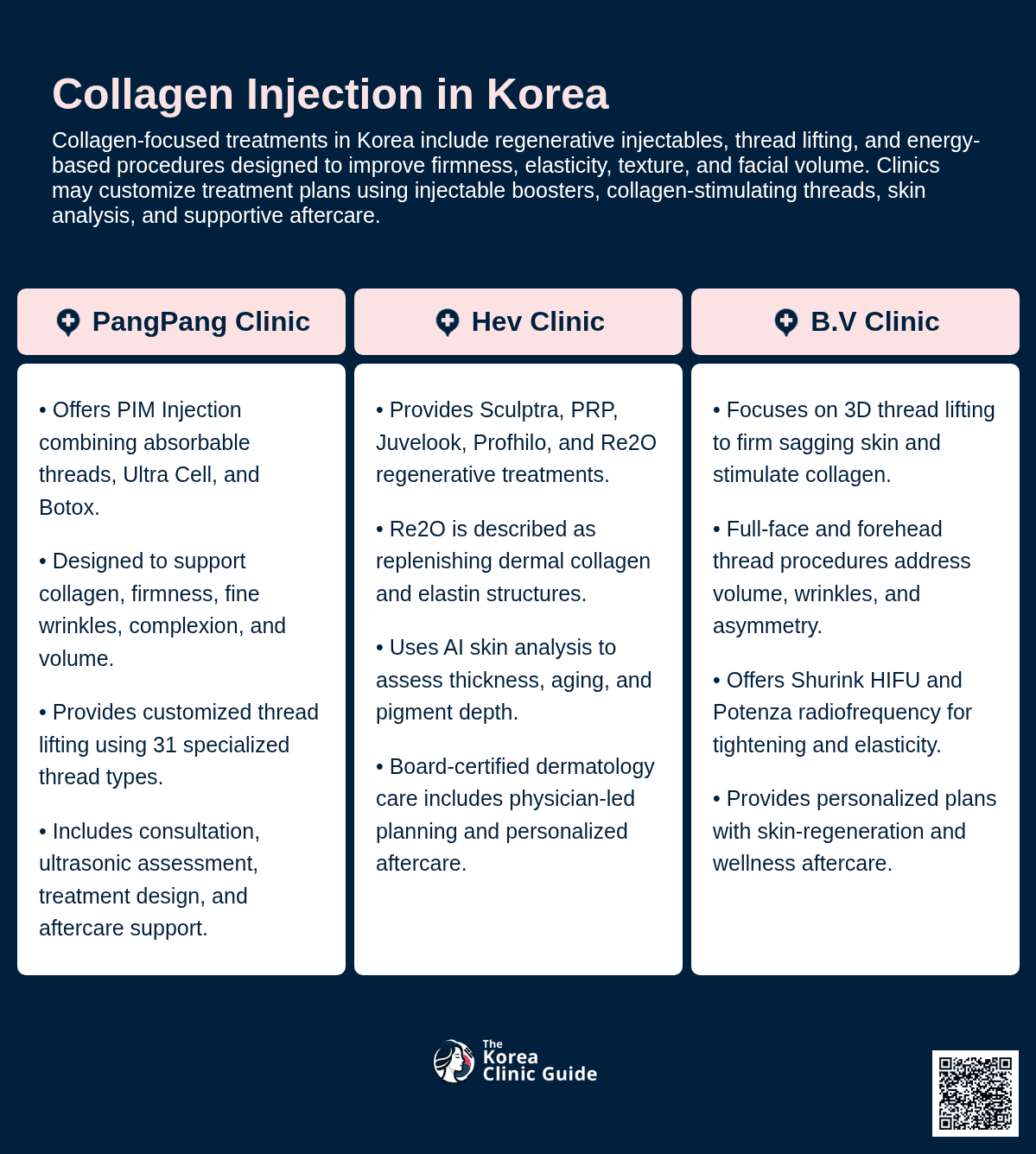
You may consider PangPang Clinic if your collagen-focused goals overlap with lifting and facial volume support: its core approach is thread lifting, which is described as providing an immediate lift while promoting your own collagen production over time. The clinic also offers PIM Injection, a protocol combining Ultra Cell, thread-lifting components, and Botox to address fine wrinkles, elasticity, and facial volume without surgery.
- URL: PangPang Clinic Website
- Location: Gangnam-gu, Seoul
- Collagen-focused options:
- PIM Injection is described as using absorbable thread components to support collagen production while improving fine wrinkles, firmness, complexion, and volume.
- PIM Injection sessions take about 30 minutes with local anesthesia; the provided information describes minimal pain and no recovery period.
- For PIM Injection, the clinic recommends monthly treatment, with three to five treatments suggested for optimal effect.
- Thread-lifting approach:
- The clinic reports using 31 specialized thread types, with customized selection of lifting, assist, tightening, and volume threads.
- Thread lifting can be used on the face, neck, breasts, buttocks, and abdomen; the stated treatment time is 30 minutes to one hour.
- Its planning process includes a personalized doctor consultation, ultrasonic visual assessment, and pre-procedure design.
- Research and aftercare:
- PangPang states that it established a Thread Lifting Research Institute and continues developing procedures using research and clinical data.
- A dedicated consultation center is described as tailoring plans to your needs.
- A thread aftercare package is offered to support and prolong treatment effects.
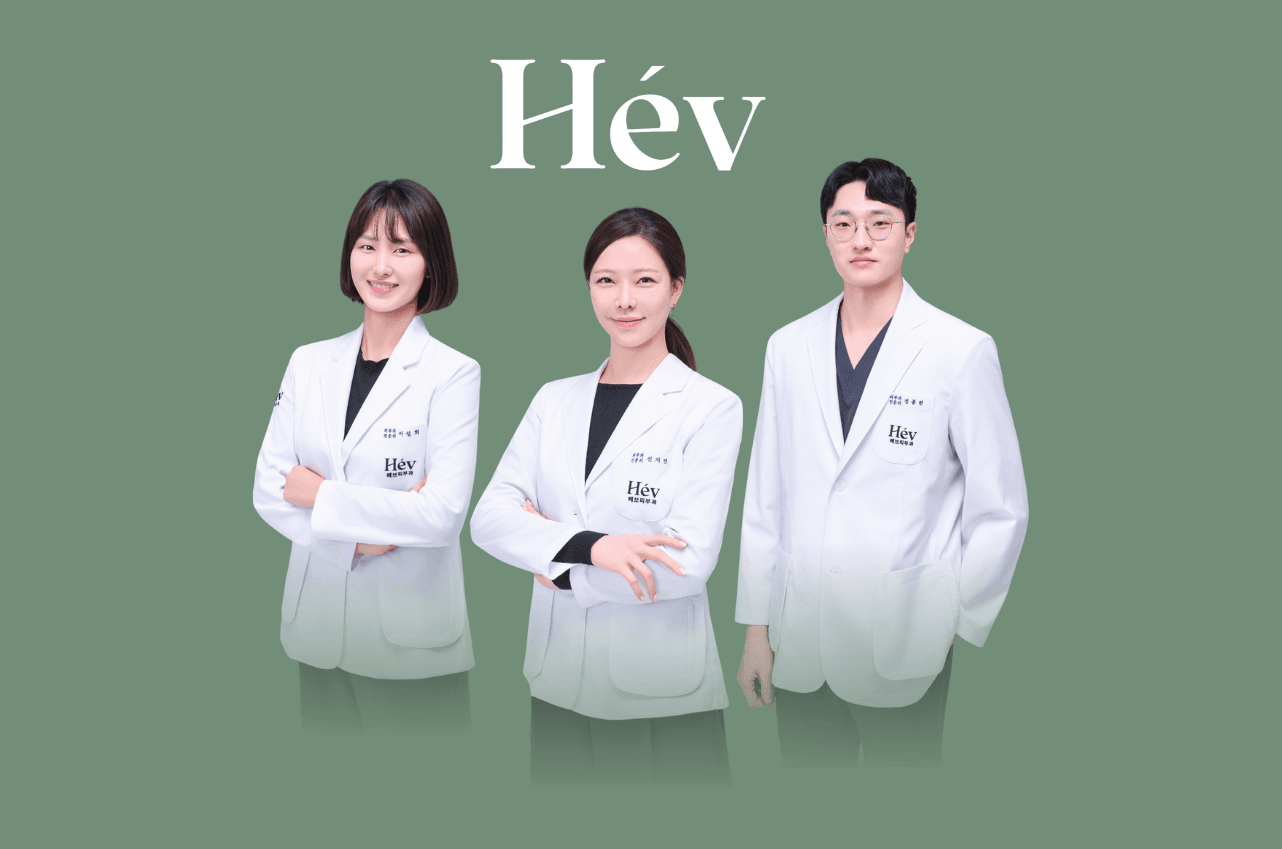
2. Hev Clinic
You may consider Hev Clinic for a collagen injection because it offers several regenerative injectable approaches under board-certified dermatologist oversight, including Sculptra, PRP, Juvelook, and Re2O. In particular, Re2O is described as delivering human-derived collagen and elastin extracellular-matrix material into the dermis to improve firmness, texture, and pores, while your plan is based on AI skin analysis and managed by the same attending dermatologist from consultation through aftercare.
- URL: Hev Clinic Website
- Location: Gangnam-gu, Seoul
- Collagen and regenerative injectables:
- Sculptra is a poly-L-lactic acid injectable intended to gradually improve volume and skin firmness; the supplied information states that results build through a series of sessions and may last 18–24 months.
- PRP uses concentrated plasma from your own blood by injection or microneedling to support healing and collagen stimulation for tone and texture.
- Re2O is described as replenishing the dermal structural scaffold with human-derived collagen and elastin rather than only stimulating collagen production; three monthly sessions are stated to provide results lasting over a year.
- Skin-booster options listed include Juvelook and Profhilo; Profhilo is described as a high-concentration hyaluronic acid treatment for hydration, elasticity, and crepiness.
- Physician-led planning:
- Dr. Shin Ji-yeon is identified as a board-certified dermatologist with specialization in well-aging, device-based lifting, dermal structure restoration, and customized nonsurgical facial contouring.
- The clinic states that the same attending dermatologist performs your care from consultation through procedure completion.
- AI diagnostic equipment is used to assess skin thickness, aging, and pigment depth for an individualized plan.
- Comfort and complementary care:
- A non-sedation pain-control system is intended to allow real-time communication during treatment; the clinic also describes using cannula and needle techniques to reduce injectable discomfort.
- Thermage FLX and Ultherapy may be paired with Re2O, with the stated aim of treating deeper layers before dermal replenishment.
- Aftercare includes the clinic's Repair Barrier Cream and a maintenance plan aligned with a stated 3–4 week skin-cell regeneration cycle.
3. B.V Clinic
You may consider B.V Clinic when you want collagen-supporting rejuvenation centered on thread lifting and skin-tightening treatments rather than a specifically named collagen injectable. Its 3D thread lifting is designed to lift and firm sagging skin while stimulating collagen production, and the clinic also offers radiofrequency and HIFU options that are described as supporting elasticity, tightening, and natural facial contours.
- URL: B.V Clinic Website
- Location: Seoul
- Collagen-supporting lifting:
- 3D Thread Lifting places threads strategically to lift and firm sagging skin, targets the SMAS layer, and is described as stimulating collagen production for sustained improvement.
- Full Face Lifting is intended to restore facial volume and balance, smooth forehead wrinkles and nasolabial folds, and address asymmetry without surgery.
- Non-surgical forehead wrinkle restoration uses tailored threads for upper-face concerns, including forehead wrinkles and sagging around the eyes.
- Skin-tightening options:
- Shurink Lifting uses high-intensity focused ultrasound to target deeper skin layers for tightening, elasticity support, and contour refinement.
- Potenza Lifting uses radiofrequency and is tailored to individual skin needs for collagen and elasticity support, scar improvement, and pore-texture refinement.
- Thor Lifting uses radiofrequency for skin tightening and body contouring across various areas.
- Aftercare and supportive services:
- The clinic describes post-treatment skin-regeneration care intended to minimize swelling and improve elasticity, including nutritional skincare products and ultrasound treatments.
- An all-in-one wellness program includes detox injections, vitamin drips, and immune-support treatments.
- Treatment plans are described as personalized to your aesthetic goals.
Collagen injection From Start to Finish
- Remote consultation and records — Send unfiltered photos in neutral light and disclose allergies, medications, autoimmune or bleeding conditions, prior fillers, threads, fat grafting, surgery, laser treatments, and injections in the proposed area. Request English-language communication or interpretation and ask for the exact planned product.
- Product and travel confirmation — Confirm collagen source, concentration, cross-linking status, lidocaine content, intended site and plane, current Korean instructions, allergy-test requirement, appointment timing, and written emergency contact plan before travel.
- In-person assessment — The clinician examines facial anatomy, skin quality, inflammation, scars, existing material, and the cause of the concern. The plan should change if the problem is primarily muscle movement, tethered scarring, laxity, or a contraindicated treatment area.
- Consent and allergy precautions — Review common and serious risks, expected longevity, alternatives, and the absence of a hyaluronidase reversal option for collagen. Where required by the exact formulation, complete a patch or intradermal allergy test before proceeding; a negative test does not eliminate all allergy risk.
- Preparation and anesthesia — Makeup is removed and skin disinfected. Topical anesthetic can be applied; in the Korean study it was left on for 30 minutes. Local anesthetic may already be part of a lidocaine-containing filler. Office collagen injections do not inherently require fasting or sedation.
- Injection — The clinician places the sterile collagen filler with a needle or cannula in the planned dermal or subdermal plane. Injection time is often only minutes, while the full appointment includes examination, photographs, consent, numbing, treatment, and observation.
- Immediate review and discharge — The clinician checks symmetry and circulation and decides whether molding is appropriate. Leave with written aftercare, a 24-hour contact route, and documentation of product, lot, expiry date, amount, injection locations, and technique.
- Local and remote follow-up — Remain locally available for 72 hours, send requested photographs, and arrange review at roughly 2–4 weeks for persistent swelling, asymmetry, nodules, or further treatment planning. Seek emergency care immediately for signs of vascular compromise or neurologic symptoms.
Alternatives to a Collagen Injection
The best alternative depends on whether the visible concern is localized volume loss, dynamic wrinkling, scar tethering, poor skin texture, or generalized facial deflation. Non-surgical options involve less downtime but often need maintenance; fat grafting addresses broader volume loss but is a surgical procedure with more recovery and variable graft survival.
Hyaluronic-acid filler
Hyaluronic-acid facial filler is the principal alternative for localized folds and volume deficits.
- Durability tradeoff — Older split-face evidence found HA more durable than bovine collagen for nasolabial folds at six months, with similar local injection-site reactions, as reported in this randomized study.
- Complication management — HA remains capable of serious filler complications, including vascular occlusion, but hyaluronidase can enzymatically degrade HA; it does not degrade collagen.
Botulinum toxin
Facial Botox is better suited to lines driven mainly by repeated muscle contraction, such as selected forehead, frown, or crow’s-feet lines.
- Tradeoff — It relaxes targeted muscle activity rather than filling a static fold, scar, or volume deficit.
Biostimulatory injectables
Collagen boosters and Sculptra are not direct collagen fillers.
- Tradeoff — Products based on PLLA, CaHA, PCL, or PDO-related materials have different active materials, delayed onset, session schedules, and management of complications. Do not assume they are interchangeable with injected collagen.
Scar-directed procedures
Acne scar treatment can be more appropriate for tethered depressed scars or texture change.
- Tradeoff — Subcision, laser resurfacing, RF microneedling, peels, or scar surgery treat the scar mechanism rather than simply raising a depression with filler.
Autologous fat grafting
Facial fat grafting can address broader facial volume loss.
- Tradeoff — It requires fat harvesting and recovery time, and long-term volume retention is variable; it is not a quick office injection.
How Can I Prepare for a Collagen Injection?
- Confirm the exact material — Obtain the product name, manufacturer, collagen source, concentration, cross-linking status, lidocaine content, planned anatomical site, allergy-test protocol, lot-record policy, and current Korean authorization details before paying for travel.
- Disclose medicines and supplements — Report aspirin, ibuprofen and other NSAIDs, clopidogrel, warfarin, apixaban, rivaroxaban, corticosteroids, immunosuppressants, herbal products, fish oil, vitamin E, and prior injection reactions. Do not stop prescribed anticoagulants or antiplatelet medicines without approval from the prescribing clinician and injector.
- Resolve infection and inflammation — Postpone treatment for acne cysts, rash, hives, dermatitis, herpes outbreak, dental/oral infection, or inflammation at or near the intended injection site.
- Alcohol and smoking — Avoid alcohol for about 24 hours before and after treatment because it can worsen bruising and swelling. Follow clinic-specific smoking or vaping restrictions, especially when another procedure is combined.
- Fasting and transport — Do not fast for an office injection performed with topical or local anesthetic alone. Fasting, an escort, and driving restrictions apply only when sedation or a combined procedure requires them.
- Treatment-day skin care — Arrive without makeup where practical. Avoid tanning, aggressive facials, exfoliation, or rubbing of the proposed area before the appointment.
- Travel buffer — Book flexible flights and accommodation that allow at least 72 hours of local availability after injection. Keep the clinic’s emergency number and nearby urgent-care access available.
Travel note: A product requiring bovine-collagen skin testing weeks in advance does not fit a short treatment holiday. Confirm testing requirements before purchasing flights.
Confirm the treating doctor’s individualized preparation instructions; they take precedence over this general guidance.
Aftercare Advice
Protect the treated area, monitor circulation and allergic symptoms closely, and do not judge the cosmetic result during the first few days.
- Normal early effects — Redness, tenderness, pinpoint bleeding, swelling, itching, bruising, and temporary asymmetry are common and are often most noticeable for 24–72 hours. Most people return to light routine activities the same day; allow 1–2 weeks to judge the settled appearance.
- Activity and heat — Avoid strenuous exercise for 24 hours; extend this to 48 hours when swelling or bruising persists. Avoid saunas, hot baths, intense heat, tanning, facials, and vigorous rubbing for at least 24 hours.
- Contact and positioning — Do not massage or mold the treated area unless the injector specifically instructs it. Sleep on the back with the head elevated when facial swelling is noticeable.
- Sun protection — Avoid deliberate sun exposure and use broad-spectrum SPF 50 on healed, non-irritated facial skin, particularly when bruising or inflammation is present.
- Urgent warning signs — Seek immediate emergency evaluation for severe or increasing pain; white, gray, blue, or mottled skin; blistering; expanding dark discoloration; cold skin; eye pain, double vision, or any vision change; facial weakness; difficulty speaking; sudden numbness; severe headache; dizziness; or trouble walking. Contact the injector urgently for spreading redness or warmth, pus, fever, persistent swelling, or new nodules.
- Maintenance and review — Arrange review at about 2–4 weeks. Direct collagen effects commonly decline over time, and maintenance is often needed within roughly 3–12 months depending on formulation and area; Korean nasolabial-fold research observed waning improvement after about six months.
Follow the treating doctor’s instructions over general advice, and contact the clinic promptly whenever the treated area looks or feels wrong.
Frequently Asked Questions
Related Blogs
Fraxel Laser in Korea: Treatment Methods, Recovery, Risks and Travel Planning
Non-ablative Fraxel DUAL uses 1550-nm resurfacing for scars, texture and fine lines, 1927-nm treatment for pigment and photodamage, or both with individualized settings. The article covers candidacy, travel planning for Korea, treatment steps, recovery, aftercare, warning signs and alternatives such as CO2 laser, RF microneedling and subcision.
Updated: Sep 17, 2026

IPL in Korea: Uses, Recovery, Safety, and Travel Planning
IPL is a broad-spectrum light treatment for superficial pigment, redness, small vessels, and long-term hair reduction, usually delivered in 3–6 sessions spaced 2–4 weeks apart. The article covers candidate screening, treatment steps, travel planning, preparation, aftercare, expected recovery, warning signs, and alternatives.
Updated: Sep 17, 2026

Oligio Lifting in Korea: Candidates, Results, Recovery, and Travel Planning
Oligio lifting uses monopolar RF to gradually tighten mild-to-moderate facial and neck laxity without incisions or formal downtime. The article covers candidacy, contraindications, treatment steps, Korea travel planning, aftercare, warning signs, and follow-up through six months.
Updated: Sep 17, 2026
Juvelook Collagen Booster in Korea: Treatment Methods, Recovery, Risks, and Travel Planning
Juvelook collagen booster uses PDLLA-HA microinjections or selected cannula placement for gradual improvement in texture, fine lines, pores, mild laxity, and selected shallow acne scars. International patients can plan a 2–3-night Korea stay, obtain product traceability records, follow aftercare guidance, and arrange follow-up for swelling or other concerns.
Updated: Sep 17, 2026
Clinics offering Collagen injection

Haru Clinic Korea | Seoul Facelift, Threads, Botox & Fillers
Sinsa
Hev Clinic Korea | Sinsa Skin, Laser & Injectables
Sinsa

Made Young Plastic Surgery: Rejuvenating Aesthetic Excellence in Korea for Face Lifts, Contouring and More
Gangnam Station

PangPang Clinic: Korea's Premier Thread Lifting and Skin Rejuvenation Specialist in Gangnam, Seoul
Sinsa