
Medical Tourism Blog
Implant in Korea: Treatment Steps, Recovery, Travel Timing, and Alternatives
Table of contents
- Implant at a Glance
- What Is a Dental Implant?
- Who Is a Good Candidate for a Dental Implant?
- How Is a Dental Implant Performed?
- Why Visit Korea for a Dental Implant?
- Key Information for International Patients
- Which Are the Best Clinics in Korea for Clear Choice Dental Implants?
- How Much Does a Dental Implant Cost in Korea?
- Implant From Start to Finish
- Alternatives to a Dental Implant
- How Can I Prepare for a Dental Implant?
- Aftercare Advice
Considering treatment in Korea? Everything you need to know e.g. — how to avoid scams, visas, interpreters, recovery tips — in our Medical Tourism Master Guide. Plan with confidence in minutes, not weeks!
Last updated: September 2026
Implant at a Glance
- What it replaces — A dental implant is a titanium or titanium-alloy artificial tooth root placed in the jawbone; after healing, it can support a single crown, bridge, or implant-supported denture.
- Typical cost in Korea — A dental implant is quoted at ₩1,700,000–₩2,800,000 (about US$1,300–$2,100); grafting, sinus augmentation, sedation, and the final crown or other restoration can change the total.
- Treatment timeline — Initial surgery is followed by a 7–14-day healing review, while conventional healing before the definitive crown, bridge, or denture commonly takes 3–6 months.
- Travel commitment — Plan to stay in Korea about 7–14 days after placement; a second trip is often required for final restoration unless a home dentist has agreed in advance to take over care.
- Who is suitable — Good candidates have a missing or non-restorable tooth, controlled gum disease and infection, enough bone or a workable grafting plan, stable bite forces, and access to lifelong hygiene and maintenance.
- Key limitation — An immediate temporary tooth may be possible in selected cases, but it is not automatically safe for normal chewing and does not eliminate the need for osseointegration or a later definitive restoration.
- Korea-specific priority — Korea has established implant-treatment workflows, but its available evidence does not prove superior outcomes; international patients should prioritize complete implant-system records and a written plan for home-country restoration, emergencies, and maintenance.
What Is a Dental Implant?
A dental implant is an artificial tooth root placed in the jaw to support a crown, bridge, or denture. It replaces missing or non-restorable teeth to restore chewing, appearance, and bite function while avoiding reliance on adjacent teeth. Dental implant treatment is surgical, followed by restorative care once healing is complete.
Who Is a Good Candidate for a Dental Implant?
- Missing or non-restorable tooth — Good candidates need replacement for one or more missing teeth, or have a tooth that cannot be predictably saved after a proper tooth-preservation assessment.
- Treatable gum and tooth health — Gum disease, decay, and oral infection should be controlled before surgery; healthy neighboring and opposing teeth are also important for bite planning.
- Adequate bone or an augmentation plan — The jaw must have enough bone for stable placement, or the clinician must be able to offer ridge preservation, guided bone regeneration, bone grafting, or sinus augmentation.
- Commitment to maintenance — Implants require consistent plaque control, professional maintenance, and access to long-term restorative and emergency care after returning home.
- Stable bite forces — Patients with clenching or grinding need their bite assessed and managed before a definitive implant crown, bridge, or denture is made.
Elective treatment is generally deferred until active periodontal disease or infection is stabilized, and during pregnancy unless urgent dental care is required. Poorly controlled diabetes, uncontrolled systemic illness, nicotine exposure, inadequate bone, unfavorable lower-jaw nerve or upper-jaw sinus anatomy, and unmanaged severe bruxism can make treatment unsuitable or require a modified plan. Current or previous medication-related osteonecrosis of the jaw, or treatment with antiresorptive, antiangiogenic, chemotherapy, or immunosuppressive drugs requires coordinated assessment with the prescribing clinician and implant team. Do not stop anticoagulants, antiplatelets, diabetes medicines, osteoporosis medicines, or immunosuppressants independently.
How Is a Dental Implant Performed?
Placement and restoration timing determine the treatment pathway. The right approach depends on extraction-site infection, bone contours, primary implant stability, gum appearance, bite forces, and whether a temporary tooth can be kept out of damaging contact.
- Immediate placement — The titanium implant fixture is placed into a fresh extraction socket. It can reduce the number of surgical stages, but requires favorable local anatomy and infection control.
- Early placement — Implant surgery follows initial soft-tissue or hard-tissue healing after extraction. This approach can be useful when the extraction site needs time to settle.
- Delayed placement — The site heals more fully before implant placement. It is often selected when infection, bone loss, grafting, or soft-tissue conditions need management first.
- Immediate or early loading — A provisional crown or other restoration is attached soon after placement in carefully selected cases. It can shorten the visible-tooth timeline but is not automatically a same-day chewing tooth.
- Conventional loading — The implant heals before the definitive abutment and crown, bridge, or denture are fitted; conventional osseointegration commonly takes 3–6 months.
- One-stage or two-stage surgery — A healing abutment can remain exposed after surgery, or the implant can be covered beneath the gum for a later uncovering procedure.
Comparative evidence supports more than one placement and loading pathway; a 2023 meta-analysis found no statistically significant survival disadvantage for immediate versus delayed placement, but that does not make immediate treatment appropriate for every patient. A recent systematic review also identifies validated immediate, early, and late protocols while noting differences in evidence strength.
Why Visit Korea for a Dental Implant?
South Korea has established dental-implant treatment pathways and substantial domestic use of implant dentistry. For overseas patients, the practical value is access to a staged surgical and restorative workflow rather than a claim that Korean outcomes are inherently better. A documented plan and reliable home-country follow-up matter more than destination alone.
- Established implant utilization — Korea’s National Health Insurance Service records implant benefits and utilization within its dental coverage framework, reflecting a well-established domestic implant-treatment environment.
- Structured planning and staging — Implant care commonly combines examination, periodontal assessment, radiographs and, when indicated, three-dimensional CBCT imaging to assess bone, sinus, and nerve anatomy before surgery.
- Restorative options — A fixture can support a single implant crown, implant-supported bridge, or implant-supported denture, with grafting or sinus augmentation incorporated when anatomy requires it.
- Records for cross-border care — Ask for the implant manufacturer and system, diameter, length, component and lot details, operative report, imaging, prescriptions, and restoration schedule. These records are essential if another dentist will restore or maintain the implant.
- Evidence limitation — The available Korea-specific material supports access and utilization, not proof that implant survival or complication rates in South Korea are superior to those in other countries.
Key Information for International Patients
- Minimum stay — For implant placement alone, plan 7–14 days in Korea when feasible. This allows an early healing review and removal of non-dissolving sutures when used.
- Second visit — Conventional definitive restoration commonly follows 3–6 months of osseointegration. A second trip is often needed unless a qualified home-country dentist has agreed in advance to complete the crown, bridge, or denture.
- Flying after surgery — A dental-tourism air-travel review proposed waiting at least 72 hours after implant placement, with about 1 week preferred after most dental procedures. After a sinus lift, it proposed at least 2 weeks and preferably 6 weeks; the authors also noted that the evidence is limited and needs individual clinical interpretation.
- Itinerary impact — Expect swelling, soreness, bruising, minor bleeding, and a soft-food diet during the first week. Multiple implants, bone grafting, full-arch work, or sinus augmentation require more recovery time and should not be scheduled around a tight sightseeing itinerary.
- Remote follow-up — Confirm an emergency contact route, the format for video or photo reviews, and who will manage complications after departure. Arrange local dental care before travel rather than searching after a problem develops.
- Long-term commitment — Implant survival is not freedom from peri-implant disease, bone loss, gum recession, mechanical loosening, fractured restorations, or future repair. A 20-year pooled survival estimate of 93.0% for titanium root-form implants is encouraging but does not predict an individual or complication-free outcome.
Travel note: Do not book a non-refundable flight home before the surgeon confirms the extent of treatment. Grafting, sinus surgery, unexpected infection, or a difficult extraction can change both the recovery and flying schedule.
Which Are the Best Clinics in Korea for Clear Choice Dental Implants?
Listed below are some of the best clinics in Korea for clear choice dental implants.
1. Gangnam Gentle Dental Clinic
For implant care, you can expect 3D-guided planning alongside Straumann and Osstem implant options at Gangnam Gentle Dental Clinic. Your treatment is described as individualized following a thorough consultation, with digital examinations intended to support precise planning and a focus on limiting treatment to what is necessary.
- URL: Gangnam Gentle Dental Clinic Website
- Location: Seocho-gu, Seoul
- Implant options:
- 3D-guided implant placement is available, using 3D imaging for planning and precision.
- Straumann and Osstem implant systems are offered.
- Care considerations:
- Dr. Travis Kim studied at Ohio State University, speaks fluent English, and provides personalized treatment.
- The clinic describes established infection-prevention and sterilization systems.
- Weekday and weekend appointments, including emergency dental care, are available according to schedules.
- Other dental care: Services include gum treatment, root canal treatment, cavity fillings, wisdom-tooth extraction, clear aligners, veneers, whitening, and TMJ care.
2. Minish Dental Hospital
You may consider Minish Dental Hospital if you want implant treatment within a large dental facility that also provides in-house laboratory support and Minish Implants designed to replace missing teeth in harmony with your mouth’s natural structure and appearance. The clinic states that it accommodates international visitors without language barriers and provides personalized treatment plans.
- URL: Minish Dental Hospital Website
- Location: Gangnam-gu, Seoul
- Implant and restorative care:
- Minish Implants are offered for missing-tooth replacement.
- Prosthodontic care includes crowns, bridges, and dentures.
- Minish Bridges are available for missing front teeth as an alternative approach to traditional bridges and implants.
- Clinical resources:
- The facility spans 14 floors and has an in-house laboratory and technology company.
- The clinic reports using 19 advanced dental devices.
- Its team includes Dr. Jung Ho Kang and veneer, orthodontic, and general dental specialists.
- Related oral-health services:
- Periodontal therapy is available to support gum and bone health.
- Care is also available for cavities, orthodontic needs, bruxism, and TMJ concerns.
3. TU Dental Clinic (TU Dental)
At TU Dental Clinic, you can explore digitally planned implant treatment that emphasizes accurate planning, minimal incisions, and preservation of natural teeth where possible. For more extensive tooth loss, its Fullcase Implant approach uses 3D imaging and customized prostheses; partial implants are also available for one or more missing teeth.
- URL: TU Dental Clinic (TU Dental) Website
- Location: Seocho-gu, Seoul
- Implant treatment:
- Fullcase Implant treatment is described for complex cases involving at least 4 to 6 teeth.
- 3D imaging is used to assess oral conditions and create a surgical plan.
- The process includes a minimal incision and a customized prosthesis.
- Partial implants can restore one or more teeth while considering implant shape, color, and transparency.
- Restorative and aesthetic options:
- Zirconia crowns are available for front teeth and molars, with an emphasis on durability and a natural tooth-like color.
- Ceramic inlays and onlays are offered for caries treatment.
- ZeroNate uses a 0.01 mm ceramic coating to alter tooth shape and color with minimal tooth removal.
- Care approach:
- The clinic prioritizes minimizing treatment discomfort and preserving natural teeth.
- Orthodontic plans are personalized around tooth alignment, age group, and lifestyle.
How Much Does a Dental Implant Cost in Korea?
A Dental Implant is quoted at ₩1,700,000–₩2,800,000 (approximately US$1,300–$2,100). Individual quotes vary because the clinical plan can range from placement of a single fixture to a staged surgical and restorative treatment pathway.
| Procedure Price | Korean Won (₩) | USD ($) |
|---|---|---|
| Low Price | ₩1,700,000 | $1,300 |
| High Price | ₩2,800,000 | $2,100 |
Exchange rate as of 2026-09-06: 1 KRW = 0.000741 USD.
What Affects the Price?
- Restoration type and number of teeth — A single implant-supported crown requires one fixture, abutment, and crown, while multiple implants supporting a bridge or an implant-supported denture require more surgical sites, restorative components, laboratory work, and bite adjustment.
- Bone grafting or sinus augmentation — Ridge preservation, guided bone regeneration, bone grafting, or a sinus lift adds surgical steps, graft and barrier materials, operating time, and a potentially longer healing sequence before restoration.
- Immediate versus conventional loading — Immediate placement or an immediate provisional restoration requires favorable anatomy, primary implant stability, and careful bite control. This pathway can require provisional components and additional planning, whereas conventional loading typically separates surgery from definitive restoration after osseointegration.
- Sedation requirement — Implant surgery is commonly performed under local anesthesia, but selected cases use oral or IV sedation. Sedation adds medication, monitoring, trained personnel, and facility resources beyond a local-anesthetic outpatient procedure.
Cost tip: Request an itemized quote that states what is included, particularly the implant fixture, abutment, provisional or definitive crown/bridge/denture, imaging, anesthesia or sedation, grafting materials, surgery, reviews, and planned follow-up.
The US$1,300–$2,100 conversion is approximate, based on an exchange rate of 0.000741 on 2026-09-06. Check the exchange rate again when budgeting.
Implant From Start to Finish
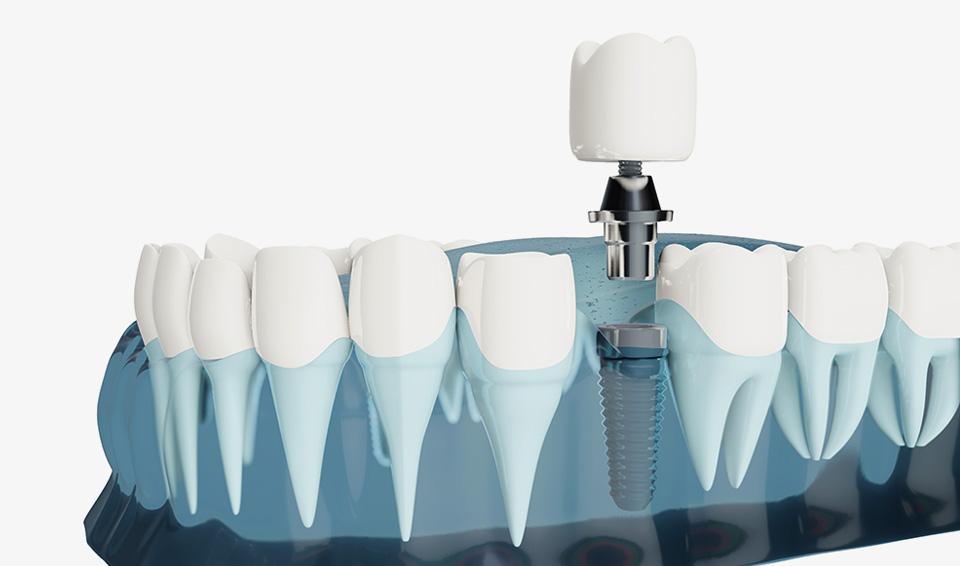
- Pre-travel screening — Send recent X-rays or CBCT files if available, dental and periodontal records, photographs, medical conditions, allergies, and a complete medication and supplement list. An English-language virtual consultation can identify likely options, but remote review cannot finalize the surgical plan.
- In-person diagnostic consultation — The dentist examines the tooth or gap, gums, bite, adjacent teeth, opposing teeth, bone, and relevant sinus or nerve anatomy. Imaging is reviewed or obtained, and the clinician confirms whether the natural tooth is restorable before extraction is accepted.
- Treatment and travel coordination — Receive a written staged plan covering extraction, grafting, implant placement, temporary restoration, expected healing, definitive crown or bridge, fees, and the clinician responsible for care after departure. Confirm whether a home dentist can provide restoration and maintenance.
- Surgical preparation and anesthesia — Implant surgery is usually outpatient under local anesthesia. Oral or IV sedation can be considered for selected patients, with fasting, escort, and post-sedation travel restrictions set by the treating team.
- Extraction, grafting, and fixture placement — When indicated, the failing tooth is removed, the socket is cleaned, and bone grafting or ridge preservation is performed. The titanium or titanium-alloy fixture is placed into the jawbone and either covered beneath the gum or fitted with a healing abutment.
- Temporary tooth and discharge — Selected cases receive an immediate provisional restoration. It must be protected from heavy biting forces. The clinic provides instructions for prescribed medicines, oral hygiene, rinsing, food texture, activity limits, and emergency contact.
- Early healing review — Return around 7–14 days for wound assessment and removal of non-dissolving sutures where applicable. Initial soreness, swelling, bruising, minor bleeding, and pain commonly improve over about one week.
- Osseointegration and definitive restoration — The implant commonly heals for 3–6 months before the final abutment, digital scan or impression, crown, bridge, or denture is made and bite-adjusted. Extraction healing, infection treatment, grafting, sinus augmentation, multiple implants, and complications can extend this stage.
- Overseas follow-up and maintenance — Before leaving Korea, collect all implant-system details, operative notes, pre- and postoperative imaging, prescriptions, and the planned restoration timeline. Continue professional implant and periodontal maintenance for life, with remote review or local care arranged for concerns.
Alternatives to a Dental Implant
A dental implant replaces a missing tooth without preparing adjacent teeth, but it requires surgery, sufficient bone or grafting, healing time, and lifelong implant maintenance. Non-surgical or tooth-preserving options can be faster or avoid surgery, but each has its own tradeoffs for neighboring teeth, hygiene, bone preservation, appearance, and durability.
Root Canal Treatment
- Best role — Preserves a tooth that remains predictably restorable despite pulp infection or damage.
- Tradeoff — Root-canal treatment, retreatment, endodontic surgery, and a protective restoration can avoid extraction, but cannot rescue every cracked, severely decayed, or periodontally compromised tooth.
- Related procedure — Read about root canal treatment.
Fixed Dental Bridge
- Best role — Replaces a missing tooth with a fixed restoration supported by neighboring teeth.
- Tradeoff — It avoids implant surgery and can be completed faster, but typically requires reshaping supporting teeth and does not place a root substitute in the missing-tooth site.
- Related procedure — Read about a dental bridge.
Removable Partial or Complete Denture
- Best role — Replaces several or all missing teeth when surgery, bone volume, budget, health factors, or treatment time limit implant treatment.
- Tradeoff — It avoids surgery but can move during function, needs removal and cleaning, and often provides less stable chewing than a fixed implant-supported restoration.
Implant-Supported Denture or Full-Arch Restoration
- Best role — Replaces multiple missing teeth using a planned number of implants to retain a denture or support a fixed arch.
- Tradeoff — This remains implant surgery and can require grafting, staged healing, and extensive bite planning, but offers more retention than a conventional removable denture.
Orthodontic Space Closure
- Best role — Selected gaps can be closed by moving teeth into position.
- Tradeoff — It avoids an artificial tooth root but is only appropriate when bite, tooth size, gum contours, and the missing-tooth location permit it.
- Related procedures — Consider clear aligners or braces.
How Can I Prepare for a Dental Implant?
- Provide complete records early — Send available X-rays, CBCT scans, periodontal records, prior implant details, medical history, allergies, and a full list of prescription drugs, over-the-counter medicines, vitamins, and herbal supplements.
- Confirm whether the tooth can be saved — Request a tooth-preservation assessment before agreeing to extract a compromised tooth; extraction is irreversible.
- Do not alter medication without approval — Anticoagulants, antiplatelets, diabetes medicines, antiresorptive osteoporosis drugs, chemotherapy, and immunosuppressants need individualized instructions from the relevant prescriber and implant team.
- Control infection and gum disease — Complete treatment for active periodontal disease, untreated decay, or oral infection before elective implant placement unless the surgeon gives a staged plan.
- Stop nicotine exposure — Smoking, vaping, and other nicotine exposure impair healing and increase implant complications. Follow the surgeon’s cessation timeframe and avoid restarting during healing.
- Follow fasting instructions exactly — Local-anesthetic surgery often has different requirements from oral or IV sedation. For sedation, follow the clinic’s food, drink, escort, and medication instructions rather than using a generic fasting rule.
- Plan food and accommodation — Book accommodation close enough for the early review, stock soft foods, and avoid scheduling strenuous activities. Arrange an escort and private transport after sedation.
- Keep travel flexible — Build in 7–14 days for review after surgery and avoid booking a flight during the minimum recovery window. Plan a second visit or written handover for final restoration 3–6 months later.
Travel note: Before departure, obtain written confirmation of the provisional-restoration plan and whether it can be adjusted or repaired at home. A temporary tooth is not a guarantee that it is safe to bite normally.
Confirm the treating clinic’s individualized requirements for medicines, fasting, nicotine cessation, transport, and flights; those instructions take precedence over general guidance.
Aftercare Advice
Protect the surgical site and temporary restoration during early healing; recovery depends on the number of implants, grafting, sinus surgery, infection treatment, and bite forces.
- Control bleeding and swelling — Use pressure exactly as instructed for minor oozing, and take prescribed pain medicine, antibiotics, or antiseptic rinse only as directed. Initial soreness, swelling, bruising, and minor bleeding commonly improve over about one week.
- Eat soft foods and protect the implant — Follow the clinic’s food-texture instructions. Do not chew hard, sticky, or crunchy foods on the surgical site or provisional crown until cleared.
- Maintain gentle hygiene — Brush and clean around the area only as instructed. Do not disturb sutures, graft material, or a healing abutment; use mouth-rinses only when prescribed.
- Avoid nicotine, alcohol, heat, and exertion — Avoid smoking, vaping, nicotine, alcohol, strenuous exercise, and heat exposure during the period specified by the surgeon. These restrictions are especially important after grafting or sinus surgery.
- Attend the early review — Return for the planned 7–14-day wound check and non-dissolving suture removal if used. Keep all later restorative, bite-adjustment, and professional maintenance appointments.
- Seek urgent help for warning signs — Contact the clinic urgently for uncontrolled bleeding, fever, worsening rather than improving pain or swelling, pus or persistent bad taste, prolonged altered sensation, a loose implant or restoration, trouble opening the mouth, swallowing or breathing, or nasal and sinus symptoms after upper-jaw surgery.
- Expect the final result later — Definitive crown, bridge, or denture treatment commonly follows 3–6 months of osseointegration. Grafting, sinus augmentation, and complications can extend that timeline.
Follow the treating doctor’s written instructions over general advice and contact the clinic promptly when anything appears wrong.
Frequently Asked Questions
Related Blogs
Root Canal Treatment in Korea: Treatment Steps, Recovery, Travel Timing, and Alternatives
Root canal treatment removes infected or inflamed pulp, disinfects and seals the canals, and is followed by a durable filling or crown when needed. The article covers candidate assessment, treatment options, Korea travel planning, records, flight timing, aftercare, and follow-up.
Updated: Sep 21, 2026
Bruxism Treatment in Korea: Splints, Masseter Botox, Recovery, and Travel Planning
Bruxism treatment begins with an assessment of teeth, bite, jaw muscles and joints, with options including habit care, a custom stabilization splint, dental repair, sleep evaluation, or selected masseter botulinum-toxin injections. International patients visiting Korea can plan 1–2 days for assessment or 2–5 days for a new splint, and should arrange adjustment time, treatment records, and home-den
Updated: Sep 21, 2026
Periodontal Disease Treatment in Korea: Methods, Recovery, Travel Planning, and Aftercare
Periodontal disease treatment starts with charting, radiographs, cleaning and home-care instruction, followed by deep cleaning, reassessment and selected surgery for persistent pockets or defects. International patients can plan 2–4 business days for non-surgical care, 7–10 days for early surgical review, and should arrange transferable records and follow-up with a home periodontist.
Updated: Sep 21, 2026
Wisdom Tooth Removal in Korea: Methods, Recovery, Risks and Travel Planning
Wisdom tooth removal may involve simple or surgical extraction, complete extraction, or coronectomy depending on impaction, root anatomy, nerve risk, and disease. The article covers imaging, anesthesia, recovery and travel planning in Korea, aftercare, warning signs, and follow-up requirements.
Updated: Sep 21, 2026
Clinics offering Implant

Minish Dental Hospital: Korea's Premier Dental Clinic Offering Advanced Treatments and Personalized Care
Sinsa

Gangnam Gentle Dental Clinic: Your Trusted Dental Care Provider in Korea Offering Comprehensive Services with Optimal Comfort and Safety
Sinnonhyeon Station

Experience Advanced Dental Care at TU Dental Clinic (TU Dental) in Korea: Top-Rated Orthodontics, Implants, and Esthetic Treatments
Gangnam Station

Blanche Dental Clinic in Korea: Advanced & Tailored Dental Care for a Healthy, Beautiful Smile
Nonhyeon