
Medical Tourism Blog
Cheekbone Implant in Korea: Types, Recovery, Travel Planning and Alternatives

Table of contents
- Cheekbone Implant at a Glance
- What Is a Cheekbone Implant?
- Who Is a Good Candidate for a Cheekbone Implant?
- What Are the Different Types of Cheekbone Implant?
- Why Visit Korea for a Cheekbone Implant?
- Key Information for International Patients
- Which Are the Best Clinics in Korea for Cheekbone Implant?
- Cheekbone Implant From Start to Finish
- Alternatives to a Cheekbone Implant
- How Can I Prepare for a Cheekbone Implant?
- Aftercare Advice
Considering treatment in Korea? Everything you need to know e.g. — how to avoid scams, visas, interpreters, recovery tips — in our Medical Tourism Master Guide. Plan with confidence in minutes, not weeks!
Last updated: September 2026
Cheekbone Implant at a Glance
- What it does — A cheekbone, or malar, implant is a solid device placed over the zygomatic bone to create lasting structural cheek projection; it is different from filler or fat grafting, which add soft-tissue volume.
- Best candidates — It is most suitable for adults with true cheekbone underprojection who want defined high-cheek, submalar, or extended-midface contour rather than treatment for generalized fat loss, skin laxity, or excessive cheekbone width.
- Procedure approach — The surgeon creates a pocket over the cheekbone and positions a malar, submalar, or extended implant, commonly through an incision inside the upper mouth; standalone surgery is often outpatient.
- Recovery and results — Initial recovery typically takes about 1–2 weeks, but swelling and apparent asymmetry can continue settling for several weeks to months; solid implants are intended to be long-lasting, though revision or removal is sometimes needed.
- Korea stay requirement — International patients should plan to remain in Korea at least 7–10 days after an uncomplicated standalone procedure for an in-person postoperative review and surgeon clearance before flying home.
- Key risks — Potential complications include infection, bleeding, numbness, asymmetry, implant movement or visible edges, chronic pain, erosion, and dissatisfaction; active dental, gum, sinus, or facial-skin infection should be treated before elective surgery.
- Korea-specific check — Verify that the clinic is registered to treat foreign patients and confirm the operating surgeon’s relevant specialist credentials; Korea’s foreign-patient statistics do not prove better cheek-implant safety or outcomes than other countries.
What Is a Cheekbone Implant?
A cheekbone implant, also called a malar implant, is a solid device placed over the cheek area to create more structural facial projection. It addresses naturally flat, underprojected, or asymmetric cheeks for a stronger high-cheek or midface contour that lasts longer than filler. Cheekbone implantation is a surgical procedure.
Who Is a Good Candidate for a Cheekbone Implant?
- Structural midface underprojection — Good candidates have true malar (cheekbone) deficiency and want stronger, lasting projection over the zygomatic prominence rather than temporary soft-tissue volume.
- Defined contour goal — Candidates understand the difference between high-cheek, submalar, and extended midface augmentation and can describe the direction of projection they want.
- Selected reconstructive or gender-affirming needs — A malar implant can be considered for congenital underprojection, selected post-traumatic asymmetry, or facial-feminization goals after anatomy-based assessment.
- Medically prepared adult — Candidates can undergo anesthesia or sedation, follow oral-incision care where relevant, remain in Korea for review, and arrange support after discharge.
Elective surgery should be deferred for active dental, gum, sinus, or facial-skin infection, pregnancy, or medical conditions that make anesthesia or wound healing unsafe. Uncontrolled diabetes, significant heart or lung disease, bleeding disorders, untreated hypertension, nicotine use under the surgeon’s cessation policy, and medicines affecting bleeding all require individualized planning; never stop warfarin, apixaban, rivaroxaban, clopidogrel, or prescribed aspirin independently. Insufficient soft-tissue coverage, major pre-existing asymmetry, prior facial trauma or surgery, and previous filler or fat grafting can change the plan; CT or 3D planning is particularly useful for revision, trauma, marked asymmetry, reconstruction, or custom implants. Assessment must also rule out a problem better treated with volume replacement, jaw surgery, reconstruction, or cheekbone reduction, which is the opposite operation.
What Are the Different Types of Cheekbone Implant?
Implant selection follows the location and direction of skeletal deficiency, not simply a larger size. A surgeon assesses the face from the front, oblique view, and profile to distinguish bony underprojection from soft-tissue hollowing or midface descent.
- Malar or high-cheek implant — Adds projection directly over the zygomatic prominence. This suits patients seeking more defined high-cheek contour.
- Submalar implant — Sits lower or more anteriorly to address relative hollowing below the cheekbone. It is not a substitute for correcting generalized facial-fat loss.
- Malar–submalar or extended midface implant — Augments both the cheekbone and lower cheek transition for broader midface support when both areas are deficient.
- Standard versus custom implant — Standard devices are selected from established shapes. Custom implants generally require imaging-based planning and are more relevant to complex asymmetry, trauma, reconstruction, or revision.
- Material choice — Solid silicone, porous polyethylene (including Medpor), expanded polytetrafluoroethylene, titanium, and hydroxyapatite-based materials are used in facial implants. Material affects tissue integration, fixation, imaging appearance, palpability, and how difficult later removal or revision can be; there is no universally established best material or fixation strategy.
Why Visit Korea for a Cheekbone Implant?
Korea has a formal system for registering institutions that treat foreign patients, allowing international visitors to verify eligibility before booking. Its published medical-tourism data also show substantial foreign-patient activity in plastic-surgery departments, although this does not prove superior cheek-implant outcomes.
- Foreign-patient registration check — Confirm that the institution appears in Korea’s registered medical-institution system before committing to treatment.
- Specialist verification — Ask for the operating surgeon’s relevant credentials and confirm them through the Korean Society of Plastic and Reconstructive Surgeons, rather than relying on marketing titles.
- Documented international demand — Plastic surgery represented 12% of foreign-patient department visits in Medical Korea’s reported 2024 cumulative dataset, according to Medical Korea. This is specialty-level activity, not cheek-implant procedure volume.
- Evidence limitation — Korea does not publish a robust cheek-implant registry reporting procedure volume, complications, removals, revisions, or long-term satisfaction. Do not assume the country has proven better safety or aesthetic outcomes for routine malar implants than elsewhere.
Key Information for International Patients
- Minimum stay — Plan at least 7–10 days in Korea after an uncomplicated standalone implant, including an in-person postoperative review before departure. Combined surgery, significant swelling, wound concerns, infection, or clotting risk can require a longer stay.
- Treatment schedule — Allow time for a remote consultation before travel, an in-person examination and any indicated testing after arrival, surgery, discharge, and postoperative review. Standalone surgery is often outpatient, but observation depends on anesthesia, health status, combined procedures, and facility protocol.
- Flying home — Do not book a rigid early return flight. Leave only after the operating surgeon examines you and clears travel; recent surgery plus a flight longer than four hours adds venous-thromboembolism considerations described in the CDC travel guidance.
- Flight precautions — Follow the clinician’s individualized plan for movement, seated calf exercises, hydration, and any compression or medication advice. Seek emergency care for one-sided leg pain or swelling, chest pain, shortness of breath, coughing blood, fainting, or a rapid or irregular heartbeat.
- Itinerary impact — Expect swelling, bruising, tightness, tenderness, and temporary sensory changes. Ordinary non-strenuous routines often resume around 1–2 weeks when cleared, but visible contour and apparent asymmetry continue settling for weeks to months.
- Records and remote care — Obtain an English discharge summary, medicine list, implant brand/material and operative record, relevant imaging, emergency contact details, and a written remote-follow-up pathway before leaving Korea.
Travel note: A responsible adult should accompany anyone discharged after IV sedation or general anesthesia and remain available for the first night.
Which Are the Best Clinics in Korea for Cheekbone Implant?
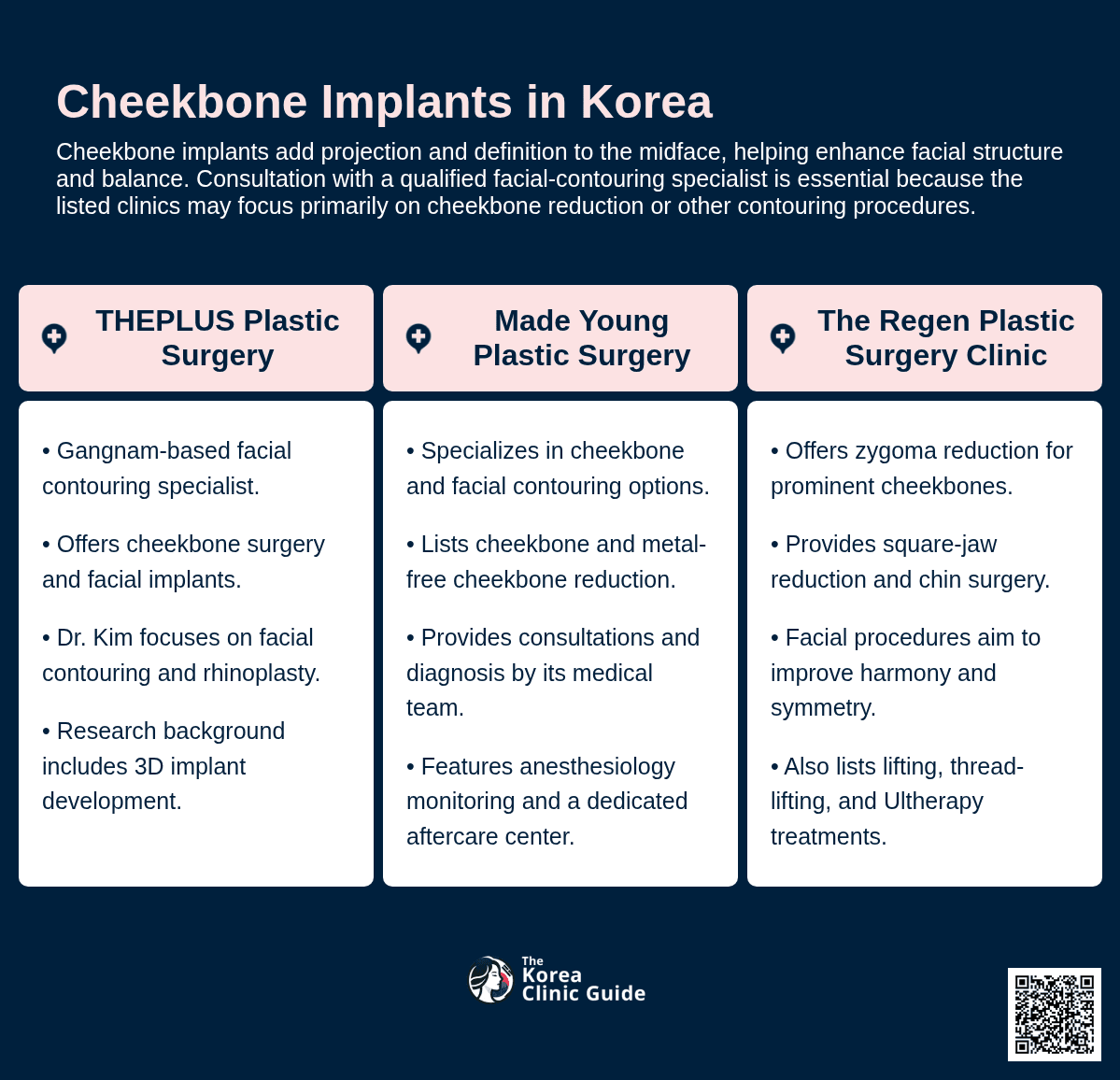
Listed below are some of the best clinics in Korea for cheekbone implant.
1. THEPLUS Plastic Surgery
For facial contouring involving the cheekbones, you can expect an approach centered on balancing the midface with your overall facial proportions. THEPLUS lists both cheekbone surgery for reducing or repositioning prominent cheekbones and facial implants for added facial projection, while Dr. Kim’s research on 3D implants and facial-contouring focus may be relevant when discussing your goals; the available information does not specify a dedicated cheekbone-implant procedure.
- URL: THEPLUS Plastic Surgery Website
- Location: Gangnam-gu, Seoul
- Cheekbone and facial contouring:
- Cheekbone surgery is described as reducing or repositioning prominent cheekbones to create a softer outline and a more balanced midface.
- Full face contouring, square jaw surgery, and chin surgery are also listed for patients considering proportion across multiple facial areas.
- Facial implants are offered to add projection and definition where additional facial structure is needed.
- Relevant surgical background:
- Dr. Kim is a board-certified plastic surgeon whose stated areas of expertise include rhinoplasty and facial contouring.
- His background includes awards for research on 3D implants and annual educational sessions for other plastic surgeons.
2. Made Young Plastic Surgery
You may consider Made Young if your cheekbone concern is prominence rather than augmentation: it lists cheekbone reduction and metal-free cheekbone reduction to refine facial proportions, but the supplied information does not identify cheekbone implants as a service. You can also expect direct consultation and diagnosis by its medical team, alongside on-site board-certified anesthesiologists and a dedicated aftercare center.
- URL: Made Young Plastic Surgery Website
- Location: Seocho-gu, Seoul
- Cheekbone options:
- Cheekbone reduction is listed to reduce cheekbone size and create a more harmonious facial structure.
- Metal-free cheekbone reduction is described as avoiding metal fixtures while aiming for a natural contour after recovery.
- Related contouring options include V-line surgery, chin surgery, and jaw-reduction surgery.
- Safety and aftercare:
- Full-time board-certified anesthesiologists are on site.
- A one-to-one monitoring system assigns one anesthesiologist to continuous monitoring of one person during procedures.
- The clinic describes emergency cross-checking among anesthesiologists, CCTV coverage of procedures, and a separate aftercare center.
3. The Regen Plastic Surgery Clinic
At The Regen Plastic Surgery Clinic, the cheekbone-focused option described is zygoma reduction for prominent cheekbones, intended to improve facial contour, harmony, and symmetry; a cheekbone-implant service is not specified in the supplied information. If you are exploring broader facial proportion, the clinic also lists square-jaw reduction and chin surgery.
- URL: The Regen Plastic Surgery Clinic Website
- Location: Seocho-gu, Seoul
- Facial contouring options:
- Zygoma (cheekbone) reduction is listed for reducing prominent cheekbones and balancing facial contours.
- Square-jaw reduction is offered to smooth and narrow a square jawline.
- Chin surgery may involve augmentation, reduction, or contouring to improve proportion.
- Related facial services:
- Face lifting, stem cell face lift, thread lifting, and 3STEP customized lifting are listed for facial lifting concerns.
- Ultherapy is listed as a non-invasive ultrasound treatment intended to lift and tighten skin.
Cheekbone Implant From Start to Finish
- Remote consultation and records review — Send requested unfiltered photographs, medical history, medicines and supplements, allergies, prior facial procedures, dental and sinus history, and relevant scans. Confirm the proposed anatomical target, implant material, incision route, fixation plan, anesthesia, estimated recovery, and responsibility for overseas follow-up in writing.
- Arrival assessment — Attend an in-person facial examination with standardized photographs and discussion of frontal, oblique, and profile contour. The surgeon determines whether the concern is true malar deficiency, submalar hollowing, facial-fat loss, descent, asymmetry, or a jaw-related issue.
- Planning and medical clearance — Complete consent, anesthesia assessment, and laboratory or medical testing when indicated by health history or facility policy. CT or 3D planning is used selectively for custom implants, major asymmetry, trauma, reconstruction, or revision rather than routinely for every cosmetic implant.
- Anesthesia and incision — Surgery uses local anesthesia with sedation, IV sedation, or general anesthesia, depending on the surgical plan and patient factors. The surgeon commonly uses an upper gingivobuccal incision inside the mouth; selected cases use a lower-eyelid or subciliary incision.
- Implant placement — The surgeon creates a subperiosteal pocket over the cheekbone, positions the malar, submalar, or extended implant, and stabilizes it with pocket fit, sutures, or screws as planned. The procedure length depends on implant design, fixation, access route, and whether other facial surgery is performed.
- Recovery and discharge — After monitoring, most standalone cases leave the same day when discharge criteria are met. Receive prescribed medicines, oral- or wound-care instructions, diet guidance, swelling-management instructions, emergency contacts, and a follow-up appointment.
- Korea review and remote follow-up — Attend the scheduled postoperative review, commonly within the first 5–10 days and before international departure. Continue video or photo follow-up after returning home, and contact the operating team promptly if warning signs develop.
Alternatives to a Cheekbone Implant
Non-surgical options avoid an implanted device and offer less downtime, but they do not reliably create the same skeletal projection or permanence. Surgical alternatives can address descent, jaw position, or excess cheekbone width when an implant is not the anatomical answer.
Hyaluronic-Acid Cheek Filler
- Best for — Modest, temporary cheek-volume correction or a reversible trial of contour.
- Tradeoff — Filler does not create fixed bony projection and carries facial vascular-injection risks. Read about facial filler.
Autologous Fat Grafting
- Best for — Mild-to-moderate soft-tissue volume deficiency when using the patient’s own tissue is preferred.
- Tradeoff — Fat retention varies, so repeat treatment can be needed. A small prospective one-year comparative study in 40 self-selected facial-feminization patients found improvement with both implants and fat grafting, with no satisfaction superiority for either technique.
- Related procedure — See face fat grafting.
Midface Lift
- Best for — Midface descent or laxity rather than a lack of cheekbone projection.
- Tradeoff — Lifting repositions tissue; it does not replace a deficient zygomatic framework.
Orthognathic or Reconstructive Surgery
- Best for — Significant malocclusion, congenital deformity, or post-traumatic skeletal problems.
- Tradeoff — These operations address underlying skeletal relationships but involve substantially broader planning and recovery than cosmetic implant placement.
Cheekbone Reduction
- Best for — Excess zygomatic width or prominence, not a flat or underprojected cheek.
- Tradeoff — Reduction removes or repositions bone and has the opposite aesthetic goal to augmentation. See cheekbone reduction.
How Can I Prepare for a Cheekbone Implant?
- Medical disclosure — Provide the surgeon and anesthesia team with every prescription medicine, over-the-counter drug, vitamin, herbal product, injectable, allergy, recreational substance, prior facial procedure, dental issue, and sinus problem. Report pregnancy, breastfeeding, pregnancy plans, and hormone medicines.
- Bleeding-risk medicines — Ask the surgeon and prescribing clinician for an individualized plan for aspirin, NSAIDs, anticoagulants, antiplatelet medicines, and supplements that affect bleeding. Never independently stop warfarin, apixaban, rivaroxaban, clopidogrel, or cardiovascular aspirin.
- Nicotine and alcohol — Follow the operating surgeon’s specific cessation and testing policy for cigarettes, vaping, nicotine pouches, and nicotine-replacement products. Follow the clinic’s alcohol restriction because requirements vary with anesthesia and prescribed medicines.
- Fasting and regular medicines — Follow the anesthesiologist’s exact fasting, fluid, and day-of-surgery medication instructions. Do not use generic fasting rules in place of the clinic’s directions.
- Oral and skin health — Treat active dental, gum, sinus, or facial-skin infection before elective surgery. For an intraoral incision, prepare the soft or liquid foods and oral-hygiene supplies specified by the clinic.
- Travel logistics — Reserve accommodation close to the facility, arrange a responsible adult and non-driving transport after sedation or general anesthesia, and keep return flights flexible until cleared at the postoperative review.
Travel note: Bring medicine in original labeled containers and keep digital and paper copies of your medical history, test results, and insurer contact details.
Confirm all clinic-specific medicine-stop periods, fasting rules, nicotine requirements, diet, and travel timing with the operating surgeon and anesthesiologist.
Aftercare Advice
Protect the implant position and incision during early healing; swelling can distort the contour for weeks, so do not judge the final result too soon.
- Activity and pressure — Rest during the first days, keep the head elevated when instructed, and avoid strenuous exercise, contact sports, facial massage, cheek pressure, swimming, saunas, and heat exposure until the surgeon clears them.
- Oral incision care — For an intraoral approach, use the prescribed mouth rinse, maintain careful oral hygiene, follow the advised soft or liquid diet, and avoid wide mouth opening or hard chewing until cleared.
- Medicines and wound care — Take only medicines approved by the surgical team. Follow the specific instructions for external-incision cleansing, dressings, sutures, and any facial support garment; do not apply unapproved products near the incision.
- Follow-up and travel — Attend the in-person Korea review before departure, retain implant and operative records, and complete arranged photo or video follow-up after returning home.
- Warning signs — Contact the surgical team promptly for fever, worsening pain or swelling, spreading redness or warmth, pus or foul oral drainage, persistent bleeding, rapidly enlarging one-sided swelling, wound separation, marked new asymmetry, suspected implant movement, or persistent sensory change. Seek emergency care immediately for breathing difficulty, chest pain, fainting, vision changes, or a severe sudden headache.
- Result timing — Initial recovery is usually about 1–2 weeks, while swelling and apparent asymmetry can take several weeks to months to settle. Solid implants are intended to be long-lasting, but infection, malposition, visible edges, erosion, dissatisfaction, or late inflammatory problems can require revision or removal.
Follow the treating doctor’s individualized instructions over general guidance and contact the clinic promptly when anything appears wrong.
Frequently Asked Questions
Related Blogs
Korea Paranasal Implant: Solution for Weak Midface Structure with Advanced Procedures
Discover how Korea leads in treating weak midface structures through advanced procedures like paranasal implants and cheek augmentation. These expert interventions address midfacial hypoplasia, correcting hollow cheeks, underdeveloped maxilla, and nasal profile issues. Combining aesthetic and functional benefits, Korea offers high-quality, affordable options for patients seeking facial balance and
Updated: Oct 9, 2026
Gaunt Cheeks Solutions: Cheekbone Implant Procedures in Korea for Fuller, Youthful Faces
Discover the transformative power of cheekbone implants in Korea, a leading destination for medical tourism. This article explores causes of gaunt cheeks—including aging and weight loss—and how Korea’s advanced clinics perform cheekbone implant procedures using silicone, Medpor®, and Gore-Tex. Benefit from expert care, natural results, and long-lasting outcomes in Korea’s top facilities. Learn abo
Updated: Oct 9, 2026
Craniofacial Asymmetry in Adults: Facial Asymmetry Correction Procedures in Korea
Discover how Korea leads in facial asymmetry correction through advanced procedures like orthognathic surgery, genioplasty, and facial contouring. Whether caused by congenital, developmental, or acquired factors, adult skeletal imbalance can impact appearance, function, and confidence. Korea's cutting-edge, affordable treatments and expert surgeons offer safe, personalized solutions for facial asy
Updated: Oct 9, 2026
Crooked Jaw Solutions in Korea: Facial Asymmetry Correction Procedures for a Balanced Appearance
Discover effective solutions for crooked jaw correction in Korea. This comprehensive guide covers causes like TMJ disorders, trauma, and malocclusion, and details procedures such as orthognathic surgery, mandibular osteotomy, genioplasty, and facial implants. Learn about treatment options, costs in Korea compared to other countries, and patient experiences that highlight transformative results. Ko
Updated: Oct 8, 2026
Clinics offering Cheekbone Implant

THEPLUS Plastic Surgery Korea | Eye, Nose, Face & Body Surgery
Sinsa

Made Young Plastic Surgery: Rejuvenating Aesthetic Excellence in Korea for Face Lifts, Contouring and More
Gangnam Station

The Regen Plastic Surgery Clinic in Korea: Comprehensive Aesthetic Procedures for Eye, Nose, Facial Contouring, and Face Lifting
Hakdong

Mind Plastic Surgery: Excellence in Cosmetic & Reconstructive Procedures in Korea
Sinnonhyeon Station