Medical Tourism Blog
Overcoming Orgasm Difficulty with G-Spot Injection Procedures in Korea
Table of contents
- Understanding Orgasm Difficulty
- The G-spot and G-spot Injection Procedures
- Best Clinics in Korea for Orgasm Difficulty
- The Process of Getting G-spot Injections in South Korea
- Costs and Medical Tourism Comparison
- Efficacy, Patient Experiences, and Medical Perspectives
- Conclusion
- References
Considering treatment in Korea? Everything you need to know e.g. — how to avoid scams, visas, interpreters, recovery tips — in our Medical Tourism Master Guide. Plan with confidence in minutes, not weeks!
Difficulty reaching climax during intercourse is a common concern many people search for solutions about online. Known medically as orgasm difficulty, this issue can deeply affect sexual satisfaction and overall well-being. Recently, procedures like G-spot injections have gained attention as possible treatments. This guide offers a clear, evidence-based overview of orgasm difficulty and G-spot injections. It covers the medical procedures, costs, practical tips for medical tourists in South Korea, and critically examines patient outcomes alongside current scientific views. The goal is to equip patients and their advisors with accurate information to make informed choices, especially about treatments with evolving or debated scientific support.
Understanding Orgasm Difficulty
Definition and Common Pseudonyms
Orgasm difficulty, medically called Delayed Orgasm (DO) or Anorgasmia (AO), means having persistent trouble, delay, or inability to reach orgasm despite adequate sexual stimulation, causing personal distress. This definition is consistent with major medical authorities like the World Health Organization (WHO) and the DSM-5. These conditions fall under "orgasm disorders," a subset of sexual dysfunctions affecting up to 43% of women and 31% of men to varying degrees.
Common terms found in medical literature and everyday talk include "retarded orgasm," "inhibited orgasm," "retarded ejaculation," and "inhibited ejaculation." Older, less precise terms like "frigidity" for women and "impotence" for men are now outdated, replaced by more specific diagnoses such as erectile dysfunction. Anorgasmia is sometimes called "Coughlan's syndrome." The condition can be classified by onset (lifelong or acquired), context (generalized or situational), and severity (mild, moderate, severe).
Common Causes
Orgasm involves a complex interplay of the genitals, brain, nerves, and hormones. Difficulties can arise from many interconnected factors:
- Physiological Causes:
- Medications: Certain drugs, especially Selective Serotonin Reuptake Inhibitors (SSRIs) used for depression, often cause anorgasmia. Other medications like antipsychotics, opioids, and alpha-blockers (e.g., tamsulosin for BPH) can also impair orgasm by raising prolactin levels, which suppress sexual function.
- Hormonal Imbalances: Low testosterone (hypogonadism), high prolactin (hyperprolactinemia), menopause-related estrogen decline, and thyroid disorders can all contribute.
- Neurological Conditions: Diseases affecting genital nerves—such as multiple sclerosis, diabetic neuropathy, spinal cord injury, and cauda equina syndrome—may cause orgasmic dysfunction.
- Vascular Diseases: Poor blood flow from arterial hardening or other vascular issues can reduce sexual arousal and climax ability.
- Chronic Illnesses: Diabetes and hypertension are commonly linked to sexual dysfunction.
- Surgical Complications: Procedures like hysterectomy or prostatectomy can alter orgasmic function.
- Pelvic Conditions (Females): Chronic pelvic pain, endometriosis, and pelvic floor prolapse may physically hinder orgasm.
- Psychological Factors:
- Mental health issues such as anxiety, chronic stress, and depression.
- Relationship problems including conflicts and poor communication.
- Sexual performance anxiety.
- Negative sexual attitudes from cultural or religious repression and histories of sexual abuse or trauma.
- Lifestyle Factors: Alcoholism, smoking, obesity, and sedentary habits negatively affect sexual health.
Because so many factors can contribute, orgasm difficulty is rarely caused by a single issue. This complexity means a thorough medical and psychological evaluation is essential before considering treatments like G-spot injections. For example, if medication side effects or psychological trauma are the root causes, a localized injection won’t address the problem effectively.
The G-spot and G-spot Injection Procedures
What is the G-spot?
The G-spot, or Grafenberg spot, is described as a spongy, nerve-rich area shaped like a lima bean, located on the front vaginal wall about 1 to 4 inches inside. Some compare it to the male prostate due to its glandular features. When stimulated, it is said to produce intense orgasms and sometimes a thicker ejaculation. Unlike external clitoral stimulation, the G-spot requires direct internal pressure.
Despite its popularity in culture and belief among many women (84.3% believe it exists, 65.9% report having one), the G-spot’s exact anatomy, size, and even existence remain controversial and unproven in scientific literature. Studies have conflicting results, and major medical bodies like the American College of Obstetricians and Gynecologists (ACOG), the Society of Obstetricians and Gynaecologists of Canada (SOGC), and the International Society for the Study of Vulvovaginal Disease (ISSVD) do not recommend G-spot amplification procedures. The SOGC calls such augmentation a "mere marketing term" due to lack of rigorous evidence. A survey found 71% of doctors and medical students believe these procedures are rarely or never indicated. This scientific uncertainty is crucial for patients to understand.
G-spot Injection (G-Shot/O-Shot) Explained
G-spot enhancement, often called the G-Shot, is a quick, non-surgical procedure aiming to temporarily enlarge the G-spot to make it more sensitive and easier to stimulate. It targets sexually active women who have reduced vaginal orgasm response or have never had a vaginal orgasm. It is important to note that G-shots are marketed as enhancements, not cures for sexual dysfunction or low libido.
Common Substances Used:
- Hyaluronic Acid (HA): The most common filler, HA attracts water to add volume and plump the G-spot area. Brands include Restylane, Juvederm, and Perlane.
- Platelet-Rich Plasma (PRP): Used in the O-Shot, PRP is derived from the patient’s blood, concentrated to stimulate stem cells, tissue rejuvenation, new blood vessel growth, and increased sensitivity and lubrication.
- Collagen Injection: A natural protein offering firmer augmentation; allergy testing may be needed.
- Synthetic Fillers: Such as poly-L-lactic acid (PLLA), which stimulate collagen production and last longer.
- Autologous Fat (Lipofilling): Fat harvested from the patient’s body and injected into the G-spot for longer-lasting results.
Procedure Details:
- Duration: Injection takes 10-20 minutes; O-Shot including blood processing takes about 45 minutes.
- Anesthesia: Usually local, with EMLA cream applied 30 minutes before to numb the area; some G-Shots may not require anesthesia.
- Process: The G-spot is located by touch or self-stimulation, cleaned, then injected with the chosen filler using a fine needle. For O-Shot, PRP is injected into the clitoris and vaginal wall.
- Recovery: No downtime; mild discomfort or spotting may occur but resolves in 1-2 days. Sexual activity is generally avoided for 24-72 hours.
- Duration of Effects: HA fillers last 4-8 months, requiring repeat treatments every 5-9 months. O-Shot effects last 8-18 months or longer, with some patients reporting benefits up to 4 years.
There is a trend shifting from HA-based G-Shots to PRP-based O-Shots, reflecting perceived advantages in safety and efficacy, though both lack strong scientific validation. PRP’s autologous nature reduces allergic risks compared to synthetic fillers. Small studies show PRP may improve sexual function, but ACOG discourages HA G-spot enhancement due to risks.
| Feature | G-Shot (Hyaluronic Acid) | O-Shot (Platelet-Rich Plasma) |
|---|---|---|
| Primary Substance | Hyaluronic Acid (HA) | Platelet-Rich Plasma (PRP) from patient's own blood |
| Mechanism of Action | Adds volume/plumps G-spot for increased pressure/prominence | Activates stem cells, forms new blood vessels, rejuvenates tissues |
| Primary Purpose | Enhance sensitivity and facilitate orgasm for normal function | Enhance sensation, arousal, lubrication, and orgasm; improves vaginal health |
| Reported Duration | 4-8 months | 8-18 months, potentially 1-4 years |
| FDA Status | HA fillers FDA-approved for cosmetic use, not specifically for G-spot; ACOG discourages | PRP is autologous, not FDA-regulated as a drug |
| Key Side Effects/Complications | Mild pain, bleeding, tenderness; rare: urinary retention, UTI, scar formation, erosion, pulmonary embolus | Mild pain, swelling, numbness, bruising; rare: continuous arousal, spontaneous orgasm |
| Who Might Benefit | Women seeking enhanced penetrative orgasm | Women with lubrication issues, stimulation difficulties, or urinary incontinence |
Best Clinics in Korea for Orgasm Difficulty
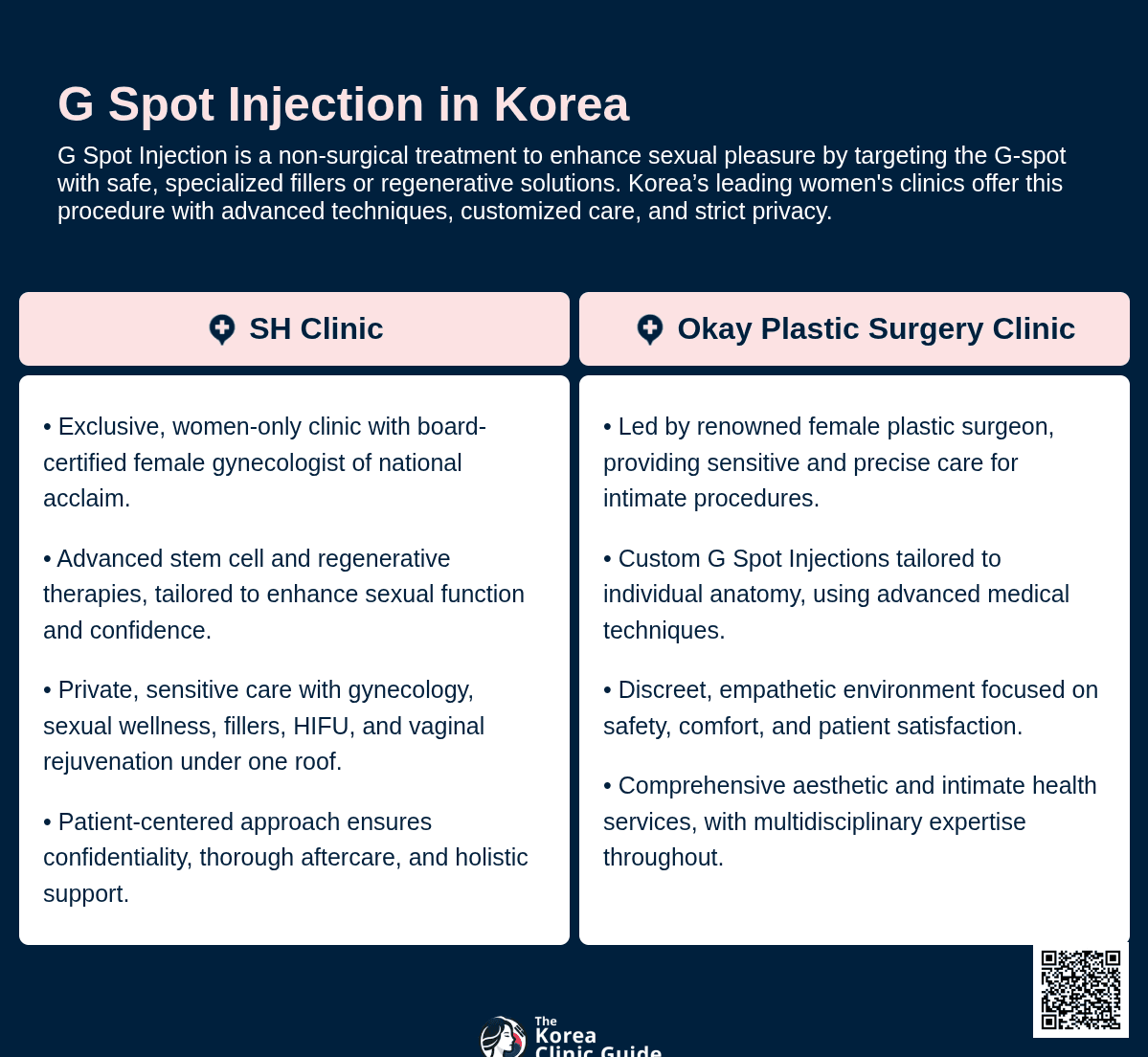
Listed below are the best clinics in Korea for orgasm difficulty:
| Clinic Name | Key Features | Special Techniques |
|---|---|---|
| SH Clinic | All treatments and surgeries performed by a board-certified female gynecologist with national-level recognition; specialized women’s care clinic; supportive and understanding setting for female patients; comprehensive women’s health services from routine gynecology to advanced rejuvenation; focus on patient comfort, privacy, and well-being. | Personalized stem cell therapies for sexual health (including orgasm difficulty); vaginal rejuvenation; vaginal fillers; stem cell injections; HIFU laser procedures; integration of regenerative medicine, aesthetic dermatology, and plastic surgery. |
| Okay Plastic Surgery Clinic | Personalized, patient-centered care; led by a renowned female plastic surgeon; empathetic expert-led treatment; holistic approach to aesthetic and sexual wellness; private and supportive environment; broad range of specialized services; commitment to innovation and best practices. | Tailored solutions for sexual wellness (including orgasm difficulty); body contouring; breast augmentation; facial rejuvenation; advanced skin care; integrated gynecological and aesthetic procedures. |
SH Clinic
SH Clinic in Sinsa, Seoul, is a leading multi-specialty medical center renowned for its expertise in women’s health, gynecologic surgery, and advanced stem cell therapies. At SH Clinic, all surgeries and procedures are personally performed by a highly experienced, board-certified female gynecologist, distinguished with a commendation from Korea’s Minister of Health and Welfare. This specialized women’s care clinic offers a uniquely comfortable and expert environment for female patients, addressing sensitive issues like orgasm difficulty through state-of-the-art solutions tailored to individual needs. Combining regenerative medicine with comprehensive gynecological and aesthetic services, SH Clinic stands out as the premier choice for women seeking effective, discreet, and world-class care for sexual health concerns.
Key highlights of SH Clinic:
- All treatments and surgeries are carried out by a board-certified female gynecologist with national-level recognition, ensuring the highest standards of skill, safety, and sensitivity.
- Specialized women’s care clinic, providing a supportive and understanding setting for female patients.
- Personalized stem cell therapies designed to address sexual health difficulties, including orgasm difficulty, by enhancing sexual function and satisfaction.
- Full spectrum of women’s health services, ranging from routine gynecology to advanced vaginal rejuvenation, vaginal fillers, stem cell injections, HIFU laser procedures, and surgical solutions for sexual function.
- Integration of stem cell-based regenerative medicine, aesthetic dermatology, and plastic surgery, offering holistic and customized care for every patient.
- Comprehensive approach to patient comfort, privacy, and long-term well-being, making SH Clinic the best destination for resolving orgasm difficulty in Korea.
You can check out their website here: SH Clinic Website
Okay Plastic Surgery Clinic
Okay Plastic Surgery Clinic is a leading medical facility in Korea dedicated to providing a transformative and comprehensive approach to aesthetic care. Driven by a team of specialized professionals, including a renowned female plastic surgeon with significant expertise, the clinic places a strong emphasis on individualized treatments rooted in sincerity, precision, and advanced medical techniques. Each patient is offered a tailored solution that addresses their unique aesthetic and medical needs, creating a personal journey of self-improvement and confidence. Okay Plastic Surgery Clinic distinguishes itself not only with its broad range of specialized services, but also with its empathetic and expert-led care—making it a trusted destination for those seeking support for orgasm difficulty and sexual wellness.
Key highlights of Okay Plastic Surgery Clinic:
- Emphasis on personalized, patient-centered care for every individual
- Led by a renowned and experienced female plastic surgeon
- Integrates empathy, expertise, and the latest medical technology
- Offers a holistic approach to both aesthetic concerns and sexual wellness, including orgasm difficulty
- Provides a private, supportive environment tailored to the sensitivities of sexual health concerns
- Extensive range of specialized services spanning body contouring, breast augmentation, facial rejuvenation, skin care, and more
- Proven track record of transformative results and positive patient outcomes
- Continued commitment to innovation and best practices in medical aesthetics and gynecological procedures
With its unique blend of medical skill, understanding of female anatomy, and deep respect for patient privacy and individualized goals, Okay Plastic Surgery Clinic stands out as Korea’s premier choice for those seeking effective solutions for orgasm difficulty.
You can check out their website here: Okay Plastic Surgery Clinic Website
The Process of Getting G-spot Injections in South Korea
South Korea is a top destination for medical tourism, especially cosmetic procedures, thanks to advanced technology, skilled surgeons, and excellent facilities. Medical tourism agencies often help international patients navigate the process smoothly.
Step-by-Step Process:
- Initial Consultation: Usually online, patients share their goals and medical history with agencies or clinics, which match them with suitable doctors.
- Pre-Travel Preparations: Patients should treat any genital infections beforehand and follow hygiene protocols like betadine washes. Avoid blood-thinning medications and alcohol before the procedure.
- Travel and Accommodation: Agencies provide concierge services including airport pickup and help with accommodation, which ranges from budget guesthouses to luxury hotels near clinics.
- Injection Session: On procedure day, anesthetic cream is applied 30 minutes prior. The G-spot is located and injected with the chosen filler in a quick 10-20 minute session.
- Post-Procedure Care: Patients can return to normal activities quickly, with mild discomfort possible. Sexual activity is usually avoided for 24-72 hours. Follow-ups are often included, and agencies assist with ongoing support.
While these services ease travel logistics, they don’t resolve the scientific uncertainties or guarantee long-term follow-up care. Patients should have realistic expectations and understand that complications or dissatisfaction after returning home may be challenging to manage.
Costs and Medical Tourism Comparison
Estimated Costs in South Korea
Reported costs vary widely. Some sources list $500-$1,500 USD, but more consistent data shows around ₩5,600,000 KRW (~$3,855-$4,000 USD) for the procedure alone. Costs depend on clinic reputation, filler type, and location, typically including consultation, injection, and follow-ups without hospital stays. A 10% deposit may be required.
Total Estimated Medical Tourism Cost (One Week):
- Procedure: $3,855 - $4,000
- Flights (round-trip US-Korea): $700 - $1,500
- Accommodation (mid-range): $350 - $1,050
- Local Transport: <$100
- Food/Miscellaneous: ~$300
Total: Approximately $5,305 to $6,950 USD
Cost Comparison Across Countries
| Country | Estimated Procedure Cost (USD) |
|---|---|
| South Korea | ~$3,855 - $4,000 |
| Turkey | From $575 (average $783-$1,652, max $3,564) |
| Thailand (Bangkok) | From $1,330 (average $1,758, max $1,900) |
| United States | ~$1,250 |
| Mexico | No consistent G-spot injection price; fillers $501-$716; vaginoplasty $2,000-$9,500 |
Analysis
South Korea offers advanced care but at a higher price compared to Turkey and Thailand. Turkey is the most affordable, while the US may offer lower prices than Korea for this procedure. Mexico’s pricing is less clear but fillers are cheaper, with more complex procedures costing more. Price differences likely reflect market factors rather than quality or efficacy, especially given the procedure’s unproven status. Patients should not rely solely on cost when choosing providers.
Efficacy, Patient Experiences, and Medical Perspectives
Reported Patient Benefits
Many patients report:
- Increased sexual pleasure, arousal, and more intense orgasms.
- Easier G-spot location and stimulation.
- Shorter time to orgasm.
- Improved natural lubrication and reduced vaginal dryness (especially with O-Shot).
- Enhanced overall sensation and a youthful vulva appearance.
- Improvement in urinary incontinence (noted with O-Shot).
- Some report immediate or quick results.
Scientific Evidence and Medical Stance
Despite positive testimonials, scientific evidence does not support G-spot amplification as an effective treatment for sexual dysfunction.
- Major organizations (ACOG, SOGC, ISSVD) do not recommend these procedures, calling them marketing-driven without rigorous evidence.
- The G-spot’s anatomical existence remains controversial, undermining the rationale for targeted procedures.
- A case report on lipofilling showed no improvement in orgasm despite patient satisfaction.
- A small PRP (O-Shot) study showed significant improvements in sexual function but lacked controls and had a small sample.
- HA injections are intended to enhance normal function, not treat dysfunction.
- Established treatments like psychotherapy and medical therapies have success rates over 70%.
This gap between patient reports and scientific consensus may reflect placebo effects or subjective satisfaction rather than objective efficacy. Patients should understand that "satisfaction" does not always mean clinical effectiveness.
PRP (O-Shot) shows promise but is not FDA-regulated as a drug, meaning it lacks large-scale, controlled trial validation. While generally safe due to its autologous nature, its long-term effects remain less certain.
Potential Side Effects and Complications
- Common Mild Effects: Temporary bleeding, pain, tenderness, swelling, numbness.
- Rare Severe Complications (HA G-Shot): Urinary retention, persistent arousal, hematuria, UTI, scar formation, pelvic pain, vaginal wetness.
- ACOG Warnings: Risks include erosion, urinary obstruction, pulmonary embolus; procedure discouraged.
- PRP (O-Shot) Side Effects: Generally safe; rare reports of continuous arousal, spontaneous orgasm, or urination-triggered arousal.
Conclusion
Orgasm difficulty is a complex issue with many causes, requiring thorough evaluation before treatment. G-spot injections, including HA-based G-Shots and PRP-based O-Shots, are marketed as enhancements but lack strong scientific support and are not recommended by major medical bodies. While some patients report benefits, these often contrast with limited clinical evidence. PRP shows more promise but remains experimental without FDA drug approval. Patients considering these procedures, especially via medical tourism in South Korea, should seek comprehensive evaluation, maintain realistic expectations, research providers carefully, understand risks, and consider established treatments with proven efficacy. Informed decisions prioritize overall health and evidence-based care.
References
1, 2, 3, 4, 5, 6, 7, 8, 9, 10, 11, 12, 13, 14, 15, 16, 17, 18, 19, 20, 21, 22, 23, 24, 25, 26, 27, 28, 29, 30, 31, 32, 33, 34