Medical Tourism Blog
Hymenoplasty in Korea: Methods, Recovery, Travel Planning, and Safety Limits

Table of contents
- Hymenoplasty at a Glance
- What Is Hymenoplasty?
- Who Is a Good Candidate for Hymenoplasty?
- How Is Hymenoplasty Performed?
- Why Visit Korea for Hymenoplasty?
- Key Information for International Patients
- Which Are the Best Clinics in Korea for Hymenoplasty?
- Hymenoplasty From Start to Finish
- Alternatives to Hymenoplasty
- How Can I Prepare for Hymenoplasty?
- Aftercare Advice
Considering treatment in Korea? Everything you need to know e.g. — how to avoid scams, visas, interpreters, recovery tips — in our Medical Tourism Master Guide. Plan with confidence in minutes, not weeks!
Last updated: September 2026
Hymenoplasty at a Glance
- What it does — Hymenoplasty is an elective outpatient operation that reconstructs tissue at the vaginal entrance, usually with absorbable sutures; techniques may join remaining hymenal tissue or use adjacent introital tissue.
- Results are not guaranteed — The procedure cannot prove sexual history or restore medically verifiable “virginity,” and bleeding with later penetration is not a reliable or guaranteed outcome.
- Recovery and restrictions — Soreness, swelling, light spotting, and discomfort sitting or walking are common for the first several days; avoid sex, tampons, sex toys, douching, and all vaginal penetration until the surgeon confirms healing, often at least 4 weeks.
- Who can proceed — Appropriate candidates are independently consenting adults with realistic goals who have been assessed for infection, unexplained bleeding, pain, urinary symptoms, and pregnancy; coercion, threats, or forced-marriage concerns require confidential safeguarding support rather than surgery.
- Key risks and evidence gap — Potential complications include bleeding, infection, wound separation, scarring, narrowing of the vaginal opening, and painful penetration; methods and outcomes are not standardized, and strong comparative safety or durability data are lacking.
- Korea travel planning — International patients should plan 5–7 days in Korea when feasible for an early in-person wound review, use flexible flights, and secure remote follow-up plus local care at home; no study defines a universally safe post-hymenoplasty flight date.
- Korea-specific distinction — Medical Korea’s international-patient registration system can help identify facilities serving overseas visitors, but registration is not evidence of better hymenoplasty outcomes, lower complication rates, or a superior technique.
What Is Hymenoplasty?
Hymenoplasty is an elective operation that reconstructs or changes tissue at the vaginal entrance. It addresses a personal anatomical goal but cannot verify sexual history, restore “virginity,” or guarantee bleeding after later penetration. Hymenoplasty is a surgical procedure, usually performed as an outpatient operation.
Who Is a Good Candidate for Hymenoplasty?
- Independent adult decision-makers — Candidates must be able to give freely made, private, informed consent without pressure from a partner, relative, broker, community member, or threat.
- Patients with realistic anatomical goals — Hymenoplasty changes tissue at the vaginal entrance; it cannot prove sexual history, restore a medically verifiable state of “virginity,” or guarantee bleeding after later penetration.
- People cleared after gynecologic assessment — A clinician must first assess unexplained bleeding, genital or pelvic pain, urinary symptoms, discharge, sores, and possible infection.
- Patients able to protect healing — Plan to avoid vaginal penetration, tampons, sex toys, douching, and friction-producing activities until the operating surgeon confirms healing.
This procedure is unsuitable for minors, anyone unable to consent independently, and anyone whose request is shaped by coercion, violence, trafficking, forced-marriage concerns, or acute safety risks. Elective surgery should be postponed for pregnancy or possible pregnancy, active vulvovaginal, cervical, urinary, or sexually transmitted infection, unexplained genital bleeding, or unassessed pain. Uncontrolled diabetes, significant anemia, bleeding disorders, immunosuppression, and anticoagulant or antiplatelet treatment require individualized medical planning; never stop prescribed medicines without the prescribing clinician and surgeon. Professional guidance is clear that hymenal appearance cannot establish intercourse history, and hymenoplasty is not an evidence-based treatment for vaginal laxity or painful intercourse.
How Is Hymenoplasty Performed?
There is no universally standardized or society-endorsed hymenoplasty technique. Terms such as “temporary” and “permanent” are marketing descriptions, not guarantees of anatomy, durability, or bleeding.
- Hymenal-remnant approximation — Where a residual hymenal rim is present, the surgeon may freshen and bring together tissue edges using absorbable sutures.
- Adjacent-tissue reconstruction — With limited residual tissue, adjacent introital or vaginal tissue can be used to create a partial ring or tissue bridge at the vaginal entrance.
- “Temporary” hymenoplasty — This term generally describes a repair scheduled nearer to anticipated penetration. It has no standardized technique, expected duration, or reliable bleeding outcome.
- “Permanent” hymenoplasty — This usually refers to remnant- or tissue-based reconstruction intended to last longer. It can still separate, scar, or change during healing or later penetration.
- Anesthesia approach — Published retrospective reports include ambulatory procedures under local anesthesia; some facilities use IV sedation or general anesthesia. Available evidence does not show that one anesthetic plan, suture strategy, or surgical method is superior.
Why Visit Korea for Hymenoplasty?
South Korea has international-patient registration pathways that can help patients identify facilities serving foreign visitors. That administrative access does not demonstrate better hymenoplasty results, lower complication rates, or a superior technique.
- International-patient verification — The Medical Korea registered-system information can be one starting point for checking whether a facility participates in an international-patient framework; it is not a procedure-specific quality endorsement.
- Records and communication — Before booking, request written confirmation of language support, private-consultation policy, anesthesia arrangements, complication contact details, operative documentation, and secure remote follow-up.
- Evidence limitation — ACOG notes that evidence for elective female genital cosmetic procedures other than labiaplasty is sparse and outcome reporting is not standardized. No credible comparative research establishes that Korea has better hymenoplasty outcomes than other countries.
- Independent consent remains essential — Medical-tourism logistics, a broker, or a clinic interpreter must never replace confidential time alone with the treating clinician.
Key Information for International Patients
- Recommended stay — Plan 5–7 days in Korea when feasible, with flexible flights and an early in-person postoperative review before departure. This is practical travel planning, not an evidence-based universal flight interval.
- Travel clearance — Do not fly with active or increasing bleeding, suspected infection, wound separation, urinary symptoms, uncontrolled pain, or without surgeon clearance.
- Anesthesia and escort — Local anesthesia without sedation may allow same-day discharge without a companion under some facility policies. IV sedation or general anesthesia commonly requires a responsible adult to escort the patient after discharge and stay overnight; confirm the actual policy before booking accommodation.
- Early recovery — Soreness, swelling, light spotting, and discomfort when sitting or walking can occur during the first several days. Keep the itinerary quiet and avoid cycling, horseback riding, swimming, hot tubs, heavy lifting, and strenuous exercise until cleared.
- Repeat visits and follow-up — Arrange an in-person wound review before leaving Korea where feasible, then secure remote follow-up and identify a gynecologist or urgent-care service at home before travel.
- Privacy planning — Agree on safe contact methods, whether voicemail or email is permitted, who can access records, and how payment or follow-up messages will be described.
Travel note: Do not schedule this surgery immediately before a long-haul flight or an inflexible onward journey. Healing problems need in-person assessment, and no hymenoplasty-specific study defines a universally safe date to fly.
Which Are the Best Clinics in Korea for Hymenoplasty?
Listed below are some of the best clinics in Korea for hymenoplasty.
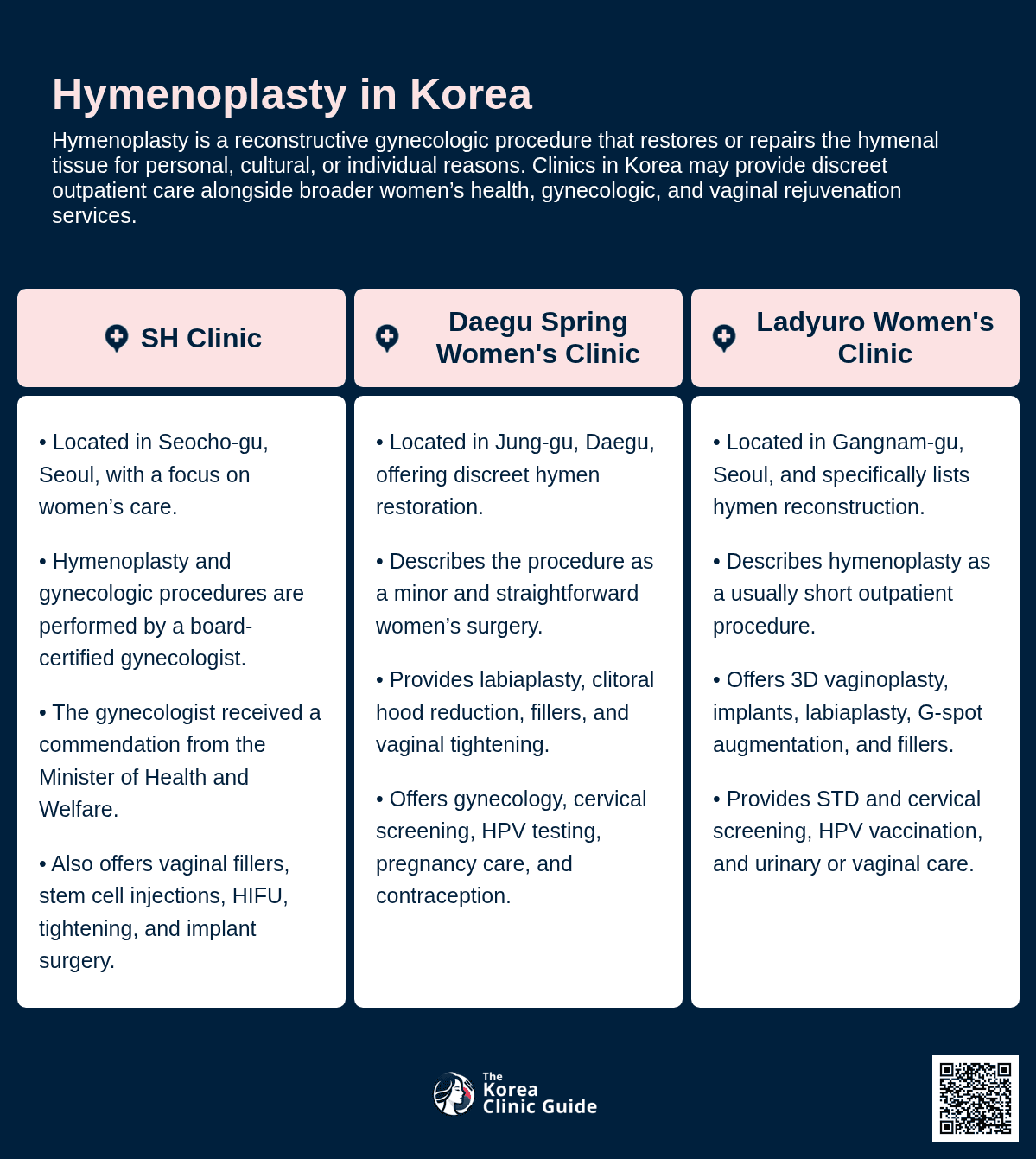
1. SH Clinic
If you are exploring hymenoplasty in Seoul, SH Clinic offers a women’s-care setting where gynecologic procedures are performed directly by an experienced, board-certified gynecologist recognized with a commendation from the Minister of Health and Welfare. You can expect care within a clinic focused on gynecology and vaginal rejuvenation services.
- URL: SH Clinic Website
- Location: Seocho-gu, Seoul
- Gynecologic care:
- The clinic provides general gynecologic care alongside vaginal rejuvenation options.
- Listed vaginal services include vaginal fillers, stem cell injections, HIFU laser treatments, vaginal tightening, and implant surgery.
- Clinician:
- Surgeries and procedures are performed directly by the clinic’s board-certified gynecologist.
- The gynecologist has received a commendation from the Minister of Health and Welfare.
2. Daegu Spring Women's Clinic
At Daegu Spring Women’s Clinic, you can seek hymen restoration—a minor surgical procedure described as straightforward and discreet—for personal or cultural reasons. The clinic also provides broader gynecologic, screening, and vaginal-health services, which may be useful if you want related care assessed in the same setting.
- URL: Daegu Spring Women's Clinic Website
- Location: Jung-gu, Daegu
- Procedure details:
- Hymen restoration is offered as part of the clinic’s women’s external surgery services.
- The clinic describes the procedure as minor, straightforward, and discreet.
- Related women’s services:
- External surgery options include labiaplasty and clitoral hood reduction.
- Vaginal-health options include vaginal pressure measurement, ultrasound-based SonoCare, thermal vaginal treatment, laser tightening, and vaginal fillers.
- General gynecology care includes evaluation and treatment for vaginitis, cystitis, menstrual disorders, abnormal uterine bleeding, menopausal changes, and Bartholin’s cysts.
- Screening and reproductive care:
- Cervical cancer screening includes Pap smears and HPV testing.
- The clinic provides pregnancy management and contraception services.
3. Ladyuro Women's Clinic
You may consider Ladyuro Women’s Clinic for hymenoplasty if you want a clinic that specifically lists hymen reconstruction among its vaginal rejuvenation procedures. The clinic describes hymenoplasty as a usually short outpatient procedure and also offers related gynecologic and vaginal-health services.
- URL: Ladyuro Women's Clinic Website
- Location: Gangnam-gu, Seoul
- Procedure details:
- Hymenoplasty is intended to reconstruct the hymen for personal or cultural reasons.
- The clinic describes it as usually a short outpatient procedure.
- Related procedures:
- Vaginal rejuvenation services include 3D vaginoplasty, Lady Implant, labiaplasty, G-spot augmentation, vaginal laser therapy, and vaginal filler.
- Other listed aesthetic treatments include genital whitening and depilation, as well as Botox for vaginal tightness or muscle spasms.
- Women’s health services:
- The clinic offers STD and comprehensive AIDS testing, plus cervical cancer screening and HPV vaccination.
- Care is listed for urinary incontinence, vaginitis or bladder inflammation, and vaginal dryness or anorgasmia.
Hymenoplasty From Start to Finish
- Confidential first contact — Ask whether an English-speaking clinician or qualified independent interpreter is available and request a private virtual or written pre-screening. Confirm that no partner, family member, broker, or community interpreter will direct the consultation.
- Medical and safeguarding review — Provide medical history, allergies, prior childbirth or genital surgery, current symptoms, bleeding or clot history, anesthesia history, and every prescription medicine, over-the-counter drug, supplement, nicotine product, alcohol, cannabis, and other substance. The clinician should assess independent consent, realistic expectations, safety concerns, and legal considerations.
- In-person gynecologic assessment — The surgeon evaluates the external genital and introital tissues and investigates symptoms requiring standard care, including infection, unexplained bleeding, pelvic pain, urinary symptoms, or possible pregnancy. Pregnancy and STI testing are individualized clinical decisions, not proof of eligibility.
- Technique and anesthesia plan — The surgeon explains whether hymenal remnants can be sutured or whether adjacent introital tissue would be used. Local anesthesia, IV sedation, and general anesthesia have different fasting, medication, discharge, and escort requirements.
- Procedure day — Hymenoplasty is generally an outpatient operation. The surgeon reconstructs tissue at the vaginal entrance with the selected method and usually uses absorbable sutures; operating time depends on available tissue, technique, anesthesia, and any additional evaluation.
- Discharge and accommodation — Leave with written wound-care directions, prescribed medicines, an operative summary, anesthesia record when applicable, emergency contacts, and travel advice. Rest near the facility rather than planning sightseeing or long transfers.
- Early postoperative review — Attend the planned wound check before departure when feasible. The clinician assesses bleeding, swelling, pain, healing, and whether travel is appropriate.
- Remote follow-up at home — Use the agreed secure communication route, retain all records, and seek local urgent gynecologic assessment for heavy bleeding, fever, worsening pain, foul discharge, inability to urinate, wound opening, chest pain, shortness of breath, or one-sided calf swelling.
Alternatives to Hymenoplasty
Hymenoplasty is not an appropriate solution for proving sexual history, ensuring bleeding, treating vaginal laxity, or treating painful penetration. Non-surgical assessment is the safer and clinically relevant route when the underlying issue is safety, infection risk, pelvic pain, anxiety, or a diagnosed anatomical condition.
No Procedure and Accurate Education
- Key fact — Hymenal tissue varies naturally, and neither its appearance nor bleeding after intercourse can establish “virginity.”
- Tradeoff — This avoids surgical risks and false assurances; it does not address external pressure or safety threats, which require confidential support.
Confidential Safeguarding and Sexual-Health Care
- Best suited for — Requests connected to coercion, threats, forced marriage, violence, trauma, contraception, STI concerns, or anxiety about sexual history.
- Tradeoff — This does not reconstruct tissue, but it addresses the actual medical, psychological, and safety issue without creating surgical injury or a promise that cannot be fulfilled.
Pelvic-Pain or Pelvic-Floor Assessment
- Best suited for — Painful penetration, pelvic-floor overactivity, vulvodynia, postpartum symptoms, or unexplained pelvic discomfort.
- Tradeoff — Pelvic-floor physical therapy and specialist gynecologic assessment address pain or function rather than hymenal appearance.
Medically Indicated Hymenal Surgery
- Best suited for — A diagnosed imperforate, septate, or otherwise symptomatic hymenal variant causing obstruction, retained menstrual blood, urinary symptoms, or structural pain.
- Tradeoff — This follows a diagnostic gynecology pathway and differs fundamentally from elective hymen reconstruction.
How Can I Prepare for Hymenoplasty?
- Protect independent consent — Arrange time alone with the clinician and state clearly that no partner, relative, broker, or interpreter may make decisions or remain present for confidential discussion.
- Disclose medicines and supplements — Report anticoagulants, antiplatelets, NSAIDs, diabetes medicines, corticosteroids, hormonal contraception, psychiatric medicines, fish oil, vitamin E, herbal products, and St John’s wort. Do not stop prescribed anticoagulants, antiplatelets, diabetes medicines, psychiatric medicines, or contraception independently.
- Report symptoms before travel — Tell the clinic about discharge, odor, genital sores, fever, urinary symptoms, recent STI exposure, unexpected bleeding, pelvic pain, or possible pregnancy. Elective surgery should wait for appropriate assessment and treatment.
- Follow anesthesia instructions exactly — Local anesthesia, IV sedation, and general anesthesia have different fasting and medication rules. Follow the anesthetist’s written instructions rather than generic online fasting advice.
- Avoid intravaginal products — Do not douche or use tampons, vaginal creams, suppositories, or other intravaginal products unless the surgeon specifically directs it. Confirm whether shaving or waxing is wanted; do not assume hair removal is required.
- Avoid nicotine and alcohol as instructed — Disclose smoking, vaping, nicotine replacement, alcohol, cannabis, and other substances. Follow the surgeon’s specified stop periods because anesthesia and wound-healing advice depends on the anesthetic plan and medical history.
- Plan transport and recovery — Book nearby accommodation, flexible flights, loose breathable underwear, sanitary pads if advised, and original-packaging medicines. Arrange an adult companion if sedation or general anesthesia is planned.
Travel note: No procedure-specific sun restriction is relevant because the operative site is not sun-exposed. Focus instead on privacy, clean accommodation, transport after discharge, and the ability to stay for an early review.
Confirm every clinic-specific medical, fasting, medication, escort, and travel requirement with the treating surgeon and anesthetist before departure.
Aftercare Advice
Protect the surgical site from pressure, friction, contamination, and penetration until the operating surgeon confirms adequate healing.
- Bleeding and hygiene — Light spotting, soreness, swelling, and discomfort with sitting or walking can occur for several days. Use pads if advised; keep the external area clean and dry exactly as instructed, and avoid tampons, douching, and intravaginal products until cleared.
- Penetration restriction — Avoid intercourse, sex toys, tampons, and all vaginal penetration until the surgeon confirms healing. Published instructions often use at least 4 weeks, but there is no validated universal abstinence interval.
- Activity restriction — Walk gently as comfort allows, especially during travel. Avoid strenuous exercise, cycling, horseback riding, heavy lifting, swimming, hot tubs, and activities causing pressure or friction until cleared.
- Warning signs — Obtain urgent surgical or gynecologic assessment for heavy or increasing bleeding, fever or chills, worsening pain, foul-smelling discharge, pus, inability to urinate, increasing swelling, wound opening, protruding tissue, fainting, chest pain, shortness of breath, or one-sided calf pain or swelling.
- Results and expectations — Judge the healed appearance only after swelling has settled. Bleeding with later intercourse is not assured; small retrospective reports do not support treating bleeding as a reliable outcome or proof of sexual history.
Follow the treating doctor’s written instructions over general guidance, attend planned follow-up, and contact the clinic promptly when healing appears abnormal.
Frequently Asked Questions
Related Blogs
Female Incontinence in Korea: Diagnosis, Treatment Options, Travel Planning and Recovery
Female incontinence care begins with diagnosis of stress, urgency, mixed, or other leakage patterns, followed by conservative treatment, medication, injections, neuromodulation, or surgery when appropriate. International patients can find assessment steps, procedure details, Korea stay planning, follow-up needs, recovery restrictions, and warning signs after bladder Botox or sling surgery.
Updated: Sep 21, 2026
Vaginal Implant in Korea: Dreamcore Evidence, Safety, Recovery, and Alternatives
Dreamcore vaginal implant placement uses a permanent silicone band passed through pelvic fascia via vaginal incisions, but evidence is limited to one case report involving concurrent mesh repair and a sling. The article covers candidate assessment, device documentation, a planned 2–3-week Korea stay, travel precautions, recovery restrictions, follow-up needs, warning signs, and established prolaps
Updated: Sep 21, 2026
Laser Labiaplasty in Korea: Techniques, Recovery, Risks, and Travel Planning
Laser labiaplasty permanently reduces or reshapes labia minora tissue using CO2 or Er:YAG laser techniques, with trim, wedge, and selected central reduction approaches. The article covers candidacy, travel and follow-up planning in South Korea, recovery restrictions, preparation, alternatives, and warning signs requiring urgent care.
Updated: Sep 21, 2026
Clitoroplasty with Laser in Korea: Methods, Recovery, Risks and Travel Planning
Laser clitoroplasty may involve reduction, recession, repositioning, or reconstruction, with laser use limited to incision or coagulation rather than a standardized procedure. The article covers candidate screening, risks, Korea travel planning, preparation, recovery, aftercare, and alternatives such as clitoral hood reduction.
Updated: Sep 21, 2026