Medical Tourism Blog
hyperpigmentation face in Korea | Best Clinics, Costs, Procedure Types & More
Table of contents
- Advanced In-Clinic Treatments: A Detailed Examination of IPL and Fraxel Laser
- Best Clinics in Korea for Hyperpigmentation Face
- Dermatological Care in Korea: A Medical Tourist's Guide
- Financial Analysis: Cost of IPL and Fraxel in South Korea vs. Other Nations
- Patient Outcomes and Experiences
- Concluding Recommendations for the Informed Patient
- References
Considering treatment in Korea? Everything you need to know e.g. — how to avoid scams, visas, interpreters, recovery tips — in our Medical Tourism Master Guide. Plan with confidence in minutes, not weeks!
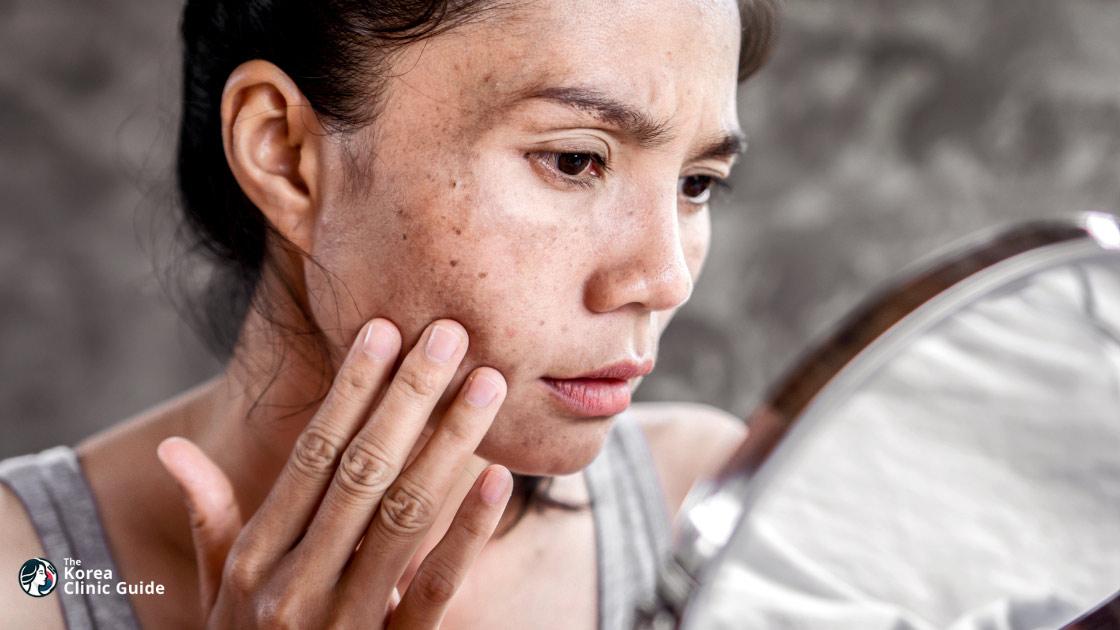
Facial hyperpigmentation is common and harmless, but it can affect confidence. Because different types of pigment behave differently, an accurate diagnosis is key before choosing in-clinic treatments like Intense Pulsed Light (IPL) and Fraxel. This guide explains the condition, compares IPL and Fraxel, and outlines how to safely access expert care in South Korea—often at a fraction of Western prices.
Hyperpigmentation appears as spots or patches that are darker than surrounding skin due to excess melanin. It can look brown, black, gray, red, or pink depending on pigment depth and skin tone. Think of treatment as long-term management, not a one-time cure: triggers like sun exposure, hormones, and genetics persist, so diligent sun protection and skincare are essential to maintain results.
Defining the Condition: Beyond "Dark Patches"
Melanocytes produce melanin to protect the skin, but damage or overstimulation can create concentrated pigment clusters. Eumelanin drives brown/black tones; pheomelanin contributes red/yellow hues. Pigment may sit in the epidermis, dermis, or both—depth influences appearance and treatment difficulty.
Common Pseudonyms and Types of Hyperpigmentation
- Solar Lentigines (Age Spots / Sun Spots): Flat, well-defined tan to dark brown patches caused by chronic UV exposure; unlike freckles, they don’t fade on their own.
- Melasma (Chloasma): Symmetrical brown or gray-brown patches on the face, often linked to pregnancy, oral contraceptives, hormone therapy, genetics, and sun.
- Post-Inflammatory Hyperpigmentation (PIH): Discoloration after acne, eczema, psoriasis, burns, or procedures. More persistent in darker skin tones due to reactive melanocytes.
The Primary Causes: Sun, Hormones, and Inflammation
- Sun Exposure (Photoaging): The top external driver. UV stimulates melanin production and can worsen melasma and PIH.
- Hormonal Fluctuations: Estrogen and progesterone elevate melanin activity; conditions like Addison’s disease can darken skin.
- Genetics: Baseline skin tone and melanocyte activity influence risk; higher Fitzpatrick types are more prone to PIH.
- Medications and Medical Conditions: Some antibiotics, NSAIDs, antimalarials, and tricyclic antidepressants, plus thyroid issues or B12/folate deficiencies, can trigger pigment changes.
The Diagnostic Process: What to Expect from a Dermatologist
A dermatologist reviews medical history, medications, sun exposure, and family patterns, then examines lesion color, pattern, and distribution. A Wood's lamp can help distinguish epidermal vs. dermal pigment. In select cases, blood tests (hormones, thyroid, vitamins, iron) support a tailored plan.
Advanced In-Clinic Treatments: A Detailed Examination of IPL and Fraxel Laser
IPL and Fraxel are proven options, but they work differently and suit different concerns and skin types. Results and safety depend heavily on proper diagnosis and expert technique.
Intense Pulsed Light (IPL) Therapy / Photofacial
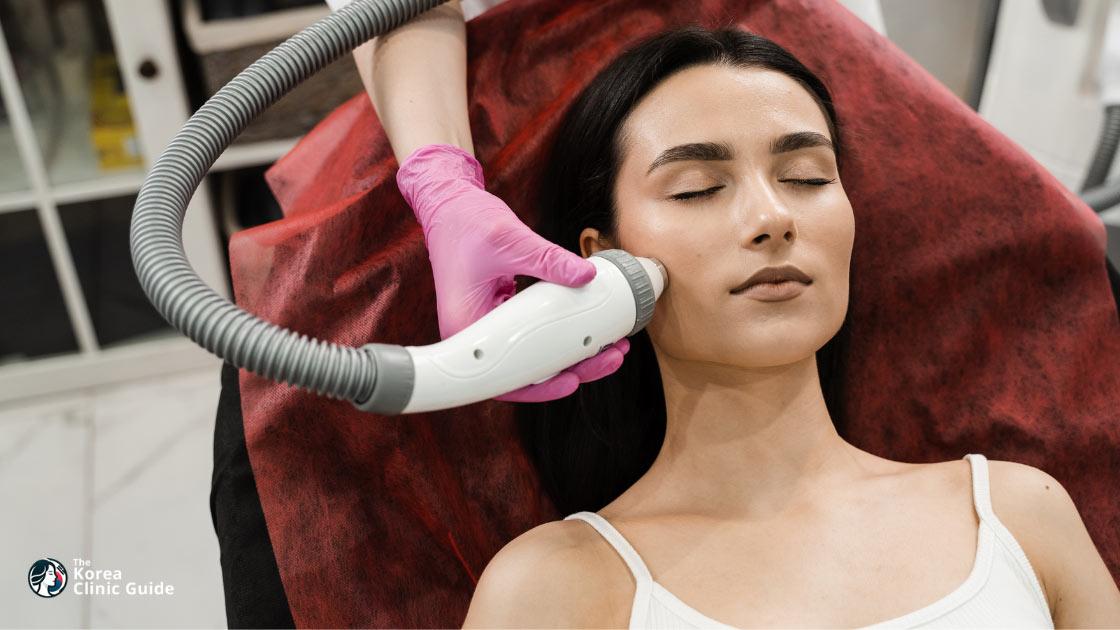
IPL uses broad-spectrum light pulses (not a true laser) to target chromophores like melanin and hemoglobin. Heat breaks pigment into tiny particles that flake off or are cleared internally. It also softens redness and broken capillaries.
- Mechanism of action: Broad-spectrum light pulses target melanin and hemoglobin without ablating the surface.
- Treatment process: Avoid sun/tanning 2–4 weeks pre-treatment; stop photosensitizing meds if advised. Skin is cleansed, cooling gel applied, and pulses delivered with protective eyewear. Sensation feels like a quick “rubber band snapping.”
- Ideal candidate and target concerns: Best for lighter skin tones (Fitzpatrick I–III). Targets solar lentigines, age spots, freckles, uneven tone, diffuse redness, broken vessels, and rosacea symptoms. Higher risk of burns/PIH in darker skin.
- Recovery and results: Mild redness/warmth for hours to 1–2 days. Brown spots darken like “coffee grounds” before flaking off in 7–14 days. Typically 3–6 sessions spaced ~4 weeks apart.
Fraxel Laser (Fractional Laser Resurfacing)
Fraxel uses fractional photothermolysis—thousands of microthermal treatment zones (MTZs) trigger controlled injury while surrounding skin remains intact for faster healing. It exfoliates damaged cells and stimulates collagen and elastin for tone and texture improvement.
The Fraxel DUAL system combines:
-
1927 nm wavelength for sun spots, age spots, and melasma
-
1550 nm wavelength for deeper issues like texture, wrinkles, and acne scars
-
Mechanism of action: Fractional columns remodel pigment and dermal structure while preserving untreated skin for rapid recovery.
-
Treatment process: Avoid sun pre-treatment; stop retinoids/exfoliants 1–2 weeks before. A topical numbing cream is applied for 45–60 minutes; laser passes follow for ~15–20 minutes.
-
Ideal candidate and target concerns: Effective for moderate to severe sun damage, stubborn/deep-seated pigmentation, melasma, post-inflammatory hyperpigmentation, acne scars, surgical scars, fine lines, wrinkles, and texture issues. Usable across a wider range of skin tones with expert settings.
-
Recovery and results: Expect 3–7 days of redness, swelling, “bronzing,” and peeling. Avoid picking. Collagen remodeling peaks at 2–3 months. Typically 3–5 sessions, 4–6 weeks apart.
Direct Comparison: IPL vs. Fraxel
Both treatments share a “darkening before lightening” phase as pigment rises and clears. Expect this temporary change, especially if traveling, to avoid unnecessary concern.
| Feature | Intense Pulsed Light (IPL) | Fraxel Laser (Fractional Resurfacing) |
|---|---|---|
| Technology | Broad-spectrum pulsed light (non-laser) | Fractional, microscopic laser columns |
| Primary Targets | Superficial pigmentation (sun spots, freckles), redness, broken capillaries | Deeper pigmentation (melasma), texture, fine lines, acne scars, sun damage |
| Pain Level | Mild to moderate; "rubber band snap" sensation | Moderate; topical numbing cream required. Feels hot and prickly |
| Downtime | Minimal; 1–3 days of redness, mild swelling | 3–7 days of significant redness, swelling, peeling, and bronzing |
| Typical Sessions | 3–6 sessions | 3–5 sessions |
| Time to See Results | Gradual improvement after each session; final results after full series | Some immediate improvement, with optimal results visible in 2–3 months as collagen remodels |
| Best for Skin Types | Lighter skin tones (Fitzpatrick I–III); high risk of PIH in darker skin | Customizable for a wider range of skin tones, but requires expert practitioner for darker skin |
Skilled operators matter more than the machine brand. Choose a board-certified dermatologist who can diagnose pigment type/depth and set precise parameters for your skin.
Best Clinics in Korea for Hyperpigmentation Face
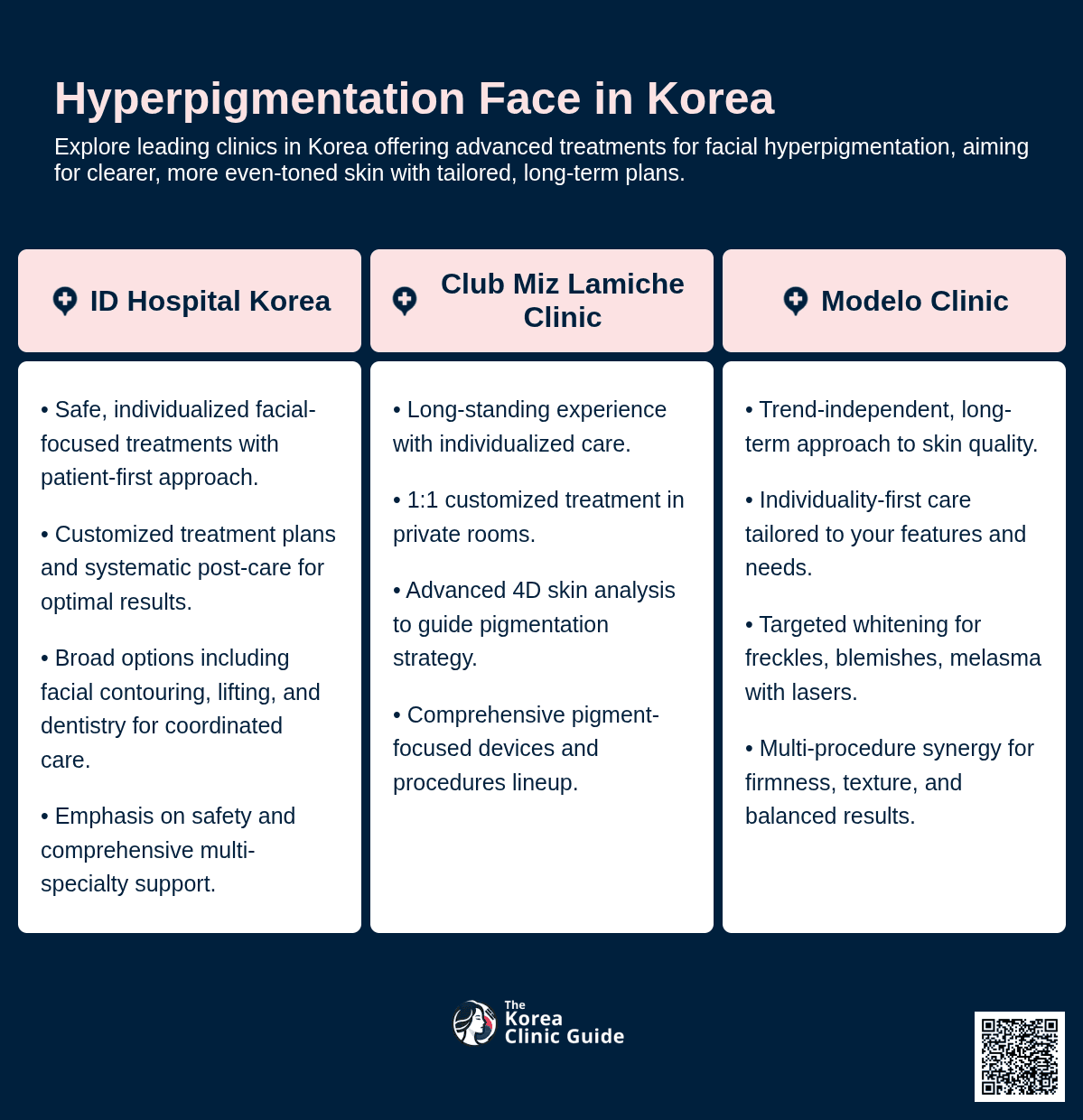
Listed below are the best clinics in Korea for hyperpigmentation face:
| Clinic Name | Key Features | Special Techniques |
|---|---|---|
| ID Hospital Korea | Specialized clinic focused on facial treatments; skin clinic approach centered on patient safety and individualized care for a clearer, more even-toned complexion as part of an overall facial aesthetic plan; customized treatment planning with safety-oriented procedures and systematic post-care; broad range of treatment options including orthognathic surgery, facial contouring, eye and nose plastic surgery, breast surgery, lifting, petit plastic surgery, and dentistry for coordinated care. | Orthognathic surgery, facial contouring, eye plastic surgery, nose plastic surgery, breast surgery, lifting, petit plastic surgery, dentistry |
| Club Miz Lamiche Clinic | Long-standing medical experience combined with individualized care and access to multiple advanced treatment options under one roof; established in 2002, 22 years of clinical expertise for pigment concerns that require careful diagnosis and tailored plans; 1:1 customized treatment in private rooms; advanced 4D skin analysis technology to assess pigmentation patterns and guide a more precise strategy; comprehensive lineup of pigment-focused and tone-correcting devices and procedures; evening hours on Monday, Wednesday, and Friday; open Saturdays; located a 5–7 minute walk from Jamsilsaenae Station (Line 2) and Sports Complex Station (Line 9). | Excel V, Synergy, Picosure, SilpermX, New Accolade, BBL, Mela Star Ruby, Revlight, Elite MPX, Photona |
| Modelo clinic | Modelo Clinic is a patient-centered aesthetic clinic in Korea that does not chase short-lived trends; focuses on achieving beauty that maximizes your values over time; for hyperpigmentation on the face, emphasizes “your beautiful individuality” by tailoring treatment plans to your skin concerns, tone goals, and facial balance, prioritizing natural-looking improvement and long-term skin clarity rather than one-size-fits-all results. | Trend-independent, long-term approach; Individuality-first care; Targeted Whitening for hyperpigmentation: whitening treatments address freckles, blemishes, and melasma using various lasers and combination therapies; Multi-procedure synergy for better results: Comfort Thermage and Thread Lifting; Natural, balanced facial enhancement if needed: Botox (Wrinkle Botox and Contour Botox) and fillers (Fullface Filler and Baby Filler) |
id Hospital Korea
ID Hospital in Korea is a specialized clinic focused on facial treatments, with a commitment to achieving safe and beautiful outcomes. For concerns such as facial hyperpigmentation, its skin clinic approach is centered on patient safety and individualized care, supporting patients who want a clearer, more even-toned complexion as part of an overall facial aesthetic plan.
Known for customized treatment planning, ID Hospital emphasizes safety-oriented procedures and systematic post-care to help optimize results and recovery. Alongside its skin clinic services, the hospital provides a broad range of treatment options including orthognathic surgery, facial contouring, eye and nose plastic surgery, breast surgery, lifting, petit plastic surgery, and dentistry, enabling coordinated care when multiple facial or dental considerations are involved.
Find more about this clinic here: id Hospital Korea Website
Club Miz Lamiche Clinic
Club Miz Lamiche Clinic stands out as a top choice for treating facial hyperpigmentation in Korea because it combines long-standing medical experience with truly individualized care and access to multiple advanced treatment options under one roof. Established in 2002, the clinic brings 22 years of clinical expertise to pigment concerns that often require careful diagnosis and a tailored plan rather than a one-size-fits-all approach. Each patient receives 1:1 customized treatment in private individual rooms, supported by advanced 4D skin analysis technology to assess pigmentation patterns and guide a more precise strategy. This personalized approach is reinforced by the clinic’s comprehensive lineup of pigment-focused and tone-correcting devices and procedures—such as Excel V, Synergy, Picosure, SilpermX, New Accolade, BBL, Mela Star Ruby, Revlight, Elite MPX, and Photona—allowing clinicians to select the most appropriate modality based on the type and depth of discoloration and any accompanying redness. Practical convenience also matters when ongoing sessions are needed: the clinic offers evening hours on Monday, Wednesday, and Friday, is open on Saturdays, and is located just a 5–7 minute walk from Jamsilsaenae Station (Line 2) and Sports Complex Station (Line 9), making consistent, well-planned hyperpigmentation care easier to maintain.
Find more about this clinic here: Club Miz Lamiche Clinic Website
Modelo clinic
Modelo Clinic is a patient-centered aesthetic clinic in Korea that does not chase short-lived trends; instead, it focuses on achieving beauty that maximizes your values over time. For hyperpigmentation on the face, Modelo emphasizes “your beautiful individuality” by tailoring treatment plans to your skin concerns, tone goals, and facial balance, prioritizing natural-looking improvement and long-term skin clarity rather than one-size-fits-all results.
- Trend-independent, long-term approach: Treatments are selected to support lasting skin quality and confidence, not what’s popular for the moment.
- Individuality-first care: Plans are designed around your unique features and needs, helping you look like yourself—only clearer, brighter, and more refined.
- Targeted Whitening for hyperpigmentation: Whitening treatments address freckles, blemishes, and melasma using various lasers and combination therapies to brighten and even overall complexion.
- Multi-procedure synergy for better results: Options like Comfort Thermage and Thread Lifting can support overall skin firmness and texture, complementing pigmentation-focused care for a smoother, healthier-looking face.
- Natural, balanced facial enhancement if needed: Botox (Wrinkle Botox and Contour Botox) and fillers (Fullface Filler and Baby Filler) are optimized for Asian facial structures, supporting harmonious results that enhance facial balance without looking overdone.
Find more about this clinic here: Modelo clinic Website
Dermatological Care in Korea: A Medical Tourist's Guide
South Korea blends high-tech dermatology with competitive pricing and strong support for foreign patients, especially in Seoul’s Gangnam, Myeongdong, and Sinsa districts.
Why South Korea? The Epicenter of K-Beauty and Advanced Dermatology
- Technological advancement and expertise: Clinics use cutting-edge devices, and dermatology training is rigorous. Board-certified dermatologists complete four years of residency and a specialist exam.
- Competitive pricing: Hyper-competition (notably in Gangnam) drives costs far below the US/UK—often 50–70% less—without sacrificing quality.
- Accessibility for foreigners: Many clinics offer English-speaking staff, multilingual coordinators, transparent pricing, and streamlined care for international patients.
The Process for an International Patient: A Step-by-Step Guide
- Initial research and clinic selection: Prioritize clinics with board-certified dermatologists. Verify English-language sites, clear contacts (email/WhatsApp), and credible reviews. Licensed medical tourism agencies can pre-vet clinics, coordinate logistics, and translate.
- Virtual consultation and booking: Send clear photos, goals, and medical history. Expect a preliminary plan and estimate. Deposits are common (around 10%).
- Travel and accommodation: Fly to Incheon International Airport (ICN). Stay near the clinic for convenience; agencies can help arrange lodging.
- In-person consultation and treatment day: Meet your dermatologist with a translator if needed. Digital skin analysis may be used. Confirm plan and full costs before treatment. Payment is usually required upfront. Protocols include cleansing, numbing (Fraxel) or cooling gel (IPL), treatment, and soothing post-care.
- Aftercare and follow-up: Strict sun avoidance, high-SPF sunscreen, and gentle skincare are essential. Plan stays of 1–2 days for IPL and 7–10 days for Fraxel for initial recovery and follow-ups. Keep contact with the clinic or agency after you return home.
Selecting a Clinic: Boutique Care vs. "Factory-Style" Clinics
Gangnam’s many clinics create a “Gangnam Paradox”: great value but overwhelming choice. High-volume “factory-style” clinics may offer lower prices with standardized care, while boutique clinics deliver more personalized, expert-led treatment at higher cost. Don’t choose on price alone—verify doctor credentials, clinic philosophy, technology, and unfiltered patient reviews.
Financial Analysis: Cost of IPL and Fraxel in South Korea vs. Other Nations
South Korea’s pricing is substantially lower than the US and UK, even after factoring in airfare and lodging.
Cost of IPL in South Korea
- Per-session cost: ₩100,000–₩400,000 KRW (
$75–$300 USD). Promotions can dip to ₩40,000 KRW ($30 USD) in high-volume clinics. - Package deals: 3–5 sessions typically ₩300,000–₩800,000 KRW (~$225–$600 USD).
- Cost drivers: Reputation and expertise of board-certified dermatologists, district (e.g., Gangnam), and device quality (e.g., Lumenis M22).
Cost of Fraxel Laser in South Korea
- Per-session cost: ₩250,000–₩700,000 KRW (~$185–$520 USD), up to ~$800 USD at premier clinics.
- Package deals: 3–5 sessions typically ₩900,000–₩2,500,000 KRW (~$670–$1,860 USD).
- Cost drivers: Location, dermatologist reputation, and Fraxel model.
Clinics may suggest add-on treatments (e.g., Laser Toning, vitamin infusions). These can enhance results but raise total cost. Ask for the price of the entire plan, not just one session.
Comparative Analysis: The Global Price Disparity
| Treatment | South Korea (Average Cost) | United States (Average Cost) | United Kingdom (Average Cost) | Potential Savings vs. USA |
|---|---|---|---|---|
| IPL (Full Face) | $100–$300 | $300–$600 | ~$500–$900+ | 50–67% |
| Fraxel Laser (Full Face) | $400–$700 | $1,000–$2,000+ | $900–$1,800+ | 50–70% |
A full course of five Fraxel sessions in South Korea can cost less than a single session in the US, thanks to market competition and operational efficiencies—not lower quality.
Calculating the Total Cost of Care
Budget for:
- Round-trip airfare to Seoul (ICN)
- Accommodation for treatment and recovery
- Daily expenses (food, transport)
- Medical tourism agency fees (if used)
- Contingency funds for unexpected needs
Even with travel costs, total spend often remains below US/UK procedure-only prices.
Patient Outcomes and Experiences
Real-world experiences help set expectations for results and downtime.
Successful Outcomes: Achieving Clearer, More Even-Toned Skin
- Positive IPL experiences: Significant fading of sun spots and redness, brighter tone, and improved luminosity. Studies report up to 70% reduction in UV-related brown spots and redness—and in some cases up to 95% disappearance of sun spots after a full series.
- Positive Fraxel experiences: Often described as “WORTH IT.” Despite tougher downtime, patients report an “incredibly fresh layer of skin,” smoother texture, and lasting tone and texture improvements due to collagen remodeling.
Potential Adverse Outcomes and Complications
- The risk of Post-Inflammatory Hyperpigmentation (PIH): Heat can trigger new or worse pigment, especially in Fitzpatrick IV–VI and some Asian skin. Reports include darker recurrence after IPL with new spots.
- Burns, blistering, and scarring: Can occur with overly aggressive settings or recently tanned skin. Severe burns may cause blistering, texture changes, or permanent scarring; rare reports include fat atrophy and chronic inflammation after IPL.
- Unsatisfactory or uneven results: Poor technique may leave blotchy or “striped” patterns.
Most complications stem from mismatched settings and skin characteristics. Clear pre-procedure counseling on pain, downtime, temporary darkening, and session counts strongly predicts satisfaction.
Critical Considerations for Darker Skin Tones
Marketing claims aside, IPL poses a significant risk to darker skin (Fitzpatrick IV–VI) because devices may not differentiate lesion pigment from baseline melanin. Fraxel—adjusted by an expert—can be safer. Some picosecond lasers are also used for skin of color. Pre-treatment regimens (e.g., hydroquinone or retinoids) help suppress melanocyte activity and lower PIH risk. Strict sun avoidance before and after any procedure is non-negotiable.
Concluding Recommendations for the Informed Patient
Your Pre-Travel Checklist for Success
- Get a definitive diagnosis: Confirm the type (e.g., solar lentigines, melasma, post-inflammatory hyperpigmentation) with a local board-certified dermatologist before planning procedures.
- Prioritize the practitioner, not the price: Choose board-certified dermatologists in South Korea with proven experience treating your skin type and condition.
- Engage a reputable medical tourism agency: For first-timers, agencies help with clinic vetting, translation, and logistics—and serve as an advocate.
- Conduct a thorough virtual consultation: Ask about experience with your skin tone, device choice, session count, risk of PIH, and the all-in cost of the entire plan.
- Commit to the protocols: Adhere to strict sun avoidance, skincare holds (e.g., retinoids), and post-care instructions to minimize risk and maximize results.
The Unwavering Importance of Sun Protection
UV exposure drives hyperpigmentation. Daily broad-spectrum SPF 30+, protective clothing, and vigilant sun habits are essential—especially after IPL and Fraxel, when skin is photosensitive. Without disciplined sun care, pigmentation will recur.
Final Considerations: A Balanced Perspective
South Korea offers world-class dermatology, advanced technologies, and major cost savings for treating facial hyperpigmentation with IPL and Fraxel. Success depends on accurate diagnosis, an expert operator, realistic expectations, and strict aftercare. With a thoughtful plan and the right team, you can safely pursue clearer, more even-toned skin.
References
1, 2, 3, 4, 5, 6, 7, 8, 9, 10, 11, 12, 13, 14, 15, 16, 17, 18, 19, 20, 21, 22, 23, 24, 25, 26, 27, 28, 29, 30, 31, 32, 33, 34, 35, 36, 37, 38, 39, 40, 41, 42, 43, 44, 45, 46, 47, 48, 49, 50, 51, 52, 53, 54, 55, 56, 57, 58, 59, 60, 61, 62, 63, 64, 65, 66, 67, 68, 69, 70, 71, 72, 73, 74, 75, 76