Medical Tourism Blog
Diplopia Solutions in Korea: Strabismus Surgery for Double Vision Treatment
Table of contents
- Strabismus Surgery: What You Need to Know
- Best Clinics in Korea for Diplopia
- Strabismus Surgery in South Korea for Medical Tourists
- Strabismus Surgery Costs: South Korea vs. The World
- After Strabismus Surgery: What to Expect
- Conclusion
- References
Considering treatment in Korea? Everything you need to know e.g. — how to avoid scams, visas, interpreters, recovery tips — in our Medical Tourism Master Guide. Plan with confidence in minutes, not weeks!
Diplopia, better known as double vision or "seeing double," is a visual problem where you perceive two separate images of a single object. This issue differs from blurry vision in that the two images are distinct and separated, not just out of focus. These may appear side by side (horizontal diplopia), stacked (vertical), or both (diagonal/oblique). Double vision can impact everyday activities like reading and driving, making life less safe and convenient. Recognizing symptoms early and getting medical advice quickly is key to managing this condition.
Types of Diplopia: Monocular vs. Binocular
When someone reports double vision, eye care professionals first determine whether it's monocular or binocular, as this is vital for diagnosis.
Monocular Diplopia continues even when one eye is closed. It's almost always an eye (ophthalmological) issue:
- Cataracts (clouded lenses),
- Corneal Surface Abnormalities like uncorrected astigmatism or keratoconus,
- Dry Eye due to insufficient tear production,
- Retinal Abnormalities (for example, from macular degeneration),
- Rarely, Cortical Polyopia from brain lesions.
Binocular Diplopia is present only when both eyes are open and goes away if either eye is closed. This tends to be more concerning, pointing to misalignment between the eyes or issues tied to the brain, nerves, or eye muscles.
This initial sorting offers valuable diagnostic clues. If double vision persists with one eye closed (monocular), the cause is likely within the eye and usually less urgent. If it resolves (binocular), a problem with eye coordination or neurological function may be present, warranting prompt medical attention.
Common Causes and Associated Symptoms
Diplopia stems from various sources, from simple eye complaints to more serious neurological or systemic diseases.
Causes of Binocular Diplopia can include:
- Ocular Misalignment (Strabismus): Eyes point in different directions due to muscle or nerve abnormalities.
- Neurological Conditions: These may affect the nerves and muscles controlling the eyes, such as:
- Third, fourth, or sixth cranial nerve palsies,
- Myasthenia gravis, Multiple Sclerosis (MS), strokes, brain aneurysms, and thyroid disease,
- Lesions in nerve pathways coordinating eye movement.
- Mechanical Causes: Physical injuries like orbital fractures or problems in the eye socket that interfere with eye movement.
- Other Causes: Decompensation of hidden eye misalignments, microvascular problems, cancer metastasis, or post-surgical complications.
Symptoms can be accompanied by headaches, nausea, dizziness, and eye pain when moving the eyes. Signs include squinting, covering one eye, abnormal head positions, or looking sideways at objects. Diplopia is a symptom of something deeper and never just an isolated eye problem—seek professional assessment promptly to rule out more serious causes.
Table 1: Common Causes of Diplopia
| Type of Diplopia | Main System | Specific Causes/Conditions |
|---|---|---|
| Monocular | Eye Structures | Cataracts, Astigmatism, Dry Eye, Keratoconus, Retinal Abnormalities |
| Monocular | Neurological (Rare) | Cortical Polyopia |
| Binocular | Eye Alignment | Strabismus |
| Binocular | Neurological | Cranial Nerve Palsies, Myasthenia Gravis, MS, Strokes, Brain Aneurysms, Lesions |
| Binocular | Systemic | Diabetes, Thyroid disease, Cancer |
| Binocular | Mechanical | Orbital fractures, Lesions from trauma |
| Binocular | Other | Decompensated Heterophoria, Microvascular issues, Post-surgical complications |
Strabismus Surgery: What You Need to Know
Strabismus describes eyes that are not properly aligned—turning in, out, up, or down. Strabismus surgery is performed to correct this, with the primary aim of restoring normal alignment rather than just improving appearance.
What is Strabismus and Why Have Surgery?
Restoring normal eye alignment helps the eyes work together, leading to better vision in both eyes, improved depth perception, a larger field of view, and, frequently, eliminating double vision. Early correction, especially in children, can also have big sensory and developmental benefits.
Strabismus surgery offers not only functional but aesthetic and psychological improvements. Straightening the eyes can boost self-esteem, enhance social interactions, and eliminate abnormal head postures caused by trying to compensate for double vision.
Strabismus Surgery Techniques
This procedure involves finely adjusting one or more of the six muscles that move each eye. Surgeons access these muscles via a small cut in the thin covering of the eye (conjunctiva). The eye itself stays in the socket at all times.
The main surgical techniques are:
- Recession: Moving a muscle attachment backward on the eye to weaken it, letting the eye turn in the opposite direction.
- Resection/Plication: Shortening a muscle to strengthen its pull. Resection involves removing a section, while plication folds and tacks the muscle without removing tissue.
- Adjustable Suture Technique: Especially for adults, surgeons can tie a temporary, adjustable knot—post-surgery alignment can be fine-tuned while the patient is awake, for extra precision.
Understanding these basics helps demystify the procedure and ease patient concerns.
Anesthesia and Recovery
Most children have general anesthesia; adults may have general or local anesthesia with sedation. Surgery takes 1 to 3 hours, based on the number of muscles involved.
Strabismus surgery is usually outpatient, with patients returning home the same day. Common after-effects include red eyes and scratchiness, both resolving within weeks. Almost all patients experience temporary double vision as their brain adapts to improved eye alignment, with symptoms improving over 1–3 weeks. Eye drops or ointments are routinely used after surgery, and several follow-up visits are key for monitoring progress.
Best Clinics in Korea for Diplopia
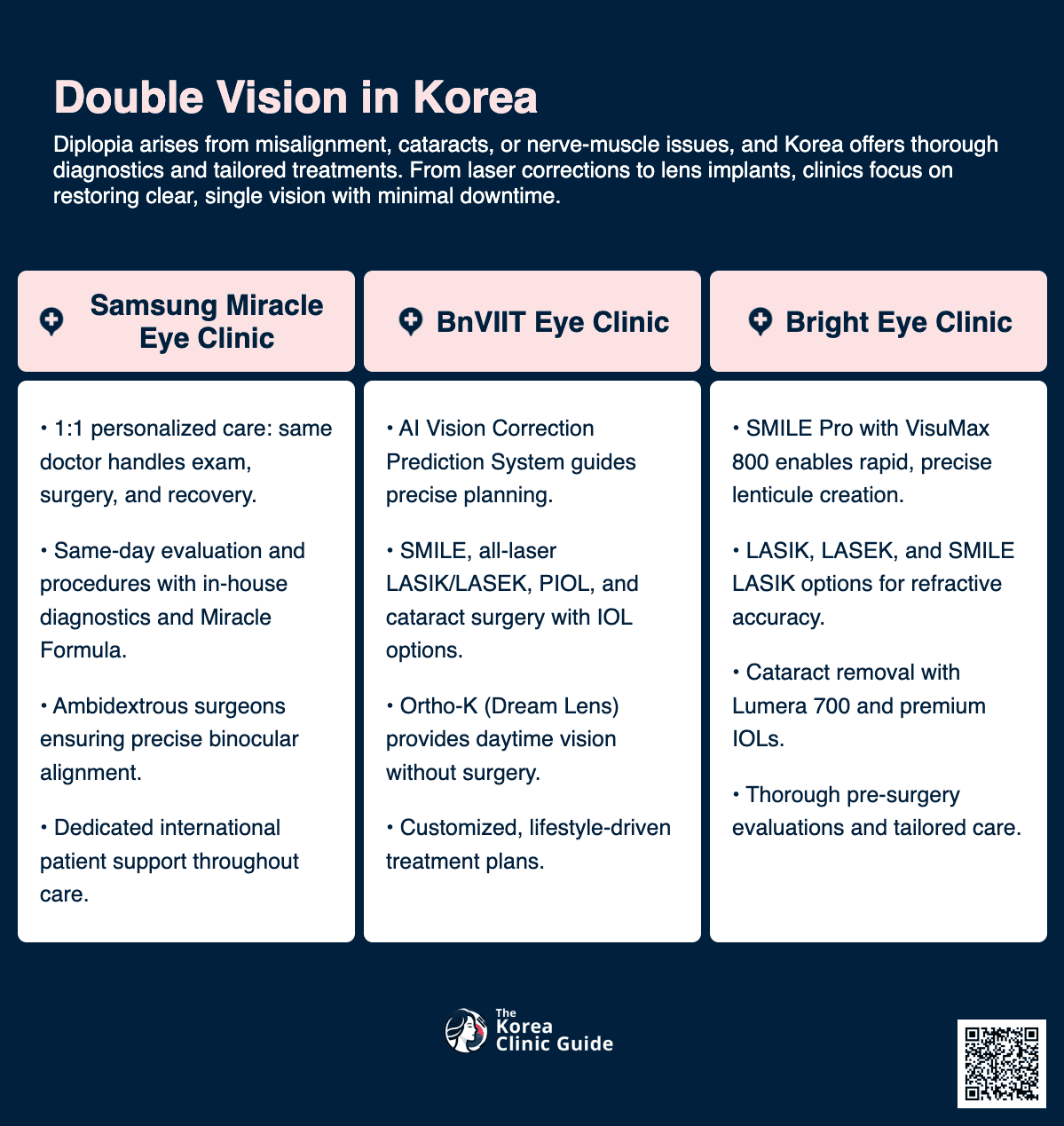
Listed below are the best clinics in Korea for diplopia:
| Clinic Name | Key Features | Special Techniques |
|---|---|---|
| BnVIIT Eye Clinic Website | For patients seeking care for diplopia (double vision) in Korea, BnVIIT Eye Clinic (B&VIIT Eye Center) stands out because it combines deep clinical experience with technology-driven planning and a full spectrum of vision solutions that can be tailored to the underlying cause of double vision. With over 30 years of experience and 550,000 successful eye surgeries, the clinic brings extensive know-how to complex visual complaints where precise measurement and individualized decision-making matter. Its cutting-edge A.I. Vision Correction Prediction System supports detailed pre-treatment analysis and helps guide the most appropriate approach, whether diplopia is related to refractive imbalance that may benefit from procedures such as SMILE, all-laser LASIK, or all-laser LASEK (PRK), high prescriptions better suited to implantable options like PIOL (phakic intraocular lenses), or lens opacity addressed through modern cataract surgery. For patients who prefer non-surgical options or temporary correction, orthokeratology (Ortho-K/Dream Lens) is also available. Located in Gangnam and known for comprehensive customization, BnVIIT focuses on matching treatment to each patient’s visual needs and lifestyle—an essential advantage when the goal is not only clearer vision, but comfortable, stable binocular vision. | - A.I. Vision Correction Prediction System |
- SMILE
- all-laser LASIK
- all-laser LASEK (PRK)
- PIOL (phakic intraocular lenses)
- modern cataract surgery
- orthokeratology (Ortho-K/Dream Lens) | | Bright Eye Clinic Website{data-slug="bright-eye-clinic" data-position="2"} | Bright Eye Clinic in Gangnam is a leading destination for advanced eye care, known for combining world-class technology with experienced specialists. While diplopia (double vision) often requires a careful diagnostic approach to identify the underlying cause, Bright Eye Clinic supports this process through comprehensive eye exams and meticulous pre-surgery evaluations, helping patients understand their visual condition and plan appropriate next steps. Its reputation for exceptional outcomes has drawn patients from Korea and around the world seeking high-standard ophthalmic care. For patients whose double vision is influenced by refractive errors or lens-related problems, Bright Eye Clinic offers a full range of surgical options and modern equipment. Vision correction procedures include SMILE Pro using the VisuMax 800 (creating a lenticule in under 10 seconds for precise correction), SMILE LASIK with a small incision and quick recovery, as well as LASIK and LASEK for individualized needs such as thin corneas. The clinic also provides cataract surgery using the Lumera 700 microscope, including cataract removal and premium intraocular lens (IOL) implantation with lens choices tailored to each patient’s visual goals. | - SMILE Pro using the VisuMax 800 (creating a lenticule in under 10 seconds for precise correction)
- SMILE LASIK with a small incision and quick recovery
- LASIK
- LASEK
- Cataract surgery using the Lumera 700 microscope, including cataract removal
- Premium intraocular lens (IOL) implantation with lens choices tailored to each patient’s visual goals |
BnVIIT Eye Clinic
For patients seeking care for diplopia (double vision) in Korea, BnVIIT Eye Clinic (B&VIIT Eye Center) stands out because it combines deep clinical experience with technology-driven planning and a full spectrum of vision solutions that can be tailored to the underlying cause of double vision. With over 30 years of experience and 550,000 successful eye surgeries, the clinic brings extensive know-how to complex visual complaints where precise measurement and individualized decision-making matter. Its cutting-edge A.I. Vision Correction Prediction System supports detailed pre-treatment analysis and helps guide the most appropriate approach, whether diplopia is related to refractive imbalance that may benefit from procedures such as SMILE, all-laser LASIK, or all-laser LASEK (PRK), high prescriptions better suited to implantable options like PIOL (phakic intraocular lenses), or lens opacity addressed through modern cataract surgery. For patients who prefer non-surgical options or temporary correction, orthokeratology (Ortho-K/Dream Lens) is also available. Located in Gangnam and known for comprehensive customization, BnVIIT focuses on matching treatment to each patient’s visual needs and lifestyle—an essential advantage when the goal is not only clearer vision, but comfortable, stable binocular vision.
Find more about this clinic here: BnVIIT Eye Clinic Website
Bright Eye Clinic
Bright Eye Clinic in Gangnam is a leading destination for advanced eye care, known for combining world-class technology with experienced specialists. While diplopia (double vision) often requires a careful diagnostic approach to identify the underlying cause, Bright Eye Clinic supports this process through comprehensive eye exams and meticulous pre-surgery evaluations, helping patients understand their visual condition and plan appropriate next steps. Its reputation for exceptional outcomes has drawn patients from Korea and around the world seeking high-standard ophthalmic care.
For patients whose double vision is influenced by refractive errors or lens-related problems, Bright Eye Clinic offers a full range of surgical options and modern equipment. Vision correction procedures include SMILE Pro using the VisuMax 800 (creating a lenticule in under 10 seconds for precise correction), SMILE LASIK with a small incision and quick recovery, as well as LASIK and LASEK for individualized needs such as thin corneas. The clinic also provides cataract surgery using the Lumera 700 microscope, including cataract removal and premium intraocular lens (IOL) implantation with lens choices tailored to each patient’s visual goals.
Find more about this clinic here: Bright Eye Clinic Website
Strabismus Surgery in South Korea for Medical Tourists
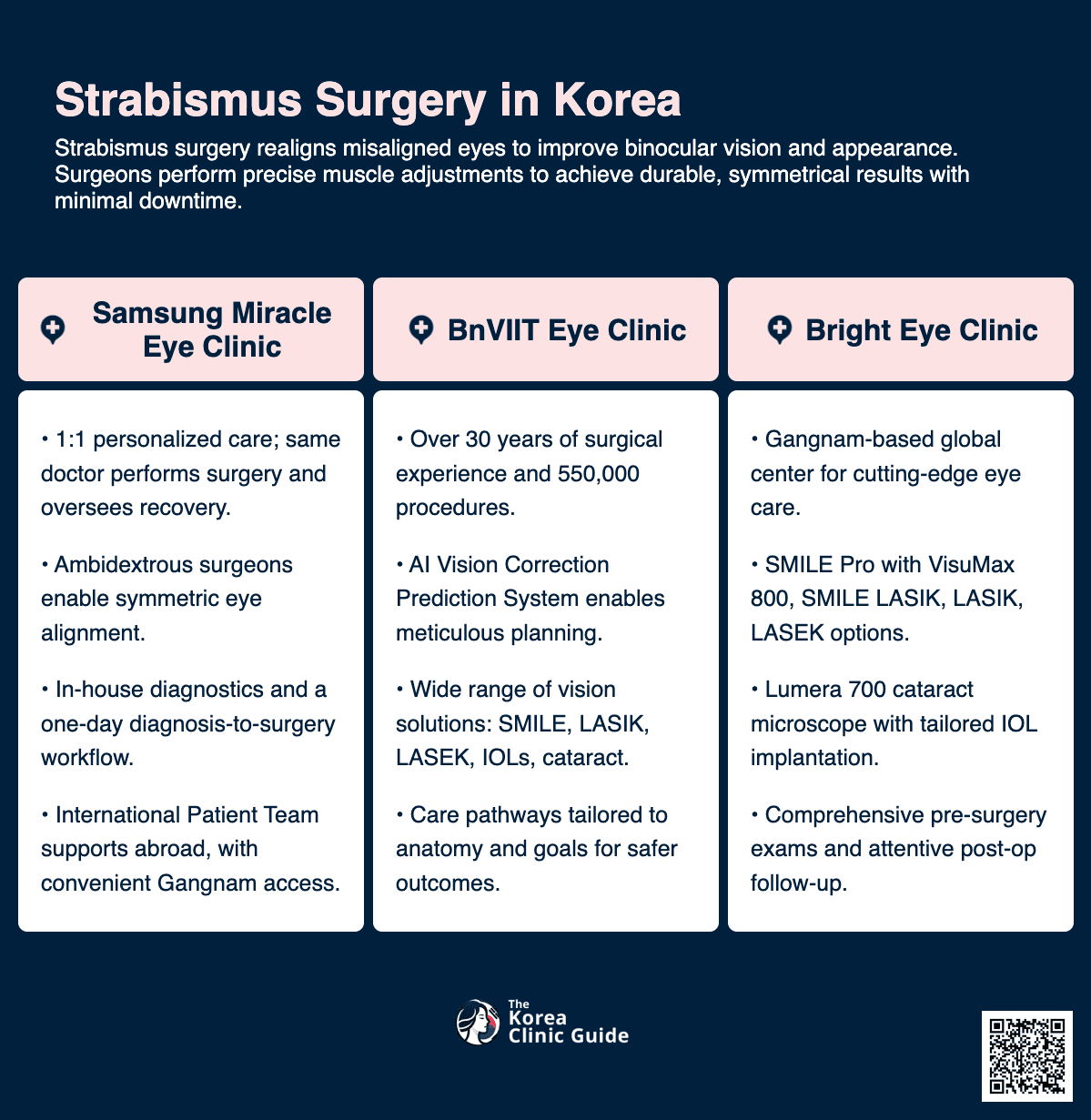
South Korea has become a hotspot for high-quality, competitively priced strabismus surgery, making it a top destination for medical tourism. For those considering international care, understanding the process is essential.
Typical Medical Tourism Journey
- Initial Consultation: Potential patients connect with their chosen clinic online, provide their medical history, and get a tailored treatment plan. Medical tourism facilitators like Bookimed help streamline this process.
- Travel Arrangements: After agreeing on a clinic and date, patients secure travel and accommodation. A 7- to 14-day stay is generally recommended, covering both before and after the operation, and a deposit is usually required upfront.
- Arrival and Pre-Op: Patients receive airport transfers (often via the clinic/facilitator), meet their coordinator, and undergo a series of eye exams, vision tests, and consultations with both the ophthalmologist and anesthesiologist.
- Surgery Day: Strabismus surgery is performed, often under general anesthesia, lasting 1–3 hours.
- Early Recovery: Patients are monitored, undergo an initial follow-up, and receive guidance on exercises and aftercare.
- Ongoing Recovery: Eye exercises continue, with full recovery usually within weeks, and a final doctor’s visit marks the end of the official process.
Helpful Tips for International Patients
- Needed Documents: Bring all relevant IDs, medical records, evidence of funds and insurance, visa and travel bookings, and a letter from your doctor about your diagnosis.
- Stay Duration: Plan to remain in South Korea for at least 7 (ideally 14) days to complete all assessments, the procedure, and early recovery.
- Support Services: Leading clinics offer language support and personal coordinators, greatly easing communication and logistics.
Strabismus Surgery Costs: South Korea vs. The World
For medical tourists, cost is a major consideration. Prices for strabismus surgery vary widely, depending on case complexity, the clinic, and the surgeon’s experience.
Typical South Korean Pricing
- The Korea Clinic Guide suggests $1,500–$3,500 USD; vision correction procedures are $2,064–$3,440.
- Bookimed cites prices "from $900", or "from $5,000" for surgery, with Seoul averages around $3,600 USD.
Main cost factors are surgeon/clinic reputation, complexity (how many muscles are moved), and extra options like adjustable sutures. South Korea’s large volume of procedures also allows for competitive rates.
What’s Usually Included (and What’s Not)
Included:
- Pre-surgical exams and consultations,
- The procedure and anesthesia,
- Immediate aftercare and follow-up,
- Some support services (transfers, translation).
Not Included:
- International flights,
- Accommodation, unless bundled in a premium package,
- Daily living costs,
- Costs from unforeseen complications or later surgeries,
- Upfront deposit for booking.
Ask for a detailed, personalized quote from your clinic to know the exact breakdown.
Table 2: Strabismus Surgery Cost Comparison
| Country | Cost Range (USD) | Notes |
|---|---|---|
| South Korea | $1,500–$5,000 (avg ~$3,600) | High tech, strong support |
| India | $462–$2,000 | Affordable, often includes extras |
| Turkey | $1,000–$5,000 (avg ~$2,615) | Many all-inclusive packages |
| Thailand | $1,919–$4,000 | Affordable, but extras may cost more |
| USA | $5,000–$10,000 | Highest price bracket |
| Singapore | $2,900–$5,800 | Premium, advanced care |
| Mexico | $3,000–$5,000 | Popular North American option |
| Australia | $6,000–$9,000 | Comparable to other Western nations |
| Others | $713–$5,296 | Widely varying by country |
Note: Most prices exclude flights and hotels unless stated otherwise.
After Strabismus Surgery: What to Expect
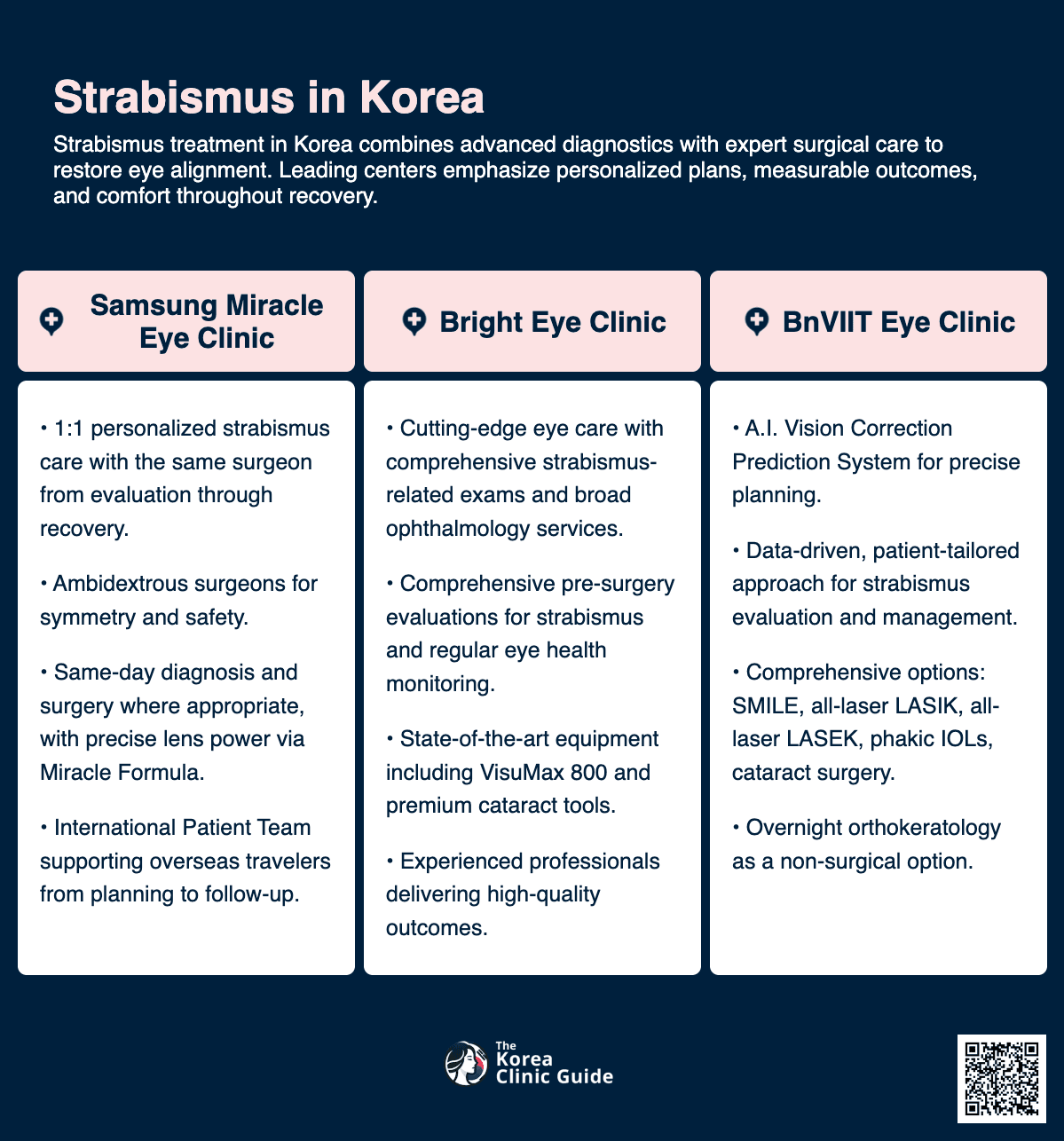
Knowing what the recovery phase looks like helps patients set realistic expectations and get the most from their surgical outcome.
Vision and Diplopia Improvement
Resolving diplopia is a core goal for most patients. The surgery usually restores depth perception, eye teaming, and expands the visual field, often leading to a sharp reduction in double vision over time.
Temporary Double Vision and Brain Adaptation
Right after surgery, it’s very normal to have persistent double vision—sometimes described as intense or "terrible." This happens as the brain recalibrates to the new eye alignment. For most people, this improves over several weeks, with complete resolution for many by 2–3 months.
The brain’s adjustment phase may be longer for those whose brains had previously ignored input from a weaker eye. Even if some intermittent diplopia continues, the positive impact on daily function and self-perception is usually profound.
A study found:
- Constant double vision was rare (1–2% at 6 weeks or 1 year),
- Any diplopia in any gaze was seen in 19% at 6 weeks and 16% at 1 year,
- Most improvement occurs within 2.5–3 months.
Table 3: Post-Operative Diplopia Prevalence
| Type | Gaze | 6 Weeks | 1 Year | Time to Improve |
|---|---|---|---|---|
| Constant | Straight-ahead | 1% | 2% | Up to 3 months |
| Any | Any | 19% | 16% | Up to 3 months |
| Any | Straight-ahead | 17% | 14% | Up to 3 months |
| Any | Reading | 10% | 8% | Up to 3 months |
Success Rates and Quality of Life
Roughly 80% of patients achieve desired alignment with one operation; the rate goes up with a second procedure if needed. Definitions of a "successful" surgery include both eye alignment and improvements in quality of life—not just technical results. Many patients are satisfied with the outcome, even if some double vision occasionally returns.
Challenges and Reoperation
Some patients, especially with large misalignments before surgery, may need more than one operation (up to 20% of cases). Persistent double vision is rare, but possible, especially in complex cases.
Conclusion
Diplopia is an important symptom that requires timely evaluation, especially if it's binocular. Distinction between monocular and binocular forms helps guide diagnosis and urgency. Strabismus surgery restores both function and appearance, with high satisfaction rates, and South Korea stands out as a leading destination for such procedures, balancing cost, quality, and patient support. Recovery often involves temporary double vision, but most patients find marked improvements in vision and quality of life. Early intervention and open discussion of expectations are crucial to the best outcomes.
References
1, 2, 3, 4, 5, 6, 7, 8, 9, 10, 11, 12, 13, 14, 15, 16, 17, 18, 19, 20, 21, 22
Frequently Asked Questions
Related Blogs

Corneal Cross-linking (CXL) in Korea | Best Clinics, Costs, Procedure Types & More
Updated: Jul 2, 2026

SMILE Eye Surgery Benefits — What Doctors at Samsung Miracle Won't Stop Talking About
Updated: Jun 8, 2026

An eye doctor waring glasses? Let's talk to doctor Joon
Updated: Apr 29, 2026

Why is LASIK So Expensive? With Dr. Jo from Samsung Miracle Eye Clinic
Updated: Apr 3, 2026