
Medical Tourism Blog
Skin Whitening Treatment in Korea: Methods, Safety, Recovery and Travel Planning

Table of contents
- Skin Whitening Treatment at a Glance
- What Is Skin Whitening Treatment?
- Who Is a Good Candidate for Skin Whitening Treatment?
- How Is Skin Whitening Treatment Performed?
- Which Are the Best Clinics in Korea for Skin Whitening Treatment?
- Why Visit Korea for Skin Whitening Treatment?
- Key Information for International Patients
- Skin Whitening Treatment From Start to Finish
- Alternatives to Skin Whitening Treatment
- How Can I Prepare for Skin Whitening Treatment?
- Aftercare Advice
Considering treatment in Korea? Everything you need to know e.g. — how to avoid scams, visas, interpreters, recovery tips — in our Medical Tourism Master Guide. Plan with confidence in minutes, not weeks!
Last updated: August 2026
Skin Whitening Treatment at a Glance
- What it treats — This is diagnosis-led management of melasma, post-inflammatory hyperpigmentation, freckles, lentigines, or sun damage—not a single treatment that safely and permanently changes healthy baseline skin color.
- How treatment works — Supervised topical therapy and daily broad-spectrum SPF 50 are the foundation; selected patients may add superficial peels, low-fluence 1,064-nm Nd:YAG laser toning, IPL, or lesion-targeted lasers.
- Results take time — Topical regimens are usually reassessed after 8–12 weeks, while laser toning requires a series of sessions; one Korean series used a median of 10 weekly treatments.
- Recovery — Topicals have no procedural downtime but may irritate skin; laser toning usually causes brief warmth or redness, while superficial peels can cause visible flaking for several days.
- Key limitation — Melasma and PIH can recur with UV or visible light, heat, hormones, or inflammation, so maintenance care and consistent sun protection are more realistic than a permanent result.
- Travel planning — Plan 2–3 days in Korea for consultation and treatment, with a 24–48-hour buffer for local review; arrange photo follow-up at 1–2 weeks and continue any treatment series at home.
- Korea-specific caution — Korean clinics have substantial experience with low-fluence Nd:YAG laser toning, but no universal protocol exists and overly aggressive repeated treatment can cause rebound darkening or mottled hypopigmentation; avoid IV glutathione whitening drips.
What Is Skin Whitening Treatment?
Skin whitening treatment is an umbrella term for diagnosis-led care that reduces unwanted dark spots or uneven pigmentation, rather than changing healthy baseline skin color. It aims to gradually fade concerns such as melasma, sun spots, freckles, or marks left after inflammation while helping prevent recurrence. It is non-surgical and can include topical medicines, sun protection, superficial peels, or selected light-based treatments.
Who Is a Good Candidate for Skin Whitening Treatment?
- Defined pigment concern — Good candidates have a diagnosis-led goal, such as melasma, freckles, solar lentigines, photodamage, or post-inflammatory hyperpigmentation (PIH) after acne, eczema, injury, or inflammation.
- Realistic treatment goals — Suitable patients accept gradual, sometimes partial fading rather than permanent alteration of healthy baseline complexion. Melasma in particular often needs long-term maintenance.
- Commitment to trigger control — Daily broad-spectrum sun protection, management of acne or dermatitis, and avoidance of tanning, friction, and irritating products are central to treatment success.
- Careful procedural candidates — People considering laser toning, IPL, or peels need assessment of Fitzpatrick phototype, pigment depth, previous pigment reactions, and risk of PIH, hypertrophic scars, or keloids.
“Skin whitening” is not itself a diagnosis, and a new, asymmetric, rapidly changing, bleeding, painful, or unusually dark lesion requires medical assessment rather than cosmetic lightening. Delay peels, microneedling, laser, or IPL when there is active dermatitis, infection, open skin, an active cold-sore outbreak, sunburn, or impaired wound healing. Pregnancy and breastfeeding warrant deferral or specialist-led selection of pigment treatment; do not self-start prescription lightening agents or oral tranexamic acid (TXA). Oral TXA requires prescriber screening for thromboembolic, cardiovascular, and menstrual history, relevant medicines including estrogen-containing contraception, and baseline coagulation testing as recommended by expert consensus. Intravenous glutathione should not be used for cosmetic lightening because evidence of benefit is insufficient and adverse effects are a concern.
How Is Skin Whitening Treatment Performed?
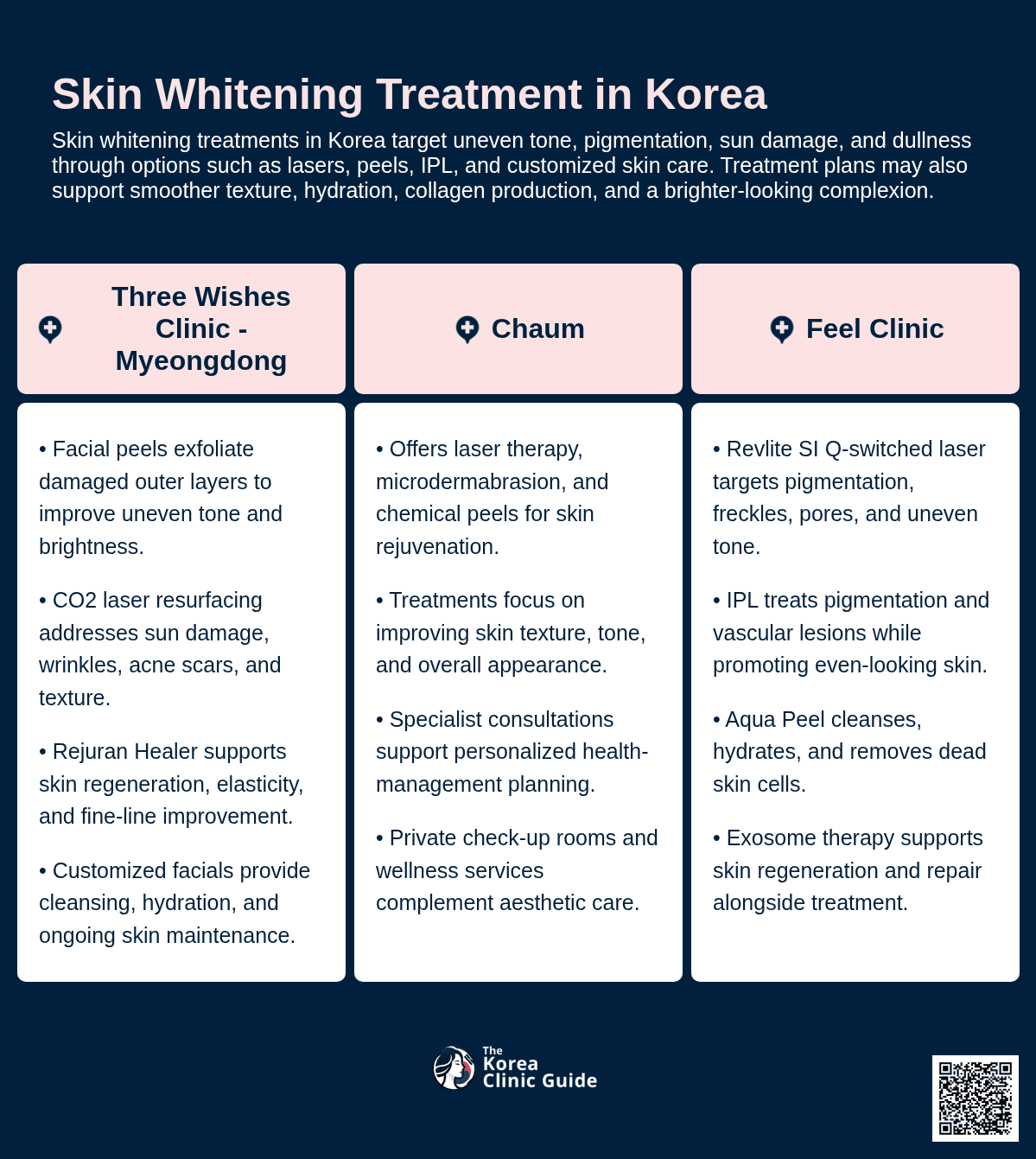
Treatment follows the diagnosis, pigment depth, skin reactivity, and trigger history—not a generic “whitening” menu. For melasma, photoprotection and supervised topical care are the foundation; procedures are selected adjuncts rather than replacements.
- Topical treatment and photoprotection — A clinician may select time-limited hydroquinone, tretinoin, regulated triple-combination cream, azelaic acid, kojic acid, cysteamine, niacinamide, vitamin C, or topical TXA. Hydroquinone needs supervision because irritation and prolonged inappropriate use can worsen pigment problems.
- Superficial chemical peel — Glycolic, lactic, salicylic, or Jessner-type peels create controlled surface exfoliation for selected epidermal pigment. Expect redness, tightness, and visible flaking for several days; aggressive peeling increases the risk of dermatitis and PIH. See chemical peels in Korea.
- Low-fluence 1,064-nm Q-switched Nd:YAG laser toning — Often used for melasma, this non-ablative approach delivers repeated low-energy treatments. Studies suggest improvement is possible, especially with combination topical therapy, but settings and schedules are not standardized; repeated or overly aggressive treatment can cause rebound hyperpigmentation or persistent mottled hypopigmentation. Laser-toning evidence remains heterogeneous with limited long-term recurrence data. Learn more about laser toning.
- Picosecond and lesion-targeted lasers — Pico devices and other pigment lasers can suit selected freckles, lentigines, or refractory pigment concerns, but they are not automatically better for melasma. A randomized-trial meta-analysis found low-certainty evidence and a higher PIH rate for picosecond alexandrite laser than topical creams. See pico toning.
- IPL, fractional laser, or radiofrequency microneedling — These energy-based options address selected diagnoses and accompanying texture concerns, but inflammation can worsen PIH. They are not interchangeable with Nd:YAG toning; network evidence supports combining Q-switched Nd:YAG with topical medication rather than using laser alone.
- Oral TXA — This prescription, commonly off-label option is an adjunct for carefully screened refractory melasma, not a cosmetic supplement or one-visit treatment. It requires continuity of monitoring after travel.
Which Are the Best Clinics in Korea for Skin Whitening Treatment?
Listed below are some of the best clinics in Korea for skin whitening treatment.
1. Three Wishes Clinic - Myeongdong
For skin-brightening goals, you can explore facial peels at Three Wishes Clinic - Myeongdong, which exfoliate damaged outer layers to help improve uneven tone and reveal a brighter, smoother-looking complexion. CO2 laser resurfacing and customized skin-care treatments are also available when texture, sun damage, hydration, or maintenance are part of your concerns.
- URL: Three Wishes Clinic - Myeongdong Website
- Location: Jung-gu, Seoul
- Skin tone and texture options:
- Facial peels are offered for uneven tone, sun damage, fine lines, and mild scars.
- CO2 laser resurfacing removes damaged skin layers and stimulates collagen production; it is described for wrinkles, acne scars, and overall texture improvement.
- Rejuran Healer uses polynucleotide injections intended to support skin regeneration, texture, elasticity, and fine lines.
- Related skin care:
- Customized skin-care treatments can include cleansing, hydration, and maintenance facials tailored to individual concerns.
- PDT acne treatment uses light-activated solutions to target acne-causing bacteria and reduce inflammation.
2. Chaum
At Chaum, you can discuss skin rejuvenation options that include laser therapy, microdermabrasion, and chemical peels to address skin texture, tone, and overall appearance. Its personalized health-care setting also combines specialist consultations with private check-up rooms, which may be useful if you want skin concerns considered alongside broader wellness needs.
- URL: Chaum Website
- Location: Seoul
- Skin rejuvenation options:
- Skin rejuvenation services include laser therapy, microdermabrasion, and chemical peels.
- These treatments are described as aiming to improve skin texture, tone, and overall appearance.
- Care setting:
- Private check-up rooms allow medical specialists and equipment to come to you.
- Specialist consultations and personalized health-management plans are available through its health-care programs.
- Wellness services:
- TheraSpa provides massage, aromatherapy, and hydrotherapy services focused on relaxation and stress relief.
- The Benefit Center offers personalized fitness programs based on individual health needs and fitness levels.
3. Feel Clinic
Feel Clinic offers two directly relevant approaches for uneven pigmentation and tone: Revlite SI, a Q-switched laser treatment described for pigmentation, freckles, pores, and uneven tone, and IPL for pigmentation and vascular lesions. You can also pair these with Aqua Peel cleansing and hydration if improving surface smoothness is part of your plan.
- URL: Feel Clinic Website
- Location: Guro-gu, Seoul
- Pigmentation and tone treatments:
- Revlite SI uses Q-switched laser technology for pigmentation, freckles, pores, and uneven skin tone.
- IPL uses broad-spectrum light to treat pigmentation and vascular lesions while promoting more even tone and texture.
- Laser tattoo removal is available as a separate treatment and is described as requiring multiple sessions for gradual removal.
- Complementary skin care:
- Aqua Peel deeply cleanses and hydrates while removing dead skin cells.
- Exosome therapy is offered to support skin regeneration and repair.
- Related acne care:
- Dermacne uses laser therapy to reduce acne inflammation and help prevent future breakouts.
- PDT combines light and photosensitive agents for severe acne, targeting sebum production and acne-causing bacteria.
Why Visit Korea for Skin Whitening Treatment?
Korea has established clinical familiarity with pigment-focused dermatology, including low-fluence Nd:YAG laser toning. Its regulated cosmetic market also distinguishes functional cosmetics claiming to aid skin whitening from ordinary cosmetics. Neither fact proves that a particular clinic, injection, product, or protocol will be safer or more effective.
- Laser-toning experience — Korean dermatology research includes substantial experience with low-fluence Q-switched 1,064-nm Nd:YAG protocols for melasma, although published schedules range from weekly treatments to two-week intervals and no universal protocol exists.
- Functional-cosmetic oversight — Korea’s Ministry of Food and Drug Safety regulates cosmetics making functional skin-whitening claims through its functional-cosmetics framework. This is product regulation, not proof of clinical efficacy for a clinic treatment.
- Choice of adjunctive approaches — Consultations can distinguish topical therapy, superficial peels, laser toning, pico-toning, IPL, and combination care according to diagnosis. Request the exact device model, wavelength, planned settings where appropriate, medication names and concentrations, test-spot policy, and complication plan rather than accepting “whitening” marketing.
- Important evidence limit — There is no high-quality evidence for a durable, acceptably safe method to lighten normal baseline complexion throughout the body. Glutathione studies are short-term, mixed in quality, and do not establish durable results.
Key Information for International Patients
- Minimum stay — Plan 2–3 days for consultation plus a non-ablative laser or superficial peel. This practical buffer allows a local review within 24–48 hours if redness, swelling, blistering, or pigment change develops.
- Repeat visits — Do not expect to complete melasma treatment in one trip. Topical regimens are generally assessed after 8–12 weeks, while laser-toning programs involve repeated sessions; one Korean series used a median of 10 weekly sessions.
- Flights — No established no-fly interval applies after uncomplicated, non-sedated non-ablative laser or superficial peeling. Keep a 24–48-hour observation buffer before a long-haul flight, and do not begin systemic TXA just before travel without clinician-led clot-risk assessment.
- Itinerary impact — Topical care has no procedural downtime but can irritate skin over days to weeks. Laser toning commonly causes short-lived warmth or erythema; superficial peels can leave visible scaling for several days. Avoid scheduling beach, ski, sauna, or high-heat activities immediately afterward.
- Remote follow-up — Arrange secure photo review at about 1–2 weeks after an energy-based treatment and identify a dermatologist at home for medication monitoring, relapse care, or complications.
- Companions and transport — A companion is usually unnecessary for topical care, non-ablative laser, IPL, or superficial peel without sedation. Arrange hotel transport and a companion if sedatives, anxiolytics, or strong pain medicine are used.
Travel note: Bring written aftercare, exact product names and concentrations, device details, and an urgent-contact number before leaving Korea. Complete a treatment series at home unless repeat travel is clinically sensible.
Skin Whitening Treatment From Start to Finish
- First contact and virtual review — Submit unfiltered daylight photographs, the exact areas of concern, prior treatment history, and a complete medication list. Ask whether an English-language or virtual consultation is available, and request the proposed diagnosis, treatment method, expected session number, spacing, test-spot plan, and overseas complication pathway.
- In-person assessment — The clinician reviews distribution and pigment depth, Fitzpatrick phototype, UV and visible-light exposure, heat, hormones, pregnancy history, acne, eczema, friction, medicines, and past PIH. Atypical lesions may need dermoscopy, biopsy, or referral instead of cosmetic treatment.
- Safety screening and planning — Topical treatment, superficial peels, IPL, and non-ablative facial laser normally do not require routine blood tests. Oral TXA requires a prescriber-led thrombotic-risk assessment and coagulation testing; decline IV glutathione or “whitening drips.”
- Treatment-area preparation — Staff cleanse the skin, take baseline photographs, and provide protective eyewear for laser or IPL. A test spot can be appropriate for pigment-reactive skin or when the diagnosis and response risk are uncertain.
- Outpatient treatment — The clinician applies topical therapy or performs a superficial peel, IPL, or non-ablative laser treatment with cooling when needed. These treatments usually require no fasting, general anesthesia, hospitalization, or sedation; appointment duration depends on the area and method.
- Discharge instructions — Leave with written product directions, a bland-moisturizer and sunscreen plan, warning signs, and a direct contact route. Arrange a local review within 24–48 hours if there is concerning redness, swelling, blistering, or pigment change.
- Remote review and maintenance — Send standardized photographs at approximately 1–2 weeks after an energy-based procedure. Reassess topical treatment at 8–12 weeks before changing the regimen, and schedule further procedures only after the skin has settled and the response has been evaluated.
Alternatives to Skin Whitening Treatment
The best alternative depends on whether the concern is melasma, PIH, freckles, lentigines, or normal baseline complexion. Non-surgical options avoid surgery but still carry pigment and irritation risks; for stable healthy complexion, choosing no lightening treatment is a valid option.
Diagnosis-Led Pigmentation Care
- Targeted treatment — Pigmentation treatment focuses on identifying the cause and using topical therapy, trigger control, and selected procedures rather than pursuing generalized lightening.
- Best fit — Appropriate when acne, eczema, friction, hormonal factors, or sun exposure are driving recurrent discoloration.
Laser Toning
- Treatment focus — Laser toning uses repeated low-fluence Nd:YAG sessions as an adjunct for selected melasma or diffuse pigmentation.
- Tradeoff — Limited immediate downtime, but several sessions, strict photoprotection, relapse risk, and possible mottled hypopigmentation.
Pico Toning
- Treatment focus — Pico toning uses picosecond laser technology for selected pigment concerns.
- Tradeoff — It is not universally superior to conventional laser toning, and PIH remains a material risk in pigment-reactive skin.
Superficial Peels
- Treatment focus — Chemical peels can support treatment of selected superficial, epidermal pigment.
- Tradeoff — Several days of flaking and a meaningful PIH risk if the peel is too strong or skin is inflamed.
No Cosmetic Lightening
- Treatment focus — Continue sun protection and manage any underlying skin disease without attempting to change normal skin color.
- Tradeoff — This avoids procedure and systemic-treatment risks, particularly where no medical pigment disorder is present.
How Can I Prepare for Skin Whitening Treatment?
- Send accurate information early — Provide unfiltered daylight photographs and disclose all medicines, supplements, allergies, hormones, anticoagulants or antiplatelets, isotretinoin exposure, prior pigment procedures, cold-sore history, clotting history, pregnancy, and breastfeeding status.
- Do not stop prescribed medicine independently — Ask the prescribing clinician and treating doctor whether any medicine needs adjustment. Oral TXA requires specific review of estrogen-containing contraception, clotting history, cardiovascular risk, and menstrual abnormalities.
- Avoid tanning and irritation — Prevent sunburn and tanning before travel. Stop newly introduced or irritating skincare only when instructed by the treating clinic; inflamed skin raises the risk of PIH.
- Plan photoprotection — Bring broad-spectrum SPF 50 sunscreen. For melasma, ask whether tinted sunscreen containing iron oxides is appropriate because visible light can be a trigger.
- Fasting and alcohol — No fasting is ordinarily needed for topical care, superficial peels, IPL, or non-ablative facial laser without sedation. Avoid alcohol around treatment if the clinician advises it, and follow different instructions if sedation or a stronger procedure is proposed.
- Book flexible travel logistics — Keep 24–48 hours in Korea after treatment, avoid direct-sun activities, and book accommodation with easy transport to the clinic. Arrange a companion and hotel transport only if sedation is planned.
Travel note: Do not schedule a first systemic pigment treatment immediately before a long-haul flight. Obtain a written plan for complications and follow-up at home.
Confirm the treating doctor’s individualized requirements, which take precedence over general preparation guidance.
Aftercare Advice
Protect treated skin from inflammation and light exposure: both can worsen pigmentation and undo early improvement.
- Use gentle skincare — Apply bland moisturizer and prescribed products exactly as directed. Do not introduce exfoliating acids, retinoids, scrubs, or other active products until the clinician confirms that the skin has recovered.
- Do not pick or rub — Leave flaking skin, crusts, and blisters intact. Friction and picking increase the risk of infection, scarring, and PIH.
- Block UV and visible light — Apply broad-spectrum SPF 50 every day and reapply as directed. Use shade, hats, and physical coverage; for melasma, use tinted iron-oxide sunscreen when recommended.
- Avoid heat and exertion while inflamed — Skip sauna, hot baths, vigorous exercise, tanning, direct sun, and facial friction until redness, warmth, swelling, and peeling resolve.
- Know when to contact the clinic — Seek urgent advice for escalating pain, blistering, crusting, pus, spreading rash, facial swelling, fever, herpes-like lesions, sharply worsening darkening, or pale mottled patches.
- Track results realistically — Topical treatment is generally reviewed at 8–12 weeks. Laser-toning results develop across repeated sessions; melasma and PIH can relapse after UV or visible-light exposure, heat, hormonal triggers, inflammation, or stopping maintenance care.
Follow the treating doctor’s instructions over general advice and contact the clinic promptly when anything appears wrong.
Frequently Asked Questions
Related Blogs
Filler Dissolver in Korea: Hyaluronidase Methods, Recovery, Risks, and Travel Planning
Filler dissolver uses targeted hyaluronidase injections to reduce confirmed or suspected hyaluronic-acid filler causing lumps, migration, asymmetry, discoloration, or excess volume, with ultrasound available for uncertain or deep deposits. International patients can plan consultation, treatment, early review, aftercare, travel timing, documentation, and emergency follow-up, while urgent pain, skin
Updated: Sep 19, 2026
Inmode Lifting in Korea: Forma, MiniFX, Results, Recovery and Travel Planning
InMode lifting uses contact or suction-coupled radiofrequency handpieces, such as Forma and MiniFX, for mild laxity, early jawline softness, texture concerns, or selected contour areas. The article covers candidacy, Korea travel planning, treatment steps, recovery, aftercare, warning signs, and alternatives.
Updated: Sep 19, 2026
Knee Whitening in Korea: Methods, Safety, Recovery, and Travel Planning
Knee whitening begins with dermatology assessment, trigger control, and topical care, with selected patients receiving superficial peels or conservative laser after a test spot. Korea listings start at ₩30,000; plan 3–5 days, obtain English treatment records, and follow friction, sun, and aftercare restrictions.
Updated: Sep 19, 2026
Armpit Whitening in Korea: Diagnosis, Treatment Methods, Recovery, and Travel Planning
Armpit whitening begins with diagnosing the cause of darkening, then uses trigger control, clinician-directed topicals, superficial peels, or selected low-fluence laser/IPL. In Korea, listed cost is KRW 30,000; allow 2–3 days, plan follow-up, and avoid treatment on irritated or infected skin.
Updated: Sep 18, 2026
Clinics offering Skin Whitening Treatment

Three Wishes Clinic - Myeongdong, Korea: Advanced Botox, Fillers, Laser, and Skin Treatments for Confidence and Care
Myeongdong

Seojin Plastic Surgery Clinic Korea: Pioneering Advanced Cosmetic Procedures for Personalized Aesthetic Transformation
Apgujeong
Chaum Clinic Korea: Personalized Health Care, Anti-Aging, and Wellness Services in Sinnonhyeon Station
Apgujeong

Ladyuro Women's Clinic in Korea: Premier Destination for Vaginal Rejuvenation and Aesthetic Enhancements
Sinsa