Medical Tourism Blog
Torr Lifting in Korea: Treatment Process, Safety, Recovery, and Travel Planning
Table of contents
- Torr Lifting at a Glance
- What Is Torr Lifting?
- Who Is a Good Candidate for Torr Lifting?
- How Is Torr Lifting Performed?
- Why Visit Korea for Torr Lifting?
- Key Information for International Patients
- Which Are the Best Clinics in Korea for Torr Lifting?
- Torr Lifting From Start to Finish
- Alternatives to Torr Lifting
- How Can I Prepare for Torr Lifting?
- Aftercare Advice
Considering treatment in Korea? Everything you need to know e.g. — how to avoid scams, visas, interpreters, recovery tips — in our Medical Tourism Master Guide. Plan with confidence in minutes, not weeks!
Last updated: September 2026
Torr Lifting at a Glance
- What it is — Torr Lifting is a noninvasive external radiofrequency treatment using the TORR RF/MTX-C1 handpiece, which is moved over the skin without needles, threads, incisions, or sedation.
- Best suited concerns — It is most appropriate for gradual, modest improvement in mild-to-moderate laxity, fine lines, early jawline or neck softness, and selected cellulite or skin-texture concerns—not major sagging, excess skin, or a large fat deposit.
- Results and evidence — Any collagen-remodeling change should be assessed around 6–12 weeks, but no independent TORR-specific studies establish result size, longevity, ideal session number, or maintenance schedule.
- Recovery — Light activity is usually possible immediately; warmth, redness, mild swelling, tenderness, or tightness generally settle within hours to 1–3 days based on broader external-RF evidence.
- Key risks and exclusions — Burns, blisters, pigment changes, numbness, and scarring are possible; treatment should not be performed over pacemakers, defibrillators, metal beneath the skin, or tattoos containing metal pigment.
- Korea travel planning — Allow 1–2 days in Korea for an uncomplicated stand-alone session, avoid scheduling immediately before a major event, and arrange remote follow-up before departing.
- Korea-specific verification — TORR is marketed as a Korean-made platform, but this does not prove better outcomes; confirm the exact MTX-C1 device and its current Korean authorization because publicly available product-registration information is unresolved.
What Is Torr Lifting?
Torr Lifting is an external radiofrequency treatment that warms the skin without needles, threads, or incisions. It aims for gradual, modest improvement in mild skin laxity, fine lines, early jawline or neck softness, and selected body texture or cellulite concerns. Torr Lifting is non-surgical and noninvasive, with results varying by anatomy and treatment plan.
Who Is a Good Candidate for Torr Lifting?
- Mild laxity and skin-quality concerns — Good candidates want gradual improvement in mild-to-moderate facial or neck laxity, fine lines, early jawline softness, or selected body skin-texture and cellulite concerns.
- Realistic treatment goals — Torr Lifting is an external RF treatment, not a surgical lift, thread lift, HIFU procedure, or RF microneedling. Broader noninvasive facial-RF evidence supports modest improvement in selected patients, not dramatic repositioning of sagging tissue.
- Intact, healthy treatment skin — The planned area should be free of sunburn, wounds, infection, herpes lesions, dermatitis or eczema flares, severe inflammatory acne, and unexplained rashes.
- Anatomy suited to noninvasive treatment — Early skin looseness and texture concerns are more appropriate than substantial excess skin, marked facial ptosis, pronounced platysmal neck bands, or a large localized fat deposit.
External RF is not appropriate directly over an active implanted electronic device such as a pacemaker or defibrillator, or over metal beneath the skin; the FDA submission also lists metal-containing tattoo pigment as a reason not to treat the tattooed area. Review an IUD, retained metal, fillers, threads, silicone, implants, prior surgery, neuropathy, impaired healing, uncontrolled diabetes, immunosuppressive treatment, isotretinoin use, and recent procedures in the same zone before booking. Defer elective treatment during pregnancy because safety data are inadequate; breastfeeding requires device-specific, individualized advice. No Torr-specific age threshold was identified, so elective treatment in younger patients requires a clinician’s assessment of skin development, expectations, and the reason for treatment. The MTX-C1 FDA record documents these device-related restrictions, but it does not establish Torr-specific aesthetic outcomes.
How Is Torr Lifting Performed?
Torr Lifting uses the TORR RF/MTX-C1 platform externally: a clinician moves a handpiece continuously across the skin rather than inserting needles, threads, or probes. The available specifications describe technical options, not evidence-based protocols for facial lifting or fat reduction.
- Handpiece selection — The manufacturer describes a 20-mm micro handpiece for delicate or periorbital areas, a 40-mm handpiece for the face, and a 50-mm handpiece for body areas. Claimed approximate treatment depths are 1.5–2 mm, 2.5–6 mm, and 3.5–10 mm respectively.
- Bipolar 1-MHz RF delivery — FDA 510(k) K212561 identifies MTX-C1 as a bipolar 1-MHz RF system used with a continuous rubbing or massage technique. Bench testing in the submission described superficial skin temperatures of 40–45°C.
- Mode and pulse settings — The manufacturer describes LOW and DEEP modes and selectable single, pulse, and repeat delivery. The provider should explain how settings and handpiece choice relate to the specific area, skin thickness, prior procedures, and heat tolerance.
- Temperature monitoring — TORR promotional materials describe skin-temperature monitoring and automatic cutoff. This feature does not remove the risk of overheating, burns, pigment change, or scarring, and no independent Torr-specific clinical protocol was identified. Manufacturer specifications should not be confused with independent efficacy evidence.
Why Visit Korea for Torr Lifting?
Torr Lifting is marketed in Korea as a Korean-made TORR RF treatment, so it is available through Korean aesthetic clinics. That availability does not demonstrate superior results in Korea, and Torr-specific clinical outcome studies were not identified. Verify the exact device and its current Korean authorization before paying a deposit.
- Access to the named platform — TORR RF/MTX-C1 is marketed by BRITZMEDI with facial, micro, and body handpieces, allowing clinics to plan treatment by anatomical zone rather than using one applicator for every area. The manufacturer’s product information is technical and promotional material, not clinical proof.
- Regulatory verification is essential — BRITZMEDI describes MFDS No. 22-156 as a manufacturing licence. A third-party MFDS-derived listing reportedly records a separate TORR product authorization as cancelled or withdrawn on August 7, 2024; this research could not independently confirm the current status through the official MFDS portal. Ask the provider to show the current Korean registration or authorization for the exact MTX-C1 unit. BRITZMEDI’s certification page does not itself resolve that product-status question.
- Clearer device identification — The U.S. device record identifies ILOODA.CO., LTD. as the MTX-C1 labeler, while available Korean manufacturing information has involved BRITZMEDI. Confirm the device model, serial or identifying details where appropriate, clinician supervision, and the clinic’s complication pathway rather than relying on a treatment name alone. The UDI device record supports this labeler distinction.
- Evidence limitation — The device’s U.S. clearance is for temporary improvement in local circulation, temporary reduction in cellulite appearance, and temporary relief of minor muscle symptoms. It is not FDA approval or evidence of facial lifting, wrinkle reduction, facial-fat reduction, or durable body contouring. The FDA clearance documentation sets this narrower scope.
Key Information for International Patients
- Minimum stay — Plan 1–2 days in Korea for an uncomplicated stand-alone session. Consultation and treatment can be arranged on the same day, but this is a clinic scheduling decision rather than a Torr-specific requirement.
- Flight timing — No Torr-specific evidence establishes a required delay before flying. Flying is generally practical after an uncomplicated external RF session, but postpone departure and obtain review for marked or persistent pain, swelling, blistering, or skin-colour change.
- Repeat visits — No Torr-specific evidence-based session interval, maintenance schedule, or durability data were identified. Do not book a series solely from a package offer; obtain a written plan explaining the rationale for every session.
- Itinerary impact — Light daily activity is generally practical immediately after uncomplicated external RF. Temporary warmth, redness, mild swelling, tenderness, or tightness can affect photographs, heat exposure, exercise, and spa plans for hours to 1–3 days.
- Remote follow-up — Arrange an English-language contact method before treatment, send clinic-approved photographs if symptoms develop after departure, and identify a clinician at home who can assess a suspected burn or infection.
Travel note: Do not schedule Torr Lifting immediately before important event photographs. Early tightening can be temporary; any collagen-remodelling effect should be judged conservatively at about 6–12 weeks, based on broader noninvasive-RF evidence rather than Torr-specific data. A systematic review of noninvasive facial RF found mostly minor transient redness and swelling, but no included study formally measured downtime.
Which Are the Best Clinics in Korea for Torr Lifting?
Listed below are some of the best clinics in Korea for torr lifting.
1. Amred Clinic
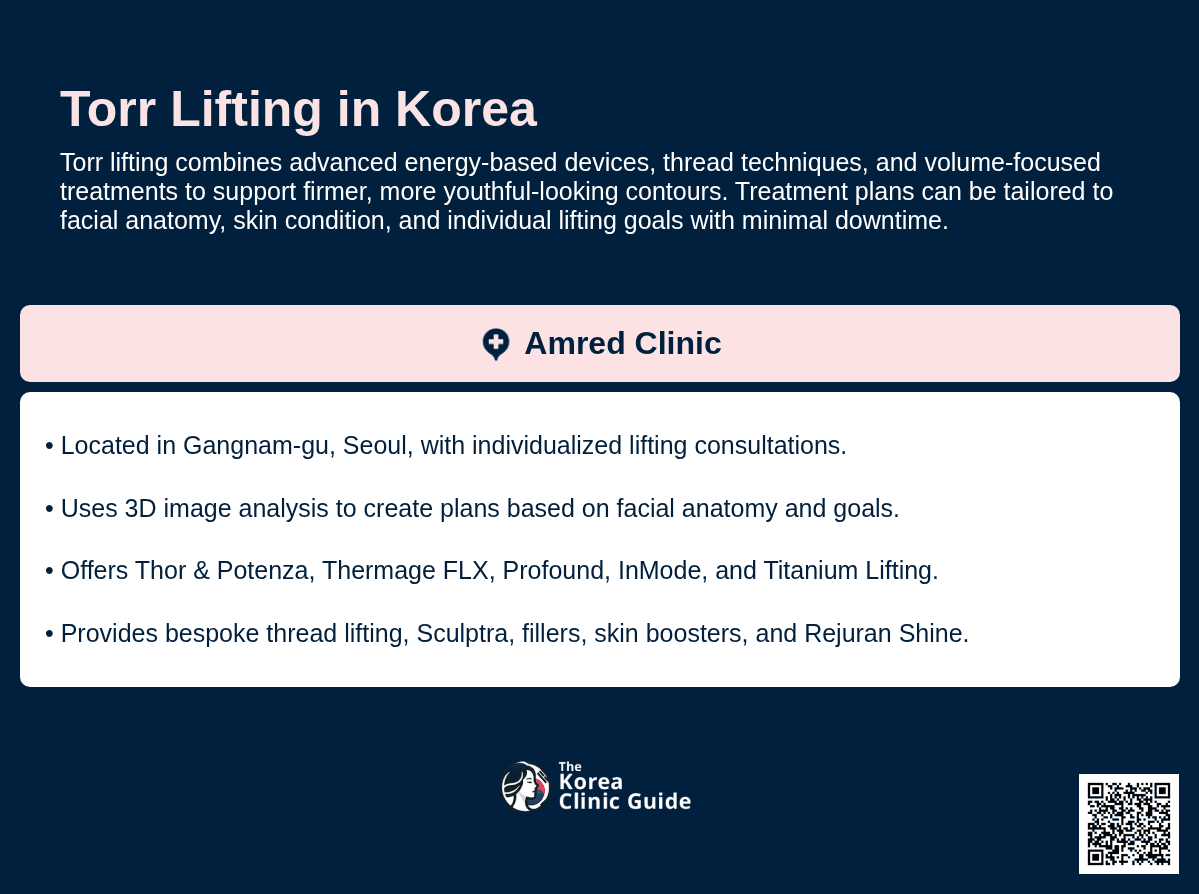
You may consider Amred Clinic for Torr Lifting if you want a lifting plan shaped around your facial anatomy and goals: the clinic combines one-on-one consultation, 3D image analysis, and a broad menu of device-based, thread, and volume-focused rejuvenation options to tailor treatment rather than rely on a single standard approach.
- URL: Amred Clinic Website
- Location: Gangnam-gu, Seoul
- Lifting approach:
- Its listed lifting options include Thor & Potenza, Thermage FLX, Profound radiofrequency microneedling, InMode, Titanium Lifting, and bespoke face and neck thread lifting.
- Profound is described as targeting stimulation of elastin, collagen, and hyaluronic acid.
- The clinic also lists Ultrasound Contour Scan for contouring plans tailored to your needs.
- Personalization and complementary care:
- One-on-one consultations and 3D image analysis are used as part of individualized image consulting.
- If volume loss or skin quality is also relevant to your concerns, listed complementary options include bespoke Sculptra, fillers, skin boosters, Rejuran Shine, pore and scar care, and customized skin care.
Torr Lifting From Start to Finish
- Initial contact and photographs — Send unfiltered photographs, desired treatment zones, medical history, medications, allergies, prior fillers, threads, implants, tattoos, and surgery details. Ask whether the clinic offers English communication or a video consultation, and request confirmation that the unit is TORR RF/MTX-C1.
- Pre-travel treatment plan — Obtain the proposed zones, number of sessions, expected charges, likely visible effects, contraindication screening, and a written plan for problems after returning home. Ask the clinic to document the current Korean authorization applicable to the exact device.
- In-person assessment — The clinician examines skin laxity, fat distribution, scars, sensation, active skin disease, tattoo placement, and previous treatment areas. They should explain when RF is unlikely to address the main concern and when a different procedure is more appropriate.
- Skin preparation — Remove makeup, sunscreen, and jewellery from the treatment zone. No fasting is normally needed because this external treatment does not normally involve sedation; a conductive gel can be applied.
- RF treatment — The provider moves the handpiece continuously over the planned area while monitoring comfort and skin response. FDA documentation describes continuous rubbing or massage application; the exact handpiece, energy, passes, and treatment duration are not established by Torr-specific clinical evidence.
- Immediate check and discharge — The skin is checked for excessive redness, pain, swelling, or an abnormal reaction. In an uncomplicated session, there is no incision care or sedation recovery, and departure from the clinic is normally the same day.
- Short-term recovery — Follow the clinic’s instructions on heat, exercise, skincare actives, sun exposure, and makeup. Report escalating pain, blisters, crusting, drainage, numbness, or persistent colour change promptly.
- Overseas follow-up — Take standardized photographs only if requested, maintain the agreed remote contact route, and seek local in-person assessment for a suspected burn, infection, or persistent adverse reaction. Assess longer-term change at roughly 6–12 weeks rather than on the day of treatment.
Alternatives to Torr Lifting
The right alternative depends on whether the dominant concern is lax skin, lost facial volume, dynamic expression lines, acne scarring and texture, focal fat, or substantial tissue descent. Non-surgical options offer less disruption but generally more modest change; surgical procedures address excess skin and deeper structural laxity more directly, with longer recovery and greater risk.
External RF or focused ultrasound
- Comparable noninvasive tightening — Thermage lifting, InMode lifting, and ultrasound-based Ultherapy lifting or Shurink lifting target selected patients with mild laxity.
- Tradeoff — Device technologies, depths, discomfort, treatment protocols, and evidence bases differ. No independent head-to-head evidence was identified showing that Torr is better than these alternatives.
RF microneedling
- Texture-focused option — Potenza combines RF with needle-based skin injury and is more relevant when acne scars, pores, or uneven texture accompany laxity.
- Tradeoff — Needles create greater procedural disruption and require more careful post-treatment skincare and pigment-risk planning than external RF.
Injectable volume or muscle treatment
- Volume loss and folds — Facial filler is directed at volume depletion and structural hollows rather than heating lax skin.
- Expression lines — Facial Botox treats muscle-driven lines; it does not tighten loose skin or remove fat.
Thread lift
- Temporary mechanical repositioning — A thread lift can suit selected patients seeking more immediate repositioning than external RF is expected to provide.
- Tradeoff — Threads are inserted under the skin and carry different risks, including irregularity, visibility, infection, and the need for revision or removal.
Fat reduction or surgical lifting
- Focal submental fat — Double-chin liposuction addresses a localized fat deposit more directly than external RF.
- Substantial laxity — A face lift is the more meaningful option for excess skin, marked jowling, or major neck laxity. It involves incisions, anesthesia planning, and a much longer recovery.
- Sequencing — Do not combine energy devices, threads, or injectables solely because a package is offered. Prior filler, threads, implants, and surgery change the treatment plan and require in-person assessment.
How Can I Prepare for Torr Lifting?
- Medical disclosure — Provide a complete history before travel, including pacemakers or defibrillators, IUDs, retained metal, tattoos, permanent fillers, threads, silicone, implants, neuropathy, diabetes, connective-tissue disorders, cancer history, allergies, and prior procedures in the planned zone.
- Medicines and supplements — Disclose anticoagulants, antiplatelet medicines, isotretinoin, immunosuppressants, and medicines that affect healing or sensation well before treatment. Do not independently stop prescribed medicine; obtain advice from the prescribing clinician and treating doctor.
- Treatment-area condition — Reschedule for sunburn, open skin, herpes outbreak, active infection, eczema or dermatitis flare, severe inflammatory acne, or unexplained rash. Avoid booking immediately after another energy-based, injectable, peeling, or surgical treatment in the same area until the clinician sets the sequence.
- Day-of skin preparation — Arrive with clean skin. Remove makeup, sunscreen, and jewellery from the treatment area; clinics can apply conductive gel for the moving handpiece.
- Fasting and transport — No fasting is normally required when no sedation is planned. Arrange independent transport only if the clinic plans a separate procedure, medicine, or sedation that affects alertness.
- Travel flexibility — Keep at least 1–2 days in Korea and avoid an inflexible flight or major event immediately afterward, particularly when treating a visible facial area or combining procedures.
Travel note: Bring records or clear photographs of prior injectable, thread, implant, and surgical treatment when available. These details can change the treatment zone or lead the clinician to defer RF.
Confirm the treating doctor’s clinic-specific requirements and individualized instructions before treatment; they take precedence over general guidance.
Aftercare Advice
Protect the treated skin from heat, friction, irritation, and sun exposure while warmth, redness, swelling, tenderness, or tightness settles.
- Activity and heat — Resume light daily activities if comfortable. Avoid vigorous exercise, very hot showers, sauna, steam rooms, and overheating until redness and tenderness have resolved.
- Skincare and contact — Use bland, non-irritating skincare. Pause retinoids, exfoliating acids, benzoyl peroxide, scrubs, aggressive massage devices, and vigorous rubbing until the skin is calm.
- Sun protection — Apply broad-spectrum SPF 50 to exposed treated skin and avoid deliberate sun exposure, especially while redness or irritation remains.
- Expected timing — Temporary skin warmth, redness, mild swelling, tenderness, or tightness generally settles within hours to 1–3 days in the broader noninvasive facial-RF literature. Judge any collagen-remodelling effect at about 6–12 weeks, not immediately after treatment; these are not Torr-specific outcome data.
- Warning signs and follow-up — Contact the clinic promptly for worsening pain, extensive swelling, blistering, crusting, drainage, numbness, persistent colour change, or a suspected burn. The FDA lists redness, swelling, blisters, burns, nodules, pigment changes, and scarring among potential RF body-contouring adverse effects in its MTX-C1 documentation.
Follow the treating doctor’s instructions over this general guidance, and contact the clinic promptly whenever the treated area appears abnormal or symptoms worsen.
Frequently Asked Questions
Related Blogs
Armpit Whitening in Korea: Diagnosis, Treatment Methods, Recovery, and Travel Planning
Armpit whitening begins with diagnosing the cause of darkening, then uses trigger control, clinician-directed topicals, superficial peels, or selected low-fluence laser/IPL. In Korea, listed cost is KRW 30,000; allow 2–3 days, plan follow-up, and avoid treatment on irritated or infected skin.
Updated: Sep 18, 2026
Oxygen therapy in Korea: HBOT indications, safety, travel planning, and recovery
Oxygen therapy may involve prescribed supplemental oxygen or hospital-supervised hyperbaric oxygen therapy, with diagnosis-specific screening, controlled chamber sessions, monitoring, and follow-up care. The article covers candidate criteria, contraindications, Korea travel planning, typical outpatient schedules, safety preparation, aftercare, and emergency warning signs.
Updated: Sep 18, 2026
Neck Wrinkle Treatment in Korea: Methods, Recovery, Travel Planning, and Alternatives
Neck wrinkle treatment may use HA filler for horizontal lines, botulinum toxin for platysmal bands, or radiofrequency microneedling and laser for texture and mild laxity. The article covers candidate assessment, treatment steps, recovery timelines, travel planning in Korea, aftercare, warning signs, and surgical alternatives for significant skin excess.
Updated: Sep 18, 2026
Hand Wrinkle Treatment in Korea: Methods, Recovery, Travel Planning, and Safety
Hand wrinkle treatment uses fillers or fat grafting for volume loss and laser, light, or peels for pigment and texture, with staged plans for combined concerns. In Korea, costs range from ₩1,250,000–₩2,650,000 (about US$900–$2,000), and international patients can review stay times, aftercare, clinic safeguards, and follow-up planning.
Updated: Sep 18, 2026