Medical Tourism Blog
Scalp Reduction Surgery in Korea: Candidacy, Recovery, Risks and Travel Planning
Table of contents
- Scalp Reduction Surgery at a Glance
- What Is Scalp Reduction Surgery?
- Who Is a Good Candidate for Scalp Reduction Surgery?
- How Is Scalp Reduction Surgery Performed?
- Why Visit Korea for Scalp Reduction Surgery?
- Key Information for International Patients
- Which Are the Best Clinics in Korea for Scalp Reduction Surgery?
- Scalp Reduction Surgery From Start to Finish
- Alternatives to Scalp Reduction Surgery
- How Can I Prepare for Scalp Reduction Surgery?
- Aftercare Advice
Considering treatment in Korea? Everything you need to know e.g. — how to avoid scams, visas, interpreters, recovery tips — in our Medical Tourism Master Guide. Plan with confidence in minutes, not weeks!
Last updated: September 2026
Scalp Reduction Surgery at a Glance
- What it does — Scalp reduction surgery removes a section of bald crown or vertex scalp and advances nearby hair-bearing scalp to reduce the bald area; it does not create new follicles, stop androgenetic hair loss, or lower the frontal hairline.
- Best candidates — It is a selective option for adults with a large, stable crown bald area, dense hair at the sides and back, and enough scalp laxity for a low-tension closure.
- Immediate change, evolving result — Bald-skin coverage changes immediately after excision, but scar maturation, scalp “stretch-back,” and continuing hair loss determine the longer-term appearance over months.
- Recovery and Korea stay — For a non-expander procedure in Korea, plan at least 10–14 days for wound checks and possible suture or staple removal; the operating surgeon must clear travel after examining the incision.
- May require staged care — Serial reductions or later FUE/FUT transplantation may be needed to manage residual thinning, camouflage the scar, refine the hairline, or address future hair loss; tissue expansion requires repeated visits over roughly 8–12 weeks.
- Main tradeoff — The procedure exchanges bald scalp for a tension-bearing incision and potentially visible scar, with risks including wound separation, impaired scalp blood supply, numbness, widened scarring, and recurrent baldness from stretch-back.
- Korea-specific limitation — South Korea has strong international-patient and hair-restoration infrastructure, but no modern Korean registry or outcome series specific to scalp reduction was identified, so surgeon-specific case experience and cross-border follow-up should be verified.
What Is Scalp Reduction Surgery?
Scalp reduction surgery removes part of a bald scalp area and advances nearby hair-bearing skin to close the gap. It aims to reduce a stable bald area on the crown or top of the scalp, though it does not create new hair follicles or stop future hair loss. It is a surgical procedure.
Who Is a Good Candidate for Scalp Reduction Surgery?
- Stable crown or vertex baldness — Suitable candidates have a large, relatively stable bald area at the crown with dense hair-bearing scalp at the sides and back.
- Adequate scalp mobility — The operation depends on enough scalp laxity to advance hair-bearing skin and close the incision without excessive tension or compromised blood supply.
- Realistic staged-treatment goals — Candidates understand that scalp reduction removes bald skin but does not create follicles, stop androgenetic alopecia, or reliably construct a natural frontal hairline. Later hair transplant, scar revision, or another reduction can be necessary.
- Optimized surgical health — Adults whose nutrition, diabetes control, bleeding risk, nicotine exposure, and anesthesia risk are appropriately managed are better placed for elective surgery.
Active inflammatory, infectious, unstable, or scarring hair-loss disease requires diagnosis and control before surgery. In primary cicatricial alopecia, surgery is generally deferred until activity is completely stable, although that stability cannot always be achieved. Very young adults with evolving pattern hair loss, people with limited donor hair or scalp laxity, and anyone unwilling to accept a visible scar or possible future procedures should postpone or avoid reduction. Poorly controlled diabetes, impaired healing, anticoagulation issues, and unrealistic expectations also require correction or a different plan; do not independently stop prescribed aspirin, clopidogrel, warfarin, direct oral anticoagulants, insulin, metformin, GLP-1 medicines, or other chronic drugs.
How Is Scalp Reduction Surgery Performed?
Scalp reduction is individualized around bald-area size, scalp laxity, blood supply, and the likelihood of future hair loss. It is also called alopecia reduction; it is not forehead reduction or hairline lowering.
- Simple scalp reduction — The surgeon excises an individualized segment of bald crown or vertex scalp, undermines and mobilizes adjacent hair-bearing scalp, then closes the incision. Limited cases can use local anesthesia with sedation.
- Serial scalp reduction — More than one excision is staged after healing and reassessment. This approach limits the amount removed at one time when a single closure would create unsafe tension.
- Galeal release or tension management — Subgaleal undermining, galeal release incisions, and surgeon-selected mechanical stretching techniques can increase mobility. They do not guarantee that a larger excision can be closed safely.
- Tissue-expander-assisted reduction — A temporary expander beneath hair-bearing scalp is filled gradually over about 8–12 weeks before reduction. It creates additional coverage but produces a visible bulge and needs repeated in-person care; it is more relevant to stable burn, trauma, or scar-related alopecia than ordinary pattern baldness.
- Reduction with follicular-unit transplantation — FUE or FUT/FUSS grafting can be staged before, during, or after reduction to refine a hairline, camouflage the reduction scar, cover residual thinning, or manage later progression.
Why Visit Korea for Scalp Reduction Surgery?
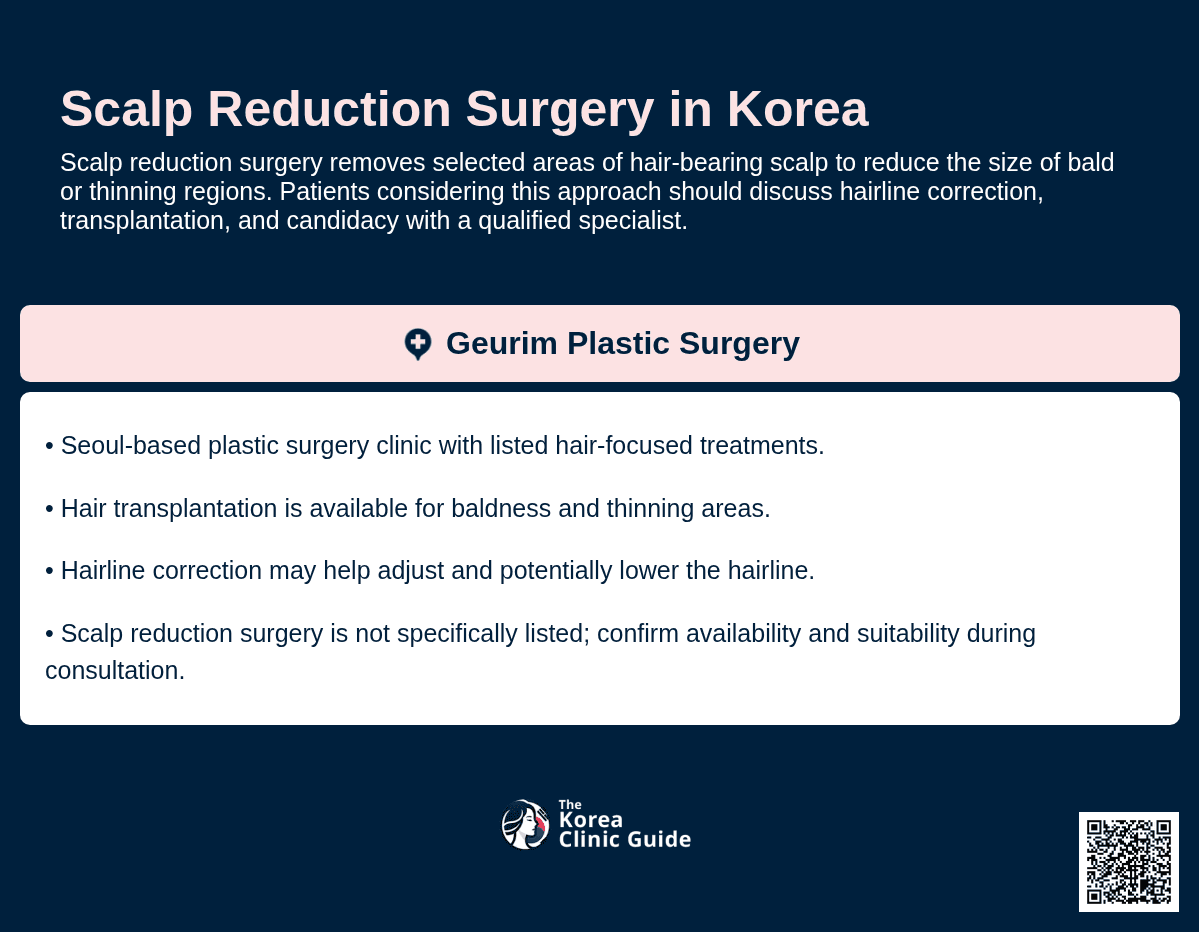
South Korea has a substantial international-patient infrastructure and an active hair-restoration field. Those facts do not prove that scalp reduction is widely available or produces better outcomes in Korea. For this uncommon operation, choose a Korean provider only after verifying surgeon-specific experience and a workable cross-border follow-up plan.
- International-care infrastructure — Korea’s government medical-tourism platform provides an established entry point for international medical visitors through Medical Korea.
- Hair-restoration professional community — The Korean Society of Hair Restoration Surgery provides a relevant professional context for hair-loss and transplantation practice, but membership or general transplant experience does not demonstrate competence in alopecia reduction.
- Scar-camouflage pathway — A South Korean publication describes FUE transplantation into postsurgical scalp scars, which is relevant when planning later scar camouflage, but it is not evidence that scalp reduction itself is routinely performed or has established Korean outcomes.
- Evidence limitation — No Korean registry, modern case series, or comparative outcome study specific to scalp reduction was identified. Ask for the surgeon’s current case experience, incision and closure strategy, anesthesia setting, plan for excessive tension or reduced skin perfusion, and written approach to revisions and remote complications.
Key Information for International Patients
- Minimum stay — For a non-expander reduction, plan at least 10–14 days in Korea for early wound reviews and possible suture or staple removal. The operating surgeon—not a standard calendar day—must decide whether the incision is ready for travel.
- Expansion schedule — Tissue-expander-assisted treatment requires repeated in-person visits over roughly 8–12 weeks. Plan an extended stay or a formally coordinated multi-trip pathway; it is not compatible with a short cosmetic trip.
- Flights and clot risk — Obtain explicit clearance after an in-person wound check before any flight, particularly one longer than four hours. Recent surgery and prolonged travel both add to venous-thromboembolism risk; discuss prevention if there is prior VTE, obesity, estrogen treatment, pregnancy/postpartum status, cancer, older age, or a clotting disorder.
- First-night support — Arrange a responsible adult to take you to accommodation and remain available overnight after sedation or general anesthesia. Do not drive, ride a motorcycle, or navigate alone while dizzy or using opioid pain medicine.
- Itinerary limits — Stay near the surgical facility during early healing. Avoid strenuous sightseeing, long domestic transfers, swimming, sauna or spa visits, direct sun, and scalp traction until cleared.
- Remote follow-up — Leave with an English operative report, anesthesia record, generic drug names and doses, written wound-care instructions, photographs, emergency contact details, and a scheduled video or photo-review plan. Arrange a clinician at home in advance if closure material will remain in place after departure.
Travel note: Do not book an irreversible return flight before the surgeon has reviewed the wound. Do not fly with active bleeding, wound separation, infection, concerning swelling, uncontrolled pain, or unresolved anesthesia effects.
Which Are the Best Clinics in Korea for Scalp Reduction Surgery?
Listed below are some of the best clinics in Korea for scalp reduction surgery.
1. Geurim Plastic Surgery
If you are exploring scalp reduction surgery, Geurim Plastic Surgery’s listed hair-focused options include hair transplantation and hairline correction, which may be relevant when discussing ways to address thinning areas or alter hairline position. The available information does not specifically list scalp reduction surgery, so you should clarify whether it is offered and whether it is appropriate for your goals.
- URL: Geurim Plastic Surgery Website
- Location: Seoul
- Hair-focused services:
- Hair transplantation is listed for baldness or thinning areas.
- Hairline correction is listed to adjust the position of the hairline, often by lowering it.
- Hair transplantation on scar tissue is listed as an option to mask scars.
- Related reconstructive care:
- Scar revision surgery and burn-scar treatment are listed among the clinic’s scar-care services.
- Foreign body removal and cleft lip and palate repair are also listed specialized procedures.
Scalp Reduction Surgery From Start to Finish
- Remote screening — Send standardized, unfiltered scalp photographs, hair-loss history, prior procedures, medication and supplement list, allergies, chronic conditions, nicotine status, and any history of abnormal scars, bleeding, VTE, or anesthesia reactions. Confirm that the proposed operation is scalp reduction for a bald crown, not a forehead reduction or a transplant.
- Virtual consultation and travel planning — Discuss whether English consultation is available, the surgeon’s current alopecia-reduction experience, anticipated number of stages, estimated Korea stay, anesthesia plan, incision position, contingency plan for high closure tension, and overseas revision policy.
- In-person diagnosis and clearance — The surgical team reassesses the cause and progression of hair loss, donor density, miniaturization, scars, crown dimensions, scalp mobility, and medical/anesthesia suitability. The final examination can change or cancel a remote plan.
- Marking and consent — The surgeon marks the intended bald-scalp excision and expected scar location, explains risks including widened scar, wound separation, skin-perfusion problems, numbness, and stretch-back, and confirms the role of medical treatment or later transplantation.
- Anesthesia and operation — Limited procedures can use local anesthesia with sedation; extensive or expansion-assisted cases can require general anesthesia. The surgeon removes bald scalp, mobilizes hair-bearing scalp through subgaleal dissection and, when appropriate, galeal release or other tension-management techniques, then closes with selected sutures or staples.
- Discharge and early recovery — A limited procedure is often outpatient, while medical or anesthesia factors can require observation. Tightness, swelling, numbness, and a visible linear or curvilinear incision are expected initially. Leave with approved medicines, dressing instructions, and an emergency contact.
- Wound checks and departure decision — Attend scheduled reviews. Initial incision healing commonly needs about 10–14 days for assessment and possible closure-material removal, but timing depends on the closure method, tension, and wound condition.
- Overseas follow-up — Send requested photographs and attend remote reviews after returning home. Scar maturation, recurrent laxity, ongoing hair loss, and the need for later hair transplant are assessed over months.
Alternatives to Scalp Reduction Surgery
For pattern baldness, medical treatment and follicular-unit transplantation are generally more mainstream than removing a broad scalp segment. Surgical reduction gives immediate reduction in bald-skin area but exchanges it for a tension-bearing incision and scar; non-surgical camouflage avoids surgery but does not restore follicles.
Medical hair-loss treatment
- Best role — Dermatologic assessment can guide topical minoxidil and, for appropriately selected patients, oral finasteride for androgenetic alopecia.
- Tradeoff — These treatments do not remove an existing bald crown immediately and require ongoing use; suitability, adverse effects, and reproductive considerations require individualized counseling. See hair loss treatment.
Follicular-unit hair transplant
- Best role — FUE or FUT/FUSS adds grafts without excising a broad scalp area and is often preferable when scalp laxity is poor, loss is evolving, or the scar-and-tension tradeoff is unacceptable.
- Tradeoff — Donor supply limits coverage, and transplanted hair takes months to grow. Learn more about hair transplant.
Scalp micropigmentation
- Best role — Pigment reduces contrast between scalp and hair, helping a shaved or closely cropped appearance and sometimes camouflaging scars.
- Tradeoff — It creates no follicles and does not slow alopecia. See scalp micropigmentation.
Tissue expansion and reconstruction
- Best role — Expansion with reconstructive flap procedures is more relevant to selected stable burn, trauma, or scar-related alopecia defects.
- Tradeoff — This is invasive, visibly staged treatment with weeks of in-person expansion, not a brief travel procedure. See scalp tissue expansion.
How Can I Prepare for Scalp Reduction Surgery?
- Full medication disclosure — Give the surgeon and anesthesia team every prescribed and non-prescribed product: anticoagulants, antiplatelet medicines, NSAIDs, diabetes and weight-loss medicines, hormones, sleep, pain, or anxiety medicines, vitamins, herbal products, CBD/cannabis, and recreational substances. Do not stop prescribed blood thinners, cardiac or stroke-prevention medicine, or diabetes medicine without coordinated instructions from the prescriber and surgical team.
- Nicotine cessation — Stop cigarettes, vaping, nicotine patches, gum, and oral nicotine on the surgeon’s timetable. Nicotine compromises wound healing and scalp blood supply.
- Fasting and alcohol — Follow the facility’s exact fasting instructions for sedation or general anesthesia. Avoid alcohol according to the surgical team’s schedule and disclose cannabis/CBD use because both can affect anesthesia planning.
- Scalp preparation — Ask whether minoxidil or other scalp treatments should be paused. Do not shave, dye, bleach, chemically treat, massage, or sunburn the operative area unless the team instructs otherwise.
- Medical optimization — Report diabetes control, nutritional concerns, recent illness, skin inflammation, bleeding or clot history, and past anesthesia reactions early enough for assessment or referral.
- Recovery logistics — Book accommodation near the facility, bring loose front-opening clothing, arrange a first-night companion, and keep the itinerary quiet. Use flexible flights and avoid commitments that conflict with wound checks.
Travel note: Reserve enough time for surgeon-directed follow-up rather than scheduling departure around a presumed universal suture-removal day.
Confirm all fasting, medicine, nicotine, scalp-care, and travel requirements directly with the treating surgeon; individualized instructions take precedence over general guidance.
Aftercare Advice
Protect the incision and attend wound reviews: early closure quality determines both safety and the eventual scar.
- Dressing and washing — Keep the dressing and incision clean and dry exactly as directed. Once washing is permitted, use lukewarm water and gentle shampoo, let water run over the incision rather than scrubbing, then pat dry. Do not pick crusts.
- Pain medicines and products — Use only medicines, antibiotics, and topical products approved by the surgical team. Avoid unapproved aspirin, ibuprofen, naproxen, supplements, alcohol, and scalp products during early healing unless specifically permitted.
- Activity and contact — Avoid bending, heavy lifting, strenuous exercise, contact sports, tight hats or helmets, traction, vigorous brushing, hair coloring, swimming, sauna, and steam rooms until cleared. Sleep with the head elevated if instructed.
- Sun protection — Keep the incision out of direct sun. Once the wound is fully closed and the team permits product use, protect exposed scalp and scar with SPF 50 sunscreen or physical coverage that does not rub or compress the incision.
- Warning signs — Seek urgent assessment for rapidly increasing swelling or pressure, uncontrolled bleeding, spreading redness or heat, pus or foul drainage, fever, wound separation, dusky or black scalp skin, escalating pain, fainting, shortness of breath, chest pain, or one-sided leg pain or swelling.
- Result timing — Bald-skin coverage changes immediately because tissue has been removed, but swelling, scar maturation, stretch-back, and continuing alopecia are judged over months. Historical evidence found that stretch-back can materially reduce the initial gain, mostly within the first 8–12 weeks, but this older research cannot predict an individual modern outcome.
Follow the treating doctor’s written instructions over general advice and contact the clinic promptly when the incision or recovery appears wrong.
Frequently Asked Questions
Related Blogs
Sideburn Transplant in Korea: Methods, Recovery, Travel Planning, and Alternatives
Sideburn transplantation uses scalp follicular grafts placed at shallow angles to restore sparse, asymmetric, or scar-related sideburns, with FUE or FUT donor harvesting. The article covers candidacy, Korea travel planning, recovery, aftercare, regrowth timelines, and alternatives such as micropigmentation or scar reconstruction.
Updated: Sep 23, 2026
PRP Hair Loss in Korea: Candidacy, Treatment Process, Recovery and Travel Planning
PRP for early-to-moderate pattern hair loss involves drawing blood, preparing platelet-containing plasma, and injecting it into thinning scalp areas, commonly in three monthly sessions with individualized maintenance. The article covers candidate screening, Korea travel planning, preparation, aftercare, follow-up, and alternatives including minoxidil, hair transplant, and scalp micropigmentation.
Updated: Sep 20, 2026
Hair transplant on Scar in Korea: Methods, Recovery, Travel Planning and Results
Hair transplantation on a stable scar uses FUE or FUT grafts to camouflage hairless areas, with treatment planned around scar blood supply, donor hair, realistic density, and possible staged sessions. The article covers candidate screening, Korea travel planning, procedure steps, recovery timelines, aftercare, warning signs, and alternatives such as scalp micropigmentation or reconstructive surger
Updated: Sep 19, 2026
Scalp Tissue Expansion in Korea: Stages, Recovery, Risks and Travel Planning
Scalp tissue expansion is a staged reconstruction for stable localized hair-bearing scalp loss, using saline-filled expanders followed by advancement or rotation of expanded scalp to cover the defect. The article covers candidate screening, serial fills over months, international travel planning, recovery, aftercare, complication warning signs, and alternatives for complex scalp wounds.
Updated: Sep 19, 2026