Medical Tourism Blog
Scalp Tissue Expansion in Korea: Stages, Recovery, Risks and Travel Planning
Table of contents
- Scalp Tissue Expansion at a Glance
- What Is Scalp Tissue Expansion?
- Who Is a Good Candidate for Scalp Tissue Expansion?
- How Is Scalp Tissue Expansion Performed?
- Why Visit Korea for Scalp Tissue Expansion?
- Key Information for International Patients
- Which Are the Best Clinics in Korea for Scalp Tissue Expansion?
- Scalp Tissue Expansion From Start to Finish
- Alternatives to Scalp Tissue Expansion
- How Can I Prepare for Scalp Tissue Expansion?
- Aftercare Advice
Considering treatment in Korea? Everything you need to know e.g. — how to avoid scams, visas, interpreters, recovery tips — in our Medical Tourism Master Guide. Plan with confidence in minutes, not weeks!
Last updated: September 2026
Scalp Tissue Expansion at a Glance
- What it does — A two-stage reconstructive surgery that places a temporary saline expander under healthy scalp, then uses the newly expanded hair-bearing scalp to cover a localized bald scar or defect.
- Best candidates — Most suitable for stable, localized scalp loss from burns, trauma, prior surgery, or selected lesion excision when healthy, mobile, well-vascularized scalp is available beside the area.
- Treatment timeline — After stage-1 placement, saline fills usually start once the incision heals and are commonly performed weekly or every other week for more than 8–12 weeks before stage-2 expander removal and scalp-flap coverage.
- Recovery and results — Each operation typically needs 1–2 weeks of close wound review; activity restrictions are often reassessed at 4–6 weeks, while scars, sensation, contour, and hair-pattern appearance can settle over 6–12 months.
- Key limitation — This procedure redistributes existing hair-bearing scalp; it does not create follicles, restore hair across diffuse androgenetic hair loss, or stop ongoing genetic thinning.
- Complication risk — Infection, bleeding or hematoma, leakage, skin thinning, expander exposure, flap blood-supply problems, and early device removal can occur; one systematic review reported a 27.3% complication rate in its scalp subgroup, though this does not predict an individual risk.
- Korea travel commitment — International patients should plan about 10–16 weeks or longer in Korea if the operating team manages both stages and serial fills; Korea has published experience with complex electrical-burn scalp reconstruction, but no high-quality evidence shows superior national outcomes.
What Is Scalp Tissue Expansion?
Scalp tissue expansion is a staged reconstructive procedure that gradually stretches healthy nearby scalp so it can cover a localized bald scar or defect. It aims to restore coverage with your own hair-bearing scalp, improving hair, color, and texture matching after burns, trauma, or prior surgery. It is surgical, involving expander placement, repeated saline fills, and a later operation to transfer the expanded scalp.
Who Is a Good Candidate for Scalp Tissue Expansion?
- Localized hair-bearing scalp loss — Good candidates have a stable bald scar or localized defect from a burn, trauma, prior surgery, or selected lesion excision and want coverage with their own adjacent hair-bearing scalp.
- Adequate surrounding scalp — Expansion requires healthy, mobile scalp next to the defect, with sufficient blood supply and a plan that respects existing hair direction.
- Staged-care availability — Candidates can attend repeated sterile-saline fill appointments, protect the expander from pressure and trauma, and obtain urgent care promptly if a problem develops.
- Complex reconstruction assessment — Selected patients with cranial wounds, exposed skull, or planned cranioplasty need joint planning around the scalp, pericranium, bone, hardware, and any infection history.
This is not a treatment for diffuse androgenetic hair loss: it redistributes and expands existing hair-bearing scalp rather than creating follicles or stopping genetic thinning. Urgent cancer treatment, active scalp or systemic infection, contaminated wounds, and unresolved skull osteomyelitis generally require a different or delayed reconstructive sequence. Previously irradiated, severely scarred, or poorly vascularized scalp is a relative contraindication because it raises the risk of wound problems; smoking and radiation have been reported as tissue-expansion complication risk factors in a meta-analysis of the literature. Uncontrolled diabetes, malnutrition, anemia, bleeding risk, unstable cardiopulmonary illness, or immunosuppression must be assessed and optimized before surgery.
How Is Scalp Tissue Expansion Performed?
Scalp tissue expansion is an internal, staged technique. Device selection and flap design are individualized around the defect’s size and position, available scalp, scar quality, blood supply, and hair direction.
- Single versus multiple expanders — One expander can provide tissue for a smaller localized defect; larger, irregular, or multi-area defects can require two or more devices.
- Expander shape and orientation — Rectangular, crescent, and round silicone expanders are selected and positioned to create usable tissue in the direction needed for scalp advancement or rotation.
- Integrated versus remote port — The saline injection port can be incorporated into the expander or placed separately. The surgeon chooses the arrangement that best suits the planned pocket and access for serial fills.
- Expanded scalp flap transfer — At the second operation, the expander is removed and the new scalp is advanced or rotated to cover the scarred, bald, or deficient area.
- External extension devices — External tissue-extension systems are distinct from internal saline expansion and have different indications, protocols, and complication profiles; they should not be presented as interchangeable options. A review of external expansion techniques describes this distinction and the variability between devices (evidence review).
Why Visit Korea for Scalp Tissue Expansion?
South Korea has published clinical experience using scalp tissue expansion for complex electrical-burn defects with skull exposure. This supports the availability of reconstructive experience, but it does not establish that Korean outcomes are superior to those in other countries. For an international patient, continuity of care is more important than destination marketing because fills and wound reviews extend over months.
- Published local experience — A Korean 10-patient series reported tissue expansion for electrical-burn scalp defects, including cases with skull exposure (published case series). This is small observational evidence, not a comparison with other health systems.
- Complex-case planning — Cases involving prior burns, scars, skull defects, cranial hardware, or cranioplasty require reconstructive planning beyond cosmetic hair restoration; ask who will coordinate plastic surgery, neurosurgery, imaging, and infection care when relevant.
- Documented follow-up structure — Before committing to treatment, obtain the surgeon’s written plan for fills, wound reviews, after-hours contact, complication management, and transfer of records. Professional guidance on surgical travel warns that distance can prevent routine in-person follow-up and complicate postoperative care (ASPS travel-care guidance).
- Evidence limitation — No high-quality direct studies were identified comparing scalp-expansion outcomes in Korea with those elsewhere. Claims of a national outcome advantage are unsupported.
Key Information for International Patients
- Minimum stay — Plan about 10–16 weeks or longer in Korea when the operating team will manage stage 1, incision healing, serial fills, and stage 2. Defect size, expander capacity, scalp quality, prior radiation or surgery, tolerance of fills, and complications determine the actual duration.
- Repeat visits — Fills commonly begin only after the stage-1 incision heals and are often scheduled weekly or every other week. The expansion phase commonly exceeds 8–12 weeks (clinical review).
- Split-trip care — Arrange a split-trip plan only when the Korean surgeon and a qualified clinician near home agree in writing on fill volumes, intervals, records, urgent treatment, and responsibility for complications. Do not assume a local clinician will take over expander care.
- Flight timing — No universally accepted scalp-specific long-haul flight interval was identified after placement or removal. Do not book a return flight until the surgeon confirms that wound healing, mobility, anesthesia recovery, clot risk, and follow-up needs permit travel.
- Itinerary impact — Stage 1 and stage 2 each need close wound review for roughly 1–2 weeks. Avoid itineraries involving strenuous activity, swimming, saunas, contact sports, tight helmets, or activities that can press on or injure the expander.
- Remote follow-up — Remote review can supplement, not replace, access to urgent in-person care. Keep operative reports, device details, fill records, medication lists, imaging, and the surgical team’s emergency contact information available.
Travel note: Treat this as multi-month reconstructive care rather than a short medical-tourism procedure. Confirm exactly where infection, expander exposure, leakage, or wound separation will be treated after you leave Korea.
Which Are the Best Clinics in Korea for Scalp Tissue Expansion?
Listed below are some of the best clinics in Korea for scalp tissue expansion.
1. Geurim Plastic Surgery
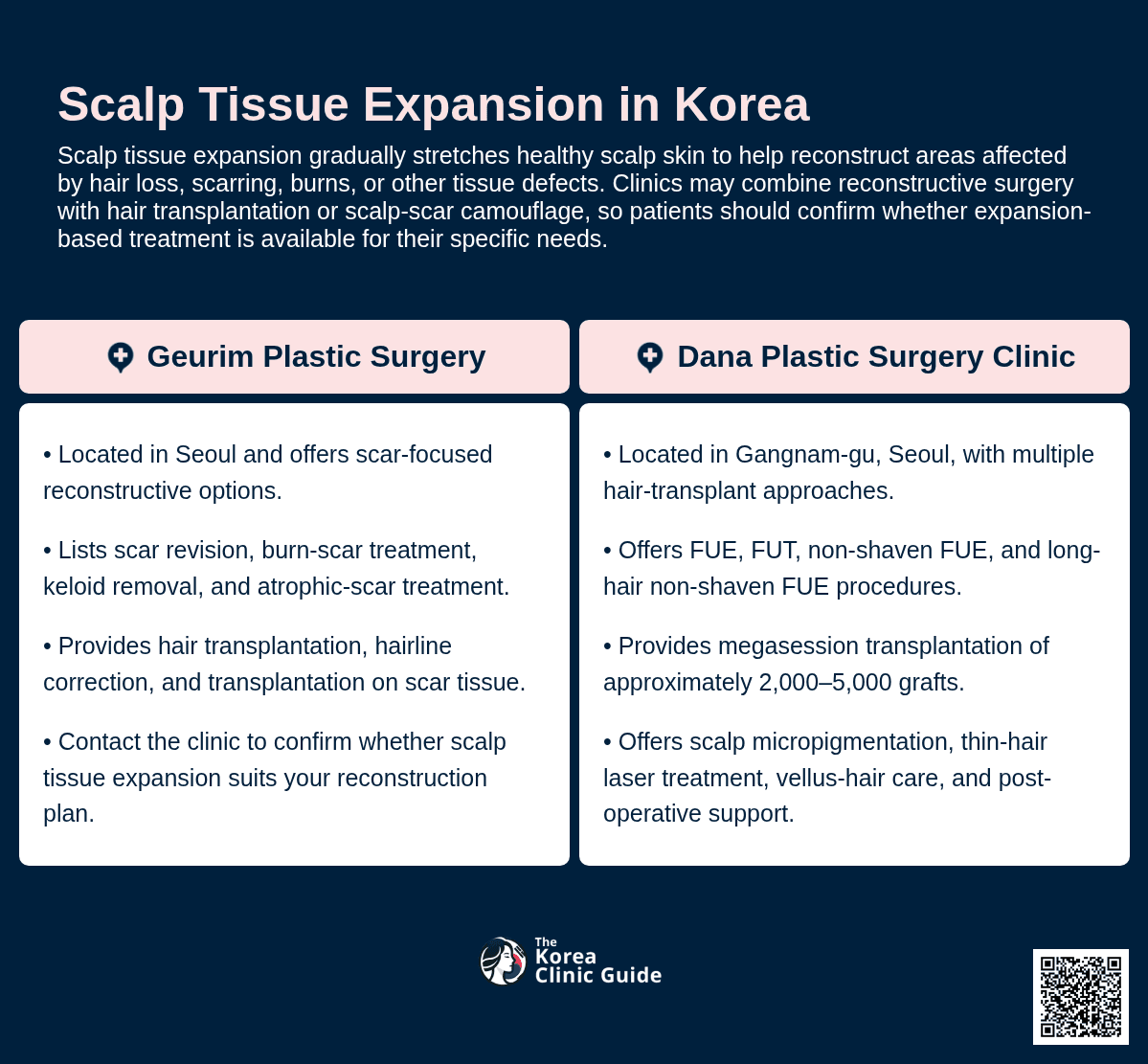
You may consider Geurim Plastic Surgery if your scalp tissue-expansion planning is connected to scar reconstruction or restoring hair coverage, as the clinic lists scar revision, burn-scar treatment, hair transplantation, hairline correction, and hair transplantation on scar tissue. The provided information does not specifically confirm scalp tissue expansion, so you would need to clarify whether it is available for your particular scar, hair-loss, or reconstructive goals.
- URL: Geurim Plastic Surgery Website
- Location: Seoul
- Scar and reconstructive options:
- Lists scar revision surgery, burn-scar treatment, keloid removal, atrophic-scar treatment, and acne-scar treatment.
- Lists foreign-body removal and congenital reconstructive procedures including cleft lip and cleft palate surgery.
- Hair-related services:
- Offers hair transplantation and hairline correction.
- Lists hair transplantation on scar tissue, which may be relevant when scar coverage is part of your treatment plan.
2. Dana Plastic Surgery Clinic
You may consider Dana Plastic Surgery Clinic when your scalp concern involves restoring hair coverage or disguising a scalp scar alongside reconstructive planning: it offers FUE and FUT transplantation, large-session grafting, and scalp-scar camouflage with micropigmentation. The supplied information does not specifically list scalp tissue expansion, so you should confirm whether the clinic provides expansion-based reconstruction for your needs.
- URL: Dana Plastic Surgery Clinic Website
- Location: Gangnam-gu, Seoul
- Hair-transplant approaches:
- Offers FUE, FUT, non-shaven FUE, and long-hair non-shaven FUE.
- Lists megasession transplantation of approximately 2,000–5,000 grafts for extensive coverage, including a non-shaven megasession option.
- Offers non-shaven FUE hairline correction and side-hairline correction.
- Scalp scar and density support:
- Offers scalp micropigmentation to camouflage scalp scars from prior surgery or injury.
- Lists micropigmentation for crown-area thinning and laser treatment for thin hair.
- Provides vellus-hair treatment intended to improve overall hair density and fullness.
- Post-procedure care: Lists comprehensive post-operative care and support.
Scalp Tissue Expansion From Start to Finish
- Remote inquiry and records review — Send high-resolution photographs with hair parted around the affected area, measurements, prior operative and pathology reports, radiation and infection history, medication and allergy lists, nicotine status, and available CT or MRI images. Ask whether an English-language virtual consultation is available.
- In-person assessment and planning — The surgeon examines defect depth and dimensions, scalp laxity, vascularity, scar maturity, hair direction, and the possible involvement of pericranium, skull, hardware, or dura. Imaging and multidisciplinary assessment are used when cranial reconstruction is relevant.
- Pre-anesthetic evaluation — The team reviews medical conditions and medicines and orders testing based on the planned surgery and medical history. Testing can include blood counts, glucose or HbA1c, renal and electrolyte tests, coagulation studies when indicated, pregnancy testing when applicable, and anesthesia review.
- Stage 1: expander placement — Usually under general anesthesia, the surgeon creates a pocket beneath healthy scalp and places one or more silicone expanders with injection ports. A drain and a small initial saline fill can be used. Stage-1 incision care and drain management, when needed, are followed by early wound review over about 1–2 weeks.
- Serial saline expansion — Once the incision has healed adequately, the clinical team injects sterile saline through the port at scheduled visits, often weekly or every other week. Tightness, pressure, headache, or short-lived discomfort can occur after a fill; report worsening pain, skin thinning, drainage, or a change in device size promptly.
- Stage 2: definitive scalp coverage — After sufficient expansion, the surgeon removes the device, excises or revises the planned abnormal tissue, and advances or rotates the expanded hair-bearing scalp flap into position. The expansion duration and the final flap design depend on the defect and the scalp’s response.
- Early recovery and local review — Stage 2 also usually requires about 1–2 weeks of close wound review. The surgeon reassesses activity restrictions around 4–6 weeks, while scar maturation, sensation changes, and contour settling can continue for 6–12 months (recovery review).
- Overseas follow-up — Before departure, obtain a complete record and a written contingency plan. Share wound photographs only through the clinic’s approved channel, attend local care immediately for urgent symptoms, and maintain scheduled remote review with the operating team.
Alternatives to Scalp Tissue Expansion
The best alternative depends on defect size, depth, scalp laxity, hair-bearing goals, vascularity, prior radiation, infection, and skull exposure. Non-expansion surgery can shorten treatment but often provides less like-for-like hair-bearing coverage; large, irradiated, or skull-exposing wounds can require vascularized tissue rather than prolonged expansion.
Primary Closure or Local Scalp Flap
- Best fit — Small defects with enough lax surrounding scalp can be closed directly or covered with a rotation or advancement flap without an expansion phase.
- Tradeoff — This avoids serial fills and a second expander-removal operation, but closure tension and the amount of available scalp limit its use.
Skin Grafting or Dermal Substitute
- Best fit — A graft can cover a defect with a suitable vascularized wound bed; dermal substitutes can be part of staged coverage when the wound requires it.
- Tradeoff — Grafts generally do not restore hair-bearing scalp and can differ in texture, color, contour, and durability.
Regional or Free-Flap Reconstruction
- Best fit — Very large defects, irradiated tissue, major scarring, recurrent infection, exposed skull, or cranioplasty needs can require vascularized regional or microvascular free tissue.
- Tradeoff — This is more extensive surgery but can bring reliable blood supply to a compromised wound where expansion is unsafe or impractical.
Hair Transplantation Into a Mature Scar
- Best fit — Hair transplant on scar can be considered for selected stable scars with adequate blood supply after reconstructive healing is complete.
- Tradeoff — Scar circulation and thickness limit graft survival, and transplantation does not replace missing soft tissue or manage a deep defect.
Scalp Micropigmentation
- Best fit — Scalp micropigmentation can visually reduce contrast between a stable scar or sparse area and surrounding hair.
- Tradeoff — It is camouflage, not hair growth or defect reconstruction, and does not correct contour loss or unstable scar tissue.
How Can I Prepare for Scalp Tissue Expansion?
- Provide complete records — Send prior operative, pathology, radiation, infection, and cranioplasty records; current imaging; and clear scalp photographs before travel. Bring original reports and imaging files to the in-person consultation.
- Disclose every medicine and supplement — List prescription medicines, anticoagulants, antiplatelet drugs, diabetes medicines, antiseizure drugs, corticosteroids, hormone therapy, GLP-1 medicines, over-the-counter pain medicines, vitamins, herbal products, and allergies. Do not stop or alter any of them independently; the surgeon and anesthesiologist set medicine-stop or continuation instructions.
- Address nicotine use early — Report smoking, vaping, chewing tobacco, nicotine replacement, and other nicotine exposure. Nicotine-related healing risk must be addressed with the surgical team before committing to expansion.
- Complete requested optimization — Control diabetes and correct anemia, malnutrition, infection, or other identified wound-healing risks before surgery. Complete requested blood tests, anesthesia review, and CT or MRI when skull loss, hardware, or cranioplasty is relevant.
- Follow fasting instructions exactly — General anesthesia requires clinic-specific fasting instructions. Confirm the last permitted times for solid food, clear liquids, and essential medicines with the anesthesia team.
- Prepare for staged recovery — Book accommodation near the treating facility for early reviews after each operation, arrange an adult companion for discharge after general anesthesia, and keep flights and work commitments flexible for complications or schedule changes.
- Protect the treatment area — Arrive with a clean scalp and report active rashes, sores, drainage, or recent infection. Do not color, chemically treat, shave, or apply unapproved scalp products near the planned incision area unless the team instructs otherwise.
Travel note: Do not plan to manage serial fills through casual appointments while moving between cities or countries. Establish the named clinician and urgent-care route for every part of the expansion phase before stage 1.
The treating surgeon’s individualized instructions take precedence over this general guidance; confirm all clinic-specific medicine, fasting, transport, accommodation, and travel requirements before surgery.
Aftercare Advice
Protect the incision and expander throughout the entire expansion phase: infection, pressure injury, skin thinning, and device exposure need prompt clinical assessment.
- Wound and drain care — Keep dressings, washing, drain care, and prescribed medicines exactly as directed. Do not pull at drains, remove dressings early, or apply unapproved products to incisions.
- Protect the expander — Do not press, manipulate, puncture, or attempt to fill the device outside the assigned clinical team. Avoid tight hats, helmets, compressive headwear, sleeping pressure on the site, and any activity that could cause scalp trauma.
- Restrict activity and heat — Avoid strenuous exercise, swimming, saunas, hot tubs, contact sports, and hair coloring or chemical treatments until the surgeon clears them. Restrictions change after each operation and according to wound healing.
- Attend every fill and review — Keep serial-fill and wound-review appointments. Report pain or pressure that is increasing rather than settling after a fill, and ask before rescheduling a planned fill.
- Watch for urgent complications — Contact the clinic urgently for fever or chills; increasing redness, warmth, swelling, pain, pus, foul drainage, wound opening, persistent bleeding, rapidly enlarging swelling, sudden expander deflation or size change, pale/dusky/black scalp edges, thinning skin, visible expander or port, or new neurologic symptoms. Infection, hematoma, leakage, exposure, extrusion, flap ischemia, and premature device removal are recognized risks. A systematic review reported an 8.73% overall complication rate across head-and-neck expansion studies and 27.3% in its scalp subgroup, but the pooled observational data used varied patients, devices, and complication definitions and cannot predict an individual outcome (systematic review).
- Allow time for final settling — Early healing after each operation commonly takes 1–2 weeks; scars, altered sensation, hair-pattern appearance, and flap contour can continue to mature for 6–12 months.
Follow the treating doctor’s instructions over general advice, and contact the clinic immediately when something appears wrong rather than waiting for the next scheduled review.
Frequently Asked Questions
Related Blogs

Large Birthmark Removal Gap Solutions: Scalp Tissue Expansion Procedure in Korea
Discover how Korea leads in advanced scalp tissue expansion procedures for large birthmark removal gaps, especially after giant congenital melanocytic nevus (GCMN) excision. This cutting-edge reconstructive method offers natural hair growth and excellent aesthetic results. Combined with Korea’s renowned medical expertise and affordable costs, medical tourism for scalp reconstruction is becoming in
Updated: Nov 1, 2026

Fix Your Sideburn Gap with Expert Sideburn Transplant Procedures in Korea
Discover effective solutions for sideburn gaps in Korea with advanced hair transplant procedures like FUE, FUT, DHI, and robotic techniques. Whether caused by alopecia, trauma, or aging, Korea’s expert surgeons provide natural, permanent results through personalized treatments. Enjoy state-of-the-art technology, comprehensive care, and affordability — making Korea a leading destination for medical
Updated: Oct 30, 2026

Discover Effective Solutions for Extensive Crown Baldness with Scalp Reduction Surgery in Korea
Discover effective solutions for extensive crown baldness in Korea with scalp reduction surgery. This advanced procedure, complemented by tissue expanders and multi-session techniques, reduces large bald areas in the vertex, delivering natural-looking results. Ideal for stable hair loss patients, Korean clinics offer expert care, comprehensive packages, and innovative methods at competitive prices
Updated: Oct 29, 2026
Effective Hairline Correction Procedures for Forelock Thinning in Korea
Discover effective hair restoration options in Korea for forelock thinning caused by alopecia, including PRP therapy, hair transplants (FUE, FUT), and scalp lowering procedures. Learn how Korea’s advanced clinics provide safe, affordable treatments with expert surgeons, ensuring natural-looking results. This guide explores causes like androgenetic alopecia and frontal fibrosing alopecia, alongside
Updated: Oct 29, 2026