
Medical Tourism Blog
Mid-Cheek Groove Removal in Korea: Methods, Recovery, Risks, and Travel Planning
Table of contents
- Mid-Cheek Groove Removal at a Glance
- What Is Mid-Cheek Groove Removal?
- Who Is a Good Candidate for Mid-Cheek Groove Removal?
- How Is Mid-Cheek Groove Removal Performed?
- Which Are the Best Clinics in Korea for Midcheek Groove Removal?
- Why Visit Korea for Mid-Cheek Groove Removal?
- Key Information for International Patients
- Mid-Cheek Groove Removal From Start to Finish
- Alternatives to Mid-Cheek Groove Removal
- How Can I Prepare for Mid-Cheek Groove Removal?
- Aftercare Advice
Considering treatment in Korea? Everything you need to know e.g. — how to avoid scams, visas, interpreters, recovery tips — in our Medical Tourism Master Guide. Plan with confidence in minutes, not weeks!
Last updated: September 2026
Mid-Cheek Groove Removal at a Glance
- Anatomy-based correction — “Mid-cheek groove removal” is not one standard procedure; treatment may use HA cheek filler, fat grafting, or lower-eyelid/midface surgery depending on whether the shadow comes from true volume loss, tethering, eye bags, edema, laxity, or tissue descent.
- Best filler candidates — Conservative hyaluronic-acid filler is most suitable for mild-to-moderate true hollowing with adequate cheek support and without prominent malar swelling, festoons, eye bags, or lower-lid laxity.
- Fast but temporary filler — HA filler is usually an office treatment taking about 15–60 minutes, with an immediate contour change; swelling or bruising can mask the settled result for up to 2 weeks, and reassessment is usually at 2–4 weeks.
- Fat retention is variable — Fat grafting can suit broader midface volume loss and may last longer than filler, but retained volume is unpredictable: reviews found average facial-fat retention of about 42–47% at roughly 3–24 months.
- Surgery for bags or laxity — When orbital-fat prolapse, excess lower-lid skin, lid laxity, or midface descent drives the groove, fat repositioning, blepharoplasty, or a midface lift may be more appropriate than repeated filler, but recovery and eyelid-specific risks are greater.
- Korea stay requirements — Plan at least 2–3 days in Korea for uncomplicated filler, about 7–10 days for fat grafting, and at least 10–14 days for lower-eyelid or midface surgery, including an early local review before long-haul travel.
- Time-critical filler risk — Rare vascular compromise after filler can threaten skin and vision; severe pain, pale or mottled skin, blistering, eye pain, or any visual or neurologic symptom requires immediate in-person emergency assessment.
What Is Mid-Cheek Groove Removal?
Mid-cheek groove removal is an anatomy-based treatment that softens a hollow or shadow between the lower eyelid and cheek, often with hyaluronic-acid filler. It aims to create a smoother midface contour when volume loss, tissue position, or eye bags contribute to a tired-looking appearance. It is usually minimally invasive with filler, though selected cases require surgical fat grafting or eyelid and midface procedures.
Who Is a Good Candidate for Mid-Cheek Groove Removal?
- HA filler candidates — Adults with a mild-to-moderate true hollow, adequate cheek support, and no prominent malar swelling, eye bags, or lower-lid laxity can be considered for conservative hyaluronic-acid (HA) filler.
- Fat-grafting candidates — Adults with broader midface volume loss, sufficient donor fat, and acceptance of a donor-site procedure and uncertain retained volume can consider facial fat grafting.
- Surgical-assessment candidates — People whose groove is driven mainly by orbital-fat prolapse, lower-lid skin excess, lid laxity, or midface descent need assessment for under-eye fat removal or repositioning, blepharoplasty, or a midface lift rather than repeated filler.
- Deferral candidates — Active facial or dental infection, inflammatory skin disease, recent illness, pregnancy or breastfeeding, unknown prior filler, and inability to remain locally for review are reasons to postpone elective treatment.
This treatment is for adults with a stable congenital or age-related contour concern who understand that the goal is softening or camouflage, not literal and permanent erasure of a naturally occurring groove. “Mid-cheek groove” is not a standardized diagnosis: it can describe a malar groove, palpebromalar groove, tear-trough extension, Indian band, or shadow from eye bags and malar edema. Prominent festoons, malar bags, or edema can worsen when filler is added. Avoid treatment with a known allergy to the planned filler, anesthetic, or antiseptic; uncontrolled bleeding risk; or unrealistic expectations of exact symmetry. Fat grafting and surgery also require anesthetic fitness, adherence to nicotine cessation, safe local accommodation, transport, and follow-up.
How Is Mid-Cheek Groove Removal Performed?
The correct technique follows the cause of the shadow. An in-person examination distinguishes volume loss from tethering, edema, lower-eyelid fat prominence, skin excess, and laxity.
- Structural HA cheek filler — The clinician places HA filler in a deep medial or lateral cheek plane to restore support, then uses small, selective amounts to blend the remaining line. It is an office treatment, usually taking about 15–60 minutes, with an immediate contour change; swelling and bruising can obscure the settled result for up to 2 weeks.
- Cannula tunneling or subcision with filler — For a tethered line, a blunt cannula and/or controlled release of fibrous attachments can be considered before conservative filling. This does not suit every groove and adds procedural trauma, bruising, and irregularity risk.
- Autologous fat transfer — Processed fat is harvested through small-volume liposuction and placed through multiple small passes in volume-deficient cheek areas. It offers living-tissue volume but not predictable permanence: a review of 27 studies reported pooled facial-fat retention of 47% across 3–24 months, while another review found a mean weighted retention of 41.63% at a mean 13.9 months.
- Lower-eyelid fat repositioning or midface surgery — Repositioning prolapsed orbital fat, releasing retaining structures, supporting the lower lid, and sometimes lifting the midcheek addresses an anatomical lid-cheek problem that filler cannot reliably correct. This has the longest downtime and eyelid-specific risks, including dry eye, lower-lid retraction, ectropion, and revision.
- Adjunctive tightening or collagen stimulators — Threads, energy devices, and collagen stimulators can have a limited role for mild laxity or skin-quality concerns. They are not direct substitutes for volume restoration or surgery when a fixed groove is caused by substantial hollowing, tethering, bags, or festoons.
Which Are the Best Clinics in Korea for Midcheek Groove Removal?
Listed below are some of the best clinics in Korea for midcheek groove removal.
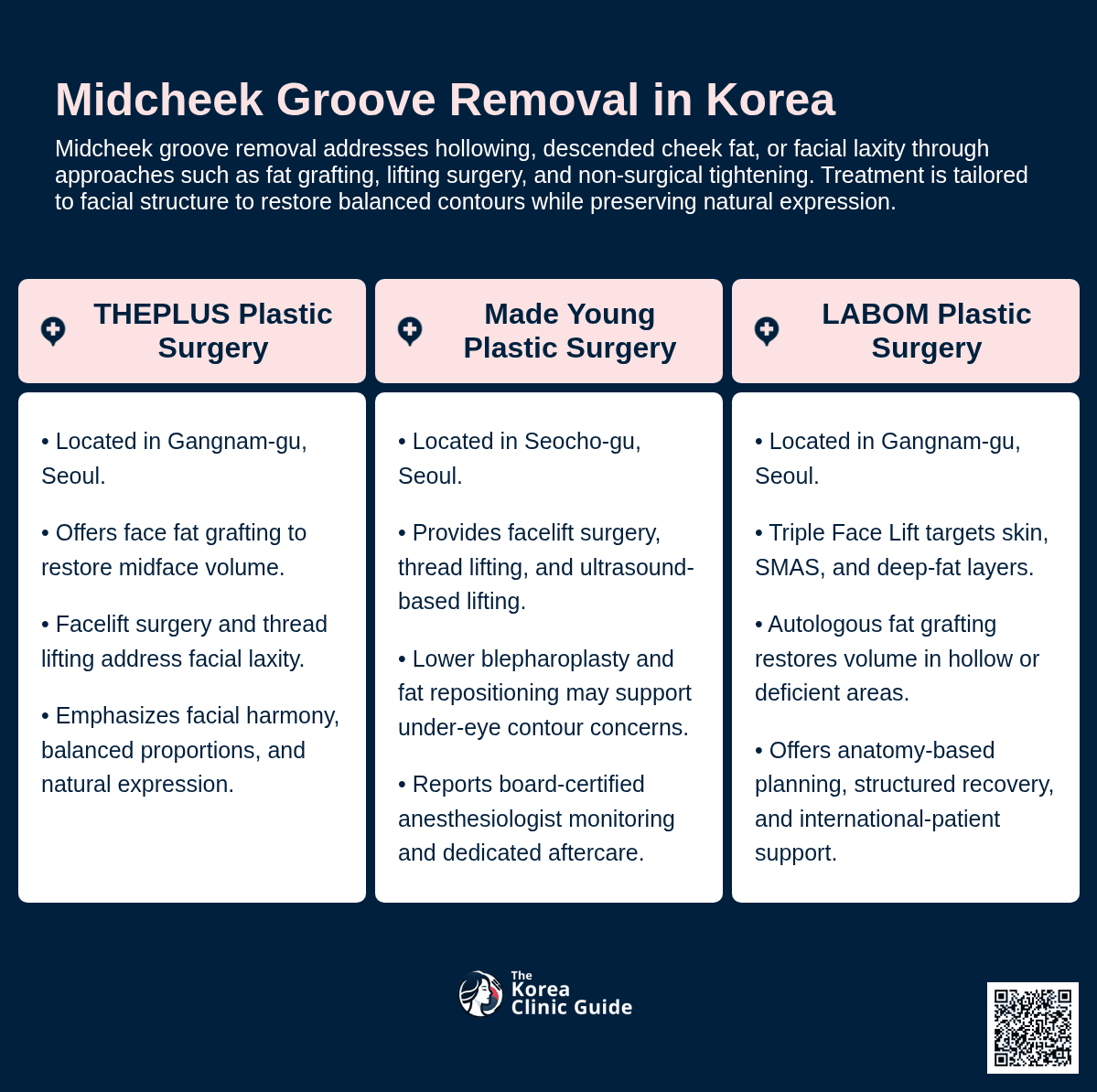
1. THEPLUS Plastic Surgery
You may consider THEPLUS Plastic Surgery for a midcheek-groove concern if your assessment points toward restoring midface volume or addressing facial tissue laxity: the clinic offers face fat grafting, facelift surgery, and thread lifting, alongside facial-contouring planning intended to maintain balanced proportions and natural expression.
- URL: THEPLUS Plastic Surgery Website
- Location: Gangnam-gu, Seoul
- Relevant approaches:
- Face fat grafting transfers your own fat to areas that need volume, which may help soften hollow or flattened facial contours.
- Facelift surgery repositions sagging facial tissue to improve facial contours, while thread lifting is offered for mild sagging with a less invasive approach.
- Surgical perspective:
- Dr. Kim is a board-certified plastic surgeon with stated expertise in facial contouring and research recognition related to 3D implants.
- The clinic describes its approach as seeking harmony among your facial features rather than treating an area in isolation.
2. Made Young Plastic Surgery
You may consider Made Young Plastic Surgery for a midcheek-groove concern if you want a clinic centered on facial and anti-aging care that can evaluate surgical and non-surgical lifting options; its listed services include facelift surgery, thread lifting, ultrasound-based lifting, skin boosters, and lower-eyelid procedures that may be relevant when midface laxity or under-eye contour also contributes to the concern.
- URL: Made Young Plastic Surgery Website
- Location: Seocho-gu, Seoul
- Lifting and eye-area options:
- Facelift surgery is offered to tighten underlying facial tissues and address excess skin associated with aging.
- Non-surgical options include thread lifting, Shurink focused ultrasound, Ultherapy, and skin boosters.
- Lower blepharoplasty and dark-circle treatments are also listed, including approaches such as fat repositioning, when the under-eye area is part of your overall contour assessment.
- Safety and follow-up:
- The clinic states that full-time board-certified anesthesiologists are on site, with one-to-one anesthesiologist monitoring and a cross-check system for emergencies.
- It reports direct medical-team consultation and diagnosis before procedures, a dedicated aftercare center, and full CCTV coverage of procedures.
3. LABOM Plastic Surgery
You may consider LABOM Plastic Surgery for midcheek-groove removal when your evaluation suggests that descended cheek fat, facial volume loss, or deeper tissue laxity is involved: its Triple Face Lift is specifically described as repositioning sagging cheek fat across the skin, SMAS, and deep-fat layers, while autologous facial fat grafting is available for volume-deficient areas.
- URL: LABOM Plastic Surgery Website
- Location: Gangnam-gu, Seoul
- Midface-focused options:
- The proprietary Triple Face Lift addresses the skin, SMAS, and deep-fat layer simultaneously and is described as repositioning sagging cheek fat while tightening underlying structures.
- Facial fat grafting uses purified fat harvested from your own donor area to restore facial volume; the clinic lists deep folds and generalized volume loss among its applications.
- The clinic states that its lifting procedure is performed under sedation with local anesthesia, typically takes 3–4 hours, and has a stated recovery period of 7–14 days.
- Planning philosophy:
- Plastic-surgery specialists directly perform procedures, and the clinic reports more than 30 years of clinical experience across facial and hand anti-aging procedures.
- Planning is described as one-to-one and anatomy-based, considering your facial structure and degree of aging rather than using a standardized design.
- The clinic says it aims to correct underlying tissue position and structure while avoiding overcorrection and preserving natural expression.
- Recovery support:
- The clinic describes individualized pre-operative diagnosis, safe anesthesia and continuous monitoring systems, and technology including high-definition endoscopy and autologous fat-purification equipment.
- Aftercare includes regular progress checks and structured programs for recovery, swelling, bruising, and scar management; it also states that it has a dedicated system for international patients.
Why Visit Korea for Mid-Cheek Groove Removal?
Korea offers an established international-patient infrastructure, but country-level evidence does not show that Korea produces superior safety, longevity, or aesthetic outcomes for mid-cheek groove correction. The most important decision is whether the clinician identifies the actual anatomy rather than treating every under-eye-to-cheek shadow with filler. Verify credentials, records, emergency access, and follow-up arrangements before booking.
- International-patient framework — Korea’s official Medical Korea platform provides information on its registered medical-institution system, which can help travelers identify facilities participating in the international-patient framework.
- Method choice over marketing labels — “Mid-cheek groove removal” covers several different concerns rather than one defined operation. The available evidence lacks a universally accepted standalone definition and lacks robust direct comparisons between filler, fat grafting, and surgery for this specific presentation.
- Documented treatment planning — Ask for standardized photographs, the proposed anatomical diagnosis, alternatives discussed, and a written complication plan. For HA filler, request the product name, amount, injection plane, lot number, and a plan for suspected vascular compromise.
- Evidence limit — Validated scales and 3D imaging have been used for adjacent infraorbital hollowing, but a small prospective protocol illustrates that this is measurement development, not comparative proof for mid-cheek grooves.
Key Information for International Patients
- Minimum stay — Plan at least 2–3 days for uncomplicated HA filler: an in-person assessment and treatment, plus availability for reassessment during the first 24–48 hours. Plan about 7–10 days for fat grafting and at least 10–14 days for lower blepharoplasty with fat repositioning or a midface lift.
- Flight timing — Do not schedule a long-haul flight immediately after filler, when early swelling and rare urgent complications need local access to the treating team. After facial cosmetic surgery, general NHS travel guidance advises avoiding air travel for 7–10 days; the operating surgeon must give individual clearance.
- Itinerary impact — Filler commonly causes visible redness, tenderness, bruising, swelling, or firmness for several days to 2 weeks. Fat grafting also affects the donor site. Surgical bruising and swelling often require about 2 weeks away from public-facing plans, while contour and scars mature for months.
- Repeat visits — Reassess HA filler at about 2–4 weeks before any conservative adjustment. Assess retained fat at roughly 3–6 months; a second session, if needed, is usually discussed only after stabilization.
- Remote follow-up — Before departure, obtain procedure notes, photographs, prescriptions, emergency contacts, and written aftercare. A clinician at home may not be able to provide elective revision care without product and operative records.
Travel note: Keep flights and major events flexible. Urgent filler symptoms, particularly severe pain, mottled or pale skin, or any visual change, require immediate in-person emergency assessment rather than a message after leaving Korea.
Mid-Cheek Groove Removal From Start to Finish
- Remote screening — Send unfiltered frontal, oblique, profile, smiling, and upward-lighting photographs; disclose goals, medicines, supplements, allergies, nicotine use, cold sores, dry-eye symptoms, dental issues, illness, and all prior fillers or facial procedures. English-language or virtual consultation availability varies by clinic.
- Travel planning — Schedule enough time for an in-person examination and early review. For fat grafting or surgery, arrange nearby accommodation, no-driving transport after anesthesia, and an adult companion when required.
- In-person diagnosis — The clinician examines the face upright at rest and in movement, assesses cheek volume, skin quality, lower-lid support, eye bags, edema/festoons, asymmetry, and prior filler. This visit can change the remote plan or lead to deferral.
- Consent and treatment plan — Review whether HA filler, cannula release plus filler, fat grafting, or lower-eyelid/midface surgery fits the anatomy. Discuss limitations, expected downtime, alternatives, costs, and the urgent-management plan; take standardized photographs.
- Anesthesia and treatment — HA filler is typically performed with topical anesthetic, filler containing lidocaine, or both. Fat grafting and surgery use local anesthesia with or without sedation or general anesthesia according to the extent of treatment and anesthetic assessment.
- Technique and duration — HA treatment usually takes 15–60 minutes, including assessment and photography where applicable. Fat is harvested, processed, and placed in multiple small passes; lower-eyelid or midface surgery follows the surgeon’s operative plan and requires longer operative and recovery time.
- Discharge and early review — Filler patients generally leave the same day if no sedative was used. After sedation, general anesthesia, or fat harvest, leave with a responsible adult and do not drive. Attend the planned local review before long-haul departure.
- Overseas follow-up — Send scheduled photographs and report concerns promptly. Keep the clinic’s records available for clinicians at home, especially if delayed swelling, infection, contour change, or a surgical wound concern develops.
Alternatives to Mid-Cheek Groove Removal
Non-surgical options offer shorter downtime but cannot correct every lid-cheek problem. Surgical options can address bags, laxity, and tissue descent more directly, but involve longer recovery and higher eyelid-specific risk.
Conservative Cheek or Under-Eye Filler
- Best fit — Mild true volume loss without active edema, prominent bags, or significant lower-lid laxity.
- Trade-off — Immediate but temporary contour change and no donor site, balanced against bruising, irregularity, puffiness, and the rare but time-critical vascular risk. See facial filler and under-eye filler.
Facial Fat Grafting
- Best fit — Broader midface deflation in a person with suitable donor fat who accepts a surgical procedure.
- Trade-off — Uses autologous tissue and can provide longer-lasting volume, but retention is variable, early swelling hides the result, and both face and donor site recover over 1–2 weeks. See face fat grafting.
Lower-Eyelid Fat Repositioning
- Best fit — Orbital-fat prolapse, a pronounced lid-cheek junction, or eye bags that create the apparent groove.
- Trade-off — More anatomically targeted than repeated filler for selected patients, but requires surgery and carries dry-eye, lid-position, scar, and revision risks. See under-eye fat removal or repositioning.
Midface or Facelift Surgery
- Best fit — Significant midface descent and laxity contributing to a deeper contour transition.
- Trade-off — Addresses tissue position rather than simply adding volume, but requires substantial recovery and is not a minor-treatment alternative. See face lift and deep plane face lift.
How Can I Prepare for Mid-Cheek Groove Removal?
- Medical disclosure — Provide every prescription medicine, over-the-counter product, vitamin, herbal supplement, allergy, prior filler record, autoimmune condition, bleeding history, cold-sore history, dry-eye symptom, recent vaccination or illness, and dental infection or planned dental work.
- Medicine changes — Do not independently stop aspirin, anticoagulants, antiplatelet medicines, diabetes medicines, blood-pressure medicines, psychiatric medicines, or prescribed supplements. Change bruising-risk medicines or supplements only when both the prescriber and treating clinician agree it is safe.
- Filler-day routine — Eat a normal meal and hydrate unless the clinic gives different instructions. Avoid alcohol shortly before and after injection if instructed, and arrive without irritated or inflamed skin in the treatment area.
- Surgery and fat grafting — Follow the surgeon’s fasting instructions exactly; fasting depends on the anesthesia plan. Stop nicotine, smoking, and vaping for the period specified by the surgeon, as nicotine impairs healing.
- Travel logistics — Book local accommodation, arrange a companion and no-driving transport after sedation or general anesthesia, and keep flights flexible until the early review is complete.
- Documents — Bring identification, medical-clearance documents if requested, prior imaging or operative notes, and the exact names and locations of previous fillers.
Travel note: Do not arrange filler and a same-day long-haul departure. Leave time for an in-person reassessment and access to urgent care.
Confirm the treating clinic’s individualized medication, fasting, nicotine, and travel requirements; those instructions take precedence over general guidance.
Aftercare Advice
Protect the treated midface from pressure and give swelling time to settle before judging the contour.
- Filler protection — Use intermittent cool compresses only if advised. Do not rub, massage, use gua sha, facial devices, or sustained pressure on the treated area unless the injector specifically directs it.
- Activity and heat — Avoid strenuous exercise, alcohol, sauna, hot tubs, intense heat, intense sun, facials, peels, laser or light treatments, and microneedling for the period set by the injector. Sleep on the back with head elevation if swelling is bothersome.
- Fat grafting or surgery — Follow the written plan for cleansing, incisions, donor-site compression, pain medicine, head elevation, and activity restriction. Do not smoke or vape, massage grafted cheeks, swim, bend heavily, lift, or strain until cleared by the surgeon.
- Sun protection and appearance — Use broad-spectrum SPF 50 on healed, exposed skin when the clinician permits. HA filler is visible immediately, but wait about 2–4 weeks for meaningful reassessment; retained fat is better assessed at 3–6 months, and surgical contour continues refining for months.
- Urgent warning signs — Seek immediate emergency assessment for severe or escalating pain; white, gray, blue, dusky, mottled, cold, blistered, or black skin; new eye pain or visual symptoms; severe headache; weakness; speech difficulty; or other neurologic symptoms. After surgery, urgently report fever, spreading redness, pus-like drainage, uncontrolled bleeding, sudden severe pain, persistent vomiting, or visual symptoms.
Follow the treating doctor’s individualized instructions and contact the clinic promptly when anything appears wrong.
Frequently Asked Questions
Related Blogs
Forehead Lift in Korea | Best Clinics, Costs, Procedure Types & More
Updated: Sep 2, 2026
Forehead Reduction Surgery in Korea | Procedure Types, Before/After, Costs & Best Clinics
Updated: Sep 2, 2026
Face Lift in Korea: Methods, Recovery, Travel Planning, and Safety
Updated: Sep 2, 2026
Temporal Lift in Korea | Best Clinics, Costs, Procedure Types & More
Updated: Aug 19, 2026
Clinics offering Mid-Cheek Groove Removal

THEPLUS Plastic Surgery Korea | Eye, Nose, Face & Body Surgery
Sinsa

Haru Clinic Korea | Seoul Facelift, Threads, Botox & Fillers
Sinsa

Made Young Plastic Surgery: Rejuvenating Aesthetic Excellence in Korea for Face Lifts, Contouring and More
Gangnam Station

LABOM Plastic Surgery: Expertise in Non-Surgical Nose, Facial Lifting & Anti-Aging Surgeries in Korea
Apgujeong