Medical Tourism Blog
Lip Blushing in Korea: Safety, Healing, Travel Planning and Results
Table of contents
- Lip Blushing at a Glance
- What Is Lip Blushing?
- Who Is a Good Candidate for Lip Blushing?
- How Is Lip Blushing Performed?
- Why Visit Korea for Lip Blushing?
- Key Information for International Patients
- Which Are the Best Clinics in Korea for Lip Blushing?
- Lip Blushing From Start to Finish
- Alternatives to Lip Blushing
- How Can I Prepare for Lip Blushing?
- Aftercare Advice
Considering treatment in Korea? Everything you need to know e.g. — how to avoid scams, visas, interpreters, recovery tips — in our Medical Tourism Master Guide. Plan with confidence in minutes, not weeks!
Last updated: September 2026
Lip Blushing at a Glance
- What it does — Lip blushing is cosmetic tattooing that implants pigment into the lip vermilion for a soft, makeup-like tint, mild border definition, or improved appearance of minor color unevenness; it does not add volume or reliably correct major asymmetry.
- Best candidates — Suitable candidates are adults seeking subtle color who accept that fresh pigment looks darker than the healed result and that retention and color shift are not fully predictable.
- Healing timeline — Swelling, tenderness, dryness, and bright or deep-looking color are expected initially; surface healing and fine flaking commonly take 3–7 days, while the retained color should be assessed at about 4–6 weeks.
- Touch-up planning — A refinement decision is usually made only after the 4–6 week healing assessment, so international patients generally need a second Korea visit, remote review, or a prearranged local touch-up plan.
- Travel stay — Plan at least 2–3 days in Korea for consultation, treatment, and a possible early check-in; staying 3–7 days is more cautious because cold-sore reactivation, infection, swelling, or pigment reactions can appear during the first week.
- Key safety issue — Do not proceed with an active cold sore, lip infection, crack, ulcer, dermatitis, sunburn, or unexplained lesion; lip trauma can reactivate HSV-1, so anyone with prior cold sores should discuss individualized prescription antiviral planning with their clinician.
- Korea-specific check — Korea’s Tattooist Act is scheduled to take effect on October 29, 2027, so its licensing and safety framework is not yet proven in practice; verify the provider’s credentials, sterile single-use cartridges, pigment lot details, and medical-complication referral plan.
What Is Lip Blushing?
Lip blushing is a cosmetic tattoo procedure that places pigment in the lips to create a soft, makeup-like tint and subtle definition. It addresses the appearance of mild uneven lip color and can reduce reliance on daily lip makeup, without adding volume or correcting major asymmetry. It is a minimally invasive cosmetic procedure performed with needles, not surgery.
Who Is a Good Candidate for Lip Blushing?
- Adults seeking subtle color — Good candidates want a translucent makeup-like tint, modest definition of the vermilion border or cupid’s bow, and improvement in the appearance of mild color unevenness.
- Realistic expectations — Lip blushing deposits pigment; it does not add volume, correct major asymmetry, or treat medical causes of lip discoloration.
- Healed-result focused — Candidates accept that fresh color is substantially deeper than the healed result and that pigment retention, fading, and color shift are not fully predictable.
- Able to attend follow-up — A review at about 4 weeks is useful for assessing retained color and deciding whether a refinement session is appropriate.
Do not proceed with an active cold sore, fever blister, lip infection, impetigo, ulcer, open crack, dermatitis, sunburn, or unexplained lesion on or near the lips. Pregnancy and breastfeeding, immunosuppression, poorly controlled diabetes, bleeding disorders, problematic scarring, active inflammatory or autoimmune skin disease, and a prior pigment or anesthetic reaction require postponement or individualized medical assessment. Lip trauma can reactivate HSV-1; a published case report documented herpes labialis two days after cosmetic lip tattooing, although reliable lip-blushing-specific incidence data are unavailable in the published HSV guidance. Disclose recent lip filler, lip surgery, resurfacing, peels, needling, previous lip tattooing, isotretinoin use, and every medicine or supplement before treatment.
How Is Lip Blushing Performed?
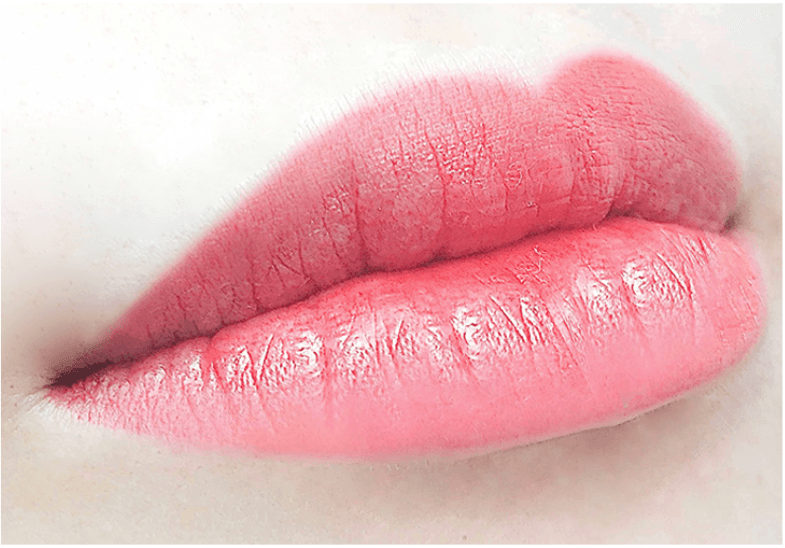
Technique choices affect coverage, border definition, and the predictability of correction work rather than creating medically separate types of treatment.
- Sheer or full-lip shading — Low-density pigment is placed across most of the lip vermilion for a soft, tinted appearance. This suits patients seeking color rather than a sharply outlined lip.
- Contour-focused work — The practitioner emphasizes the vermilion border and cupid’s bow to create mild visual definition. It cannot reliably correct major structural asymmetry.
- Neutralization or color correction — Balancing pigments are selected for uneven baseline tone or melanin-rich lips. Healed color is less predictable because it depends on the underlying lip tone and pigment retention.
- Corrective or revision work — Previous cosmetic tattooing can complicate shade selection and needle work. Fading or clinician-led removal may be needed before revision when old pigment is dense, misplaced, or has shifted color.
Why Visit Korea for Lip Blushing?
Korea is a practical destination only when the individual provider’s standards, documentation, and follow-up plan are clear. There is no robust comparative evidence that Korean lip-blushing outcomes, infection rates, pigment retention, or correction rates are superior to those elsewhere. Treat lip blushing as tattooing rather than assuming that a beauty setting is a medical facility.
- Changing regulatory framework — Korea’s Tattooist Act was promulgated on October 28, 2025 and is scheduled to take effect on October 29, 2027. Its licensing, registration, hygiene, and safety framework is therefore not yet a proven indicator of real-world quality or enforcement, as shown in the current statutory record.
- Provider verification matters — Ask whether the practitioner is a physician, works in a medical institution, or is a tattoo/permanent-makeup practitioner. Confirm credentials, infection-control arrangements, and a named pathway for medical complications.
- Traceable materials — Request the exact pigment brand, ingredient or safety-data information, lot number, expiry date, and needle or cartridge type. The FDA notes that permanent makeup involves needle insertion of colored ink and carries allergic, inflammatory, infectious, cosmetic, and technical risks.
- Portfolio standards — Review healed, not fresh, results in people with comparable natural lip tone. Confirm that the proposed outline remains within an anatomically reasonable lip boundary and that the clinic will provide written aftercare in a language you understand.
Key Information for International Patients
- Minimum stay — Plan 2–3 days for an in-person consultation, treatment, and an early check-in if the provider offers one. A 3–7 day stay is more cautious because HSV reactivation, infection, pronounced swelling, and pigment reactions can arise during the first week.
- Flights — No evidence-based air-travel prohibition applies after an uncomplicated outpatient lip cosmetic tattoo without general anesthesia. Fly only when feeling well and when there is a practical plan for urgent care at the destination.
- Touch-up planning — Surface healing commonly takes 3–7 days, but retained color should not be judged until about 4–6 weeks. A refinement session cannot usually be completed during a short first trip; arrange a second visit, remote review, or a local provider before booking.
- Itinerary impact — Expect visible swelling, stronger-than-final color, dryness, and peeling. Avoid scheduling formal photos, beach activities, swimming, sauna visits, or strenuous exercise around the treatment and early healing period.
- Remote follow-up — Obtain a written complication plan with contact details, instructions for secure photo review, and clear criteria for local medical assessment. Do not rely on messaging alone for worsening pain, spreading redness, pus, fever, blisters, or facial swelling.
Travel note: A prior history of cold sores needs clinician-led planning before travel. Ask the clinician who knows your medical history whether prescription antiviral prophylaxis is appropriate; do not self-prescribe or use a universal regimen.
Which Are the Best Clinics in Korea for Lip Blushing?
Listed below are some of the best clinics in Korea for lip blushing.
1. Three Wishes Clinic - Myeongdong
You may consider Three Wishes Clinic - Myeongdong for lip blushing because it specifically offers lip microblading/lip blush, using semi-permanent pigment to enhance your natural lip color and shape for a fuller, more defined look without daily lip makeup.
- URL: Three Wishes Clinic - Myeongdong Website
- Location: Jung-gu, Seoul
- Lip blushing details:
- Lip microblading, also described as lip blush, is listed among the clinic’s semi-permanent makeup services.
- The stated goal is enhancement of your natural lip color and shape with a semi-permanent result.
- This service may suit you if you want more lip definition and color while reducing reliance on daily makeup.
- Related aesthetic services:
- The clinic also lists dermal fillers for lip volume and contour enhancement.
- Skin treatments include chemical peels, CO2 laser resurfacing, Rejuran Healer, customized skin care, and laser hair removal.
- Other semi-permanent makeup options include eyebrow and hairline/scalp microblading.
2. Rejuel Clinic
You may consider Rejuel Clinic if you are looking for a clinic that lists medical semi-permanent makeup alongside dermatologist-led skin rejuvenation and injectable services; however, its provided service information specifically names brows, lash line, and scalp micropigmentation rather than lip blushing, so lip-blush availability is not confirmed by this information.
- URL: Rejuel Clinic Website
- Location: Seoul
- Semi-permanent makeup scope:
- Medical micropigmentation is described as placing medical-grade pigment in the dermis.
- The listed areas are brows, lash line, and scalp, with aims such as restoring definition, camouflaging gaps, and simplifying daily makeup.
- Lip blushing is not specifically listed in the provided service details.
- Related aesthetic care:
- Dermal fillers are listed for natural contour refinement, including lip enhancement.
- Medical-grade skincare includes customized facials, peels, and barrier-repair treatments for hydration, sensitivity control, and brightening.
- The clinic lists dermatologist-led skin rejuvenation, lifting, injectables, and body contouring with an emphasis on natural-looking results.
Lip Blushing From Start to Finish
- Remote inquiry and screening — Send clear photos without lipstick or filters, disclose prior cold sores, allergies, medical conditions, medicines, previous lip procedures, and prior tattoos. Confirm whether English communication or a virtual consultation is available before committing to travel.
- Design and medical assessment — At the in-person visit, the provider reviews health information, inspects the lips for cracks, lesions, infection, and dermatitis, discusses the desired shade and border, and takes baseline photographs. Defer treatment when there is an active lesion or unresolved medical concern.
- Consent and material verification — Review the planned technique, limitations, risks, aftercare, touch-up policy, and overseas complication plan. Ask to see or receive the pigment brand, shade, lot number, expiry date, and confirmation of a new sterile single-use needle or cartridge.
- Preparation of the treatment area — Surface makeup is removed, the lips are marked, and an appropriate antiseptic is used. A topical anesthetic can be used where lawful and clinically appropriate; lip blushing is generally an outpatient procedure without general anesthesia.
- Pigment implantation — Controlled needle passes place pigment into the vermilion while the provider checks the outline, symmetry, and saturation. Coverage, needle configuration, number of passes, and treatment time depend on lip anatomy, baseline color, correction needs, and the chosen design.
- Same-day discharge — Expect temporary swelling, tenderness, dryness, and color that looks brighter or deeper than the final result. Leave with written instructions, approved cleanser or ointment guidance, and emergency contact details.
- Early healing — Fine flaking and surface healing commonly occur over about 3–7 days. Keep the area clean, avoid picking, and report symptoms suggesting HSV, infection, or an allergic reaction promptly.
- Remote review and refinement decision — Share healing photographs as agreed. Review retained pigment at about 4–6 weeks; only then can the provider judge whether a touch-up is appropriate.
Alternatives to Lip Blushing
The best alternative depends on whether the goal is reversible color, greater volume, structural change, or assessment of a possible medical condition. Non-surgical color options are reversible but need repeated application; filler and surgery alter structure rather than pigment.
Conventional Lip Makeup
- Best for — People who want reversible color, liner definition, or the freedom to change shades.
- Tradeoff — Lipstick, tinted balm, and liner require regular reapplication but do not implant pigment or carry tattoo-related risks.
Lip Fillers
- Best for — Volume loss, dehydration lines, or contour support rather than color change.
- Tradeoff — Hyaluronic-acid filler does not treat pigment unevenness and has injection-specific risks. Read about lip fillers when volume is the primary concern.
Lip Augmentation or Lip Surgery
- Best for — Structural concerns such as significant shape imbalance, proportion, or volume.
- Tradeoff — These procedures are not color-correction treatments and involve more recovery and risk than cosmetic tattooing. Compare lip augmentation and lip plastic surgery.
Medical Assessment for Discoloration
- Best for — New, progressive, patchy, painful, bleeding, or lesion-associated color change.
- Tradeoff — Dermatology or oral-medicine assessment takes priority over cosmetic tattooing because lip blushing does not diagnose or treat disease.
Tattoo Fading or Removal
- Best for — Unwanted prior cosmetic tattoo pigment before revision, when clinically appropriate.
- Tradeoff — Removal can require multiple sessions and has unpredictable results. Learn about laser tattoo removal before pursuing corrective tattoo work.
How Can I Prepare for Lip Blushing?
- Screen for lip problems — Postpone treatment for cold sores, cracks, bleeding, sunburn, infection, dermatitis, ulcers, or unexplained lip lesions. Seek medical assessment when the cause is unclear.
- Plan HSV care early — Tell both the provider and your usual clinician about any history of cold sores before travel. Discuss prescription antiviral prophylaxis individually; no validated universal lip-blushing regimen exists.
- Disclose medicines and supplements — Provide a complete list, including warfarin, apixaban, rivaroxaban, aspirin, clopidogrel, NSAIDs, isotretinoin, corticosteroids, immune-suppressing medicines, vitamins, and herbal products. Do not independently stop prescribed anticoagulants or antiplatelet medicines.
- Avoid unvalidated cutoffs — Follow the treating clinician’s instructions on alcohol, smoking or vaping, NSAIDs, and supplements that can affect bleeding or irritation. Evidence does not establish one universal stop period for lip blushing.
- Eat normally unless instructed otherwise — Fasting is not ordinarily needed when topical anesthetic alone is planned. Follow different instructions if the provider proposes any additional medicine or sedation.
- Arrive with clean lips — Avoid lipstick, gloss, exfoliants, acids, retinoids, benzoyl peroxide, and unknown fragranced lip products on the day of treatment unless the provider directs otherwise.
- Keep travel flexible — Book accommodation with easy access to medical care, avoid non-refundable plans during the first week where possible, and do not schedule swimming, saunas, or strenuous activities immediately afterward.
Travel note: Bring your medical history, medication list, allergy details, and travel-insurance information in English. Save the clinic’s after-hours contact details before treatment.
Confirm the treating doctor’s or practitioner’s individualized requirements, which take precedence over general guidance.
Aftercare Advice
Protect the healing lip surface from contamination, friction, heat, and unapproved products until it has fully closed and the treating provider clears normal lip care.
- Hands and products — Wash hands before touching the lips. Use only the cleanser and ointment specified by the provider; avoid lipstick, gloss, exfoliants, retinoids, acids, benzoyl peroxide, and fragranced or unfamiliar lip products until healed.
- Water and heat — Keep water contact to the minimum directed by the provider during early healing; micropigmentation guidance commonly advises avoiding direct water contact for 3–7 days. Avoid pools, hot tubs, saunas, steam rooms, and potentially contaminated water while the surface is open.
- Do not pick — Dryness and fine flaking are expected. Do not rub, scratch, bite, or peel flakes, as this can disrupt healing and pigment retention.
- Activity and sun — Avoid strenuous exercise and heavy sweating during early healing. Keep the lips out of direct sun; once the surface has healed, use SPF 50 lip protection when tolerated and approved by the provider.
- Know the warning signs — Seek prompt in-person medical care for worsening redness, heat, swelling, or pain; pus, fever, spreading rash, tingling or clustered blisters, generalized hives, swelling beyond the treatment area, breathing or swallowing difficulty, nonhealing ulceration, or persistent nodules. Lip-specific HSV and lichenoid pigment reactions have been reported in the medical literature, but case reports cannot establish their frequency.
- Judge color late — Fresh color is not the final result. Surface healing usually takes 3–7 days, while pigment appearance stabilizes around 4–6 weeks; arrange review before deciding on a touch-up.
Follow the treating doctor’s or practitioner’s instructions over general advice, and contact the clinic promptly when healing appears abnormal.
Frequently Asked Questions
Related Blogs
Lip Microblading in Korea: Methods, Recovery, Risks, and Travel Planning
Lip microblading, also called lip blushing or cosmetic lip tattooing, uses a needle-driven device to place pigment for longer-lasting lip color or border definition. The article covers candidacy, Korea travel planning, provider verification, healing timelines, aftercare, warning signs, and alternatives.
Updated: Sep 23, 2026
Hairline Microblading in Korea: Methods, Healing, Travel Planning and Alternatives
Hairline microblading uses manual strokes, machine-placed pigment dots, or a hybrid technique to camouflage stable frontal thinning without growing hair or stopping hair loss. The article covers candidate screening, Korea travel planning, provider verification, healing timelines, aftercare, complications, and alternatives including SMP, hair transplantation, and dermatologic treatment.
Updated: Sep 23, 2026
Laser Microblading Removal in Korea: Methods, Color Changes, Recovery and Travel Planning
Laser microblading removal uses pigment-selective Nd:YAG laser treatment, often with a test spot for uncertain pigments, and typically requires several sessions at least six weeks apart. The article covers candidate screening, travel planning, procedure steps, recovery, aftercare, risks, alternatives, and documentation for international follow-up.
Updated: Sep 14, 2026
Scalp Micropigmentation in Korea: Methods, Recovery, Travel Planning, and Risks
Scalp micropigmentation uses superficial pigment dots to create a shaved-look effect, reduce visible scalp among existing hair, or camouflage mature scars without restoring hair follicles. The article covers candidate screening, staged sessions, Korea travel planning, practitioner checks, aftercare, follow-up, and alternatives for hair loss or scars.
Updated: Sep 14, 2026