
Medical Tourism Blog
Ligamentolysis in Korea: Candidacy, Surgical Methods, Recovery, and Travel Planning
Table of contents
- Ligamentolysis at a Glance
- What Is Ligamentolysis?
- Who Is a Good Candidate for Ligamentolysis?
- How Is Ligamentolysis Performed?
- Why Visit Korea for Ligamentolysis?
- Key Information for International Patients
- Which Are the Best Clinics in Korea for Ligamentolysis?
- Ligamentolysis From Start to Finish
- Alternatives to Ligamentolysis
- How Can I Prepare for Ligamentolysis?
- Aftercare Advice
Considering treatment in Korea? Everything you need to know e.g. — how to avoid scams, visas, interpreters, recovery tips — in our Medical Tourism Master Guide. Plan with confidence in minutes, not weeks!
Last updated: September 2026
Ligamentolysis at a Glance
- What it does — Ligamentolysis releases the penile suspensory ligament to expose more of the internal shaft, primarily improving visible or flaccid projection; it does not create erectile tissue or guarantee greater erect length.
- Results take months — Swelling and scar maturation make early measurements unreliable, so meaningful measurement-based reassessment is typically done over 3–6 months, while many studies report outcomes at 6–12 months or later.
- Key functional trade-off — Because the suspensory ligament helps support erections, release can lower the erection angle or cause greater instability or mobility during intercourse.
- Recovery and aftercare — Bruising, swelling, discomfort, and incision care commonly last about 1–2 weeks; strenuous activity, cycling, heavy lifting, and sexual activity require surgeon clearance, and prescribed traction timing varies by technique.
- Travel planning — International patients should plan at least 7–14 days in South Korea after an uncomplicated standalone procedure for anesthesia recovery and an in-person wound review, with a longer stay for combined surgery or complications.
- Evidence and candidacy — Evidence is limited and techniques vary; an older 42-patient series found a mean stretched-length increase of 1.3 ± 0.9 cm but only 35% overall satisfaction, making realistic goals, formal measurements, and psychological screening important.
- Korea-specific check — No reliable evidence shows superior ligamentolysis outcomes in South Korea, so verify the surgeon’s relevant specialty, exact operative plan, anesthesia and emergency arrangements, and post-return complication or revision support rather than relying on destination marketing.
What Is Ligamentolysis?
Ligamentolysis is an operation that releases tissue supporting the penis at its base to allow more shaft to project outward. It aims to improve visible, especially flaccid, penile length for people concerned about concealment or projection, without creating new erectile tissue or assuring greater erect length. It is a surgical procedure, sometimes combined with reconstructive or contouring treatments.
Who Is a Good Candidate for Ligamentolysis?
- Adults seeking greater visible projection — Candidates understand that penile suspensory-ligament release exposes more of the internal shaft and primarily affects visible or flaccid projection; it does not create new erectile tissue or guarantee a meaningful erect-length increase.
- Patients with a documented anatomical concern — Assessment can identify suprapubic fat concealment, adult acquired buried penis, penoscrotal webbing, skin tethering, or other anatomy for which a different or combined reconstructive approach could be more appropriate.
- People prepared for structured aftercare — Good candidates can follow incision care, abstinence, activity limits, in-person review before international travel, and any prescribed penile traction or extender regimen.
- Patients with realistic measurement-based goals — Baseline assessment should include bone-to-tip and skin-junction-to-tip stretched measurements. The EAU guideline considers stretched measurement the minimum assessment and supports flaccid and, where feasible, pharmacologically induced erect measurements before surgery is considered.
Ligamentolysis is unsuitable for minors and for people whose main concern is untreated body-image distress, suspected penile dysmorphic disorder, unrealistic expectations, or relationship pressure. The operation can lower erection angle and reduce erection stability because the suspensory ligament normally supports the penis. Active genital, urinary, or skin infection, open wounds, uncontrolled diabetes, uncorrected bleeding disorders, unoptimized anesthesia risk, and unassessed erectile dysfunction, Peyronie’s disease, sensory change, urinary symptoms, or penile instability require evaluation or treatment first. The EAU recommends psychotherapeutic assessment where psychopathology or adverse relationship dynamics drive an augmentation request; an older 42-patient series reported only 35% overall satisfaction and 27% satisfaction among men with penile dysmorphic disorder, reinforcing why screening matters before cosmetic lengthening surgery.
How Is Ligamentolysis Performed?
“Ligamentolysis” is not one standardized operation. The planned components determine the incision, scar pattern, recovery burden, traction requirements, and the meaning of any reported length change.
- Isolated infrapubic release — The surgeon accesses the suspensory ligament through an incision above the penile base and divides or releases it to permit more shaft projection. This is the closest match to standalone penile suspensory-ligament release.
- Release with V-Y or Z-plasty — V-Y advancement or Z-plasty rearranges skin to cover the newly projected shaft and address skin tension. These skin-plasty techniques change the scar configuration and add wound-healing considerations.
- Release with penopubic reconstruction — Reconstruction reshapes or fixes tissue at the penis–pubis junction to improve contour or reduce tethering. It is distinct from simply dividing the ligament.
- Release with spacer or graft — An interposition material is intended to limit scar re-attachment between released structures. It also adds material-specific risks, including infection, erosion, foreign-body problems, graft complications, and revision.
- Buried-penis or suprapubic-fat surgery — Suprapubic liposuction, lipectomy, fixation, skin reconstruction, or fat management addresses concealment by the fat pad. This may improve apparent length without producing the same anatomical effect as ligament release.
The EAU guideline does not identify a superior incision, spacer material, combined technique, or universal traction protocol. Ask for the exact operative plan in writing rather than accepting “ligamentolysis” as a complete description.
Why Visit Korea for Ligamentolysis?
There is no reliable comparative evidence that ligamentolysis in South Korea produces superior length, erectile-function, complication, satisfaction, revision, or surgeon-experience outcomes versus other countries. Choose a surgeon and facility on the specifics of assessment, technique, anesthesia, emergency access, and post-return care—not destination marketing. For this procedure, careful verification is more important than claims of national advantage.
- Registered-provider verification — International patients can use the Korean government’s registered medical-institution system as one administrative check, then independently confirm the operating surgeon’s specialty and credentials.
- Technique-specific discussion — Request direct answers on isolated release versus V-Y/Z-plasty, spacer/graft use, suprapubic fat reduction, or buried-penis reconstruction. These are not interchangeable operations and cannot be compared by one advertised “length gain.”
- Measurement and counseling standard — Ask whether the clinic records bone-to-tip and skin-junction-to-tip stretched measurements and evaluates erection quality, curvature, buried penis, webbing, prior filler or surgery, and psychological suitability, consistent with EAU assessment principles.
- Continuity after departure — Confirm who handles wound concerns, traction questions, complications, and possible revision after return home. Published evidence remains limited on safe remote follow-up and long-haul-flight timing after the different ligamentolysis combinations.
Key Information for International Patients
- Minimum stay — Plan at least 7–14 days in South Korea after an uncomplicated standalone operation. This conservative timeframe allows recovery from anesthesia, an early in-person wound review, and management of bleeding, infection, wound, or urinary concerns before a long-haul flight.
- Longer stay for combined surgery — Remain longer after liposuction, fat grafting, V-Y/Z-plasty, spacer or graft placement, buried-penis reconstruction, catheterization, or any complication. Each addition changes wound care and fit-to-fly decisions.
- Flight timing — Do not book a fixed early return flight. No validated ligamentolysis-specific long-haul-flight interval exists; obtain the operating surgeon’s written fit-to-fly clearance after examination.
- Early itinerary impact — Expect swelling, bruising, suprapubic or perineal discomfort, and incision-care needs for roughly 1–2 weeks. Keep the first days close to the accommodation and clinic; do not schedule strenuous sightseeing, cycling, gym sessions, heavy lifting, hot baths, saunas, or sexual activity.
- Traction planning — Postoperative penile traction or extender therapy is often intended to reduce scar re-attachment, but timing, daily wear hours, and total duration vary by surgeon and technique. Confirm whether equipment is supplied, how to travel with it, and who will monitor its use remotely.
- Documents and contact — Leave Korea with an English operative and discharge summary, medication list, wound-care instructions, explicit activity and sexual restrictions, traction instructions, and a direct after-hours contact.
Travel note: Build flexibility into flights and accommodation. A wound concern, urinary problem, or delayed clearance should take priority over returning on the original travel date.
Which Are the Best Clinics in Korea for Ligamentolysis?
Listed below are some of the best clinics in Korea for ligamentolysis.
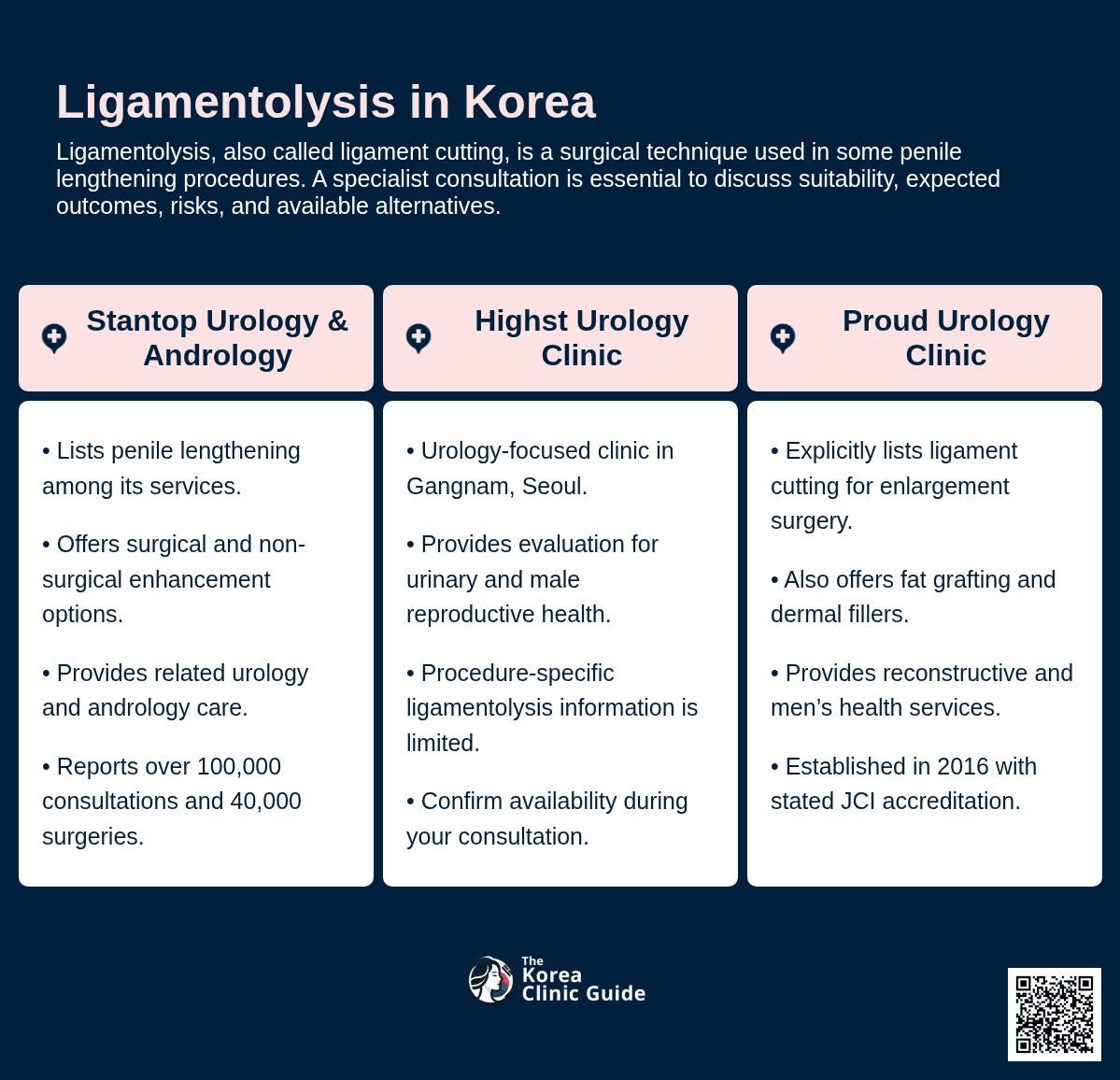
1. Stantop Urology & Andrology
For ligamentolysis as part of penile lengthening, you can expect a urology-and-andrology setting that lists penile lengthening among its services and offers both surgical and non-surgical approaches to length enhancement. Your consultation and treatment can be arranged with separate spaces for men and women to support privacy.
- URL: Stantop Urology & Andrology Website
- Location: Seoul
- Lengthening and enhancement:
- Penile lengthening is listed alongside penile enlargement and glans enlargement services.
- Penile enlargement may use injectable fillers or surgical methods, while the clinic describes lengthening as surgical or non-surgical.
- Related urology services:
- Erectile-dysfunction options listed include inflatable or malleable penile implants, stem-cell therapy, and shockwave therapy.
- The clinic also lists premature-ejaculation care, STD testing, circumcision, vasectomy, and treatment for prostate conditions.
- Clinic notes:
- The clinic states that it has completed more than 100,000 consultations and 40,000 surgeries.
- It describes personalized VIP care and dedicated facilities intended to support comfort and privacy.
2. Highst Urology Clinic
You may consider Highst Urology Clinic if you are seeking a urology-focused clinic in Korea for evaluation of urinary or male reproductive health, but the available information does not confirm that it offers ligamentolysis or provide procedure-specific details.
- URL: Highst Urology Clinic Website
- Location: 14, 15F, 655 Seolleung-ro, Gangnam-gu, Seoul, Republic of Korea
3. Proud Urology Clinic
For ligamentolysis, Proud Urology Clinic explicitly lists ligament cutting as one of the techniques used in penis enlargement surgery, alongside fat grafting and dermal fillers. You can therefore discuss whether ligament cutting is appropriate for your length or girth goals within a clinic that also provides related men’s enhancement and reconstructive services.
- URL: Proud Urology Clinic Website
- Location: Seoul
- Procedure details:
- Penis enlargement surgery may be performed using ligament cutting, fat grafting, or dermal fillers.
- The clinic describes these procedures as intended to increase penile length or girth.
- Related services:
- Men’s services include erectile-dysfunction surgery with penile implants, premature-ejaculation treatment, circumcision, and vasectomy or vasectomy reversal.
- Reconstructive care includes penile-curvature correction, removal of injected Vaseline or other foreign substances, and scrotal reconstruction.
- Clinic notes:
- Established in 2016.
- The clinic states that it has JCI accreditation and professionally trained staff.
Ligamentolysis From Start to Finish
- Remote inquiry and consultation — Send medical history, current medicines and supplements, prior genital procedures, relevant photographs only through the clinic’s secure process, and a clear description of goals. Confirm whether an English-speaking coordinator, interpreter, or virtual consultation is available.
- Preliminary surgical plan — The surgeon should explain whether the proposal is isolated ligament release or a combined procedure with skin plasty, penopubic reconstruction, suprapubic fat surgery, or a spacer/graft. Request a written explanation of the expected trade-offs, especially erection-angle change and possible instability.
- In-person examination and measurements — The team assesses stretched length, pubic-fat concealment, skin availability, penoscrotal webbing, curvature, erection quality, sensation, urinary symptoms, prior filler or surgery, and medical fitness. Bone-to-tip and skin-junction-to-tip measurements establish a more meaningful baseline than self-measurement alone.
- Screening and consent — Preoperative tests and anesthesia assessment depend on age, health history, anesthesia plan, and operative extent. Discuss psychological or psychosexual assessment when body-image distress, dysmorphia, or relationship conflict is present; the EAU advises this evaluation when such factors underlie an augmentation request.
- Anesthesia and surgery — Depending on the facility and extent of surgery, the operation is performed under local anesthesia with sedation, regional anesthesia, or general anesthesia. The surgeon makes the planned infrapubic access incision, releases the suspensory ligament, and performs any agreed skin, fat-pad, reconstruction, or interposition steps.
- Immediate recovery and discharge — Standalone surgery is commonly outpatient or involves short observation. Staff monitor pain, bleeding, urination, nausea, and recovery from anesthesia before discharge; a catheter is more likely with more extensive reconstruction than isolated release.
- Early wound review in Korea — Attend the scheduled in-person review before international departure. The surgeon checks the incision, swelling, bruising, wound separation, signs of infection, and whether traction can start.
- Recovery and objective reassessment — Early swelling and scar maturation make immediate measurements unreliable. Reassessment over about 3–6 months is more meaningful, while many published series report outcomes at 6–12 months or longer.
- Remote follow-up after return home — Send requested wound photographs through the clinic’s designated secure channel and arrange video follow-up. Seek urgent local assessment rather than waiting for remote advice if serious warning signs develop.
Alternatives to Ligamentolysis
Non-surgical and reconstructive alternatives can better match the underlying problem, but they have different limits. Ligament release targets shaft projection and carries scar, wound, erection-angle, and stability trade-offs; non-surgical traction requires substantial adherence, while reconstructive surgery is reserved for defined anatomy or disease.
Penile Traction Therapy
- What it addresses — A penile extender applies gradual traction without dividing the suspensory ligament.
- Trade-off — The EAU states traction may be considered, but protocols, adherence, and results vary, and it requires sustained daily use.
- Related option — See penis lengthening.
Suprapubic Fat-Pad Reduction
- What it addresses — Liposuction, lipectomy, or mons surgery can uncover a shaft concealed by suprapubic tissue or contribute to adult acquired buried-penis treatment.
- Trade-off — This improves apparent or visible length rather than adding erectile tissue; it has liposuction or excision-specific healing risks.
- Related options — See pubic fat pad removal or monsplasty.
Ventral Phalloplasty or Scrotoplasty
- What it addresses — Penoscrotal webbing or ventral skin tethering can make the penis appear shorter.
- Trade-off — This targets skin anatomy, not the suspensory ligament, and can be more appropriate when webbing is the main finding.
Peyronie’s or Erectile-Dysfunction Care
- What it addresses — Curvature, painful erections, shortening from Peyronie’s disease, or poor erection rigidity require diagnostic treatment rather than cosmetic ligament release.
- Trade-off — These pathways aim to preserve or restore sexual function; they do not serve as routine cosmetic lengthening procedures.
- Related options — See Peyronie’s disease treatment and erectile dysfunction treatment.
Reconstructive Surgery
- What it addresses — Penile implant surgery, graft-based reconstruction, or phalloplasty is reserved for specific medical or reconstructive indications.
- Trade-off — These are substantially more invasive than cosmetic ligament release and carry their own functional, device, graft, and revision considerations.
- Related options — See penile implant and phalloplasty.
How Can I Prepare for Ligamentolysis?
- Medical disclosure — Provide the surgeon and anesthesia team with all diagnoses, allergies, prior genital surgery or filler, erectile or urinary symptoms, smoking or nicotine use, and every prescription, over-the-counter medicine, vitamin, herbal product, and supplement.
- Blood-thinning medicines — Report anticoagulants, antiplatelet drugs, aspirin, NSAIDs, fish oil, vitamin E, and herbal supplements that can affect bleeding. Do not stop prescribed medication independently; the prescribing clinician, surgeon, and anesthesia team must agree the perioperative plan and timing.
- Infection and skin check — Report urinary burning, discharge, genital ulcers, rashes, ingrown hairs, fever, or open skin before travel. Active infection or damaged skin can require postponement.
- Smoking and alcohol — Stop smoking, vaping, and nicotine products for the period set by the surgeon because nicotine impairs wound healing. Avoid alcohol as instructed before surgery and while taking postoperative pain medicine or antibiotics.
- Fasting — Follow the clinic’s exact fasting instructions for general anesthesia or sedation. Do not assume a universal food or clear-fluid cutoff.
- Transport and companion — Arrange a responsible adult to accompany or collect you after sedation or general anesthesia and avoid driving, operating equipment, or making important decisions until cleared.
- Accommodation and flights — Stay near the clinic for the early recovery period, choose lodging that allows privacy for wound care and traction, and book changeable flights. Plan at least 7–14 days in Korea for uncomplicated standalone surgery.
Travel note: Bring enough regularly prescribed medicine for the entire trip plus a buffer, in original labeled containers, and carry a medication list in English.
Confirm the treating surgeon’s individualized medication, fasting, nicotine, hygiene, accommodation, companion, and travel requirements; those instructions take precedence over general guidance.
Aftercare Advice
Protect the incision and the surgical result during the first weeks: early swelling, bruising, and discomfort are expected, but rapidly worsening symptoms are not.
- Walking and activity — Take gentle walks to avoid prolonged immobility, but avoid strenuous exercise, cycling, heavy lifting, and friction or pressure on the operative area until the surgeon clears them.
- Incision care — Keep dressings, showering, drying, ointment, and garment use exactly as instructed. Do not soak in baths, pools, hot tubs, or saunas until the incision is sealed and the surgeon permits it.
- Sexual restrictions — Avoid masturbation, intercourse, and other activity that produces erections or mechanical stress as directed. A 4–6 week abstinence interval is common in penile-surgery instructions, but no evidence-based ligamentolysis-specific interval exists and combined surgery can require longer.
- Traction or extender — Start only on the surgeon’s stated date and follow the prescribed hours and duration. Early or excessive traction can disrupt healing; skipping a prescribed regimen can affect scar re-attachment risk.
- Pain and medicines — Take prescribed pain medicine and antibiotics only as directed. Avoid alcohol with sedating pain medicines, and ask before restarting medicines or supplements that affect bleeding.
- Urgent warning signs — Seek urgent local care for uncontrolled bleeding, rapidly enlarging swelling, fever, spreading redness, foul drainage, wound opening, inability to urinate, a cold or blue penis, severe worsening pain, chest pain, shortness of breath, or a painful swollen calf.
- Results and follow-up — Do not judge length in the first weeks. Swelling and scar maturation distort early appearance; arrange measurement-based reassessment over 3–6 months and continue follow-up at the interval set by the operating surgeon.
Follow the treating doctor’s instructions over general advice, and contact the clinic promptly when the incision, swelling, urination, erection stability, sensation, or pain appears wrong.
Frequently Asked Questions
Related Blogs
BPH(Benign Prostatic Hyperplasia) in Korea: Diagnosis, Treatment Options, Recovery, and Travel Planning
BPH treatment ranges from monitoring and medication to transurethral procedures such as TURP, HoLEP, Aquablation, UroLift, and Rezūm, selected by prostate anatomy, symptoms, complications, and ejaculation priorities. International patients can find guidance on testing, catheter recovery, Korea stay planning, flight clearance, records, and follow-up.
Updated: Oct 13, 2026
Male Menopause Treatment in Korea: Testing, Testosterone Therapy, Fertility, and Travel Planning
Male hypogonadism treatment in Korea requires symptoms plus repeat early-morning low testosterone tests, cause and safety assessment, and consideration of fertility plans. International patients should plan 3–5 business days for testing and review, then arrange home-country monitoring and medicine-travel documentation.
Updated: Oct 13, 2026
Prostatitis Treatment in Korea: Diagnosis, Treatment Pathways, Travel Planning, and Follow-Up
Prostatitis evaluation uses urine cultures, symptom assessment, and selective imaging or localization testing to distinguish infection, pelvic pain, obstruction, and complications. Stable international patients visiting Korea should allow 2–5 days, arrange record review and follow-up, and seek local urgent care instead for fever, retention, sepsis symptoms, or suspected abscess.
Updated: Oct 13, 2026
Aquablation in Korea: Candidacy, Recovery, Travel Planning, and Alternatives
Aquablation is a general-anesthesia BPH procedure that uses ultrasound-guided robotic waterjet tissue removal through the urethra, with catheter care and bleeding management afterward. International patients should plan at least 7–10 days in Korea, avoid flying until successful catheter removal and voiding, and arrange records and follow-up with a home urologist.
Updated: Oct 13, 2026
Clinics offering Ligamentolysis

StanTop Urology & Andrology: Korea's Premier Clinic for Advanced Urological and Andrological Treatments
Sinnonhyeon Station
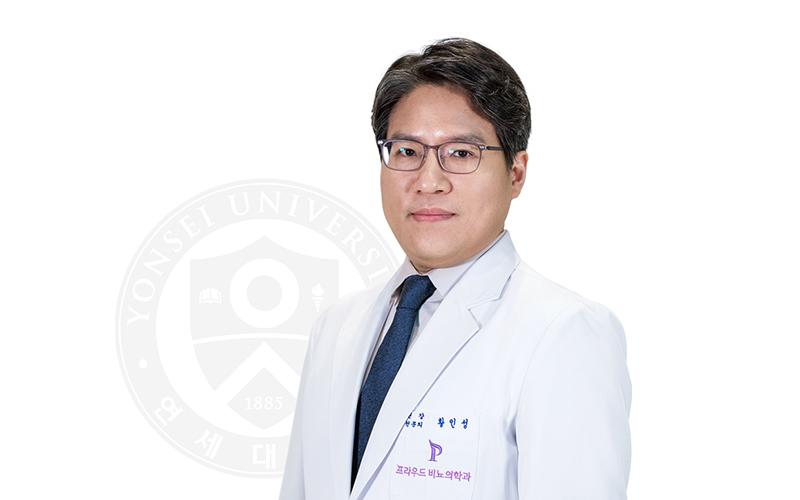
Proud Urology Clinic: Leading Provider of Men Enhancement and Body Sculpting Services in Korea
Nonhyeon

Highst Urology Clinic Korea | Urology Evaluation & Treatment for Urinary and Male Reproductive Health in Nonhyeon
Nonhyeon