
Medical Tourism Blog
Body Laser Hair Removal in Korea: Devices, Sessions, Recovery, and Travel Planning

Table of contents
- Body Laser Hair Removal at a Glance
- What Is Body Laser Hair Removal?
- Who Is a Good Candidate for Body Laser Hair Removal?
- How Is Body Laser Hair Removal Performed?
- Why Visit Korea for Body Laser Hair Removal?
- Key Information for International Patients
- Which Are the Best Clinics in Korea for Body Laser Hair Removal?
- Body Laser Hair Removal From Start to Finish
- Alternatives to Body Laser Hair Removal
- How Can I Prepare for Body Laser Hair Removal?
- Aftercare Advice
Considering treatment in Korea? Everything you need to know e.g. — how to avoid scams, visas, interpreters, recovery tips — in our Medical Tourism Master Guide. Plan with confidence in minutes, not weeks!
Last updated: September 2026
Body Laser Hair Removal at a Glance
- What it does — Laser hair removal uses focused light to target pigment in hair follicles for long-term hair reduction on areas such as the legs, arms, underarms, chest, back, bikini line, and Brazilian area; it does not guarantee complete permanent removal.
- Best candidates — Dark, coarse terminal hair on untanned, healthy skin responds best; white, gray, red, and very light blonde hair has too little pigment for conventional laser or IPL and is usually better suited to electrolysis.
- Treatment course — An initial course requires multiple sessions over several months because only some follicles are responsive per visit; appointments are commonly spaced 4–6 weeks apart, sometimes longer depending on the body site and response.
- Recovery and results — Most people resume ordinary non-strenuous activity the same day, with redness, warmth, and follicular swelling typically lasting 1–3 days; treated hairs usually shed over 1–3 weeks rather than disappearing immediately.
- Travel timing — Plan 1–2 days in Korea for one session, since consultation and treatment can often occur on day 1; same-day or next-day flying is generally feasible after an uncomplicated awake treatment, but a full course cannot be completed during a short trip.
- Key safety limitation — Recent tanning, sunburn, self-tanner, active skin infection or rash, and pregnancy require postponement; deeply pigmented skin or a history of pigment changes warrants careful device selection, cooling, and often a test spot to reduce burn and discoloration risk.
- Korea-specific consideration — Korea’s practical distinction is its foreign-patient institution framework, not proven superior hair-reduction results; verify that the exact clinic is currently registered for international patients and ask about your skin-type experience, wavelength, cooling, test spots, and English complication follow-up.
What Is Body Laser Hair Removal?
Body laser hair removal uses focused laser light to target pigment in hair follicles and reduce unwanted hair over time. It helps people achieve longer-lasting reduction of coarse body hair and can lessen shaving-related irritation or ingrown hairs. It is a non-surgical procedure, usually performed awake in a series of office-based sessions.
Who Is a Good Candidate for Body Laser Hair Removal?
- Best hair profile — Candidates usually have dark, coarse terminal hair on the legs, arms, underarms, chest, abdomen, back, shoulders, buttocks, bikini line, or Brazilian area. Dark pigment in the hair shaft gives laser energy a clearer target.
- Realistic treatment goal — Good candidates want long-term hair reduction, can attend a series spaced over months, and accept that finer or lighter regrowth and later maintenance can occur.
- Ingrown-hair concerns — Laser reduction can be useful where repeated shaving causes ingrown hairs, razor bumps, or pseudofolliculitis; it does not treat body contour, loose skin, or an underlying hormonal condition.
- Darker skin tones — Deeply pigmented skin can be treated, but device wavelength, pulse duration, fluence, cooling, and test-spot decisions need particular care to limit epidermal heating and pigment change.
Conventional laser and IPL systems are poor options for white, gray, red, and very light blonde hair because there is too little follicular pigment. Defer treatment for recent tanning, sunburn, self-tanner, active folliculitis, rash, open wounds, or bacterial, fungal, or viral infection in the treatment area. Postpone elective cosmetic treatment during pregnancy: the available pregnancy laser literature is low-level and not specific enough to establish cosmetic epilation safety. A history of keloids, pigment changes after inflammation, recurrent herpes simplex, photosensitivity, or a recent medication change requires clinician assessment and often a conservative test spot. New, rapid, widespread hair growth—especially with irregular periods, acne, androgenic symptoms, or a possible medication cause—needs medical evaluation before starting a cosmetic series.
How Is Body Laser Hair Removal Performed?
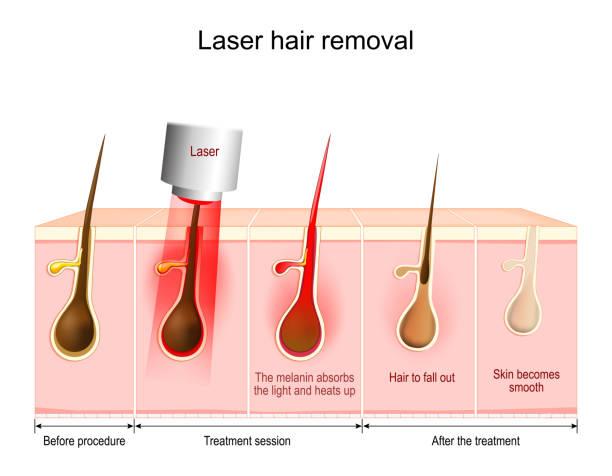
The correct system depends on natural hair color and thickness, Fitzpatrick skin type, tanning history, body site, prior reactions, and treatment goals. Device names alone do not predict results; ask why the proposed wavelength and cooling method fit your skin and hair.
- Alexandrite laser (755 nm) — Often used for dark, coarse hair in lighter skin tones. It requires careful parameter selection in darker skin because shorter wavelengths have greater epidermal melanin absorption.
- Diode laser (commonly 800–810 nm) — Commonly selected for medium and large areas such as legs, back, chest, and arms, across a range of skin types. A 2023 network meta-analysis found that laser and IPL approaches reduce hair versus controls, but did not establish one device category as superior in all long-term settings.
- Long-pulsed Nd:YAG laser (1064 nm) — Often the conventional laser category to discuss for deeply pigmented skin because its longer wavelength has less epidermal melanin absorption. It can be less efficient for fine hair and can feel more uncomfortable.
- IPL — Intense pulsed light is filtered broad-spectrum light, not a laser. It can reduce hair in suitable patients, but outcome and safety depend heavily on filters, settings, cooling, and operator technique; see IPL hair removal for the specific tradeoffs.
- Pulse delivery and cooling — A handpiece can place individual pulses or move continuously across the skin. Contact cooling, air cooling, cryogen spray, gel, and vacuum-assisted systems are comfort and skin-protection measures, not guarantees of a particular reduction percentage.
- Test spot — A test spot is particularly useful after a pigmentary complication, with darker skin, uncertain photosensitivity, recent irritation, a new device, or a large or intimate-area treatment plan. The clinician may review it after several days to one week before treating the full area.
Why Visit Korea for Body Laser Hair Removal?
Korea’s supportable advantage for this procedure is its international-patient framework, not proven superiority in hair-reduction outcomes. No high-quality evidence shows that body laser hair removal in Korea produces better results than equivalent care elsewhere. Choose a provider based on experience with comparable skin and hair characteristics, device selection, cooling, test-spot practice, and a clear plan for adverse-event follow-up.
- Registered foreign-patient institutions — Medical Korea describes a registration system for institutions serving international patients. Its March 2025 reliability information reported 3,114 registered foreign-patient-attraction medical institutions.
- Malpractice-insurance framework — The same Medical Korea information states that registered institutions are required to carry medical-malpractice liability insurance and reported 100% insurance registration among relevant registered institutions and agencies. Verify the current status of the exact institution rather than relying on a broker or social-media listing.
- Practical booking questions — Before paying a deposit, confirm the treating clinician, exact device and wavelength, whether the clinic treats your Fitzpatrick skin type, cooling method, test-spot policy, intimate-area policy, English aftercare, and a direct contact route for complications.
- Evidence limits — Comparative research remains heterogeneous. A systematic review of long-term randomized evidence found only five eligible trials with 223 participants, so universal reduction percentages and claims that one device is always best are not credible.
Key Information for International Patients
- Minimum stay — Plan 1–2 days in Korea for one body-area session. Consultation, an indicated test spot, and treatment can often happen on day 1; reserve a next-day review after a strong reaction or treatment of a large or sensitive area.
- Course timing — Do not book a short visit expecting to complete full-body laser hair removal. Sessions are commonly about 4–6 weeks apart, and some body sites need longer intervals based on growth cycle, response, skin type, and device.
- Flying home — Same-day or next-day commercial flying is generally practical after an uncomplicated awake treatment. Delay departure and seek in-person care for blistering, severe pain, rapidly spreading redness, pus, fever, or suspected infection.
- Itinerary restrictions — Schedule treatment away from beach days, skiing, tanning, hot springs, sauna visits, swimming, hot yoga, and strenuous outdoor activity. Redness, warmth, and follicular swelling commonly last 1–3 days.
- Remote follow-up — Before leaving, obtain an English treatment record with treated areas, device or wavelength, treatment date, settings where available, aftercare instructions, and a clinic contact. Use the clinic’s approved photo process for mild reactions, but obtain local in-person care for a worsening or blistering reaction.
- Independent travel — Fasting, a companion, and medical transport are not normally needed because treatment is performed awake. Arrange a ride or companion when oral sedating medicine is used or anxiety and pain would impair safe travel.
Travel note: Treated hairs often look unchanged at first and then shed over 1–3 weeks. Schedule photographs, beachwear, and friction-heavy activities with this visible transition in mind.
Which Are the Best Clinics in Korea for Body Laser Hair Removal?
Listed below are some of the best clinics in Korea for body laser hair removal.
1. Three Wishes Clinic - Myeongdong
For body laser hair removal, you can receive targeted laser treatment designed to destroy hair follicles for long-lasting reduction of unwanted hair. The clinic states that treatment can be used across almost all body areas, allowing your plan to focus on the areas you want to address.
- URL: Three Wishes Clinic - Myeongdong Website
- Location: Jung-gu, Seoul
- Procedure details:
- Laser energy is directed at hair follicles to reduce unwanted hair over time.
- Treatment is described as suitable for almost all body areas.
- The stated goal is smooth skin with long-lasting hair reduction.
- Other available care:
- Skin-focused options include CO2 laser resurfacing, PDT acne treatment, chemical peels, Rejuran Healer, and customized skin care.
- The clinic also offers Shurink ultrasound-based lifting and tightening for the face or body.
- Additional aesthetic services listed include Botox, fillers, fat-dissolving injections, thread lifting, and semi-permanent makeup.
2. Cheongdam Oracle Dermatology & Plastic Surgery Clinic
Cheongdam Oracle Dermatology & Plastic Surgery Clinic describes personalized cosmetic and dermatologic treatment planning, but the provided clinic information does not specify body laser hair removal or its laser-hair-removal technology. You may want to confirm whether this treatment is available and which body areas can be addressed before arranging care.
- URL: Cheongdam Oracle Dermatology & Plastic Surgery Clinic Website
- Location: Gangnam-gu, Seoul
- Related skin and aesthetic services:
- Listed skin treatments include laser resurfacing, chemical peels, microneedling, and HydraFacial.
- Body-contouring options listed include liposuction, CoolSculpting, and ultrasound cavitation.
- The clinic also lists Botox, dermal fillers, thread lifting, hair transplant, scalp micropigmentation, and several plastic-surgery procedures.
3. Daybeau Clinic - Hongdae
For body laser hair removal, Daybeau Clinic - Hongdae lists laser hair removal as a long-term option for unwanted body hair. Its described approach emphasizes individualized treatment planning, hygiene, and avoiding unnecessary procedures, which can be relevant when you are considering treatment for your specific areas and goals.
- URL: Daybeau Clinic - Hongdae Website
- Location: Mapo-gu, Seoul
- Procedure approach:
- Laser hair removal is listed as a long-term solution for unwanted body hair.
- The clinic describes tailoring treatments to individual needs rather than imposing unnecessary procedures.
- Its stated care approach emphasizes safety, hygiene, and anatomically informed techniques.
- Other available care:
- Skin services include laser treatment for pigmentation, spots, and tattoo removal, as well as treatments for redness, visible blood vessels, pores, and scars.
- Body and lifting options listed include Onda Lifting, Titanium Lifting, Shrink Universe, and facial contouring treatments.
- The clinic also lists treatment and prescription services for acne, hair loss, and weight management.
Body Laser Hair Removal From Start to Finish
- Remote consultation and screening — Send unfiltered daylight photographs and identify every intended zone. Disclose natural hair color, skin tone, tanning, pregnancy possibility, previous laser or IPL treatment, pigment or scar reactions, herpes history, skin disease, hormonal conditions, allergies, medicines, and supplements. Ask whether English consultation and written aftercare are available.
- Travel and session planning — Confirm whether the clinic can assess and treat on the same day, whether a test spot needs separate review, and how long the proposed areas will take. Large areas such as both legs, chest, or back can take more than an hour.
- In-person assessment — The clinician examines hair caliber and density, skin condition, tan level, planned areas, medication risks, and the appropriate device. They should distinguish ordinary unwanted body hair from a pattern that needs endocrine, gynecologic, or primary-care assessment.
- Test spot when indicated — For deeply pigmented skin, uncertain photosensitivity, prior pigment changes, recent irritation, a new device, or extensive/intimate-area treatment, a small test area can be treated first. The clinician may wait several days to one week before proceeding.
- Skin preparation and comfort measures — Staff check for irritation or tanning, then shave or clip remaining hair when needed and cleanse the skin. Wear wavelength-appropriate protective eyewear. Sensitive areas can be treated with topical anesthetic, which generally needs advance application time.
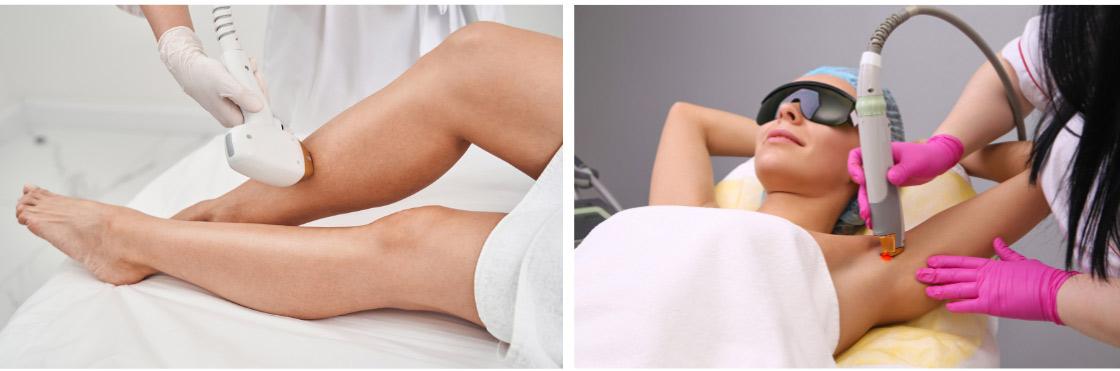
- Laser or IPL treatment — The handpiece delivers pulses across the marked area with an appropriate cooling approach. Sensation is commonly described as brief snapping, heat, or pinpricks. Energy targets pigment in the hair shaft and follicle rather than removing all visible hair immediately.
- Discharge and short recovery — Cooling and written aftercare are provided, and most patients leave independently for non-strenuous normal activity. Mild perifollicular redness, warmth, and swelling are common for 1–3 days.
- Series and overseas follow-up — Treated hairs shed over roughly 1–3 weeks. Arrange the next session at the clinician’s recommended interval, often 4–6 weeks or longer for some sites, and use remote follow-up for routine progress while seeking local care for serious symptoms.
Alternatives to Body Laser Hair Removal
Laser is efficient for broad areas of dark terminal hair but produces long-term reduction rather than a guarantee of complete permanent removal. Alternatives are more suitable when hair lacks pigment, only a few hairs remain, temporary removal is preferred, or an underlying medical cause needs treatment.
Electrolysis
- Best role — The meaningful permanent-removal option for blonde, white, gray, and red hair, and for isolated residual hairs after a laser series.
- Tradeoff — Each follicle is treated individually, so large areas take substantially more time than laser reduction.
Area-specific laser treatment
- Best role — A narrower treatment plan can suit travelers focused on one region rather than full-body treatment, such as underarm laser hair removal, leg laser hair removal, arm laser hair removal, or Brazilian laser hair removal.
- Tradeoff — Targeting fewer areas shortens a single appointment but still requires spaced sessions and does not address hair elsewhere.
At-home IPL or laser devices
- Best role — Selected users who accept slower, maintenance-oriented reduction and can follow device safety instructions.
- Tradeoff — Do not substitute home treatment for clinician assessment when there is deeply pigmented skin, a pigment disorder, scarring tendency, active skin disease, uncertain photosensitivity, or a prior laser complication.
Medical management of excess hair growth
- Best role — Evaluation and treatment are important when androgen excess, another endocrine disorder, or medication contributes to new or progressive hair growth.
- Tradeoff — Medical treatment can address a driver of recurrence but does not instantly remove existing visible hair; laser can be used alongside it when clinically appropriate.
How Can I Prepare for Body Laser Hair Removal?
- Avoid tanning — Avoid deliberate sun exposure, tanning beds, and self-tanner until the skin has returned to its normal baseline color. Use broad-spectrum SPF 30+ and protective clothing on exposed treatment zones.
- Keep the follicle intact — Do not wax, pluck, thread, sugar, or epilate from the root for the interval set by the clinic. Shaving or clipping is generally preferred; follow the clinic’s instructions on when to shave and avoid razor cuts or razor burn.
- Disclose every medicine and supplement — Send a complete list of prescriptions, over-the-counter drugs, topical products, herbal products, and supplements. Highlight tetracyclines, thiazide diuretics, amiodarone, retinoids, St John’s wort, and any medicine associated with a prior sun reaction. Do not independently stop aspirin, anticoagulants, isotretinoin, hormonal treatment, or any prescribed medicine.
- Report skin and herpes history — Tell the clinician about active rashes, folliculitis, eczema, wounds, pigment changes, keloids, hypertrophic scarring, and recurrent herpes simplex, including genital herpes for intimate-area treatment.
- Arrive with clean skin — Remove deodorant, perfume, body oils, self-tanner, body makeup, and irritating active products from the planned area. Wear loose, soft clothing to reduce friction afterward.
- Food, alcohol, smoking, and transport — Fasting is not routinely required for awake laser hair removal. Evidence does not establish universal alcohol, smoking, or routine-supplement stop periods; disclose use and follow the clinic’s individualized instructions. Arrange transport if oral sedation is planned.
- Build a flexible itinerary — Avoid booking treatment immediately before beach activities, hot springs, sauna, intense exercise, swimming, or a long sun-exposed excursion. Keep a flexible flight option when treating a large or sensitive area or after a prior adverse reaction.
Travel note: Bring an up-to-date medication and allergy list, previous laser/IPL records, and photographs of prior pigmentary or scarring reactions.
Confirm the treating doctor’s clinic-specific shaving, medication, test-spot, and travel requirements; these instructions take precedence over general guidance.
Aftercare Advice
Protect treated skin from heat, friction, irritation, and ultraviolet exposure until redness and tenderness have settled.
- First 24–48 hours — Use cool compresses, gentle washing, loose clothing, and a bland fragrance-free moisturizer only if the clinic advises it. Redness, warmth, a sunburn-like feeling, and small swollen follicles are common for 1–3 days.
- Avoid heat and friction — Skip hot baths and showers, sauna, steam rooms, hot yoga, vigorous exercise, swimming pools, hot tubs, tight clothing, and rubbing of the treated area for 24–48 hours or until the skin is calm.
- Use simple skincare — Avoid exfoliants, fragranced products, retinoids, and other irritating active ingredients on the treatment zone until irritation resolves. Do not scratch, pick, wax, pluck, or epilate treated hairs.
- Prevent pigment change — Use broad-spectrum SPF 50 and protective clothing on exposed areas. Avoid tanning, tanning beds, and self-tanner around each appointment.
- Expect delayed shedding — Hairs commonly shed over 1–3 weeks. Do not judge reduction immediately after the session; only a proportion of follicles is in a responsive growth phase at each treatment.
- Know the warning signs — Contact the clinic promptly and seek urgent local care when appropriate for escalating pain, extensive blistering, white or gray discoloration, crusting, pus, spreading redness or warmth, fever, marked facial or genital swelling, or allergic-reaction symptoms.
Follow the treating doctor’s instructions over general advice and contact the clinic promptly when the treated area looks or feels worse rather than steadily improving.
Frequently Asked Questions
Related Blogs
Abdominal Laser Hair Removal in Korea: Methods, Recovery, Sessions and Travel Planning
Abdominal laser hair removal uses laser or IPL pulses with cooling to reduce dark, coarse abdominal hair over 4–8 sessions spaced several weeks apart. The article covers candidate screening, preparation, aftercare, travel planning for Korea, device options, and warning signs requiring clinical assessment.
Updated: Sep 22, 2026
Chest Laser Hair Removal in Korea: Methods, Recovery, Treatment Course, and Travel Planning
Chest laser hair removal uses targeted light pulses to reduce dark, coarse hair over 4–8 sessions spaced about 6–8 weeks apart, with device selection based on skin tone, hair characteristics, and prior reactions. International patients can plan 1–2 days for consultation and treatment, obtain an English treatment summary, and avoid sun, heat, heavy exercise, and friction while the skin recovers.
Updated: Sep 22, 2026
Arm Laser Hair Removal in Korea: Methods, Results, Travel Timing, and Aftercare
Arm laser hair removal uses selected laser wavelengths and cooling to reduce pigmented, coarse hair over spaced sessions, with maintenance sometimes needed. International patients can plan a 1–2 day stay, prepare by avoiding tanning and follicle-removing methods, and arrange follow-up and later sessions near home.
Updated: Sep 22, 2026
Upper Lip Laser Hair Removal in Korea: Methods, Recovery, Risks, and Travel Planning
Upper lip laser hair removal uses cooling and laser pulses to reduce dark, coarse hair over repeated sessions typically spaced 4–6 weeks apart, with maintenance often needed for facial growth. The article covers candidate screening, device selection, Korea travel planning, preparation, aftercare, warning signs, and alternatives such as electrolysis for light or fine hairs.
Updated: Sep 22, 2026
Clinics offering Body Laser Hair Removal

Three Wishes Clinic - Myeongdong, Korea: Advanced Botox, Fillers, Laser, and Skin Treatments for Confidence and Care
Myeongdong

Seojin Plastic Surgery Clinic Korea: Pioneering Advanced Cosmetic Procedures for Personalized Aesthetic Transformation
Apgujeong

Cheongdam Oracle Dermatology & Plastic Surgery Clinic in Korea: Offering Advanced Skin, Anti-Aging, Body Contouring Treatments and More
Seolleung

Eugene's Clinic: Premier Medical Services and Treatments in Korea
Apgujeong