Medical Tourism Blog
Penile Retraction Solutions: Ligamentolysis Procedure in Korea for Enhanced Confidence
Table of contents
- Penile Retraction: Definition, Causes, and Pseudonyms
- Ligamentolysis: The Procedure Explained
- Best Clinics in Korea for Penile Retraction
- Ligamentolysis in Korea: The Medical Tourism Journey
- Ligamentolysis Costs: International Comparison
- Patient Experiences and Outcomes
- Conclusion
- References
Considering treatment in Korea? Everything you need to know e.g. — how to avoid scams, visas, interpreters, recovery tips — in our Medical Tourism Master Guide. Plan with confidence in minutes, not weeks!
Penile retraction—where the penis appears shorter or seems to be drawn inward—can deeply affect a man’s physical health and mental well-being. For many, this issue leads to not only functional and hygiene problems but also significant emotional stress. This guide breaks down the causes of penile retraction, clarifies myths, details the ligamentolysis procedure, and provides practical info for those considering surgery—especially in South Korea, a major hub for this type of medical tourism. We compare international costs and share honest perspectives from patients and medical experts alike to help readers make informed decisions.
Penile Retraction: Definition, Causes, and Pseudonyms
Defining Penile Retraction
Penile retraction is a condition where the penis becomes partially or completely hidden beneath the skin, making it look shorter or “pulled in.” Many think this is caused by “ligament tension,” but in reality, the penis is naturally anchored to the pubic bone by suspensory ligaments. These ligaments help maintain position, especially during an erection. Often, the sensation of being “drawn inward” comes from other factors, like fat or scar tissue, and less frequently because of excess tension in the ligaments.
The surgical procedure ligamentolysis works by cutting these suspensory ligaments, releasing the internal segment of the penis so that more becomes visible externally. It’s important to note that ligamentolysis isn’t addressing pathological “tension” but rather the anatomical tethering of the penis.
This condition is also known by several other names, such as “buried penis,” “hidden penis,” and “retractile penis.”
Diverse Causes of Penile Retraction
Penile retraction is not a single diagnosis; it’s actually a symptom that can result from a variety of underlying issues, each needing a different approach:
- Temporary Factors: Cold weather or anxiety can temporarily cause retraction, which resolves once the trigger passes.
- Obesity: Excess fat in the pubic area can bury the penis, create hygiene issues, and cause ongoing infection and scarring.
- Scarring and Adhesions: Overly aggressive circumcision, chronic conditions like Balanitis Xerotica Obliterans (BXO), or persistent infections can lead to scar tissue that buries the penis.
- Congenital Conditions: Some are born with a buried penis due to inadequate shaft skin or other developmental factors.
- Penoscrotal Lymphoedema: Swelling due to lymphatic blockage can cause the penis and scrotum to enlarge and conceal the organ.
- Dysgenic Dartos: Weakness or abnormal attachments of penile skin allow “telescoping” into the scrotum.
- Ligament Laxity: Loose ligaments can worsen the buried appearance.
- Other Factors: Conditions like Peyronie’s disease, psychiatric syndromes (e.g., Koro), or trauma can simulate or cause retraction.
The best treatment depends on the exact cause—ligamentolysis mainly benefits cases where ligament anchor release can increase visible length. It’s not a cure-all for retraction caused by fat, scarring, or psychological issues.
Symptoms and Diagnosis
Penile retraction can cause more than just cosmetic concerns. Symptoms often include difficulty urinating, incontinence, recurring infections, sexual dysfunction, pain, and psychological distress like low self-esteem or depression. Diagnosis generally means a thorough physical exam and history; imaging is rarely needed. Recognizing the influence of body image issues (like penile dysmorphophobia) is crucial—many men seeking surgery actually have a normally sized, healthy penis and are motivated by perception more than anatomical abnormality. A personalized care plan, including possible psychological counseling, is sometimes needed, not just surgery.
Non-Surgical Approaches
Before pursuing surgery such as ligamentolysis, many cases can be managed non-surgically:
- Weight Loss: This is a key recommendation for obesity-related retraction.
- Hygiene and Skin Care: Uncircumcised men should gently retract the foreskin daily to prevent adhesions.
- Vacuum Devices and Traction: These can increase visible length or treat related issues like Peyronie’s disease.
- Fillers and Fat Removal: Injectable fillers and suprapubic liposuction can enhance girth/length or reduce the fat pad.
- Hormone Therapy: Reserved for cases of underdeveloped genitalia.
Ligamentolysis: The Procedure Explained
What is Ligamentolysis and its Objective?
Ligamentolysis is a minimally invasive surgical technique designed to increase the visible (not functional) length of the penis by releasing its suspensory ligaments. These ligaments normally anchor internal penile tissue to the pubic bone. By cutting them, a previously hidden part of the penis can be revealed, making it appear longer, especially when flaccid.
It’s important to clarify: ligamentolysis mostly affects flaccid appearance. Most men observe very little change (if any) in erect length unless they commit to extensive post-surgical traction. Any erection length gains are usually minor and occur only with diligent device use for months following surgery.
Surgical Technique
Ligamentolysis is normally performed under general anesthesia and usually takes about an hour, sometimes longer if combined with other procedures. The standard approach involves an incision in the pubic hair region, but “hidden” incisions (in the scrotum or at the shaft top) can reduce visible scarring but require advanced skill.
A major challenge is preventing the ligaments from reattaching, which would undo the length gain. Surgeons may insert tissue, synthetic material, or silicone buffers as barriers, but even more critical is strict use of post-op stretching or traction devices by the patient. If all ligaments are completely divided, the penis can point downward when erect but usually remains functional.
Complementary Procedures
Ligamentolysis is often paired with other enhancements:
- Liposuction: Removing pubic fat makes the penis more prominent.
- Web Correction: Adjusting penoscrotal webbing enhances length visually.
- Girth and Glans Enhancement: This includes fat transfer (from the patient's body), dermal grafts, synthetic fillers, or PRP injections to improve girth or glans size.
Combining procedures can offer a more satisfying aesthetic result but increases surgery time and complexity.
Risks and Patient Considerations
Though less invasive than some surgeries, ligamentolysis carries real risks:
- Scarring: Visible scars are likely, although expert methods can minimize their visibility.
- Ligament Re-attachment/Re-shortening: Without proper stretching, length gains can be lost.
- Changes in Erection Angle: The penis may point lower or be less stable during erection.
- Pain and Discomfort: Swelling, bruising, and sexual pain can occur.
- Infection: Standard risks with any surgery, heightened if synthetic barriers are used.
- Wound Healing Problems: Including wound reopening or hematoma.
- Reduced Sensitivity/Nerve Injury: Rare but possible.
It’s critical to realize that major urological organizations like the American Urological Association (AUA) do not currently endorse ligamentolysis for lengthening, citing insufficient evidence of safety or efficacy, and some academic reviews warn of high complication and low satisfaction rates.
Best Clinics in Korea for Penile Retraction
Listed below are the best clinics in Korea for penile retraction:
| Clinic Name | Key Features | Special Techniques |
|---|---|---|
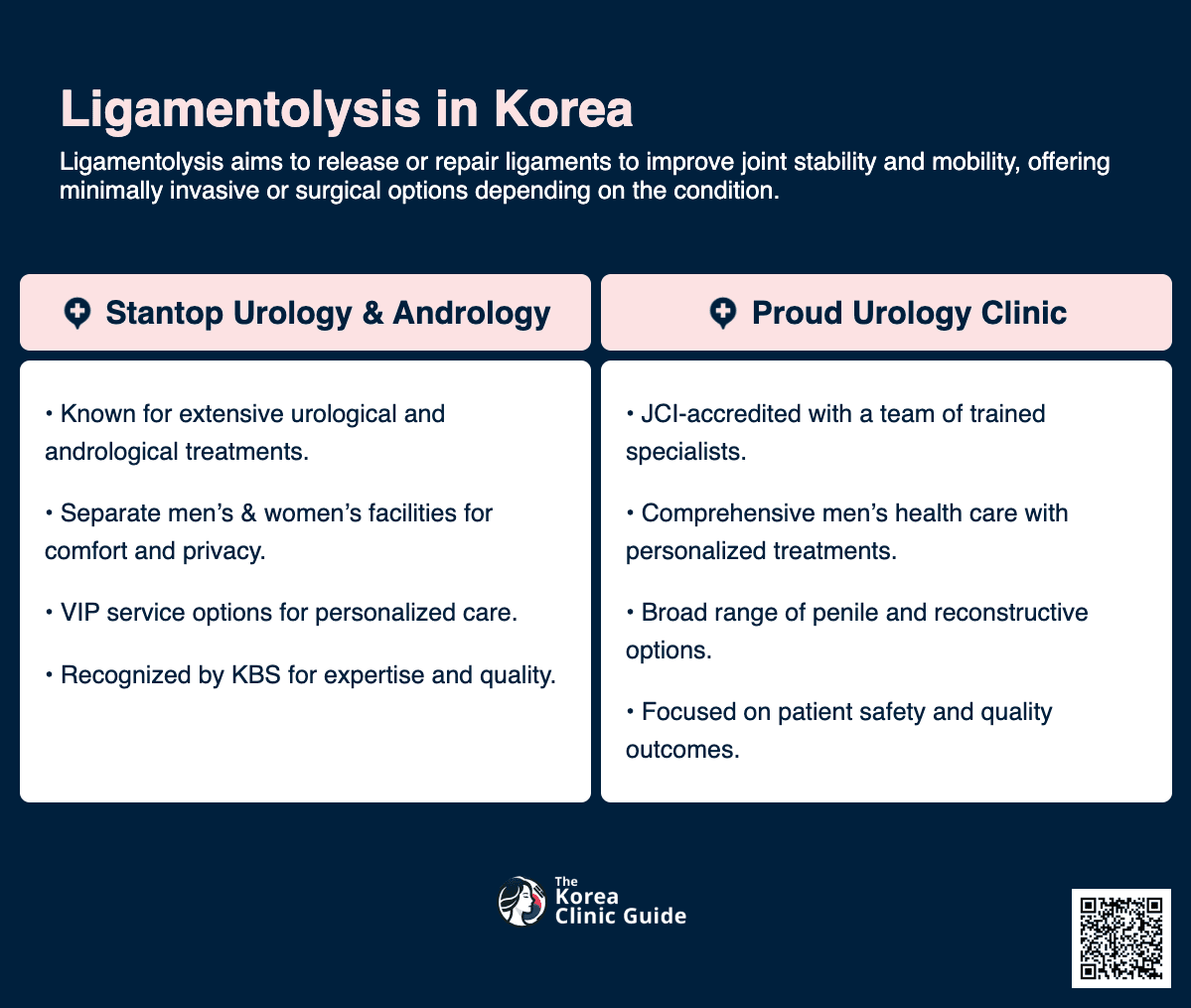
| Stantop Urology & Andrology | StanTop Urology & Andrology Clinic is an excellent choice for treating penile retraction in Korea because it combines deep, specialized expertise in urology and andrology with a patient-centered environment designed for discretion and comfort. As a dedicated institution focused on improving quality of life for patients from Korea and abroad, StanTop offers separate consultation and treatment rooms for men and women to protect privacy while providing thorough evaluation and individualized care. Penile retraction often requires a clinic that can accurately distinguish contributing factors and offer comprehensive solutions—from functional concerns such as erectile dysfunction (addressed with options like shockwave therapy, stem cell therapy, and implants when appropriate) to structural and aesthetic considerations supported by experience in penile enlargement, glans enlargement, and lengthening procedures. With KBS recognition, more than 100,000 patient consultations, and 40,000 surgeries performed, StanTop’s track record provides the level of trust, clinical experience, and procedural capability that patients typically seek when addressing sensitive, complex concerns such as penile retraction. | Shockwave therapy; stem cell therapy; implants; penile enlargement; glans enlargement; lengthening procedures |
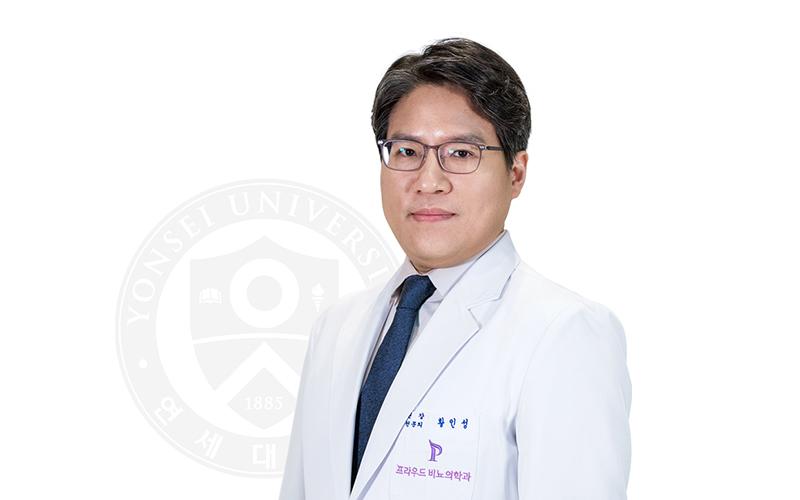
| Proud Urology Clinic Website | Proud Urology Clinic is a specialized men’s health and enhancement center in Korea, established in 2016, offering comprehensive care for concerns that can overlap with penile retraction—such as penile size perception, erectile function, and reconstructive needs. With JCI accreditation and professionally trained staff, the clinic emphasizes high standards of safety, patient-centered evaluation, and tailored treatment planning to support both functional outcomes and confidence. The clinic provides a wide range of services, including men enhancement procedures such as penis enlargement surgery (fat grafting, dermal fillers, and ligament cutting), erectile dysfunction surgery with penile implants, and premature ejaculation treatment, as well as circumcision and vasectomy/vasectomy reversal. For patients needing corrective or restorative care, Proud Urology Clinic also offers reconstruction options like penile curvature correction, vaseline removal, and scrotal reconstruction, alongside body sculpting procedures (liposuction, male breast reduction, abdominal liposuction) and essential sexual health services such as STD/STI testing and treatment and HPV vaccination. | Penis enlargement surgery (fat grafting, dermal fillers, ligament cutting); erectile dysfunction surgery with penile implants; penile curvature correction; vaseline removal; scrotal reconstruction; liposuction; male breast reduction; abdominal liposuction; STD/STI testing and treatment; HPV vaccination |
| Highst Urology Clinic Website | Highst Urology Clinic in Nonhyeon is a urology-focused clinic providing evaluation and treatment services for urinary and male reproductive health, making it a strong choice for men seeking care for concerns such as penile retraction. Because penile retraction can be influenced by multiple factors and may overlap with other urologic or male reproductive conditions, Highst Urology Clinic’s specialty focus supports a careful, medically grounded approach—from clarifying the likely cause to guiding an individualized management plan. - Urology-focused care: The clinic is dedicated to urology, keeping assessment and treatment centered on urinary and male reproductive health. This focus is particularly important when penile retraction may be linked to broader urologic factors that require specialist evaluation. - Comprehensive, cause-first evaluation: Penile retraction is not a one-size-fits-all issue, and effective care starts with identifying contributing factors. A urology-based evaluation helps differentiate normal variation from conditions that may warrant targeted treatment. - Individualized treatment planning: Management of penile retraction often depends on personal anatomy, symptoms, and goals. Highst Urology Clinic’s male reproductive health services support tailored decision-making rather than a generic approach. - Continuity of care for sensitive concerns: Men often delay seeking help due to embarrassment or uncertainty. A dedicated urology clinic setting supports ongoing, structured follow-up so patients can track changes and adjust the plan as needed. - Convenient access in Nonhyeon: Location and accessibility can matter when visits are needed for assessment and follow-up. Being based in Nonhyeon can make it easier to seek timely care and maintain continuity. | Not specified in provided text |
Stantop Urology & Andrology
StanTop Urology & Andrology Clinic is an excellent choice for treating penile retraction in Korea because it combines deep, specialized expertise in urology and andrology with a patient-centered environment designed for discretion and comfort. As a dedicated institution focused on improving quality of life for patients from Korea and abroad, StanTop offers separate consultation and treatment rooms for men and women to protect privacy while providing thorough evaluation and individualized care. Penile retraction often requires a clinic that can accurately distinguish contributing factors and offer comprehensive solutions—from functional concerns such as erectile dysfunction (addressed with options like shockwave therapy, stem cell therapy, and implants when appropriate) to structural and aesthetic considerations supported by experience in penile enlargement, glans enlargement, and lengthening procedures. With KBS recognition, more than 100,000 patient consultations, and 40,000 surgeries performed, StanTop’s track record provides the level of trust, clinical experience, and procedural capability that patients typically seek when addressing sensitive, complex concerns such as penile retraction.
You can check out their website here: Stantop Urology & Andrology Website
Proud Urology Clinic
Proud Urology Clinic is a specialized men’s health and enhancement center in Korea, established in 2016, offering comprehensive care for concerns that can overlap with penile retraction—such as penile size perception, erectile function, and reconstructive needs. With JCI accreditation and professionally trained staff, the clinic emphasizes high standards of safety, patient-centered evaluation, and tailored treatment planning to support both functional outcomes and confidence.
The clinic provides a wide range of services, including men enhancement procedures such as penis enlargement surgery (fat grafting, dermal fillers, and ligament cutting), erectile dysfunction surgery with penile implants, and premature ejaculation treatment, as well as circumcision and vasectomy/vasectomy reversal. For patients needing corrective or restorative care, Proud Urology Clinic also offers reconstruction options like penile curvature correction, vaseline removal, and scrotal reconstruction, alongside body sculpting procedures (liposuction, male breast reduction, abdominal liposuction) and essential sexual health services such as STD/STI testing and treatment and HPV vaccination.
Find more about this clinic here: Proud Urology Clinic Website
Highst Urology Clinic
Highst Urology Clinic in Nonhyeon is a urology-focused clinic providing evaluation and treatment services for urinary and male reproductive health, making it a strong choice for men seeking care for concerns such as penile retraction. Because penile retraction can be influenced by multiple factors and may overlap with other urologic or male reproductive conditions, Highst Urology Clinic’s specialty focus supports a careful, medically grounded approach—from clarifying the likely cause to guiding an individualized management plan.
-
Urology-focused care: The clinic is dedicated to urology, keeping assessment and treatment centered on urinary and male reproductive health. This focus is particularly important when penile retraction may be linked to broader urologic factors that require specialist evaluation.
-
Comprehensive, cause-first evaluation: Penile retraction is not a one-size-fits-all issue, and effective care starts with identifying contributing factors. A urology-based evaluation helps differentiate normal variation from conditions that may warrant targeted treatment.
-
Individualized treatment planning: Management of penile retraction often depends on personal anatomy, symptoms, and goals. Highst Urology Clinic’s male reproductive health services support tailored decision-making rather than a generic approach.
-
Continuity of care for sensitive concerns: Men often delay seeking help due to embarrassment or uncertainty. A dedicated urology clinic setting supports ongoing, structured follow-up so patients can track changes and adjust the plan as needed.
-
Convenient access in Nonhyeon: Location and accessibility can matter when visits are needed for assessment and follow-up. Being based in Nonhyeon can make it easier to seek timely care and maintain continuity.
Find more about this clinic here: Highst Urology Clinic Website
Ligamentolysis in Korea: The Medical Tourism Journey
Why South Korea?
South Korea is a global cosmetic surgery leader, known for innovative techniques, highly skilled surgeons, and advanced technology. Clinics offer affordable pricing compared to Western countries, drawing international patients seeking both quality and cost savings.
Process for International Patients
- Pre-Operative Consult: Start with a discussion about goals, a medical review, and a physical exam. Some routine testing may be needed.
- Surgery Day: Procedures are typically performed under anesthesia in top-tier, sterile medical facilities.
- Recovery: Patients are monitored post-op for a few hours and supplied with pain medication. Swelling and bruising are normal. Diligent use of traction devices is vital—protocols may require usage for weeks or even months. Clinics usually include follow-up visits in their packages.
The end result relies heavily on patient commitment to post-op care—failures in this area can erase length gains.
Ligamentolysis Costs: International Comparison
Ligamentolysis Costs in South Korea
The cost depends on the surgeon’s experience, clinic, and whether the procedure is bundled:
- Standalone ligamentolysis: $1,200 to $1,800 USD
- Comprehensive packages (including enhancements): $1,378 to $10,342 USD
Bundles often include consults, post-op care, and stays in Seoul, with discounts for combination procedures.
Global Cost Comparison
Here’s how South Korea stacks up against other countries:
| Country | Estimated Cost Range (USD) | Notes |
|---|---|---|
| South Korea | $1,200 - $10,342 | Standalone or bundled, often includes consults and aftercare. |
| United States | $8,000 - $50,000 | Highest costs; often excludes travel and some pre-op expenses. |
| Mexico | $1,500 - $16,000 | Often includes accommodation, travel, and some aftercare. |
| Thailand | $1,000 - $12,000 | Mid-range; longer stays may be needed for recovery. |
| Turkey | $2,000 - $13,000 | Competitive rates. |
| Australia | $6,900 - $13,800 | Higher cost; usually includes hospital stay and follow-ups. |
| United Kingdom | $3,500 - $15,000 | Moderate to high. |
| Italy | $5,500 - $23,000 | |
| Switzerland | $5,500 - $16,000 |
Note: Always confirm what each quote includes—travel, accommodation, aftercare, and pre-op assessments can all affect the final price.
South Korea offers some of the most attractive pricing and is widely regarded for innovative surgical techniques—a rare combo of affordability and advanced care.
Patient Experiences and Outcomes
Reported Gains and Longevity
Ligamentolysis typically results in a flaccid length increase of 1-5 cm (about 0.3 to 2 inches), with some studies citing an average gain near 3.5 cm. Erect length rarely increases unless traction is used consistently for an extended period. Maintaining results is highly dependent on the use of stretching devices—without this, the benefits can fade.
Patient Satisfaction
Satisfaction rates after ligamentolysis are mixed. Some clinics and studies report satisfaction rates as high as 85%, while others, including NHS-referenced research, report as low as 35%. Patient satisfaction hinges on realistic expectations, surgeon expertise, and strict adherence to post-surgical regimens. Satisfaction is often higher when both surgeon and patient are clear about what is achievable and what isn’t.
Complications and Challenges
Common issues with ligamentolysis include:
- Re-retraction/Shortening: Ligament re-attachment undoes gains.
- Scarring: Sometimes aesthetically displeasing or excessive.
- Erection Angle Issues: Downward tilt or decreased firmness.
- Pain, Swelling, and Infection: Standard risks, potentially longer-term if severe.
- Sensitivity Loss: Rare but can happen.
- Other Risks: Bulging, lymph fluid buildup, or issues with fat transfer (if performed).
Patients need to be aware that these complications aren’t rare, and sometimes require further surgery to correct.
Medical Community Views
The American Urological Association and other leading organizations generally advise against ligamentolysis for cosmetic penile lengthening, describing it as unproven and investigational. Some clinics claim improved safety and effectiveness, but the absence of large, long-term studies and consensus means patients should go into consultations fully informed and cautious.
Conclusion
Penile retraction has many causes and treatments, requiring an individualized approach—and sometimes, surgery isn’t the best or only solution. Ligamentolysis can increase visible penis length but brings real risks and often limited impact on erect length. Patient outcomes and satisfaction rely on setting realistic goals and following demanding post-op routines. South Korea provides advanced care at competitive prices, but anyone considering ligamentolysis should get multiple opinions, understand the commitment involved, and weigh all risks and potential benefits before proceeding.
References
1, 2, 3, 4, 5, 6, 7, 8, 9, 10, 11, 12, 13, 14, 15, 16, 17, 18, 19, 20, 21, 22, 23, 24, 25, 26, 27, 28