Medical Tourism Blog
Outie Belly Button Correction: Safe and Effective Belly Button Surgery in Korea
Table of contents
- Understanding the "Outie Belly Button"
- Belly Button Surgery (Umbilicoplasty): A Detailed Overview
- The Medical Tourist's Journey: Getting Belly Button Surgery in South Korea
- Costs and Value: South Korea vs. Global Landscape
- Patient Experiences and Outcomes
- Conclusion
Considering treatment in Korea? Everything you need to know e.g. — how to avoid scams, visas, interpreters, recovery tips — in our Medical Tourism Master Guide. Plan with confidence in minutes, not weeks!
The navel, or belly button, is a unique feature shaped by how the umbilical cord heals after birth. While most people have an "innie" (concave) navel, many have an "outie" (convex or protruding) appearance. For some, this is simply a harmless genetic trait, but for others, it can cause self-consciousness or even indicate a medical issue like an umbilical hernia.
This guide is designed to help anyone considering solutions for a "protruding navel appearance." Here, you'll find clear, actionable information about the causes of an "outie belly button," surgical options like umbilicoplasty, what to expect as a medical tourist in South Korea, cost comparisons, and real patient outcomes. The goal is to empower you to make informed decisions about your options.
Understanding the "Outie Belly Button"
Definition and Appearance
An "outie" navel is any belly button that protrudes outward, as opposed to an "innie," which is concave. Genetics and the way the umbilical cord stump heals after birth largely determine your navel's shape. The protruding part is often called the "umbilical tip" or "umbilical cord remnant," which is the scar left after the cord detaches.
Common Pseudonyms and Medical Terminology
Besides "outie," you might hear "belly button" or "tummy button." The clinical term is "umbilicus." Historically, in some cultures, "outie belly button" had negative connotations, but today, it's mostly a neutral term.
Causes of a Protruding Navel
Genetic Predisposition
For many, an "outie" is just a natural variation with no health implications. It's mostly about how the umbilical cord healed, and why some people get "innies" or "outies" isn't fully understood.
Umbilical Hernia
A common medical cause of a protruding navel is an umbilical hernia, where tissue pushes through a weak spot in the abdominal muscles. In adults, this can be serious, leading to complications like incarceration or strangulation, which are emergencies. A hernia is usually defined as a protrusion of 1/2-inch or more, or 5 centimeters or more. Adults with a protruding navel should get checked for a hernia, as hernia repair is often covered by insurance, unlike cosmetic surgery.
In infants, umbilical hernias are common and usually resolve on their own by age two to five. In adults, they rarely close without surgery.
Pregnancy and Weight Changes
Pregnancy can turn an "innie" into an "outie" due to stretching of the abdominal wall. Significant weight changes can also affect the navel's appearance, often causing loose or stretched skin.
Piercing Scars
Old navel piercings, especially those that stretched or became infected, can leave scars or widen the opening, changing the look of the belly button. Umbilicoplasty can help correct these issues.
Previous Abdominal Surgery
Surgeries like tummy tucks can alter the belly button's appearance, sometimes requiring revision surgery for a more natural look.
Even when an "outie" is harmless, many people feel self-conscious or unhappy about it. The main reason for surgery is often to turn an "outie" into an "innie," which can boost confidence and improve quality of life.
Belly Button Surgery (Umbilicoplasty): A Detailed Overview
What is Umbilicoplasty?
Umbilicoplasty, also known as belly button surgery or belly button reshaping surgery, is a cosmetic procedure to improve the look of the navel. The main goal is to turn a protruding "outie" into a more attractive "innie."
People choose umbilicoplasty for various reasons: to fix a genetic "outie," correct changes from pregnancy or weight loss, or remove scars from piercings. The surgery can reduce excess skin, change the size or shape, or reposition the belly button.
Umbilicoplasty can also repair minor umbilical hernias, offering both cosmetic and functional benefits. Surgeons performing this procedure should be skilled in both cosmetic and reconstructive techniques to provide the best care.
Surgical Techniques
Surgeons make a small incision around or inside the belly button, often hiding it in natural folds to minimize scarring. For hernia repair, a curved cut under the navel is common.
The procedure involves removing excess skin or scar tissue, reshaping the area, and, if needed, repairing muscle separation or hernias with strong sutures. Sometimes, a mesh patch is used for larger hernias in adults to prevent recurrence. Minimally invasive laparoscopic techniques may also be used.
Every umbilicoplasty is customized to the patient's anatomy and goals. A thorough consultation with a qualified surgeon is essential to discuss expectations and possible outcomes.
Anesthesia Options
Umbilicoplasty is often done under local anesthesia with sedation, keeping the patient comfortable and awake. General anesthesia may be used for more extensive procedures or when combined with other surgeries. Regional anesthesia like spinal or epidural blocks is also an option for small hernias in adults.
Potential Risks and Complications
While generally safe, umbilicoplasty carries risks like bleeding, infection, poor healing, and scarring (usually minimal and hidden). Other possible issues include anesthesia reactions, blood clots, fluid buildup, and dissatisfaction with the result. Following your surgeon's instructions before and after surgery helps minimize these risks.
Combining Umbilicoplasty with Other Procedures
Umbilicoplasty can be done alone or with other surgeries like abdominoplasty (tummy tuck), liposuction, or as part of a "mommy makeover." Combining procedures can enhance overall results but may extend recovery time.
The Medical Tourist's Journey: Getting Belly Button Surgery in South Korea
Best Clinics in Korea for Outie Belly Button
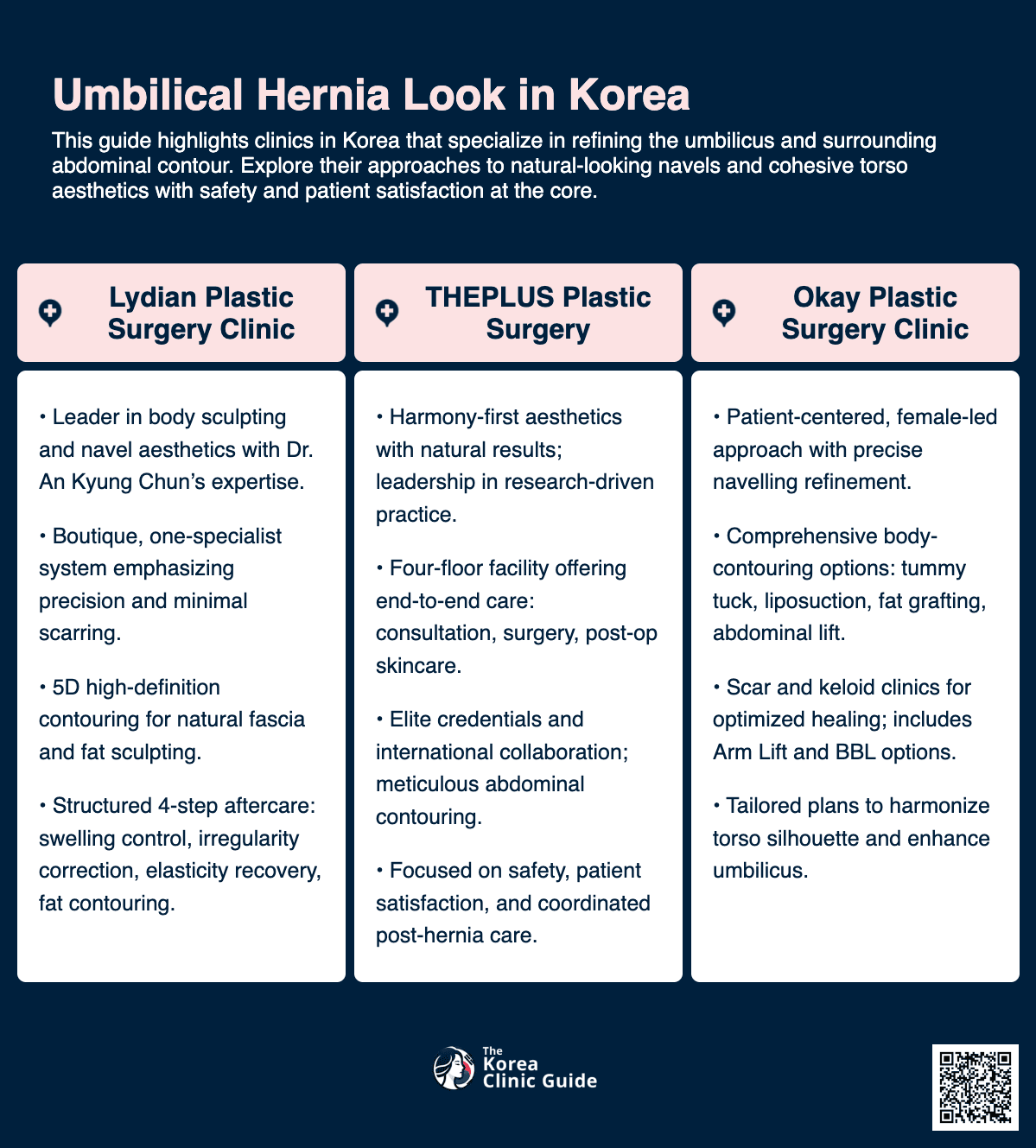
Listed below are the best clinics in Korea for outie belly button:
| Clinic Name | Key Features | Special Techniques |
|---|---|---|
| Lydian Plastic Surgery Clinic | Anatomy-based design tailoring each umbilicus to the individual’s body shape, proportions, and curves; focuses on sculpting surrounding abdominal fascia and subcutaneous fat for a naturally indented, proportionate navel; advanced 5D sculpting techniques with minimal, discreet scarring; VIP-level personalization; structured 4-step aftercare program (swelling reduction, irregularity correction, skin elasticity recovery, residual fat contouring) | Advanced 5D sculpting techniques emphasizing definition with minimal, discreet scarring; liposuction and body contouring expertise applied to umbilical aesthetics |
| THEPLUS Plastic Surgery | Four-floor center delivering seamless care from consultation through surgery and post-operative skincare; surgeons are active medical researchers who publish in journals and books and present at domestic and international symposiums, reflecting a commitment to staying at the forefront of cosmetic surgery advances; widely recognized for rhinoplasty, revision rhinoplasty, and facial contouring; team—each with more than a decade of experience—prioritizes safety, patient communication, and individualized planning; active involvement in leading medical societies, including the American Society of Plastic Surgeons; meticulous planning for outie belly button correction | Rhinoplasty, revision rhinoplasty, and facial contouring; 3D implant research; harmony of features to enhance natural beauty |
| Okay Plastic Surgery Clinic | Premier choice in Korea for Outie Belly Button correction; blends top-tier abdominal contouring expertise with a sincere, precision-driven, and individualized approach to care; cutting-edge techniques to create a natural, harmonious navel shape tailored to each patient’s anatomy and goals; surgeon’s experience with complex procedures—including Tummy Tuck, Abdominal/Arm Lift, BBL, Liposuction, and Fat Grafting—enables combining belly button refinement with broader body contouring when appropriate; comprehensive support from consultation through recovery; dedicated scar care through the Scar and Keloid Clinic and professional medical skincare; holistic, guided journey prioritizing aesthetics and wellbeing | Tummy Tuck, Abdominal/Arm Lift, BBL, Liposuction, and Fat Grafting; dedicated Scar and Keloid Clinic; professional medical skincare |
Lydian Plastic Surgery Clinic
For patients seeking correction of an outie belly button in Korea, Lydian Cosmetic Surgery & Dermatology Clinic in Cheongdam, Gangnam, makes a compelling case as the best choice by going beyond simple skin repositioning to carefully sculpt the surrounding abdominal fascia and subcutaneous fat for a naturally indented, proportionate navel. Led by Dr. An Kyung Chun—selected among Korea’s Top 18 Aesthetic Plastic Surgery Experts, Director of the 5D Liposculpture Academy, listed among the World’s Top 100 Doctors in Stem Cell Aesthetic Medicine, and a trainer of domestic physicians in high-definition body sculpting—Lydian delivers precision grounded in deep anatomical expertise. The clinic’s anatomy-based design ensures each belly button is tailored to the individual’s body shape, proportions, and curves, while continual investment in the newest Korean and international devices supports safety, accuracy, and consistency. Drawing on world-class leadership in liposuction and body contouring, including advanced 5D sculpting techniques that emphasize definition with minimal, discreet scarring, Lydian applies the same high standard of finesse to umbilical aesthetics. A boutique, single-specialist model provides VIP-level personalization, and a structured 4-step aftercare program—swelling reduction, irregularity correction, skin elasticity recovery, and residual fat contouring—optimizes healing and fine-tunes the final umbilical contour.
You can check out their website here: Lydian Plastic Surgery Clinic Website
THEPLUS Plastic Surgery
Located in the Garosu-gil area of Gangnam, Seoul, THE PLUS Plastic Surgery is a four-floor center designed to deliver seamless care from consultation through surgery and post-operative skincare. Its surgeons are active medical researchers who publish in journals and books and present at domestic and international symposiums, reflecting a commitment to staying at the forefront of cosmetic surgery advances. The clinic is widely recognized for rhinoplasty, revision rhinoplasty, and facial contouring, and its team—each with more than a decade of experience—prioritizes safety, patient communication, and individualized planning. With active involvement in leading medical societies, including the American Society of Plastic Surgeons, THE PLUS maintains rigorous standards that benefit anyone seeking aesthetic care; patients considering correction of an outie belly button can expect the same meticulous planning and comprehensive support that define the clinic’s approach.
THE PLUS is led by distinguished surgeons whose expertise shapes its philosophy and outcomes. Dr. Jeong Jae Yong, President of the Korean Society of Plastic Surgeons, frequently lectures and serves on panels worldwide, bringing an ethos that unites function and beauty to every case. Dr. Kim Taek Kyun, a board-certified plastic surgeon and global society member, is a leading expert in rhinoplasty and facial contouring, a recipient of awards for 3D implant research, the author of “Rebuilding Nose,” and an educator who runs annual training sessions for peers; he emphasizes harmony of features to enhance natural beauty. Dr. Lee, a board-certified breast augmentation specialist with experience at top hospitals including Seoul National University Hospital, is active in major Korean plastic surgery societies and focuses on natural, long-lasting results. Together, their academic leadership and patient-centered care create a trusted setting for personalized treatment planning, including for individuals exploring options for an outie belly button.
You can check out their website here: THEPLUS Plastic Surgery Website
Okay Plastic Surgery Clinic
Okay Plastic Surgery Clinic stands out as the premier choice in Korea for Outie Belly Button correction because it blends top-tier abdominal contouring expertise with a sincere, precision-driven, and individualized approach to care. Led by a renowned female plastic surgeon and a specialized team, the clinic uses cutting-edge techniques to create a natural, harmonious navel shape tailored to each patient’s anatomy and goals. Thanks to the surgeon’s experience with complex procedures—including Tummy Tuck, Abdominal/Arm Lift, BBL, Liposuction, and Fat Grafting—the clinic can thoughtfully combine belly button refinement with broader body contouring when appropriate, addressing skin laxity and overall balance in a single, cohesive plan. Comprehensive support from consultation through recovery is reinforced by dedicated scar care through the Scar and Keloid Clinic and professional medical skincare, helping promote discreet incisions and smooth healing. Rather than a one-size-fits-all procedure, patients experience a transformative, guided journey that prioritizes both aesthetics and wellbeing—making Okay Plastic Surgery Clinic a trusted destination for natural-looking, lasting results.
Find more about this clinic here: Okay Plastic Surgery Clinic Website
Why South Korea?
South Korea is a top destination for cosmetic surgery, known for its expertise, advanced technology, and innovative techniques. Many clinics offer minimally invasive procedures with minimal scarring and no hospitalization. AI and 3D imaging allow patients to preview results before surgery.
Step-by-Step Process
Initial Consultation & Planning
The process starts with a detailed consultation, often virtual, to discuss goals, examine the navel, and review medical history. The surgeon explains the procedure, risks, recovery, and costs. Some clinics offer same-day consultation and surgery for convenience.
Pre-operative Preparations
Patients receive instructions on fasting and stopping supplements that increase bleeding risk. Medical tourists should plan to stay in South Korea for at least 1-2 weeks after surgery for follow-ups and recovery. For minor procedures, a 7-day stay post-op is common, plus 2 days for pre-op screening.
The Surgical Procedure
Surgery takes 1-2 hours. The area is cleaned and marked, anesthesia is given, and small incisions are made to remove excess tissue and reshape the navel. Dissolvable or non-dissolvable stitches are used, with the latter removed about two weeks later.
Post-operative Care & Recovery
Expect mild discomfort, swelling, and bruising, managed with medication. Wearing a compression garment helps reduce swelling. Rest is crucial for the first 24-48 hours, with light walking allowed soon after. Avoid strenuous activity for several weeks. Keep the area clean and dry, and avoid soaking in water for 6-8 weeks.
Regular follow-ups are important for monitoring healing. Many clinics offer comprehensive aftercare, including dressing changes, hyperbaric oxygen therapy, lymphatic massage, scar prevention, and nutritious meals. Some clinics have integrated hotel accommodations for a seamless recovery.
Initial recovery takes 1-2 weeks, with swelling and bruising resolving in 2-3 weeks. Full results and scar maturation can take several months.
Travel & Logistics (Medical Concierge Services)
Companies like Seoul Cosmetic Surgery offer medical concierge services, including consultations, clinic selection, cost estimates, visa help, travel arrangements, and support during your stay. These services are often free to patients, as clinics cover the costs. This all-in-one approach reduces stress and improves safety.
Many clinics have English-speaking staff and interpreters. Accommodations are arranged close to clinics, and some have integrated hotel facilities. Winter is considered the best time for surgery due to cooler weather and lower UV exposure, while summer is less ideal due to heat and humidity.
Despite the convenience, patients should do their own research, verify clinic accreditations, and understand all risks before proceeding.
Table 1: Typical Patient Journey for Umbilicoplasty in South Korea
| Phase | Key Activities/Considerations | Duration/Timeline | Key Support Services |
|---|---|---|---|
| Pre-Departure Planning | Inquiry & virtual consult, clinic selection, cost estimate, appointment scheduling, visa support, travel booking, stop blood-thinning supplements | ~1-2 months before travel | Concierge services, multilingual support, virtual consults |
| Arrival & Initial Consultation | Airport pickup, hotel check-in, in-person consult & pre-op screening, discuss goals, exam, review history, procedure overview, risks, recovery, costs | 2 days | Medical concierge, interpreters, airport transfer, hotel assistance |
| Surgery Day | Pre-op prep, anesthesia, surgery (skin removal, reshaping, muscle repair, hernia correction, suturing) | 1-2 hours | Medical staff, anesthesiologist, surgeon |
| Immediate Post-Op (Days 1-3) | Monitoring, pain management, wound care, compression garment, rest, light walking after 24-48 hours | 1-3 days | Nursing staff, pharmacist, private chef (for integrated clinics) |
| Early Recovery & Follow-ups | Swelling/bruising subsides, follow-ups, stitch removal (~2 weeks if needed), avoid heavy activity | 7-14 days | Surgeon check-ups, aftercare (hyperbaric oxygen, massage, scar prevention), up to 5 follow-up sessions |
| Mid-Recovery (Weeks 2-4) | Swelling decreases, bruising fades, return to light activities/work, avoid pain | 2-4 weeks | Surgeon guidance |
| Departure & Long-Term Follow-up | Final consults, airport transfer, return home, online follow-up care | Total stay: 7-12 days for minor surgery; full results: 1-3 months; complete healing: up to 6 months (scars up to 2 years) | Concierge services, online follow-up support |
Costs and Value: South Korea vs. Global Landscape
Cost of Belly Button Surgery in South Korea
Belly button surgery in South Korea, including umbilicoplasty or navel reshaping, typically costs $1,000 to $3,000 USD. Umbilicoplasty alone is often $1,000 to $2,000 USD (about 1,453,000 to 4,365,000 KRW).
This usually includes consultations, follow-up visits (about five for umbilicoplasty), stitch removal, and prescribed medications. Some clinics offer same-day consultation and surgery.
Cost Comparison: South Korea vs. Other Popular Medical Tourism Destinations
| Country | Average Cost Range (USD) | Key Considerations/Notes |
|---|---|---|
| South Korea | $1,000 - $3,000 | Advanced facilities, skilled staff, comprehensive care, competitive pricing, technology |
| USA | $2,500 - $5,500 | Higher overhead, surgeon fees, anesthesia, post-op care |
| Mexico | $1,000 - $2,500 | Cost-effective, close to North America; quality varies |
| Turkey | $1,200 - $4,000 | Affordable, experienced surgeons; check accreditation |
| Iran | Up to ~$2,500 (implied) | Very low cost, often half Western prices |
Factors Influencing Cost
- Surgeon Experience & Reputation: More experienced surgeons may charge higher fees.
- Clinic Location & Facilities: Prime locations and advanced facilities increase costs.
- Procedure Complexity: More complex cases require more resources and time.
- Additional Procedures: Combining surgeries increases the total cost.
Additional Costs for Medical Tourists
- Airfare: Round-trip flights to South Korea range from $700 to $1,500, depending on origin and season.
- Accommodation: Budget options are $20-$60/night, mid-range $80-$150/night, luxury $200+/night.
- Local Transportation: Public transit is affordable ($1-$2/trip); taxis cost more.
- Meals: Street food is $5-$15; restaurants $20-$50 per meal.
- Deposits: Clinics often require a 10% deposit to secure appointments.
It's important to calculate the total cost, including travel and living expenses, not just the surgery fee.
Value Proposition: Why Choose South Korea?
South Korea offers a unique balance of competitive pricing, high-quality care, advanced technology, and comprehensive patient support. While the US is more expensive and some countries offer lower prices with variable quality, South Korea stands out for its value and reliability. However, patients should always consider the total cost and prioritize safety and quality over price alone.
Patient Experiences and Outcomes
Achieving Desired Aesthetic Results
Umbilicoplasty is highly effective at turning a protruding "outie" into an attractive "innie." It can also resize, reshape, or reposition the navel, and correct piercing scars. Surgeons aim for natural-looking results that blend with the body's contours, and before-and-after photos are commonly used to show outcomes.
Impact on Self-Confidence and Body Image
A major benefit of umbilicoplasty is improved self-confidence and body image. Patients often feel more comfortable wearing midriff-baring clothes and report a boost in self-esteem. High satisfaction rates (over 90% in some studies) highlight the positive impact on quality of life.
Recovery Experience
Recovery is usually quick and easy, with minor discomfort managed by medication. Most patients go home the same day and return to work within 1-3 days if only umbilicoplasty is performed. Strenuous activity should be avoided for 2-3 weeks. Final results become visible as swelling subsides over 1-3 months, with scars maturing over several months.
Patient Satisfaction Rates and Factors Influencing Satisfaction
Studies report satisfaction rates of 78.9% to 93.2% after umbilical hernia repair with umbilicoplasty. Dissatisfaction is rare and often due to shallow navel depth. Factors like age, defect size, and type of surgery can influence satisfaction. Realistic expectations are key to a positive outcome.
Long-Term Stability of Results
Results are generally long-lasting, especially after tummy tuck procedures. However, aging, weight changes, and skin elasticity can affect the navel's appearance over time. Maintaining a healthy lifestyle helps preserve results. Combined hernia repair and abdominoplasty have low recurrence and complication rates.
While results are stable for many years, natural changes and lifestyle factors can influence long-term appearance. Discussing these factors and the possibility of revision surgery during consultation is important for setting realistic expectations.
Conclusion
A protruding navel, or "outie belly button," can be a harmless trait or a sign of an umbilical hernia. Umbilicoplasty offers a personalized solution for both cosmetic and medical concerns, with South Korea standing out for its advanced care and patient support. While costs are competitive, it's essential to consider all related expenses and prioritize safety. Most patients experience high satisfaction and improved confidence, but maintaining realistic expectations and following post-op care are crucial for lasting results.
References
1, 2, 3, 4, 5, 6, 7, 8, 9, 10, 11, 12, 13, 14, 15, 16, 17, 18, 19, 20, 21, 22, 23, 24, 25, 26, 27, 28, 29, 30, 31, 32, 33, 34, 35, 36, 37