Medical Tourism Blog
Belly Button Surgery in Korea: Methods, Recovery, Travel Planning and Alternatives
Table of contents
- Belly Button Surgery at a Glance
- What Is Belly Button Surgery?
- Who Is a Good Candidate for Belly Button Surgery?
- How Is Belly Button Surgery Performed?
- Why Visit Korea for Belly Button Surgery?
- Key Information for International Patients
- Which Are the Best Clinics in Korea for Belly Button Surgery?
- Belly Button Surgery From Start to Finish
- Alternatives to Belly Button Surgery
- How Can I Prepare for Belly Button Surgery?
- Aftercare Advice
Considering treatment in Korea? Everything you need to know e.g. — how to avoid scams, visas, interpreters, recovery tips — in our Medical Tourism Master Guide. Plan with confidence in minutes, not weeks!
Last updated: September 2026
Belly Button Surgery at a Glance
- What it treats — Umbilicoplasty reshapes, reduces, scars, or reconstructs the belly button; it may address an outie, distorted navel, or localized scar but is not abdominal contouring surgery.
- Best candidates — Suitable candidates typically have a localized navel concern, stable weight, healed abdominal tissue, realistic expectations, and enough time to complete early in-person follow-up.
- What it cannot fix — An isolated procedure does not remove significant fat, tighten loose abdominal skin, repair rectus separation, or treat an umbilical or ventral hernia; a new bulge, pain, bleeding, or drainage needs medical evaluation first.
- Korea stay and flying — For limited isolated surgery, plan at least 10–14 days in Korea for wound checks and possible removable-suture care; CDC guidance sets 10 days after abdominal surgery as a minimum no-fly benchmark, with surgeon clearance required for long-haul travel.
- Recovery and results — An early dressing or wound review is usually needed within days, while swelling, scar redness, and contour irregularity can mask the result; scar maturation and tissue settling continue for months.
- Technique and risk — The surgeon may use direct sutures, local skin flaps, or, when tissue is limited, a skin graft; risks include infection, bleeding, delayed healing, noticeable scarring, asymmetry, recurrent protrusion, and possible revision.
- Korea distinction — Seoul’s large international-patient infrastructure can support cross-border logistics and follow-up planning, but no comparative clinical evidence shows that Korea produces superior belly button surgery outcomes.
What Is Belly Button Surgery?
Belly button surgery, or umbilicoplasty, reshapes, reduces, revises, or reconstructs the navel. It addresses concerns such as a protruding “outie,” localized scarring, or a navel altered by injury or previous surgery, aiming for a more natural-looking contour. It is a surgical procedure, usually limited in scope when performed as isolated cosmetic reshaping.
Who Is a Good Candidate for Belly Button Surgery?
- Localized navel concern — Good candidates want to reduce a protruding “outie,” revise a scar, refine size or shape, or reconstruct a navel distorted by previous surgery or injury.
- Stable abdominal conditions — A stable weight, healed prior abdominal scars, and no planned near-term pregnancy support more predictable contour planning.
- Realistic surgical goals — Umbilicoplasty can improve navel architecture; it does not remove meaningful abdominal fat, tighten broad skin laxity, repair separated rectus muscles, or treat a true hernia.
- Follow-up availability — International patients need time for early wound review and, when used, removable-suture management before long-haul travel.
Active infection, dermatitis, drainage, unexplained redness, pain, bleeding, a new bulge, or a changing lesion requires medical assessment before cosmetic surgery. A possible umbilical or ventral hernia, abdominal-wall mass, urachal abnormality, or endometriosis cannot be treated with cosmetic reshaping alone. Elective surgery should be postponed during pregnancy and early postpartum recovery, with uncontrolled diabetes or significant cardiopulmonary disease, unaddressed clotting risk, nicotine exposure outside the surgeon’s cessation protocol, or an unoptimized medical condition. The surgeon must also assess abdominal scars, local tissue blood supply, skin excess, rectus laxity, and whether a more extensive abdominal operation is needed.
How Is Belly Button Surgery Performed?
There is no universally best umbilicoplasty technique. The approach depends on whether native navel tissue remains, the amount of scarring, blood supply, defect size, and whether reconstruction is combined with a tummy tuck, hernia repair, or abdominal-wall surgery. A systematic review of neoumbilicoplasty techniques describes the following practical approaches.
- Direct closure or purse-string reshaping — The surgeon removes or rearranges a limited amount of skin or scar and uses sutures to narrow an opening or create a recessed contour. Selected designs leave a small central area to heal naturally, requiring more wound care.
- Single local-skin flap — Nearby skin is designed, folded, and anchored to create depth. This has been reported commonly in open abdominal operations and combined tummy tuck or hernia-repair settings.
- Multiple local-skin flaps — Two or more local flaps create a deeper neo-umbilicus, often when reconstruction is performed during abdominoplasty.
- Full-thickness skin graft — A reconstructive option when local tissue is inadequate. The review found graft methods carried more consequential aesthetic and surgical complications than direct closure or flap approaches.
- Combined abdominal surgery — Umbilicoplasty can be incorporated into a tummy tuck, hernia repair, or abdominal-wall reconstruction. This changes the anesthesia, scar pattern, recovery restrictions, and travel timeline substantially.
Comparative evidence is limited. Studies of reconstruction performed with abdominoplasty or abdominal-flap breast reconstruction have reported differing aesthetic ratings between incision designs, but these retrospective, setting-specific findings do not establish the best technique for isolated cosmetic outie reduction. Evidence for standalone cosmetic reshaping remains sparse.
Why Visit Korea for Belly Button Surgery?
Korea has a large international medical-care infrastructure, including official Medical Korea information for overseas visitors. Seoul reported 1 million international medical tourists in 2024, reflecting substantial access to international-facing services. This does not prove that Korea delivers better umbilicoplasty results than other countries.
- International-care infrastructure — Medical Korea provides official information for overseas patients seeking treatment in Korea.
- High international patient volume in Seoul — The city reported 1 million international medical tourists in 2024, which supports the availability of clinics accustomed to cross-border patient logistics.
- Relevant reconstructive planning — Umbilicoplasty overlaps with plastic and reconstructive surgery when it involves scars, absent tissue, prior abdominal surgery, or combined abdominoplasty. Ask specifically whether the surgeon performs the proposed reconstructive design rather than relying on generic cosmetic-surgery marketing.
- Evidence limitation — No comparative clinical evidence identified establishes a Korea-specific advantage in complication rates, revision rates, or aesthetic outcomes for belly button surgery. Individual reports and treatment availability are not comparative outcome evidence.
Key Information for International Patients
- Minimum stay — For a limited isolated umbilicoplasty, plan at least 10–14 days in Korea so the surgeon can review the wound and manage removable sutures if used. A tummy tuck, open hernia repair, abdominal-wall repair, drain use, wound problem, or elevated clot risk requires a longer stay.
- Flying home — CDC medical-tourism guidance advises avoiding flying for 10 days after abdominal surgery. This is a minimum benchmark, not individual clearance for a long-haul flight; the operating surgeon must assess the wound, procedure extent, anesthesia, bleeding or infection concerns, and VTE risk.
- Repeat visits — Expect an early dressing and wound check within days. An external-suture plan can require an in-person review around 10–14 days, although timing depends on the technique.
- Activity and itinerary — Schedule a quiet first week. Walking and low-demand sightseeing may be possible once cleared, but do not build an itinerary around lifting luggage, core exercise, swimming, hot tubs, saunas, or strenuous activities.
- Remote follow-up — Arrange video review before surgery and obtain an English discharge summary, operative note, medication list, wound-care plan, warning signs, after-hours contact, and revision policy before departure.
Travel note: Surgery and long-distance air travel both increase blood-clot risk. Arrange continuity of care in your home country before travel, particularly after combined abdominal surgery or with a history of DVT/PE.
Which Are the Best Clinics in Korea for Belly Button Surgery?
Listed below are some of the best clinics in Korea for belly button surgery.
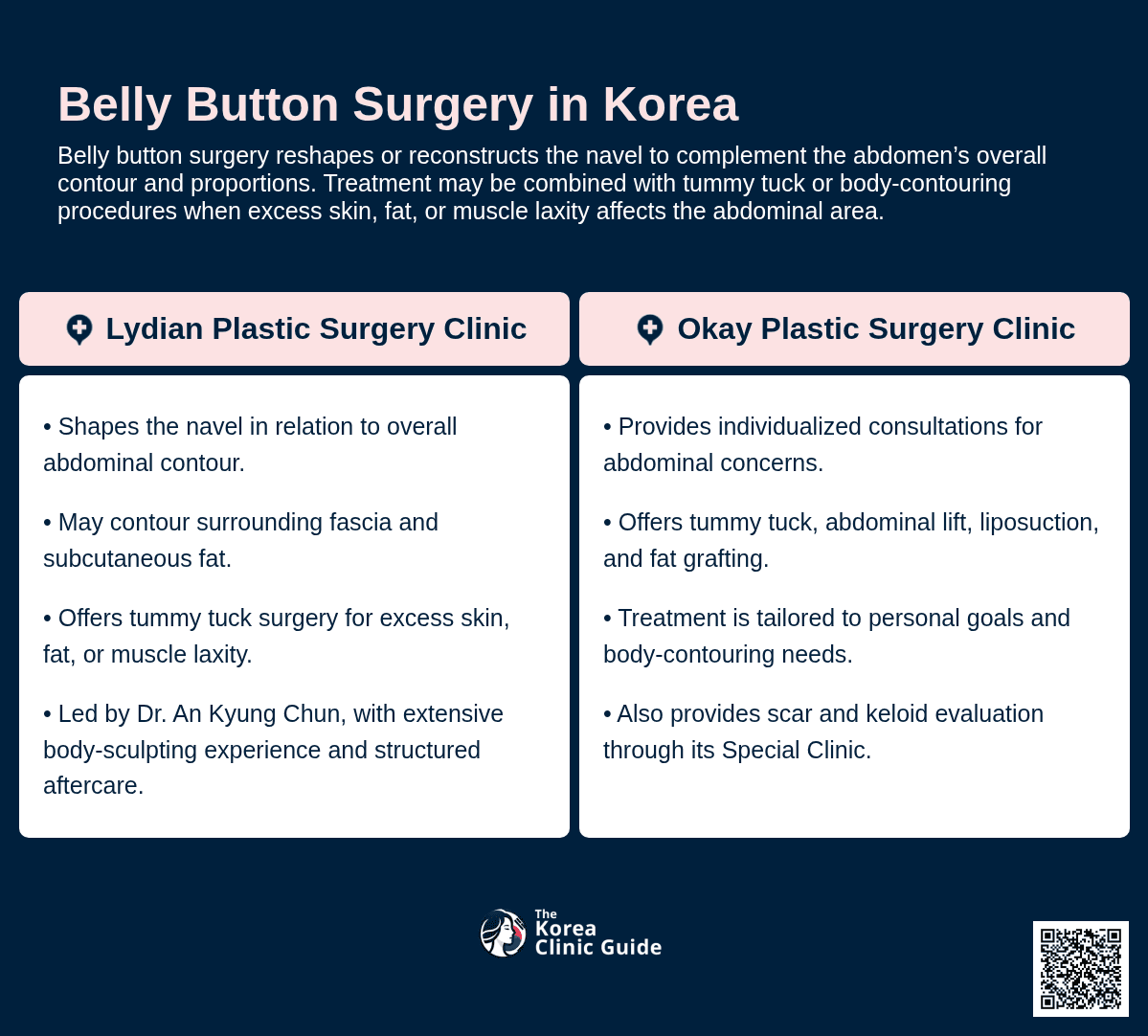
1. Lydian Plastic Surgery Clinic
You may consider Lydian Plastic Surgery Clinic for belly button reshaping when your goal is a navel designed in relation to your overall abdominal contour. The clinic describes sculpting the surrounding abdominal fascia and subcutaneous fat as needed—not simply repositioning skin—to create a natural-looking result, with tummy tuck surgery also available when excess abdominal skin, fat, or muscle laxity are relevant concerns.
- URL: Lydian Plastic Surgery Clinic Website
- Location: Gangnam-gu, Seoul
- Procedure approach:
- Belly button reshaping may include contouring the tissues around the navel, including abdominal fascia and subcutaneous fat, according to your anatomy.
- Tummy tuck surgery is offered to remove excess abdominal skin and fat and tighten the abdominal wall muscles.
- Surgeon and body-contouring focus:
- Dr. An Kyung Chun has more than two decades of specialized body-sculpting experience and is described as a clinical professor.
- Dr. An is the director of the 5D Liposculpture Academy and provides physician training in high-definition body sculpting and liposuction devices.
- Related services:
- Available body-focused options include liposuction, 5D liposculpture, tummy tuck, stem-cell fat grafting, and Brazilian butt lift.
- The clinic describes anatomy-based planning that considers your body shape, proportions, and curves.
- Aftercare: A four-step aftercare system addresses swelling reduction, irregularity correction, skin-elasticity recovery, and residual-fat contouring.
2. Okay Plastic Surgery Clinic
You can expect an individualized aesthetic consultation at Okay Plastic Surgery Clinic, where body procedures include tummy tuck and abdominal lift options that may be relevant if your belly button concern is part of excess abdominal skin, fat, or contour changes. The clinic describes care guided by specialized professionals, including a female plastic surgeon with extensive experience, with treatment tailored to your goals and needs.
- URL: Okay Plastic Surgery Clinic Website
- Location: Gangnam-gu, Seoul
- Relevant body procedures:
- Tummy tuck, abdominal lift, liposuction, fat grafting, and body-contouring treatments are available.
- The clinic also lists arm lift and Brazilian butt lift among its complex body procedures.
- Additional services:
- Scar and keloid evaluation and treatment are available through the Special Clinic.
- Other offerings include breast surgery, facial lifting, eye plastic surgery, rhinoplasty, hairline procedures, and medical skincare.
Belly Button Surgery From Start to Finish
- Remote inquiry and screening — Send standardized abdomen photographs, goals, previous abdominal-operation details, allergies, complete medicine and supplement list, nicotine exposure, pregnancy status where relevant, abnormal-scar history, and DVT/PE history. Confirm English or interpreter-supported consultation availability. Remote images cannot reliably rule out a hernia or assess tissue blood supply.
- Written treatment plan — Request confirmation of whether surgery is isolated or combined, the planned anesthesia, incision and scar placement, expected dressings, drains or removable sutures, expected in-person reviews, and the complication and revision policy.
- In-person surgical assessment — The surgeon examines the navel and abdominal wall, checks for scar-related distortion or a possible hernia, reviews achievable contour and scar limitations, and determines whether testing or medical clearance is required.
- Consent and preoperative planning — Discuss anesthetic choice, the operative design, recovery restrictions, medications, and travel timing. Limited reshaping can be performed under local anesthesia with or without sedation; larger reconstruction or combined surgery can require general anesthesia.
- Surgery — The surgeon marks the planned design, administers the agreed anesthetic, reshapes or reconstructs the navel, controls bleeding, anchors tissue to establish depth where needed, and closes or dresses the wound. Reliable published figures for isolated-procedure duration are not available.
- Discharge and first night — Isolated treatment can be outpatient. After sedation or general anesthesia, use arranged transport and follow the facility’s instructions for first-night supervision.
- Early recovery in Korea — Attend every dressing and wound check. Swelling, scar redness, and early contour irregularity can obscure the result; scar maturation and tissue settling continue for months.
- Departure handoff and remote review — Before flying home, obtain records and confirm how to send wound photographs or arrange video follow-up. Seek local urgent care and notify the operating clinic if warning signs develop after departure.
Alternatives to Belly Button Surgery
The right alternative depends on whether the concern is limited to navel shape, a scar, fat, loose skin, abdominal-wall laxity, or a true hernia. Non-navel abdominal operations can address structural or contour problems that isolated umbilicoplasty cannot, but they also involve larger scars and longer recovery.
Scar Revision
Scar removal surgery is relevant when the primary concern is a widened, tethered, painful, or distorted umbilical scar rather than the navel’s basic structure.
- Best fit — A localized scar after piercing, laparoscopic surgery, prior abdominal surgery, or injury.
- Tradeoff — Scar revision replaces or rearranges a scar; it cannot guarantee an invisible scar or correct broad abdominal laxity.
Tummy Tuck
A tummy tuck removes excess abdominal skin and can reposition or reconstruct the navel as part of abdominal reshaping.
- Best fit — Significant loose skin, lower-abdominal overhang, broad contour concerns, or a navel distorted by skin excess.
- Tradeoff — This is a larger operation than isolated umbilicoplasty, with a longer recovery and more extensive scars.
Diastasis Recti Repair
Diastasis recti repair addresses separation or laxity of the rectus muscles, not navel appearance alone.
- Best fit — A midline abdominal bulge or functional concern caused by abdominal-wall laxity.
- Tradeoff — It will not necessarily change a scarred or protruding navel unless umbilical work is included.
Abdominal Liposuction
Abdominal liposuction reduces localized subcutaneous fat.
- Best fit — Fat fullness with good skin quality and no structural navel problem.
- Tradeoff — Liposuction does not repair a hernia, correct rectus separation, or turn an outie into an innie.
Panniculectomy
Panniculectomy removes a hanging apron of lower-abdominal skin and fat in selected patients.
- Best fit — A substantial pannus causing functional or hygiene problems.
- Tradeoff — It is not a limited cosmetic navel operation and involves a more demanding recovery.
How Can I Prepare for Belly Button Surgery?
- Medical disclosure — Provide every prescription, injection, over-the-counter medicine, herbal product, vitamin, supplement, allergy, prior operation, abnormal-scar history, nicotine exposure, and DVT/PE history before booking flights.
- Blood-thinning medicines — Report warfarin, apixaban, rivaroxaban, clopidogrel, prescribed aspirin, NSAIDs, and supplements that affect bleeding. Do not independently stop anticoagulants or antiplatelet medicines; the prescribing clinician and surgeon must create the perioperative plan.
- Diabetes and GLP-1 medicines — Tell the surgeon about insulin, other diabetic medicines, and GLP-1 drugs. Follow the clinic’s individualized instructions for dosing and fasting.
- Nicotine and alcohol — Stop smoking, vaping, nicotine pouches, and nicotine replacement only according to the operating surgeon’s cessation protocol. Avoid alcohol according to the anesthetic and medication instructions.
- Fasting and skin preparation — Follow the exact fasting instructions for the planned anesthetic. Do not shave, exfoliate, apply irritating products, or treat the navel area unless the clinic directs it.
- Travel logistics — Book flexible return travel, accommodation close enough for wound reviews, and transport from the facility. Arrange a companion or first-night supervision when sedation or general anesthesia is planned.
- Records and communication — Bring prior operative reports when available and confirm an English-language discharge package, after-hours contact route, and remote follow-up arrangement.
Travel note: Do not schedule departure before the expected wound review. A 10-day no-fly interval after abdominal surgery is a minimum CDC benchmark, not a substitute for surgeon clearance.
Confirm the treating doctor’s clinic-specific medication, fasting, nicotine, testing, transport, and travel requirements; those individualized instructions take precedence over general guidance.
Aftercare Advice
Protect the incision and complete scheduled wound checks; early appearance is not the final result.
- Dressings and wound care — Keep dressings clean and dry exactly as instructed. Do not pick crusts or apply peroxide, alcohol, topical antibiotics, silicone, scar tape, compression, or other products unless the surgeon approves them.
- Movement and lifting — Walk gently once medically cleared to support circulation, but avoid heavy lifting, core exercise, running, deep stretching, and strenuous activity until the wound has healed and the surgeon clears it. Restrictions are longer after a tummy tuck, hernia repair, or abdominal-wall operation.
- Heat and water exposure — Avoid swimming pools, hot tubs, baths, and saunas until the incision is fully healed and cleared. Keep the navel protected from friction and direct pressure.
- Scar protection — Once the surgeon permits normal skin exposure, protect the scar from sun; use SPF 50 on healed exposed skin. Redness and firmness often improve gradually over months.
- Warning signs — Seek urgent assessment for rapidly worsening pain or swelling, spreading redness or warmth, pus or foul drainage, fever, active bleeding, wound separation, dark or gray skin, blistering, a sudden asymmetric abdominal bulge, calf pain or swelling, chest pain, shortness of breath, fainting, or coughing blood.
- Follow-up and results — Send photographs or attend video review as arranged. Swelling, scar maturation, and contour settling can continue for months; symmetry and an invisible scar cannot be guaranteed.
Follow the treating doctor’s instructions over generic advice and contact the clinic promptly when the wound or symptoms appear wrong.
Frequently Asked Questions
Related Blogs
Inmode Body Laser Lifting in Korea: Devices, Results, Recovery and Travel Planning
InMode Body Laser Lifting refers to external RF treatments such as BodyFX, MiniFX, Plus, or Forma Plus that heat targeted areas without surgical fat removal, typically requiring weekly sessions over 6–8 weeks for gradual contour refinement. International patients can fit one external session into a 1–2-day Korea stay, but should confirm the exact handpiece, external-only treatment plan, contraindi
Updated: Sep 20, 2026
Arm Lift in Korea: Types, Recovery, Risks, and Travel Planning
Arm lift surgery removes excess upper-arm skin through limited, full, or extended incisions, with liposuction added selectively; candidates generally have stable weight, adequate nutrition, controlled health conditions, and acceptance of permanent scars. Practical guidance covers Korea provider and visa checks, a 10–14-day postoperative stay, travel planning, preparation, recovery restrictions, wo
Updated: Sep 20, 2026
Thigh Lift in Korea: Types, Recovery, Scars, Risks, and Travel Planning
Thigh lift surgery removes excess thigh skin through an incision pattern matched to localized or extensive laxity, with permanent scars and wound-care needs as key trade-offs. The article covers candidacy, procedure steps, recovery, complication warning signs, alternatives, and international travel planning including at least 14 days in Korea and surgeon clearance before long-haul flights.
Updated: Sep 20, 2026
Emsculpt in Korea: Treatment Options, Results, Recovery, and Travel Planning
Emsculpt uses HIFEM muscle contractions, with Emsculpt NEO adding RF heat, to refine muscle tone and selected localized fat concerns without surgery. The article covers candidate screening, a typical four-session course over 2–4 weeks, Korea travel planning, preparation, aftercare, and alternatives for fat, loose skin, or abdominal-wall concerns.
Updated: Sep 20, 2026