
Medical Tourism Blog
Arm Lift in Korea: Types, Recovery, Risks, and Travel Planning
Table of contents
- Arm Lift at a Glance
- What Is an Arm Lift?
- Who Is a Good Candidate for an Arm Lift?
- What Are the Different Types of Arm Lift?
- Why Visit Korea for an Arm Lift?
- Key Information for International Patients
- Which Are the Best Clinics in Korea for Arm Lift?
- Arm Lift From Start to Finish
- Alternatives to an Arm Lift
- How Can I Prepare for an Arm Lift?
- Aftercare Advice
Considering treatment in Korea? Everything you need to know e.g. — how to avoid scams, visas, interpreters, recovery tips — in our Medical Tourism Master Guide. Plan with confidence in minutes, not weeks!
Last updated: September 2026
Arm Lift at a Glance
- What it does — An arm lift, or brachioplasty, removes hanging upper-arm skin and may include liposuction for localized fat; it improves contour but is not a weight-loss procedure.
- Best candidates — It is most suited to medically and nutritionally optimized adults with stable weight and significant loose upper-arm skin after aging or weight loss who accept a permanent scar.
- Scar trade-off — A full arm lift typically leaves a permanent inner- or back-arm scar extending from the armpit toward the elbow; extended surgery can continue onto the side of the chest.
- Recovery timeline — The operation usually takes 1–2 hours and is often outpatient; desk-type activity may resume in 5–10 days, while heavy lifting and upper-body exercise are commonly restricted for about 4–6 weeks.
- Results and longevity — Arms can look slimmer immediately, but swelling improves over several weeks and scars mature over 6–12 months; results last best with stable weight, though aging or weight changes can cause recurrent laxity.
- Risk to weigh — Wound separation, problematic scarring, seroma, infection, altered sensation, asymmetry, and blood clots are recognized risks; a meta-analysis estimated aesthetic reintervention at 7.46%, though this is not an individual prediction.
- Korea travel planning — International patients should plan to stay in Korea for 10–14 days for wound checks and surgeon-led flight clearance, and should verify foreign-patient facility registration, surgeon credentials, anesthesia arrangements, and remote follow-up before booking.
What Is an Arm Lift?
An arm lift, also called brachioplasty, is an operation that removes excess upper-arm skin and sometimes fat to reshape the arm. It addresses hanging or loose upper-arm tissue after weight loss, aging, or reduced skin elasticity, creating a firmer arm contour while leaving a permanent scar. It is a surgical body-contouring procedure.
Who Is a Good Candidate for an Arm Lift?
- Stable-weight patients — Good candidates have redundant, hanging upper-arm skin after major weight loss, aging, or inherited loss of skin elasticity, with a weight that has stabilized.
- Skin-laxity concerns — Brachioplasty is most relevant when loose skin, rather than fat alone, creates the main concern along the inner or back upper arm.
- Realistic scar trade-off — Candidates accept that excess-skin removal creates a permanent scar, usually extending from the armpit toward the elbow for a full arm lift.
- Medically and nutritionally optimized adults — Good surgical candidates have controlled chronic conditions, adequate nutrition, and a plan to stop all nicotine exposure under the surgeon's protocol.
An arm lift is not a weight-loss operation and cannot replace weight stabilization, nutrition treatment, or bariatric care. Defer surgery during active major weight loss, before planned bariatric surgery, or when nutrition remains inadequate; post-weight-loss patients can require assessment for anemia and protein, iron, folate, vitamin B12, zinc, selenium, and vitamin deficiencies before contouring surgery, as outlined in post-bariatric body-contouring guidance. Current smoking, vaping, nicotine pouches, nicotine replacement, uncontrolled diabetes, active infection, bleeding disorders, significant cardiopulmonary disease, or unaddressed clot risk can make surgery unsafe. The examination must also establish whether laxity is limited to the upper arm or continues through the axilla onto the lateral chest wall, and whether the patient can follow wound care, compression, and lifting restrictions.
What Are the Different Types of Arm Lift?
The incision length and placement follow the amount and distribution of loose skin, the contribution of fat, and willingness to accept a visible scar. No scar pattern is proven universally best: the available comparative evidence is observational and subject to anatomy and selection differences.
- Limited-incision or short-scar arm lift — Uses an incision concentrated in the armpit for mild, mainly upper-arm laxity close to the axilla. It cannot remove extensive loose skin reaching toward the elbow.
- Standard or full brachioplasty — Uses a longer inner-arm or posterior-arm scar from the axilla toward the elbow. This is the primary excisional approach for moderate to severe upper-arm skin excess.
- Extended brachioplasty — Continues the excision and scar through the armpit onto the side of the chest, often in an L-shaped pattern. It is considered when major weight loss has left excess tissue in the arm, axilla, and lateral chest wall.
- Liposuction-assisted brachioplasty — Combines fat removal with skin excision when localized upper-arm fat materially affects the contour. A 2022 meta-analysis associated adjunctive liposuction with fewer certain complications, but its 29 included studies were observational; it does not prove that liposuction is safer or appropriate for every anatomy.
- Scar placement — A medial straight scar was preferred over posterior straight or sinusoidal scars in one scar-preference study, but preference is not a safety outcome. Choose the scar plan based on tissue excess, arm position, skin quality, chest-wall involvement, and the surgeon's experience.
Why Visit Korea for an Arm Lift?
Korea has a government-linked framework for registered foreign-patient providers and a medical-visa pathway relevant to some short-term treatment visitors. These practical systems can help with planning, but they do not establish superior Korean arm-lift outcomes. Verify the facility, surgeon, anesthesia plan, and after-hours support directly before booking travel.
- Foreign-patient provider verification — Use the Medical Korea registered-provider system to check whether a prospective facility is registered to treat foreign patients; separately verify the individual surgeon's plastic-surgery qualifications.
- Medical-visa information — A C-3(M) medical visa can be relevant for some visitors receiving treatment for 90 days or less, including cosmetic surgery. Review Medical Korea's visa information and confirm eligibility and required documents with the relevant Korean consulate before purchasing non-refundable tickets.
- Written safety arrangements — Request the operating-facility details, anesthesia staffing, emergency-transfer pathway, overnight-monitoring criteria, drain and wound-care protocol, English-language consent, and direct after-hours contact in writing.
- Evidence limitation — A small Korean single-center report described only five brachioplasty cases and cannot support country-level claims about safety or results; some patients had wound separation or hypertrophic scarring. Read it as limited local experience, not comparative evidence of an advantage for Korea.
Key Information for International Patients
- Minimum stay — Plan to remain in Korea for 10–14 days after surgery. This is a prudent follow-up window for wound review, possible drain or suture care, and surgeon-led travel clearance—not an arm-lift-specific evidence-based flight rule.
- Arrival and appointments — Arrive 1–2 days before surgery for an in-person examination, consent review, anesthesia assessment, and any indicated laboratory tests or ECG. Patients after bariatric surgery or substantial weight loss can need additional nutrition testing.
- Return flight — The American Society of Plastic Surgeons gives general advice to wait 5–7 days before flying after body procedures, but a long-haul flight after brachioplasty needs individualized clearance. Recent surgery and travel longer than four hours both increase venous-thromboembolism risk, according to the CDC.
- Activity and itinerary — Treat the first two weeks as recovery time, not sightseeing time. Avoid carrying luggage, strenuous walking itineraries, alcohol, swimming, upper-body exercise, and prolonged sun exposure on healing scars unless the surgeon clears them.
- Discharge support — Arrange a responsible adult companion or clinic-approved escort for the first night after general anesthesia or sedation. Book step-free or elevator-access accommodation near the facility.
- Remote follow-up — Agree before surgery on scheduled video reviews, standardized wound photographs, an urgent-contact route, and the plan for a wound problem after returning home. Limited continuity of care is a recognized medical-tourism concern, as noted in the ASPS medical-tourism briefing.
Travel note: Do not assume a surgeon in the home country will provide routine postoperative care or undertake revision surgery. Identify a local clinician or urgent-care route before leaving Korea.
Which Are the Best Clinics in Korea for Arm Lift?
Listed below are some of the best clinics in Korea for arm lift.
1. Okay Plastic Surgery Clinic
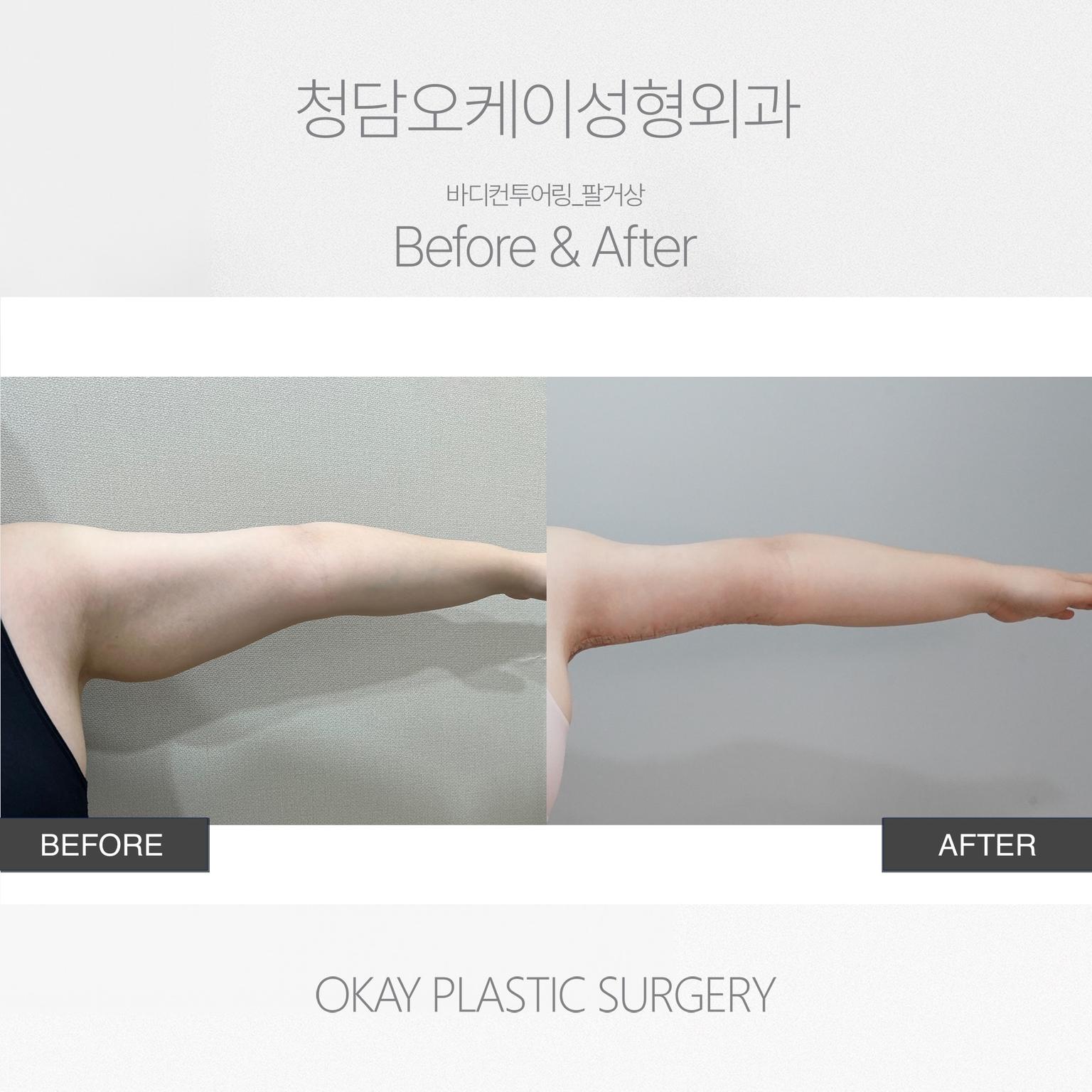
For an arm lift, you can expect a body-contouring approach designed to remove excess skin and fat for a firmer, more toned arm appearance. Okay Plastic Surgery Clinic lists arm lift surgery among the complex procedures available through its specialized team, with treatment tailored to your individual goals.
- URL: Okay Plastic Surgery Clinic Website
- Location: Gangnam-gu, Seoul
- Procedure details:
- Arm lift surgery is offered as part of the clinic’s body-contouring services and is described as removing excess skin and fat.
- The clinic also lists liposuction, line-fat treatment, fat grafting, and contouring treatments among its body-focused options.
- Care approach:
- The clinic describes its approach as individualized, with treatment plans shaped around your needs and aesthetic goals.
- Its team includes a female plastic surgeon with extensive experience.
2. Woori Plastic Surgery
If you are considering an arm lift at Woori Plastic Surgery, the available information supports asking about an individualized body-contouring plan: the clinic specifically lists liposuction for the arms to remove targeted excess fat and refine contour, but does not provide arm-lift technique details.
- URL: Woori Plastic Surgery Website
- Location: Gangnam-gu, Seoul
- What is listed for the arms:
- Arm liposuction is listed as a body-contouring option for targeted fat removal and contour refinement.
- The clinic states that treatments are tailored to your individual needs and goals.
- Related body-contouring services:
- Tummy tuck surgery is available for excess abdominal skin removal and underlying muscle tightening.
- The clinic also offers facial, breast, and non-surgical aesthetic procedures.
3. Navi Plastic Surgery
For arm concerns at Navi Plastic Surgery, you can discuss body contouring with surgeons who offer liposuction for localized fat deposits in the arms, among other areas. The provided information does not specifically list an arm lift or its surgical technique, so you should clarify whether excess-skin removal is available and appropriate for your goals.
- URL: Navi Plastic Surgery Website
- Location: Seocho-gu, Seoul
- Arm-focused consideration:
- Liposuction is listed for localized fat deposits in the arms, abdomen, and thighs that are resistant to diet and exercise.
- A personalized treatment plan is described as addressing your aesthetic desires and functional needs.
- Related surgical services:
- Abdominoplasty is available to remove abdominal excess skin and fat while tightening underlying muscles.
- The clinic also offers breast surgery, facial contouring, lifting procedures, and skin treatments.
Arm Lift From Start to Finish
- Remote consultation and record review — Send medical history, allergies, previous operations, weight history, nicotine status, medication and supplement lists, and requested arm photographs. Ask whether English-language virtual consultation and written consent are available.
- Surgical planning before travel — Discuss the likely scar pattern, whether liposuction or lateral-chest extension is needed, the expected scar trade-off, anesthesia, drain policy, and whether other major body-contouring surgery should be staged rather than combined.
- In-person examination in Korea — The surgeon assesses skin excess, fat distribution, asymmetry, axillary and chest-wall laxity, scar placement, and operative suitability. Vital signs, anesthesia assessment, blood tests, ECG, and nutrition testing are ordered according to health status and facility policy.
- Preoperative marking and anesthesia — The surgeon marks the arms while standing to plan tissue removal. General anesthesia is common; selected limited cases use local anesthesia with sedation.
- Brachioplasty — Through an inner-arm or posterior-arm incision, the surgeon removes excess skin, removes selected fat by liposuction when planned, and can tighten deeper supportive tissue. The wounds are closed in layers, dressed, and placed in compression sleeves; drains are used selectively.
- Recovery and discharge — An arm lift alone often takes about 1–2 hours and is usually outpatient surgery. Extensive procedures, combined surgery, or medical concerns can require overnight monitoring. Leave only with an escort after sedation or general anesthesia.
- Early clinic reviews — Attend the surgeon's scheduled wound, dressing, drain, and suture reviews, commonly including a visit around postoperative day 5–7. The team assesses swelling, circulation, wound closure, pain control, and readiness for travel.
- Travel clearance and overseas follow-up — Before departure, obtain an English operative report, anesthesia record, medication list, written wound-care instructions, follow-up schedule, and direct clinician contact. Continue video reviews and send photographs as directed after returning home.
Alternatives to an Arm Lift
The central trade-off is straightforward: surgical excision removes substantial hanging skin but leaves a permanent scar and requires recovery; non-surgical approaches do not remove comparable amounts of skin. Choose an alternative only when the primary issue is fat, laxity is mild, or surgery is not currently appropriate.
Arm Liposuction
- Best fit — Patients whose main concern is localized upper-arm fat and whose skin has good recoil.
- Trade-off — Liposuction does not remove loose skin and can leave substantial laxity more apparent. Read about arm liposuction.
Energy-Based Body Tightening
- Best fit — Mild laxity or localized fat in patients seeking a non-excisional option.
- Trade-off — Energy-based treatments cannot remove the quantity of skin addressed by brachioplasty, and results for significant hanging skin are less predictable. Relevant options include BodyTite and InMode body laser lifting.
Deferring Surgery
- Best fit — Patients with changing weight, unresolved nutritional or medical risk, ongoing nicotine exposure, unacceptable scar concerns, or no safe follow-up plan.
- Trade-off — Deferral avoids immediate surgical risk but does not remove redundant skin. Stabilize weight and address health risks before reconsidering surgery.
How Can I Prepare for an Arm Lift?
- Medication plan — Do not stop prescribed medicines independently. Obtain a written plan from the surgeon and anesthesiologist for anticoagulants, antiplatelet drugs, aspirin, NSAIDs, diabetes medicines, GLP-1 medicines, hormonal therapy, steroids, opioids, and all other regular medicines.
- Supplements and herbal products — Disclose everything taken. Ginkgo, garlic, ginseng, and vitamin E can affect bleeding risk and are commonly stopped only for the operating team's specified interval.
- Nicotine cessation — Stop cigarettes, vaping, nicotine pouches, nicotine replacement, and other nicotine products for the surgeon-specified period. Nicotine increases wound-healing and skin-flap risk.
- Weight and nutrition — Keep weight stable, maintain protein intake and hydration, and correct anemia or identified micronutrient deficiencies before surgery. This is especially important after bariatric surgery or major weight loss.
- Fasting and alcohol — Follow the anesthesiologist's fasting instructions exactly. Avoid alcohol as directed before surgery and throughout early recovery because it can interact with prescribed pain medicine and impair recovery planning.
- Skin and packing — Report rashes, open sores, or inflammation of the arms or armpits before surgery. Pack front-opening tops, loose clothing, slip-on shoes, original medication containers, a thermometer, and a small pillow for arm support.
- Transport and accommodation — Arrange a discharge escort, do not plan to carry bags, and choose nearby accommodation with elevator or step-free access. Keep flights flexible until the operating surgeon approves travel.
Travel note: Book enough time for an early wound check and a final travel-clearance review; do not schedule a fixed long-haul return flight immediately after surgery.
Confirm every fasting, medicine, nicotine, testing, arrival, and accommodation requirement with the treating surgeon and anesthesiologist, whose individualized instructions take precedence over general guidance.
Aftercare Advice
Protect the incisions and respect arm-movement restrictions: early overuse can increase swelling, discomfort, and wound stress.
- Compression and dressings — Wear the prescribed upper-arm compression garment for the instructed duration, often several weeks. Follow the clinic's specific plan for dressings, showering, drains, antibiotics, tape, silicone products, and scar care; do not apply creams or ointments unless instructed.
- Movement and lifting — Walk gently and frequently once cleared. Avoid driving and strenuous activity for at least two weeks unless cleared; avoid heavy lifting, upper-body exercise, repetitive arm work, and overhead reaching for roughly 4–6 weeks, longer after extended surgery or delayed healing.
- Water, heat, and sun — Avoid baths, hot tubs, pools, ocean swimming, and sauna-type heat until every incision and drain site has sealed and the surgeon approves. Once scars are healed, use SPF 50 sun protection and physical coverage to limit scar darkening.
- Expected recovery — Swelling, bruising, tightness, numbness, and limited overhead reach are common early on. Desk-type work or low-demand activity often resumes in 5–10 days; much swelling improves over several weeks, while permanent scars generally mature over 6–12 months.
- Urgent symptoms — Seek urgent care for chest pain, shortness of breath, coughing blood, fainting, or one-sided leg swelling or pain. Contact the operating team promptly for fever, spreading redness, foul drainage, wound separation, blood-soaked dressings, rapidly increasing arm tightness or swelling, uncontrolled pain, new weakness, worsening numbness, or persistent vomiting.
- Results and revision — The arm can look slimmer immediately, but swelling initially hides the final contour. Stable weight supports durability; aging and major weight changes can cause recurrent laxity. A 2022 meta-analysis estimated aesthetic reintervention at 7.46%, but this is not an individual prediction because the evidence was heterogeneous and observational.
Follow the treating doctor's instructions over general timelines, attend every scheduled remote review, and contact the clinic promptly when healing appears wrong.
Frequently Asked Questions
Related Blogs
Discovering Luxury in Body Transformation: The True Cost of Mommy Makeover in Korea vs. Global Markets
Discover the cost of a Mommy Makeover in Korea, where advanced medical techniques and world-class facilities make it an attractive destination for body contouring procedures. Explore the factors that influence pricing and learn why Korea is becoming a popular choice for mothers seeking comprehensive post-pregnancy transformations.
Updated: Oct 24, 2026
Korean Emsculpt: Unveiling Global Cost Differences and Travel Insights for This Body Contouring Experience
Discover the cost and benefits of Emsculpt in Korea, a leading destination for advanced cosmetic treatments. Explore how this innovative procedure can help you achieve your body contouring goals at competitive prices.
Updated: Oct 24, 2026
Explore Global Mini Liposuction Costs: Why Korea Leads in Quality and Innovation Compared to the USA, Turkey, and Thailand
Discover the cost and benefits of mini liposuction in Korea, where advanced techniques meet competitive pricing. Explore how this popular cosmetic procedure offers an effective solution for targeted fat reduction, enhancing contours without breaking the bank.
Updated: Oct 24, 2026
Discover How Diet IV Therapy Costs Compare: Korea vs. Global Hotspots for Wellness Seekers
Explore the cost of Diet IV therapy in Korea with our detailed guide, highlighting affordability, benefits, and what to expect from this popular wellness trend. Discover if this innovative treatment is the right fit for your health goals and budget.
Updated: Oct 24, 2026
Clinics offering Arm Lift

Okay Plastic Surgery Clinic in Korea: Comprehensive Aesthetic Procedures with Sincerity and Care
Cheongdam
Evita Clinic Korea: Body Contouring, Breast & Gender-Affirming Surgery in Seoul (Apgujeong)
Apgujeong

Navi Plastic Surgery: Leading Aesthetic Clinic in Korea Offering Comprehensive and Personalized Plastic Surgery Procedures
Hakdong

Woori Plastic Surgery - Top-Rated Korean Clinic for Personalized Cosmetic Procedures
Seolleung