Medical Tourism Blog
Chicken Skin Arms Treatment with Peeling Procedures in Korea: Effective Solutions for Smooth Skin
Table of contents
- Chemical Peeling: Rejuvenating Skin with Precision
- Best Clinics in Korea for Chicken Skin Arms
- Medical Tourism in South Korea: Getting a Chemical Peel
- Chemical Peel Costs in South Korea (and Globally)
- Real-World Effectiveness and the Patient Experience
- Conclusion
- References
Considering treatment in Korea? Everything you need to know e.g. — how to avoid scams, visas, interpreters, recovery tips — in our Medical Tourism Master Guide. Plan with confidence in minutes, not weeks!
Keratosis Pilaris (KP), often called "chicken skin arms," is a common and harmless skin condition that shows up as dry, rough patches with tiny, painless bumps. These bumps usually appear on the upper arms, thighs, cheeks, and buttocks, but can also occur on the forearms, lower legs, and faces—especially in children. The texture can feel like sandpaper or look like goosebumps.
KP is caused by a buildup of keratin, a protein meant to shield the skin from outside threats. In KP, keratin clogs hair follicles, resulting in that distinct bumpy texture. While it’s not usually painful, the affected skin can be dry or itchy.
A few factors can make KP worse: dry air, especially in winter, genetics (it often runs in families), and links to other conditions like eczema. There may even be a connection to Vitamin A deficiency. Many people notice KP fading by age 30, but it can linger or fluctuate with the seasons.
KP can affect more than just skin—it often impacts self-image and quality of life. In fact, studies say over 40% of KP sufferers feel it affects their confidence, which may lead to embarrassment, anxiety, or depression, especially when it’s visible. Even though doctors consider KP medically benign, its emotional effects are valid and often drive people to seek treatment.
Chemical Peeling: Rejuvenating Skin with Precision
Chemical peeling is a popular dermatological technique for smoothing skin and improving texture. It works by applying a chemical solution to exfoliate the skin’s upper layers, encouraging new cell growth and natural healing.
This process removes dead or damaged cells—including the keratin plugs that define Keratosis Pilaris—and reveals healthier, brighter skin below. The treatment can even out pigmentation and speed up cellular turnover.
Types of Chemical Peels for Keratosis Pilaris
Chemical peels come in different strengths:
- Superficial Peels: Target the outer skin layer; minimal downtime and best for mild skin blemishes.
- Medium Peels: Reach deeper into the dermis, treating moderate imperfections.
- Deep Peels: Penetrate the lower dermis for severe issues, but involve more downtime and higher risks.
For Keratosis Pilaris, superficial to medium peels are most common—they strike a balance between effectiveness and recovery time.
Key Chemical Agents in Peels for KP
- Alpha Hydroxy Acids (AHAs):
- Lactic Acid: Known for gentle exfoliation with minimal irritation; good for sensitive skin and acts as a moisturizer. A 10% solution helps exfoliate and brighten.
- Glycolic Acid: Breaks down cell bonds to clear keratin buildup, used in concentrations from 50% to 70% for significant improvement in KP papules, redness, and pigmentation.
- Beta Hydroxy Acids (BHAs):
- Salicylic Acid: Penetrates deep into pores, dissolving keratin plugs and smoothing out skin; typically used between 0.5% and 30%, with 3% a common starting point.
- Trichloroacetic Acid (TCA): A stronger agent, goes deeper and helps with scars and discoloration; best for more resistant KP.
- Blended Peels: Formulas like "The Perfect Peel" and "VI Peel Precision Plus" mix ingredients like Glutathione, Kojic Acid, Salicylic Acid, TCA, Vitamin C, and Retinoic Acid for a broad range of benefits.
Choosing the right peel for KP is never one-size-fits-all. Each acid has its properties; lactic acid is milder, while salicylic acid is best for oily, clogged skin. Therefore, selecting a peel requires a dermatologist’s assessment to adapt the peel type and concentration to the patient’s specific severity, skin sensitivity, and recovery needs.
Best Clinics in Korea for Chicken Skin Arms
Listed below are the best clinics in Korea for chicken skin arms:
| Clinic Name | Key Features | Special Techniques |
|---|---|---|
| D.A Plastic Surgery Clinic | DA Plastic Surgery Clinic, conveniently located near Gangnam Station in Seoul, offers advanced cosmetic care in a safe, comfortable setting focused on personalized treatment plans. With experienced surgeons and a dedicated staff, the clinic is designed for patients who want professional guidance and a tailored approach to aesthetic concerns, including body contouring goals that may be relevant for those bothered by the appearance of “chicken skin arms.” In addition to a broad range of facial, breast, nose, lifting, eye, and skin treatments, DA Plastic Surgery Clinic provides body procedures such as liposuction to help refine and sculpt areas like the arms for a cleaner, more defined contour. For patients seeking overall skin-quality and firmness support, the clinic also offers non-surgical options including Skin Elasticity Treatment, Ulthera Tuner, Thermage FLX, and Thread Lifting, which can be considered as part of an individualized plan depending on skin condition and aesthetic priorities. | liposuction; Skin Elasticity Treatment; Ulthera Tuner; Thermage FLX; Thread Lifting |
| Nana Plastic Surgery Clinic | Nana Plastic Surgery Clinic, located near Sinnonhyeon Station in Seoul, is known for advanced aesthetic care supported by extensive clinical data and a wide range of surgical experience across facial contouring, body contouring, lifting, breast, nose, eye, and dermatology treatments. For patients concerned about “chicken skin arms” (rough, bumpy-looking upper-arm skin), Nana’s strength is its ability to evaluate both skin-quality concerns and arm-shape concerns in one place, then guide patients toward the most appropriate combination of non-surgical dermatology options and, when needed, body contouring procedures. - Convenient Seoul location: Easily accessible from Sinnonhyeon Station for consultations and follow-up visits. - Data-backed, experience-driven care: Renowned for advanced procedures supported by extensive clinical data and diverse surgical experience, helping patients pursue more predictable aesthetic planning. - Comprehensive arm-focused options in one clinic: If “chicken skin arms” concerns are paired with arm contour issues, Nana can discuss body procedures such as liposuction and arm lift approaches alongside skin-focused care. - Dermatology treatments that target overall skin appearance: Laser treatments and skin-tightening programs are available to support smoother-looking, firmer-looking skin with minimal downtime options. - Personalized treatment pathway: Because “chicken skin arms” can look different from person to person, Nana’s broad service range supports tailored recommendations rather than one-size-fits-all solutions. - Continuity of care: A clinic structure that supports planned follow-ups and ongoing aesthetic management, which is especially important when addressing texture and appearance concerns over time. | Liposuction; Arm lift; Laser treatments; Skin-tightening programs; Non-surgical dermatology options; Body contouring procedures; Personalized treatment pathway; Continuity of care |
| Modelo Clinic | At Modelo Clinic, we don’t follow trends. Our focus is on achieving beauty that continues to maximize your value over time, guided by “your beautiful individuality” rather than comparisons to others. For those concerned about the look and texture often described as “chicken skin arms,” our approach emphasizes personalized planning and balanced aesthetic improvement, with treatments selected to fit each patient’s unique characteristics and goals. Modelo Clinic offers a broad range of aesthetic procedures, including Botox (Wrinkle Botox for fine lines with natural-looking results optimized for Asian skin and facial structures, and Contour Botox for balanced definition designed for Asian faces), Filler (Fullface Filler for immediate, volumizing enhancement across multiple facial areas, and Baby Filler to refresh the under-eye area for a more youthful, “baby face” impression), and Skin treatments such as Lifting and Whitening using various laser and combination approaches. Additional options include Comfort Thermage for gradual, natural-looking tightening, Thread Lifting for immediate lift with continued improvement as collagen is stimulated, and Bodytoxin to help contour and smooth areas affected by excess fat and cellulite. | Botox; Contour Botox; Fullface Filler; Baby Filler; Lifting; Whitening using lasers; Comfort Thermage; Thread Lifting; Bodytoxin |
D.A Plastic Surgery Clinic
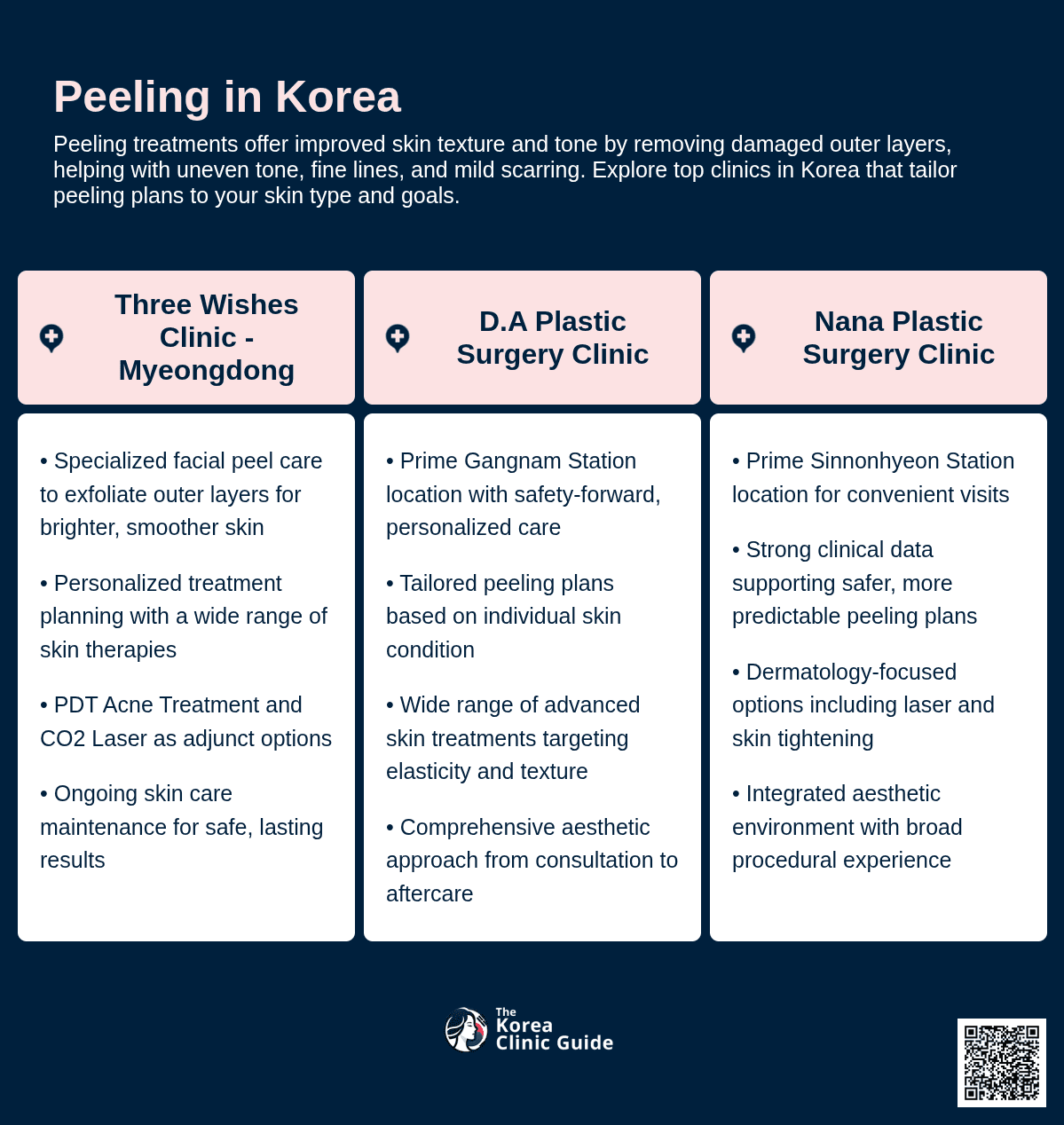
DA Plastic Surgery Clinic, conveniently located near Gangnam Station in Seoul, offers advanced cosmetic care in a safe, comfortable setting focused on personalized treatment plans. With experienced surgeons and a dedicated staff, the clinic is designed for patients who want professional guidance and a tailored approach to aesthetic concerns, including body contouring goals that may be relevant for those bothered by the appearance of “chicken skin arms.”
In addition to a broad range of facial, breast, nose, lifting, eye, and skin treatments, DA Plastic Surgery Clinic provides body procedures such as liposuction to help refine and sculpt areas like the arms for a cleaner, more defined contour. For patients seeking overall skin-quality and firmness support, the clinic also offers non-surgical options including Skin Elasticity Treatment, Ulthera Tuner, Thermage FLX, and Thread Lifting, which can be considered as part of an individualized plan depending on skin condition and aesthetic priorities.
Find more about this clinic here: D.A Plastic Surgery Clinic Website
Nana Plastic Surgery Clinic
Nana Plastic Surgery Clinic, located near Sinnonhyeon Station in Seoul, is known for advanced aesthetic care supported by extensive clinical data and a wide range of surgical experience across facial contouring, body contouring, lifting, breast, nose, eye, and dermatology treatments. For patients concerned about “chicken skin arms” (rough, bumpy-looking upper-arm skin), Nana’s strength is its ability to evaluate both skin-quality concerns and arm-shape concerns in one place, then guide patients toward the most appropriate combination of non-surgical dermatology options and, when needed, body contouring procedures.
- Convenient Seoul location: Easily accessible from Sinnonhyeon Station for consultations and follow-up visits.
- Data-backed, experience-driven care: Renowned for advanced procedures supported by extensive clinical data and diverse surgical experience, helping patients pursue more predictable aesthetic planning.
- Comprehensive arm-focused options in one clinic: If “chicken skin arms” concerns are paired with arm contour issues, Nana can discuss body procedures such as liposuction and arm lift approaches alongside skin-focused care.
- Dermatology treatments that target overall skin appearance: Laser treatments and skin-tightening programs are available to support smoother-looking, firmer-looking skin with minimal downtime options.
- Personalized treatment pathway: Because “chicken skin arms” can look different from person to person, Nana’s broad service range supports tailored recommendations rather than one-size-fits-all solutions.
- Continuity of care: A clinic structure that supports planned follow-ups and ongoing aesthetic management, which is especially important when addressing texture and appearance concerns over time.
Find more about this clinic here: Nana Plastic Surgery Clinic Website
Modelo clinic
At Modelo Clinic, we don’t follow trends. Our focus is on achieving beauty that continues to maximize your value over time, guided by “your beautiful individuality” rather than comparisons to others. For those concerned about the look and texture often described as “chicken skin arms,” our approach emphasizes personalized planning and balanced aesthetic improvement, with treatments selected to fit each patient’s unique characteristics and goals.
Modelo Clinic offers a broad range of aesthetic procedures, including Botox (Wrinkle Botox for fine lines with natural-looking results optimized for Asian skin and facial structures, and Contour Botox for balanced definition designed for Asian faces), Filler (Fullface Filler for immediate, volumizing enhancement across multiple facial areas, and Baby Filler to refresh the under-eye area for a more youthful, “baby face” impression), and Skin treatments such as Lifting and Whitening using various laser and combination approaches. Additional options include Comfort Thermage for gradual, natural-looking tightening, Thread Lifting for immediate lift with continued improvement as collagen is stimulated, and Bodytoxin to help contour and smooth areas affected by excess fat and cellulite.
Find more about this clinic here: Modelo clinic Website
Medical Tourism in South Korea: Getting a Chemical Peel
South Korea is renowned for its advanced cosmetic procedures and dermatology expertise, often at 30–50% lower prices than Western countries, thanks to a competitive market and robust local manufacturing. Many clinics cater to international visitors with English-speaking staff and streamlined processes.
What to Expect: The Chemical Peel Process for Medical Tourists
-
Initial Contact and Consultation: Most patients connect via email or phone, with consultations often costing $50–$150. A thorough skin diagnosis is done, sometimes involving high-tech equipment, leading to a tailored plan (type of peel, number of sessions, intervals between treatments).
-
Booking and Preparation: A deposit (usually about 10%) secures the appointment. Pre-peel instructions are provided, like stopping certain skin products a week before the procedure.
-
The Peeling Procedure: Chemical solutions are carefully applied, varying in application time and strength. Popular Korean options for KP include:
- Aladdin Peel: Uses coral calcium micro-needles to exfoliate and boost regeneration, effective for arms, back, and chest without chemical side effects.
- Opal Peel and Aqua Peel: More potent than at-home peels; Aqua Peel combines exfoliation with hydration, great for sensitive skin.
- Salicylic Acid Macrogol Peeling: Clinic-based, uses 30–40% concentration and stays on the skin for about 10 minutes.
- Tranex Reti Peel: More intense, left on for up to 2–6 hours in clinic/home, offering greater results but with higher side-effect risks.
Clinics sometimes offer bundled packages—light chemical peels paired with lasers, stem cell treatments, and masks for holistic care.
-
Aftercare and Recovery: Proper aftercare is key. Patients are advised to let peeling skin shed naturally, use daily sunscreen, rely on mild cleansers and oil-free moisturizers, and avoid intense exercise or saunas for 2–3 days. Recovery from medium peels may last 7–14 days (redness can persist longer), while superficial peels usually heal within a week.
Take-home aftercare kits are often provided, including masks and moisturizers. The full effect can take months to appear, but Korea’s comprehensive care system aims to support patients throughout.
Chemical Peel Costs in South Korea (and Globally)
Typical Chemical Peel Prices in South Korea
Costs in South Korea vary based on peel depth, clinic prestige, products, and practitioner experience:
- $50–$200 USD per session (₩72,800–₩291,300 KRW), with some reaching $800 USD for deeper, more exclusive treatments.
- Aqua Peels: $100–$300 USD per session.
- Initial Consultations: $50–$150 USD.
- Cosmetic peels usually aren't covered by insurance.
How South Korea Compares Internationally
Korea’s chemical peel prices are typically much lower than the US or Europe. For example, a treatment costing over $1,000 stateside may cost $500 in Seoul. Below is a global cost comparison:
| Country | Chemical Peel Cost Range (USD) | Notes |
|---|---|---|
| South Korea | $50 - $800 | Varies by type, depth, clinic reputation, district location |
| USA | $200 - $6,000 | Light peels $100–$300; deep peels add anesthesia/facility fees |
| Mexico | $175 - $1,000 | Light/medium $175; deep peels up to $1,000, sometimes surgical |
| Turkey | $450 - $8,000 | Quality/safety vary; post-care may be extra |
| Canada | $200 - $1,000 | Extra fees for add-ons/requirements |
| Australia | $200 - $5,500 | Additional consultation and aftercare fees possible |
| United Kingdom | $200 - $6,000 | Expertise level affects cost |
| Japan | $150 - $5,750 | Dependent on expertise/facility reputation |
| UAE | $175 - $5,000 | Higher sophistication drives up costs |
| Thailand | $25 - $594 | Wide range; post-care quality can vary |
Travel costs also add up: flights to Korea may cost $600–$1,500, accommodation $30–$250/night, local transit $1.50–$4.50 per ride, and meals $5–$15. Medical tourists should account for these when budgeting.
Real-World Effectiveness and the Patient Experience
Many with Keratosis Pilaris experience real improvements after chemical peels. Patients frequently report smoother, clearer skin, less redness, and raised confidence ("my arms had never felt more smooth!"). It’s described as "intense exfoliation" with quick, noticeable results.
Clinical studies back this up: for instance, one showed that 50–70% glycolic acid peels led to a 60% reduction in bumps by day 80—plus improvements in pigmentation and redness. Seventy-six percent of study participants saw improvements with no worsening.
Yet, KP is persistent; several years after treatment, results often fade, and regular maintenance is needed. Peels manage KP, they don’t cure it. Patients online often ask if “the KP came back”—ongoing care is usually needed. Side effects can include redness, dryness, or mild irritation, mostly for a few days. Rarely, deeper peels can cause scarring, pigment changes, or infections—especially in darker skin tones. Deep treatments require skilled professionals due to possible organ risks.
Importantly, improving KP can also boost self-esteem. By tackling its visible symptoms, many report reductions in anxiety and better body satisfaction—proving the emotional impact of this “benign” ailment.
Conclusion
Keratosis Pilaris impacts confidence and comfort, but chemical peeling provides an effective solution—especially when personalized to skin type and symptom severity. South Korea’s blend of affordability, technology, and patient-centered care makes it a leading choice for KP treatment. While peels offer clear short-term improvements, ongoing maintenance is key for lasting results. Consulting with a qualified dermatologist and considering the full scope of costs and aftercare are essential for a safe, satisfying medical tourism experience.
References
1, 2, 3, 4, 5, 6, 7, 8, 9, 10, 11, 12, 13, 14, 15, 16, 17, 18, 19, 20, 21, 22, 23, 24, 25, 26, 27, 28