
Medical Tourism Blog
Armpit Whitening in Korea: Diagnosis, Treatment Methods, Recovery, and Travel Planning
Table of contents
- Armpit Whitening at a Glance
- What Is Armpit Whitening?
- Who Is a Good Candidate for Armpit Whitening?
- How Is Armpit Whitening Performed?
- Why Visit Korea for Armpit Whitening?
- Key Information for International Patients
- Which Are the Best Clinics in Korea for Armpit Whitening?
- How Much Does Armpit Whitening Cost in Korea?
- Armpit Whitening From Start to Finish
- Alternatives to Armpit Whitening
- How Can I Prepare for Armpit Whitening?
- Aftercare Advice
Considering treatment in Korea? Everything you need to know e.g. — how to avoid scams, visas, interpreters, recovery tips — in our Medical Tourism Master Guide. Plan with confidence in minutes, not weeks!
Last updated: September 2026
Armpit Whitening at a Glance
- What it is — Armpit whitening is diagnosis-led treatment for axillary hyperpigmentation, using trigger control, clinician-directed topicals, superficial peels, or selected low-fluence laser/IPL rather than one standardized procedure.
- Cost in Korea — Listed pricing is KRW 30,000 (about USD 22 at the stated exchange rate), but the final quote can differ substantially based on consultation, topicals, test areas, peel or device sessions, and follow-up.
- Best candidates — It is best suited to stable, non-infected darkening after shaving, friction, ingrown hairs, folliculitis, or a resolved product reaction, with willingness to reduce ongoing skin irritation.
- Results need time — Improvement is gradual rather than permanent or immediate; topical and peel plans are commonly assessed over 8 weeks, and repeat sessions are often needed.
- Recovery — Topicals have no procedural downtime but can cause dryness or flaking; superficial peels may visibly peel for several days, while laser/IPL redness and tenderness usually settle within hours to a few days.
- Key safety limit — New, one-sided, rapidly changing, painful, itchy, ulcerated, or thick velvety darkening needs medical assessment first, and pigment treatment should wait until eczema, infection, folliculitis, or active irritation is controlled.
- Korea travel plan — Allow 2–3 full days for assessment, a test area or initial session, and an early skin check; Korea offers strong international dermatology access, but no evidence shows better underarm-pigment outcomes than treatment elsewhere.
What Is Armpit Whitening?
Armpit whitening is diagnosis-led care to reduce underarm darkening, using trigger control, topical treatments, superficial peels, or selected laser or IPL therapy. It aims for gradual improvement in uneven color and texture while addressing irritation, shaving-related inflammation, or underlying conditions that can sustain pigmentation. It is non-surgical dermatologic management, with treatment chosen according to the cause and condition of the skin.
Who Is a Good Candidate for Armpit Whitening?
- Stable post-inflammatory darkening — Good candidates have persistent underarm discoloration after shaving, waxing, ingrown hairs, folliculitis, friction, or a resolved product reaction, with intact, non-infected skin.
- Mild, cosmetic pigmentation concerns — Treatment suits people seeking gradual reduction in uneven color or rough texture rather than an immediate or permanent change to an arbitrary skin shade.
- Trigger-control commitment — Lasting improvement depends on reducing the cause of inflammation: harsh deodorants, tight clothing, friction, repetitive hair-removal trauma, or recurrent folliculitis.
- Assessed acanthosis nigricans — Patients with symmetric dark, thickened, velvety underarm skin can discuss cosmetic management after medical assessment and management of relevant insulin resistance, diabetes, obesity, or PCOS.
New, rapidly progressive, one-sided, painful, itchy, ulcerated, or markedly velvety darkening requires diagnostic assessment rather than cosmetic treatment alone. Defer peels, laser/IPL, and strong active topicals for eczema, contact dermatitis, razor burn, folliculitis, hidradenitis lesions, intertrigo, infection, open skin, or suspected deodorant allergy. Pregnancy, breastfeeding, attempts to conceive, hydroquinone use, and topical retinoids require individualized clinician advice. Fitzpatrick IV–VI skin, prior procedure-related pigment change, keloids, or hypertrophic scars do not automatically rule out treatment, but favor conservative settings and often a test area before a peel or energy-based procedure.
How Is Armpit Whitening Performed?
Treatment starts with identifying the cause of axillary hyperpigmentation. “Armpit whitening” is not a standardized medical procedure, and the correct approach differs for post-inflammatory hyperpigmentation and acanthosis nigricans.
- Trigger control and barrier care — Fragrance-free cleansing and moisturizing, less friction, a change from irritating deodorant, and modified hair removal form the foundation. Treat dermatitis, folliculitis, intertrigo, or hidradenitis before targeting pigment.
- Clinician-directed topical therapy — Depending on the diagnosis and tolerance, a dermatologist may use tretinoin, urea, salicylic acid, glycolic acid/AHAs, niacinamide, hydroquinone, or selected combinations. Randomized acanthosis-nigricans studies have assessed topical urea 10–20%, tretinoin 0.025–0.05%, and salicylic acid 10% over roughly 8 weeks to 2 months; these results do not apply equally to every cause of dark underarms. Evidence on topical and peel approaches
- Superficial chemical peel — Glycolic acid, salicylic acid, or selected trichloroacetic-acid protocols can address superficial pigment and roughness. Strength, contact time, neutralization, and session interval require individual planning because excessive injury can cause burns, scarring, hypopigmentation, or worsening PIH. Deep peels have no routine role in underarm lightening.
- Low-fluence laser or IPL — Q-switched 1064-nm Nd:YAG laser and IPL are outpatient options for selected stable cases. In a 22-person split-side study with five treatments every two weeks, both improved axillary pigmentation without a significant efficacy difference; IPL produced lower pain scores, while transient erythema and hyperpigmentation occurred in one IPL-treated participant each. This comparative study was small.
- Hair-removal strategy — Underarm laser hair removal is not a direct treatment for acanthosis nigricans or pigment, but can reduce shaving-related inflammation, ingrown hairs, and folliculitis that perpetuate PIH. Plan it separately from pigment procedures when necessary.
Why Visit Korea for Armpit Whitening?
Korea offers substantial access to dermatology services used by international patients. That supports practical consultation and treatment access, not better pigment outcomes than treatment elsewhere. Axillary pigmentation still requires diagnosis-led, conservative care and reliable follow-up at home.
- International-patient service availability — KHIDI recorded 1,170,467 foreign patients in 2024, with dermatology and plastic surgery among prominent fields; Seoul accounted for 85.4% of cases. These figures demonstrate service volume and access, not superior results for underarm pigmentation.
- Access to different conservative modalities — A dermatology consultation can distinguish whether topical therapy, a superficial peel, laser/IPL, trigger control, or medical evaluation is the appropriate next step instead of treating all darkening as one cosmetic problem.
- Evidence limitations — A 2025 systematic review found only 10 studies and no standard treatment for axillary hyperpigmentation. The evidence is heterogeneous and does not establish a best country, device, peel protocol, or universal regimen.
Key Information for International Patients
- Minimum stay — Allow 2–3 full days for an in-person assessment, a conservative test area or first session where indicated, and access to a short review if early irritation occurs.
- Repeat visits — This is rarely a one-visit cure. In one acanthosis-nigricans trial, glycolic-acid peels were delivered every two weeks for four sessions and assessed over 8 weeks; topical plans also need weeks of monitored use. The trial favored tretinoin 0.05% over that peel schedule for axillary lesions, but does not define the best plan for all patients.
- Flying home — Flying the next day is generally feasible after uncomplicated topical care, a superficial peel, or non-sedated laser/IPL. Delay departure for blistering, open skin, severe pain, or suspected infection.
- Itinerary impact — Expect warmth, redness, mild swelling, or tenderness for hours to several days after laser/IPL. Superficial peels can cause visible flaking for several days; stronger peels can need a week or longer and are poorly suited to a short trip.
- Remote follow-up — Arrange a dermatologist or primary-care clinician at home before travel. Request an English treatment record with the diagnosis, topical medication and concentration, peel agent, or laser/IPL device and wavelength, dates, aftercare instructions, red flags, and clinic contact details.
Travel note: A companion is not normally needed for topical treatment, superficial peels, laser, or IPL without sedation. Sedation or strong analgesia requires an escort and no driving.
Which Are the Best Clinics in Korea for Armpit Whitening?
Listed below are some of the best clinics in Korea for armpit whitening.
1. Three Wishes Clinic - Myeongdong
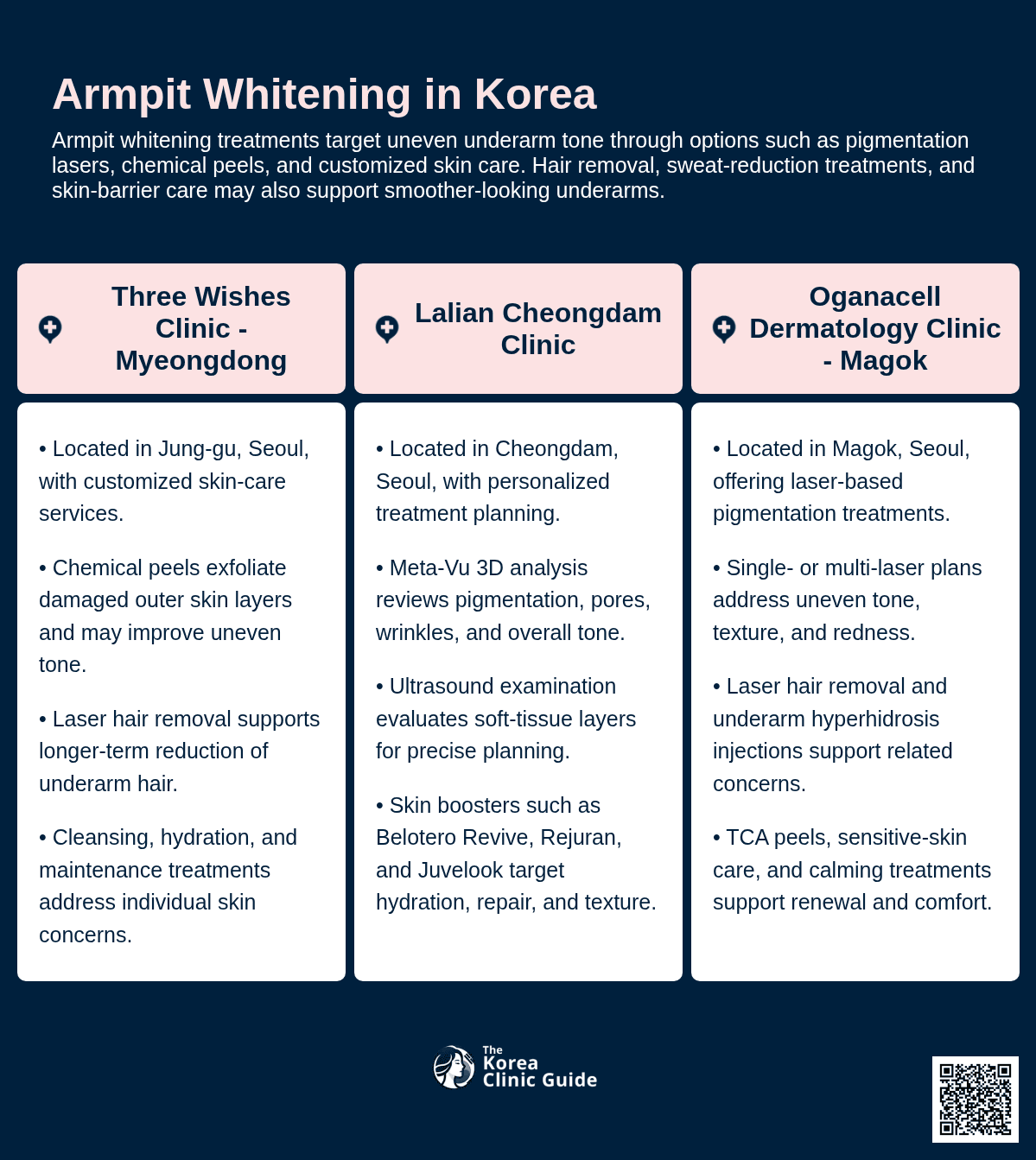
For armpit whitening, Three Wishes Clinic - Myeongdong lists chemical facial peels and laser hair removal among its skin services, which may be relevant to underarm tone and hair-management concerns; however, a dedicated underarm-whitening protocol is not specified in the available information. You can expect its listed care to include customized skin treatments alongside device- and exfoliation-based options.
- URL: Three Wishes Clinic - Myeongdong Website
- Location: Jung-gu, Seoul
- Relevant skin services:
- Chemical peels are listed for exfoliating damaged outer skin layers and improving uneven tone.
- Laser hair removal is offered for almost all body areas and provides longer-term reduction of unwanted hair.
- Customized skin care treatments include cleansing, hydration, and maintenance therapies tailored to individual skin concerns.
2. Lalian Cheongdam Clinic
Lalian Cheongdam Clinic’s documented approach centers on personalized skin assessment and treatment planning, including 3D skin analysis that reviews pigmentation and overall skin tone. A specific armpit-whitening treatment is not listed, so you should not assume that its facial-focused energy devices, injectables, or boosters will be used for the underarm area.
- URL: Lalian Cheongdam Clinic Website
- Location: 2nd floor, Dosan-daero 59-gil, 9, Gangnam-gu, Seoul, South Korea
- Assessment and planning:
- Meta-Vu 3D skin analysis assesses pores, wrinkles, pigmentation, and overall skin tone to support treatment planning and track changes.
- Ultrasound examination evaluates soft-tissue layers such as fat and muscle depth for more precise planning.
- Documented skin treatments:
- Belotero Revive is a hyaluronic-acid and glycerol skin booster used for hydration, dullness, and texture concerns.
- Rejuran Healer is a polynucleotide skin-repair injection used to support regeneration and texture improvement.
- Juvelook is a collagen-stimulating injectable intended for gradual improvement in pores, fine lines, and uneven texture.
3. Oganacell Dermatology Clinic - Magok
For armpit whitening, Oganacell Dermatology Clinic - Magok offers laser treatments for pigmentation and uneven tone, with plans built around single- or multi-laser sessions. The clinic does not specifically list an underarm-whitening protocol, but it also provides laser hair removal and underarm hyperhidrosis injections that may be relevant if hair reduction or sweating is part of your underarm-care concerns.
- URL: Oganacell Dermatology Clinic - Magok Website
- Location: 2F, Tower4, K-Square Magok, 105-7 Magokjungang-ro, Gangseo-gu, Seoul
- Relevant treatment options:
- Laser treatments address concerns including pigmentation, tone, texture, and redness through single-laser or multi-laser plans.
- Laser hair removal is available for facial and body areas to reduce unwanted hair growth over the longer term.
- Hyperhidrosis injections reduce excessive sweating in the underarms by decreasing sweat-gland activity.
- Skin renewal and comfort care:
- TCA peels exfoliate the skin and promote renewal for rough texture, acne marks, and uneven tone.
- Sensitive skin treatment focuses on calming reactive skin and strengthening the skin barrier.
- Calming care is designed to reduce redness and discomfort after irritation or procedures.
How Much Does Armpit Whitening Cost in Korea?
Armpit Whitening is listed at KRW 30,000 (approximately USD 0–0). Individual quotes vary because axillary hyperpigmentation management ranges from clinician-directed topical care to superficial peels or energy-based treatment, with different treatment plans and resource needs.
| Procedure Price | Korean Won (₩) | USD ($) |
|---|---|---|
| Low Price | ₩30,000 | $0 |
| High Price | ₩30,000 | $0 |
Exchange rate as of 2026-09-06: 1 KRW = 0.000741 USD.
What Affects the Price?
- Treatment modality — A clinician-directed topical regimen uses prescribed or selected active formulations and does not require procedural equipment. A superficial glycolic, salicylic, or other peel requires controlled application, contact-time management, neutralization when applicable, and post-treatment instructions. Laser or IPL requires an appropriate device, eye protection, conservative parameter selection, and treatment-room time.
- Number of treatment sessions and treated axillary areas — Topical and peel protocols are commonly assessed over about eight weeks, and peel or laser/IPL treatment may be scheduled as a series rather than as a single visit. Treating both axillae and performing repeat sessions increases clinician time, consumables, device use for laser/IPL, and follow-up planning.
- Test-area and pigment-safety requirements — For pigment-prone skin, prior procedure-induced color change, or a history of hypertrophic scars or keloids, a conservative test area and lower-intensity peel or energy settings may be required. This adds assessment, treatment planning, and review time before broader treatment.
- Diagnostic and inflammation-control needs — Darkening caused by active dermatitis, folliculitis, infection, deodorant allergy, or suspected acanthosis nigricans should be assessed and managed before cosmetic pigment treatment. Evaluation for the underlying condition and a barrier-first topical plan require a different clinical pathway from straightforward stable post-inflammatory hyperpigmentation.
Cost tip: Request an itemized quote stating what is included, such as the consultation, diagnosis-led assessment, topical products, peel agent or laser/IPL session, test area, aftercare instructions, and planned review or remote follow-up.
The USD conversion uses the exchange rate dated 2026-09-06 and is approximate; check the exchange rate again when budgeting.
Armpit Whitening From Start to Finish
- Send records before travel — Request an English or virtual consultation where available. Send clear, unfiltered photographs of both underarms in even light and disclose onset, progression, itch, pain, odor, lumps, discharge, hair removal, deodorant and skincare products, medication changes, allergies, prior pigment reactions, pregnancy possibility, diabetes risk, and PCOS history.
- Confirm the working diagnosis and plan — Ask whether the clinician suspects PIH, acanthosis nigricans, contact dermatitis, folliculitis, infection, or another flexural condition. Confirm whether a test area, laboratory evaluation, patch testing, or a delayed procedure is appropriate.
- Attend the in-person assessment — The clinician examines symmetry, pigment pattern, thickening, texture, follicular lesions, dermatitis, infection, scars, and atypical lesions. When acanthosis nigricans is suspected, glucose, HbA1c, or other metabolic/endocrine assessment can be relevant.
- Prepare the treatment area — Staff photograph the axillae, confirm there is no active irritation or skin injury, and remove deodorant and creams. Topical treatment, superficial peel, laser, or IPL normally needs neither fasting nor sedation; eye protection is mandatory for laser/IPL.
- Receive the selected treatment — Topical therapy is prescribed for home use, a peel is applied for a controlled interval and neutralized when required, or laser/IPL is delivered using conservative parameters. The exact approach depends on skin tone, diagnosis, prior PIH, and the condition of the axillary skin that day.
- Leave with written aftercare — Obtain the full product list or medication concentrations, device details, treatment settings where available, activity restrictions, and instructions for contacting the clinic. Do not add unapproved acids, retinoids, bleaching mixtures, or fragranced deodorant to the plan.
- Complete remote review — A remote check at about 48–72 hours is prudent after a peel or energy-based treatment close to departure, followed by reassessment at 4–8 weeks. Do not judge pigment improvement while redness or peeling remains active.
Alternatives to Armpit Whitening
Non-surgical options trade speed and intensity against irritation and PIH risk. Treating the trigger or using a topical-only plan is usually lower intensity but slower; peels and energy-based treatment require stricter aftercare and may need a series.
Cause-directed medical care
- Underlying condition — Treat dermatitis, product allergy, folliculitis, intertrigo, hidradenitis, diabetes, insulin resistance, obesity, or PCOS when relevant. Cosmetic pigment treatment alone is unlikely to control recurrence while the driver persists.
- Relevant profile — Best for thick, velvety, symptomatic, recurrent, or newly changing pigmentation.
Topical-only management
- Approach — A clinician-directed regimen of barrier care and selected active ingredients avoids a procedure visit and can be continued with a home clinician.
- Tradeoff — Results are gradual and irritation from overuse can worsen PIH.
Superficial chemical peeling
- Approach — Chemical peeling can be considered for selected superficial pigment or roughness after trigger control and assessment.
- Tradeoff — Peeling is more visible and carries greater irritation, burn, and pigment-change risk than a conservative topical plan.
Laser or IPL pigment treatment
- Approach — Pigmentation treatment, including selected low-fluence laser or IPL approaches, is an option for stable cases after counseling and often a test area.
- Tradeoff — Neither IPL nor Q-switched Nd:YAG is proven universally superior, and repeated sessions are common.
Underarm laser hair removal
- Approach — Underarm laser hair removal can reduce repeated shaving trauma and ingrown hairs when these are persistent triggers.
- Tradeoff — It is an adjunct, not a proven direct cure for dark underarms or acanthosis nigricans.
How Can I Prepare for Armpit Whitening?
- Disclose medicines and supplements — Provide a complete list of prescription and nonprescription products, including isotretinoin, topical retinoids, hydroquinone, benzoyl peroxide, exfoliating acids, steroids, anticoagulants, diabetes medicines, and photosensitizing drugs. Do not stop essential medicines independently.
- Pause irritants only as directed — Follow the treating clinician’s timing for retinoids, acids, scrubs, fragranced deodorant, depilatories, and hair removal. Do not layer multiple pigment products before assessment.
- Arrive with intact skin — Avoid shaving, waxing, plucking, depilatory creams, and abrasive exfoliation for several days before treatment and until the clinician confirms recovery. Reschedule if there is razor burn, cuts, active ingrown hair, rash, or infection.
- Wear low-friction clothing — Choose a clean, loose sleeveless or wide-armhole cotton top. Avoid tight straps and fabrics that rub the axillary vault after treatment.
- Plan flexible travel — Keep the day after treatment clear and book accommodation that allows a skin check if redness, blistering, or significant peeling develops.
Travel note: Bring prior laboratory results or medical letters if acanthosis nigricans, diabetes, PCOS, recurrent rashes, or previous procedure-related pigment change is relevant.
Confirm the clinic’s specific preparation requirements; the treating doctor’s individualized instructions take precedence over general guidance.
Aftercare Advice
Protect the treated underarm from irritation, heat, moisture, and friction while its skin barrier recovers.
- Keep care simple — Clean gently, pat dry, and use only the clinician-approved moisturizer, ointment, or topical regimen. Do not scrub or pick flaking skin.
- Avoid irritants and hair removal — Do not use fragranced deodorant, exfoliating acids, retinoids, benzoyl peroxide, unprescribed bleaching mixtures, depilatories, loofahs, shaving, waxing, or plucking until the barrier has recovered and the clinician permits it.
- Limit sweat and heat — Avoid vigorous exercise, sauna, steam rooms, hot baths, swimming, and other sweat-and-friction exposure for at least 24–48 hours after a superficial peel or laser/IPL session. Extend this restriction while redness, soreness, blistering, or peeling continues.
- Reduce rubbing and sun exposure — Wear loose clothing that does not chafe. Use SPF 50 on exposed treated skin when sleeveless clothing or swimwear leaves the area in sunlight; sun exposure can prolong pigment change.
- Act on warning signs — Contact the clinic promptly for increasing pain, marked swelling, spreading redness or warmth, pus, fever, clustered blisters, open erosions, persistent crusting, or significant new darkening or lightening.
- Assess results at the right time — Stinging, dryness, and fine flaking can occur in the first days to weeks with topicals; peel recovery takes several days and laser/IPL redness commonly settles within hours to days. Reassess pigment at 4–8 weeks, not during active inflammation or peeling.
Follow the treating doctor’s instructions over general advice and contact the clinic promptly when anything appears wrong.
Frequently Asked Questions
Related Blogs
Comparing Global Costs of Pico Fraxel: Why Korea is a Top Choice for Skin Rejuvenation Without Compromise
Discover the affordability of Pico Fraxel laser treatments in Korea, where cutting-edge technology meets competitive pricing. Explore why many are choosing Korea for their skincare journey and how it compares to global costs.
Updated: Oct 21, 2026
Optimize Your Wellness: See Why Vitamin Injections in Korea Offer Value Beyond Costs Compared to the USA & More
Discover the latest trends in the cost of vitamin injections in Korea, exploring factors affecting pricing and popular clinics. Learn how these wellness treatments can boost your energy and overall health.
Updated: Oct 21, 2026
Laser Tattoo Removal Costs: Is Korea Your Best Option Compared to the USA, Turkey, and Beyond?
Discover the factors influencing the cost of laser tattoo removal in Korea, from technology and expertise to session frequency. Explore why Korea is becoming a popular destination for this effective and advanced cosmetic procedure.
Updated: Oct 21, 2026
Unlock Radiant Skin: Comprehensive Cost Analysis of Steroid Injections for Scars in Korea vs USA, Turkey & More
Explore the cost of steroid injections for scars in Korea, a popular cosmetic procedure aimed at minimizing the appearance of scar tissue. This article breaks down the pricing, factors influencing cost, and potential savings compared to other countries.
Updated: Oct 21, 2026
Clinics offering Armpit Whitening

Three Wishes Clinic - Myeongdong, Korea: Advanced Botox, Fillers, Laser, and Skin Treatments for Confidence and Care
Myeongdong

Oganacell Dermatology Clinic - Magok, Korea | Lifting, Acne, Laser & Hair Removal in Seoul
Magok

Episode Clinic Korea | Jamsil Seoul: Botox, Fillers, Lasers & Ultherapy
Jamsil

All Clinic Korea | Myeongdong Fillers, Botox, HIFU, Thermage
Myeongdong